
Commercial Truck Transmissions
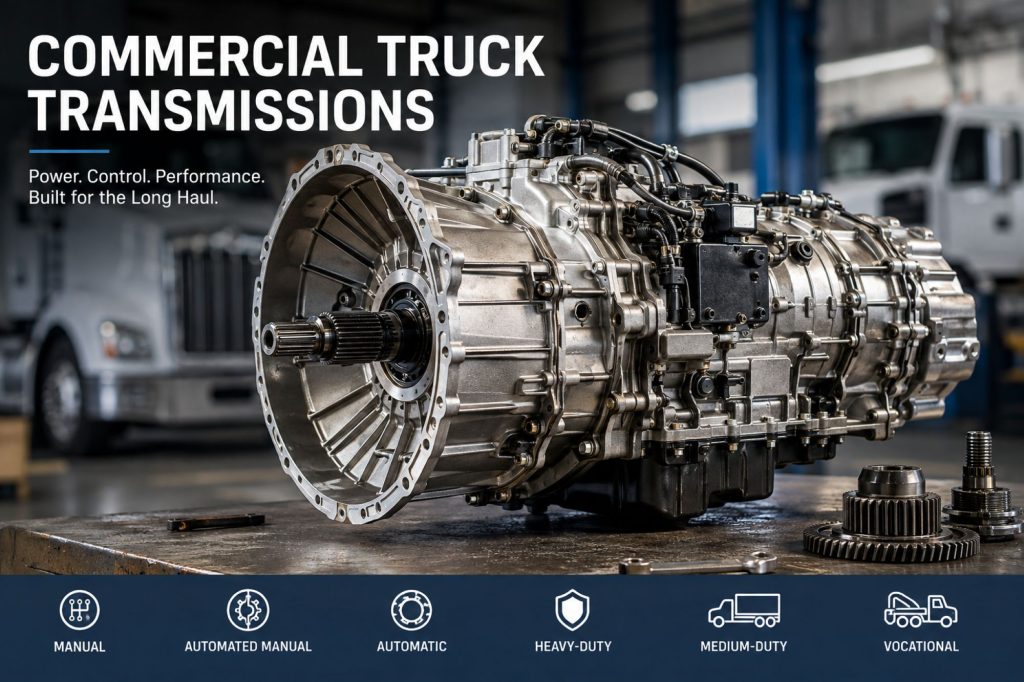
Commercial truck transmissions are responsible for transferring engine power through the drivetrain and allowing a truck to operate efficiently across changing speeds, loads, grades, and working conditions.
Truck Equipment Atlas covers manual, automated manual, and fully automatic transmissions used throughout medium-duty, heavy-duty, vocational, regional, long-haul, severe-service, and specialized commercial truck applications.
The Transmission Library includes individual transmission profiles, transmission categories, manufacturer coverage, specifications, applications, operating characteristics, maintenance considerations, and educational information designed to help readers better understand one of the most important components of a commercial truck powertrain.
Explore Transmission Categories
Commercial truck transmissions can be classified both by how they operate and by the applications they are designed to serve. Explore the major transmission categories on Truck Equipment Atlas:
Manual Transmissions
Traditional commercial truck transmissions that give the driver direct control over gear selection and clutch operation. Manual transmissions remain important in many heavy-duty, vocational, severe-service, and specialized applications.
Automated Manual Transmissions
Automated manual transmissions, commonly called AMTs, use a traditional geared transmission architecture with electronic and automated control of shifting and clutch operation. AMTs have become widely used throughout modern Class 8 trucking.
Automatic Transmissions
Fully automatic transmissions use automatic shifting and, in many commercial applications, torque-converter technology to provide smooth power delivery and reduce driver workload.
Heavy-Duty Transmissions
Heavy-duty transmissions are engineered for Class 8 trucks and demanding applications involving high gross vehicle weights, high engine torque, long-distance freight, heavy haul, and severe operating conditions.
Medium-Duty Transmissions
Medium-duty transmissions are designed for commercial vehicles used in delivery, utility, towing, municipal, construction, service, and other Class 4 through Class 7 applications.
Vocational Transmissions
Vocational transmissions are used in trucks that operate in demanding work environments such as construction, refuse, utility, logging, heavy haul, municipal service, concrete, dump, and other job-site applications.
Commercial Truck Transmissions on Truck Equipment Atlas
Truck Equipment Atlas includes a growing library of individual commercial transmission profiles from many of the leading manufacturers and drivetrain suppliers serving the trucking industry.
Explore the transmission models and families currently available:
Aisin
Allison Transmission
Detroit
Eaton and Eaton Cummins
- Eaton AutoShift
- Eaton Cummins Endurant HD
- Eaton Cummins Endurant HD V
- Eaton Cummins Endurant XD
- Eaton Cummins Endurant XD Pro
- Eaton Fuller 10-Speed Manual
- Eaton Fuller 13-Speed Manual
- Eaton Fuller 18-Speed Manual
- Eaton Fuller 8LL
- Eaton Fuller 9ALL
- Eaton Fuller RT Series
- Eaton Fuller RTLO Series
- Eaton Fuller Super 10
- Eaton UltraShift
- Eaton UltraShift PLUS
Ford
General Motors
International
Mack
PACCAR
Volvo
Additional transmission models and families will be added as the Truck Equipment Atlas Transmission Library continues to expand.
Transmission Guides
- How Commercial Truck Transmissions Work — understand gearing, clutches, converters, and power flow.
- Manual vs Automated Manual vs Automatic Transmissions — compare operating characteristics and duty-cycle tradeoffs.
- How to Choose a Commercial Truck Transmission — match the transmission to the engine, load, axle ratio, and application.
For the complete learning path, visit Transmission Guides.
Understanding Commercial Truck Transmission Types
Commercial truck transmissions are available in several fundamentally different configurations.
Manual Transmissions
Manual transmissions require the driver to select gears and manage clutch engagement. Traditional heavy-duty manuals are available in numerous gear configurations and have long been used in over-the-road, vocational, heavy-haul, construction, and severe-service trucking.
Manual transmissions can provide direct driver control and are still important in specialized applications, although their presence in new highway tractors has declined as automated manual transmissions have become more common.
Automated Manual Transmissions
An automated manual transmission uses a mechanically geared transmission architecture while automating clutch operation and gear selection through electronic controls and actuators.
Modern AMTs can coordinate transmission operation with the engine and other vehicle systems to select gears based on load, road speed, grade, throttle demand, and operating conditions.
AMTs have become particularly important in long-haul and regional Class 8 trucking because they can reduce driver workload while supporting consistent shifting and fuel-efficient operation.
Fully Automatic Transmissions
Fully automatic transmissions automatically manage gear changes without requiring normal clutch operation by the driver.
Commercial automatics are particularly common in medium-duty and vocational trucks where frequent stopping, low-speed maneuvering, repeated acceleration, and demanding work cycles can make smooth automatic operation valuable.
Applications can include delivery trucks, refuse vehicles, utility trucks, emergency vehicles, construction equipment, buses, towing and recovery vehicles, and other vocational equipment.
Common Transmission Configurations
Commercial truck transmissions vary considerably according to application.
Common configurations include:
- 6-speed automatic transmissions
- 8-speed transmissions
- 10-speed manual and automated transmissions
- 12-speed automated manual transmissions
- 13-speed manual transmissions
- 14-speed automated manual transmissions
- 18-speed manual and automated transmissions
- Direct-drive configurations
- Overdrive configurations
- Multi-range heavy-duty transmissions
- Vocational and severe-service gearing
Gear count alone does not determine whether a transmission is appropriate for a particular truck. Engine torque, axle gearing, gross vehicle weight, terrain, operating speed, startability, gradeability, duty cycle, and intended application must also be considered.
Heavy-Duty and Medium-Duty Applications
Transmission requirements change significantly according to vehicle class and operating environment.
Heavy-duty highway tractors require transmissions capable of handling high engine torque while maintaining efficient operation at highway speeds.
Heavy-haul and severe-service trucks may require additional ratios, deeper reduction gearing, specialized clutch systems, or transmission programming designed around high gross combination weights.
Medium-duty trucks often operate under very different conditions. Delivery vehicles, utility trucks, tow trucks, municipal equipment, and vocational trucks may experience frequent starts and stops, extended low-speed operation, PTO use, and repeated maneuvering.
For this reason, selecting a transmission should be based on the complete vehicle application rather than transmission type alone.
Vocational Transmission Applications
Vocational trucks can place particularly demanding requirements on a transmission.
Common applications include:
- Dump trucks
- Refuse trucks
- Concrete and construction equipment
- Utility trucks
- Tow and recovery trucks
- Logging trucks
- Heavy-haul tractors
- Municipal vehicles
- Snow and road-maintenance equipment
- Oilfield and energy-sector trucks
- Severe-service equipment
Transmission selection for these applications may depend on low-speed control, startability, PTO compatibility, reverse gearing, torque capacity, terrain, axle ratios, and the amount of time the vehicle operates away from highway conditions.
Advantages of Modern Commercial Transmissions
Modern transmission technology can provide several operational advantages:
- Reduced driver workload
- More consistent shifting
- Improved powertrain integration
- Optimized engine operation
- Improved low-speed control in certain applications
- Better adaptation to changing loads and terrain
- Reduced dependence on driver shifting technique
- Application-specific transmission programming
The actual benefits depend on transmission design, vehicle specification, operating environment, and duty cycle.
Transmission Limitations and Considerations
No single transmission configuration is ideal for every commercial truck.
Important considerations include:
- Initial purchase cost
- Transmission weight
- Torque capacity
- Maintenance requirements
- Clutch replacement on applicable transmissions
- Electronic and actuator complexity
- Fluid and filter service requirements
- Repair availability
- Parts availability
- Driver familiarity
- PTO compatibility
- Engine compatibility
- Axle gearing
- Vehicle application
A transmission that performs well in a long-haul tractor may not be the best choice for a dump truck, refuse vehicle, heavy-haul tractor, or local delivery truck.
Driver and Operator Considerations
Transmission type directly affects how a commercial truck is driven.
Traditional manual transmissions require greater driver involvement and knowledge of engine speed, gear selection, clutch operation, terrain, and vehicle load.
AMTs reduce much of the physical shifting workload but still require drivers to understand how the transmission responds to grades, low-speed maneuvering, changing traction, heavy loads, and different operating modes.
Fully automatic transmissions generally provide the simplest driver interface, which can be valuable in operations involving frequent stops, multiple drivers, urban environments, or demanding vocational duty cycles.
Maintenance and Ownership
Commercial transmissions require proper maintenance to provide reliable service.
Important maintenance areas can include:
- Transmission fluid inspection
- Fluid and filter replacement
- Clutch inspection and adjustment where applicable
- Electronic diagnostic monitoring
- Shift actuator inspection
- Cooling system inspection
- Seal and leak inspection
- Software and calibration updates
- Driveline inspection
- Monitoring changes in shift quality or transmission behavior
Maintenance requirements vary significantly between transmission designs and manufacturers. Owners and technicians should follow the service procedures specified for the exact transmission model and application.
Major Commercial Transmission Manufacturers
Truck Equipment Atlas covers transmissions from manufacturers and drivetrain brands that have played important roles throughout the commercial trucking industry.
Current coverage includes:
- Aisin
- Allison Transmission
- Detroit
- Eaton
- Eaton Cummins Automated Transmission Technologies
- Ford
- General Motors
- International
- Mack
- PACCAR
- Volvo
Manufacturer coverage will continue to expand as additional transmission families and historical platforms are added.
Related Truck Equipment Resources
A transmission is only one part of the complete commercial truck powertrain and drivetrain.
Explore related Truck Equipment Atlas resources:
- Diesel Engines
- Commercial Trucks
- Equipment Systems
- Axles & Differentials
- PTO System Explained
- Trucking Equipment Guides
Understanding how the engine, transmission, driveshaft, axles, gearing, tires, and vehicle application work together is essential when evaluating a commercial truck powertrain.
How to Use the Transmission Library
Individual Truck Equipment Atlas transmission profiles provide deeper information about specific transmission models and families.
Depending on the transmission, these pages may include:
- Transmission overview
- Manufacturer information
- Transmission type
- Gear configurations
- Torque capacity
- Applications
- Compatible truck and engine applications
- Operating characteristics
- Highway and vocational use
- Driver considerations
- Maintenance information
- Ownership considerations
- Availability and replacement considerations
Readers can begin with one of the transmission categories above or explore individual transmission profiles by manufacturer.
Transmission Library Expansion
The Truck Equipment Atlas Transmission Library will continue to grow with additional manual, automated manual, automatic, medium-duty, heavy-duty, vocational, and specialized transmission profiles.
Future development will also expand the connections between transmissions and the trucks, engines, drivetrain systems, manufacturers, and applications in which they are used.
The goal is to build an organized commercial transmission reference that helps drivers, owner-operators, fleets, technicians, students, equipment buyers, and industry professionals better understand how commercial truck transmissions work and where different transmission platforms fit within the trucking industry.
Follow the Growth of Truck Equipment Atlas
Truck Equipment Atlas continues to expand with new trucks, trailers, diesel engines, transmissions, equipment systems, manufacturer information, freight resources, and educational guides.