
Eaton UltraShift PLUS Automated Manual Transmission
Quick Facts
- Manufacturer: Eaton
- Transmission Family: Eaton UltraShift PLUS
- Transmission Type: Heavy-Duty Automated Manual Transmission
- Pedal Configuration: Two-Pedal Design with No Driver-Operated Clutch Pedal
- Internal Design: Mechanically Based Eaton Fuller Transmission with Electronic Shift and Clutch Actuation
- Available Forward Speeds: 10, 13, or 18 depending on series and configuration
- Torque Capacity Range: Approximately 1,450–2,250 lb-ft depending on model
- Common Series: LAS, LSE, MHP, MXP, VCS, VMS, VXP, and VHP
- Common Operating Modes: Automatic, Manual, and Low
- Clutch Type: Heavy-Duty Dry Clutch with Electronic Clutch Actuator
- Shift Control: Push-Button Console, Lever, or OEM-Integrated Shift Control depending on truck
- Hill-Start Feature: Intelligent Hill Start Aid on equipped configurations
- Low-Speed Features: Creep Mode, Urge to Move, and Blended Pedal depending on calibration
- PTO Compatibility: Available on properly equipped vocational configurations
- Common Applications: Linehaul, Regional Hauling, Construction, Dump, Heavy Haul, Refuse, Agriculture, Logging, Tanker, and Specialized Vocational Work
- Common Truck Classes: Primarily Class 8 with certain lighter vocational applications
- Production Status: Legacy product family; many applications have transitioned to newer Eaton Endurant transmissions, but UltraShift PLUS remains widely supported in existing trucks
Overview
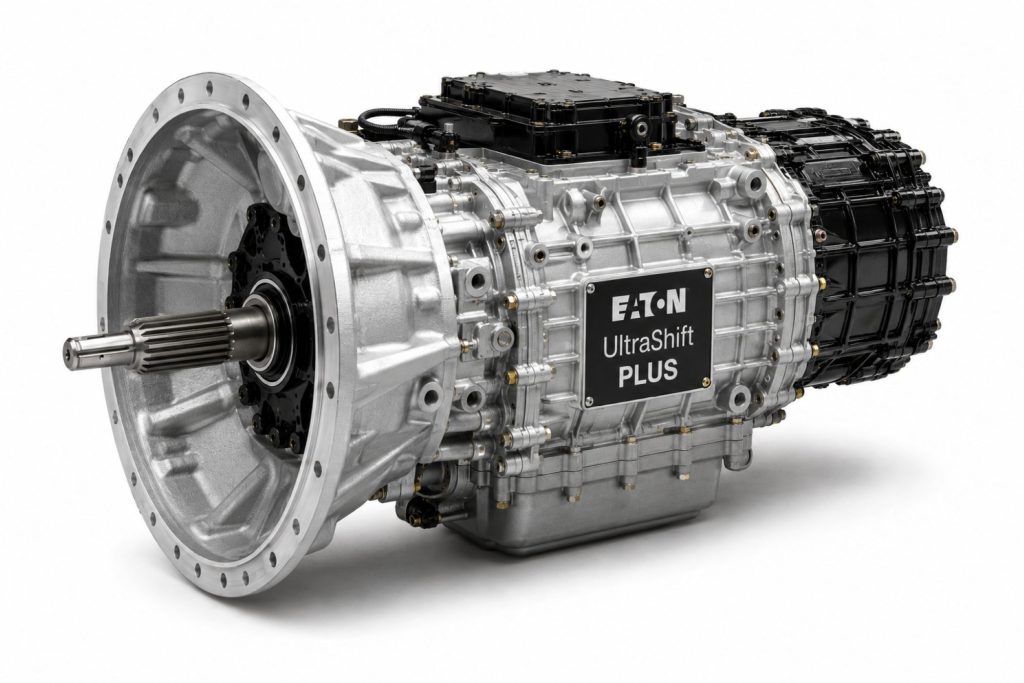
The Eaton UltraShift PLUS is a heavy-duty automated manual transmission developed to combine the mechanical efficiency of an Eaton Fuller manual gearbox with computer-controlled shifting and clutch operation.
Unlike a conventional manual transmission, the UltraShift PLUS does not require the driver to operate a clutch pedal or manually move a gearshift lever through every ratio. Electronic controls operate the clutch, select gears, and coordinate engine torque during shifting.
The transmission remains mechanically different from a conventional torque-converter automatic. It uses a dry clutch and gear-based manual-transmission architecture, but electronic actuators perform the work normally handled by the driver.
Eaton produced multiple UltraShift PLUS series for different operating environments. Highway-oriented models focused on fuel efficiency and reduced driver workload, while vocational models added features and calibrations for construction, dump, refuse, heavy haul, logging, agriculture, and off-highway work.
Depending on the series, UltraShift PLUS configurations may provide 10, 13, or 18 forward speeds and torque ratings from approximately 1,450 to 2,250 lb-ft.
The transmission became a common option in sleeper trucks, day cab trucks, vocational trucks, and heavy-haul trucks.
Key Characteristics
The UltraShift PLUS uses a two-pedal design. The driver operates the accelerator and brake pedals while the transmission electronically controls clutch engagement and gear selection.
An Electronic Clutch Actuator operates the mechanical dry clutch. The Transmission Electronic Control Unit communicates with the engine and other vehicle systems to coordinate clutch engagement, engine torque, and shift timing.
In Automatic mode, the transmission selects gears based on vehicle weight, road speed, throttle position, engine speed, grade, and programmed operating strategy.
Manual mode allows the driver to request upshifts and downshifts. The transmission evaluates the requested gear and may prevent a shift that could overspeed, lug, or damage the drivetrain.
Low mode helps the transmission remain in lower gears longer. It can be useful when descending grades, maneuvering at low speed, or using engine braking.
Vocational configurations may include Creep Mode, Urge to Move, Blended Pedal, Hill Start Aid, enhanced reverse functionality, and application-specific clutch calibrations.
The transmission can skip unnecessary ratios when the truck is lightly loaded. When vehicle weight or terrain requires additional control, it can use more of the available gears.
How the Transmission Works
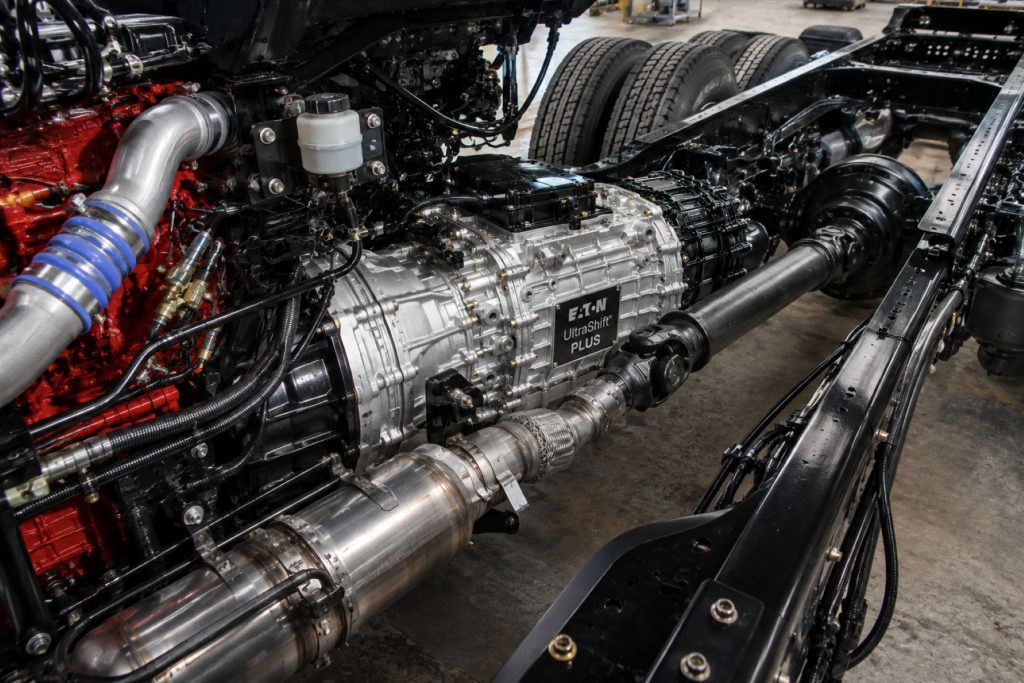
The UltraShift PLUS begins with the mechanical architecture of an Eaton Fuller manual transmission. Engine power enters through a dry clutch, passes through the transmission’s gearsets, and exits through the output shaft to the driveshaft and drive axles.
The major difference is that electronic and electromechanical systems operate the clutch and shifting mechanisms.
Electronic Clutch Operation
The Electronic Clutch Actuator controls clutch engagement and release.
When the truck begins moving, the transmission determines how quickly the clutch should engage based on accelerator position, vehicle weight, grade, selected mode, and programmed calibration.
Once the clutch is fully engaged, the transmission provides a direct mechanical connection similar to a conventional manual transmission.
Automatic Gear Selection
In Automatic mode, the Transmission Electronic Control Unit selects the starting gear and subsequent ratios.
The system evaluates:
- Vehicle weight
- Road grade
- Throttle demand
- Engine speed
- Vehicle speed
- Current gear
- Engine torque
- Brake inputs
- Selected operating mode
The transmission may skip gears during light-load acceleration or use additional ratios when the truck is heavily loaded.
Upshifting
During an upshift, the transmission communicates with the engine to reduce torque. It disengages the current gear, moves the shift mechanism into the next ratio, and restores engine torque after engagement.
The driver does not need to release the accelerator during a normal automatic shift.
Downshifting
The transmission selects lower gears as vehicle speed falls or additional power is required.
Electronic engine communication helps match engine speed with the lower gear before engagement.
Manual Mode
Manual mode allows the driver to request shifts through the shift control.
The system retains protective authority and may deny a requested shift if it would cause excessive engine speed, engine lugging, or drivetrain damage.
Low Mode
Low mode holds lower gears longer and limits unnecessary upshifting.
It can improve vehicle control on grades, job sites, loose surfaces, and during operations requiring stronger engine braking.
Hill Start Aid
Intelligent Hill Start Aid uses the truck’s foundation brakes to help prevent rollback or forward roll while the clutch engages on a grade.
It is intended to assist with launching and does not replace the service brakes or parking brakes for holding the truck stationary.
Creep Mode
Creep Mode allows controlled low-speed movement with reduced accelerator input.
It is useful for docking, backing, connecting to trailers, maneuvering around job sites, and positioning vocational equipment.
Common Specifications
Transmission Type
The Eaton UltraShift PLUS is a heavy-duty automated manual transmission.
It uses mechanical manual-transmission gearing combined with electronic clutch and shift actuation.
Forward Speeds
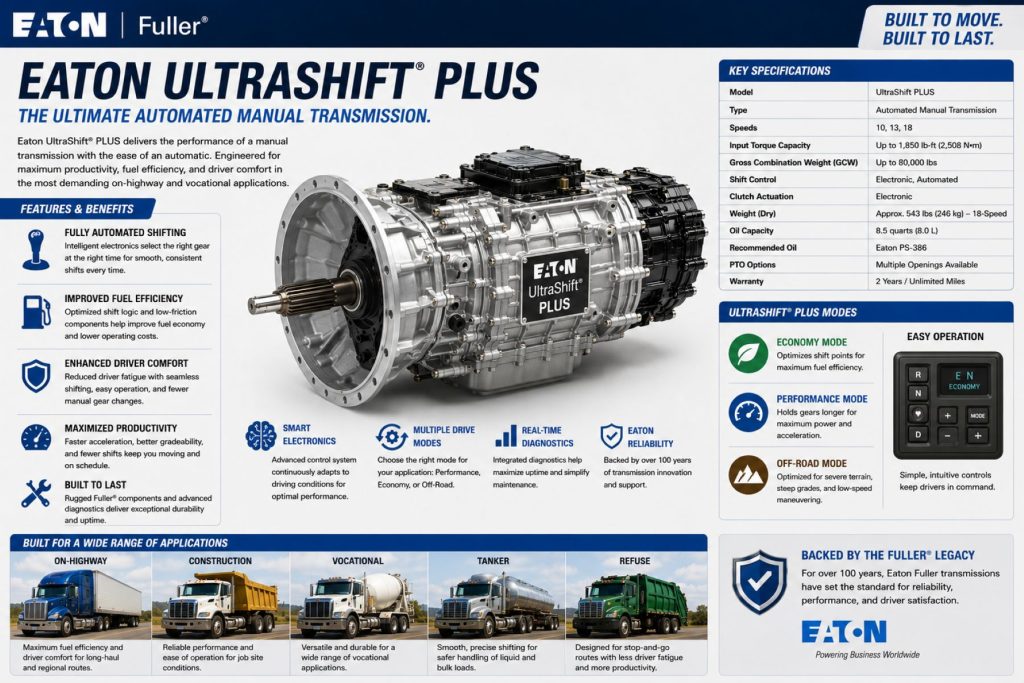
UltraShift PLUS configurations may provide 10, 13, or 18 forward speeds depending on the series and intended application.
Highway-oriented versions commonly use fewer ratios, while extreme-duty and heavy-haul configurations may use 18-speed gearing.
Reverse Speeds
Reverse-ratio availability varies by model. Certain vocational and extreme-duty configurations provide multiple reverse ratios for low-speed maneuvering and specialized operation.
Torque Capacity
UltraShift PLUS models cover torque ratings from approximately 1,450 to 2,250 lb-ft.
The selected transmission must meet or exceed the engine’s programmed maximum torque.
Gross Combination Weight
Maximum approved combination weight varies by model and application.
Certain heavy-duty and extreme-performance configurations support very high or application-approved unlimited GCW, but the complete truck remains limited by its frame, axles, suspension, tires, brakes, driveline, permits, and legal weight requirements.
Clutch System
The transmission uses a heavy-duty dry clutch operated by an Electronic Clutch Actuator.
There is no clutch pedal in the cab.
Electronic Clutch Actuator
The Electronic Clutch Actuator engages and releases the clutch under the command of the transmission controller.
It also provides clutch-position information used for launch control, shifting, clutch-protection strategies, and diagnostics.
Transmission Electronic Control Unit
The Transmission Electronic Control Unit manages gear selection, clutch engagement, shift timing, protection strategies, and communication with the engine and other vehicle systems.
Shift Actuation
Electric and pneumatic components move the transmission between gears, ranges, and splitter positions depending on model.
The driver selects the operating direction and mode rather than physically moving the internal gears.
Driver Controls
Controls vary by truck manufacturer and model year. Common arrangements include:
Push-button shift console
Dash-mounted selector
Steering-column stalk
OEM-integrated transmission control
The control generally provides Reverse, Neutral, Drive, Manual, and Low selections.
Gear Display
A dashboard display shows the selected mode, current gear, target gear, neutral status, and certain warning conditions.
Flashing gear indications or fault messages may identify an incomplete shift or diagnostic condition.
Automatic Mode
Automatic mode allows the transmission to select gears without routine driver input.
Shift programming may prioritize fuel economy, performance, vocational control, or a balance of these goals.
Manual Mode
Manual mode allows the driver to request upshifts and downshifts.
The transmission may override or deny a request to protect the engine and drivetrain.
Low Mode
Low mode holds lower ratios longer and can increase engine-braking effectiveness.
Hill Start Aid
Hill Start Aid helps prevent unintended movement while the clutch engages on an incline or decline.
Drivers must continue using the service brakes when stopping or holding the truck on a grade.
Creep Mode
Creep Mode provides controlled low-speed movement for docking, backing, construction sites, refuse routes, and other maneuvering operations.
Availability and behavior depend on the model and vehicle calibration.
Urge to Move
Urge to Move allows the truck to begin moving slowly after the service brake is released, similar to the initial movement of a conventional automatic transmission.
Blended Pedal
Blended Pedal functionality coordinates accelerator input and clutch control to improve low-speed maneuverability.
The feature does not convert the dry clutch into a torque converter and should not be used to hold the vehicle on a grade.
Skip Shifting
The transmission may skip gears when conditions allow, reducing unnecessary shifts and improving acceleration efficiency.
PTO Compatibility
Certain vocational UltraShift PLUS models support transmission-mounted PTO equipment.
The PTO must match the transmission model, operating speed, rotation, torque requirement, lubrication system, and vehicle programming. More information is available in PTO System Explained.
Lubrication System
The transmission uses Eaton-approved lubricant to protect the gears, bearings, shafts, and auxiliary components.
Oil capacity and service intervals vary by model.
Cooling Requirements
Certain severe-duty, high-weight, or PTO applications may require enhanced transmission cooling.
Cooling requirements should be confirmed through the application approval for the exact transmission model.
Diagnostic System
Electronic faults are recorded as diagnostic trouble codes.
Eaton ServiceRanger and compatible OEM diagnostic systems can be used to retrieve codes, monitor components, perform tests, update software, and complete calibration procedures.
Installation Requirements
Installation must account for engine compatibility, electronic communication, clutch calibration, shift controls, driveshaft angles, axle gearing, wiring, air supply, PTO requirements, and software configuration.
Common Applications
- Long-haul freight
- Regional hauling
- Dedicated freight
- Dry van operations
- Refrigerated freight
- Flatbed operations
- Tanker operations
- Dump trucks
- Construction trucks
- Concrete mixers
- Refuse trucks
- Heavy-haul tractors
- Logging operations
- Agricultural hauling
- Oilfield transportation
- Bulk and pneumatic operations
- Municipal fleets
- Utility trucks
- Specialized vocational equipment
Truck and Engine Compatibility
The Eaton UltraShift PLUS was installed in Class 8 trucks from Freightliner, Western Star, International, Peterbilt, Kenworth, Mack, Volvo, and other manufacturers.
Highway applications included aerodynamic fleet tractors, traditional owner-operator trucks, regional tractors, and sleeper-equipped trucks.
Vocational applications included dump trucks, mixers, refuse trucks, logging trucks, heavy-haul tractors, construction equipment, and PTO-equipped chassis.
Common compatible truck platforms include the Freightliner Cascadia, Freightliner Coronado, Freightliner 122SD, Western Star 4900, and Western Star 6900XD.
Other applications include the Peterbilt 389, Peterbilt 567, Kenworth T800, Kenworth T880, Kenworth W900, and International HX Series.
Common engine pairings include the Cummins X15, Cummins ISX15, Cummins X12, Detroit DD13, Detroit DD15, Detroit DD16, and other electronically controlled heavy-duty engines.
Compatibility requires more than matching the engine’s torque rating. The engine and transmission must communicate electronically using approved software, wiring, and vehicle-network configurations.
An engine swap, transmission conversion, or change in torque programming may require new calibration, wiring, controls, clutch setup, and OEM approval.
Advantages
- Two-pedal operation eliminates the clutch pedal
- Reduces driver workload
- Automatic shifting can improve consistency
- Available in 10-, 13-, and 18-speed configurations
- Torque capacity reaches approximately 2,250 lb-ft
- Highway and vocational series are available
- Electronic clutch control improves launch consistency
- Automatic mode simplifies normal driving
- Manual mode provides additional driver control
- Low mode supports grades and vocational operation
- Hill Start Aid helps reduce rollback
- Creep Mode improves low-speed maneuverability
- Skip shifting reduces unnecessary gear changes
- Dry-clutch design provides efficient mechanical power transfer
- Can support PTO-driven vocational equipment
- Reduces dependence on advanced manual-shifting skills
- Useful for fleets with drivers of varying experience levels
- Can improve driver recruitment and retention
Limitations or Considerations
- Electronic controls add diagnostic complexity
- Electronic Clutch Actuator failure can disable the truck
- Still uses a wear-prone dry clutch
- Does not provide the continuous torque multiplication of a conventional automatic
- Low-speed behavior differs from a torque-converter automatic
- Improper accelerator use can overheat the clutch
- Should not be used to hold the truck on a grade
- Requires proper engine and transmission communication
- Air-system faults can interrupt shifting
- Sensors and wiring require specialized diagnosis
- Software calibration affects drivability
- Some models and components are legacy products
- Parts availability can vary by model
- Not every repair shop is equipped to diagnose automated transmissions
- Clutch replacement may require electronic calibration
- Poor battery voltage can create shifting problems
- Towing without following proper procedures can damage the transmission
Driver and Operator Experience
The Eaton UltraShift PLUS is designed to reduce the physical work associated with operating a heavy-duty truck.
The driver does not need to press a clutch pedal or manually move a shift lever through every gear. In Automatic mode, the driver normally selects Drive, releases the brakes, and controls the truck with the accelerator and brake pedals.
The transmission may feel different from a conventional torque-converter automatic. During shifts, the system briefly reduces engine torque, disengages the current gear, selects the next ratio, and restores power. This can create a noticeable pause in acceleration.
Drivers should maintain steady accelerator input during normal shifts. Rapidly changing throttle position can cause the system to reconsider its gear selection and may make shifts feel less predictable.
Manual mode can be useful when approaching a grade, preparing for a descent, operating on loose surfaces, or selecting a gear for specialized work.
Low mode helps retain lower gears and increase engine-braking control.
Drivers should use the service brakes to hold the truck on a grade. Using accelerator input to prevent rollback can cause the clutch to slip and overheat.
Creep Mode can improve docking and backing, but drivers must understand that the transmission still uses a dry clutch. Excessive creeping or prolonged low-speed slipping can increase clutch temperature and wear.
When a warning appears, the driver should stop safely and follow the vehicle or Eaton instructions. Continuing to operate with an overheated clutch or active transmission fault can cause additional damage.
Maintenance and Ownership Notes
The UltraShift PLUS combines mechanical transmission maintenance with electronic and electromechanical system maintenance.
Transmission lubricant must be checked and replaced according to the schedule for the exact model and application.
Oil leaks should be inspected around the input seal, output seal, PTO covers, shift-bar housing, auxiliary case, and other case joints.
The dry clutch should be monitored for wear, overheating, contamination, and improper engagement.
The Electronic Clutch Actuator and clutch-position system must remain correctly calibrated. Clutch replacement or actuator service may require a diagnostic procedure.
Battery condition is especially important. Low voltage, poor grounds, corroded terminals, damaged cables, or charging-system problems can cause incomplete shifts, false fault codes, or failure to engage a gear.
Wiring harnesses and connectors should be inspected for water intrusion, corrosion, rubbing, loose terminals, and heat damage.
The transmission’s air supply, filter regulator, hoses, valves, and fittings should be checked for leaks and contamination.
Software updates and calibration changes should be performed using approved diagnostic equipment.
Owners should record the complete model and serial numbers from the transmission identification tag before ordering parts.
Because UltraShift PLUS includes several product families, technicians must use service information written for the exact transmission model rather than treating every UltraShift PLUS unit as identical.
Common Transmission Problems
Electronic Clutch Actuator Faults
A failed or improperly calibrated Electronic Clutch Actuator can prevent the clutch from engaging or releasing correctly.
Symptoms may include failure to select a gear, harsh engagement, incomplete shifts, fault messages, or a transmission that remains in neutral.
Clutch Wear
The dry clutch wears over time. Heavy traffic, excessive creeping, repeated hill starts, poor calibration, and improper accelerator use can accelerate wear.
Clutch Overheating
The clutch can overheat during prolonged slipping, repeated low-speed maneuvering, aggressive hill starts, or attempts to hold the truck with the accelerator.
A warning should be treated seriously. The clutch may need time to cool before operation continues.
Failure to Engage a Gear
The transmission may remain in neutral because of low voltage, an actuator problem, a clutch fault, an incomplete calibration, air-system problems, sensor faults, or internal mechanical damage.
Incomplete Shifts
A gear display that flashes during a shift can indicate that the target gear has not been fully engaged.
Possible causes include speed-sensor faults, shift-actuator problems, clutch issues, wiring faults, low voltage, or internal damage.
Range or Splitter Faults
Air leaks, contaminated valves, damaged cylinders, sensor problems, or internal auxiliary-section wear can prevent the range or splitter from operating correctly.
Speed-Sensor Problems
Input-, mainshaft-, or output-speed sensor faults can interfere with gear selection and engine-speed matching.
Damaged wiring or connector problems can create symptoms similar to a failed sensor.
Shift-Actuator Problems
The electric shift actuator can experience motor, sensor, wiring, mechanical, or calibration problems.
A failure may prevent the transmission from finding neutral or selecting the requested gear.
Communication Faults
The transmission depends on communication with the engine and vehicle network.
Damaged wiring, poor grounds, incompatible programming, or network faults can cause shifting problems and diagnostic codes.
Low-Voltage Problems
Weak batteries or charging-system problems can cause slow actuators, incomplete shifts, false fault codes, or no-start conditions.
Oil Leaks
Leaks can develop at seals, PTO openings, case joints, and auxiliary components.
Low lubricant can damage gears and bearings.
Internal Gear or Bearing Wear
Mechanical wear can produce noise, vibration, incomplete engagement, or metal contamination in the lubricant.
Buying Considerations
- Identify the complete transmission model and series.
- Determine whether it is a 10-, 13-, or 18-speed configuration.
- Verify the maximum torque rating.
- Compare the transmission rating with the engine’s programmed torque.
- Confirm the original truck and engine application.
- Check whether the model remains fully supported.
- Review the clutch replacement history.
- Check Electronic Clutch Actuator service records.
- Retrieve active and inactive diagnostic codes.
- Verify that the transmission engages Drive and Reverse promptly.
- Test Automatic, Manual, and Low modes.
- Test Creep Mode and Hill Start Aid if equipped.
- Check the dashboard gear display.
- Watch for flashing gear indications.
- Evaluate launch smoothness.
- Check for harsh or delayed shifts.
- Inspect the batteries and charging system.
- Inspect wiring harnesses and connectors.
- Check the transmission air supply.
- Inspect the case and PTO openings for leaks.
- Review lubricant-service history.
- Confirm PTO compatibility when required.
- Verify that software and calibrations are current.
- Confirm local diagnostic and repair support.
- Compare clutch, actuator, and replacement-transmission costs.
Variants and Configurations
- UltraShift PLUS LAS
- UltraShift PLUS LSE
- UltraShift PLUS VCS
- UltraShift PLUS VMS
- UltraShift PLUS VHP
- UltraShift PLUS VXP
- UltraShift PLUS MHP
- UltraShift PLUS MXP
- Linehaul Active Shifting Configuration
- Linehaul Small-Step Configuration
- Vocational Construction Series
- Vocational Multipurpose Series
- Vocational High-Performance Series
- Vocational Extreme-Performance Series
- Multipurpose High-Performance Series
- Multipurpose Extreme-Performance Series
- 10-Speed Configuration
- 13-Speed Configuration
- 18-Speed Configuration
- 1,450 lb-ft Configuration
- 1,650 lb-ft Configuration
- 1,850 lb-ft Configuration
- 2,050 lb-ft Configuration
- 2,250 lb-ft Configuration
- PTO-Equipped Configuration
- Creep-Mode Configuration
- Hill-Start-Aid Configuration
Comparison to Similar Equipment
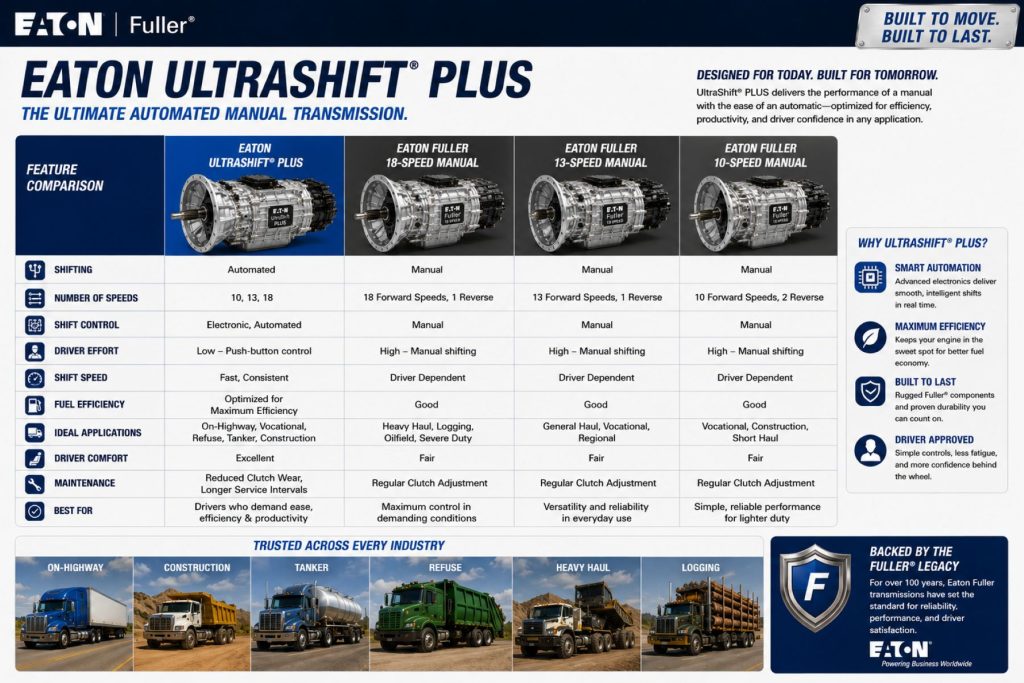
Compared with an Eaton Fuller manual transmission, the UltraShift PLUS uses electronic controls to operate the clutch and change gears. A manual provides direct driver control, while the UltraShift PLUS reduces physical workload and manual-shifting requirements.
Compared with the Eaton AutoShift, UltraShift PLUS provides fully automated clutch operation. Many AutoShift configurations still require the driver to use a clutch pedal when starting and stopping.
Compared with the Eaton Fuller Advantage Automated, UltraShift PLUS covers a broader range of vocational and extreme-duty applications. Fuller Advantage models place greater emphasis on linehaul efficiency and lower weight.
Compared with the Eaton Endurant, the UltraShift PLUS represents an earlier automated-manual generation. Endurant transmissions generally provide newer electronics, lighter designs, integrated diagnostics, and more modern powertrain communication.
Compared with a Detroit DT12, the UltraShift PLUS was offered across multiple truck and engine platforms. The DT12 is more tightly integrated with Detroit engines and Daimler truck platforms.
Compared with an Allison fully automatic transmission, the UltraShift PLUS uses a dry clutch and automated mechanical gears rather than a torque converter with planetary gearing. The Allison generally provides smoother uninterrupted power during launch and shifts, while the UltraShift PLUS can provide efficient mechanical power transfer at highway speeds.
Best Fit For
- Fleets wanting two-pedal operation
- Drivers who do not have advanced manual-shifting experience
- Long-haul fleet tractors
- Regional-haul operations
- Vocational fleets
- Dump truck operations
- Construction companies
- Refuse fleets
- Agricultural operations
- Logging companies
- Moderate and extreme heavy-haul operations
- PTO-equipped vocational trucks
- Fleets seeking consistent gear selection
- Operations wanting reduced driver fatigue
- Used-truck buyers with access to Eaton diagnostic support
Related Truck Types
- Sleeper Trucks
- Day Cab Trucks
- Vocational Trucks
- Heavy-Haul Trucks
- Class 8 Highway Tractors
- Construction Trucks
- Dump Trucks
- Refuse Trucks
- Logging Trucks
- Agricultural Trucks
Related Truck Models
- Freightliner Cascadia
- Freightliner Coronado
- Freightliner 122SD
- Western Star 4900
- Western Star 6900XD
- Peterbilt 389
- Peterbilt 567
- Kenworth W900
- Kenworth T800
- Kenworth T880
- International HX Series
Related Engines
- Cummins X15
- Cummins ISX15
- Cummins X12
- Cummins ISM
- Detroit DD13
- Detroit DD15
- Detroit DD16
- PACCAR MX-13
Related Transmission Types
- Automated Manual Transmissions
- Heavy-Duty Transmissions
- Linehaul Transmissions
- Vocational Transmissions
- Heavy-Haul Transmissions
- 10-Speed Automated Transmissions
- 13-Speed Automated Transmissions
- 18-Speed Automated Transmissions
- Two-Pedal Transmissions
Related Equipment Systems
- Electronic Clutch Actuators
- Dry Clutch Systems
- Transmission Control Modules
- Shift Actuators
- Vehicle Communication Networks
- Driveshafts
- Axles and Differentials
- Transmission Lubrication Systems
- Transmission Cooling Systems
- Electrical and Charging Systems
- PTO Systems
Related Guides
Understand the operating principles in How Commercial Truck Transmissions Work, compare drivetrain designs in Manual vs Automated Manual vs Automatic Transmissions, and evaluate gearing, application, and compatibility in How to Choose a Commercial Truck Transmission.
Regulatory and Compliance Notes
The Eaton UltraShift PLUS must be installed and operated within the torque, weight, duty-cycle, and application limits approved for the specific transmission model.
The complete vehicle must remain within its gross vehicle weight rating, gross combination weight rating, axle ratings, tire ratings, brake capacity, federal bridge-formula requirements, and applicable state limits.
Engine and transmission software must be compatible. Unapproved torque programming or performance modifications can exceed the clutch and transmission ratings.
Electronic repairs, software updates, calibrations, and transmission conversions should follow Eaton and vehicle-manufacturer procedures.
PTO installations must use properly rated components and approved programming. Safety interlocks should prevent unintended vehicle movement or equipment operation.
The automated transmission does not replace the driver’s responsibility to maintain control of the vehicle. Service brakes and parking brakes must be used appropriately, especially when stopping or holding the truck on a grade.
Real World Operating Notes
In everyday operation, the UltraShift PLUS can significantly reduce driver workload, especially in congested traffic, regional routes, construction sites, and operations involving frequent stops.
Drivers should allow the transmission to complete its shifts instead of rapidly changing accelerator position or attempting to force a different ratio during the shift.
The system may hold a gear longer when the truck is heavily loaded or climbing. It may skip gears when lightly loaded.
Low-speed maneuvering should be performed carefully. Creep Mode and Blended Pedal can make positioning easier, but continuous clutch slipping creates heat.
The accelerator should not be used to hold the truck stationary on a hill. The service brakes should hold the vehicle until the driver is ready to move.
Before shutting down, the driver should select Neutral, confirm a solid neutral indication, apply the parking brakes, and follow the truck manufacturer’s shutdown procedure.
If the transmission will not select a gear, the driver should check the display, air pressure, battery voltage, and active warnings before repeatedly cycling the controls.
Frequently Asked Questions
Is the Eaton UltraShift PLUS an automatic transmission?
It is an automated manual transmission. Electronic controls operate a mechanical manual gearbox and dry clutch.
Does the UltraShift PLUS have a clutch pedal?
No. It uses a two-pedal design with an electronically operated clutch.
How many gears does the UltraShift PLUS have?
Depending on the model, it may provide 10, 13, or 18 forward speeds.
What is the maximum torque capacity?
UltraShift PLUS configurations are available with ratings from approximately 1,450 to 2,250 lb-ft.
Can the driver select gears manually?
Yes. Manual mode allows the driver to request upshifts and downshifts, although the transmission may deny a harmful request.
What does Low mode do?
Low mode keeps the transmission in lower gears longer and can improve engine braking and low-speed control.
What is Creep Mode?
Creep Mode allows controlled low-speed movement for docking, backing, job-site operation, and other maneuvering.
Can the UltraShift PLUS hold a truck on a hill?
Hill Start Aid can temporarily help prevent rollback during launch. The service brakes must be used to hold the truck stationary.
Does the UltraShift PLUS use a torque converter?
No. It normally uses a heavy-duty dry clutch operated by an Electronic Clutch Actuator.
Can a PTO be installed?
Certain vocational configurations support PTO equipment. Compatibility must be confirmed for the exact transmission and vehicle programming.
Why will the transmission not go into gear?
Possible causes include low voltage, an actuator fault, clutch problems, air-system issues, speed-sensor faults, wiring damage, communication faults, or an incomplete calibration.
Is the Eaton UltraShift PLUS still available?
It is primarily a legacy transmission family. Many newer applications use Eaton Endurant products, but UltraShift PLUS units remain common in operating trucks and are supported through parts, diagnostics, service information, and remanufactured replacements.
Availability and Where to Find
Eaton UltraShift PLUS transmissions are available through used commercial truck dealers, Eaton-authorized service locations, drivetrain specialists, transmission rebuilders, salvage operations, fleet-equipment sales, auctions, and heavy-truck parts suppliers.
Buyers may find remanufactured transmissions, used take-out units, replacement actuators, clutch components, electronic controls, and model-specific service parts.
Because UltraShift PLUS includes multiple highway and vocational series, buyers should verify the full model number rather than purchasing based only on the UltraShift PLUS name.
The replacement transmission must match the engine, truck wiring, vehicle network, clutch, shift controls, axle gearing, PTO equipment, and software configuration.
Eaton provides UltraShift PLUS training and technical information through its official automated-transmission video library.
Support Trucking Families
Truck Equipment Atlas supports the mission of Grey Cross, a nonprofit dedicated to helping families of truck drivers who lose their lives while on the road. As the site grows, part of its mission is to bring awareness and support to these families.
Podcast or Video Section
Learn More Through Audio and Video
Truck Equipment Atlas will continue expanding with podcast episodes, interviews, and equipment breakdowns to help drivers and fleets better understand trucks and equipment.
Follow the Growth of Truck Equipment Atlas
Truck Equipment Atlas continues to expand with new truck profiles, trailer coverage, diesel engine pages, equipment system resources, manufacturer information, and educational guides.
Visit our Site Updates page to explore recent additions, project milestones, and upcoming resources as we continue building one of the industry’s growing commercial trucking equipment reference libraries.
View the Latest Site Updates: Truck Equipment Atlas Site Updates