
Axle and Differential Guides
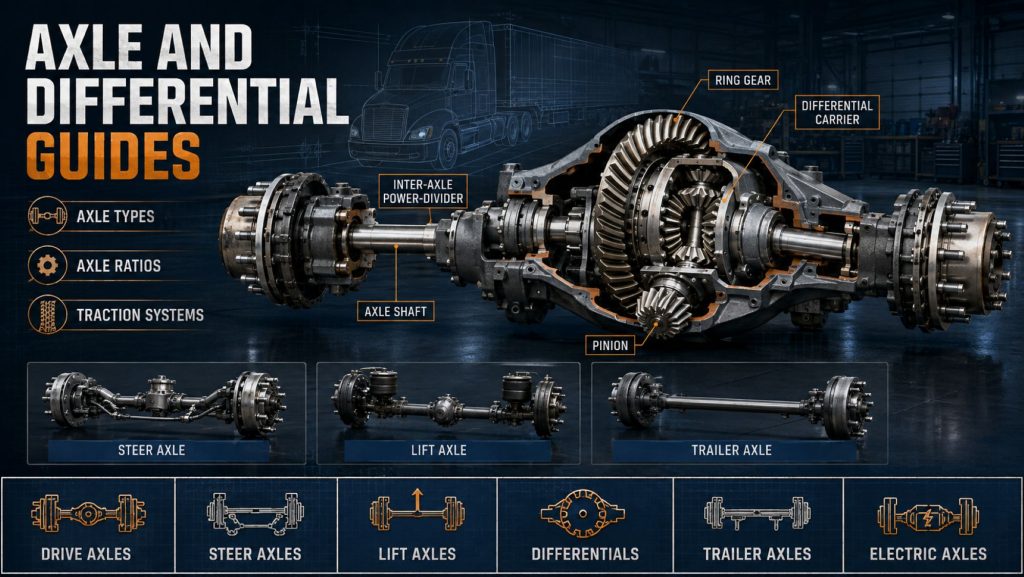
Commercial truck axles and differentials influence load capacity, traction, maneuverability, engine speed, fuel efficiency, tire wear, and overall drivetrain performance.
The guides in this section explain how drive axles, steer axles, lift axles, trailer axles, differentials, axle ratios, and emerging electric drive axles work. They are designed to help drivers, fleet operators, technicians, buyers, and equipment owners understand the systems beneath commercial trucks and trailers.
Use this guide library to compare axle configurations, understand differential operation, evaluate axle ratios, and learn how these components should be matched to a vehicle’s weight, duty cycle, terrain, and powertrain.
Axle and Differential Guides on Truck Equipment Atlas
Axle Fundamentals
How Commercial Truck Axles and Differentials Work
A complete introduction to steer axles, drive axles, axle shafts, differentials, wheel ends, and the transfer of power through a commercial truck drivetrain.
Commercial Truck Axle Types Explained
Learn the differences among steer axles, drive axles, pusher axles, tag axles, trailer axles, and electric drive axles.
Gross Axle Weight Ratings Explained
Understand gross axle weight ratings, axle-group capacity, component ratings, vehicle certification, and why an axle’s published capacity does not determine legal payload by itself.
Drive-Axle Guides
Single-Axle vs Tandem-Axle Trucks
Compare single-drive and tandem-drive truck configurations, including capacity, traction, maneuverability, weight, maintenance, and common applications.
Learn how power is distributed through the forward-rear axle, inter-axle differential, power divider, rear-rear axle, and wheel differentials.
How to Choose a Commercial Truck Drive Axle
Review the major considerations involved in matching drive-axle capacity, gearing, traction equipment, brakes, suspension, and wheel ends to a truck’s application.
Axle-Ratio Guides
Commercial Truck Axle Ratios Explained
Learn how ring-and-pinion gearing affects engine speed, wheel torque, startability, gradeability, fuel efficiency, and highway performance.
How to Choose the Right Axle Ratio
Understand how engine torque, transmission gearing, tire size, vehicle weight, terrain, road speed, and duty cycle influence axle-ratio selection.
Direct Drive vs Overdrive and Axle Ratio Selection
Explore how direct-drive and overdrive transmission configurations interact with axle ratios to determine cruising speed, engine rpm, and drivetrain efficiency.
Differential Guides
Open, Locking, and Limited-Slip Differentials
Compare the major differential types used in commercial trucks and learn how each design manages wheel-speed differences and traction.
Inter-Axle Locks vs Wheel Differential Locks
Understand the difference between locking the two drive axles together and locking the left and right wheels across an individual axle.
How to Use Commercial Truck Differential Locks
Learn when differential locks may improve traction, when they should be disengaged, and how improper operation can damage tires or drivetrain components.
Steer-, Lift-, and Auxiliary-Axle Guides
How Commercial Truck Steer Axles Work
Learn how the steer axle supports the front of the truck and connects the steering, suspension, brakes, wheel ends, wheels, and tires.
Compare the placement, operation, advantages, and common applications of pusher and tag auxiliary axles.
How Lift Axles and Auxiliary Axles Work
Understand how liftable and load-bearing auxiliary axles help distribute vehicle weight across additional tires and axle positions.
Trailer-Axle Guides
Commercial Trailer Axle Configurations Explained
Explore single, tandem, spread-axle, tridem, liftable, self-steering, and specialized multi-axle trailer configurations.
Sliding Tandem vs Fixed Trailer Axles
Compare sliding and fixed trailer axle groups, including weight distribution, maneuverability, cargo placement, and common trailer applications.
Spread Axle vs Closed Tandem Trailers
Learn how axle spacing affects weight distribution, maneuverability, tire scrubbing, stability, and legal loading.
Electric-Axle Guides
Learn how e-axles combine electric motors, reduction gearing, differentials, axle components, power electronics, and regenerative braking.
Electric Drive Axles vs Central Electric Drivetrains
Compare integrated e-axles with electric powertrains that use centrally mounted motors, transmissions, and conventional driveshafts.
Understanding Axles and Differentials
An axle supports vehicle weight and provides a structural connection between the vehicle and its wheels. Depending on its position and design, an axle may steer the vehicle, transfer propulsion torque, support additional weight, or carry a commercial trailer.
The differential is the gear assembly inside a conventional drive axle that transfers power to the axle shafts while allowing the left and right wheels to rotate at different speeds during turns.
A commercial truck may use several axle types:
- Steer axle
- Single drive axle
- Tandem drive axles
- Pusher axle
- Tag axle
- Liftable axle
- Trailer axle
- Self-steering auxiliary axle
- Electric drive axle
The correct combination depends on vehicle class, weight, wheelbase, powertrain, operating territory, traction requirements, and intended application.
Why Axle Configuration Matters
Axle configuration affects how a commercial vehicle carries weight and transfers power to the road.
Important effects include:
- Gross vehicle weight capacity
- Payload distribution
- Traction
- Maneuverability
- Turning radius
- Tire wear
- Braking capacity
- Ride quality
- Fuel or energy consumption
- Drivetrain efficiency
- Startability
- Gradeability
- Highway engine speed
- Legal axle loading
A highway tractor, dump truck, refuse vehicle, heavy-haul tractor, delivery truck, and commercial trailer may each require a different axle configuration.
Axle Capacity and Vehicle Weight
Every axle and axle group has a rated capacity. However, the complete vehicle’s allowable weight is limited by more than the axle housing alone.
The working and legal capacity may also depend on:
- Manufacturer gross axle weight rating
- Vehicle gross weight rating
- Suspension capacity
- Brake capacity
- Wheel-end ratings
- Wheel ratings
- Tire size and load ratings
- Frame capacity
- Axle spacing
- Bridge-weight formulas
- State and provincial regulations
- Permit conditions
The lowest-rated component can limit the capacity of the complete system.
Axle Ratios and Powertrain Performance
The axle ratio describes the relationship between driveshaft rotation and wheel rotation.
Numerically higher axle ratios generally provide greater torque multiplication and stronger low-speed pulling performance. Numerically lower ratios can reduce engine speed during highway operation when properly matched to the engine, transmission, tires, and vehicle weight.
Axle-ratio selection affects:
- Engine rpm at road speed
- Starting performance
- Grade-climbing ability
- Fuel efficiency
- Maximum geared road speed
- Transmission selection
- Tire-size compatibility
- Driveline torque
- Vocational performance
Axle ratios should be selected as part of the complete powertrain rather than as an isolated specification.
Continue with transmission ratios and power flow and matching a transmission to axle gearing and duty cycle.
Differential and Traction Systems
Different differential designs provide different levels of traction.
Common commercial-truck systems include:
- Open differentials
- Limited-slip differentials
- Automatic locking differentials
- Driver-controlled wheel differential locks
- Inter-axle differentials
- Inter-axle differential locks
An inter-axle differential distributes power between two drive axles in a tandem. A wheel differential distributes power between the left and right wheels of an individual drive axle.
Understanding that distinction is essential when selecting or operating traction-control equipment.
Choosing the Right Guide
Use the introductory guides if you are learning how axle systems work or comparing the major axle types.
Use the axle-ratio guides when evaluating engine speed, fuel efficiency, pulling capability, transmission gearing, or tire-size changes.
Use the differential guides when comparing traction systems or learning how inter-axle and wheel differential locks operate.
Use the application-specific guides when selecting equipment for highway, vocational, heavy-haul, trailer, or electric-vehicle operation.
Explore Axle and Differential Categories
- Commercial Truck Drive Axles
- Commercial Truck Steer Axles
- Lift Axles and Auxiliary Axles
- Truck Differentials
- Electric Drive Axles
- Commercial Trailer Axles
Related Equipment Resources
- Axles and Differentials
- Trucks
- Trailers
- Transmissions
- Engines
- Suspension Systems
- Brake Systems
- Tires and Wheels
- Electrical Systems
- Safety Systems
Explore the Complete Axle and Differential Library
Visit the Axles and Differentials hub to explore drive axles, steer axles, lift axles, auxiliary axles, differentials, electric drive axles, trailer axles, manufacturer profiles, and educational guides.