
Eaton Cummins Endurant HD Automated Transmission
Quick Facts
- Manufacturer: Eaton Cummins Automated Transmission Technologies
- Transmission Family: Endurant HD Series
- Transmission Type: Heavy-Duty Automated Manual Transmission
- Available Configurations: 12-Speed Overdrive and 11-Speed Direct Drive
- Maximum Input Torque: Up to 1,850 lb-ft depending on model
- Maximum Engine Horsepower: Up to approximately 515 horsepower depending on application approval
- Maximum Gross Combination Weight: 110,000 lbs
- Clutch Type: Electronically Controlled Diaphragm-Spring Dry Clutch
- Pedal Configuration: Two-Pedal Design with No Driver-Operated Clutch Pedal
- Housing Material: Lightweight Aluminum
- Approximate Weight: Approximately 657 lbs depending on model and equipment
- Oil Capacity: Approximately 16 pints or 7.5 liters
- Lubricant: Eaton PS-386 Approved Transmission Lubricant
- Lubrication Interval: Up to 750,000 miles in approved linehaul applications
- Cooling Design: Cooler-Less in most approved applications
- PTO Compatibility: Standard bottom 8-bolt opening with optional rear PTO on compatible 12-speed models
- Maximum Combined PTO Output: Up to approximately 95 horsepower depending on configuration
- Common Applications: Long Haul, Regional Haul, Pickup and Delivery, Bulk Hauling, Flatbed, Tanker, Beverage, Moving Van, and On-Highway Vocational Operations
- Production Status: Active Production
Overview
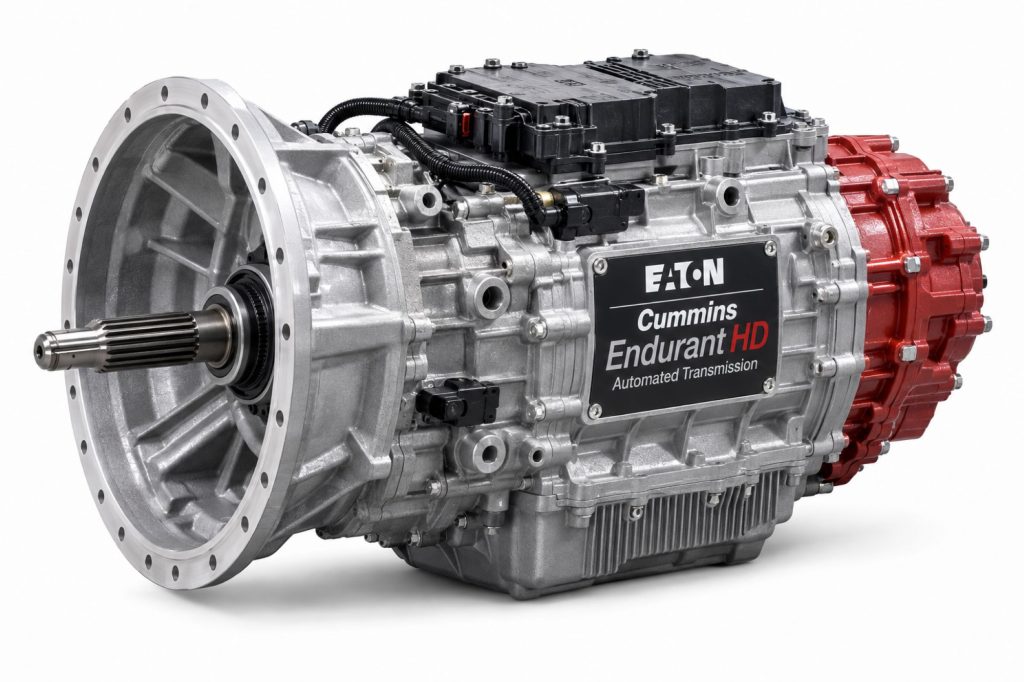
The Eaton Cummins Endurant HD is a lightweight heavy-duty automated manual transmission designed primarily for on-highway and regional commercial trucking.
It was developed by Eaton Cummins Automated Transmission Technologies, a joint venture formed by Eaton and Cummins. The transmission combines mechanical twin-countershaft gearing with electronic clutch control, automated gear selection, engine communication, and application-specific software.
The Endurant HD is available as a 12-speed overdrive transmission and an 11-speed direct-drive transmission. This allows fleets to match the transmission with the truck’s engine, rear-axle ratio, tire size, route profile, operating weight, and fuel-efficiency goals.
Unlike a conventional manual transmission, the Endurant HD does not require the driver to operate a clutch pedal or manually move a shift lever through the gears. Electronic controls select the starting gear, operate the clutch, coordinate engine torque, and complete each shift.
Unlike a conventional torque-converter automatic, the Endurant HD uses a dry clutch and mechanical gearing. This provides an efficient mechanical connection after the clutch is fully engaged.
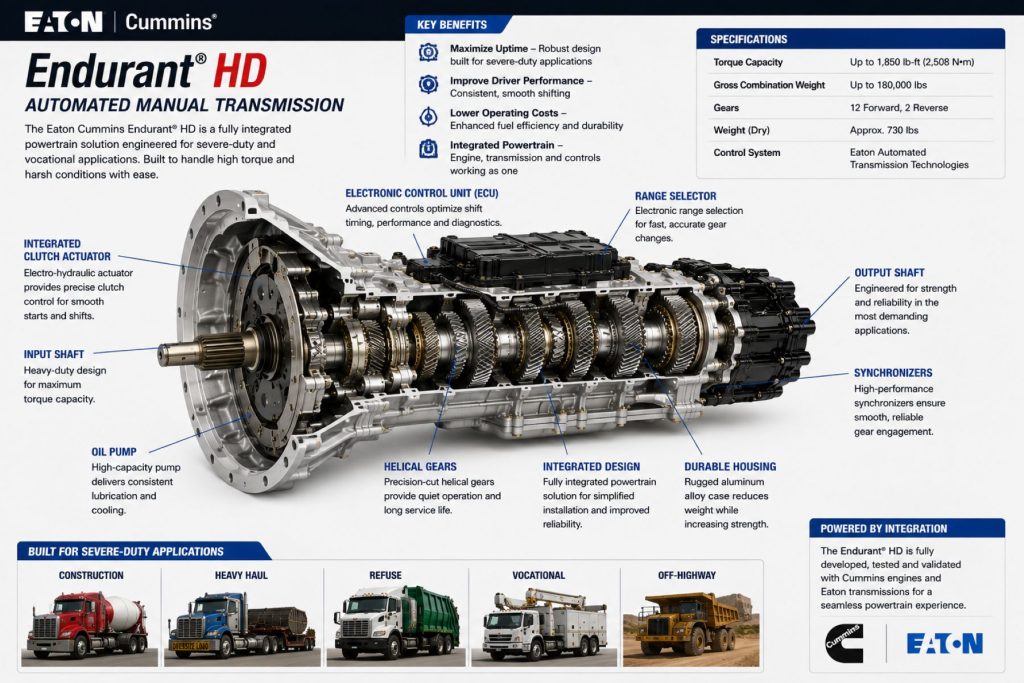
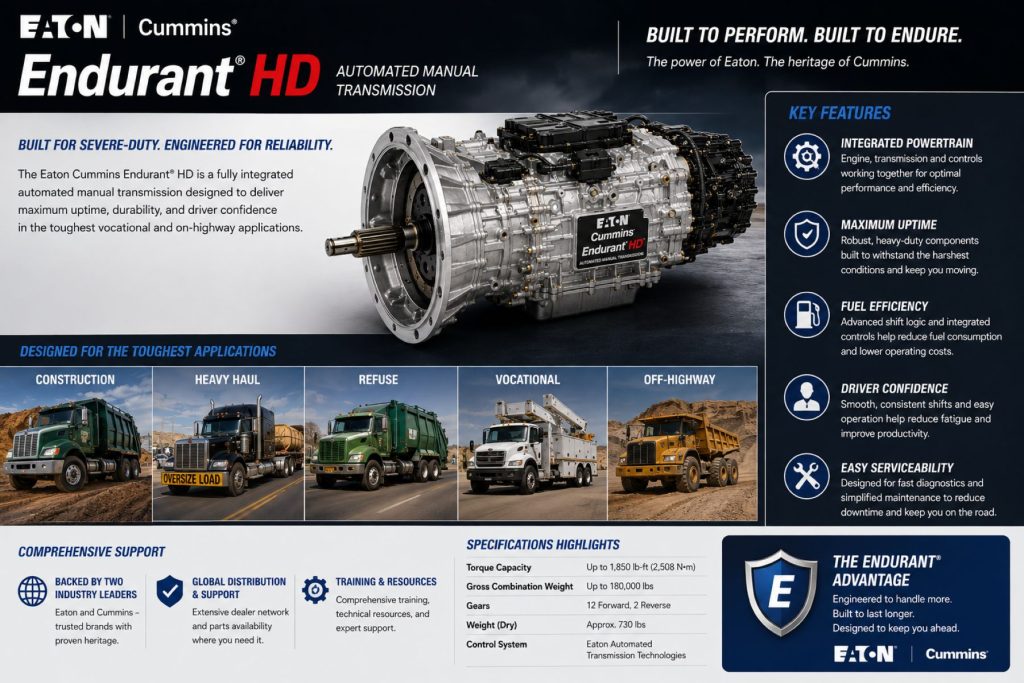
The transmission is intended primarily for sleeper trucks, day cab trucks, linehaul tractors, regional trucks, and lighter on-highway vocational applications operating at up to 110,000 pounds GCW.
Key Characteristics
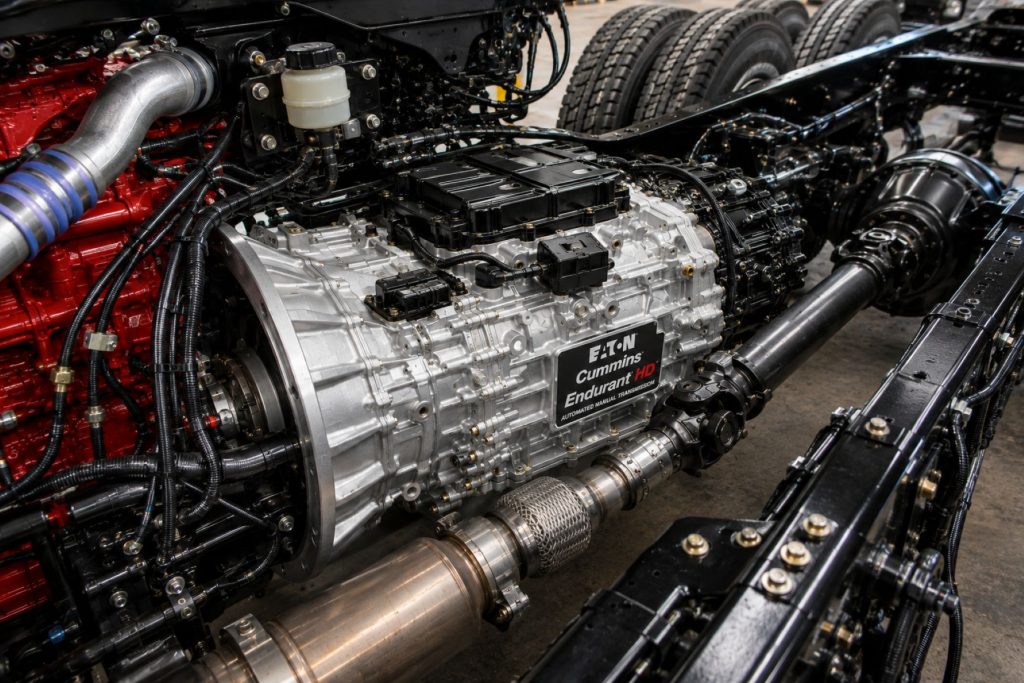
The Endurant HD uses a purpose-built automated-transmission design rather than adding electronic actuators to a traditional manual-transmission platform.
Its aluminum housing reduces weight and helps manage operating temperature. Eaton Cummins engineered the transmission to reduce lubricant requirements, eliminate an external transmission cooler in most approved applications, and extend lubricant-change intervals.
A twin-countershaft design distributes engine torque between two countershafts. Helical gearing helps improve operating smoothness and reduce noise.
The Endurant HD’s electronically controlled diaphragm-spring clutch provides automatic launch control and low-speed maneuverability without a clutch pedal.
The transmission uses integrated sensors to monitor operating conditions. A transmission-fluid pressure sensor can warn the driver and fleet when oil pressure indicates a low-lubricant or related operating problem.
Predictive shifting and GearLogic software use vehicle, engine, load, and route information to select gears. On properly equipped trucks, look-ahead information can help the transmission anticipate grades and choose a more efficient shift strategy.
The Endurant HD is available with direct-drive and overdrive gearing, diesel and natural-gas compatibility, single or dual PTO provisions, and different software Performance Goals.
How the Transmission Works
The Endurant HD transfers engine power through an electronically controlled dry clutch and a set of mechanical transmission gears.
The Transmission Electronic Control Unit communicates with the engine and vehicle systems to manage clutch engagement, engine torque, gear selection, and shift timing.
Vehicle Launch
When the driver selects Drive and presses the accelerator, the transmission chooses an appropriate starting gear.
The selected starting gear depends on:
- Vehicle weight
- Road grade
- Accelerator demand
- Rear-axle ratio
- Transmission programming
- Operating mode
The clutch actuator gradually engages the dry clutch and begins moving the truck.
Automatic Shifting
During normal operation, the transmission evaluates engine speed, vehicle speed, throttle position, grade, calculated load, and driver demand.
When an upshift is needed, the transmission requests a reduction in engine torque, disengages the current gear, synchronizes the next ratio, engages it, and restores engine torque.
Downshifting follows a similar process. The transmission coordinates engine speed with the lower ratio before engagement.
Predictive Shifting
Predictive shifting uses available route and terrain information to anticipate changes in grade.
The system may hold a gear before reaching the crest of a hill, avoid unnecessary shifts, or prepare the powertrain for an approaching climb.
Exact functionality depends on the truck manufacturer, engine, software package, and installed navigation or terrain-prediction systems.
Manual Mode
Manual mode allows the driver to request upshifts and downshifts.
The transmission maintains protective authority and may deny a request that would overspeed the engine, lug the powertrain, or damage drivetrain components.
Low Mode
Low mode helps keep the transmission in lower gears longer.
It can be useful during low-speed operation, descending grades, maneuvering, and situations where stronger engine braking is desired.
Low-Speed Maneuvering
Depending on the truck and calibration, the Endurant HD may use Urge to Move, Auto Launch, or Creep Mode to help the driver maneuver at low speeds.
These functions assist with:
- Backing into loading docks
- Connecting to trailers
- Moving through congested yards
- Maintaining low speed in traffic
- Positioning around customer facilities
Because the transmission uses a dry clutch, extended creeping or repeated aggressive launches can still generate clutch heat.
Common Specifications
Transmission Type
The Endurant HD is a heavy-duty automated manual transmission with electronic clutch and shift control.
Forward Speeds
The Endurant HD is available as:
- 12-speed overdrive
- 11-speed direct drive
The correct configuration depends on the truck, route, axle ratio, and desired cruising characteristics.
Reverse Speeds
Reverse-ratio availability varies by configuration. Common Endurant HD models provide one or two reverse ratios.
Maximum Torque Capacity
The Endurant HD is available in models rated for approximately:
- 1,450 lb-ft
- 1,650 lb-ft
- 1,850 lb-ft
The transmission model must equal or exceed the engine’s maximum programmed torque.
Maximum Horsepower
The Endurant HD supports engines producing up to approximately 515 horsepower, subject to application approval.
Maximum Gross Combination Weight
Maximum approved GCW is 110,000 pounds.
Operations exceeding 110,000 pounds should be evaluated for the heavier-duty Endurant XD or Endurant XD Pro rather than Endurant HD.
Overdrive Configuration
The 12-speed overdrive model uses a top-gear ratio below 1.00:1.
This helps reduce engine rpm during highway operation when paired with the proper rear-axle ratio and tire size.
Direct-Drive Configuration
The 11-speed direct-drive model uses a 1.00:1 top gear.
Direct drive can reduce internal power-flow losses in top gear but normally requires a faster numerical rear-axle ratio to achieve the desired highway speed.
Gear Ratios
A common 12-speed overdrive ratio set includes:
- First Gear: Approximately 14.43:1
- Eleventh Gear: 1.00:1
- Twelfth Gear: Approximately 0.77:1
- Overall Ratio Coverage: Approximately 18.85:1
Exact ratios must be confirmed for the specific transmission model.
Clutch System
The Endurant HD uses an electronically controlled diaphragm-spring dry clutch.
The clutch is designed to provide consistent launch characteristics and low-speed maneuverability without a clutch pedal.
Clutch Actuation
An electronic clutch actuator controls engagement and release.
Clutch operation is coordinated with engine torque, vehicle weight, accelerator input, grade, and selected transmission mode.
Shift Actuation
Electronic and electromechanical components move the transmission between gears under the command of the Transmission Electronic Control Unit.
Transmission Control Module
The controller manages:
- Starting-gear selection
- Clutch operation
- Upshifts and downshifts
- Engine-torque coordination
- Gear protection
- Low-speed features
- Fault monitoring
- Diagnostic communication
Housing Construction
An aluminum housing reduces transmission weight and helps manage heat.
Transmission Weight
A common Endurant HD configuration weighs approximately 657 pounds. Exact weight varies by model, clutch, shift control, PTO equipment, and other options.
Transmission Length
Common Endurant HD configurations are approximately 37.9 inches long. Installation dimensions vary by model and equipment.
Lubricant Capacity
The transmission requires approximately 16 pints or 7.5 liters of lubricant.
The exact service-fill quantity should be confirmed using the transmission model and current service information.
Recommended Lubricant
Eaton PS-386 approved lubricant is commonly specified.
Using the correct lubricant is essential for gear protection, bearing life, shift performance, temperature control, and proper fluid-pressure monitoring.
Lubricant-Change Interval
The approved linehaul lubricant-change interval can reach 750,000 miles.
Shorter intervals may apply to severe-duty, vocational, contaminated, high-temperature, or non-linehaul operation.
Precision Lubrication System
The lubrication system directs oil to gears and bearings where it is needed.
This helps reduce oil volume, internal drag, and energy loss while maintaining component protection.
Transmission-Fluid Pressure Sensor
A fluid-pressure sensor monitors lubricant-system performance.
The system can alert the driver or fleet to conditions that may indicate low lubricant or inadequate pressure before severe damage occurs.
Cooler-Less Design
The Endurant HD normally does not require an external transmission-oil cooler in approved applications.
Eliminating external cooler lines and fittings reduces potential leak points, weight, and maintenance requirements.
PTO Capability
The Endurant HD includes a standard bottom 8-bolt PTO opening.
Compatible 12-speed models may also be available with an optional rear-mounted PTO, allowing single or dual PTO installations.
PTO Capacity
Endurant HD PTO configurations can provide up to approximately 95 horsepower of output, depending on the transmission, PTO equipment, operating speed, and application approval.
More information about vocational power equipment is available in PTO System Explained.
Diagnostics
Endurant HD supports electronic diagnostics, fault-code reporting, software updates, calibration procedures, and remote-diagnostic capabilities.
ServiceRanger and approved OEM diagnostic systems are used for service and troubleshooting.
Installation Requirements
Installation must account for:
- Approved engine compatibility
- Engine and transmission software
- Rear-axle ratio
- Tire size
- Vehicle network communication
- Clutch calibration
- Electrical power and grounds
- Shift-control compatibility
- Driveshaft angles
- PTO programming
- Vehicle application approval
Common Applications
- Long-haul freight
- Regional hauling
- Dedicated routes
- Dry van operations
- Refrigerated freight
- Flatbed operations
- Tanker operations
- Bulk hauling
- Pickup and delivery
- Beverage distribution
- Moving vans
- Stake trucks
- Landscape trucks
- Refuse roll-off trucks operating primarily on-road
- Refuse transfer vehicles
- Fleet sleeper tractors
- Fleet day cab tractors
- Natural-gas fleet applications with Endurant HD N
Truck and Engine Compatibility
The Eaton Cummins Endurant HD is designed primarily for electronically integrated Class 8 truck powertrains.
Availability depends on the truck manufacturer, engine, model year, axle ratio, software configuration, and intended application.
Common truck applications include the Kenworth T680, Peterbilt 579, International LT Series, and other modern linehaul or regional tractors approved for the Endurant HD.
The transmission is especially associated with the Cummins X15 and Cummins X12 in approved diesel applications.
Natural-gas configurations use the Endurant HD N, which includes clutch and software changes designed for compatible Cummins natural-gas engines.
The Endurant HD should not be selected only by matching torque capacity. Engine software, vehicle wiring, electronic communication, clutch configuration, rear-axle gearing, and truck-manufacturer application approval are also required.
Some PACCAR trucks use the closely related PACCAR TX-12 transmission. Although the TX-12 shares technology and development connections with Endurant, it should be treated as a separate branded transmission with its own specifications, programming, and parts identification.
Advantages
- Two-pedal operation reduces driver workload
- Purpose-built automated-transmission design
- Available in overdrive and direct-drive configurations
- Maximum torque capacity of approximately 1,850 lb-ft
- Maximum GCW of 110,000 pounds
- Lightweight aluminum housing
- Approximately 657-pound transmission weight
- Efficient twin-countershaft design
- Helical gears help reduce operating noise
- Electronically controlled clutch
- Predictive shifting capability
- Load-based starting-gear selection
- Skip shifting improves efficiency
- Transmission-fluid pressure sensor
- Long lubricant-change interval
- Reduced lubricant capacity
- Cooler-less design reduces leak points
- Standard PTO opening
- Optional dual-PTO capability
- Strong integration with Cummins engines
- Remote diagnostic capability
- No driver-operated clutch pedal
Limitations or Considerations
- Maximum GCW is limited to 110,000 pounds
- Not designed for extreme off-highway operation
- Not intended to replace Endurant XD Pro in severe service
- Maximum input torque is approximately 1,850 lb-ft
- Maximum horsepower is approximately 515
- Electronic systems require specialized diagnostics
- Clutch actuator faults can disable the truck
- Still uses a wear-prone dry clutch
- Does not provide torque-converter multiplication
- Low-speed operation differs from a conventional automatic
- Extended creeping can generate clutch heat
- Software calibration strongly affects drivability
- Engine and transmission must be electronically compatible
- Poor battery voltage can cause shifting faults
- Clutch replacement requires calibration procedures
- PTO capacity is lower than Endurant XD models
- Some repairs require approved diagnostic equipment
Driver and Operator Experience
The Endurant HD provides two-pedal operation similar to an automatic transmission, but its shifting behavior reflects its automated-manual design.
The driver selects Drive, releases the brakes, and uses the accelerator to begin moving. The transmission selects a starting gear based on load, grade, and vehicle programming.
During a shift, the transmission briefly reduces engine torque, moves into the selected gear, and restores power. The driver may notice a short interruption in acceleration that would not occur in the same way with a torque-converter automatic.
Drivers should maintain steady accelerator input during normal shifts. Rapid throttle changes can cause the transmission to reconsider its gear selection.
The transmission may skip several gears when the truck is lightly loaded. When climbing or hauling near its maximum operating weight, it may use more of the available ratios.
Manual mode allows the driver to request a particular gear before a grade, descent, curve, or traffic condition. The transmission may deny a request that could damage the engine or drivetrain.
Low mode can help retain lower gears and improve engine-braking control.
Drivers should use the service brakes to hold the truck stationary on a grade. Accelerator input should not be used to hold the truck because doing so can overheat the dry clutch.
Creep Mode and Urge to Move can improve docking and low-speed traffic operation. Drivers should still avoid unnecessary prolonged clutch slipping.
Maintenance and Ownership Notes
The Endurant HD was designed to reduce routine maintenance requirements compared with earlier automated transmissions.
The lubricant-change interval can reach 750,000 miles in approved linehaul service. The correct interval should be confirmed for the truck’s duty cycle.
The transmission-fluid pressure sensor helps detect low-lubricant conditions, but it does not eliminate the need to inspect for leaks and follow scheduled maintenance.
Leak areas can include the input seal, output seal, PTO openings, case joints, shift components, and installed PTO equipment.
The dry clutch should be monitored for wear, overheating, contamination, and improper engagement.
Clutch service or actuator replacement may require electronic calibration with approved diagnostic equipment.
Battery and charging-system condition are important. Weak batteries, poor grounds, corroded cables, or low system voltage can cause actuator faults, communication problems, or incomplete shifts.
Wiring harnesses and connectors should be checked for corrosion, water intrusion, rubbing, impact damage, and loose terminals.
Software updates should be completed according to Eaton Cummins and truck-manufacturer procedures.
The complete model and serial numbers should be recorded from the identification tag before parts are ordered.
Common Transmission Problems
Failure to Select a Gear
The transmission may remain in neutral because of low battery voltage, clutch-actuator faults, shift-actuator problems, sensor failures, communication faults, or incomplete calibration.
Clutch Actuator Problems
A failed or improperly calibrated actuator can cause harsh engagement, failure to move, incomplete shifts, or active fault codes.
Clutch Wear
Normal clutch wear eventually affects launch quality and engagement.
Repeated stop-and-go operation, excessive creeping, aggressive launches, and hill-holding with the accelerator can accelerate wear.
Clutch Overheating
The clutch can overheat during prolonged slipping, repeated low-speed maneuvers, heavy launches, or attempts to hold the truck stationary using engine power.
Low-Lubricant or Pressure Warnings
A fluid-pressure warning may indicate low oil level, leakage, an incorrect lubricant, sensor problems, or another lubrication-system fault.
The warning should be investigated before continued operation causes mechanical damage.
Shift-Actuator Faults
Shift-actuator problems can prevent the transmission from finding neutral, selecting the target gear, or completing a shift.
Speed-Sensor Faults
Input-, mainshaft-, or output-speed sensor problems can interfere with synchronization and gear selection.
Wiring damage can create symptoms similar to a failed sensor.
Communication Faults
The transmission depends on communication with the engine and vehicle network.
Damaged wiring, poor grounds, incompatible software, or network faults can cause erratic shifting or failure to operate.
Low-Voltage Problems
Weak batteries or charging-system problems can cause slow actuators, incomplete shifts, false diagnostic codes, and no-start conditions.
Oil Leaks
Leaks may develop around seals, PTO openings, case joints, or auxiliary components.
Low lubricant can damage gears and bearings despite the transmission’s protective sensors.
PTO-Related Problems
Incorrect PTO installation, programming, lubrication, speed, or torque loading can cause engagement problems and transmission damage.
Internal Gear or Bearing Wear
Mechanical wear may produce noise, vibration, metal contamination, incomplete engagement, or persistent diagnostic faults.
Buying Considerations
- Identify the complete Endurant model number.
- Determine whether it is an 11-speed direct-drive or 12-speed overdrive model.
- Verify the maximum input-torque rating.
- Confirm the maximum approved horsepower.
- Confirm that operating weight will remain below 110,000 pounds GCW.
- Verify truck and engine compatibility.
- Check the rear-axle ratio and tire size.
- Calculate expected cruising rpm.
- Retrieve active and inactive diagnostic codes.
- Review clutch-life information when available.
- Check clutch and actuator service history.
- Test Drive, Reverse, Manual, and Low modes.
- Check starting-gear selection.
- Evaluate launch smoothness.
- Watch for flashing gear indications.
- Test low-speed maneuverability.
- Inspect the batteries and charging system.
- Inspect wiring, connectors, and grounds.
- Check for transmission and PTO leaks.
- Review lubricant-service records.
- Verify that the proper lubricant was used.
- Confirm PTO capacity and mounting requirements.
- Check whether current software updates have been installed.
- Confirm warranty or extended-coverage status.
- Verify local Eaton Cummins diagnostic support.
- Compare Endurant HD with Endurant XD when operating near the weight limit.
Variants and Configurations
- Endurant HD 12-Speed Overdrive
- Endurant HD 11-Speed Direct Drive
- Endurant HD N Natural-Gas Transmission
- 1,450 lb-ft Configuration
- 1,650 lb-ft Configuration
- 1,850 lb-ft Configuration
- Single-PTO Configuration
- Dual-PTO Configuration
- Bottom 8-Bolt PTO Configuration
- Optional Rear-PTO Configuration
- Diesel Engine Configuration
- Natural-Gas Engine Configuration
- Linehaul Performance Goal
- Regional-Haul Performance Goal
- Fuel-Economy-Focused Calibration
- Performance-Focused Calibration
- Urge-to-Move Configuration
- Creep-Mode Configuration
Comparison to Similar Equipment
Compared with the Eaton UltraShift PLUS, the Endurant HD uses a newer purpose-built automated-transmission design. It is lighter, uses less lubricant, offers longer service intervals, and includes newer sensors and software.
Compared with the Eaton Fuller Advantage Automated, the Endurant HD provides newer clutch technology, improved diagnostics, predictive shifting, reduced lubricant requirements, and a purpose-built automated architecture.
Compared with the Endurant XD, the Endurant HD is lighter and focused more heavily on linehaul efficiency. The Endurant XD supports higher combination weights and more demanding vocational applications.
Compared with the Endurant XD Pro, the Endurant HD has lower weight, torque, PTO, and severe-duty capacities. The XD Pro is designed for off-highway work, extreme heavy haul, logging, oilfield service, and other severe applications.
Compared with the Detroit DT12, the Endurant HD is associated strongly with Cummins-powered trucks and Eaton Cummins integration. The DT12 is integrated primarily with Detroit engines and Daimler truck platforms.
Compared with an Allison fully automatic transmission, the Endurant HD uses a dry clutch and mechanical gears rather than a torque converter and planetary gearing. The Allison generally provides smoother uninterrupted power at low speed, while the Endurant HD focuses on lightweight efficiency and highway fuel economy.
Best Fit For
- Long-haul fleets
- Regional-haul carriers
- Dedicated freight operations
- Dry van fleets
- Refrigerated carriers
- Flatbed operations
- Tanker fleets
- Bulk haulers requiring a PTO
- Day cab tractors
- Sleeper tractors
- Pickup-and-delivery operations
- Beverage distributors
- Moving companies
- Operations below 110,000 pounds GCW
- Fleets using compatible Cummins engines
- Fleets prioritizing fuel efficiency
- Operators seeking reduced transmission maintenance
- Drivers wanting two-pedal operation
Related Truck Types
- Sleeper Trucks
- Day Cab Trucks
- Vocational Trucks
- Class 8 Highway Tractors
- Regional-Haul Trucks
- Bulk-Haul Tractors
- Pickup-and-Delivery Trucks
- Natural-Gas Trucks
Related Truck Models
Related Engines
- Cummins X15
- Cummins X12
- Cummins X12N Natural-Gas Engine
- Cummins ISX12N Natural-Gas Engine
Related Transmission Types
- Automated Manual Transmissions
- Heavy-Duty Transmissions
- 12-Speed Transmissions
- 11-Speed Transmissions
- Overdrive Transmissions
- Direct-Drive Transmissions
- Linehaul Transmissions
- Two-Pedal Transmissions
Related Equipment Systems
- Electronic Clutch Actuators
- Diaphragm-Spring Clutches
- Transmission Control Modules
- Shift Actuators
- Vehicle Communication Networks
- Driveshafts
- Axles and Differentials
- Precision Lubrication Systems
- Transmission-Fluid Pressure Sensors
- Electrical and Charging Systems
- Predictive Cruise and Terrain Systems
- PTO Systems
Related Guides
- Understanding Horsepower vs Torque
- How Diesel Truck Engines Work
- How to Choose the Right Commercial Truck
Understand the operating principles in How Commercial Truck Transmissions Work, compare drivetrain designs in Manual vs Automated Manual vs Automatic Transmissions, and evaluate gearing, application, and compatibility in How to Choose a Commercial Truck Transmission.
Regulatory and Compliance Notes
The Endurant HD must be installed and operated within its approved torque, horsepower, weight, duty-cycle, and application limits.
The transmission’s maximum operating weight is 110,000 pounds GCW. The truck may have a lower limit based on its frame, axles, tires, suspension, brakes, driveshaft, and manufacturer ratings.
Engine and transmission software must be compatible. Unapproved engine-torque programming can exceed the transmission and clutch ratings.
Electronic repairs, software updates, and calibrations should follow Eaton Cummins and truck-manufacturer procedures.
PTO installations must use approved components, programming, controls, and safety interlocks.
The automated transmission does not replace the driver’s responsibility to control the vehicle. Service and parking brakes must be used appropriately, especially when stopping or holding the truck on a grade.
Real World Operating Notes
In everyday highway operation, the Endurant HD focuses on fuel efficiency, low driver workload, and consistent gear selection.
The transmission may skip several gears when the truck is lightly loaded. When climbing or operating near its maximum weight, it may use more of the available ratios.
Drivers should maintain steady accelerator input during shifts. Rapid throttle changes can cause the controller to reconsider its gear selection.
The transmission may hold a gear when predictive software determines that an immediate shift would be inefficient.
Low-speed features improve backing and docking, but operators should avoid prolonged clutch slipping.
The accelerator should never be used to hold the truck stationary on a grade. Service brakes should hold the truck until the driver is ready to move.
Before shutting down, the driver should select Neutral, confirm the neutral indication, apply the parking brakes, and follow the truck manufacturer’s procedure.
Frequently Asked Questions
Is the Endurant HD an automatic transmission?
It is an automated manual transmission. Electronic controls operate a mechanical gearbox and dry clutch.
Does the Endurant HD have a clutch pedal?
No. It uses a two-pedal design with an electronically controlled clutch.
How many gears does the Endurant HD have?
It is available as a 12-speed overdrive transmission and an 11-speed direct-drive transmission.
What is the maximum torque rating?
The Endurant HD supports up to approximately 1,850 lb-ft of engine torque.
What is the maximum operating weight?
The maximum approved gross combination weight is 110,000 pounds.
How much horsepower can it handle?
It supports engines producing up to approximately 515 horsepower, depending on application approval.
How much does the transmission weigh?
A common Endurant HD configuration weighs approximately 657 pounds.
How much oil does it use?
Oil capacity is approximately 16 pints or 7.5 liters.
How often does the lubricant need to be changed?
The interval can reach 750,000 miles in approved linehaul applications. Other duty cycles may require shorter intervals.
Does the Endurant HD require an oil cooler?
It uses a cooler-less design in most approved applications.
Can a PTO be installed?
Yes. It includes a standard bottom 8-bolt opening, and certain 12-speed models can support an optional rear PTO.
Can it be used for extreme heavy haul?
It is limited to 110,000 pounds GCW. Heavier or off-highway applications generally require an Endurant XD or Endurant XD Pro.
Is a natural-gas version available?
Yes. The Endurant HD N is designed for compatible Cummins natural-gas engines.
Availability and Where to Find
The Eaton Cummins Endurant HD is available through participating truck manufacturers, commercial truck dealerships, Eaton Cummins service locations, Roadranger support, drivetrain specialists, and approved parts distributors.
Used and remanufactured units may also be available through truck dealers, fleet-equipment sales, transmission rebuilders, salvage operations, and commercial equipment marketplaces.
Buyers should verify the complete model number, torque rating, direct-drive or overdrive configuration, clutch, software, wiring, PTO provisions, and original engine compatibility.
Current specifications, options, service information, and transmission-selection resources are available through the official Eaton Cummins Endurant HD page.
Support Trucking Families
Truck Equipment Atlas supports the mission of Grey Cross, a nonprofit dedicated to helping families of truck drivers who lose their lives while on the road. As the site grows, part of its mission is to bring awareness and support to these families.
Podcast or Video Section
Learn More Through Audio and Video
Truck Equipment Atlas will continue expanding with podcast episodes, interviews, and equipment breakdowns to help drivers and fleets better understand trucks and equipment.
Follow the Growth of Truck Equipment Atlas
Truck Equipment Atlas continues to expand with new truck profiles, trailer coverage, diesel engine pages, equipment system resources, manufacturer information, and educational guides.
Visit our Site Updates page to explore recent additions, project milestones, and upcoming resources as we continue building one of the industry’s growing commercial trucking equipment reference libraries.
View the Latest Site Updates: Truck Equipment Atlas Site Updates