
How to Choose a Commercial Truck Transmission
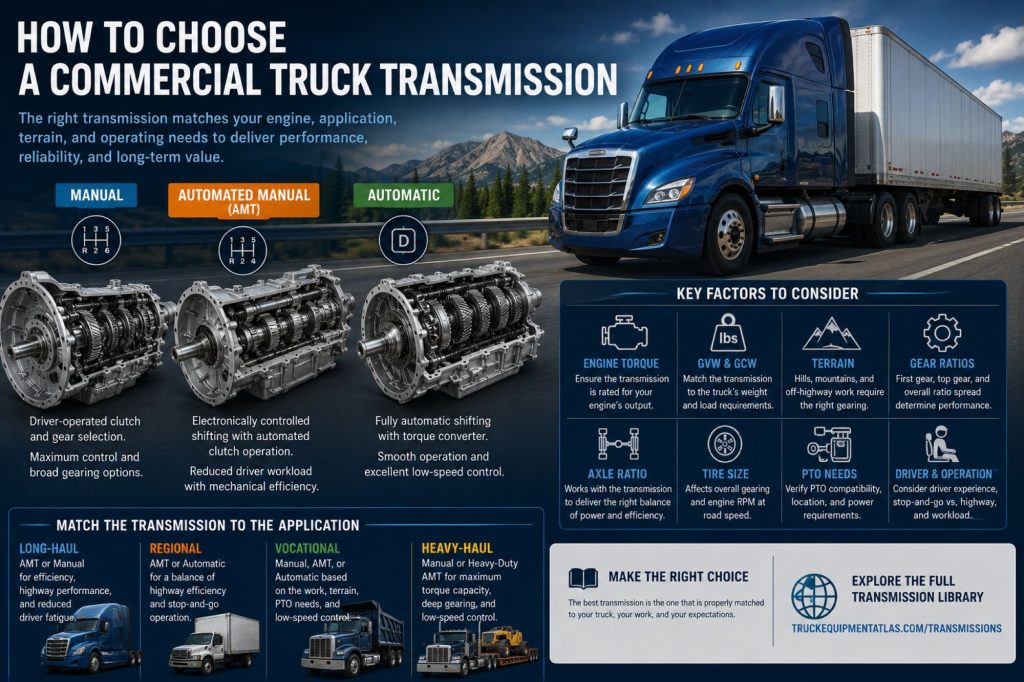
Choosing the right commercial truck transmission requires much more than deciding between a manual, automated manual, or automatic transmission.
The transmission must be matched to the engine, truck class, vehicle weight, trailer, freight, terrain, axle gearing, operating environment, and the work the truck is expected to perform.
A transmission that performs well in a long-haul highway tractor may be poorly suited to a dump truck, refuse vehicle, medium-duty delivery truck, logging truck, or heavy-haul tractor.
The goal is not simply to choose the transmission with the most gears or highest torque rating. The goal is to build a complete powertrain and drivetrain specification that works efficiently and reliably for the intended application.
This Truck Equipment Atlas guide explains the major factors to consider when selecting a commercial truck transmission.
Start With the Truck’s Application
The first question should be:
What will the truck actually do?
Transmission requirements vary dramatically between applications.
A truck operating primarily at highway speed has different requirements from one performing hundreds of stops each day.
Likewise, a heavy-haul tractor operating at extremely high gross combination weights requires different gearing from a medium-duty delivery truck.
Begin by identifying the truck’s primary application.
Common applications include:
- Long-haul
- Regional freight
- Local delivery
- Heavy haul
- Construction
- Dump operations
- Logging
- Refuse
- Utility work
- Municipal service
- Tow and recovery
- Agriculture
- Equipment transport
- Specialized vocational work
Once the application is clearly defined, transmission choices can be narrowed considerably.
Understand the Three Major Transmission Types
Commercial trucks generally use one of three major transmission technologies.
Manual Transmissions
Manual Transmissions require the driver to control gear selection and typically operate a clutch.
They can provide:
- Direct driver control
- Broad gearing options
- Deep reduction gearing
- High torque capability
- Specialized vocational configurations
- Proven heavy-haul capability
Manual transmissions remain important in heavy haul, construction, logging, and specialized operations.
Automated Manual Transmissions
Automated Manual Transmissions use a mechanically geared transmission architecture while automating clutch operation and gear selection.
They can provide:
- Reduced driver workload
- Automated shifting
- Consistent gear selection
- Engine and transmission integration
- Highway efficiency
- Application-specific programming
- Growing vocational capability
AMTs have become particularly important in modern long-haul and regional Class 8 tractors.
Automatic Transmissions
Automatic Transmissions automatically manage gear changes and commonly use torque-converter technology in commercial applications.
They can provide:
- Smooth vehicle launches
- Excellent low-speed control
- Reduced driver workload
- Strong stop-and-go performance
- Easy operation
- Effective vocational performance
Automatic transmissions are particularly important throughout medium-duty and vocational trucking.
For a detailed comparison, see Manual vs Automated Manual vs Automatic Transmissions.
Match the Transmission to the Engine
The engine and transmission must be compatible.
One of the most important specifications is engine torque.
Every transmission has limits governing how much input torque it is designed to handle.
The transmission must be rated appropriately for the engine.
Input torque capacity is only one approval check. Confirm the exact engine rating, permitted gross combination weight, duty cycle, input-speed limits, cooling package, clutch or converter specification, electronic integration, and any application-specific restrictions with the truck and transmission manufacturers. A family name or advertised maximum rating is not approval for every installation.
An engine producing more torque than the transmission is designed to handle can create durability and reliability problems.
Transmission selection should therefore consider:
- Engine manufacturer
- Engine model
- Peak torque
- Engine operating RPM range
- Engine brake
- Electronic integration
- Intended vehicle application
Modern integrated powertrains often pair specific engines and transmissions to optimize performance.
Examples include Detroit engines with the DT12, Volvo engines with I-Shift, Mack engines with mDRIVE, and PACCAR engines with PACCAR transmissions.
Consider Gross Vehicle Weight
Gross vehicle weight affects how much work the drivetrain must perform.
A lightly loaded commercial truck requires less mechanical advantage than a heavily loaded vehicle.
Transmission selection should consider the truck’s expected:
- Empty weight
- Normal operating weight
- Maximum gross vehicle weight
- Payload
A transmission should be selected for the truck’s actual working conditions rather than how it operates empty.
GVW and GCW describe actual vehicle and combination weight; GVWR and GCWR describe manufacturer ratings. Check axle, tire, truck, trailer, and transmission limits together. A transmission upgrade does not increase the vehicle’s certified ratings. Class 6 vs Class 7 vs Class 8 Trucks explains the vehicle-class context.
Consider Gross Combination Weight
For trucks pulling trailers, gross combination weight can be even more important.
A tractor pulling a standard freight trailer at normal highway weights has different requirements from a heavy-haul tractor moving oversized equipment.
Higher combination weights can require:
- Greater torque capacity
- Lower starting gears
- Broader ratio coverage
- Additional gears
- Better startability
- Improved gradeability
- Stronger drivetrain components
Heavy-haul transmission selection deserves particularly careful attention.
Think About the Trailer and Freight
The trailer and freight affect the load placed on the truck.
Consider whether the truck will pull:
- Dry vans
- Refrigerated trailers
- Flatbeds
- Step decks
- Lowboys
- RGNs
- Tank trailers
- Dump trailers
- Hopper trailers
- Specialized heavy-haul equipment
A truck hauling lightweight general freight has different drivetrain requirements from one moving construction equipment or oversized machinery.
Freight weight, trailer configuration, aerodynamic drag, and operating environment can all influence transmission selection.
Explore the Truck Equipment Atlas Trailer Library for additional information about commercial trailer configurations.
Evaluate the Terrain
Terrain plays a major role in transmission requirements.
A truck operating primarily across relatively flat highways may not need the same gearing as one regularly operating in mountainous regions.
Consider:
- Flat terrain
- Rolling hills
- Mountain grades
- Construction sites
- Forest roads
- Soft surfaces
- Off-highway conditions
Steep terrain can increase the importance of:
- Lower gearing
- Additional gear ratios
- Gradeability
- Engine braking
- Driver control
- Transmission programming
The truck should be specified for the most demanding conditions it will routinely encounter.
Understand Startability
Startability describes the truck’s ability to begin moving from a stop under load.
This becomes increasingly important as vehicle weight rises.
Startability depends on several factors working together:
- Engine torque
- Transmission first gear
- Axle ratio
- Tire size
- Vehicle weight
A deep first gear provides greater mechanical advantage.
This can be especially important in:
- Heavy haul
- Construction
- Logging
- Dump operations
- Severe service
- Off-highway applications
Choosing a transmission without considering first-gear ratio can result in a truck that struggles when starting heavy loads.
Understand Gradeability
Gradeability refers to the truck’s ability to climb a grade.
Transmission gearing allows the engine to remain within an effective operating range as road resistance increases.
A transmission with appropriate ratios can allow the truck to downshift and continue climbing while keeping the engine within its usable power band.
Gradeability depends on the complete drivetrain, including:
- Engine
- Transmission
- Axle ratio
- Tire size
- Vehicle weight
This is another reason transmission selection cannot be separated from the rest of the truck specification.
Consider the Number of Gears
More gears are not automatically better.
Commercial transmissions can include:
- 6 speeds
- 8 speeds
- 9 speeds
- 10 speeds
- 12 speeds
- 13 speeds
- 14 speeds
- 18 speeds
Additional ratios can provide smaller steps between gears and broader overall ratio coverage.
This can be valuable when:
- Moving extremely heavy loads
- Operating across steep terrain
- Maintaining engine RPM under changing conditions
- Performing specialized vocational work
A properly matched 12-speed transmission may suit a highway tractor better than an 18-speed chosen only for its higher gear count.
Application matters more than gear count.
Direct Drive vs Overdrive
Transmission top gear is another important consideration.
A direct-drive transmission generally provides a 1:1 relationship through the relevant transmission gearing in top gear.
An overdrive transmission allows the output to rotate faster relative to the input through the selected gear.
Overdrive can help reduce engine RPM during highway operation.
However, the transmission’s top gear cannot be evaluated independently.
It must be matched with:
- Axle ratio
- Tire size
- Engine operating range
- Highway speed
- Vehicle weight
- Terrain
A properly specified direct-drive powertrain can be more appropriate than an improperly matched overdrive system.
Axle Ratio Matters
The axle ratio works with the transmission to determine overall drivetrain gearing.
A numerically higher axle ratio generally provides greater mechanical advantage.
A numerically lower axle ratio generally reduces engine RPM at a given highway speed, assuming the other drivetrain variables remain unchanged.
For example, a truck designed for heavy vocational work may use different axle gearing from a long-haul tractor optimized for highway efficiency.
Transmission and axle ratios should therefore be selected together.
Consider Tire Size
Tire diameter affects the final relationship between drivetrain rotation and road speed.
Changing tire size can alter:
- Engine RPM at highway speed
- Effective gearing
- Startability
- Gradeability
- Vehicle speed characteristics
For this reason, tire size should be included when evaluating the complete drivetrain specification.
Use the tire manufacturer’s loaded revolutions-per-mile data, not only nominal diameter, when comparing cruise RPM. Check launch performance, sustained grade performance, and cruise engine speed at the expected load. How Commercial Truck Transmissions Work provides a worked overall-gearing example, and Commercial Truck Axle Ratios Explained explains how the final-drive ratio changes the result.
Long-Haul Transmission Selection
Long-haul trucks spend substantial time operating at highway speed.
Important priorities can include:
- Fuel efficiency
- Reduced driver workload
- Highway gearing
- Engine integration
- Reliability
- Service availability
- Grade performance
Modern AMTs are widely used in these applications.
Examples in the Truck Equipment Atlas library include:
Traditional manual transmissions remain common throughout the existing highway truck population as well.
Regional Transmission Selection
Regional trucks may combine highway operation with:
- Urban traffic
- Distribution centers
- Frequent stops
- Repeated acceleration
- Backing and maneuvering
- Changing terrain
An AMT can provide a useful balance between highway efficiency and reduced driver workload.
Automatic transmissions can also make sense when stop-and-go operation becomes a major part of the duty cycle.
Medium-Duty Transmission Selection
Medium-duty trucks often perform very different work from Class 8 tractors.
Applications include:
- Delivery
- Utility
- Towing
- Service
- Municipal work
- Construction
- Landscaping
- Local distribution
Automatic transmissions are particularly important in this market because of their smooth low-speed operation and simplified driver interface.
Compare real installations such as Allison 2000 Series and Ford TorqShift 10R140 against the truck’s engine, weight, and duty cycle. A model offered in one chassis is not automatically interchangeable with another.
Explore Medium-Duty Transmissions for additional platforms.
Vocational Transmission Selection
Vocational trucks require transmission specifications built around the work being performed.
Applications can include:
- Dump trucks
- Concrete trucks
- Refuse vehicles
- Utility trucks
- Logging trucks
- Tow trucks
- Construction equipment
- Municipal vehicles
Important considerations can include:
- Low-speed control
- PTO capability
- Deep reduction gearing
- Reverse gearing
- Frequent starts
- Off-highway operation
- Cooling
- High operating hours
Explore Vocational Transmissions for transmission platforms designed for demanding work applications.
Heavy-Haul Transmission Selection
Heavy haul can place some of the greatest demands on a commercial drivetrain.
Important factors include:
- Gross combination weight
- Engine torque
- First gear ratio
- Overall ratio spread
- Number of gears
- Axle ratio
- Tire size
- Terrain
- Gradeability
- Startability
- Low-speed control
Traditional 18-speed manuals remain important in heavy haul because of their broad gearing and direct driver control.
The Eaton Fuller 18-Speed Manual is one manual example to evaluate alongside approved automated platforms. Compare first gear, reverse gearing, overall ratio spread, launch durability, and manufacturer application limits rather than assuming every 18-speed has equivalent capability.
Modern heavy-duty AMTs are also expanding into these applications.
Examples include:
- Eaton Cummins Endurant XD
- Eaton Cummins Endurant XD Pro
- PACCAR TX-18
- PACCAR TX-18 Pro
- Mack mDRIVE HD
Explore Heavy-Duty Transmissions for additional information.
PTO Requirements
Many vocational trucks require a power take-off.
A PTO can provide power for:
- Dump bodies
- Hydraulic pumps
- Cranes
- Tow equipment
- Refuse systems
- Aerial lifts
- Concrete equipment
- Vacuum equipment
- Utility systems
Not every transmission provides the same PTO capability.
Before selecting a transmission, determine:
- Whether a PTO is required
- Required PTO location
- Required power
- Operating speed
- Stationary or mobile operation
- Hydraulic system requirements
Transmission and PTO compatibility should be confirmed before the truck is ordered or modified.
Specify required PTO torque, horsepower, speed ratio, rotation, mounting position, duty cycle, and stationary or mobile operation. Confirm engagement rules and whether output is available during shifts. Have the chassis, transmission, PTO, and body-equipment suppliers approve the complete arrangement.
Learn more in PTO System Explained.
Consider Low-Speed Operation
Some trucks spend significant portions of their working lives at very low speeds.
Examples include:
- Refuse trucks
- Construction vehicles
- Concrete trucks
- Utility equipment
- Tow trucks
- Heavy-haul equipment
- Municipal vehicles
Torque-converter automatics can provide excellent low-speed characteristics.
Manual transmissions can provide precise control through deep reduction gearing.
AMTs can use specialized clutch controls and operating modes.
The best technology depends on the application.
Consider Stop-and-Go Operation
Frequent stopping changes transmission priorities.
A long-haul tractor may travel hundreds of miles between significant stops.
A refuse or delivery truck may stop hundreds of times during a shift.
Frequent stop-and-go operation can increase the importance of:
- Smooth launches
- Reduced driver workload
- Transmission cooling
- Clutch durability
- Low-speed control
- Shift consistency
Automatic transmissions are particularly strong in many of these applications.
Consider Driver Experience
Driver availability can influence transmission selection.
Traditional manuals require drivers who understand:
- Clutch operation
- Gear selection
- Engine RPM
- Downshifting
- Range and splitter systems
- Grade management
AMTs and automatic transmissions reduce these training requirements.
For fleets with many drivers or frequent driver turnover, simplified operation can be an important consideration.
Owner-operators and specialized fleets may place greater value on direct driver control.
Consider Driver Fatigue
Transmission choice can affect workload throughout a driving shift.
Repeated manual shifting in urban traffic or stop-and-go operation can increase physical workload.
AMTs and automatics reduce routine shifting requirements.
For long-haul fleets, this can help simplify vehicle operation.
For vocational fleets, eliminating repeated clutch operation can be particularly valuable.
Consider Maintenance Requirements
Different transmission technologies have different maintenance needs.
Manual
Common maintenance areas include:
- Gear lubricant
- Clutch
- Clutch adjustment
- Shift linkage
- Range and splitter systems
AMT
Common maintenance areas include:
- Transmission lubricant
- Clutch
- Clutch actuator
- Shift actuators
- Sensors
- Wiring
- Software and calibration
Automatic
Common maintenance areas include:
- Transmission fluid
- Filters
- Cooling system
- Torque converter
- Electronic controls
Maintenance requirements should be considered alongside purchase price.
Consider Service Availability
A transmission is only useful if it can be maintained and repaired.
Before selecting a platform, consider:
- Dealer network
- Independent repair availability
- Parts availability
- Technician familiarity
- Diagnostic equipment
- Remanufactured transmission availability
- Replacement cost
This can be particularly important for trucks operating far from major fleet maintenance facilities.
New vs Used Truck Considerations
Transmission selection differs when purchasing a new truck versus evaluating a used truck.
With a new truck, the buyer can often specify the powertrain around the intended application.
With a used truck, the buyer must determine whether the existing transmission and drivetrain are appropriate.
When evaluating a used truck, identify:
- Exact transmission model
- Engine
- Axle ratio
- Tire size
- Vehicle application history
- Maintenance records
- Clutch history where applicable
- Transmission fluid condition
- Electronic fault history
- Current shift quality
Do not assume that a truck is properly specified simply because the transmission is physically installed in it.
Questions to Ask Before Choosing
Before making a transmission decision, answer these questions:
- What job will the truck perform?
- What engine will it use?
- How much torque does the engine produce?
- What will the truck normally weigh?
- What is the maximum expected combination weight?
- What trailer will it pull?
- What freight will it carry?
- What terrain will it encounter?
- How much highway operation will it perform?
- How much stop-and-go driving will it perform?
- Does it need PTO capability?
- Does it need specialized low gearing?
- Will it operate off-highway?
- Who will drive it?
- Who will maintain it?
- Is local service available?
These answers can narrow the transmission choices considerably.
A Simple Selection Framework
A useful way to approach transmission selection is:
Step 1: Define the Job
Determine exactly what the truck will do.
Step 2: Determine Weight
Establish expected GVW and GCW.
Step 3: Select the Engine
Know the engine’s torque and operating characteristics.
Step 4: Choose Transmission Technology
Decide whether manual, AMT, or automatic best fits the operation.
Step 5: Evaluate Gear Ratios
Review first gear, top gear, overall ratio spread, and number of ratios.
Step 6: Match the Axles
Choose axle gearing that works with the transmission and engine.
Step 7: Check Tires
Include tire size in the drivetrain calculation.
Step 8: Verify Application Requirements
Confirm PTO, heavy-haul, vocational, terrain, and low-speed requirements.
Step 9: Consider the Driver
Evaluate training, workload, and driver availability.
Step 10: Consider Ownership
Evaluate maintenance, service availability, parts, and long-term operating requirements.
The transmission should be selected as part of the complete truck rather than as an isolated component.
Explore Commercial Transmission Types
Truck Equipment Atlas organizes its Transmission Library by both technology and application.
By Transmission Type
By Application
Validate the Specification Before Purchase
Ask the supplying dealer or application engineer for a written match to the intended engine, working weight, route, trailer, PTO equipment, and tire size. Request startability and gradeability calculations using stated assumptions, then assess shift behavior, reverse control, and cooling under representative working conditions.
For a used truck, have a qualified technician confirm the transmission identification, service and fault history, clutch or converter condition, and any changes to engine calibration, axle ratios, or tires. Compare service access, downtime, fuel use, and expected maintenance as well as purchase price.
Continue Learning and Compare Models
- How Commercial Truck Transmissions Work — gear ratios, power flow, clutch and converter operation.
- Manual vs Automated Manual vs Automatic Transmissions — practical differences between the three technologies.
- How to Choose the Right Commercial Truck — fit the powertrain into the complete vehicle specification.
- Commercial Truck Transmission Library — browse individual models and the six transmission categories.
- Transmission Guides — return to the transmission learning hub.
Manufacturer Technical References
Use current model-specific instructions and application approvals for operation, maintenance, and truck specification. These manufacturer resources provide supporting technical context.
- Eaton commercial vehicle transmission guide
- Eaton AutoShift driver instructions
- Cummins PowerSpec application and gearing manual
Final Thoughts
The right transmission fits the complete job. Match the engine and approved weight ratings, verify launch and grade performance, account for tires and axle gearing, and check PTO, cooling, driver, and service requirements. Choose a documented application match rather than a gear count or transmission label alone.