
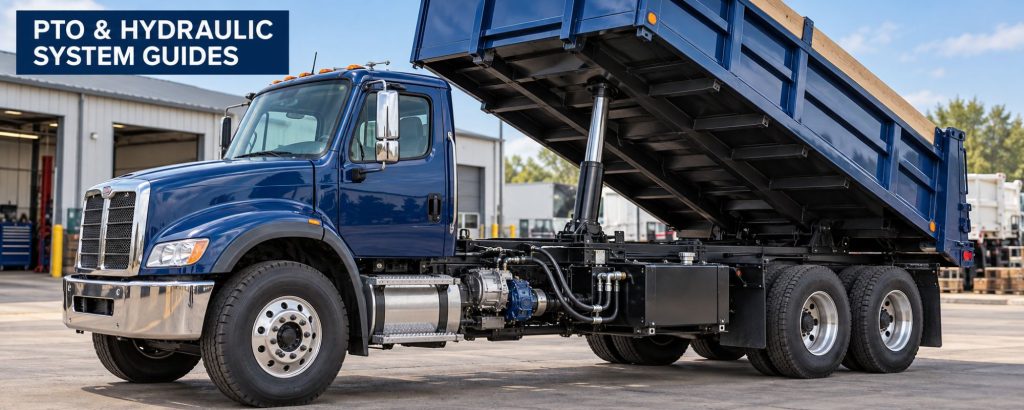
Commercial truck power take-off and hydraulic systems transfer engine or transmission power to the equipment that allows vocational trucks and trailers to perform specialized work.
The Truck Equipment Atlas PTO & Hydraulic System Guides section provides educational resources designed to help drivers, owner-operators, fleet managers, technicians, equipment buyers, body builders, students, and trucking enthusiasts understand how PTOs, pumps, reservoirs, cylinders, valves, hoses, wet kits, and hydraulic controls work together.
These guides complement the individual equipment profiles available throughout the Truck Equipment Atlas PTO & Hydraulic Systems Library by focusing on system operation, equipment selection, installation considerations, inspection, maintenance, and common application requirements.
Explore PTO & Hydraulic System Guides
How Commercial Truck PTO and Hydraulic Systems Work
Learn how a commercial truck transfers mechanical power from its engine or transmission to hydraulic equipment used to perform specialized work.
This guide explains important PTO and hydraulic-system concepts, including:
- Engine and transmission power flow
- Power take-off operation
- Hydraulic pump operation
- Hydraulic fluid circulation
- Reservoirs and filtration
- Control valves
- Hydraulic cylinders and motors
- Pressure and flow
- Open-center and closed-center systems
- Return lines and heat management
This is the best starting point for readers who want to understand how the complete PTO and hydraulic system operates.
Commercial Truck Power Take-Off Types Explained
Commercial trucks use several types of power take-offs, and each design provides different mounting, speed, torque, control, and application characteristics.
This guide covers:
- Transmission-mounted PTOs
- Engine-driven PTO systems
- Split-shaft PTOs
- Side-mount and rear-mount PTOs
- Mechanical-shift PTOs
- Air-shift PTOs
- Electric-over-air controls
- Hot-shift and constant-mesh designs
- PTO speed ratios
- Torque and horsepower ratings
- Transmission compatibility
- Common vocational applications
The guide helps readers understand why a PTO must be matched to the transmission, hydraulic pump, operating speed, torque requirement, and equipment application.
How to Choose a PTO and Hydraulic Pump
Selecting a PTO and hydraulic pump requires more than choosing components that physically fit the truck.
The complete vehicle, transmission, hydraulic circuit, operating environment, and powered equipment must be considered.
This guide examines selection factors including:
- Transmission make and model
- PTO opening and mounting position
- Required PTO speed ratio
- Torque and horsepower requirements
- Hydraulic pump type
- Required flow rate
- System operating pressure
- Pump rotation
- Direct-mount and remote-mount configurations
- Continuous and intermittent operation
- Vehicle clearance
- Hydraulic reservoir capacity
- Duty cycle and heat generation
- Control-system requirements
The goal is to help readers understand how a PTO and pump should be matched to the work the truck is expected to perform.
Commercial Truck Wet Kits Explained
A commercial truck wet kit combines the hydraulic components needed to supply and control fluid power for a trailer or truck-mounted body.
This guide explains:
- Single-line wet kits
- Two-line wet kits
- Three-line wet kits
- Dump-trailer wet kits
- Walking-floor wet kits
- Lowboy and detachable-gooseneck systems
- Hydraulic reservoir selection
- Pump and valve configurations
- Pressure and return lines
- Filters and strainers
- Quick-connect couplers
- Hydraulic fluid requirements
- Heat control and system protection
The guide also explains why the wet kit must be configured for the specific trailer, body, pump, hydraulic circuit, and intended duty cycle.
How to Inspect and Maintain Truck Hydraulic Systems
Routine inspection and maintenance help protect hydraulic components, reduce fluid loss, control heat, prevent contamination, and identify problems before equipment failure occurs.
This guide covers inspection and maintenance areas including:
- Hydraulic fluid level and condition
- Reservoir condition
- Hoses and tubing
- Fittings and connections
- Pumps and hydraulic motors
- Cylinders and seals
- Control valves
- Filters and breathers
- PTO mounting and fasteners
- Hydraulic leaks
- Fluid contamination
- Excessive system temperature
- Unusual pump noise
- Slow or erratic equipment movement
The guide is intended as an educational overview and does not replace the inspection, maintenance, and safety procedures provided by the equipment manufacturer.
Explore the PTO & Hydraulic Systems Library
Readers looking for information about specific PTOs, hydraulic pumps, cylinders, wet kits, valves, controls, reservoirs, hoses, fittings, and filtration products can explore the Truck Equipment Atlas PTO & Hydraulic Systems Library.
The library includes individual equipment profiles covering products from manufacturers and hydraulic-equipment suppliers including:
- Bezares
- Custom Hoists
- Hyva
- Mailhot
- Muncie Power Products
- Parker Chelsea
- Parker Hannifin
- Permco
Individual product profiles provide deeper information about component design, specifications, applications, operating characteristics, installation requirements, compatibility, maintenance considerations, and equipment identification.
Explore PTO and Hydraulic Equipment by Type
Truck Equipment Atlas organizes PTO and hydraulic equipment according to system function and component type.
Power Take-Off Systems
Explore transmission-mounted, engine-driven, mechanically controlled, air-shifted, and electronically controlled PTO systems used to power commercial truck equipment.
Hydraulic Pumps & Motors
Explore gear pumps, piston pumps, vane pumps, dump pumps, tandem pumps, and hydraulic motors used throughout vocational truck and trailer applications.
Wet Kits & Complete Hydraulic Systems
Explore complete hydraulic packages that combine PTOs, pumps, reservoirs, valves, hoses, fittings, filters, and controls for specific truck and trailer applications.
Hydraulic Cylinders & Dump Hoists
Explore telescopic cylinders, underbody hoists, front-mounted cylinders, and lifting systems used to raise dump bodies, trailers, platforms, and vocational equipment.
Hydraulic Valves, Controls & Reservoirs
Explore valves, control systems, tanks, reservoirs, air controls, electronic controls, and related equipment used to manage hydraulic-system operation.
Hydraulic Hoses, Fittings & Filtration
Explore the hoses, tubing, fittings, quick-connect couplers, filters, breathers, and related components that carry hydraulic fluid and help protect the system from contamination.
Explore PTO and Hydraulic Systems by Application
PTO and hydraulic-system requirements vary according to the truck, trailer, equipment function, hydraulic demand, operating environment, and duty cycle.
Dump Trucks and Dump Trailers
Dump applications use PTO-driven pumps, reservoirs, control valves, hoses, and hydraulic cylinders to raise and lower bodies or trailer hoists.
Refuse and Recycling Vehicles
Refuse vehicles rely on hydraulic systems to operate compactors, packer bodies, container-handling equipment, lifting arms, tailgates, and other work functions.
Tow Trucks and Recovery Vehicles
Towing and recovery equipment uses hydraulic power for wheel lifts, booms, winches, outriggers, carriers, stabilizers, and other recovery functions.
Utility, Crane, and Service Trucks
Utility and service vehicles use hydraulic systems to operate cranes, aerial devices, outriggers, tools, compressors, lifts, and specialized equipment.
Lowboys and Specialized Trailers
Lowboy, detachable-gooseneck, and specialized trailers may use tractor wet kits or self-contained hydraulic systems to operate goosenecks, ramps, steering systems, suspensions, and loading equipment.
Why PTO and Hydraulic System Selection Matters
A properly matched PTO and hydraulic system affects much more than whether the equipment operates.
System design and component selection can influence:
- Hydraulic flow
- Operating pressure
- Equipment speed
- Lifting capacity
- PTO and pump life
- Hydraulic-fluid temperature
- Fuel consumption
- Noise levels
- Driver control
- Equipment productivity
- Maintenance requirements
- Vehicle safety
A system configured for an end-dump trailer may not be appropriate for a walking-floor trailer, refuse body, recovery vehicle, crane, or continuous-duty hydraulic application.
Understanding these differences is an important part of selecting and maintaining commercial truck equipment.
Understanding the Complete PTO and Hydraulic System
A power take-off, hydraulic pump, or cylinder does not operate independently.
The complete system may include:
- Engine
- Transmission
- Power take-off
- Pump driveshaft or direct-mount connection
- Hydraulic pump
- Reservoir
- Control valves
- Pressure-relief valve
- Hydraulic cylinders or motors
- Hoses and fittings
- Filters and breathers
- Air or electronic controls
- Powered truck body or trailer equipment
The way these components are matched can significantly affect system performance, reliability, heat generation, and service life.
Engine speed, transmission gearing, PTO ratio, pump displacement, hydraulic flow, pressure, reservoir capacity, hose size, filtration, and duty cycle must all be considered when evaluating a commercial truck hydraulic system.
Readers can also explore the Truck Equipment Atlas Transmission Library and Equipment Systems section to understand how PTO and hydraulic equipment integrates with the complete vehicle.
PTO and Hydraulic Technology Continues to Evolve
Commercial truck PTO and hydraulic technology continues to change as manufacturers develop lighter components, more efficient pumps, improved sealing systems, electronic controls, variable-displacement designs, remote monitoring, and integrated safety functions.
Modern electronic controls can coordinate PTO engagement, engine speed, transmission status, hydraulic pressure, equipment interlocks, and body operation. These systems can help protect equipment and prevent operation under unsafe conditions.
Electric and electrohydraulic systems are also becoming more important in applications that require reduced idling, precise control, quieter operation, or integration with alternative-power commercial vehicles.
Truck Equipment Atlas will continue documenting these technologies as the PTO & Hydraulic Systems Library expands.
Additional PTO and Hydraulic Guides Coming
The PTO & Hydraulic System Guides library will continue growing beyond the initial guides.
Future topics may include:
- PTO Speed Ratios and Torque Ratings Explained
- Hydraulic Flow vs Pressure Explained
- Single-Line vs Two-Line vs Three-Line Wet Kits
- Direct-Mount vs Remote-Mount Hydraulic Pumps
- How to Choose a Hydraulic Reservoir
- Commercial Truck Hydraulic Fluid and Filtration Guide
- Common Truck Hydraulic System Problems
- PTO and Transmission Compatibility
These future resources will provide deeper coverage of commercial truck power take-off and hydraulic technology while supporting the growing collection of individual equipment profiles throughout Truck Equipment Atlas.
Explore More Truck Equipment Guides
PTO & Hydraulic System Guides are part of the larger Truck Equipment Atlas Guides Library.
Readers can also explore:
- Truck Guides
- Trailer Guides
- Engine Guides
- Transmission Guides
- Axle and Differential Guides
- Suspension System Guides
- Brake System Guides
- Fifth Wheel & Coupling Equipment Guides
- Tire & Wheel Guides
- Equipment System Guides
Truck Equipment Atlas will continue expanding these resources as new equipment categories, individual product profiles, and educational content are added to the site.
About Truck Equipment Atlas
Truck Equipment Atlas is an educational reference dedicated to commercial trucking equipment and the systems that keep freight moving throughout North America.
Our goal is to build an organized resource where readers can explore commercial trucks, trailers, engines, transmissions, axles, suspension systems, brake systems, tires, wheels, fifth wheels, PTO and hydraulic systems, manufacturers, freight sectors, and educational guides from one interconnected platform.
New PTO profiles, hydraulic-equipment pages, system guides, and educational resources will continue to be added as Truck Equipment Atlas grows.