
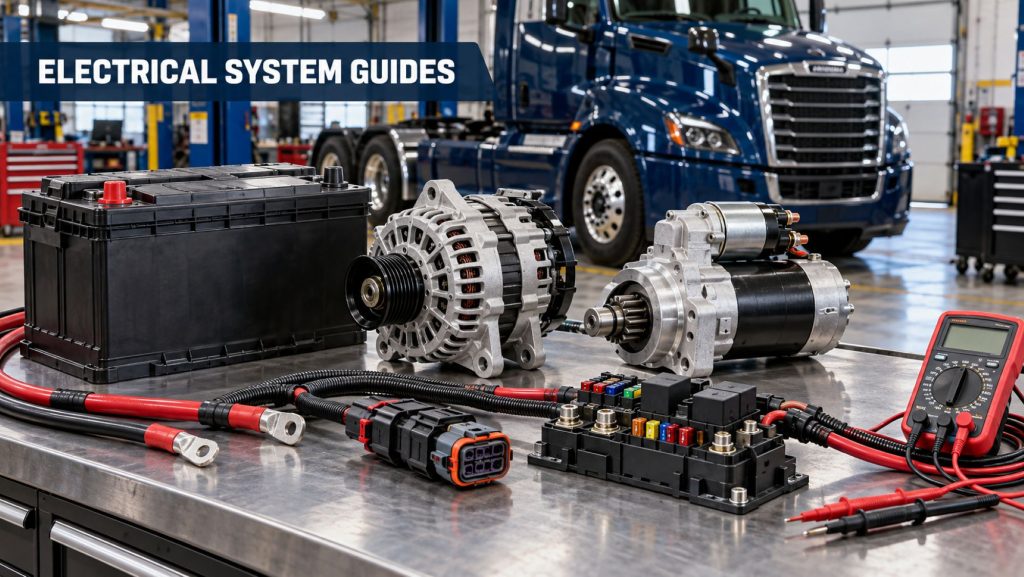
The Truck Equipment Atlas Electrical System Guides provide educational resources covering the electrical equipment used to start, charge, power, illuminate, monitor, and control commercial trucks and trailers.
These guides explain batteries, alternators, starters, wiring, connectors, power distribution, lighting, inverters, converters, auxiliary power equipment, diagnostic procedures, electrical safety, and system-maintenance practices.
The goal is to help drivers, owner-operators, technicians, fleet managers, students, equipment buyers, and other trucking professionals understand how commercial-vehicle electrical systems operate and how individual components work together.
Electrical System Guides on Truck Equipment Atlas
Explore the commercial truck and trailer electrical guides being added to Truck Equipment Atlas:
How Commercial Truck Electrical Systems Work
Learn how batteries, alternators, starters, wiring, grounds, circuit protection, control modules, lighting, and auxiliary power equipment work together within a commercial vehicle’s electrical system.
Commercial Truck Batteries Explained
Understand commercial battery construction, voltage, capacity, cold-cranking performance, battery groups, flooded and absorbed glass mat designs, auxiliary batteries, testing, charging, maintenance, and replacement considerations.
Commercial Truck Alternators and Charging Systems Explained
Explore how alternators generate electrical power, maintain battery charge, support vehicle loads, regulate system voltage, and interact with batteries, wiring, engine controls, and modern energy-management systems.
Commercial Truck Starters and Starting Systems Explained
Learn how starter motors, solenoids, relays, batteries, cables, switches, interlocks, and engine controls work together to crank and start a commercial diesel engine.
How to Inspect and Maintain Truck Wiring and Electrical Connections
Learn how to inspect harnesses, terminals, connectors, grounds, circuit protection, junction boxes, tractor-to-trailer connections, and other electrical components for corrosion, heat, damage, looseness, and voltage loss.
Commercial Truck and Trailer Lighting Systems Explained
Understand commercial headlamps, stop-turn-tail lamps, clearance and marker lights, identification lamps, work lights, trailer lighting, LED technologies, wiring connections, inspection practices, and common lighting problems.
Additional guides covering inverters, converters, auxiliary electrical power, multiplex systems, electrical diagnostics, battery testing, voltage-drop testing, idle-reduction equipment, and emerging commercial-vehicle electrical technologies will be added as the library expands.
What Commercial Vehicle Electrical Systems Do
Commercial-vehicle electrical systems perform several essential functions throughout a truck or trailer.
- Crank and start the engine
- Generate and regulate electrical power
- Store electrical energy
- Distribute power to vehicle circuits
- Operate exterior and interior lighting
- Power engine and transmission controls
- Support braking and safety electronics
- Operate sleeper-cab appliances and accessories
- Power liftgates and trailer equipment
- Supply telematics and communication equipment
- Monitor vehicle and trailer conditions
- Protect circuits from overloads and short circuits
A problem in one electrical component can affect several vehicle systems. For example, weak batteries, excessive voltage drop, poor grounding, or insufficient charging output can create starting problems, lighting faults, electronic warnings, and unreliable accessory operation.
Major Electrical System Areas
Commercial truck and trailer electrical equipment can be organized into several major areas:
Commercial Truck Batteries & Energy Storage
Batteries store electrical energy for engine starting, vehicle electronics, sleeper accessories, emergency loads, liftgates, and auxiliary equipment. Battery type, capacity, condition, charging history, temperature, and connections all affect performance.
Alternators & Charging Systems
Alternators generate electrical power while the engine operates. Charging systems support active vehicle loads, recharge batteries, regulate voltage, and help maintain dependable electrical operation.
Starters & Starting Systems
Starting systems use stored battery energy to operate the starter motor and crank the engine. Their performance depends on batteries, cables, terminals, grounds, solenoids, relays, controls, and mechanical engine condition.
Wiring, Connectors & Power Distribution
Wiring harnesses, connectors, grounds, junction boxes, fuses, circuit breakers, relays, switches, and control modules distribute and protect electrical power throughout trucks and trailers.
Truck & Trailer Lighting Systems
Commercial lighting systems provide roadway illumination, vehicle identification, position marking, braking signals, turn indications, warning visibility, and work-area lighting.
Inverters, Converters & Auxiliary Electrical Power
Auxiliary power equipment converts, stores, controls, and distributes energy for sleeper appliances, tools, liftgates, refrigeration equipment, service bodies, communication systems, and engine-off electrical loads.
Why Electrical System Knowledge Matters
Commercial vehicles depend on electrical power for far more than engine starting and lighting. Modern trucks and trailers use electronic controls, sensors, communication networks, safety technologies, emissions equipment, automated transmissions, braking systems, telematics, and driver-assistance equipment.
Understanding electrical fundamentals can help drivers and fleets:
- Recognize developing electrical problems
- Reduce unexpected no-start events
- Identify battery and charging-system problems
- Prevent repeated component replacement
- Improve lighting reliability
- Protect wiring and electronic equipment
- Select compatible replacement components
- Manage auxiliary electrical loads
- Reduce vehicle downtime
- Communicate more effectively with technicians
Electrical diagnosis should be based on testing rather than appearance alone. A battery, alternator, starter, lamp, control module, or other component may be blamed for a failure that is actually caused by resistance, poor grounding, damaged wiring, insufficient charging, or an excessive electrical load.
Understanding Voltage, Current, and Resistance
Voltage represents electrical potential, current describes the flow of electrical charge, and resistance restricts that flow. These measurements are closely related and are fundamental to diagnosing commercial-vehicle electrical systems.
A circuit may show normal voltage when it is unloaded but fail when a high-current component operates. For that reason, technicians commonly evaluate voltage while the circuit is working and perform voltage-drop tests across cables, terminals, switches, connections, and grounding paths.
Understanding how electrical demand changes under load is particularly important when testing starter circuits, alternator output, auxiliary battery charging, inverters, lighting circuits, liftgates, and trailer electrical connections.
Truck and Trailer Electrical Integration
A tractor and trailer operate as separate electrical systems connected through electrical cables, plugs, receptacles, and communication circuits. The tractor normally supplies power and control signals for required trailer lighting, braking electronics, and other approved functions.
Trailers may also contain independent batteries, liftgate charging equipment, refrigeration systems, tire-monitoring devices, telematics, interior lighting, cargo sensors, and auxiliary electrical systems.
A failure affecting the trailer may originate in the tractor, electrical cable, plug, receptacle, junction box, trailer harness, grounding system, control module, or powered component. Diagnosis should follow the complete circuit rather than focus on only one side of the connection.
Electrical Inspection and Preventive Maintenance
Routine inspection can identify electrical problems before they cause a roadside failure, no-start condition, lighting violation, damaged component, or vehicle fire.
Important inspection areas include:
- Battery cases, terminals, hold-downs, and cables
- Alternator mounting, drive belt, wiring, and output connections
- Starter cables, solenoids, relays, and grounding paths
- Wiring harness routing and support
- Connectors, terminals, seals, and locking tabs
- Fuses, circuit breakers, relays, and junction boxes
- Truck and trailer lighting
- Tractor-to-trailer electrical cables and receptacles
- Inverters, converters, chargers, and auxiliary batteries
- Signs of corrosion, heat, abrasion, looseness, or water intrusion
Preventive maintenance should follow the vehicle, component, and fleet requirements for the exact equipment being inspected.
Common Commercial Vehicle Electrical Problems
- Engine cranks slowly or will not crank
- Batteries repeatedly discharge
- Alternator does not maintain system voltage
- Starter operates intermittently
- Lights are dim, intermittent, or inoperative
- Fuses repeatedly open
- Circuit breakers repeatedly trip
- Connectors or terminals overheat
- Electronic modules lose communication
- Trailer electrical functions operate incorrectly
- Auxiliary batteries fail to charge
- Inverters shut down under load
- Parasitic loads discharge batteries while parked
- Corrosion creates excessive resistance
Repeated failure usually indicates that the underlying cause has not been corrected. Replacing a damaged component without checking circuit load, voltage drop, grounding, charging output, mounting, heat, and environmental exposure can allow the problem to return.
Using the Electrical System Guides
Each guide focuses on a specific electrical-system subject while connecting it to the complete vehicle. Readers can begin with the general electrical-system overview and then explore batteries, alternators, starters, wiring, lighting, auxiliary power, inspection, maintenance, and diagnostic topics.
These guides are intended to provide educational information. They do not replace manufacturer service information, electrical diagrams, diagnostic procedures, technician training, fleet policies, or applicable safety requirements.
Vehicle-specific specifications, test points, torque values, conductor sizes, circuit protection, programming procedures, and replacement requirements should always be verified using information for the exact truck, trailer, engine, component, and electrical configuration.
Related Electrical System Categories
- Commercial Truck Batteries & Energy Storage
- Alternators & Charging Systems
- Starters & Starting Systems
- Wiring, Connectors & Power Distribution
- Truck & Trailer Lighting Systems
- Inverters, Converters & Auxiliary Electrical Power
Related Equipment System Guides
- Engine Guides
- Transmission Guides
- Axle and Differential Guides
- Suspension System Guides
- Brake System Guides
- Fifth Wheel & Coupling Equipment Guides
- Tire & Wheel Guides
- PTO & Hydraulic System Guides
- Driveline & Steering System Guides
- Equipment System Guides
Related Truck and Equipment Resources
- Electrical Systems
- Equipment Systems
- Commercial Trucks
- Commercial Trailers
- Engines
- Transmissions
- Brake Systems
- Telematics & ELD Systems
- Safety Systems
Electrical System Guide Library Expansion
Truck Equipment Atlas will continue expanding its electrical guide library as additional components, diagnostic methods, charging technologies, power-management systems, and commercial-vehicle applications are added.
Future guide topics may include:
- How to perform commercial-vehicle voltage-drop testing
- Flooded vs AGM vs lithium commercial batteries
- How to diagnose parasitic battery drain
- Commercial truck inverter and auxiliary power systems explained
- Truck and trailer electrical connectors explained
- Commercial-vehicle multiplex electrical systems
- How to select a heavy-duty alternator
- How to test commercial-truck batteries
- Commercial truck electrical safety
- Electric and hybrid commercial-vehicle systems
The goal is to develop a practical educational resource that connects electrical theory with real commercial trucks, trailers, components, maintenance decisions, and operating conditions.
Explore the Complete Electrical Systems Library
Visit the Electrical Systems hub to explore commercial batteries, alternators, charging systems, starters, wiring, connectors, power-distribution equipment, truck and trailer lighting, inverters, converters, auxiliary electrical equipment, product profiles, and educational guides.
Follow the Growth of Truck Equipment Atlas
Truck Equipment Atlas continues to expand with new truck profiles, trailer coverage, diesel engine pages, equipment-system resources, manufacturer information, and educational guides.
Visit our Truck Equipment Atlas Site Updates page to explore recent additions, project milestones, and upcoming resources.