
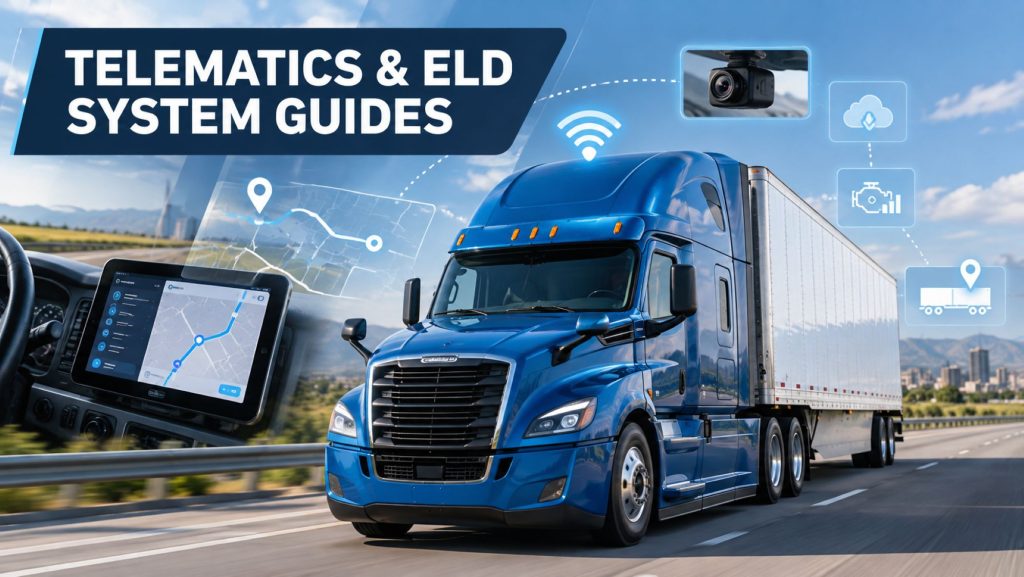
Commercial truck telematics systems connect vehicles, drivers, trailers, equipment, dispatchers, maintenance departments, safety teams, and fleet managers through onboard hardware, wireless communication, and cloud-based software.
Electronic logging devices record driver-duty information and vehicle activity to support hours-of-service compliance. Broader telematics platforms can provide GPS tracking, vehicle diagnostics, driver communication, camera integration, trailer monitoring, fuel analysis, maintenance alerts, safety information, and fleet-performance reporting.
The Truck Equipment Atlas Telematics & ELD System Guides explain how these systems work, examine their major components and capabilities, outline important compliance and installation considerations, and help fleets compare different connected-vehicle technologies.
These guides are designed for commercial drivers, owner-operators, fleet managers, safety directors, maintenance personnel, dispatchers, equipment buyers, CDL students, and anyone who wants to better understand connected commercial-vehicle systems.
Explore Telematics & ELD System Guides
How Commercial Truck Telematics Systems Work
Learn how commercial-truck telematics hardware collects, transmits, processes, and displays vehicle and fleet information.
This guide explains vehicle gateways, GPS receivers, cellular communication, diagnostic connections, cloud platforms, driver interfaces, sensors, fleet dashboards, reporting tools, software integrations, and the movement of information between vehicles and fleet operations.
Electronic Logging Devices and Hours-of-Service Compliance Explained
Understand how electronic logging devices record driver-duty activity and support commercial-driver hours-of-service compliance.
This guide covers engine synchronization, records of duty status, driver logins, duty-status changes, unidentified driving events, personal conveyance, yard moves, log certification, roadside data transfer, supporting documents, malfunctions, data-diagnostic events, and driver and carrier responsibilities.
How to Choose a Commercial Truck ELD and Telematics System
Review the major factors involved in selecting an ELD and telematics platform for a commercial fleet.
This guide examines vehicle compatibility, compliance requirements, GPS tracking, driver communication, camera integration, diagnostic capabilities, trailer tracking, workflow tools, software integrations, hardware installation, subscription costs, data ownership, cybersecurity, training, and technical support.
GPS Fleet Tracking and Vehicle Telematics Explained
Learn how GPS tracking and vehicle telematics provide fleets with location, movement, utilization, and operating information.
This guide covers GPS positioning, cellular communication, location-reporting intervals, route history, geofences, vehicle utilization, dispatch support, fuel and idle-time analysis, driver-performance information, vehicle diagnostics, alerts, and fleet-management reporting.
AI Dash Cameras and Video Telematics Explained
Understand how commercial-truck dash cameras combine video, GPS information, vehicle data, and artificial-intelligence event detection.
This guide explains road-facing and dual-facing cameras, event recording, continuous recording, in-cab alerts, collision documentation, driver coaching, video retrieval, live viewing, privacy considerations, storage, multi-camera systems, installation, calibration, and system limitations.
Commercial Trailer and Asset Tracking Systems Explained
Learn how fleets use GPS trackers, gateways, sensors, and connected software to monitor trailers and mobile equipment.
This guide covers powered and unpowered tracking devices, battery and solar-powered systems, location reporting, geofences, utilization, dwell time, unauthorized movement, cargo monitoring, door sensors, environmental sensors, tire and brake integrations, installation, and equipment compatibility.
What These Guides Cover
The Telematics & ELD System Guides provide educational information about connected commercial-vehicle hardware, software, communication networks, compliance systems, installation requirements, operating capabilities, maintenance needs, data management, and equipment-selection considerations.
Topics include:
- Commercial-truck telematics operation
- Electronic logging devices
- Hours-of-service compliance
- Vehicle gateways and telematics control units
- GPS fleet tracking
- Cellular and wireless communication
- Vehicle diagnostic connections
- Driver communication and workflow systems
- AI dash cameras and video telematics
- Trailer and asset tracking
- Remote vehicle diagnostics
- Predictive and preventive maintenance
- Fuel and idle-time analysis
- Driver-performance monitoring
- Fleet dashboards and reports
- Transportation-management system integration
- Data ownership and cybersecurity
- Hardware installation and maintenance
- System and vehicle compatibility
How Commercial Truck Telematics Systems Work
A commercial-truck telematics system uses onboard hardware to collect information from the vehicle, driver, connected equipment, and supported sensors.
A vehicle gateway may connect with the truck’s diagnostic port or electronic data network. The gateway can collect supported information such as vehicle speed, mileage, engine hours, fuel consumption, idle time, diagnostic fault codes, power take-off activity, driver-duty status, and GPS location.
The gateway transmits information through a cellular, satellite, Wi-Fi, or other supported communication network. A cloud-based platform processes and organizes the data for fleet personnel.
Begin with How Commercial Truck Telematics Systems Work for a complete overview of connected commercial-vehicle technology.
Electronic Logging Devices and Hours-of-Service Information
An electronic logging device connects with the commercial vehicle’s engine or supported electronic control system and records required vehicle and driver information.
Depending on the applicable regulations and system design, an ELD may record:
- Date and time
- Vehicle location
- Engine power status
- Vehicle motion status
- Engine hours
- Vehicle mileage
- Driver identification
- Vehicle and carrier identification
- Duty-status changes
- Unidentified driving activity
- Malfunction and data-diagnostic events
Drivers and motor carriers remain responsible for reviewing records, correcting permitted errors, adding required annotations, certifying logs, retaining supporting documents, and following approved malfunction procedures.
Read Electronic Logging Devices and Hours-of-Service Compliance Explained for the complete compliance overview.
GPS Fleet Tracking and Location Information
GPS fleet tracking determines the location of trucks, trailers, equipment, and other connected assets. The telematics system transmits location information to a platform where authorized fleet personnel can review vehicle movement and operating activity.
Location-based information may include:
- Current or last-reported location
- Route and movement history
- Vehicle speed
- Arrival and departure events
- Geofence activity
- Customer dwell time
- Vehicle and trailer utilization
- Unauthorized movement
- Route progress
- Dispatch and estimated-arrival information
Visit GPS Fleet Tracking and Vehicle Telematics Explained for the complete guide.
AI Dash Camera and Video-Telematics Information
Video telematics combines camera footage with vehicle, driver, GPS, and event information. Systems may use road-facing, driver-facing, side-mounted, rear-mounted, or cargo-area cameras.
Depending on the system, artificial-intelligence tools may help identify or classify events involving following distance, lane departure, distraction, drowsiness, mobile-device use, seat-belt use, harsh braking, rapid acceleration, cornering, and collision risk.
Camera alerts and classifications must be reviewed in context. Weather, lighting, road markings, windshield condition, camera placement, calibration, and unusual traffic conditions can affect system performance.
Read AI Dash Cameras and Video Telematics Explained for the complete video-telematics guide.
Trailer and Asset Tracking Information
Trailer and asset tracking systems help fleets locate and monitor powered and unpowered equipment. Tracking devices may use vehicle power, internal batteries, rechargeable batteries, solar charging, or a combination of power sources.
Advanced systems may support:
- GPS location and movement history
- Geofence alerts
- Trailer utilization and dwell-time reporting
- Unauthorized-movement detection
- Door-position monitoring
- Cargo-presence monitoring
- Temperature and environmental sensing
- Tire-pressure and inflation-system monitoring
- ABS and braking-system fault information
- Battery and device-health reporting
Visit Commercial Trailer and Asset Tracking Systems Explained for the complete guide.
Choosing an ELD and Telematics System
Fleet size alone does not determine which ELD or telematics platform is appropriate. The selected system must support the fleet’s vehicles, drivers, routes, customers, compliance responsibilities, maintenance processes, and operational goals.
Important selection factors include:
- ELD registration and regulatory suitability
- Vehicle and diagnostic-port compatibility
- Hardware durability and mounting requirements
- GPS tracking and reporting frequency
- Driver communication and workflow capabilities
- Dash-camera and video integration
- Trailer and asset tracking
- Remote diagnostics and maintenance information
- Transportation-management system integration
- Application programming interface access
- Data ownership and export options
- Cybersecurity and account permissions
- Driver and administrator training
- Hardware, installation, and subscription costs
- Warranty and technical support
Use How to Choose a Commercial Truck ELD and Telematics System for the complete selection guide.
Who These Guides Are For
The Telematics & ELD System Guides are designed for:
- Commercial truck drivers
- Owner-operators
- Fleet owners and managers
- Safety directors
- Compliance managers
- Dispatchers and operations personnel
- Maintenance managers and technicians
- Driver trainers
- Transportation technology specialists
- Truck and trailer dealers
- Equipment buyers
- Highway and regional carriers
- Private and vocational fleets
- Trailer-leasing companies
- CDL students
- Anyone learning about commercial telematics and ELD systems
How to Use the Telematics & ELD System Guides
- Begin with How Commercial Truck Telematics Systems Work to understand the complete connected-vehicle data process.
- Use Electronic Logging Devices and Hours-of-Service Compliance Explained to understand ELD operation and compliance responsibilities.
- Read How to Choose a Commercial Truck ELD and Telematics System when comparing hardware, software, integrations, costs, and support.
- Consult GPS Fleet Tracking and Vehicle Telematics Explained for location, routing, utilization, and operating-data information.
- Use AI Dash Cameras and Video Telematics Explained to understand camera configurations, event recording, alerts, coaching, and privacy considerations.
- Read Commercial Trailer and Asset Tracking Systems Explained when researching trailer gateways, GPS trackers, sensors, geofences, utilization, and equipment security.
Related Guide Libraries
- Truck Guides
- Trailer Guides
- Electrical System Guides
- Brake System Guides
- Tire & Wheel Guides
- Driveline & Steering System Guides
- Equipment System Guides
Related Equipment Systems
- Telematics & ELD Systems
- Electrical Systems
- Safety Systems
- Engines
- Transmissions
- Brake Systems
- Tires & Wheels
Telematics & ELD Guide Library Expansion
Truck Equipment Atlas will continue expanding its telematics and ELD guide library as additional technologies, manufacturers, compliance subjects, maintenance tools, connected-vehicle capabilities, and fleet applications are added.
Future guides may cover:
- ELD malfunctions and data-diagnostic events
- Personal conveyance and yard moves
- ELD roadside inspections and data transfer
- Driver workflow and dispatch communication
- Telematics gateway installation
- Commercial-vehicle diagnostic protocols
- Remote engine and powertrain diagnostics
- Predictive maintenance and fleet intelligence
- Fuel and idle-time reporting
- Driver-performance and safety scoring
- Dash-camera privacy and data retention
- Multi-camera commercial-vehicle systems
- Smart-trailer sensor integration
- Trailer utilization and dwell-time analysis
- Telematics cybersecurity and data ownership
- Transportation-management system integration
- Fleet telematics costs and return on investment
Follow the Growth of Truck Equipment Atlas
Truck Equipment Atlas continues to expand with new truck profiles, trailer coverage, diesel engine pages, equipment-system resources, manufacturer information, and educational guides.
Visit our Site Updates page to explore recent additions, project milestones, and upcoming resources as we continue building one of the industry’s growing commercial trucking equipment reference libraries.
View the Latest Site Updates: Truck Equipment Atlas Site Updates