
Vocational Transmissions
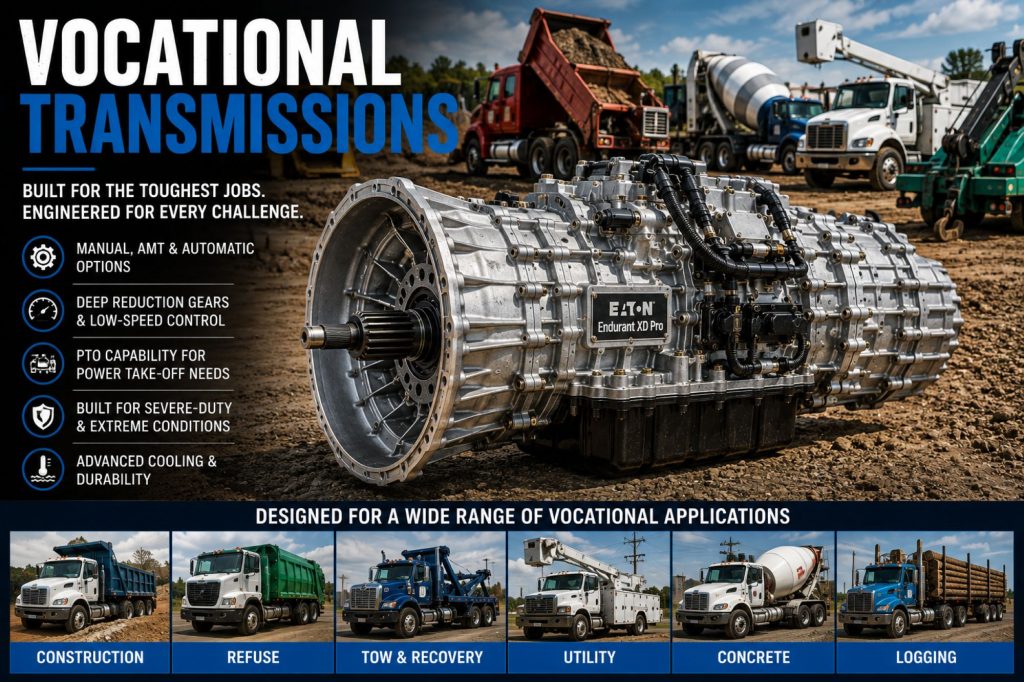
Vocational transmissions are used in commercial trucks that perform demanding jobs beyond conventional highway freight transportation.
Construction trucks, dump trucks, refuse vehicles, utility trucks, heavy-haul tractors, logging trucks, tow and recovery vehicles, municipal equipment, concrete trucks, and other work trucks can place very different demands on a transmission than a typical long-haul tractor.
These applications may require low-speed control, deep reduction gearing, high torque capacity, frequent starts and stops, PTO capability, specialized reverse gearing, severe-duty components, and transmission programming designed around specific work environments.
Truck Equipment Atlas covers manual, automated manual, and fully automatic transmissions used throughout vocational and severe-service commercial trucking.
Vocational Transmission Models on Truck Equipment Atlas
Explore the vocational transmissions currently covered on Truck Equipment Atlas:
Allison Transmission
Eaton and Eaton Cummins
- Eaton Cummins Endurant HD V
- Eaton Cummins Endurant XD
- Eaton Cummins Endurant XD Pro
- Eaton Fuller 8LL
- Eaton Fuller 9ALL
- Eaton Fuller 13-Speed Manual
- Eaton Fuller 18-Speed Manual
- Eaton Fuller RT Series
- Eaton Fuller RTLO Series
- Eaton UltraShift PLUS
Mack
PACCAR
Additional vocational transmission models and families will be added as the Truck Equipment Atlas Transmission Library continues to expand.
What Is a Vocational Transmission?
Vocational transmission is a broad term describing transmissions used in trucks built primarily to perform a specific job or operate under demanding work conditions.
Unlike a long-haul tractor that may spend most of its operating time at highway speed, a vocational truck can experience:
- Frequent starts and stops
- Low-speed operation
- Construction sites
- Steep grades
- Loose surfaces
- Mud and uneven terrain
- Heavy payloads
- High gross combination weights
- Repeated reversing
- PTO operation
- Extended idle time
- Severe duty cycles
Transmission requirements therefore depend heavily on the work the truck performs.
Manual Vocational Transmissions
Traditional manual transmissions remain important in many vocational applications.
Manual transmissions can provide direct control over gear selection and are available with specialized gearing designed for demanding work.
Vocational manual configurations can include:
- Deep reduction gears
- Low-low gearing
- Multiple reverse ratios
- Broad ratio spreads
- High torque capacity
- Range and splitter systems
Transmissions such as the Eaton Fuller 8LL and 9ALL are particularly associated with vocational applications because their gearing provides additional low-speed capability.
Traditional 13-speed and 18-speed transmissions are also used in heavy vocational and heavy-haul applications.
Explore additional platforms in the Manual Transmissions section.
Compare clutch operation, launch behavior, and application tradeoffs in Manual vs Automated Manual vs Automatic Transmissions.
Automated Manual Vocational Transmissions
Automated manual transmissions have expanded significantly into vocational trucking.
Modern vocational AMTs can combine automated shifting with specialized programming and gearing designed for demanding work environments.
Potential capabilities can include:
- Automated clutch operation
- Low-speed maneuvering modes
- Specialized vocational gearing
- Grade response
- Heavy-load programming
- PTO integration
- Driver-selectable operating modes
- Electronic engine integration
Platforms such as the Endurant XD, Endurant XD Pro, Mack mDRIVE HD, and PACCAR TX-18 family demonstrate how AMT technology is expanding into demanding vocational and heavy-haul applications.
Explore additional AMTs in the Automated Manual Transmissions section.
Automatic Vocational Transmissions
Fully automatic transmissions are widely used throughout vocational trucking.
Torque-converter automatic transmissions can provide smooth vehicle launches and strong low-speed control without requiring manual clutch operation.
These characteristics can be particularly useful in applications involving repeated stops, maneuvering, frequent direction changes, or multiple drivers.
Allison transmissions are widely associated with commercial vocational applications ranging from medium-duty work trucks to heavy severe-service equipment.
Explore additional platforms in the Automatic Transmissions section.
Construction Applications
Construction trucks operate in environments that can be very different from normal highway conditions.
Applications can include:
- Dump trucks
- Concrete trucks
- Equipment transport trucks
- Contractor trucks
- Material delivery trucks
- Heavy construction vehicles
These trucks may operate on dirt, gravel, steep grades, job sites, and uneven surfaces.
Transmission requirements can include strong startability, low-speed control, appropriate gearing, high torque capacity, and PTO compatibility.
Dump Truck Applications
Dump trucks frequently combine highway operation with demanding job-site conditions.
A dump truck transmission may need to handle:
- Heavy payloads
- Repeated starts
- Soft surfaces
- Steep grades
- Low-speed maneuvering
- PTO operation
- Frequent forward and reverse movement
The correct transmission depends heavily on vehicle weight, engine torque, axle gearing, terrain, and whether the truck operates primarily on-road or off-road.
Heavy-Haul Applications
Heavy-haul tractors can place extreme demands on transmissions.
Moving oversized and overweight loads may require:
- High torque capacity
- Deep reduction gearing
- Broad ratio coverage
- Strong startability
- Closely spaced gears
- Low-speed control
- Grade performance
- Specialized programming
Traditional 18-speed manuals remain important in heavy haul, while newer AMT platforms provide additional automated options for specialized operations.
Refuse Applications
Refuse trucks operate under one of the most repetitive commercial vehicle duty cycles.
A refuse vehicle may perform hundreds of starts and stops during a working shift.
Transmission requirements can include:
- Smooth launches
- Frequent acceleration
- Low-speed control
- Repeated stopping
- PTO or hydraulic system operation
- High operating hours
- Durable cooling systems
Fully automatic transmissions are particularly important in many refuse applications because of their smooth low-speed operation and ability to handle repeated stop-and-go cycles.
Logging Applications
Logging trucks may operate across highways, rural roads, forest roads, steep grades, and unpaved surfaces.
Transmission selection may prioritize:
- High torque capacity
- Deep gearing
- Gradeability
- Startability
- Driver control
- Durability
- Heavy gross combination weights
Manual transmissions have historically been common in logging applications, although automated transmission technology continues expanding into severe-service trucks.
Utility and Municipal Applications
Utility and municipal trucks perform a wide range of jobs.
Applications can include:
- Bucket trucks
- Snowplows
- Road maintenance vehicles
- Sewer and vacuum trucks
- Utility service vehicles
- Municipal dump trucks
- Emergency support equipment
Many of these vehicles use PTO-driven equipment, making transmission PTO capability an important specification consideration.
Tow and Recovery Applications
Tow and recovery trucks require precise vehicle positioning and may operate under changing loads.
Applications range from light and medium-duty towing to heavy recovery vehicles.
Transmission requirements can include:
- Smooth low-speed control
- Strong launch capability
- PTO operation
- High torque capacity
- Frequent maneuvering
- Highway operation
The appropriate transmission depends on the size and class of the recovery vehicle.
PTO Requirements
Power take-off capability is one of the most important considerations in many vocational trucks.
A PTO allows the engine to power auxiliary equipment through the transmission or another drivetrain component.
PTO-driven equipment can include:
- Hydraulic pumps
- Dump bodies
- Refuse systems
- Tow equipment
- Cranes
- Aerial lifts
- Concrete equipment
- Vacuum equipment
- Utility systems
- Other specialized machinery
Transmission and PTO compatibility should be considered when the truck is originally specified.
See PTO System Explained for auxiliary-power layouts and the compatibility questions to discuss with the transmission and equipment suppliers.
Low-Speed Control
Many vocational applications require precise operation at very low speeds.
Low-speed control can be important when:
- Positioning equipment
- Operating on construction sites
- Maneuvering heavy loads
- Backing trailers
- Operating around workers
- Moving across rough terrain
- Performing refuse collection
- Positioning tow equipment
Different transmission technologies achieve low-speed control in different ways.
Manual transmissions may use deep reduction gearing, AMTs can use specialized clutch control and programming, and automatics can use torque-converter characteristics.
Transmission Cooling
Vocational applications can generate substantial transmission heat.
Repeated starts, low-speed operation, heavy loads, PTO operation, and limited vehicle airflow can increase thermal demands.
Transmission cooling systems must be properly sized and maintained for the application.
Excessive transmission temperature can reduce lubricant life and contribute to accelerated component wear.
Choosing a Vocational Transmission
Selecting the right vocational transmission requires evaluating the complete vehicle and job.
Important factors include:
- Engine torque
- Vehicle class
- Gross vehicle weight
- Gross combination weight
- Payload
- Terrain
- Highway versus off-road operation
- Number of starts and stops
- PTO requirements
- Low-speed operation
- Reverse operation
- Heavy-haul requirements
- Axle gearing
- Driver experience
- Maintenance capabilities
- Service availability
There is no single transmission type that is best for every vocational truck.
The correct transmission is the one properly matched to the truck’s engine, drivetrain, weight, equipment, and operating environment.
Use How to Choose a Commercial Truck Transmission to check engine compatibility, working weight, axle gearing, tires, PTO needs, and service requirements together.
Maintenance and Ownership
Vocational duty cycles can be harder on drivetrain components than normal highway operation.
Important transmission maintenance areas can include:
- Transmission fluid or lubricant
- Filters
- Clutch condition
- Shift actuators
- Clutch actuators
- Electronic controls
- Cooling systems
- PTO components
- Seals
- Transmission mounts
- Driveshafts
- Universal joints
- Diagnostic fault codes
Maintenance schedules should account for the actual duty cycle of the vehicle.
Trucks operating in severe vocational conditions may require more frequent inspection and service than trucks primarily operating on highways.
Related Transmission Categories
Explore additional commercial transmission categories:
- Manual Transmissions
- Automated Manual Transmissions
- Automatic Transmissions
- Heavy-Duty Transmissions
- Medium-Duty Transmissions
Explore the Complete Transmission Library
Vocational transmissions represent some of the most diverse drivetrain applications in commercial trucking.
Visit the Truck Equipment Atlas Transmission Library to explore individual manual, automated manual, automatic, heavy-duty, medium-duty, and vocational transmission profiles.
Truck Equipment Atlas will continue adding vocational transmission models, manufacturers, applications, and educational resources as the Transmission Library expands.
Continue learning with How Commercial Truck Transmissions Work.