
Ford TorqShift 10R140 Transmission
Quick Facts
- Manufacturer: Ford Motor Company
- Transmission Type: Heavy-Duty Fully Automatic Transmission
- Transmission Model: 10R140
- Brand Name: Ford TorqShift 10-Speed Automatic
- Forward Speeds: 10
- Reverse Speeds: 1
- First-Gear Ratio: Approximately 4.62:1
- Top-Gear Ratio: Approximately 0.63:1
- Direct-Drive Gear: 7th Gear
- Overdrive Gears: 8th, 9th, and 10th
- Control Type: Electronically Controlled Automatic
- Launch System: Hydraulic Torque Converter
- Internal Design: Planetary Gearsets with Wet Clutch Packs
- Primary Engine Pairing: Ford 6.7L Power Stroke V8 Turbo Diesel
- Common Truck Applications: Ford F-250 through F-600 Super Duty and diesel-powered Ford F-650 and F-750 commercial trucks
- PTO Compatibility: Live-Drive PTO Provision on Compatible Chassis-Cab and Medium-Duty Configurations
- Drive Modes: Normal, Tow/Haul, Eco, Slippery, and application-specific modes depending on truck
- Production Status: Active Production
Overview
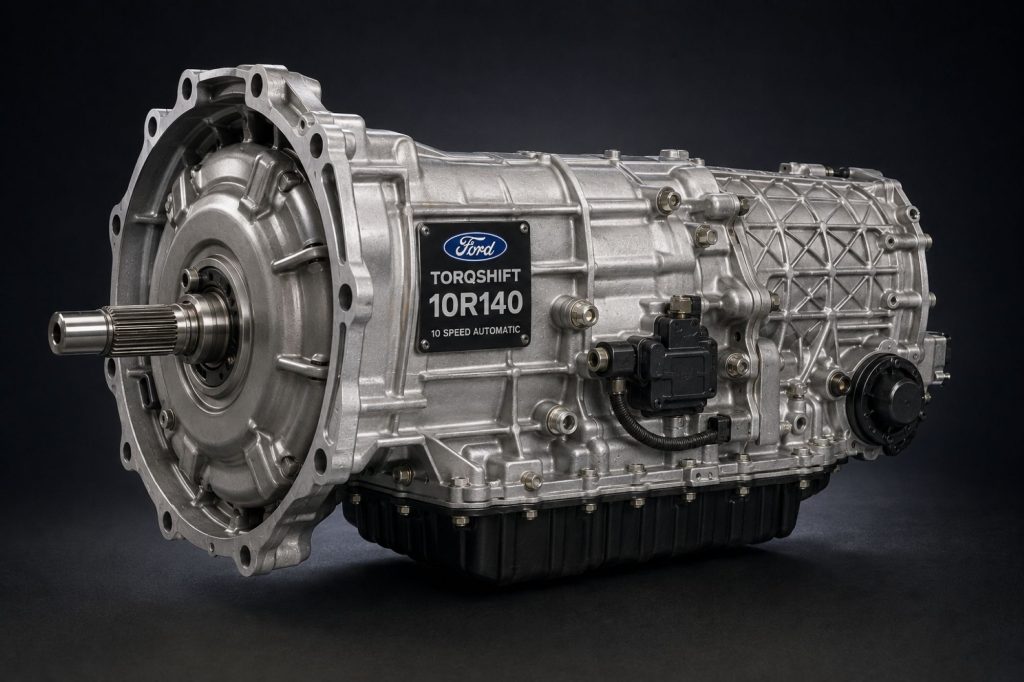
The Ford TorqShift 10R140 is a heavy-duty 10-speed automatic transmission developed for Ford Super Duty and commercial trucks powered by the 6.7L Power Stroke diesel engine.
Ford introduced the 10R140 for the 2020 Super Duty generation as the successor to the six-speed 6R140. Its ten forward ratios provide a much wider operating range and smaller steps between gears.
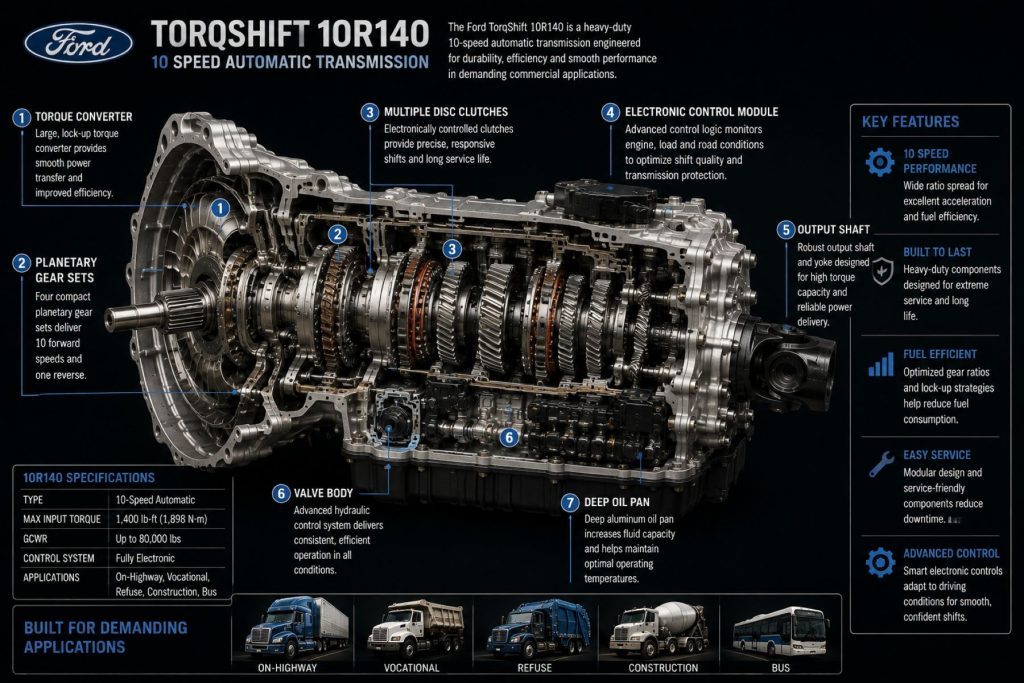
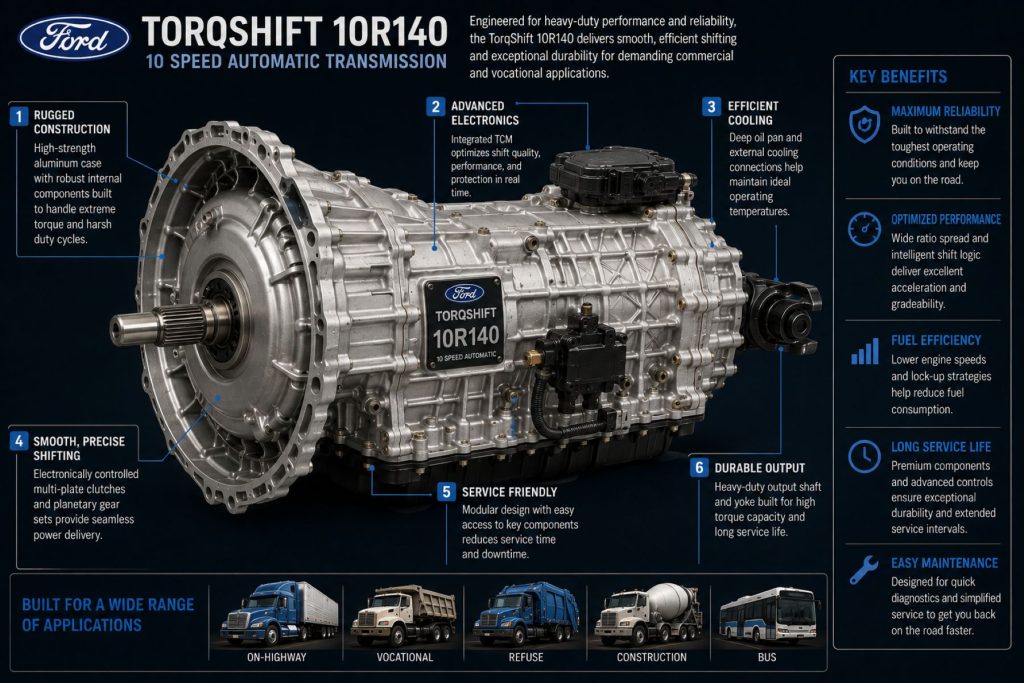
The transmission combines a hydraulic torque converter, electronically controlled lockup clutch, planetary gearsets, wet internal clutch packs, and advanced powertrain controls.
A deep 4.62:1 first gear improves loaded startability, while three overdrive gears help reduce engine speed during highway operation. Seventh gear is direct drive, and tenth gear provides an approximately 0.63:1 ratio.
Commercial chassis-cab and medium-duty configurations can include a live-drive PTO provision. This allows compatible hydraulic or mechanical equipment to receive power while the truck is stationary or moving, depending on the completed installation and programming.
Key Characteristics
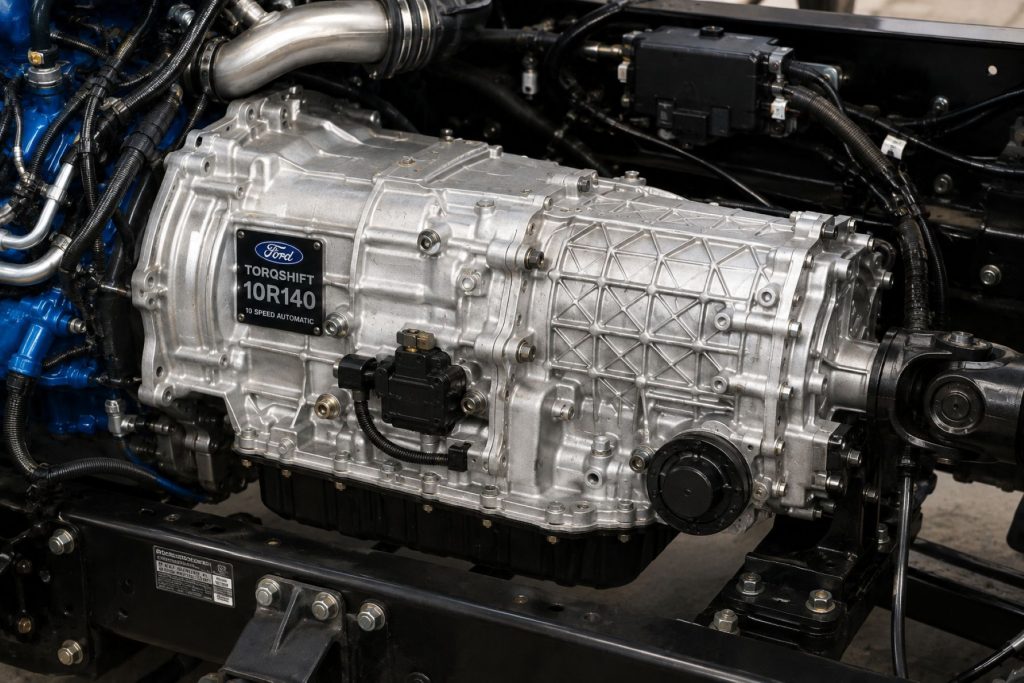
The 10R140 was engineered specifically for the high torque output and demanding towing requirements of Ford’s 6.7L Power Stroke diesel trucks.
Its wide ratio spread allows the transmission to provide strong launch performance without sacrificing highway efficiency. The ratio progression also gives the electronic controls more choices for keeping the engine in an efficient operating range.
The transmission can skip unnecessary gears. A lightly loaded truck may move through only selected ratios, while a heavily loaded truck may use more of the ten gears.
Three overdrive ratios provide flexibility for towing, cruising, axle selection, and fuel economy. The transmission does not need to reach tenth gear under every operating condition.
The torque converter provides smooth low-speed movement and torque multiplication. Once the truck is moving, the lockup clutch can reduce converter slippage and improve efficiency.
The 10R140 should not be confused with the lighter Ford 10R80 used in F-150, Expedition, Mustang, and other light-duty applications. It is also distinct from the TorqShift-G 10-speed used with certain gasoline-powered Super Duty trucks.
How the Transmission Works
Engine power enters the transmission through the torque converter. The engine-driven converter impeller moves transmission fluid, transferring power to the turbine and transmission input.
During launch, the converter multiplies torque and permits the truck to remain stopped while the engine continues running in Drive.
The transmission control module monitors accelerator position, engine torque, vehicle speed, selected drive mode, brake input, transmission temperature, road grade, trailer information, and other operating data.
The controller applies combinations of internal wet clutches to control the planetary gearsets. Each clutch combination produces a different forward or reverse ratio.
As the truck accelerates, the transmission can move through all ten ratios or skip gears when they are unnecessary.
The lockup clutch creates a more direct connection between the engine and transmission. Lockup reduces heat and improves fuel efficiency during suitable operating conditions.
Tow/Haul mode changes shift scheduling and grade behavior. It can hold lower gears longer during acceleration and provide more aggressive downshifting when descending.
On trucks with the Power Stroke exhaust brake, the transmission and engine controls work together to select a gear that supports vehicle-speed control on grades.
Common Specifications
Transmission Type
The 10R140 is an electronically controlled, longitudinal, fully automatic transmission with a hydraulic torque converter and planetary gearsets.
Forward Speeds
The transmission provides ten forward speeds.
The large number of ratios allows closer spacing than the older six-speed 6R140 while retaining a deep starting gear and multiple overdrives.
Gear Ratios
Common published ratios are approximately:
- 1st: 4.615:1
- 2nd: 2.919:1
- 3rd: 2.132:1
- 4th: 1.773:1
- 5th: 1.519:1
- 6th: 1.277:1
- 7th: 1.000:1
- 8th: 0.851:1
- 9th: 0.687:1
- 10th: 0.632:1
- Reverse: Approximately 4.695:1
Ratios should be confirmed for the specific model year and transmission calibration.
Direct Drive
Seventh gear is the transmission’s 1.00:1 direct-drive ratio.
Overdrive
Eighth, ninth, and tenth are overdrive ratios.
Tenth gear provides the lowest cruising ratio at approximately 0.63:1.
Torque Capacity
The 10R140 was designed for the high-torque 6.7L Power Stroke diesel. Early versions were commonly associated with engine outputs around 1,050 lb-ft.
Newer Power Stroke applications produce still higher advertised engine torque. Compatibility depends on Ford’s engine calibration, internal transmission updates, torque management, truck model, and production year.
The transmission model number should not be treated as a universal aftermarket torque rating.
Torque Converter
The hydraulic torque converter provides smooth launch performance, torque multiplication, and controlled low-speed operation.
Converter design and calibration can vary by truck model and engine rating.
Lockup Clutch
An electronically controlled torque-converter clutch reduces slippage and heat after launch.
The control system can apply or release lockup according to load, speed, temperature, gear, and driver demand.
Internal Design
The transmission uses multiple planetary gearsets and electronically controlled wet clutch packs.
Internal clutch combinations create ten forward ratios without requiring ten separate gear pairs.
Electronic Controls
The transmission communicates with:
- Engine control module
- Accelerator controls
- Brake system
- Exhaust brake
- Transfer case where equipped
- PTO controls
- Trailer systems
- Instrument cluster
- Drive-mode selector
- Vehicle body controls
This integration helps coordinate torque during shifting and protect the drivetrain.
SelectShift
SelectShift allows the driver to limit the highest available gear or manually request gear changes, depending on truck configuration.
The transmission can reject a requested shift that would overspeed the engine or create an unsafe operating condition.
Drive Modes
Available modes can include:
- Normal
- Tow/Haul
- Eco
- Slippery
- Deep Sand/Snow
- Off-Road
The available modes vary by Super Duty model, equipment package, and commercial configuration.
Neutral Idle
Compatible chassis-cab trucks can use Neutral Idle programming.
When operating conditions permit, the transmission reduces engine load while the truck is stopped and automatically resumes Drive when the driver releases the brake.
Live-Drive PTO
Applicable diesel chassis-cab and F-650/F-750 configurations offer live-drive PTO capability.
An engine-connected output gear allows approved equipment to receive power whenever the engine is operating, subject to PTO controls and interlocks.
Mobile PTO Operation
Compatible installations can operate selected PTO-driven equipment while the vehicle is moving.
Mobile operation depends on the PTO, hydraulic equipment, software, truck model, body upfit, and safety requirements.
Split-Shaft Capability
Diesel commercial configurations may support split-shaft applications when properly equipped and programmed.
Split-shaft systems require careful coordination of the transmission, driveshaft, auxiliary equipment, and vehicle controls.
Lubrication
The 10R140 requires Ford-approved automatic transmission fluid meeting the specification listed for the truck’s model year.
Fluid type should be verified through Ford service information or the owner’s manual rather than assumed from an older TorqShift transmission.
Cooling System
The transmission uses an oil cooler to control temperature during towing, vocational work, low-speed operation, and heavy hauling.
Cooling capacity, line condition, airflow, engine-cooling performance, and fluid level all affect transmission temperature.
Transmission Weight
Exact weight varies by truck model, two-wheel-drive or four-wheel-drive configuration, PTO provision, converter, output section, and production version.
The 10R140 is physically larger and heavier than the light-duty 10R80.
Installation Requirements
Installation requires compatible Ford engine controls, transmission programming, torque converter, wiring, cooling system, flexplate, mounts, driveshaft, transfer case where equipped, and vehicle electronics.
A replacement unit generally requires configuration according to the truck’s VIN and installed equipment.
Common Applications
- Heavy-duty pickup trucks
- Commercial chassis-cab trucks
- Utility-service trucks
- Tow trucks
- Rollback carriers
- Dump-body trucks
- Snowplow trucks
- Ambulances
- Fire-service support vehicles
- Service-body trucks
- Crane-body trucks
- Bucket trucks
- Municipal vehicles
- Construction-support trucks
- Trailer towing
- Fifth-wheel towing
- Gooseneck towing
- Equipment hauling
- Recreational towing
- PTO-powered vocational equipment
Truck and Engine Compatibility
The 10R140 is primarily paired with Ford’s 6.7L Power Stroke diesel in Super Duty and commercial-truck applications.
Common truck platforms include:
- Ford F-250 Super Duty
- Ford F-350 Super Duty
- Ford F-450 Super Duty
- Ford F-550 Super Duty
- Ford F-600 Super Duty
- Ford F-650
- Ford F-750
The primary engine pairing is:
The 10R140 should not automatically be listed with the Ford 7.3L Gas V8. Gasoline Super Duty applications commonly use the related but distinct TorqShift-G 10-speed transmission.
Exact compatibility must be verified using the truck’s VIN, model year, engine calibration, drive configuration, PTO equipment, and transmission identification.
Advantages
- Ten forward ratios provide a wide operating range
- Deep first gear improves loaded startability
- Three overdrive gears support efficient highway operation
- Torque converter provides smooth low-speed control
- No manual clutch pedal
- Strong integration with the Power Stroke diesel
- Tow/Haul mode improves towing behavior
- Works with the Power Stroke exhaust brake
- Skip shifting avoids unnecessary gear changes
- SelectShift gives the driver additional control
- Live-drive PTO is available in commercial configurations
- Mobile PTO operation is supported where properly equipped
- Neutral Idle can reduce stopped engine load
- Well suited for towing and vocational work
- More ratio flexibility than the older 6R140
- Smooth automatic operation reduces driver workload
Limitations or Considerations
- More mechanically complex than the 6R140
- Electronic diagnosis requires suitable Ford software
- Repairs can be expensive
- Correct fluid is critical
- Heavy towing creates significant heat
- PTO capability is not identical across all models
- Used transmissions may require VIN-specific programming
- Different production years may have internal revisions
- It should not be confused with the 10R80
- It should not be confused with the TorqShift-G gas transmission
- High engine tuning can exceed approved operating limits
- Valve-body or software issues can affect shift quality
- Incorrect tire size or axle programming can alter shifting
- Transmission replacement is physically demanding because of size and weight
Driver and Operator Experience
The 10R140 provides familiar two-pedal automatic operation. The driver selects Drive or Reverse and allows the transmission to manage shifting.
Under light throttle, the transmission may skip several gears. This is normal and reduces unnecessary shifting.
During heavy acceleration or towing, the transmission may use more ratios to keep the Power Stroke within its productive operating range.
Tow/Haul mode changes the transmission’s behavior for loaded operation. It can hold gears longer, reduce gear hunting, and command downshifts on descents.
The transmission may not remain in tenth gear when towing into a headwind or climbing rolling terrain. Ninth, eighth, or seventh gear can be more appropriate under load.
Drivers should use smooth accelerator input during trailer backing and equipment positioning. The torque converter provides controlled movement, but excessive throttle can still produce heat and abrupt vehicle response.
Maintenance and Ownership Notes
Owners should follow the Ford maintenance schedule for the truck’s model year, operating conditions, and vocation.
Severe operation includes frequent towing, commercial service, extended idling, plowing, off-road work, repeated stop-and-go driving, and PTO use.
Only the Ford-approved transmission fluid specified for the exact model year should be installed.
The transmission cooler, lines, fittings, wiring, connectors, pan, seals, and output components should be inspected regularly.
Fluid should be checked for discoloration, burnt odor, water, coolant, metal, or clutch material.
Software updates can affect shifting, converter lockup, Tow/Haul behavior, PTO operation, and diagnostic functions.
After replacement or major repairs, the transmission may require adaptive learning or relearning procedures.
PTO-equipped trucks need additional inspection of the PTO unit, seals, mounting bolts, hydraulic pump, controls, wiring, and interlocks.
Common Transmission Problems
Harsh Shifting
Harsh gear changes can result from software, adaptive-learning problems, valve-body faults, solenoid problems, incorrect fluid level, or internal clutch wear.
Delayed Engagement
A delay when selecting Drive or Reverse may indicate low fluid, hydraulic leakage, converter drain-back, valve-body problems, or internal wear.
Gear Hunting
Repeated shifts between adjacent gears can result from heavy load, rolling terrain, unsuitable drive mode, incorrect tire programming, engine-performance problems, or calibration.
Torque-Converter Shudder
Shudder during lockup may be related to fluid condition, converter-clutch wear, programming, engine misfire, or driveline vibration.
Transmission Overheating
Heavy towing, restricted cooling, low fluid, excessive converter operation, or high ambient temperature can produce excessive heat.
Valve-Body Problems
Worn valves, sticking components, contamination, or solenoid faults can cause delayed, harsh, or incorrect shifts.
Software and Calibration Issues
Some shift complaints may be corrected through updated Ford programming or completion of the proper adaptive-learning procedure.
Fluid Leaks
Leaks can occur around cooler lines, pan seals, case connections, input or output seals, and PTO equipment.
Speed-Sensor or Wiring Faults
Sensor failures, damaged harnesses, loose connectors, or poor grounds can trigger fault codes, limited operation, or incorrect shifting.
PTO Problems
Incorrect programming, damaged wiring, failed interlocks, unsuitable PTO equipment, or hydraulic overload can prevent proper PTO operation.
Buying Considerations
- Confirm that the transmission is a 10R140.
- Do not rely only on the TorqShift name.
- Record the transmission identification information.
- Verify the truck’s VIN and model year.
- Confirm compatibility with the 6.7L Power Stroke rating.
- Determine whether the truck is two-wheel drive or four-wheel drive.
- Confirm the transfer-case interface where applicable.
- Check whether a live-drive PTO provision is installed.
- Determine whether mobile PTO operation is required.
- Verify split-shaft compatibility where applicable.
- Scan all powertrain controllers for active and stored faults.
- Review transmission-temperature and overheat history.
- Inspect the fluid for discoloration or contamination.
- Check the cooler and transmission lines.
- Test cold and warm engagement.
- Road-test all operating ranges.
- Evaluate Tow/Haul mode.
- Check converter lockup.
- Confirm SelectShift operation.
- Review software-update and repair records.
- Verify replacement programming and warranty availability.
Variants and Configurations
- Ford 10R140 Super Duty Pickup Configuration
- Ford 10R140 Chassis-Cab Configuration
- Ford TorqShift HD 10-Speed Medium-Duty Configuration
- Two-Wheel-Drive Configuration
- Four-Wheel-Drive Configuration
- Live-Drive PTO Configuration
- Mobile PTO Configuration
- Split-Shaft-Compatible Configuration
- Neutral Idle Configuration
- Tow/Haul Calibration
- F-250 and F-350 Pickup Configuration
- F-350 through F-600 Chassis-Cab Configuration
- F-650 and F-750 Medium-Duty Configuration
Comparison to Similar Equipment
Compared with the Ford 6R140, the 10R140 provides four additional forward ratios, a deeper first gear, and smaller steps between gears. The 6R140 is mechanically simpler and has a long-established service history.
Compared with the GM 10L1000 Allison-branded transmission, both are heavy-duty 10-speed automatics used behind high-torque diesel engines. The 10R140 is paired with the Ford Power Stroke, while the 10L1000 is paired with the GM Duramax.
Compared with the Allison 1000 Series, the 10R140 provides ten forward gears and Ford-specific powertrain integration. The Allison 1000 family has broader historical use across GM and commercial applications.
Compared with the Allison 2000 Series, the 10R140 is centered on Ford Super Duty and F-650/F-750 trucks. The Allison 2000 is used across a wider group of medium-duty manufacturers and vocational platforms.
Compared with the Ford 10R80, the 10R140 is larger and designed for much heavier diesel-truck loads. A 10R80 should never be assumed to be a direct substitute.
Compared with the TorqShift-G 10-speed, the 10R140 is the diesel-oriented heavy-duty unit. TorqShift-G versions are associated primarily with Ford’s gasoline Super Duty engines.
Best Fit For
- Ford Power Stroke owners
- Super Duty towing applications
- Commercial chassis-cab fleets
- Ford F-650 and F-750 diesel trucks
- Utility companies
- Municipal fleets
- Tow and recovery operators
- Construction contractors
- Equipment-hauling operations
- Snow and ice control fleets
- Service-body trucks
- PTO-equipped vocational trucks
- Fifth-wheel and gooseneck towing
- Fleets requiring two-pedal automatic operation
- Operators needing live-drive PTO capability
Related Truck Types
- Medium-Duty Trucks
- Vocational Trucks
- Dump Trucks
- Day Cab Trucks
- Heavy-Duty Pickup Trucks
- Chassis-Cab Trucks
Related Truck Models
- Ford F-250 Super Duty
- Ford F-350 Super Duty
- Ford F-450 Super Duty
- Ford F-550 Super Duty
- Ford F-600 Super Duty
- Ford F-650
- Ford F-750
Related Engines
Related Transmission Types
- Fully Automatic Transmissions
- Heavy-Duty Transmissions
- Medium-Duty Transmissions
- Torque-Converter Transmissions
- Vocational Transmissions
Related Equipment Systems
- Torque Converters
- Transmission Cooling Systems
- Electronic Transmission Controls
- Transfer Cases
- Driveshaft Systems
- Trailer-Towing Systems
- PTO Systems
- Axles and Differentials
- Electrical Systems
- Brake Systems
Related Guides
Understand the operating principles in How Commercial Truck Transmissions Work, compare drivetrain designs in Manual vs Automated Manual vs Automatic Transmissions, and evaluate gearing, application, and compatibility in How to Choose a Commercial Truck Transmission.
Regulatory and Compliance Notes
The 10R140 must be operated within Ford’s approved engine, towing, payload, axle, tire, cooling, PTO, and gross combined weight ratings.
The transmission’s capability does not establish the truck’s legal carrying or towing capacity. Operators must follow the vehicle certification label, hitch rating, axle ratings, tire ratings, and applicable laws.
Electronic controls communicate with the engine, emissions system, braking system, PTO equipment, instrument cluster, and other vehicle modules. Replacement transmissions and controllers must be configured correctly.
PTO-driven equipment requires properly rated pumps, shafts, hydraulic components, guards, controls, and safety interlocks.
Commercial vehicles may be subject to CDL requirements, DOT inspections, hours-of-service rules, ELD requirements, and weight regulations depending on their configuration and use.
Real World Operating Notes
The ten-speed design does not mean the transmission will use every gear during every acceleration. Skip shifting is normal.
When towing, the transmission may remain in seventh, eighth, or ninth instead of tenth. The correct gear is the one that allows the engine and transmission to operate without excessive lugging, shifting, or heat.
Tow/Haul mode should be used when carrying or pulling substantial weight. It changes shift behavior and improves downhill control.
Drivers should monitor transmission temperature during heavy towing, mountain travel, snowplowing, and vocational work.
The 10R140’s integration with the Power Stroke exhaust brake is especially useful on long descents. The system may downshift and raise engine speed to increase braking power.
Used-transmission buyers should be cautious because not every 10R140 configuration is identical. Model year, output arrangement, PTO equipment, electronics, and calibration all matter.
Frequently Asked Questions
What is the Ford 10R140?
It is Ford’s heavy-duty 10-speed automatic transmission used primarily with the 6.7L Power Stroke diesel in Super Duty and commercial trucks.
How many gears does it have?
It has ten forward gears and one reverse gear.
What is its first-gear ratio?
First gear is approximately 4.62:1.
How many overdrive gears does it have?
Eighth, ninth, and tenth are overdrive ratios.
Which gear is direct drive?
Seventh gear is the 1.00:1 direct-drive ratio.
Which engine uses the 10R140?
Its primary engine pairing is the Ford 6.7L Power Stroke.
Does the 7.3L gas engine use the 10R140?
Gas-powered Super Duty trucks commonly use the related TorqShift-G 10-speed. The exact transmission should be verified by VIN rather than assuming it is a 10R140.
Which trucks use it?
Applications include Ford F-250 through F-600 Super Duty trucks and diesel-powered Ford F-650 and Ford F-750 commercial trucks.
Does it support a PTO?
Compatible chassis-cab and medium-duty diesel configurations support live-drive PTO operation.
Is the 10R140 the same as the 10R80?
No. The 10R140 is larger and designed for substantially heavier truck and diesel-engine applications.
What replaced the Ford 6R140?
The 10R140 replaced the 6R140 in many diesel-powered Super Duty applications beginning with the 2020 model year.
Can a used 10R140 be installed without programming?
A replacement may require VIN-specific configuration, software, and adaptive-learning procedures before it operates correctly.
Availability and Where to Find
New Ford TorqShift 10R140 transmissions are installed in compatible diesel-powered Ford Super Duty, chassis-cab, F-650, and F-750 trucks.
Replacement transmissions, torque converters, valve bodies, controllers, PTO components, coolers, and service parts may be available through Ford dealers, Ford-authorized remanufacturing channels, commercial drivetrain suppliers, and used truck-parts dealers.
A used transmission should be identified through its complete part number, engineering number, vehicle application, and donor VIN. Buyers should not rely only on the 10R140 or TorqShift name.
Before purchasing a replacement, verify the truck’s model year, engine calibration, two-wheel-drive or four-wheel-drive layout, output section, PTO provision, wiring, software, and transfer-case compatibility.
Current truck specifications and dealer availability can be confirmed through Ford’s official Super Duty website and the Ford F-650/F-750 commercial-truck page.
Support Trucking Families
Truck Equipment Atlas supports the mission of Grey Cross, a nonprofit dedicated to helping families of truck drivers who lose their lives while on the road. As the site grows, part of its mission is to bring awareness and support to these families.
Podcast or Video Section
Learn More Through Audio and Video
Truck Equipment Atlas will continue expanding with podcast episodes, interviews, and equipment breakdowns to help drivers and fleets better understand trucks and equipment.
Follow the Growth of Truck Equipment Atlas
Truck Equipment Atlas continues to expand with new truck profiles, trailer coverage, diesel engine pages, equipment system resources, manufacturer information, and educational guides.
Visit our Site Updates page to explore recent additions, project milestones, and upcoming resources as we continue building one of the industry’s growing commercial trucking equipment reference libraries.
View the Latest Site Updates: Truck Equipment Atlas Site Updates