
Manual vs Automated Manual vs Automatic Transmissions
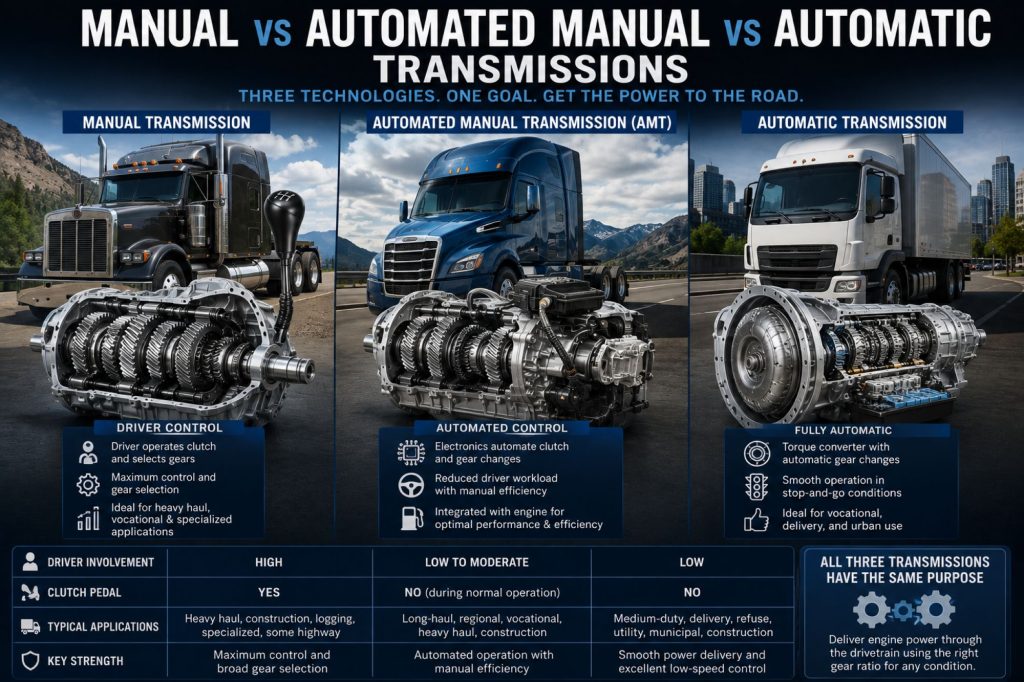
Commercial trucks use several different transmission technologies, but three configurations dominate most modern and historical applications: manual transmissions, automated manual transmissions, and fully automatic transmissions.
Each performs the same fundamental job of transferring engine power through the drivetrain while providing the gear ratios needed to start, accelerate, climb grades, maneuver, and travel efficiently at highway speeds.
How they accomplish that task is very different.
Traditional manual transmissions place gear selection and clutch control primarily in the driver’s hands. Automated manual transmissions use electronic controls and actuators to automate those functions while retaining a mechanically geared transmission architecture. Fully automatic transmissions typically use a different design that can include a torque converter and automatic gear system.
Understanding these differences is important when selecting a commercial truck, comparing equipment, evaluating operating costs, or determining which transmission technology best fits a particular application.
Quick Comparison
Manual Transmission
Basic design: Mechanically geared transmission with driver-operated shifting and clutch control.
Driver involvement: High.
Clutch pedal: Typically yes.
Common applications: Heavy haul, vocational, construction, logging, specialized operations, and older highway tractors.
Primary strength: Direct driver control and broad gearing options.
Automated Manual Transmission
Basic design: Mechanically geared transmission with electronically controlled shifting and automated clutch operation.
Driver involvement: Low to moderate.
Clutch pedal: Normally absent on modern two-pedal AMTs; older automated designs can retain one for starts and stops.
Common applications: Long-haul, regional, heavy-duty, vocational, and increasingly heavy-haul operations.
Primary strength: Combines mechanical gearing with automated operation and powertrain integration.
Automatic Transmission
Basic design: Fully automatic transmission commonly using torque-converter technology in commercial applications.
Driver involvement: Low.
Clutch pedal: No.
Common applications: Medium-duty, delivery, refuse, utility, construction, municipal, towing, emergency, and severe vocational applications.
Primary strength: Smooth power delivery and excellent low-speed and stop-and-go operation.
Manual Transmissions
Traditional Manual Transmissions have been part of commercial trucking for generations.
The driver controls gear selection and typically operates a clutch pedal to manage the connection between the engine and transmission.
Heavy-duty manual transmissions can use range and splitter systems to provide numerous gear ratios.
Common configurations include:
- 8-speed
- 9-speed
- 10-speed
- 13-speed
- 18-speed
Specialized vocational transmissions can also include extremely low reduction gears designed for demanding work.
How a Manual Transmission Operates
The driver is responsible for determining when a gear change is required.
This requires coordinating:
- Engine RPM
- Road speed
- Vehicle load
- Terrain
- Current gear
- Clutch operation
- Throttle input
The driver selects progressively higher gears as the truck accelerates and downshifts when additional mechanical advantage is required.
Proper manual shifting requires understanding how engine speed and road speed correspond with each transmission ratio.
Advantages of Manual Transmissions
Manual transmissions can offer several advantages depending on the application.
Direct Driver Control
The driver determines exactly when the transmission changes gears.
This can be valuable in specialized applications where an experienced operator wants direct control over power delivery.
Broad Gear Selection
Heavy-duty manuals are available with numerous gear configurations.
A 13-speed or 18-speed transmission can provide closely spaced ratios across a broad operating range.
Specialized Low Gearing
Vocational transmissions such as the Eaton Fuller 8LL and 9ALL can provide very low gearing for construction and severe-service applications.
Heavy-Haul Capability
Traditional 18-speed transmissions remain strongly associated with heavy-haul trucking because of their broad ratio coverage and low-speed control.
Established Technology
Manual transmissions have been used throughout commercial trucking for decades, creating a large body of service knowledge and parts availability for many platforms.
Limitations of Manual Transmissions
Manual transmissions also have important disadvantages.
Greater Driver Workload
The driver must continually manage shifting and clutch operation.
This can increase fatigue, particularly in traffic or operations involving frequent stops.
More Training
Operating a heavy-duty manual transmission properly requires training and experience.
Driver Skill Matters
Fuel efficiency, clutch life, shift quality, and drivetrain wear can be influenced by driver technique.
Clutch Wear
Poor clutch operation can accelerate wear and increase maintenance costs.
Driver Availability
As automated transmissions have become more common, fewer drivers may have extensive experience operating traditional heavy-duty manuals.
Automated Manual Transmissions
Automated Manual Transmissions, commonly called AMTs, automate much of the work traditionally performed by the driver.
An AMT generally retains a mechanically geared transmission architecture while adding electronic controls, shift actuators, and automated clutch operation.
The driver normally does not need to operate a clutch pedal or manually select every gear.
Terminology varies by generation. Eaton AutoShift automates gear changes but retains a driver-operated clutch for starting and stopping. Modern two-pedal products such as Eaton Cummins Endurant HD automate the launch clutch as well. Always identify the exact transmission before assuming how it operates.
How an AMT Operates
The transmission control system determines when gear changes should occur.
It can monitor information such as:
- Engine RPM
- Road speed
- Engine load
- Throttle demand
- Current gear
- Vehicle weight
- Road grade
- Selected operating mode
When a shift is required, the transmission and engine controls coordinate the process.
The system can reduce engine torque, operate the clutch, select the appropriate gear, re-engage the drivetrain, and restore power.
Modern AMTs can perform these operations with minimal driver involvement.
Advantages of Automated Manual Transmissions
AMTs have become widely used in modern heavy-duty trucking for several reasons.
Reduced Driver Workload
Routine clutch operation and manual shifting are largely eliminated.
Consistent Shifting
The electronic control system can provide more consistent gear selection across different drivers.
Powertrain Integration
Modern AMTs can communicate directly with the engine and other vehicle systems.
Easier Driver Training
Drivers do not need the same manual shifting skills required for a traditional heavy-duty transmission.
Highway Efficiency
AMTs can select gears according to engine load, terrain, vehicle speed, and powertrain programming.
Growing Application Range
AMTs are no longer limited primarily to highway tractors.
Modern platforms are increasingly available for vocational, construction, and heavy-haul applications.
Limitations of Automated Manual Transmissions
AMTs also have characteristics that should be considered.
Electronic Complexity
Shift actuators, clutch actuators, sensors, wiring, and control modules add electronic components to the transmission system.
Different Low-Speed Feel
Because many AMTs still use a clutch rather than a torque converter, their low-speed behavior can differ from a conventional automatic.
Repeated creeping or holding a truck on a grade with accelerator input can overheat a launch clutch. Use the brakes and the manufacturer’s approved maneuvering modes. A torque-converter automatic also needs adequate cooling during sustained low-speed work; automation does not remove thermal limits.
Specialized Diagnostics
Some repairs require electronic diagnostic equipment and manufacturer-specific knowledge.
Clutch Wear Still Exists
Automating the clutch does not eliminate the clutch itself on most AMT designs.
Programming Matters
Transmission behavior can vary depending on calibration, vehicle application, and operating mode.
Automatic Transmissions
Automatic Transmissions provide another approach to reducing driver involvement.
Many commercial automatic transmissions use a torque converter and planetary-style gearing rather than the conventional clutch and gear architecture associated with manuals and most AMTs.
The driver generally selects a driving range and allows the transmission to manage gear changes automatically.
How an Automatic Transmission Operates
The torque converter transfers engine power into the transmission while allowing controlled slip during vehicle launch and low-speed operation.
Electronic and hydraulic controls determine when the transmission changes gears.
The system can evaluate:
- Vehicle speed
- Throttle position
- Engine load
- Current gear
- Operating conditions
- Driver demand
Modern automatic transmissions can also use torque-converter lockup to create a more direct mechanical connection under appropriate operating conditions.
Advantages of Automatic Transmissions
Automatic transmissions can be particularly effective in applications involving frequent stops and low-speed operation.
Smooth Vehicle Launches
Torque-converter technology can provide smooth power delivery from a stop.
Excellent Low-Speed Control
This can be valuable in construction, refuse, utility, delivery, and other vocational operations.
Reduced Driver Workload
The driver does not need to manually operate a clutch or select routine gear changes.
Stop-and-Go Performance
Automatic transmissions are particularly well suited to operations involving repeated acceleration and stopping.
Multiple-Driver Operations
Simplified vehicle operation can make trucks easier to move between different drivers.
Vocational Capability
Heavy-duty automatic platforms are used in demanding applications including refuse, construction, emergency vehicles, municipal equipment, and severe-service trucks.
The Allison 3000 Series and Allison 4000 Series illustrate torque-converter automatic families used in commercial applications. Their exact ratings, ratios, PTO options, and approved duty cycles vary by model and installation.
Limitations of Automatic Transmissions
Automatic transmissions also have considerations that differ from manuals and AMTs.
Initial Cost
A fully automatic transmission can represent a significant portion of the vehicle specification.
Weight
Certain automatic transmission designs can weigh more than comparable alternatives.
Cooling Requirements
Torque-converter operation and demanding vocational duty cycles can generate substantial heat.
Fluid and Filter Maintenance
Automatic transmission fluid plays a critical role in lubrication, hydraulic control, and cooling.
Application Limits
Transmission torque capacity and vehicle weight ratings must be matched carefully to the intended truck application.
Manual vs AMT: The Fundamental Difference
A manual and AMT can share similar mechanical concepts.
The primary difference is who controls the clutch and shifting process.
With a manual:
Driver → Clutch → Gear Selection
With an AMT:
Electronic Controls → Actuators → Clutch and Gear Selection
The AMT essentially automates many tasks previously performed by the driver.
This distinction explains why AMTs can provide many mechanical characteristics of a manual transmission while offering a driving experience closer to an automatic.
AMT vs Automatic: The Fundamental Difference
AMTs and automatics can feel similar from the driver’s seat because neither normally requires routine clutch-pedal operation.
Mechanically, however, they can be very different.
An AMT generally uses:
- Mechanical gearsets
- Automated clutch
- Shift actuators
- Electronic controls
A conventional commercial automatic commonly uses:
- Torque converter
- Automatic internal gear system
- Hydraulic controls
- Electronic controls
The difference is especially noticeable during vehicle launch and low-speed maneuvering.
A single-clutch AMT generally interrupts engine torque while changing ratios. A conventional planetary automatic uses internal clutch packs and hydraulic control to make power-on gear changes; it still contains clutches even though it has no clutch pedal. Its torque converter can multiply launch torque, and lockup reduces slip once operating conditions allow. How Commercial Truck Transmissions Work explains these mechanisms and the gearing behind them.
Which Is Best for Long-Haul Trucking?
Modern AMTs have become a major transmission choice for long-haul tractors.
Potential reasons include:
- Reduced driver workload
- Consistent shifting
- Engine and transmission integration
- Highway efficiency
- Easier driver training
- Fleet standardization
Platforms such as the Detroit DT12, Eaton Cummins Endurant HD, PACCAR TX-12, Volvo I-Shift, and Mack mDRIVE represent this approach.
Traditional manuals remain present throughout the existing truck population and can still be preferred by certain operators.
Fully automatic transmissions can also serve heavy-duty applications, although their strongest presence is often in vocational and specialized operations.
Which Is Best for Regional Trucking?
Regional operations can combine highway driving with urban traffic, frequent stops, distribution centers, and repeated maneuvering.
AMTs can provide a strong balance between highway efficiency and reduced driver workload.
Automatic transmissions can also be attractive where the operation includes substantial stop-and-go driving.
The best choice depends on the truck, route, weight, terrain, and duty cycle.
Which Is Best for Medium-Duty Trucks?
Fully automatic transmissions are widely used in medium-duty trucks; the Medium-Duty Transmissions hub covers those applications.
Applications can include:
- Delivery trucks
- Box trucks
- Utility vehicles
- Tow trucks
- Municipal equipment
- Service trucks
- Construction trucks
These vehicles frequently operate in traffic and perform repeated starts and stops.
Automated manual transmissions are also expanding within the medium-duty market.
Which Is Best for Vocational Trucks?
There is no single answer because vocational trucking covers an enormous range of applications.
Explore Vocational Transmissions for equipment used in demanding work environments.
Manuals Can Be Well Suited For:
- Heavy haul
- Logging
- Construction
- Specialized operations
- Applications requiring specialized low gearing
AMTs Can Be Well Suited For:
- Construction
- Heavy haul
- Dump operations
- Vocational tractors
- Operations wanting automation with mechanical gearing
Automatics Can Be Well Suited For:
- Refuse
- Utility
- Municipal operations
- Concrete
- Delivery
- Tow and recovery
- Emergency equipment
- Frequent stop-and-go work
The actual truck specification remains more important than the transmission category alone.
Which Is Best for Heavy Haul?
Heavy haul requires careful transmission selection because extremely high gross combination weights can place substantial demands on the drivetrain.
Important characteristics can include:
- Deep reduction gearing
- Broad ratio coverage
- High torque capacity
- Startability
- Gradeability
- Low-speed control
Traditional 18-speed manuals remain important in heavy-haul operations.
Modern heavy-duty AMTs are increasingly designed for these applications as well.
Explore Heavy-Duty Transmissions for additional platforms.
Driver Experience
The three transmission types create very different driver experiences.
Manual
The driver is actively involved in nearly every gear change.
Skill and experience can significantly affect vehicle operation.
AMT
The transmission performs routine shifts automatically, although many systems allow the driver to request gears or use manual modes.
Automatic
The driver generally selects the desired operating range and allows the transmission to manage normal gear changes.
This can significantly simplify vehicle operation in traffic and vocational environments.
Fuel Efficiency
Transmission type alone does not determine fuel economy.
Fuel consumption is affected by:
- Engine
- Transmission gearing
- Axle ratio
- Vehicle weight
- Aerodynamics
- Terrain
- Road speed
- Driver behavior
- Duty cycle
- Powertrain programming
An efficiently specified AMT can help keep an engine within an efficient operating range, but a properly operated manual can also perform effectively.
Automatic transmissions can provide operational advantages in applications where smooth acceleration and repeated stop-and-go operation are more important than steady highway cruising.
Maintenance Comparison
Maintenance requirements differ among the three transmission technologies.
Manual Transmission Maintenance
Common areas include:
- Gear lubricant
- Clutch
- Clutch adjustment where applicable
- Shift linkage
- Range and splitter systems
- Seals
- Bearings
AMT Maintenance
Common areas include:
- Transmission lubricant
- Clutch
- Clutch actuator
- Shift actuators
- Sensors
- Wiring
- Electronic controls
- Software and calibration
Automatic Transmission Maintenance
Common areas include:
- Transmission fluid
- Filters
- Cooling system
- Torque converter
- Electronic controls
- Wiring
- Seals
Actual maintenance requirements vary considerably between individual transmission models.
PTO Compatibility
Power take-off requirements can influence transmission selection in vocational trucks.
PTO-driven equipment can include:
- Dump bodies
- Hydraulic pumps
- Tow equipment
- Cranes
- Aerial lifts
- Refuse systems
- Concrete equipment
- Utility equipment
Manual, AMT, and automatic transmissions can all support PTO applications depending on their design and configuration.
The specific transmission and PTO arrangement must be verified when specifying the truck.
Learn more in PTO System Explained.
Comparison Summary
Choose a Manual When:
Direct driver control, specialized gearing, or traditional heavy-duty operation is important and experienced manual-transmission drivers are available.
Choose an AMT When:
Reduced driver workload, automated shifting, highway efficiency, and integrated powertrain operation are priorities.
Choose an Automatic When:
Smooth launches, low-speed control, stop-and-go operation, vocational work, and simplified driver operation are especially important.
These are general guidelines rather than universal rules.
Individual transmission specifications and vehicle applications should always determine the final choice.
How to Choose Between Them
Before selecting a transmission type, consider:
- Truck class
- Engine torque
- Gross vehicle weight
- Gross combination weight
- Trailer
- Freight
- Terrain
- Highway operation
- Vocational operation
- Heavy-haul requirements
- Number of daily stops
- Low-speed maneuvering
- PTO requirements
- Driver availability
- Maintenance capabilities
- Service network
- Operating costs
The best transmission is the one matched correctly to the truck’s complete operating requirements.
The next Truck Equipment Atlas guide, How to Choose a Commercial Truck Transmission, explores these factors in greater detail.
Explore Individual Transmission Types
Truck Equipment Atlas provides dedicated libraries for each major transmission technology:
Readers can also browse transmissions by application:
Explore the Complete Transmission Library
Visit the Truck Equipment Atlas Transmission Library to explore individual commercial transmission models and families from manufacturers and drivetrain suppliers throughout the trucking industry.
The library includes profiles covering manual, automated manual, and automatic transmissions used across medium-duty, heavy-duty, highway, vocational, and specialized commercial truck applications.
Continue Learning
This comparison is part of the Truck Equipment Atlas Transmission Guides library.
Continue with:
Together, these guides provide a foundation for understanding how commercial truck transmissions operate, how the three major technologies differ, and how to select a transmission appropriate for a specific truck and application.
Manufacturer Technical References
Use current model-specific instructions and application approvals for operation, maintenance, and truck specification. These manufacturer resources provide supporting technical context.
- Eaton commercial vehicle transmission guide
- Eaton AutoShift driver instructions
- Cummins PowerSpec application and gearing manual
Final Thoughts
Manual, automated manual, and automatic transmissions all perform the same fundamental task, but they approach it in very different ways.
Manual transmissions provide direct driver control and remain important in specialized, vocational, and heavy-haul applications.
Automated manual transmissions retain a mechanically geared architecture while using electronic controls to automate shifting and clutch operation. This combination has made AMTs particularly important in modern heavy-duty highway trucking and increasingly relevant in vocational applications.
Fully automatic transmissions provide smooth power delivery and excellent low-speed operation, making them especially valuable throughout medium-duty and vocational trucking.
There is no universally superior transmission type.
The correct choice depends on the engine, truck class, vehicle weight, terrain, freight, duty cycle, PTO requirements, driver needs, maintenance capabilities, and the work the truck is expected to perform.
Understanding those differences is the first step toward choosing the right commercial truck transmission.