
Manual Transmissions
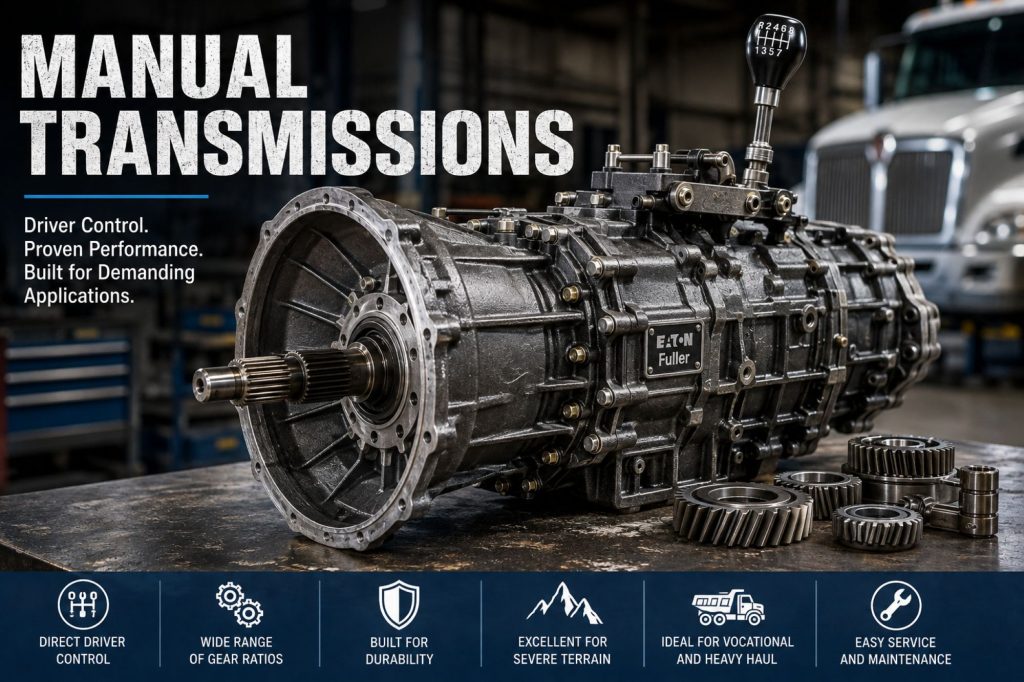
Manual transmissions have played a central role in commercial trucking for decades, providing drivers with direct control over gear selection, engine speed, and power delivery.
Although automated manual and fully automatic transmissions have become increasingly common in modern commercial trucks, traditional manuals remain important throughout heavy-duty, vocational, heavy-haul, construction, logging, and specialized trucking applications.
Truck Equipment Atlas covers manual transmission models and families used throughout the commercial trucking industry, including traditional highway transmissions and specialized vocational configurations.
Manual Transmission Models on Truck Equipment Atlas
Explore the manual commercial truck transmissions currently covered on Truck Equipment Atlas:
- Eaton Fuller 10-Speed Manual
- Eaton Fuller 13-Speed Manual
- Eaton Fuller 18-Speed Manual
- Eaton Fuller 8LL
- Eaton Fuller 9ALL
- Eaton Fuller RT Series
- Eaton Fuller RTLO Series
- Eaton Fuller Super 10
Additional manual transmission models and families will be added as the Truck Equipment Atlas Transmission Library continues to expand.
How Manual Truck Transmissions Work
A traditional commercial truck manual transmission requires the driver to control gear selection while coordinating engine speed, vehicle speed, load, and operating conditions.
Unlike a passenger vehicle manual transmission, many heavy-duty truck transmissions use multiple ranges, splitters, or auxiliary gearing to provide enough ratios for moving heavy loads efficiently.
The driver must select appropriate gearing for acceleration, climbing grades, descending grades, maneuvering, and highway operation.
This direct control is one reason manual transmissions have remained important in demanding commercial applications.
For a step-by-step explanation of power flow and gear reduction, read How Commercial Truck Transmissions Work.
Common Manual Transmission Configurations
Commercial truck manual transmissions have been produced in numerous configurations.
Common examples include:
- 8-speed vocational transmissions
- 9-speed transmissions
- 10-speed transmissions
- 13-speed transmissions
- 18-speed transmissions
- Low-low vocational gearing
- Direct-drive configurations
- Overdrive configurations
- Range transmissions
- Range-splitter transmissions
The number of gears is only one part of transmission selection. Overall ratio spread, low gear reduction, top gear ratio, engine torque, axle ratio, tire size, vehicle weight, and intended application all affect how a transmission performs.
Range and Splitter Systems
Many heavy-duty manual transmissions use range and splitter systems to provide additional gear ratios without requiring an extremely complicated shift pattern.
A range system allows the driver to use one group of gears and then shift into another range.
A splitter allows individual gears or portions of the transmission to be divided into additional ratios.
These systems make it possible for transmissions such as 13-speed and 18-speed Eaton Fuller models to provide the closely spaced ratios needed for heavy loads, changing terrain, and demanding operating conditions.
Highway Applications
Manual transmissions have historically been widely used in long-haul and regional tractors.
Highway applications typically benefit from:
- Broad gear ratio coverage
- Efficient highway gearing
- Direct driver control
- Multiple overdrive configurations
- High torque capacity
- Established service and parts networks
Modern automated manual transmissions have replaced traditional manuals in many new highway fleet specifications, but manual transmissions remain common throughout the existing North American truck population.
Vocational Applications
Manual transmissions continue to have an important role in vocational trucking.
Applications can include:
- Dump trucks
- Logging trucks
- Heavy-haul tractors
- Construction trucks
- Oilfield equipment
- Agricultural trucks
- Severe-service trucks
- Specialized transport equipment
Vocational applications may require extremely low gearing, high torque capacity, precise low-speed control, PTO compatibility, and transmission configurations designed for frequent operation away from normal highway conditions.
Heavy-Haul Applications
Heavy-haul trucking is one area where traditional manual transmissions remain particularly notable.
Moving extremely heavy combinations requires careful management of engine torque, gearing, vehicle speed, and grade.
Transmissions with deep reduction gearing and numerous ratios can help operators maintain appropriate engine speed while moving heavy loads from a stop or climbing steep grades.
The Eaton Fuller 18-speed remains one of the best-known examples of a transmission configuration associated with demanding heavy-haul applications.
Advantages of Manual Transmissions
Depending on the application, manual commercial truck transmissions can offer several advantages:
- Direct driver control
- Broad selection of gear ratios
- Strong torque capacity
- Established service knowledge
- Proven designs
- Specialized vocational gearing
- Excellent control in certain heavy-haul applications
- Fewer automated shift components
These advantages can make manual transmissions attractive for specialized applications even as AMTs become more common in general freight operations.
Limitations of Manual Transmissions
Manual transmissions also have important limitations.
These can include:
- Greater driver workload
- More training required
- Clutch wear
- Greater dependence on driver technique
- Potentially inconsistent shifting between drivers
- Increased fatigue in stop-and-go operations
- Smaller pool of drivers experienced with manual transmissions
Fleet operating requirements and driver availability have contributed significantly to the industry’s movement toward automated transmissions.
Driver Skill and Operation
Proper operation of a heavy-duty manual transmission requires considerably more than simply selecting gears.
Drivers must understand:
- Engine RPM
- Road speed
- Gear selection
- Clutch operation
- Downshifting
- Grade management
- Vehicle weight
- Engine braking
- Transmission range and splitter controls
Experienced drivers often shift based on engine sound, road speed, terrain, and load conditions rather than relying solely on instrumentation.
Poor shifting technique can increase clutch wear, damage drivetrain components, and reduce vehicle performance.
Maintenance and Ownership
Manual transmissions are durable, but they still require proper inspection and maintenance.
Important areas include:
- Transmission lubricant
- Clutch condition
- Clutch adjustment where applicable
- Shift linkage
- Air-operated range and splitter systems
- Seals and gaskets
- Transmission mounts
- Driveshaft and universal joints
- Synchronizer components where equipped
- Signs of gear or bearing wear
Changes in shifting behavior, unusual noise, difficulty selecting gears, lubricant leaks, or excessive driveline vibration should be investigated.
Manual vs. Automated Manual Transmissions
Manual and automated manual transmissions can share similar internal mechanical architectures while providing very different driving experiences.
A traditional manual requires the driver to operate the clutch and select gears.
An automated manual transmission uses electronic controls, actuators, and automated clutch operation to perform much of that work.
This distinction is important because an AMT is not necessarily the same as a conventional fully automatic transmission.
Readers interested in electronically controlled manual transmission technology can explore the Automated Manual Transmissions section.
Compare clutch operation, launch behavior, and application tradeoffs in Manual vs Automated Manual vs Automatic Transmissions.
Related Transmission Categories
Explore additional commercial transmission categories:
- Automated Manual Transmissions
- Automatic Transmissions
- Heavy-Duty Transmissions
- Medium-Duty Transmissions
- Vocational Transmissions
Explore the Complete Transmission Library
Manual transmissions represent one part of the much larger commercial truck drivetrain landscape.
Visit the Truck Equipment Atlas Transmission Library to explore manual, automated manual, automatic, medium-duty, heavy-duty, and vocational transmissions from manufacturers and drivetrain suppliers throughout the trucking industry.
Additional manual transmission models, historical transmission families, and educational resources will be added as Truck Equipment Atlas continues to expand.
Use How to Choose a Commercial Truck Transmission to evaluate the complete powertrain and duty cycle before selecting a model.