
Eaton Fuller Super 10 Transmission
Quick Facts
- Manufacturer: Eaton
- Transmission Type: Heavy-Duty Manual Transmission
- Transmission Family: Eaton Fuller Super 10
- Common Models: RTLO-12610B, RTLO-13610B, RTLO-14610B, RTLO-15610B, RTLO-16610B, and RTLO-18610B configurations
- Number of Forward Speeds: 10
- Number of Reverse Speeds: Commonly Two
- Gear-Lever Positions: Five Forward Positions with Each Position Split into Two Ratios
- Shift Control: Splitter Control with Automatic Range Transition
- Common Torque Ratings: Approximately 1,250 to 1,850 lb-ft depending on model
- Top-Gear Configuration: Overdrive
- Common Top-Gear Ratio: Approximately 0.74:1
- Clutch Type: Driver-Operated Heavy-Duty Dry Clutch
- Common Truck Classes: Class 8
- Common Applications: Line Haul, Regional Haul, Owner-Operator Trucks, and Selected Vocational Applications
- PTO Compatibility: Six-Bolt and Eight-Bolt PTO Provisions depending on model
- Common Oil Capacity: Approximately 28 pints depending on model
- Approximate Length: Around 33 inches depending on configuration
- Production Status: Discontinued Legacy Transmission with Continued Used and Rebuilt Support
Overview
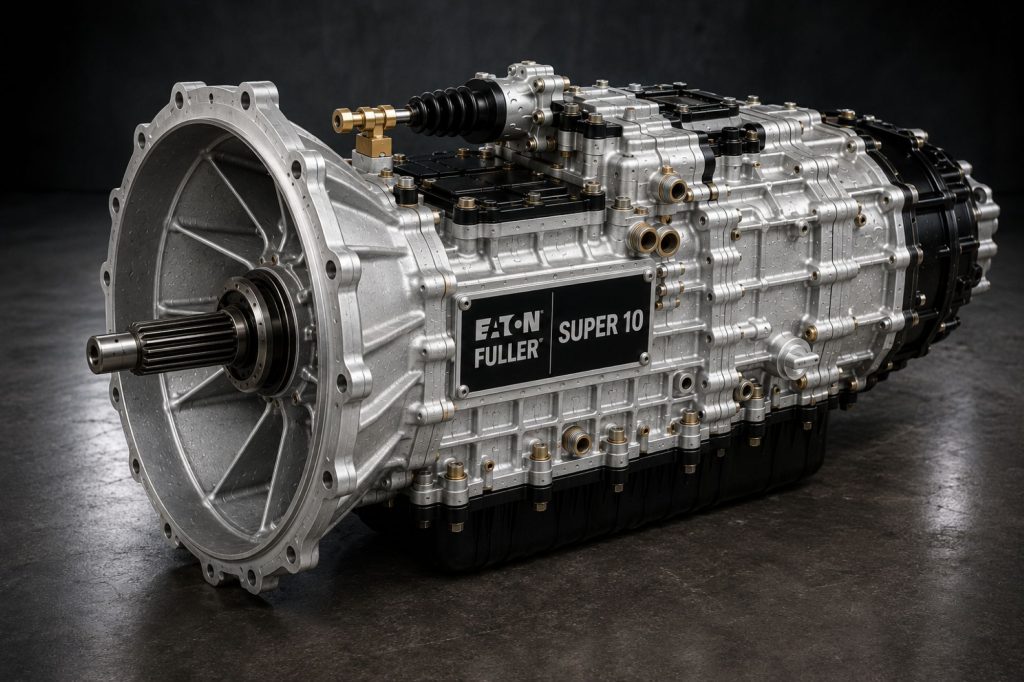
The Eaton Fuller Super 10 is a heavy-duty manual transmission that provides 10 forward ratios through five gear-lever positions.
Unlike a conventional Eaton Fuller 10-speed, the driver does not move the shift lever into a new position for every gear. Each lever position contains two ratios selected with a splitter control mounted on the shift knob.
The driver places the lever in the first position and uses the splitter to move between first and second gears. The lever is then moved to the next position, where the splitter selects third and fourth.
This pattern continues through all 10 forward ratios. The design reduces the number of times the shift lever must be moved during acceleration.
The transmission was used in numerous Class 8 trucks during the 1990s and 2000s. Common applications included Freightliner, Kenworth, Peterbilt, International, Volvo, and Western Star highway tractors.
The Super 10 was developed to provide the ratio coverage of a 10-speed transmission with fewer gear-lever movements. Some drivers appreciated its repeatable split-shift pattern, while others preferred the more familiar range pattern of a conventional 10-speed.
The Super 10 is no longer a primary current-production transmission. Used, rebuilt, and remanufactured units remain available because a substantial number of older trucks continue to operate with it.
Key Characteristics
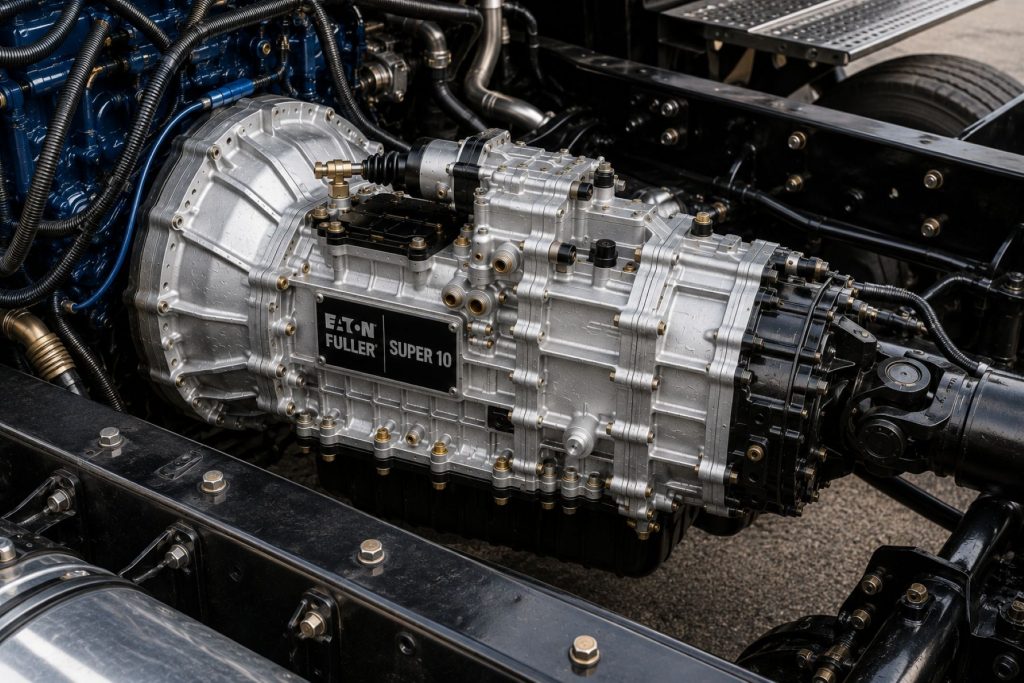
The defining feature of the Eaton Fuller Super 10 is its split-every-position shifting system.
Five forward gear-lever positions are used to create 10 forward ratios. Each position has a lower and upper ratio selected with the splitter control.
The transmission combines a mechanical main gearbox with an air-controlled auxiliary section.
An automatic range transition occurs as the driver moves across the shift pattern at the appropriate point. This eliminates the separate Low-to-High range-selector movement used on a conventional Eaton Fuller 10-speed.
The driver still operates a clutch pedal and manually positions the shift lever. The splitter system does not make the Super 10 an automated transmission.
Most Super 10 models are nonsynchronized through the main gearbox. Proper operation requires matching engine speed, road speed, and the selected ratio.
The transmission uses Eaton’s twin-countershaft construction. Engine torque is divided between two countershafts, improving torque capacity without requiring exceptionally wide gears.
How the Transmission Works
Engine power enters through the clutch and transmission input shaft.
When the clutch is engaged, torque passes into the main gearbox and is divided between the two countershafts.
The selected main-shaft gear and auxiliary-section ratio determine the final output ratio.
The driver begins with the splitter in the lower position. After accelerating, the driver preselects the upper split and briefly releases the accelerator to remove torque from the drivetrain.
When internal speeds synchronize, the auxiliary section completes the split shift. The driver reapplies the accelerator without necessarily moving the shift lever.
For the next ratio pair, the driver returns the splitter to the lower position, moves the shift lever to the next position, and completes the shift.
This process repeats through the transmission:
- First and second gears share one lever position.
- Third and fourth gears share the next position.
- Fifth and sixth gears share the third position.
- Seventh and eighth gears share the fourth position.
- Ninth and tenth gears share the final position.
The exact physical shift pattern varies with the shift-bar housing, installation, and transmission configuration. Drivers should follow the diagram installed in the truck.
Common Specifications
Transmission Type
The Eaton Fuller Super 10 is a driver-operated heavy-duty manual transmission with an air-controlled splitter and auxiliary range section.
Forward Speeds
The transmission provides 10 forward ratios.
Five shift-lever positions are used, with two ratios available in each position.
Reverse Speeds
Most configurations provide two reverse ratios.
The reverse selection and splitter operation must follow the instructions for the specific model.
Common Models
Legacy Super 10 models may include:
- RTLO-12610B
- RTLO-13610B
- RTLO-14610B
- RTLO-15610B
- RTLO-16610B
- RTLO-18610B
RTLO and model suffixes identify torque capacity, ratio design, shift arrangement, and other features.
The transmission identification tag should always be checked before ordering a replacement or internal parts.
Torque Capacity
Torque capacity varies by model designation.
Common nominal ratings include:
- RTLO-12610B: Approximately 1,250 lb-ft
- RTLO-13610B: Approximately 1,350 lb-ft
- RTLO-14610B: Approximately 1,450 lb-ft
- RTLO-15610B: Approximately 1,550 lb-ft
- RTLO-16610B: Approximately 1,650 lb-ft
- RTLO-18610B: Approximately 1,850 lb-ft
Not every model or rating was available in every year or truck.
Gear Ratios
Gear ratios vary among A-, B-, C-, and other ratio sets.
A representative overdrive Super 10 ratio progression may include approximately:
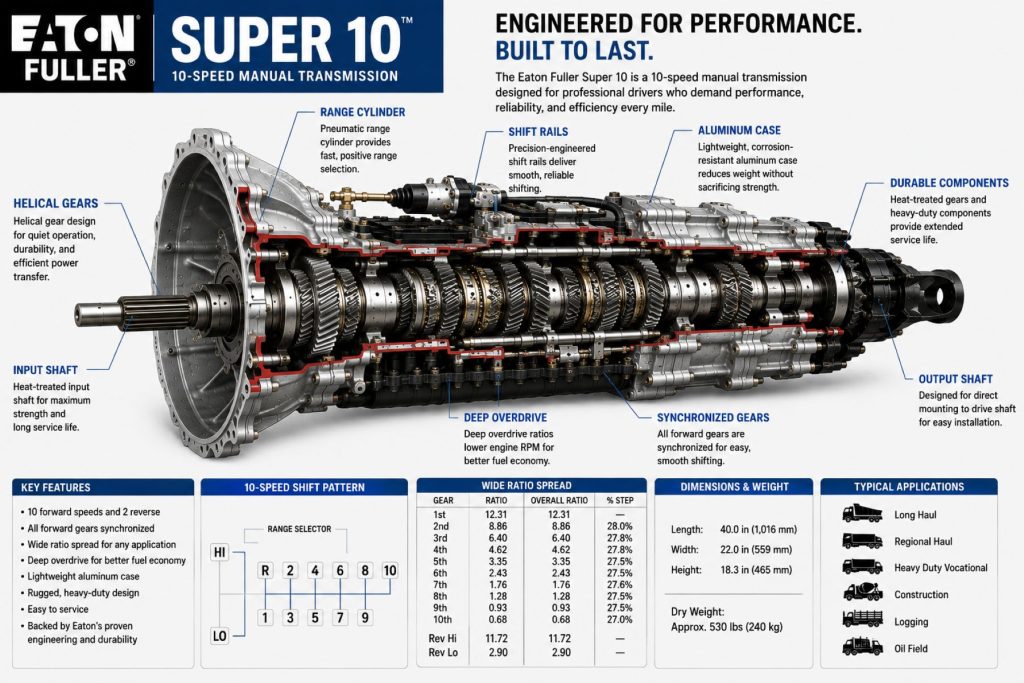
- First Gear: 12.80:1
- Second Gear: 9.24:1
- Third Gear: 6.73:1
- Fourth Gear: 4.86:1
- Fifth Gear: 3.55:1
- Sixth Gear: 2.57:1
- Seventh Gear: 1.87:1
- Eighth Gear: 1.35:1
- Ninth Gear: 1.00:1
- Tenth Gear: 0.74:1
These should be treated as representative ratios. Exact ratios must be confirmed using the model designation and Eaton specifications.
Top Gear
Most Super 10 applications use an overdrive top gear, commonly around 0.74:1.
Rear-axle ratio and tire size must be matched to the overdrive gearing.
Shift Controls
The shift controls include:
- A mechanical shift lever
- A splitter control mounted on the shift knob
- Air-operated auxiliary-section components
- Automatic range-transition components
The Super 10 does not use the same range-selector procedure as a conventional Eaton Fuller 10-speed.
Clutch System
The Super 10 uses a driver-operated heavy-duty dry clutch.
A 15.5-inch twin-disc clutch is common in Class 8 applications, although clutch size and rating depend on the engine and truck.
Clutch Brake
The clutch brake slows or stops the rotating input gearing when selecting a starting gear from a standstill.
It should not be used during normal moving shifts.
Twin-Countershaft Construction
Torque is divided between two countershafts.
This provides high torque capacity while controlling gear size and transmission weight.
Synchronization
The primary gearbox is generally nonsynchronized.
The auxiliary splitter and range systems use their own shifting and synchronizing mechanisms. The driver must still match engine speed for main-box shifts.
Transmission Length
Many Super 10 configurations are approximately 33 inches long.
Exact dimensions depend on model, clutch housing, shift arrangement, input shaft, and output configuration.
Transmission Weight
Many Super 10 models weigh approximately 700 to 730 pounds before lubricant and installation-specific components.
Exact weight must be confirmed for the model being installed.
Oil Capacity
A common lubricant capacity is approximately 28 pints, or about 13 liters.
The final oil level should be checked at the fill opening rather than relying only on a listed capacity.
Recommended Lubricant
Eaton PS-386-approved lubricant is generally appropriate for current service of many Eaton heavy-duty manual transmissions.
The correct specification should be verified using the Super 10 model, serial number, and service literature.
Transmission Cooling
An integral oil pump, external oil cooler, or filter may be installed depending on engine power, GCWR, application, and original specification.
PTO Compatibility
Applicable Super 10 models can support six-bolt and eight-bolt PTO installations.
PTO ratio, rotation, torque rating, location, and lubrication requirements depend on the transmission model.
Installation Requirements
Installation requires a compatible engine, clutch, flywheel housing, input shaft, mounts, driveshaft, air system, splitter controls, rear-axle ratio, cooling system, and PTO equipment.
Common Applications
- Long-haul freight transportation
- Regional freight transportation
- Dry van transportation
- Refrigerated transportation
- Flatbed transportation
- Tanker transportation
- Owner-operator trucks
- Day cab tractors
- Sleeper tractors
- Local pickup and delivery
- Agricultural transportation
- Logging operations
- Selected dump-truck applications
- Older Class 8 fleet trucks
Truck and Engine Compatibility
The Eaton Fuller Super 10 was offered in numerous Class 8 truck platforms.
Common applications may include the Freightliner Century Class, Freightliner Columbia, Kenworth T600, Kenworth T660, Kenworth T800, Peterbilt 379, Peterbilt 385, Peterbilt 386, International 9200, International 9400, International 9900, International ProStar, Volvo VNL, and Western Star 4900.
Exact availability depends heavily on model year. Most Super 10-equipped trucks are now found in the used market.
Common engine pairings may include:
- Detroit Series 60
- Cummins N14
- Cummins ISM
- Cummins ISX
- Caterpillar C13
- Caterpillar C15
- Caterpillar 3406E
Mack and Volvo diesel engines in applicable legacy configurations
The exact transmission model must be rated for the engine’s peak torque.
Advantages
- Provides 10 forward ratios
- Uses only five forward lever positions
- Each lever position contains two ratios
- Reduces the number of full lever movements
- Repeatable split-shift pattern
- Overdrive top gear supports highway operation
- Available in multiple torque capacities
- Twin-countershaft construction
- Driver retains direct control
- Mechanical design limits electronic complexity
- Compatible with multiple older truck brands
- Supports vocational PTO installations
- Used and rebuilt units remain available
- Some drivers find it less tiring than a conventional 10-speed
- Provides closer ratio progression than a basic five-speed pattern
- No electronic transmission control module is required for normal operation
Limitations or Considerations
- No longer a primary current-production transmission
- Requires Super 10-specific driver training
- Shift pattern differs from a conventional 10-speed
- Some drivers find the splitter pattern unintuitive
- Uses a driver-operated clutch
- Primary gears are generally nonsynchronized
- Air-system faults can interrupt splitter operation
- Automatic range-transition problems can prevent normal shifting
- Improper preselection can damage auxiliary components
- Clutch replacement remains a normal expense
- Parts availability can vary by model
- Fewer technicians regularly work on Super 10 units today
- Used transmissions may have high mileage
- Incorrect model identification can lead to incompatible parts
- Changing to another transmission can require driveline modifications
Driver and Operator Experience
The Super 10 feels different from a conventional 10-speed because the driver splits every shift-lever position.
A typical shift sequence begins with the splitter in the lower position. The driver accelerates, preselects the upper split, releases the accelerator, and allows the transmission to complete the shift.
For the next ratio, the splitter is returned to the lower position and the shift lever is moved into the next gate.
The process repeats through all five lever positions.
The driver should preselect the splitter before removing torque from the drivetrain. The air system completes the shift when engine and transmission speeds permit.
Double-clutching is the standard method when moving the shift lever between positions.
A splitter-only shift can often be completed without using the clutch by releasing and reapplying the accelerator correctly.
Drivers should not force the lever or splitter shift. If the transmission does not complete the change, engine and road speeds may not be properly matched.
Maintenance and Ownership Notes
The transmission requires the correct lubricant and oil level.
Oil should be checked at the fill opening with the truck positioned according to Eaton procedures.
The transmission should be inspected for leaks around the input shaft, output seal, countershaft bearing covers, auxiliary housing, shift-bar housing, PTO openings, fill plug, and drain plug.
The air system is especially important. Moisture, contamination, damaged lines, low pressure, or leaking seals can prevent proper splitter and range operation.
The shift knob, splitter valve, air lines, slave valves, and auxiliary cylinders should be inspected when shifts become slow or inconsistent.
Clutch free travel, release movement, and clutch-brake operation should be checked regularly.
Driveline vibration can damage transmission bearings and output components. Universal joints, carrier bearings, driveshaft balance, and axles and differentials should be included in the maintenance program.
Common Transmission Problems
Splitter Failure
A failed splitter valve, leaking air line, worn seal, low air pressure, or internal auxiliary problem can prevent shifts between the two ratios in each lever position.
Incomplete Range Transition
The transmission may fail to transition between its lower and upper operating sections because of air-control problems, synchronizer wear, or incorrect driver technique.
Gear Grinding
Grinding can result from improper rpm matching, incomplete clutch release, worn engagement teeth, or forcing the shift lever.
Jumping Out of Gear
Possible causes include worn sliding clutches, damaged engagement teeth, worn shift forks, bearing wear, excessive end play, loose mounts, or external linkage problems.
Clutch Drag
A clutch that does not release fully can cause difficult shifting and gear clash.
Common causes include incorrect adjustment, damaged linkage, warped discs, release-bearing problems, or pilot-bearing failure.
Clutch Brake Wear
A worn clutch brake can make it difficult to select a starting gear while the truck is stationary.
Using the clutch brake during moving shifts accelerates wear.
Air Leaks
Air leaks around the shift knob, splitter valve, range valve, fittings, cylinders, or transmission cover can create slow or failed shifts.
Bearing Noise
Worn input, countershaft, main-shaft, auxiliary, or output bearings may cause whining, growling, rumbling, or vibration.
Oil Leaks
Common leak points include seals, bearing covers, PTO openings, housing joints, plugs, pumps, and cooler connections.
Synchronizer Wear
The auxiliary section uses synchronizing components. Wear can cause grinding, delayed shifts, or failure to complete splitter or range changes.
PTO Problems
PTO problems may result from incorrect backlash, damaged gears, loose mounting, low lubricant, control faults, or excessive hydraulic load.
Buying Considerations
- Confirm that the transmission is a genuine Super 10.
- Do not assume every Eaton 10-speed is a Super 10.
- Record the complete model and serial number.
- Confirm the transmission’s torque capacity.
- Determine the exact ratio set.
- Verify the truck’s engine peak torque.
- Confirm the rear-axle ratio and tire size.
- Check the input-shaft dimensions and spline configuration.
- Verify the clutch and flywheel-housing compatibility.
- Confirm transmission length and mounting.
- Check output-yoke or flange compatibility.
- Test all 10 forward ratios.
- Test both reverse ratios.
- Verify every splitter shift.
- Confirm that the automatic range transition works.
- Listen for air leaks.
- Inspect the case for cracks, welding, or impact damage.
- Check input and output shafts for excessive movement.
- Inspect lubricant for water, metal, or debris.
- Check for leaks around seals and bearing covers.
- Inspect the clutch, clutch brake, linkage, and release system.
- Review rebuild and maintenance history.
- Confirm replacement parts and technician availability.
Variants and Configurations
- Eaton Fuller RTLO-12610B
- Eaton Fuller RTLO-13610B
- Eaton Fuller RTLO-14610B
- Eaton Fuller RTLO-15610B
- Eaton Fuller RTLO-16610B
- Eaton Fuller RTLO-18610B
- 1,250 lb-ft Configuration
- 1,350 lb-ft Configuration
- 1,450 lb-ft Configuration
- 1,550 lb-ft Configuration
- 1,650 lb-ft Configuration
- 1,850 lb-ft Configuration
- A-Ratio Configuration
- B-Ratio Configuration
- C-Ratio Configuration
- Overdrive Configuration
- Line-Haul Configuration
- Regional-Haul Configuration
- Six-Bolt PTO Configuration
- Eight-Bolt PTO Configuration
- Integral Oil-Pump Configuration
- External-Cooler Configuration
Comparison to Similar Equipment
Compared with the Eaton Fuller 10-Speed Manual, the Super 10 splits each of five lever positions. The conventional 10-speed uses a separate lever movement for each forward gear and repeats its pattern across Low and High ranges.
Compared with the Eaton Fuller 13-Speed Manual, the Super 10 has fewer total ratios and less highway flexibility. The Super 10 uses fewer lever positions and a simpler split-every-position concept.
Compared with the Eaton Fuller 18-Speed Manual, the Super 10 is less complex but provides fewer ratios and less heavy-haul flexibility.
Compared with the Eaton Fuller 8LL, the Super 10 is oriented more toward road operation. The 8LL provides deep-reduction ratios for vocational and off-road maneuvering.
Compared with the Eaton Fuller 9ALL, the Super 10 has much less low-speed reduction. The 9ALL is intended for concrete, asphalt, and specialized low-speed work.
Compared with Eaton AutoShift, the Super 10 requires full manual clutch and gear operation. AutoShift automates gear selection but may retain a clutch pedal for starting and stopping on certain configurations.
Best Fit For
- Drivers experienced with the Super 10 pattern
- Owner-operators who prefer manual control
- Older Class 8 highway tractors
- Regional freight operations
- Long-haul trucks already equipped with a Super 10
- Fleets maintaining legacy Eaton transmissions
- Buyers seeking a replacement for an existing Super 10
- Applications operating within the model’s torque rating
- Trucks with compatible driveline and axle gearing
- Operations with access to experienced rebuilders
Related Truck Types
- Sleeper Trucks
- Day Cab Trucks
- Vocational Trucks
- Regional-Haul Trucks
- Owner-Operator Trucks
- Legacy Class 8 Trucks
Related Truck Models
- Freightliner Century Class
- Freightliner Columbia
- Kenworth T600
- Kenworth T660
- Kenworth T800
- Peterbilt 379
- Peterbilt 385
- Peterbilt 386
- International 9200
- International 9400
- International 9900
- International ProStar
- Volvo VNL
- Western Star 4900
Related Engines
- Detroit Series 60
- Cummins N14
- Cummins ISM
- Cummins ISX
- Caterpillar C13
- Caterpillar C15
- Caterpillar 3406E
- Volvo D13
Related Transmission Types
- Manual Transmissions
- Heavy-Duty Transmissions
- Overdrive Transmissions
- Splitter Transmissions
- Range-and-Splitter Transmissions
- Highway Transmissions
- Legacy Transmissions
Related Equipment Systems
- Heavy-Duty Clutches
- Clutch Brakes
- Splitter Controls
- Air-Shift Systems
- Range Synchronizers
- Driveshafts
- Axles and Differentials
- Transmission Lubrication Systems
- Transmission Cooling Systems
- Six-Bolt and Eight-Bolt PTOs
- PTO Systems
Related Guides
- How Diesel Truck Engines Work
- Understanding Horsepower vs Torque
- How to Choose the Right Commercial Truck
Understand the operating principles in How Commercial Truck Transmissions Work, compare drivetrain designs in Manual vs Automated Manual vs Automatic Transmissions, and evaluate gearing, application, and compatibility in How to Choose a Commercial Truck Transmission.
Regulatory and Compliance Notes
The Eaton Fuller Super 10 must be matched to the engine’s peak torque, vehicle weight, clutch, driveshaft, axle ratio, and intended application.
The transmission rating does not authorize operation above federal, state, provincial, axle, tire, chassis, bridge-formula, or permit limits.
Replacement transmissions must preserve correct driveline geometry, mounting, speedometer operation, reverse-light function, and PTO controls.
Drivers must be trained in Super 10 splitter and range operation. The transmission’s shifting procedure differs from a conventional 10-speed.
PTO-driven equipment must be correctly rated, installed, guarded, and controlled.
Real World Operating Notes
Drivers familiar with the Super 10 often appreciate making fewer full gear-lever movements.
The splitter should be preselected before the driver removes torque from the transmission. The shift completes when engine and transmission speeds synchronize.
The transmission should never be forced into a split or lever position. Resistance usually indicates incorrect rpm matching, remaining driveline torque, or an air-system problem.
Drivers transitioning from a conventional 10-speed may initially attempt to move the lever for every gear. Super 10 operation requires learning to split each position instead.
A truck with a properly functioning air system and a correctly adjusted clutch generally shifts more consistently than one with leaks or clutch drag.
Because these transmissions are now older, truck condition matters as much as the original model. Air leaks, worn shift knobs, tired clutches, bearing wear, and unknown rebuild histories are common concerns.
Frequently Asked Questions
What is an Eaton Fuller Super 10?
It is a heavy-duty manual transmission that provides 10 forward ratios through five shift-lever positions, with each position split into two gears.
Is the Super 10 the same as a regular 10-speed?
No. A conventional 10-speed uses a separate lever movement for each gear across Low and High ranges. The Super 10 splits each of five lever positions.
Does the Super 10 have a range selector?
Its range transition is incorporated into the transmission’s operating pattern rather than using the conventional separate range-selector procedure found on a standard 10-speed.
Does the Super 10 have a clutch pedal?
Yes. It is a manual transmission with a driver-operated clutch.
Is the Super 10 synchronized?
The primary gearbox is generally nonsynchronized. Drivers must match engine speed to road speed and the selected gear.
How many times does the driver move the shift lever?
The driver uses five forward lever positions. Each position contains two ratios selected with the splitter.
How much torque can a Super 10 handle?
Torque capacity depends on the model. Common versions range from approximately 1,250 to 1,850 lb-ft.
Is the Super 10 an overdrive transmission?
Most common Super 10 models use an overdrive top gear, often approximately 0.74:1.
What trucks used the Super 10?
It was available in numerous Freightliner, Kenworth, Peterbilt, International, Volvo, and Western Star Class 8 trucks.
Is the Super 10 still produced?
It is primarily considered a discontinued legacy transmission. Used, rebuilt, and remanufactured units remain available.
Is the Super 10 difficult to drive?
It requires learning a different shifting rhythm from a conventional 10-speed. Drivers experienced with splitter transmissions may adapt quickly.
Can a regular 10-speed replace a Super 10?
A conversion may be possible, but transmission length, mounts, driveshaft, shift controls, air lines, clutch, output arrangement, and axle gearing must be evaluated.
Can the Super 10 operate a PTO?
Applicable models support six-bolt or eight-bolt PTO installations.
Why does a Super 10 fail to split gears?
Common causes include low air pressure, leaking lines, a failed shift-knob valve, worn seals, auxiliary-section damage, or incorrect driver technique.
Availability and Where to Find
The Eaton Fuller Super 10 is primarily available through the used, rebuilt, and remanufactured transmission market.
Potential sources include Eaton distributors, commercial transmission rebuilders, truck salvage operations, used-parts dealers, auctions, owner-operator equipment sales, and commercial truck marketplaces.
Buyers should verify the full model and serial number because several Super 10 torque ratings and ratio configurations were produced.
A seller’s statement that a transmission is a “10-speed” is not enough to identify it as a Super 10.
Eaton continues to provide an official Super 10 driver-training video explaining the transmission’s operating pattern.
Support Trucking Families
Truck Equipment Atlas supports the mission of Grey Cross, a nonprofit dedicated to helping families of truck drivers who lose their lives while on the road. As the site grows, part of its mission is to bring awareness and support to these families.
Podcast or Video Section
Learn More Through Audio and Video
Truck Equipment Atlas will continue expanding with podcast episodes, interviews, and equipment breakdowns to help drivers and fleets better understand trucks and equipment.
Follow the Growth of Truck Equipment Atlas
Truck Equipment Atlas continues to expand with new truck profiles, trailer coverage, diesel engine pages, equipment system resources, manufacturer information, and educational guides.
Visit our Site Updates page to explore recent additions, project milestones, and upcoming resources as we continue building one of the industry’s growing commercial trucking equipment reference libraries.
View the Latest Site Updates: Truck Equipment Atlas Site Updates