
Allison 1000 Series Automatic Transmission
Quick Facts
- Manufacturer: Allison Transmission
- Transmission Family: Allison 1000 Series
- Transmission Type: Fully Automatic Commercial Vehicle Transmission
- Forward Speeds: Five or Six depending on model and production year
- Reverse Speeds: One
- Torque-Transfer System: Hydraulic Torque Converter with Lockup Clutch
- Maximum Engine Power: Up to approximately 365 horsepower within the combined 1000 and 2000 Series application range
- Maximum Input Torque: Up to approximately 700 lb-ft depending on model and application
- Maximum Gross Vehicle Weight: Up to approximately 33,000 lbs within approved 1000 and 2000 Series applications
- Common Models and Designations: Allison 1000, 1000 HS, and application-specific OEM versions
- Common Operating Ranges: Park, Reverse, Neutral, Drive, Manual, and Low depending on shift-control design
- Common Gear Configuration: Six-Speed Overdrive on newer models
- Earlier Configuration: Five-Speed Overdrive
- Clutch Pedal: None
- PTO Compatibility: Limited and model-specific; many Allison 1000 configurations do not include a transmission-mounted PTO opening
- Common Applications: Pickup and Delivery, Utility Trucks, Ambulances, Light Construction, Commercial Chassis Cabs, Motorhomes, Tow Vehicles, and Medium-Duty Vocational Trucks
- Common Truck Classes: Class 4, Class 5, Class 6, and lighter Class 7 applications
- Production Status: Active Product Family with extensive legacy support
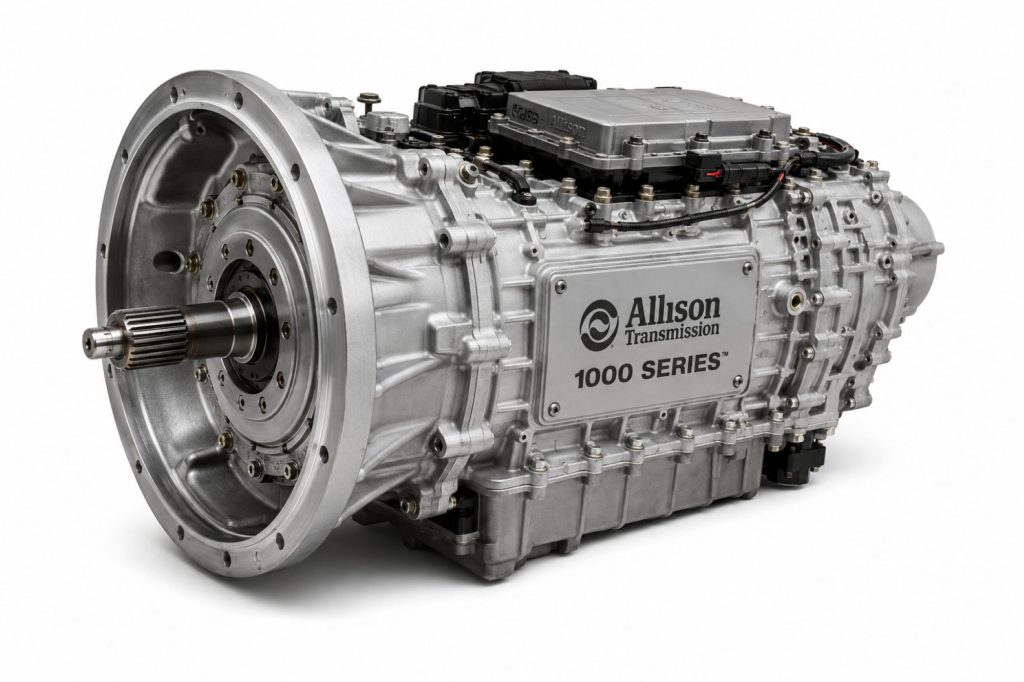
Overview
The Allison 1000 Series is a fully automatic transmission designed for light- and medium-duty commercial vehicles requiring smooth launches, dependable low-speed control, and reduced driver workload.
Unlike an automated manual transmission, the Allison 1000 uses a hydraulic torque converter to transfer power from the engine during launch and low-speed operation. The torque converter allows the truck to begin moving without using a dry clutch or interrupting power in the same way as a manual or automated manual transmission.
Once the vehicle reaches appropriate operating conditions, a lockup clutch inside the torque converter creates a more direct mechanical connection to improve efficiency and reduce heat.
Earlier Allison 1000 transmissions commonly provided five forward speeds. Later versions added a sixth forward gear, providing two overdrive ratios for lower engine speed during highway travel.
The Allison 1000 became especially well known through its use in Chevrolet and GMC heavy-duty pickups with the Duramax diesel engine. However, the transmission family also serves commercial chassis cabs, ambulances, utility trucks, delivery vehicles, tow trucks, motorhomes, and other light- and medium-duty vehicles.
It is smaller and lighter than the Allison 2000, 3000, and 4000 Series transmissions. Fleets must remain within the torque, horsepower, weight, cooling, and application limits approved for the specific Allison 1000 model.
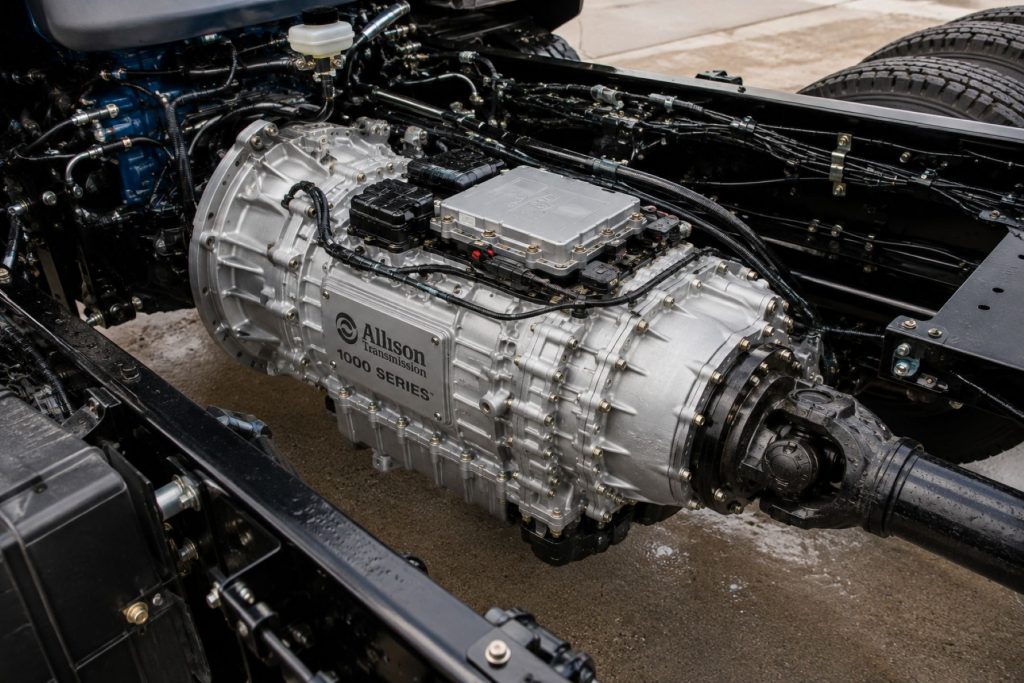
Key Characteristics
The Allison 1000 is a fully automatic transmission rather than an automated version of a manual gearbox.
Its torque converter provides smooth power delivery from a stop. This improves maneuverability during backing, trailer positioning, urban delivery, towing, and stop-and-go vocational work.
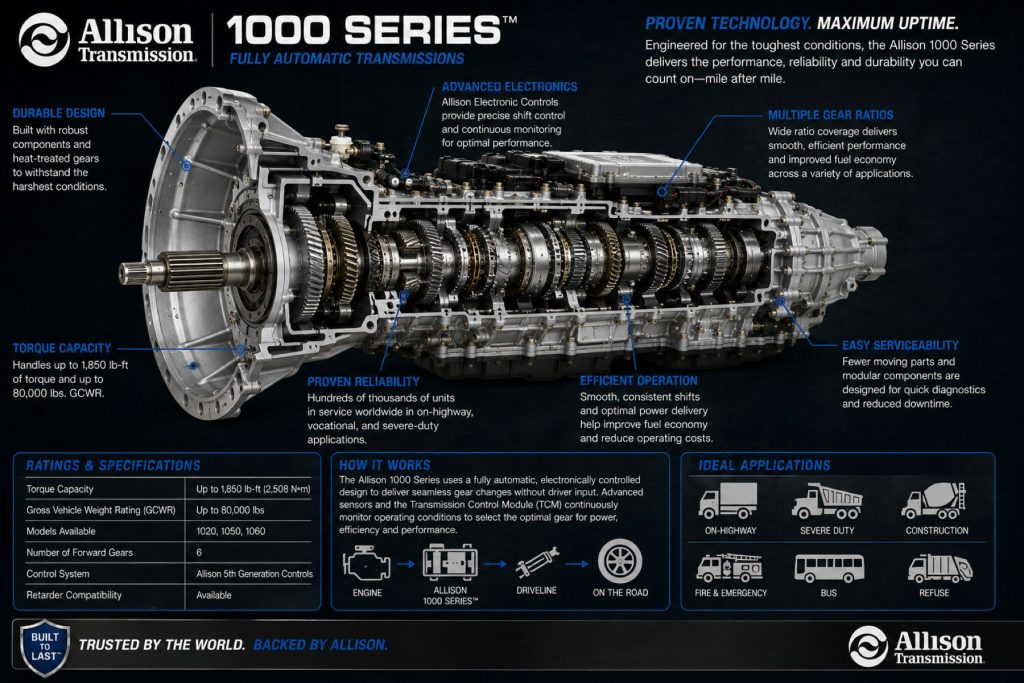
Internal planetary gearsets create the transmission’s forward and reverse ratios. Multiple hydraulic clutch packs engage different gear elements as the transmission moves through its operating ranges.
An electronic Transmission Control Module monitors engine speed, vehicle speed, throttle demand, transmission temperature, load, brake inputs, and other data to select the appropriate gear.
The torque-converter lockup clutch reduces slippage after launch. Lockup operation can occur in multiple gears depending on the model, calibration, load, and operating conditions.
Newer six-speed versions use fifth and sixth gears as overdrive ratios. This can reduce highway engine speed and improve fuel economy when matched with the correct axle gearing.
The transmission’s electronic controls also provide shift protection, temperature monitoring, diagnostic codes, adaptive behavior, and engine-torque coordination.
How the Transmission Works
Engine power enters the Allison 1000 through the torque converter.
The torque converter contains an impeller, turbine, stator, transmission fluid, and lockup clutch. It transfers and can multiply engine torque during vehicle launch.
Torque-Converter Operation
The engine turns the torque converter’s impeller. Moving transmission fluid transfers power to the turbine, which drives the transmission input.
The stator redirects fluid flow during launch and helps multiply torque when the engine and turbine are operating at different speeds.
This hydraulic connection allows the truck to remain stopped in Drive without disengaging a clutch.
Torque-Converter Lockup
Once operating conditions are appropriate, the lockup clutch connects the engine and transmission more directly.
Lockup reduces hydraulic slippage, lowers transmission temperature, and improves fuel efficiency.
The Transmission Control Module determines when the converter should lock or unlock based on speed, load, throttle demand, temperature, and selected gear.
Planetary Gearsets
The Allison 1000 uses planetary gearsets rather than the parallel-shaft gearing found in most manual transmissions.
Different combinations of internal clutch packs hold or drive elements of the planetary sets to create each gear ratio.
Automatic Shifting
The Transmission Control Module selects gears using information such as:
- Vehicle speed
- Engine speed
- Throttle position
- Calculated load
- Brake-pedal input
- Transmission-fluid temperature
- Selected operating range
- Engine-torque demand
The transmission coordinates with the engine controller to reduce torque during certain shifts and protect internal components.
Manual Range Selection
Many Allison 1000-equipped vehicles allow the driver to limit the highest available gear or request specific operating ranges.
The system may prevent a selection that could overspeed the engine or damage the transmission.
Tow/Haul Operation
Tow/Haul programming changes shift timing, torque-converter operation, and downshift behavior for towing or heavy-load operation.
It may hold lower gears longer during acceleration and downshift earlier during deceleration.
Grade Braking
On equipped vehicles, grade-braking logic can downshift the transmission when descending a hill.
This increases engine speed and allows the engine or exhaust brake to help control vehicle speed.
Common Specifications
Transmission Type
The Allison 1000 is a fully automatic electronically controlled transmission with a hydraulic torque converter, lockup clutch, planetary gearsets, and multiple hydraulic clutch packs.
Forward Speeds
Earlier Allison 1000 transmissions commonly provide five forward speeds.
Later models commonly provide six forward speeds.
The model year and complete transmission identification should be checked before ordering parts or selecting a replacement.
Reverse Speeds
The transmission provides one reverse range.
Reverse uses a deep reduction ratio to support controlled backing and maneuvering.
Maximum Engine Power
The combined Allison 1000 and 2000 Series family supports engine ratings from approximately 210 to 365 horsepower.
The precise Allison 1000 limit depends on the model, duty cycle, vehicle configuration, and application approval.
Maximum Input Torque
The combined 1000 and 2000 Series family supports input torque up to approximately 700 lb-ft.
Individual Allison 1000 models and older production versions may have lower ratings.
Gross Vehicle Weight
Allison lists combined 1000 and 2000 Series applications supporting gross vehicle weights of up to approximately 33,000 pounds.
The approved weight for a specific Allison 1000 installation may be lower and depends on the truck, engine, cooling system, axle ratio, duty cycle, and manufacturer approval.
First-Gear Ratio
A common Allison 1000 first-gear ratio is approximately 3.10:1.
This works with torque-converter multiplication to provide strong launch performance.
Second-Gear Ratio
A common second-gear ratio is approximately 1.81:1.
Third-Gear Ratio
A common third-gear ratio is approximately 1.41:1.
Fourth-Gear Ratio
Fourth gear commonly uses a 1.00:1 direct-drive ratio.
Fifth-Gear Ratio
Fifth gear commonly uses an overdrive ratio of approximately 0.71:1.
Sixth-Gear Ratio
On six-speed models, sixth gear commonly uses an overdrive ratio of approximately 0.61:1.
Reverse Ratio
A common reverse ratio is approximately 4.49:1.
Gear ratios should be verified for the exact model because OEM and production-year differences may apply.
Torque Converter
The torque converter provides hydraulic power transfer and torque multiplication during vehicle launch.
Converter specifications vary by engine, truck, stall-speed requirement, and application.
Lockup Clutch
The torque converter includes an electronically controlled lockup clutch.
Lockup improves efficiency by reducing converter slippage after launch.
Internal Clutch Packs
Hydraulically applied clutch packs select the different planetary gear combinations.
Clutch-pack condition, hydraulic pressure, fluid quality, and electronic commands affect shift quality.
Transmission Control Module
The Transmission Control Module manages:
- Gear selection
- Shift timing
- Line pressure
- Torque-converter lockup
- Temperature protection
- Engine communication
- Range protection
- Diagnostic monitoring
Shift Controls
Shift controls vary by truck and model year.
Common arrangements include:
- Column-mounted selector
- Console-mounted lever
- Push-button selector
- OEM-integrated electronic selector
Transmission Weight
Weight varies by case design, torque converter, output equipment, parking mechanism, and OEM configuration.
Many Allison 1000 units weigh approximately 330–360 pounds without transmission fluid.
Transmission Fluid
Allison recommends approved transmission fluid meeting the specification required for the model and application.
Allison TES 668-approved fluid is recommended for many current and legacy on-highway applications.
Allison TES 295 and TES 468-approved fluids may also be approved for certain models and service programs.
Fluid Capacity
Fluid capacity varies by sump depth, torque converter, cooling circuit, filter arrangement, and whether the transmission is being serviced or filled after overhaul.
The correct capacity should be identified using the transmission model, serial number, and vehicle service information.
Transmission Cooling
The Allison 1000 requires an effective transmission-fluid cooling system.
Cooling may use a radiator-integrated heat exchanger, external air-to-oil cooler, or a combination of both.
Towing, high ambient temperature, stop-and-go operation, and mountainous terrain increase cooling requirements.
External Filter
Certain Allison 1000 configurations use an external spin-on filter in addition to an internal filter.
Filter arrangements and replacement intervals vary by model and production year.
PTO Compatibility
PTO availability is limited and depends on the exact Allison 1000 model, case, truck, and OEM application.
Many pickup-based Allison 1000 transmissions do not have a usable transmission-mounted PTO opening.
Commercial chassis-cab buyers requiring a PTO should verify compatibility before ordering the vehicle. If a PTO is essential, an Allison 2000 or larger transmission may provide broader support.
Additional information is available in PTO System Explained.
Parking Mechanism
Many Allison 1000 configurations include a Park position and internal parking pawl.
Certain commercial applications may use different parking-brake arrangements.
Diagnostics
The Allison 1000 stores diagnostic trouble codes for electronic, hydraulic, temperature, speed-sensor, solenoid, and communication problems.
Allison DOC and compatible OEM diagnostic systems can retrieve codes and monitor operating data.
Installation Requirements
Installation must account for:
- Engine torque
- Engine horsepower
- Torque-converter selection
- Bellhousing compatibility
- Electronic communication
- Cooling capacity
- Rear-axle ratio
- Tire size
- Driveshaft length and angle
- Output configuration
- Shift controls
- Vehicle weight
- Duty cycle
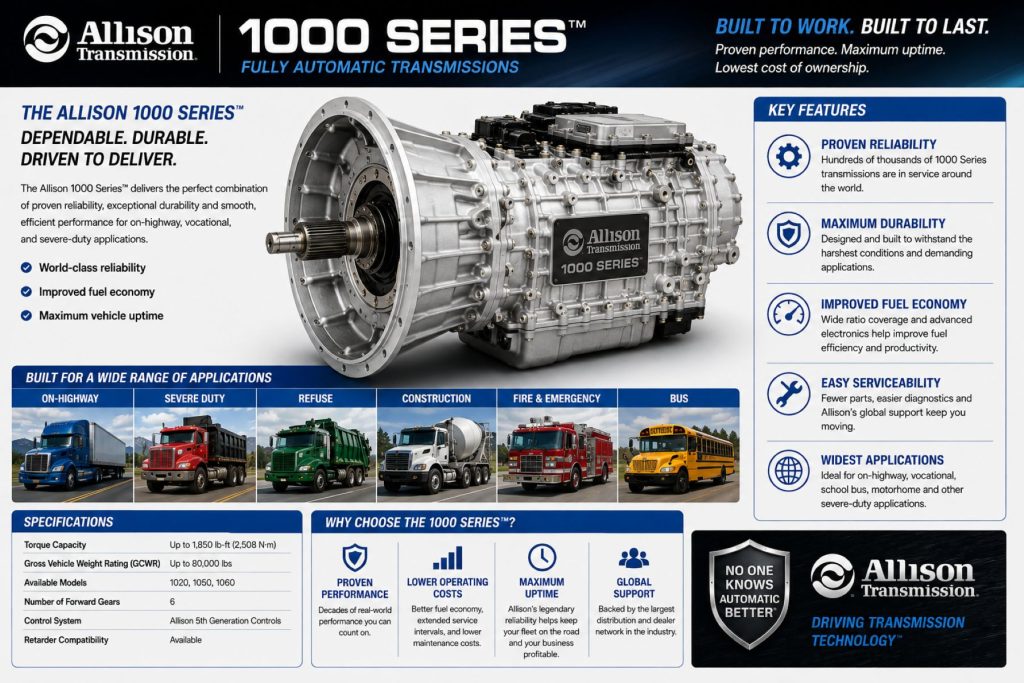
Common Applications
- Pickup and delivery trucks
- Commercial chassis cabs
- Ambulances
- Utility trucks
- Service trucks
- Tow trucks
- Light wreckers
- Landscape trucks
- Light dump trucks
- Snowplow trucks
- Fire and emergency-support vehicles
- Motorhomes
- Shuttle vehicles
- Delivery vans
- Beverage trucks
- Construction-support trucks
- Trailer-towing vehicles
- Municipal vehicles
- Agricultural service trucks
Truck and Engine Compatibility
The Allison 1000 has been installed across commercial vehicles from Chevrolet, GMC, International, Freightliner, and other manufacturers.
It is especially well known for its use with the 6.6-liter Duramax diesel in Chevrolet and GMC heavy-duty pickups and chassis cabs.
Commercial truck applications may include Chevrolet Silverado HD and GMC Sierra HD chassis cabs, the Chevrolet 4500HD through 6500HD family, and comparable commercial vehicles.
The Allison 1000 may also be found in certain International MV Series and lighter commercial truck configurations, although heavier models frequently use Allison 2000 or 3000 Series transmissions.
The transmission has been paired with engines such as the Duramax 6.6 Commercial, Cummins B6.7, Cummins ISB, and other light- or medium-duty diesel and gasoline engines.
Compatibility depends on the exact engine rating. Engines exceeding the approved input-torque or horsepower rating require a higher-capacity transmission.
Electronic compatibility is also necessary. The engine controller, Transmission Control Module, wiring, vehicle network, shift controls, instrument cluster, and brake systems must communicate correctly.
Advantages
- Fully automatic operation
- No clutch pedal
- Smooth torque-converter launch
- Uninterrupted power during initial acceleration
- Strong low-speed maneuverability
- Well suited to stop-and-go operation
- Five- and six-speed versions are available
- Two overdrive ratios on six-speed models
- Tow/Haul programming
- Grade-braking capability
- Torque-converter lockup improves efficiency
- Electronic shift protection
- Broad commercial service familiarity
- Large replacement-parts market
- Strong remanufactured availability
- Common pairing with the Duramax diesel
- Good fit for towing
- Good fit for ambulances and emergency vehicles
- Easier for inexperienced drivers to operate
- Reduces driver fatigue in urban service
Limitations or Considerations
- Lower torque capacity than larger Allison transmissions
- Lower weight capacity than the Allison 2000 or 3000 Series
- Torque converter generates heat during heavy operation
- Requires an effective cooling system
- Generally heavier than some comparable manual transmissions
- Hydraulic operation can create greater parasitic loss than an automated manual
- Fluid and filter maintenance is critical
- Overheating can damage internal clutch packs
- PTO availability is limited
- Not intended for heavy Class 8 applications
- Not designed for extreme heavy haul
- Early five-speed versions have higher highway engine speed than later six-speeds
- Electronic faults can cause reduced-power or limp operation
- Rebuilding can be expensive
- Modified diesel engines can exceed the transmission’s rating
Driver and Operator Experience
The Allison 1000 provides familiar automatic-transmission operation.
Most drivers select Drive, release the brakes, and use the accelerator to begin moving. The torque converter allows smooth launch without clutch operation.
The transmission works especially well during urban delivery, towing, emergency response, snowplowing, backing, and stop-and-go vocational service.
Tow/Haul mode changes shift behavior for heavier loads. It may hold gears longer during acceleration and downshift sooner when slowing.
On grades, downshifting can increase engine braking. Vehicles equipped with an exhaust brake may coordinate transmission gear selection with braking operation.
Drivers should monitor transmission temperature when towing, plowing snow, operating in mountains, or working in high ambient temperatures.
Holding the vehicle on a grade with the accelerator increases torque-converter heat. The service brakes should be used to hold the truck stationary.
A sudden change in shift quality, delayed engagement, slipping, warning lights, or excessive temperature should be investigated before additional damage occurs.
Maintenance and Ownership Notes
Transmission-fluid condition is one of the most important factors affecting Allison 1000 service life.
The fluid cools, lubricates, operates the hydraulic controls, applies the clutch packs, and transfers power through the torque converter.
Only fluid approved for the exact Allison specification should be used.
Fluid level should be checked using the procedure specified for the truck and transmission. Certain vehicles use a dipstick, while others require a temperature-based or diagnostic procedure.
The cooling system should be inspected for restricted coolers, damaged hoses, leaks, debris, and inadequate airflow.
External and internal filters should be replaced according to the applicable maintenance schedule.
Owners should monitor for leaks around cooler lines, electrical connectors, output seals, case joints, pan seals, and filter components.
Battery voltage, grounds, wiring, and vehicle-network communication affect electronic operation.
Transmission adaptive information or relearn procedures may be required after certain repairs.
The complete model and serial numbers should be recorded from the identification tag before ordering parts. Allison 1000 units can appear similar while using different internal components, calibrations, converters, and output arrangements.
Common Transmission Problems
Torque-Converter Shudder
Shudder during lockup may result from worn converter-clutch material, contaminated fluid, incorrect fluid, calibration problems, engine misfires, or driveline vibration.
Delayed Engagement
A delay when selecting Drive or Reverse can result from low fluid level, hydraulic leakage, worn clutch packs, valve-body problems, a damaged filter seal, or converter drain-back.
Harsh Shifting
Harsh shifts may be caused by solenoid faults, valve-body wear, incorrect adaptive values, wiring problems, speed-sensor faults, or internal clutch damage.
Transmission Slipping
Slipping may indicate low fluid, overheated fluid, worn clutch packs, inadequate hydraulic pressure, solenoid problems, or internal seal leakage.
Overheating
Overheating commonly results from heavy towing, restricted coolers, low fluid, converter slippage, excessive vehicle weight, high ambient temperature, or internal wear.
Torque-Converter Failure
Converter problems can cause noise, shudder, overheating, poor acceleration, metal contamination, or lockup-related fault codes.
Valve-Body Problems
Worn valves, sticking components, contaminated fluid, or damaged solenoids can cause incorrect pressure and poor shift quality.
Shift-Solenoid Faults
Failed solenoids or damaged wiring can prevent proper gear selection and may place the transmission into limp mode.
Speed-Sensor Problems
Input- and output-speed sensor faults can cause harsh shifts, incorrect gear selection, warning lights, and diagnostic trouble codes.
Neutral Safety or Range-Sensor Problems
A faulty range sensor can prevent starting, produce incorrect gear indications, or cause improper engagement.
Fluid Leaks
Common leak areas include cooler lines, electrical connectors, seals, pan gaskets, filters, and case joints.
Limp Mode
When a serious fault is detected, the transmission may limit available gears to protect itself.
Diagnostic codes should be retrieved before parts are replaced.
Internal Clutch-Pack Wear
Worn clutch packs can cause slipping, delayed engagement, flare shifts, overheating, and metal or friction material in the fluid.
Buying Considerations
- Identify the complete Allison model number.
- Record the transmission serial number.
- Determine whether it is a five- or six-speed version.
- Confirm the maximum input-torque rating.
- Confirm the approved engine horsepower.
- Verify the vehicle weight and duty cycle.
- Check engine and electronic compatibility.
- Inspect the transmission fluid.
- Look for burnt odor or dark discoloration.
- Check for metal or friction material.
- Retrieve active and inactive diagnostic codes.
- Test engagement into Drive and Reverse.
- Check for delayed engagement.
- Test every forward gear.
- Verify torque-converter lockup.
- Check for shudder during lockup.
- Monitor transmission temperature.
- Test Tow/Haul mode.
- Check manual range selection.
- Inspect cooler lines and fittings.
- Verify cooling-system condition.
- Review fluid and filter service records.
- Check for aftermarket engine tuning.
- Confirm PTO compatibility when required.
- Compare the Allison 1000 with the 2000 Series for heavier work.
- Verify access to an Allison-authorized service location.
Variants and Configurations
- Allison 1000 Series
- Allison 1000 HS
- Five-Speed Allison 1000
- Six-Speed Allison 1000
- Pickup-Truck Configuration
- Commercial Chassis-Cab Configuration
- Duramax Diesel Configuration
- Gasoline Engine Configuration
- Column-Shift Configuration
- Console-Shift Configuration
- Push-Button Shift Configuration
- Two-Wheel-Drive Configuration
- Four-Wheel-Drive Configuration
- Park-Pawl Configuration
- Tow/Haul Configuration
- Deep-Sump Configuration
- Shallow-Sump Configuration
- External-Cooler Configuration
- OEM-Specific Calibration
Comparison to Similar Equipment
Compared with the Allison 2000 Series, the Allison 1000 is generally intended for lighter vehicles and lower torque applications. The 2000 Series offers broader commercial and PTO configurations for heavier medium-duty work.
Compared with the Allison 3000 Series, the 1000 is smaller, lighter, and designed for lower engine torque and vehicle weight. The 3000 Series supports engines producing up to approximately 1,250 lb-ft and substantially higher vehicle weights.
Compared with an Eaton manual transmission, the Allison 1000 provides fully automatic shifting and torque-converter launch. The manual can offer a more direct mechanical connection, while the Allison reduces driver workload and provides smoother low-speed control.
Compared with an automated manual transmission, the Allison 1000 delivers smoother initial power and does not interrupt torque during the same type of dry-clutch gear change. The automated manual may provide better highway mechanical efficiency in heavier applications.
Compared with the Ford TorqShift, both transmissions serve heavy pickups and commercial chassis cabs. The TorqShift is integrated primarily with Ford powertrains, while the Allison 1000 is strongly associated with GM and other commercial applications.
Compared with the GM-branded ten-speed Allison automatic used in newer GM heavy-duty pickups, the traditional Allison 1000 uses fewer forward ratios and represents an earlier heavy-duty transmission architecture.
Best Fit For
- Commercial chassis cabs
- Pickup and delivery fleets
- Ambulance operators
- Utility companies
- Service-truck fleets
- Light tow and recovery operations
- Landscape companies
- Municipal fleets
- Motorhome owners
- Trailer-towing applications
- Snowplow operations
- Delivery fleets
- Light construction operations
- Vehicles using compatible Duramax engines
- Class 4 through lighter Class 7 trucks
- Operations prioritizing smooth low-speed performance
- Fleets wanting simple automatic operation
Related Truck Types
- Medium-Duty Trucks
- Vocational Trucks
- Day Cab Trucks
- Commercial Chassis Cabs
- Utility Trucks
- Service Trucks
- Ambulances
- Tow Trucks
- Delivery Trucks
- Light Dump Trucks
Related Truck Models
- Chevrolet 6500XD
- International MV Series
- Freightliner M2 106
- Chevrolet Silverado 2500HD
- Chevrolet Silverado 3500HD
- Chevrolet Silverado 4500HD
- Chevrolet Silverado 5500HD
- Chevrolet Silverado 6500HD
- GMC Sierra 2500HD
- GMC Sierra 3500HD
- GMC Sierra 4500HD
- GMC Sierra 5500HD
- GMC Sierra 6500HD
Related Engines
Related Transmission Types
- Automatic Transmissions
- Medium-Duty Transmissions
- Five-Speed Automatic Transmissions
- Six-Speed Automatic Transmissions
- Torque-Converter Transmissions
- Overdrive Transmissions
- Vocational Transmissions
Related Equipment Systems
- Torque Converters
- Torque-Converter Lockup Clutches
- Planetary Gearsets
- Hydraulic Clutch Packs
- Valve Bodies
- Shift Solenoids
- Transmission Control Modules
- Transmission Cooling Systems
- Transmission Filters
- Driveshafts
- Axles and Differentials
- Electrical and Charging Systems
- PTO Systems
Related Guides
Understand the operating principles in How Commercial Truck Transmissions Work, compare drivetrain designs in Manual vs Automated Manual vs Automatic Transmissions, and evaluate gearing, application, and compatibility in How to Choose a Commercial Truck Transmission.
Regulatory and Compliance Notes
The Allison 1000 must be installed and operated within the engine-torque, horsepower, gross vehicle weight, duty-cycle, and cooling limits approved for the specific transmission.
The complete truck may have a lower limit based on its frame, axles, suspension, tires, wheels, brakes, and manufacturer ratings.
Engine tuning or performance modifications can exceed the transmission’s approved input-torque capacity.
Electronic replacements and conversions require compatible controllers, wiring, software, shift controls, and vehicle-network programming.
Only approved transmission fluids should be used. An incorrect fluid can affect shift quality, temperature control, clutch durability, and warranty coverage.
PTO installations should be attempted only when the exact Allison 1000 model and OEM chassis provide approved PTO compatibility.
Real World Operating Notes
In everyday commercial service, the Allison 1000 provides smooth acceleration and easy low-speed control.
The torque converter is especially helpful when backing trailers, maneuvering around job sites, moving through traffic, or beginning on a grade.
Tow/Haul mode should be used when recommended by the truck manufacturer. It can improve shift strategy and reduce unnecessary gear hunting.
Drivers should monitor transmission temperature during heavy towing, mountain operation, snowplowing, and high-temperature service.
The service brakes should be used to hold the vehicle on a grade. Holding the truck with the accelerator generates unnecessary converter heat.
Frequent gear hunting may indicate that the vehicle is overloaded, operating with unsuitable axle gearing, experiencing an engine problem, or using an inappropriate driving mode.
Frequently Asked Questions
Is the Allison 1000 a fully automatic transmission?
Yes. It uses a hydraulic torque converter, planetary gears, hydraulic clutch packs, and electronic controls.
How many gears does the Allison 1000 have?
Earlier models commonly have five forward gears. Later models commonly have six.
Does the Allison 1000 have a clutch pedal?
No. It is a fully automatic transmission.
What is the maximum torque capacity?
The combined Allison 1000 and 2000 Series application range supports up to approximately 700 lb-ft. Exact limits vary by model.
What is the maximum horsepower rating?
The combined 1000 and 2000 Series family supports engines producing up to approximately 365 horsepower.
What vehicles use the Allison 1000?
Applications include GM heavy-duty pickups and chassis cabs, commercial delivery trucks, ambulances, utility trucks, motorhomes, and lighter medium-duty vocational vehicles.
Is the Allison 1000 used with the Duramax diesel?
Yes. It is one of the transmission families most strongly associated with the 6.6-liter Duramax diesel.
Does the Allison 1000 have overdrive?
Yes. Five-speed models commonly have one overdrive gear, while six-speed models commonly have two.
Can the Allison 1000 operate a PTO?
PTO compatibility is limited and model-specific. Many pickup-based versions do not provide a transmission-mounted PTO opening.
What fluid does the Allison 1000 use?
The required fluid depends on the model and service program. Allison recommends approved fluids, including TES 668 products for many current and legacy applications.
Why does an Allison 1000 shift harshly?
Possible causes include solenoid faults, valve-body wear, incorrect adaptive information, speed-sensor problems, wiring faults, contaminated fluid, or internal clutch damage.
Is the Allison 1000 suitable for heavy haul?
It is designed for light- and medium-duty applications. Heavy-haul trucks generally require a much larger Allison transmission or a heavy-duty manual or automated manual transmission.
Availability and Where to Find
Allison 1000 Series transmissions are available through Allison-authorized distributors and dealers, commercial truck dealerships, GM commercial dealers, transmission rebuilders, drivetrain specialists, salvage operations, fleet-equipment sales, and used commercial vehicle marketplaces.
New replacement, factory-remanufactured, independently rebuilt, and used take-out units may be available.
Buyers should verify the complete model and serial numbers, five- or six-speed configuration, engine compatibility, torque converter, output arrangement, transfer-case compatibility, shift controls, controller, wiring, and calibration.
Current product information is available through Allison’s official 1000 and 2000 Series page.
Support Trucking Families
Truck Equipment Atlas supports the mission of Grey Cross, a nonprofit dedicated to helping families of truck drivers who lose their lives while on the road. As the site grows, part of its mission is to bring awareness and support to these families.
Podcast or Video Section
Learn More Through Audio and Video
Truck Equipment Atlas will continue expanding with podcast episodes, interviews, and equipment breakdowns to help drivers and fleets better understand trucks and equipment.
Follow the Growth of Truck Equipment Atlas
Truck Equipment Atlas continues to expand with new truck profiles, trailer coverage, diesel engine pages, equipment system resources, manufacturer information, and educational guides.
Visit our Site Updates page to explore recent additions, project milestones, and upcoming resources as we continue building one of the industry’s growing commercial trucking equipment reference libraries.
View the Latest Site Updates: Truck Equipment Atlas Site Updates