
Eaton UltraShift Transmission
Quick Facts
- Manufacturer: Eaton
- Brand Family: Eaton Fuller
- Transmission Type: Automated Manual Transmission
- Common Name: Original or First-Generation Eaton UltraShift
- Common Speed Configurations: 6-Speed, 10-Speed, and 13-Speed
- Representative Models: FO-6406B-DM3, FO-6506B-DM3, F-6405B-DM3, F-6505B-DM3, RTO-10910B-DM3, RTO-12910B-DM3, RTO-14910B-DM3, RTO-16910B-DM3, RTO-18910B-DM3, and RTLO-16913A-DM3
- Forward Speeds: 6, 10, or 13 depending on model
- Reverse Speeds: Varies by model
- Maximum Input Torque: Up to approximately 1,750 lb-ft on common UltraShift applications; exact rating varies by transmission model
- Base Design: Eaton Fuller Mechanical Transmission with Automated Controls
- Clutch Type: Eaton DM Centrifugal Clutch
- Clutch Pedal: No
- Clutch Configuration: Single-Plate on many medium-duty models and Two-Plate on heavy-duty models
- Gear Selection: Electronically Controlled and Mechanically or Pneumatically Actuated
- Operating Modes: Automatic and Manual Gear-Selection Modes
- Driver Controls: Accelerator, Brake, Shift Selector, and Driver Display
- Common Truck Classes: Medium-Duty and Heavy-Duty Commercial Trucks
- PTO Compatibility: Available on compatible models and applications
- Common Applications: Highway Tractors, Regional Trucks, Delivery Trucks, Vocational Trucks, Motorhomes, and Fleet Vehicles
- Diagnostic System: Electronic fault codes and Eaton service diagnostics
- Production Status: Discontinued legacy product; replaced by later Eaton automated transmissions
Overview
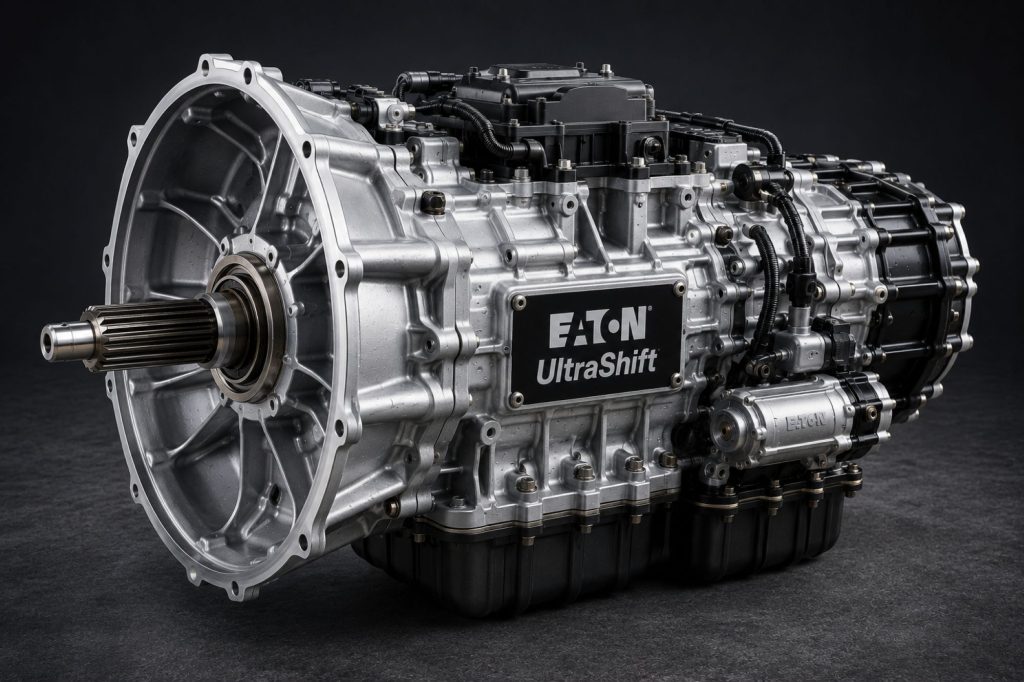
The Eaton UltraShift is a two-pedal automated manual transmission that combines a traditional Eaton Fuller mechanical gearbox with electronic gear controls and an automatically engaging centrifugal clutch.
It was developed as the successor to the Eaton AutoShift. Unlike AutoShift, which normally retains a driver-operated clutch pedal, UltraShift eliminates the in-cab clutch pedal and controls clutch engagement automatically.
The original UltraShift family included 6-speed, 10-speed, and 13-speed configurations. The 6-speed models served medium-duty and certain specialty applications, while 10-speed and 13-speed versions were used in heavy-duty commercial trucks.
UltraShift is still mechanically different from a conventional automatic transmission. It uses a mechanical geartrain and dry clutch rather than a torque converter and planetary automatic transmission.
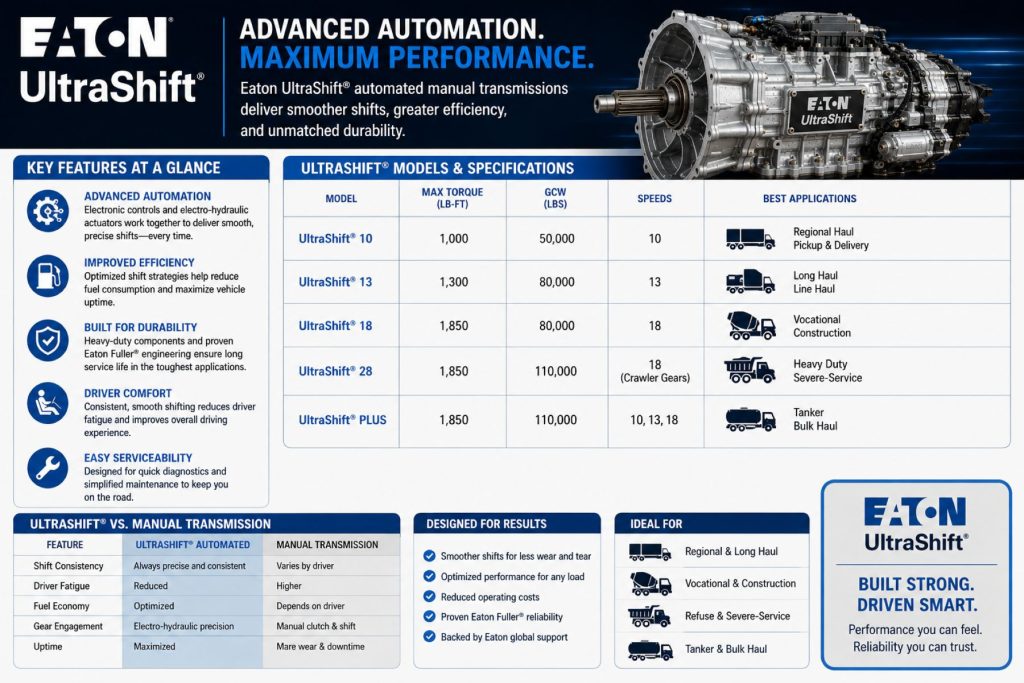
The first-generation UltraShift should not be confused with UltraShift PLUS. UltraShift PLUS introduced later clutch-actuation technology, improved low-speed maneuvering, more application-specific models, and additional driver-assistance features.
Although UltraShift is no longer a current-production transmission, many trucks equipped with it remain in service. Parts, remanufactured units, diagnostic information, and Eaton DM clutch components continue to be available through the heavy-duty aftermarket.
Key Characteristics
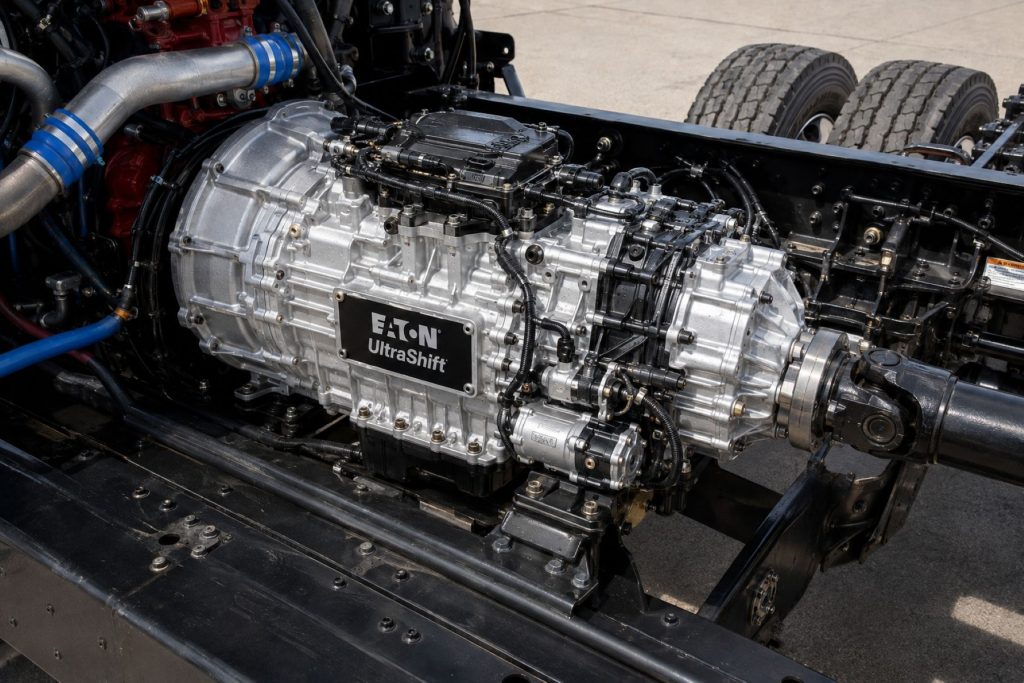
The defining feature of the original UltraShift is its Eaton DM centrifugal clutch. The clutch automatically engages as engine speed increases and disengages as engine speed falls.
This design eliminates the clutch pedal and allows the truck to be operated with only the accelerator and brake pedals.
After the vehicle begins moving, the transmission controller selects and changes gears electronically. It communicates with the engine control module to manage torque and engine speed during each shift.
The UltraShift uses internal components based on Eaton Fuller mechanical transmissions. This provides the efficiency of a mechanically geared transmission while reducing the driver’s shifting workload.
Medium-duty UltraShift models commonly use a single-plate DM clutch. Heavy-duty models generally use a two-plate clutch to support higher torque and vehicle weight.
The transmission normally provides automatic and manual operating modes. Manual mode lets the driver request upshifts or downshifts when additional control is needed.
Unlike newer UltraShift PLUS models, first-generation UltraShift transmissions have limited clutch modulation at very low speeds. The driver must use the accelerator and service brake carefully when backing, docking, or maneuvering in congested areas.
How the Transmission Works
When the driver selects drive or reverse, the transmission controller chooses an appropriate starting gear based on vehicle and operating information.
At idle, the centrifugal clutch remains disengaged. As the driver presses the accelerator and engine speed increases, centrifugal weights within the clutch move outward and apply the clutch.
The clutch gradually connects the engine to the transmission. Once engaged, engine torque passes through the input shaft and mechanical geartrain to the driveshaft and rear axle.
When an upshift or downshift is required, the transmission controller communicates with the engine control module. Engine torque is reduced so the drivetrain can unload.
The shift actuator moves the transmission out of the current gear. The controller then manages engine speed to help synchronize the transmission with the next ratio.
When the shaft speeds are appropriate, the next gear is engaged and engine torque is restored.
The DM clutch generally remains engaged during normal moving shifts. The transmission changes gears by controlling torque and matching engine speed rather than disengaging the clutch for each shift.
As the truck slows toward a stop and engine speed falls, the centrifugal clutch disengages automatically. The engine can therefore continue running without a clutch pedal.
Because the clutch responds partly to engine speed, low-speed operation requires careful use of the throttle and brake. The driver should not hold the vehicle on a grade by applying accelerator power against the clutch.
Common Specifications
Transmission Type
The Eaton UltraShift is an automated manual transmission.
It combines a dry clutch and mechanically geared transmission with electronic controls, speed sensors, a shift actuator, and engine communication.
Speed Configurations
The original UltraShift family includes:
- 6-speed UltraShift
- 10-speed UltraShift
- 13-speed UltraShift
The 6-speed versions were commonly used in medium-duty and specialty applications.
The 10-speed versions served highway and regional heavy-duty trucks.
The 13-speed models provided additional ratio coverage for heavier loads and changing terrain.
Input-Torque Capacity
Torque ratings vary by model and application.
Medium-duty 6-speed models use lower torque ratings appropriate for their engine and vehicle classes.
Heavy-duty UltraShift models were commonly rated up to approximately 1,750 lb-ft.
The Eaton DM clutch itself is listed with a maximum torque rating of approximately 1,750 lb-ft.
The complete transmission model and clutch identification must be checked before pairing the UltraShift with an engine.
Gear Ratios
Gear ratios depend on the underlying transmission model.
Some models use direct-drive gearing, while others provide an overdrive top gear.
The 13-speed configuration offers more closely spaced ratios than the 10-speed and can provide greater control under changing load and grade conditions.
Exact starting, top, reverse, and overall ratios must be confirmed from the transmission model designation.
DM Centrifugal Clutch
The original UltraShift uses the Eaton DM centrifugal clutch.
The clutch engages as engine speed increases and disengages as engine speed decreases.
Heavy-duty versions generally use two friction plates.
Medium-duty versions commonly use one friction plate.
Soft-rate dampers and ceramic friction materials help manage engagement and durability.
Clutch Pedal
The UltraShift does not normally use an in-cab clutch pedal.
Starting, stopping, and clutch engagement are controlled automatically through the centrifugal-clutch design.
Electronic Controls
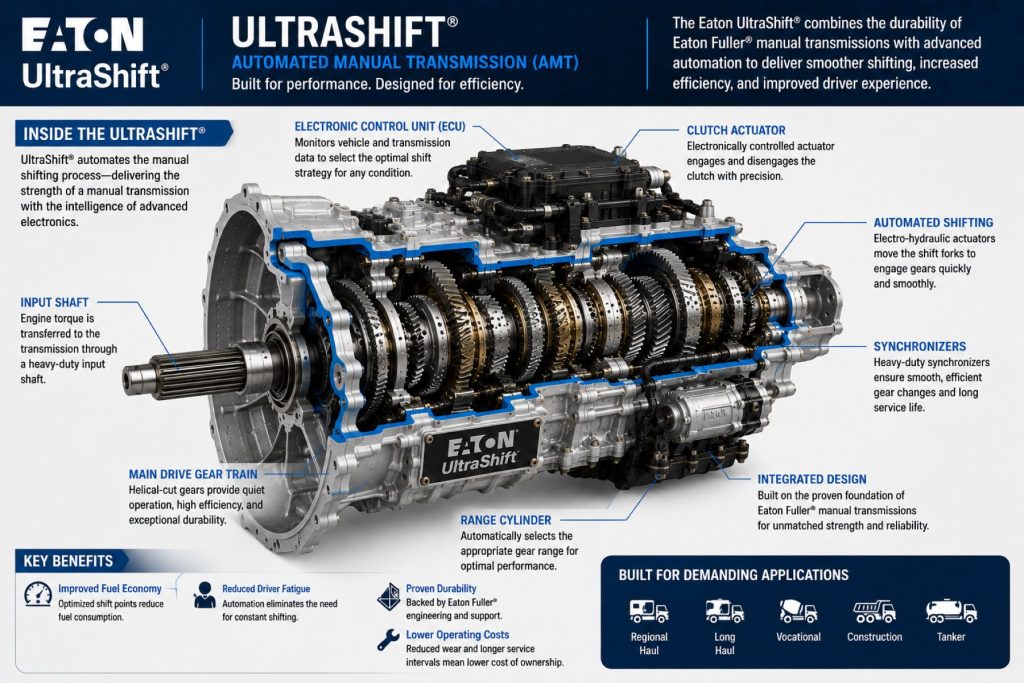
The system commonly includes:
- Transmission electronic control unit
- Engine electronic control module communication
- Shift actuator
- Input-speed sensor
- Mainshaft or output-speed sensors
- Gear-position sensors
- Shift selector
- Driver display
- Vehicle data-network connections
- Power and ground circuits
Exact components vary by model and vehicle installation.
Shift Actuation
The transmission control module commands the shift actuator to move the mechanical shift components.
Range changes on applicable heavy-duty models may also rely on the vehicle’s compressed-air system.
Driver Controls
The driver normally operates the vehicle with:
- Accelerator pedal
- Service brake pedal
- Shift selector
- Driver display
The selector commonly provides drive, neutral, reverse, low, and manual gear-selection functions.
Automatic Mode
Automatic mode allows the transmission controller to select the starting gear and perform normal upshifts and downshifts.
The system considers throttle position, engine speed, vehicle speed, grade, load, and other operating conditions.
Manual Mode
Manual mode allows the driver to request an upshift, downshift, or gear hold.
The controller may refuse a requested shift if it would over-speed or lug the engine.
PTO Compatibility
Certain UltraShift models support PTO operation.
Compatibility depends on the transmission case, PTO opening, drive gear, output requirement, electronic programming, interlocks, and truck application.
Lubrication System
UltraShift transmissions require lubricant meeting the applicable Eaton specification.
Eaton PS-386 or another specifically approved lubricant may be required depending on the model and service information.
Some installations include an oil pump, filter, or transmission cooler.
Transmission Weight
Weight varies significantly between the 6-speed medium-duty and heavy-duty 10- or 13-speed models.
Published weight may not include the clutch, lubricant, PTO, cooler, mounts, wiring, or external control components.
Installation Requirements
Proper installation requires compatible:
- Engine electronic controls
- Vehicle data network
- Transmission control module
- DM centrifugal clutch
- Flywheel and flywheel housing
- Input shaft
- Shift actuator
- Wiring harnesses
- Shift selector
- Driver display
- Air system on applicable models
- Transmission mounts
- Driveshaft and output yoke
- Speed-sensor programming
- PTO equipment
- Rear-axle gearing
- Tire size
The transmission, clutch, controls, and engine programming must be treated as a complete system.
Common Applications
- Long-haul highway tractors
- Regional sleeper tractors
- Day cab tractors
- Pickup and delivery trucks
- Medium-duty straight trucks
- Box trucks
- Motorhomes
- Municipal vehicles
- Utility trucks
- Fleet-operated Class 8 trucks
- Dedicated-route trucks
- Vocational vehicles
- Drivers transitioning from manual transmissions
- Applications seeking two-pedal operation
Truck and Engine Compatibility
The Eaton UltraShift family served both medium-duty and heavy-duty commercial vehicles. Compatibility depends on transmission model, engine torque, truck class, electronic communication, clutch configuration, axle gearing, and intended vocation.
Relevant medium-duty truck platforms with live Truck Equipment Atlas pages include:
- Freightliner M2 106
- Ford F-650
- Ford F-750
- International MV Series
- Kenworth T280
- Peterbilt 535
- Peterbilt 536
Relevant heavy-duty truck platforms with live pages include:
- Freightliner Cascadia
- Freightliner Classic
- Freightliner Coronado
- Freightliner 114SD
- Freightliner 122SD
- Kenworth T680
- Kenworth T800
- Kenworth W900
- Peterbilt 389
- Peterbilt 567
- Peterbilt 579
- International HX Series
- International LoneStar
- International LT Series
- Volvo VNL
- Volvo VHD
- Western Star 4900
Older UltraShift-equipped platforms may also include Freightliner Century Class, Freightliner Columbia, Kenworth T600, Kenworth T660, Peterbilt 379, Peterbilt 386, International 9200, International 9400, and International 9900.
Relevant medium-duty engine families with live pages include:
- Cummins B6.7
- Cummins ISB
- Cummins ISC
- Cummins ISL
- Cummins L9
- Detroit DD5
- Detroit DD8
- Caterpillar C7
- Caterpillar C9
- International DT466
- MaxxForce DT
Relevant heavy-duty engine families include:
- Detroit Series 60
- Detroit DD13
- Detroit DD15
- Cummins N14
- Cummins ISM
- Cummins ISX15
- Cummins X12
- Cummins X15
- Caterpillar 3406 and 3406E
- Caterpillar C12
- Caterpillar C13
- Caterpillar C15
- PACCAR MX-13
Advantages
- Two-pedal operation
- No driver-operated clutch pedal
- Reduces driver shifting workload
- Available for medium- and heavy-duty trucks
- Offered in 6-, 10-, and 13-speed configurations
- Can reduce driver fatigue
- Provides automatic and manual operating modes
- Promotes more consistent shift behavior
- Reduces gear grinding caused by poor manual shifting
- Retains the efficiency of a mechanical geartrain
- DM clutch requires no routine clutch-linkage adjustment
- Single- and two-plate clutch configurations support different applications
- Electronic diagnostics help identify system faults
- Can simplify driver recruitment and training
- Extensive aftermarket experience remains available
Limitations or Considerations
- First-generation design lacks later UltraShift PLUS features
- Limited clutch modulation at very low speeds
- Backing and docking can require careful throttle control
- Shift interruptions are noticeable
- May roll backward on a grade without proper brake use
- Centrifugal clutch operation depends on engine speed
- Repeated clutch slipping can create excessive heat
- Electronic faults can leave the transmission in neutral
- Sensors, wiring, and actuators add maintenance points
- Requires compatible engine programming
- Low battery voltage can cause operational faults
- Air-system problems can affect heavy-duty models
- DM clutch replacement requires correct setup and components
- Different UltraShift versions may use incompatible electronics
- Certain legacy electronic parts can be difficult to find
- Production has ended
Driver and Operator Experience
The original UltraShift operates without a clutch pedal. The driver selects drive or reverse and then uses the accelerator to initiate movement.
As engine speed rises, the centrifugal clutch begins engaging. The driver may notice a short delay between pressing the accelerator and the truck beginning to move.
Smooth launches require controlled accelerator input. Applying excessive throttle can produce harsh clutch engagement or unnecessary clutch heat.
Once the truck is moving, the transmission selects and changes gears automatically. A noticeable pause in acceleration during each shift is normal because the system must unload the drivetrain, change gears, and restore engine torque.
Manual mode allows the driver to request a different gear when approaching a grade, descending a hill, entering poor road conditions, or using the engine brake.
The driver should use the service brake to hold the truck on a hill. Applying throttle to prevent rollback can cause the clutch to slip and overheat.
Low-speed maneuvering is less refined than with UltraShift PLUS or a conventional torque-converter automatic. Drivers need time to learn the system’s clutch-engagement behavior.
Maintenance and Ownership Notes
The complete transmission model and serial numbers should be recorded from the identification tag.
The transmission must be identified as an original UltraShift rather than AutoShift or UltraShift PLUS before ordering components.
Battery voltage, charging-system performance, power connections, and electrical grounds should be tested when diagnosing intermittent faults.
Wiring harnesses should be checked for corrosion, rubbing, damaged pins, water intrusion, and previous repairs.
The transmission controller, shift actuator, gear-position sensors, speed sensors, driver display, and shift selector should be included in diagnostic inspections.
The DM centrifugal clutch should be inspected for friction wear, heat damage, damper wear, contamination, and correct installation.
Clutch replacement requires the proper single- or two-plate assembly for the transmission and engine torque.
Heavy-duty versions require a clean, dry, properly pressurized air supply for range and related transmission functions.
Lubricant level and condition must be maintained according to Eaton requirements.
Transmission mounts, output yoke, driveshaft, U-joints, and driveline angles should be inspected because vibration can damage transmission components and sensors.
Common Transmission Problems
Transmission Will Not Engage a Gear
Possible causes include low voltage, an active fault code, a failed shift actuator, clutch problems, speed-sensor faults, wiring damage, low air pressure, or lost engine communication.
Transmission Becomes Stuck in Neutral
The controller may leave the transmission in neutral when it cannot verify gear position, match shaft speeds, complete a shift, or communicate with the engine.
Harsh Launches
Harsh movement from a stop may result from excessive throttle, incorrect engine idle speed, clutch wear, clutch contamination, damaged dampers, improper clutch installation, or incorrect programming.
Delayed Movement
Some delay is normal while the centrifugal clutch begins engaging. Excessive delay may indicate clutch wear, low engine response, incorrect calibration, electronic faults, or drivetrain problems.
Clutch Overheating
Holding the truck on a grade with the accelerator, repeated backing, creeping in traffic, or operating at excessive weight can cause the DM clutch to slip and overheat.
Shift-Actuator Problems
A worn actuator, damaged wiring, poor power supply, mechanical binding, or position-sensor problem can prevent successful shifts.
Input- or Output-Speed Sensor Faults
Incorrect shaft-speed information can cause missed shifts, fault codes, harsh operation, or a transmission that remains in neutral.
Data-Network Communication Faults
The engine and transmission must exchange torque and speed information. Damaged wiring, poor grounds, failed controllers, or incompatible programming can interrupt operation.
Range-Shift Problems
Low air pressure, leaking valves, restricted air lines, damaged seals, or internal auxiliary-section wear can prevent proper range changes.
Oil Leaks
Leaks can develop at the input area, output seal, PTO opening, case joints, shift housing, auxiliary section, or sensor openings.
Excessive Noise
Noise may result from low lubricant, incorrect lubricant, worn bearings, damaged gears, driveline vibration, or internal wear.
Buying Considerations
- Confirm that the transmission is the original UltraShift rather than UltraShift PLUS.
- Locate the complete model and serial numbers.
- Confirm whether it is a 6-, 10-, or 13-speed model.
- Verify the input-torque rating.
- Identify the correct single- or two-plate DM clutch.
- Confirm engine electronic compatibility.
- Verify that the transmission controller is included.
- Check the shift actuator.
- Inspect the wiring harnesses and connectors.
- Confirm that the shift selector and driver display are included.
- Scan for active and inactive fault codes.
- Check battery and charging-system voltage.
- Inspect the case for cracks and repairs.
- Check the lubricant for metal or contamination.
- Road-test drive, reverse, automatic, and manual modes.
- Test low-speed maneuvering.
- Confirm correct starting-gear selection.
- Check for harsh engagement or clutch slipping.
- Verify PTO compatibility when required.
- Confirm parts and diagnostic support.
- Calculate programming, wiring, clutch, and installation expenses.
Variants and Configurations
- UltraShift 6-Speed
- UltraShift 10-Speed
- UltraShift 13-Speed
- Medium-Duty UltraShift HV
- Heavy-Duty UltraShift LST
- DM3 Models
- Single-Plate DM Clutch
- Two-Plate DM Clutch
- Direct-Drive Configurations
- Overdrive Configurations
- Line-Haul Configurations
- Regional Configurations
- Vocational Configurations
- PTO-Equipped Configurations
- Remanufactured UltraShift Transmissions
Comparison to Similar Equipment
Compared with the Eaton AutoShift, UltraShift eliminates the driver-operated clutch pedal. AutoShift requires the driver to operate the clutch when starting and stopping.
Compared with Eaton UltraShift PLUS, the original UltraShift uses a centrifugal clutch that engages according to engine speed. UltraShift PLUS uses a more advanced electronically controlled clutch actuator and provides improved low-speed operation.
Compared with an Eaton Fuller manual transmission, UltraShift automates the clutch and gear changes. The driver has less direct control but experiences less physical workload.
Compared with Eaton Cummins Endurant HD, the UltraShift uses an older and generally heavier transmission design. Endurant HD provides 12 forward speeds, newer electronic integration, and more advanced clutch control.
Compared with an Allison automatic transmission, UltraShift uses a dry clutch and mechanical geartrain rather than a torque converter and planetary gearsets. The Allison generally provides smoother low-speed power delivery, while the UltraShift retains the efficiency and operating feel of a mechanically geared transmission.
Best Fit For
- Fleets maintaining existing UltraShift-equipped trucks
- Drivers wanting two-pedal operation
- Regional highway operations
- Long-haul fleet trucks
- Medium-duty delivery vehicles
- Motorhome applications
- Dedicated-route operations
- Fleets transitioning away from manual transmissions
- Operators with access to Eaton diagnostic support
- Buyers seeking a lower-cost used automated transmission truck
Related Truck Types
Related Truck Models
- Freightliner M2 106
- Freightliner Cascadia
- Freightliner Classic
- Freightliner Coronado
- Freightliner 114SD
- Freightliner 122SD
- Kenworth T280
- Kenworth T680
- Kenworth T800
- Kenworth W900
- Peterbilt 535
- Peterbilt 536
- Peterbilt 389
- Peterbilt 567
- Peterbilt 579
- International MV Series
- International HX Series
- International LoneStar
- International LT Series
- Volvo VNL
- Volvo VHD
- Western Star 4900
Related Engines
- Cummins B6.7
- Cummins ISB
- Cummins ISC
- Cummins ISL
- Cummins L9
- Detroit DD5
- Detroit DD8
- Detroit Series 60
- Detroit DD13
- Detroit DD15
- Cummins N14
- Cummins ISM
- Cummins ISX15
- Cummins X12
- Cummins X15
- Caterpillar 3406 and 3406E
- Caterpillar C12
- Caterpillar C13
- Caterpillar C15
- Caterpillar C7
- Caterpillar C9
- PACCAR MX-13
Related Transmission Types
- Automated Manual Transmissions
- Medium-Duty Transmissions
- Heavy-Duty Transmissions
- Vocational Transmissions
- Automatic Transmissions
- Manual Transmissions
Related Equipment Systems
- Automated Clutch Systems
- Centrifugal Clutches
- Shift-Actuator Systems
- Transmission Electronic Controls
- Vehicle Data Networks
- Electrical Systems
- Driveshafts
- Axles and Differentials
- Transmission Cooling Systems
- PTO Systems
Related Guides
- How Diesel Truck Engines Work
- Understanding Horsepower vs Torque
- Class 6 vs Class 7 vs Class 8 Trucks
Understand the operating principles in How Commercial Truck Transmissions Work, compare drivetrain designs in Manual vs Automated Manual vs Automatic Transmissions, and evaluate gearing, application, and compatibility in How to Choose a Commercial Truck Transmission.
Regulatory and Compliance Notes
The UltraShift must be installed with the correct engine controls, transmission controller, DM clutch, wiring, sensors, mounts, driveshaft, air system, and vehicle programming.
The engine’s peak torque must remain within the transmission and clutch ratings.
Changes to tire size, axle ratio, engine programming, transmission controller, or speed-sensor configuration can affect shifting, speedometer accuracy, cruise control, engine braking, and emissions-system operation.
Electronic faults should be diagnosed with compatible Eaton service information and diagnostic equipment.
PTO installations must include the correct controls, interlocks, guarding, programming, and driven-equipment ratings.
The vehicle must remain within its gross vehicle weight, axle-weight, gross combination weight, transmission-torque, and clutch-capacity limits.
Real World Operating Notes
The original UltraShift requires a different driving technique from both a manual transmission and a conventional automatic.
The driver should apply the accelerator smoothly and allow the centrifugal clutch to engage. Excessive throttle can create harsh launches and additional clutch heat.
A brief interruption in power during shifts is normal. The transmission must unload the drivetrain before engaging the next gear.
Drivers should use the service brake to hold the vehicle on a hill. Applying throttle against the clutch to prevent rollback causes clutch slipping and heat.
Manual mode can help prevent unwanted shifts on hills or while using the engine brake.
Backing and docking require patience because the centrifugal clutch provides less precise modulation than later electronically actuated clutch systems.
The transmission can provide dependable service when the clutch, electronics, air system, lubricant, and drivetrain are maintained correctly.
Frequently Asked Questions
What is an Eaton UltraShift?
It is a two-pedal automated manual transmission that uses electronic gear controls and an Eaton DM centrifugal clutch.
Does the original UltraShift have a clutch pedal?
No. The DM centrifugal clutch engages and disengages automatically according to engine speed and operating conditions.
Is UltraShift the same as UltraShift PLUS?
No. UltraShift PLUS is a later transmission family with electronically controlled clutch actuation and improved low-speed features.
What speeds were available?
The original UltraShift family included 6-speed, 10-speed, and 13-speed configurations.
How does the DM clutch work?
Centrifugal weights apply the clutch as engine speed rises and release it as engine speed falls.
Can the driver select gears manually?
Yes. Most installations provide a manual mode for requesting upshifts or downshifts.
Why does an UltraShift roll backward on a hill?
The transmission uses a dry clutch rather than a torque converter. Unless the truck has a separate hill-hold system, the driver must use the service brake to prevent rollback.
Why does the transmission pause during shifts?
Engine torque must be reduced so the mechanical gearbox can disengage one gear, synchronize shaft speeds, and engage the next gear.
Can an UltraShift operate a PTO?
Some UltraShift models support PTO equipment. Compatibility and programming must be confirmed for the specific transmission.
Is Eaton UltraShift still produced?
The original UltraShift is discontinued. Parts, remanufactured units, DM clutches, and service information remain available.
Availability and Where to Find
Eaton UltraShift transmissions can be found through Eaton parts distributors, commercial truck dealerships, transmission remanufacturers, heavy-duty repair facilities, salvage yards, RV service providers, and used-parts marketplaces.
A replacement unit must match the original model, torque rating, ratios, clutch, controls, engine communication, input shaft, output arrangement, and PTO requirements.
Buyers should confirm that the transmission controller, shift actuator, wiring, shift selector, driver display, and correct DM clutch are available before purchasing an incomplete transmission.
Eaton provides information through its commercial-vehicle transmission resources, transmission-identification guide, and UltraShift DM clutch page.
Support Trucking Families
Truck Equipment Atlas supports the mission of Grey Cross, a nonprofit dedicated to helping families of truck drivers who lose their lives while on the road. As the site grows, part of its mission is to bring awareness and support to these families.
Podcast or Video Section
Learn More Through Audio and Video
Truck Equipment Atlas will continue expanding with podcast episodes, interviews, and equipment breakdowns to help drivers and fleets better understand trucks and equipment.
Follow the Growth of Truck Equipment Atlas
Truck Equipment Atlas continues to expand with new truck profiles, trailer coverage, diesel engine pages, equipment system resources, manufacturer information, and educational guides.
Visit our Site Updates page to explore recent additions, project milestones, and upcoming resources as we continue building one of the industry’s growing commercial trucking equipment reference libraries.
View the Latest Site Updates: Truck Equipment Atlas Site Updates