
Automatic Transmissions
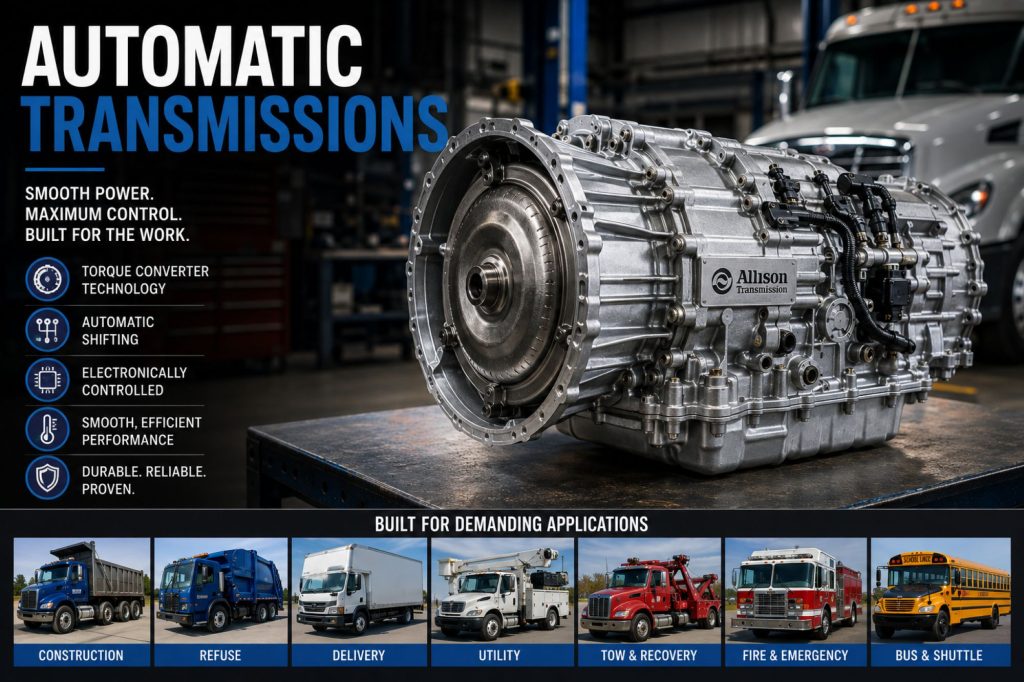
Automatic transmissions play an important role throughout commercial trucking, particularly in medium-duty, vocational, delivery, construction, towing, municipal, and other applications where smooth power delivery and reduced driver workload are valuable.
Unlike traditional manual transmissions and automated manual transmissions, commercial automatic transmissions generally manage gear changes without requiring normal clutch operation from the driver. Many use torque-converter technology to provide smooth vehicle launches, controlled low-speed operation, and uninterrupted power delivery through demanding duty cycles.
Truck Equipment Atlas covers automatic transmissions used throughout medium-duty, heavy-duty, vocational, pickup-based commercial, and specialized truck applications.
Automatic Transmission Models on Truck Equipment Atlas
Explore the automatic commercial truck transmissions currently covered on Truck Equipment Atlas:
Aisin
Allison Transmission
Ford
General Motors
Additional automatic transmission models and families will be added as the Truck Equipment Atlas Transmission Library continues to expand.
How Automatic Truck Transmissions Work
Commercial automatic transmissions automatically manage gear selection according to vehicle speed, engine load, throttle demand, operating conditions, and electronic control strategies.
Many commercial automatic transmissions use a torque converter between the engine and transmission.
The torque converter allows power to be transferred while providing smooth vehicle launches and low-speed operation without requiring the driver to manually operate a clutch.
Modern automatic transmissions also use sophisticated electronic controls that can coordinate transmission operation with the engine and other vehicle systems.
For a step-by-step explanation of power flow and gear reduction, read How Commercial Truck Transmissions Work.
Torque Converter Operation
The torque converter is one of the characteristics that distinguishes many conventional automatic transmissions from manual and automated manual designs.
Instead of relying on a conventional friction clutch for normal vehicle launch, a torque converter transfers engine power through fluid.
This can provide several benefits in commercial applications, including:
- Smooth vehicle launches
- Strong low-speed control
- Reduced risk of stalling
- Easier stop-and-go operation
- Reduced driver workload
- Controlled maneuvering
- Torque multiplication during certain operating conditions
Modern transmissions can also use lockup clutches to create a more direct mechanical connection under appropriate operating conditions.
Automatic vs. Automated Manual Transmissions
Automatic and automated manual transmissions both reduce the amount of shifting required from the driver, but they are fundamentally different transmission designs.
An automated manual transmission generally uses a mechanically geared manual-style architecture combined with automated clutch and shift controls.
A conventional commercial automatic commonly uses a torque converter and automatic gear system designed specifically for automatic operation.
The difference can be particularly noticeable during low-speed maneuvering, vehicle launch, stop-and-go driving, and vocational operation.
Readers interested in AMTs can explore the Automated Manual Transmissions section.
Compare clutch operation, launch behavior, and application tradeoffs in Manual vs Automated Manual vs Automatic Transmissions.
Medium-Duty Applications
Automatic transmissions are particularly important throughout the medium-duty truck market.
Applications can include:
- Delivery trucks
- Box trucks
- Utility trucks
- Tow trucks
- Service trucks
- Municipal vehicles
- Emergency vehicles
- Landscape trucks
- Construction trucks
- Pickup-based commercial equipment
These trucks frequently operate in environments involving repeated stops, traffic, low-speed maneuvering, and multiple drivers.
Automatic transmissions can simplify vehicle operation while providing consistent performance throughout these duty cycles.
Vocational Applications
Automatic transmissions are also widely used in demanding vocational applications.
These can include:
- Refuse trucks
- Dump trucks
- Concrete trucks
- Construction vehicles
- Utility trucks
- Fire and emergency vehicles
- Municipal equipment
- Tow and recovery trucks
- Severe-service equipment
- Oil and gas applications
Vocational trucks often require frequent starts, low-speed control, repeated direction changes, PTO operation, and predictable power delivery.
These operating conditions can make a commercial automatic transmission particularly well suited to certain vocational applications.
Heavy-Duty Automatic Transmissions
Automatic transmission technology is not limited to light and medium-duty trucks.
Heavy-duty automatic platforms such as the Allison 3000 and 4000 Series are used across numerous demanding commercial and vocational applications.
Depending on configuration, these transmissions can be found in heavy vocational trucks, severe-service equipment, refuse vehicles, emergency equipment, construction trucks, buses, and other specialized commercial vehicles.
The appropriate transmission depends on engine torque, vehicle weight, operating environment, gearing, and duty cycle.
Pickup-Based Commercial Applications
Heavy-duty pickups and chassis-cab trucks also play an important role in commercial transportation.
Transmissions such as the Ford TorqShift 10R140, GM 10L1000, Aisin AS69RC, and Allison 1000 Series represent the automatic transmission technology used across various pickup-based and lighter commercial applications.
These vehicles can be used for:
- Towing
- Equipment transport
- Construction
- Service operations
- Utility work
- Landscaping
- Agriculture
- Hotshot transportation
- Commercial trailers
Transmission requirements in these applications can differ considerably from those of a Class 8 tractor.
Advantages of Automatic Transmissions
Depending on the application, commercial automatic transmissions can provide several advantages:
- Reduced driver workload
- Smooth vehicle launches
- Strong low-speed control
- Easier stop-and-go operation
- Simplified driver training
- Consistent shifting
- Reduced dependence on driver shifting technique
- No routine manual clutch operation
- Strong performance in vocational duty cycles
- Effective integration with modern electronic powertrains
These characteristics have made automatic transmissions especially important in vocational and medium-duty commercial vehicles.
Limitations and Considerations
Automatic transmissions also have characteristics that should be considered when specifying a commercial truck.
These can include:
- Initial purchase cost
- Transmission weight
- Fluid requirements
- Cooling requirements
- Electronic complexity
- Repair costs
- Application-specific torque limitations
- PTO requirements
- Service availability
Transmission selection should always be based on the complete vehicle specification and intended operating environment.
Electronic Transmission Controls
Modern commercial automatic transmissions rely heavily on electronic controls.
Transmission control modules can monitor information from the engine, transmission, vehicle speed sensors, throttle system, braking systems, and other components.
Electronic controls can help manage:
- Shift timing
- Gear selection
- Torque converter lockup
- Engine torque during shifts
- Grade response
- Vehicle acceleration
- Economy modes
- Performance modes
- PTO operation
- Diagnostic monitoring
These systems allow the transmission to adapt its operation to different vehicle conditions and applications.
Power Take-Off Applications
Power take-off capability can be particularly important in vocational trucks.
A PTO allows engine power to operate equipment such as:
- Hydraulic pumps
- Dump bodies
- Refuse equipment
- Utility equipment
- Tow truck systems
- Cranes
- Concrete equipment
- Other auxiliary systems
Transmission specification should account for PTO requirements before the truck is purchased or configured.
Not every transmission or transmission configuration supports the same PTO arrangements.
See PTO System Explained for auxiliary-power layouts and the compatibility questions to discuss with the transmission and equipment suppliers.
Maintenance and Ownership
Proper maintenance is essential for commercial automatic transmission reliability.
Important areas can include:
- Transmission fluid
- Transmission filters
- Cooling system condition
- Fluid temperature
- Electronic diagnostic codes
- Wiring and connectors
- Transmission seals
- Torque converter operation
- Transmission mounts
- Driveshaft components
Fluid specifications and service intervals can vary significantly between manufacturers and transmission models.
Owners and technicians should follow the maintenance requirements established for the specific transmission and vehicle application.
Choosing an Automatic Transmission
Selecting the correct automatic transmission requires considering the complete truck and its intended use.
Important factors include:
- Engine torque
- Vehicle class
- Gross vehicle weight
- Gross combination weight
- Towing requirements
- Duty cycle
- Highway versus vocational operation
- Stop-and-go operation
- Terrain
- PTO requirements
- Low-speed maneuvering
- Service availability
- Maintenance requirements
A transmission appropriate for a medium-duty delivery truck may not be appropriate for a severe-service construction truck or heavy vocational vehicle.
Use How to Choose a Commercial Truck Transmission to check engine compatibility, working weight, axle gearing, tires, PTO needs, and service requirements together.
Related Transmission Categories
Explore additional commercial transmission categories:
- Manual Transmissions
- Automated Manual Transmissions
- Heavy-Duty Transmissions
- Medium-Duty Transmissions
- Vocational Transmissions
Explore the Complete Transmission Library
Automatic transmissions represent an important part of the commercial truck drivetrain landscape, particularly across medium-duty and vocational applications.
Visit the Truck Equipment Atlas Transmission Library to explore automatic, automated manual, manual, heavy-duty, medium-duty, and vocational transmission platforms.
Additional automatic transmission models, transmission families, manufacturer information, and educational resources will be added as the Truck Equipment Atlas Transmission Library continues to expand.