
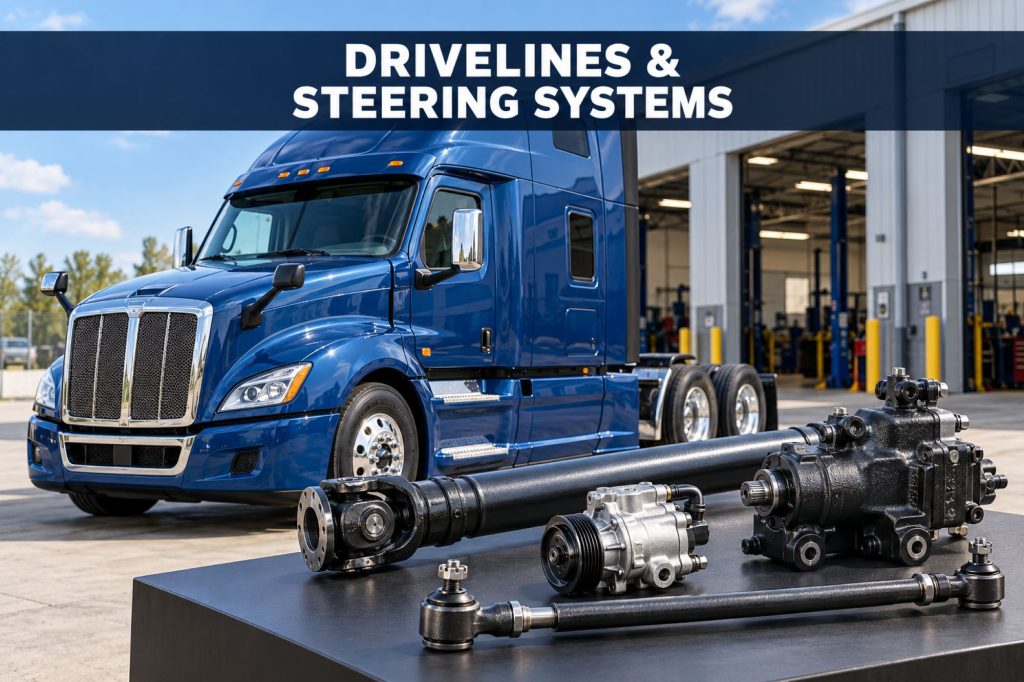
Commercial truck drivelines and steering systems transfer rotational power, control vehicle direction, maintain stable handling, and connect major drivetrain components throughout trucks, tractors, trailers, buses, and vocational equipment.
Truck Equipment Atlas covers commercial driveshafts, universal joints, slip yokes, center bearings, steering gears, steering linkage, power-steering pumps, hydraulic-assist systems, steering columns, driver controls, and advanced steering technologies used throughout highway, regional, vocational, construction, heavy-haul, and specialized commercial operations.
The Drivelines and Steering Systems Library includes individual product profiles, component categories, application information, operating considerations, compatibility details, manufacturer coverage, and educational guides designed to help readers understand these essential commercial-vehicle systems.
Explore Commercial Driveline and Steering Categories
Commercial driveline and steering equipment can be classified by component type, vehicle position, operating capacity, control method, mounting arrangement, and application. Explore the major driveline and steering categories on Truck Equipment Atlas:
Commercial Truck Driveshafts
Commercial truck driveshafts transfer rotational power between transmissions, transfer cases, drive axles, and other driven equipment. This category covers single-piece and multi-piece driveshafts, heavy-duty driveline series, service assemblies, and application-specific shaft designs.
Universal Joints, Slip Yokes & Center Bearings
Universal joints accommodate changes in driveline angle, slip yokes permit changes in effective shaft length, and center bearings support multi-piece driveshaft assemblies. This category covers the components that allow a driveline to operate as the axles, suspension, and chassis move.
Steering Gears & Steering Linkage
Steering gears convert steering-wheel movement into the mechanical force needed to turn the steer wheels. This category also covers pitman arms, drag links, tie rods, steering shafts, steering knuckles, and related linkage components.
Power Steering Pumps & Hydraulic Assist
Power-steering pumps and hydraulic-assist systems reduce the effort required to steer commercial vehicles. This category covers engine-driven pumps, electrically powered hydraulic pumps, reservoirs, hoses, valves, assist cylinders, and fluid-management components.
Steering Columns & Driver Controls
Steering columns and driver controls connect the steering wheel to the steering system while supporting driver positioning, vehicle controls, and safety functions. This category covers adjustable columns, intermediate shafts, steering-wheel controls, and column-mounted components.
Advanced Steering & Lane-Keeping Systems
Advanced steering systems can supplement conventional hydraulic steering with electric assistance, active return, lane-centering support, crosswind compensation, stability functions, and driver-assistance integration.
Driveline and Steering System Guides
The Driveline and Steering System Guides section provides educational resources covering driveshaft operation, steering-system design, universal joints, driveline angles, inspection, maintenance, vibration diagnosis, hydraulic steering, electric assistance, and common operating problems.
Commercial Driveline and Steering Products on Truck Equipment Atlas
Truck Equipment Atlas includes a growing library of individual driveline, driveshaft, steering-gear, power-steering, and advanced-steering profiles from manufacturers serving the commercial trucking industry.
Explore the products and equipment families being added to the library:
Dana Spicer
- Dana Spicer Life Series Commercial Driveshaft
- Dana Spicer SPL High-Torque Series Driveshaft
- Dana Spicer SPL 140 Driveshaft
- Dana Spicer SPL 250 High-Torque Driveshaft
- Dana Spicer SPL 350 Driveshaft
- Dana Spicer Compact Series PLUS Driveshaft
- Dana Spicer Wing Series Driveshaft
- Dana Spicer ReadyShaft Commercial Driveshaft
Cummins-Meritor
- Meritor Permalube RPL10 Driveline
- Meritor Permalube RPL14 Driveline
- Meritor Permalube RPL20 Driveline
- Meritor Permalube RPL25 Driveline
- Meritor Permalube RPL35 Driveline
- Meritor XTended Lube MXL Driveline
ZF
- ZF TRW TAS Series Steering Gear
- ZF TRW THP Series Steering Gear
- ZF ReAX Adaptive Steering System
- ZF Electrically Powered Hydraulic Steering Pump
- TRW EV Series Power Steering Pump
RH Sheppard
Additional driveshafts, universal joints, slip assemblies, center bearings, steering gears, pumps, steering columns, linkage components, hydraulic-assist systems, and advanced steering technologies will be added as the Truck Equipment Atlas Drivelines and Steering Systems Library continues to expand.
Driveline and Steering Guides on Truck Equipment Atlas
Truck Equipment Atlas is also developing educational guides that explain how commercial drivelines and steering systems work, how their components interact, and how proper inspection, adjustment, lubrication, alignment, and maintenance affect vehicle operation.
- How Commercial Truck Driveline Systems Work
- How Commercial Truck Steering Systems Work
- Single-Piece vs Multi-Piece Truck Driveshafts
- How to Inspect and Maintain Driveshafts and Universal Joints
- Hydraulic vs Electric-Assisted Commercial Truck Steering
- Common Commercial Truck Driveline Vibrations and Steering Problems
Understanding Commercial Truck Driveline Systems
A commercial truck driveline transfers torque from the transmission or transfer case to the vehicle’s drive axle or axles. Its design must accommodate frame length, axle spacing, suspension movement, driveline angles, torque output, vehicle weight, road speed, and operating conditions.
A typical driveline may include:
- Transmission output yoke
- Driveshaft tube
- Universal joints
- Slip yoke or slip spline
- Center bearing
- End yokes and companion flanges
- Interaxle driveshaft
- Axle-input yoke
- Guards and retaining hardware
The exact arrangement depends on whether the vehicle uses a single drive axle, tandem drive axles, multiple driven axles, a transfer case, auxiliary equipment, or a specialized chassis.
Single-Piece and Multi-Piece Driveshafts
A single-piece driveshaft connects two driveline components without an intermediate support bearing. It may be appropriate when the required shaft length, operating speed, tube diameter, working angles, and vehicle layout remain within the manufacturer’s design limits.
Long-wheelbase trucks frequently use multi-piece driveshaft arrangements. These systems divide the driveline into multiple shaft sections supported by one or more center bearings.
Multi-piece systems can accommodate longer chassis layouts, but their operating angles, shaft phasing, center-bearing position, slip travel, and mounting alignment must be correctly established. Incorrect geometry can cause vibration, noise, accelerated universal-joint wear, or driveline damage.
Universal Joints, Slip Assemblies, and Center Bearings
Universal joints allow torque to pass between components operating at changing angles. Commercial universal joints must withstand repeated torque loads, driveline speed, suspension movement, temperature changes, and contamination from road conditions.
Slip assemblies allow the effective length of the driveshaft to change as the suspension and axles move relative to the transmission and frame. Adequate slip travel helps prevent the shaft from binding, separating, or placing damaging loads on connected components.
Center bearings support intermediate sections of multi-piece driveshafts. Their brackets, rubber supports, mounting position, and alignment affect driveline stability and vibration control.
Understanding Commercial Truck Steering Systems
A commercial truck steering system translates driver input at the steering wheel into controlled movement of the steer wheels. The system must provide directional control while handling substantial front-axle loads, tire forces, road impacts, suspension movement, and changing operating conditions.
Common steering-system components can include:
- Steering wheel
- Steering column
- Intermediate steering shaft
- Steering gear
- Power-steering pump
- Hydraulic reservoir
- Pressure and return hoses
- Pitman arm
- Drag link
- Steering arms
- Tie rod and tie-rod ends
- Steering knuckles and kingpins
- Assist cylinders where equipped
- Position, torque, or steering-angle sensors
- Electronic steering controllers
The complete system must be matched to the vehicle’s steer-axle rating, tire equipment, suspension geometry, frame, wheelbase, duty cycle, and driver-assistance technology.
Hydraulic and Electric-Assisted Steering
Traditional commercial power steering commonly uses an engine-driven hydraulic pump to circulate fluid through the steering gear. Hydraulic pressure helps the driver turn the wheels while preserving a mechanical connection between the steering wheel and steering linkage.
Electrically powered hydraulic systems use an electric motor to operate the hydraulic pump. This arrangement can reduce dependence on engine speed and support alternative powertrains, energy-management strategies, or application-specific packaging.
Advanced steering systems can add controlled electric assistance to a conventional steering platform. Depending on the vehicle and system, available functions may include active steering return, directional stability support, lane-centering assistance, crosswind compensation, and integration with driver-assistance technology.
Common Driveline and Steering Configurations
Commercial driveline and steering arrangements vary according to chassis design, axle configuration, transmission, wheelbase, vehicle weight, and application.
Common configurations include:
- Single-piece driveshaft
- Two-piece driveshaft with one center bearing
- Multi-piece driveshaft with multiple support bearings
- Interaxle driveline for tandem drive axles
- Transfer-case driveline for all-wheel-drive vehicles
- Maintenance-free universal-joint assemblies
- Greaseable universal-joint assemblies
- Recirculating-ball hydraulic steering gear
- Dual steering gears for high-capacity front axles
- Hydraulic power steering
- Electric-hydraulic power steering
- Hydraulic steering with an auxiliary assist cylinder
- Rear-steer or multi-axle steering systems
- Advanced steering with driver-assistance integration
No configuration should be selected solely by vehicle class or approximate capacity. Torque, shaft speed, working angles, axle loads, steering geometry, mounting dimensions, tire size, frame layout, and manufacturer requirements must also be considered.
Highway, Regional, and Vocational Applications
Long-haul highway vehicles often prioritize driveline efficiency, low maintenance, reduced vibration, predictable steering, component life, and highway stability.
Regional and urban vehicles may experience frequent turns, repeated acceleration and braking, loading changes, curb contact, tight maneuvering, and high steering-system use. These operating conditions can increase demands on universal joints, steering gears, pumps, linkage, and front-end components.
Vocational vehicles may operate on construction sites, gravel roads, refuse routes, logging roads, mines, quarries, oilfield locations, and other demanding surfaces. These applications can require higher driveline torque capacity, increased steering assistance, heavy-duty mounting, greater articulation, and protection from impacts and contamination.
Advantages of Modern Driveline and Steering Systems
Modern commercial driveline and steering equipment can provide several operational advantages:
- Efficient transfer of engine torque
- Support for high-output engines and heavy vehicle loads
- Reduced driveline vibration when properly configured
- Extended lubrication intervals on applicable components
- Improved steering control
- Reduced driver steering effort
- Better directional stability
- Application-specific driveshaft and steering capacities
- Support for long-wheelbase and multi-axle vehicles
- Integration with advanced driver-assistance systems
- Improved serviceability through modular components
- Support for highway, regional, vocational, and specialized applications
Actual performance depends on correct component selection, installation, driveline geometry, steering alignment, lubrication, operating conditions, inspection, maintenance, and driver practices.
Driveline and Steering Limitations and Considerations
No single driveshaft, steering gear, pump, or control system is appropriate for every commercial vehicle.
Important considerations include:
- Maximum engine and transmission torque
- Driveshaft operating speed
- Driveline working angles
- Wheelbase and shaft length
- Single or multi-piece construction
- Universal-joint series
- Slip travel
- Center-bearing placement
- Driveshaft phasing
- Steer-axle capacity
- Steering-gear rating
- Hydraulic pump pressure and flow
- Steering linkage geometry
- Tire size and wheel offset
- Frame and mounting compatibility
- Lubrication requirements
- Electronic-system compatibility
- Inspection and maintenance requirements
A component with a similar appearance or mounting pattern should not automatically be treated as a compatible replacement. Driveline and steering parts must be identified using the exact vehicle, axle, transmission, steering, and component information.
Driver and Operator Considerations
Driveline and steering condition directly affects vehicle control, handling, vibration, tire wear, driver workload, roadside reliability, and operating safety.
Drivers should monitor for:
- Driveline vibration
- Clunking during acceleration or deceleration
- Squeaking or grinding universal joints
- Visible driveshaft or yoke damage
- Loose or missing driveline fasteners
- Steering-wheel looseness
- Excessive steering effort
- Vehicle wandering or pulling
- Slow steering return
- Steering pump noise
- Hydraulic-fluid leakage
- Uneven or rapid steer-tire wear
- Steering-system warning indicators
- Unexpected lane-assistance behavior
Sudden driveline or steering changes should be investigated promptly. A developing problem can affect connected transmissions, axles, wheel ends, suspension components, tires, and vehicle-control systems.
Maintenance and Ownership
Commercial driveline and steering systems require consistent inspection and maintenance to provide reliable service.
Important maintenance areas can include:
- Inspecting driveshaft tubes and welds
- Checking universal joints for looseness or binding
- Lubricating serviceable universal joints and slip assemblies
- Inspecting yokes, flanges, and retaining hardware
- Checking center bearings and mounting brackets
- Verifying driveshaft phasing and operating angles
- Inspecting steering gears for leakage and mounting movement
- Checking steering-column and intermediate-shaft joints
- Inspecting pitman arms, drag links, tie rods, and steering arms
- Checking hydraulic-fluid level and condition
- Inspecting power-steering hoses and fittings
- Testing steering-system warning indicators
- Checking front-end alignment and steering geometry
- Investigating vibration, noise, looseness, or abnormal tire wear
Maintenance requirements vary between manufacturers, driveline series, steering systems, chassis designs, lubrication specifications, and applications. Owners and technicians should follow the service procedures established for the exact equipment.
Major Commercial Driveline and Steering Manufacturers
Truck Equipment Atlas covers driveline and steering equipment from manufacturers that play important roles throughout the commercial trucking industry.
Current and planned coverage includes:
- Dana Spicer
- Cummins-Meritor
- ZF
- TRW
- RH Sheppard
- Bendix
- Bosch
- Nexteer
- JTEKT
- Parker
- Eaton
- Gates
- Neapco
- GKN
Manufacturer coverage will continue to expand as additional driveshafts, universal joints, steering gears, pumps, steering columns, linkage components, electronic controls, and specialty steering systems are added.
Related Truck Equipment Resources
Drivelines and steering systems operate as part of the complete commercial truck powertrain, axle, suspension, tire, brake, electrical, and vehicle-control system.
Explore related Truck Equipment Atlas resources:
- Commercial Trucks
- Commercial Trailers
- Engines
- Transmissions
- Axles & Differentials
- Suspension Systems
- Brake Systems
- Tires & Wheels
- PTO & Hydraulic Systems
- Electrical Systems
- Safety Systems
- Equipment Systems
- Equipment System Guides
Understanding how transmissions, driveshafts, axles, steering gears, front suspensions, wheel ends, tires, brakes, hydraulic systems, sensors, and electronic controls work together is essential when evaluating commercial driveline and steering equipment.
How to Use the Drivelines and Steering Systems Library
Individual Truck Equipment Atlas driveline and steering profiles provide deeper information about specific product models and equipment families.
Depending on the equipment, these pages may include:
- Product overview
- Manufacturer information
- Component type and construction
- Torque or steering capacity
- Operating specifications
- Driveline position or steering function
- Vehicle and component compatibility
- Installation and adjustment information
- Lubrication requirements
- Driver and operator considerations
- Inspection and maintenance information
- Common operating problems
- Buying and ownership considerations
- Availability and replacement information
Readers can begin with one of the driveline and steering categories above or explore individual product profiles by manufacturer.
Drivelines and Steering Systems Library Expansion
The Truck Equipment Atlas Drivelines and Steering Systems Library will continue to grow with additional driveshafts, universal joints, slip assemblies, yokes, center bearings, steering gears, power-steering pumps, hydraulic-assist systems, steering columns, linkage components, sensors, electronic controls, and advanced steering technologies.
Future development will also expand the connections between driveline and steering equipment and the trucks, transmissions, axles, suspensions, brakes, tires, hydraulic systems, safety technologies, manufacturers, freight sectors, and operating applications in which these systems are used.
The goal is to build an organized commercial driveline and steering reference that helps drivers, owner-operators, fleets, technicians, students, equipment buyers, and industry professionals understand how these systems work and where different products fit within the trucking industry.
Follow the Growth of Truck Equipment Atlas
Truck Equipment Atlas continues to expand with new trucks, trailers, diesel engines, transmissions, axles, differentials, suspension systems, brakes, fifth wheels, tires, wheels, PTO and hydraulic systems, driveline and steering equipment, manufacturer information, freight resources, and educational guides.
Visit our Site Updates page to explore recent additions, project milestones, and upcoming resources as we continue building one of the industry’s growing commercial trucking equipment reference libraries.