
Medium-Duty Transmissions
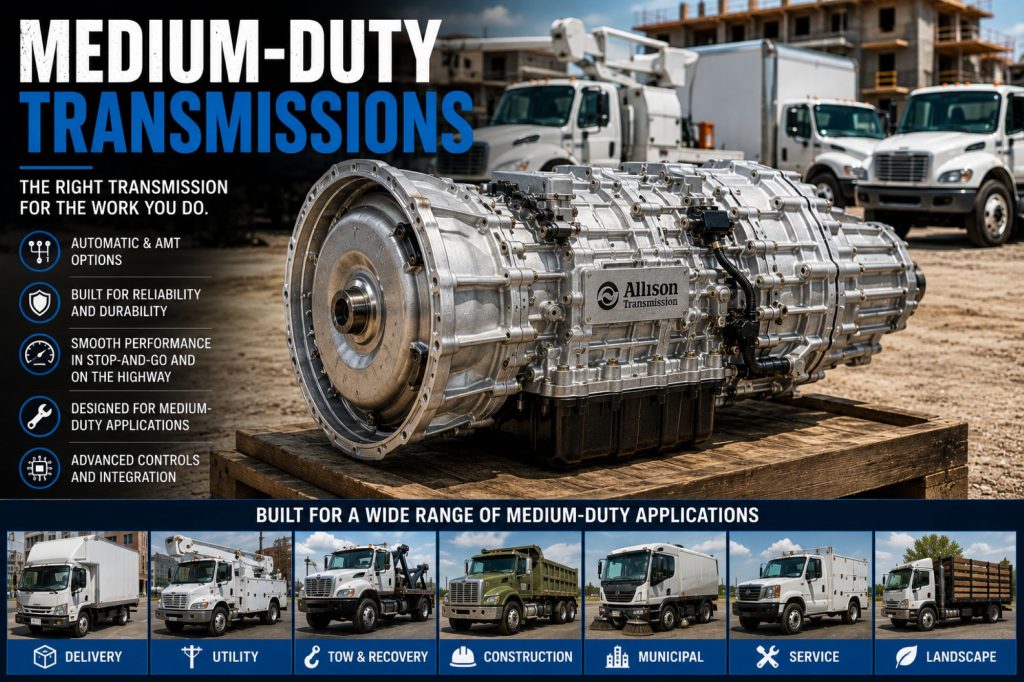
Medium-duty transmissions are designed for commercial trucks operating across delivery, utility, towing, construction, municipal, service, distribution, and other applications where vehicles must balance payload capacity, maneuverability, durability, and frequent daily operation.
The medium-duty market includes a wide variety of truck configurations and duty cycles. Some vehicles spend much of their time on highways, while others operate in urban traffic, construction sites, utility work, or repeated stop-and-go service.
For this reason, medium-duty trucks use several types of transmissions, including fully automatic transmissions and automated manual transmissions.
Truck Equipment Atlas covers a growing selection of medium-duty transmission models and families used throughout the commercial trucking industry.
Medium-Duty Transmission Models on Truck Equipment Atlas
Explore the medium-duty transmissions currently covered on Truck Equipment Atlas:
Aisin
Allison Transmission
Ford
General Motors
PACCAR
Additional medium-duty transmission models and families will be added as the Truck Equipment Atlas Transmission Library continues to expand.
What Is a Medium-Duty Transmission?
A medium-duty transmission is designed for commercial vehicles that generally operate between light-duty pickup-based equipment and Class 8 heavy trucks.
Medium-duty commercial trucks commonly fall within Class 4 through Class 7, although transmission applications can overlap vehicle classifications.
These vehicles perform a wide range of jobs and may experience very different operating conditions.
Transmission selection must account for factors such as:
- Vehicle weight
- Engine torque
- Payload
- Towing requirements
- Duty cycle
- Number of daily stops
- Terrain
- Highway operation
- Urban operation
- PTO requirements
- Low-speed maneuvering
- Vehicle application
A transmission designed for a delivery truck may have different requirements from one used in a tow truck, utility vehicle, or construction truck.
Common Medium-Duty Applications
Medium-duty trucks serve an enormous range of commercial operations.
Common applications include:
- Box trucks
- Delivery trucks
- Utility trucks
- Tow trucks
- Service trucks
- Landscape trucks
- Construction trucks
- Municipal vehicles
- Emergency vehicles
- Beverage trucks
- Moving trucks
- Flatbed trucks
- Dump trucks
- Agricultural trucks
- Chassis-cab commercial vehicles
The variety of these applications is one reason medium-duty transmission technology must cover a broad range of operating requirements.
Automatic Transmissions in Medium-Duty Trucks
Fully automatic transmissions are widely used throughout the medium-duty commercial truck market.
They are particularly useful in applications involving:
- Frequent stops
- Urban traffic
- Repeated acceleration
- Low-speed maneuvering
- Multiple drivers
- Delivery routes
- Vocational operations
Torque-converter automatic transmissions can provide smooth launches and predictable low-speed operation without requiring manual clutch control.
The Allison 1000, 2000, and 3000 Series represent important examples of automatic transmission families used across various commercial applications.
Pickup-based and chassis-cab commercial vehicles also use automatic transmissions such as the Aisin AS69RC, Ford TorqShift 10R140, and GM 10L1000.
Explore additional platforms in the Automatic Transmissions section.
Automated Manual Transmissions in Medium-Duty Trucks
Automated manual transmission technology has also expanded into the medium-duty market.
AMTs use a mechanically geared transmission architecture combined with automated clutch operation and electronic gear selection.
The PACCAR TX-8 is an example of an automated transmission platform developed for medium-duty commercial truck applications.
Potential advantages of an AMT can include:
- Reduced driver workload
- Automated shifting
- Consistent gear selection
- Powertrain integration
- Reduced dependence on manual shifting skill
- Application-specific programming
Explore additional AMT technology in the Automated Manual Transmissions section.
Delivery and Distribution Applications
Delivery and distribution trucks often experience demanding operating cycles.
A truck may start and stop dozens or hundreds of times during a working day.
Transmission requirements can include:
- Smooth launches
- Predictable low-speed control
- Reliable stop-and-go operation
- Reduced driver workload
- Efficient urban operation
- Easy vehicle maneuvering
Automatic transmissions are particularly common in these applications because they simplify operation in traffic and during repeated delivery cycles.
Utility and Service Trucks
Utility and service trucks present another important medium-duty transmission application.
These vehicles can include:
- Bucket trucks
- Line-service trucks
- Telecommunications vehicles
- Mobile repair trucks
- Crane-equipped trucks
- Municipal service vehicles
Many of these trucks require power take-off capability to operate hydraulic pumps, cranes, aerial equipment, generators, or other auxiliary systems.
Transmission specification must therefore consider both vehicle movement and stationary equipment operation.
Tow and Recovery Trucks
Tow trucks and recovery vehicles can place unique demands on a transmission.
These vehicles may operate in:
- Urban traffic
- Highway recovery
- Parking facilities
- Accident scenes
- Steep terrain
- Low-speed maneuvering environments
Smooth vehicle control can be especially important when positioning a tow truck or operating with another vehicle attached.
Transmission torque capacity and gross vehicle weight requirements must also be considered.
Construction and Vocational Applications
Medium-duty trucks are widely used throughout construction and vocational operations.
Applications can include:
- Dump trucks
- Contractor trucks
- Landscape trucks
- Utility vehicles
- Equipment service trucks
- Municipal trucks
- Small concrete or material-handling vehicles
These applications can involve low-speed operation, uneven terrain, frequent starts, heavy payloads, and PTO-driven equipment.
Explore additional work-truck transmission information in the Vocational Transmissions section.
Pickup-Based Commercial Applications
Heavy-duty pickup trucks and chassis-cab vehicles occupy an important part of the commercial vehicle market.
These trucks are commonly used for:
- Construction
- Towing
- Hotshot transportation
- Agriculture
- Utility work
- Equipment service
- Landscaping
- Trailer transport
Transmissions such as the Aisin AS69RC, Ford TorqShift 10R140, GM 10L1000, and Allison 1000 Series are associated with various pickup-based and commercial chassis applications.
These transmissions must balance towing capability, vehicle performance, durability, highway operation, and daily commercial use.
Power Take-Off Capability
Power take-off capability is particularly important in many medium-duty applications.
A PTO allows the engine and transmission system to power auxiliary equipment.
Common PTO-driven systems include:
- Hydraulic pumps
- Dump bodies
- Tow equipment
- Utility equipment
- Cranes
- Aerial lifts
- Refrigeration equipment
- Service equipment
Not every transmission configuration provides the same PTO capability.
PTO requirements should be considered when the truck and transmission are originally specified.
See PTO System Explained for auxiliary-power layouts and the compatibility questions to discuss with the transmission and equipment suppliers.
Advantages of Modern Medium-Duty Transmissions
Modern medium-duty transmission technology can provide several advantages:
- Reduced driver workload
- Smooth vehicle operation
- Consistent shifting
- Improved low-speed control
- Powertrain integration
- Application-specific programming
- Easier driver training
- Improved stop-and-go operation
- PTO compatibility on applicable models
- Broad commercial application coverage
The importance of each advantage depends on how the truck is used.
Transmission Selection Considerations
Choosing a medium-duty transmission requires understanding the complete vehicle application.
Important factors include:
- Vehicle class
- Engine
- Engine torque
- Gross vehicle weight
- Gross combination weight
- Payload
- Trailer weight
- Towing requirements
- Terrain
- Route type
- Number of daily stops
- PTO requirements
- Driver experience
- Maintenance capabilities
- Service availability
A delivery truck operating in an urban environment has very different transmission requirements from a medium-duty dump truck or towing vehicle.
Use How to Choose a Commercial Truck Transmission to check engine compatibility, working weight, axle gearing, tires, PTO needs, and service requirements together.
Maintenance and Ownership
Medium-duty commercial vehicles often accumulate significant operating hours and may experience frequent starts and stops.
Transmission maintenance can include:
- Fluid inspection
- Fluid replacement
- Filter replacement
- Cooling system inspection
- Electronic diagnostic monitoring
- Wiring and connector inspection
- Seal inspection
- Transmission mount inspection
- PTO inspection
- Driveshaft inspection
Service requirements vary according to manufacturer, transmission type, and operating conditions.
Severe vocational duty cycles may require different maintenance schedules from normal highway operation.
Medium-Duty vs. Heavy-Duty Transmissions
The distinction between medium-duty and heavy-duty transmissions is not always absolute.
Some transmission families are available across multiple vehicle classes or applications.
Medium-duty transmissions generally prioritize the operating requirements of Class 4 through Class 7 commercial vehicles, while heavy-duty transmissions are typically designed around Class 8 trucks, higher engine torque, and greater gross combination weights.
Explore the Heavy-Duty Transmissions section for transmissions used in larger commercial truck applications.
Compare clutch operation, launch behavior, and application tradeoffs in Manual vs Automated Manual vs Automatic Transmissions.
Related Transmission Categories
Explore additional commercial transmission categories:
- Manual Transmissions
- Automated Manual Transmissions
- Automatic Transmissions
- Heavy-Duty Transmissions
- Vocational Transmissions
Explore the Complete Transmission Library
Medium-duty transmissions represent an important part of the commercial drivetrain market, supporting vehicles used in delivery, construction, towing, utility work, municipal service, distribution, and numerous other industries.
Visit the Truck Equipment Atlas Transmission Library to explore individual automatic, automated manual, manual, medium-duty, heavy-duty, and vocational transmission profiles.
Additional medium-duty transmission models, manufacturers, applications, and educational resources will be added as Truck Equipment Atlas continues to expand its Transmission Library.
Continue learning with How Commercial Truck Transmissions Work.