
Trailers
Overview
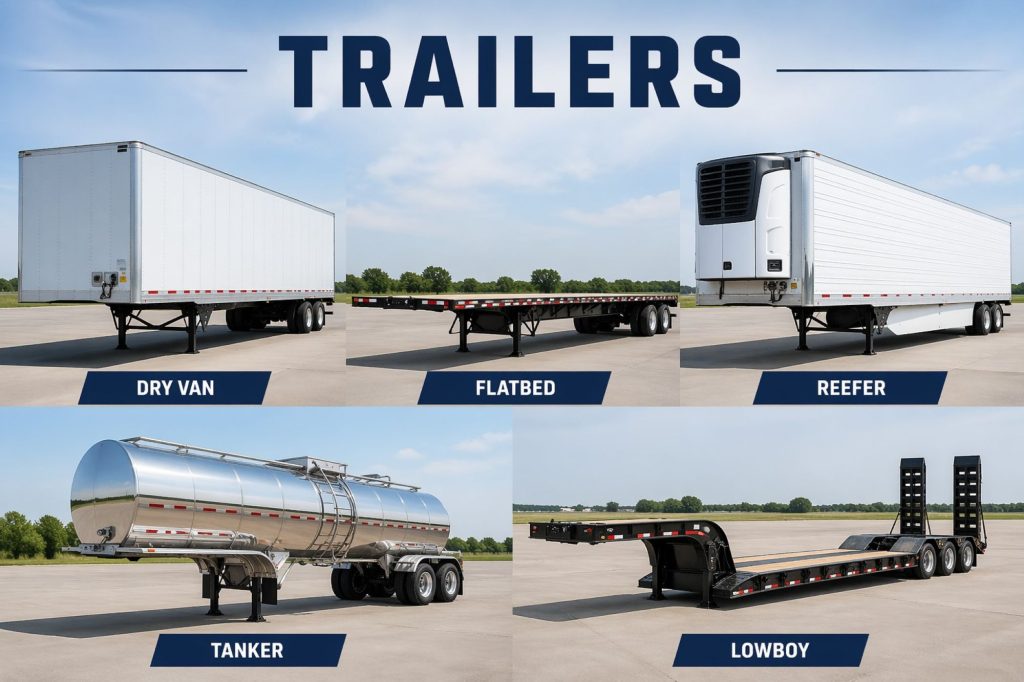
Trailers are a critical component of the trucking industry, designed to transport a wide range of freight across different sectors. From standard dry van trailers to specialized heavy haul configurations, each trailer type is built for specific cargo, operating conditions, and industry requirements.
Understanding trailer types is essential for drivers, carriers, and fleet operators to ensure proper equipment selection, safe transport, and efficient operations.
Core Trailer Categories
The Truck Equipment Atlas organizes trailers into clearly defined categories based on design, function, and the type of freight they are built to handle.
Dry Van Trailers
Standard enclosed trailers used for general freight and non-perishable goods.
Refrigerated (Reefer) Trailers
Temperature-controlled trailers designed for transporting perishable goods.
Flatbed Trailers
Open-deck trailers used for oversized or irregularly shaped freight.
Step Deck / Drop Deck Trailers
Lower deck height allows for taller loads while staying within legal height limits.
Lowboy Trailers RGN Trailers
Heavy haul trailers designed for oversized and overweight equipment.
Tanker Trailers
Specialized trailers for transporting liquids such as fuel, chemicals, and food-grade products.
Hopper / Bulk Trailers
Designed for dry bulk materials like cement, sand, and powders.
Car Hauler Trailers
Designed for transporting multiple vehicles in a stacked configuration.
Dump Trailers
Hydraulic lift trailers used for hauling and unloading loose materials like gravel, dirt, and debris.
Log Trailers
Specialized trailers designed for transporting raw timber using bunk and stake systems.
Chassis Trailers
Intermodal trailers designed to transport shipping containers using standardized locking systems.
Conestoga Trailers
Flatbed trailers equipped with a sliding tarp system for weather protection and flexible loading.
Specialty Trailers
Trailers designed for unique or niche hauling applications that fall outside standard categories, including livestock, extendable, walking floor, and other specialized configurations.
Commercial Trailer Models on Truck Equipment Atlas
Truck Equipment Atlas includes a growing library of individual commercial trailer profiles covering equipment used across general freight, refrigerated transportation, flatbed operations, heavy haul, tanker transportation, bulk freight, vehicle transport, logging, intermodal operations, and other specialized applications.
Explore the trailer models currently available on Truck Equipment Atlas below. Each profile provides information about the trailer, its applications, equipment characteristics, and the types of freight and operations it is designed to support.
Dry Van Trailers
- Great Dane Champion Dry Van
- Hyundai Translead Dry Van
- Stoughton Dry Van
- Utility 3000D Dry Van
- Wabash DuraPlate Dry Van
Refrigerated Trailers
Flatbed Trailers
- Benson Aluminum Flatbed
- Fontaine Revolution Flatbed
- MAC Aluminum Flatbed
- Reitnouer MaxMiser Flatbed
- Transcraft Eagle II Flatbed
- Wilson Flatbed
Step Deck Trailers
- Fontaine Velocity Step Deck Trailer
- MAC Step Deck
- Reitnouer Step Deck
- Transcraft Eagle II Step Deck Trailer
- Wilson Step Deck Trailer
Lowboy Trailers
- Fontaine Magnitude Lowboy Trailer
- Rogers Brothers Detachable Lowboy
- Talbert Lowboy Trailer
- Trail King TK Series Lowboy Trailer
RGN Trailers
Tank Trailers
- Brenner Chemical Tank Trailer
- Heil Tank Trailer
- MAC Tank Trailer
- Polar Tank Trailer
- Tremcar Fuel Tank Trailer
Hopper Trailers
Dump Trailers
Car Hauler Trailers
Log Trailers
Chassis Trailers
Conestoga Trailers
- Benson Conestoga Trailer
- Fontaine Velocity Conestoga
- Reitnouer MaxMiser Conestoga Trailer
- Wilson Conestoga Trailer
Traveling Axle and Hydraulic Tail Trailers
Specialized Trailers
- Kalyn Siebert Specialized Trailer
- XL Specialized Extendable Trailer
- XL Specialized Hydraulic Detachable Trailer
Truck Equipment Atlas will continue expanding this directory as additional trailer manufacturers, models, configurations, and specialized equipment are added to the site.
How to Use This Section
Each trailer category links to a dedicated page that provides detailed breakdowns of that trailer type, including configurations, uses, advantages, and operational considerations.
As the platform expands, this section will serve as a centralized reference point for understanding trailer equipment across the trucking industry.
What You’ll Find on Trailer Pages
Each trailer page on Truck Equipment Atlas follows a consistent structure to make it easy to compare and understand different equipment types.
This includes:
• Overview and real world use
• Key characteristics and specifications
• Common configurations
• Advantages and limitations
• Driver and operator considerations
• Maintenance and ownership insights
• Industry applications
How Trailers Connect to Trucks and Equipment
Trailers do not operate independently. They are part of a complete trucking system that includes the truck and supporting equipment.
• Trailers connect directly to truck configurations such as sleeper and day cab trucks
• Certain trailers are tied to specific truck types (e.g., heavy haul setups)
• Equipment components like axles, braking systems, and suspensions play a critical role in trailer performance
Looking Ahead
The Trailers section will continue to expand with additional trailer types, configurations, and real world use cases.
Future additions will include:
• Detailed trailer model pages
• Load-specific trailer breakdowns
• Maintenance and ownership guides
• Comparison pages between trailer types
Follow the Growth of Truck Equipment Atlas
Truck Equipment Atlas continues to expand with new truck profiles, trailer coverage, diesel engine pages, equipment system resources, manufacturer information, freight-sector content, and educational guides.
Visit our Site Updates page to follow major milestones, newly published resources, and future projects as we continue building one of the industry’s growing commercial trucking equipment reference libraries.
From commercial trucks and specialized trailers to diesel engines, equipment systems, and future Truck Stop Atlas resources, new content is being added regularly to help drivers, owner-operators, fleets, technicians, students, and industry professionals better understand the equipment that keeps freight moving.
Explore the Latest Site Updates
Stay Connected
As new trailer types and detailed pages are added, this section will continue to evolve into a comprehensive reference for trailer equipment.