
PACCAR TX-12 Transmission
Quick Facts
- Manufacturer: PACCAR
- Transmission Type: Automated Transmission
- Transmission Family: PACCAR TX-12 Series
- Primary Configurations: TX-12 and TX-12 PRO
- Number of Forward Speeds: 12
- Number of Reverse Speeds: Two
- Maximum Engine Torque: Up to 1,850 lb-ft for the TX-12
- Maximum Engine Horsepower: Up to 510 hp for the TX-12
- Maximum GCWR: Up to 110,000 lbs for the TX-12
- TX-12 PRO Torque Rating: Up to 1,700 lb-ft
- TX-12 PRO Horsepower Rating: Up to 455 hp
- TX-12 PRO Maximum GCWR: Up to 70,000 lbs
- Control Type: Electronically Controlled Automated Shifting
- Launch System: Electronically Controlled Dry Clutch
- Clutch Pedal: None
- Common Engine Pairings: PACCAR PX-9, PACCAR MX-11, and PACCAR MX-13
- Common Truck Brands: Kenworth and Peterbilt
- PTO Compatibility: Bottom-mounted and rear-mounted PTO provisions
- System Weight: Approximately 657 lbs for TX-12 and 665 lbs for TX-12 PRO
- Oil Capacity: Approximately 16 pints
- Production Status: Active Production
Overview
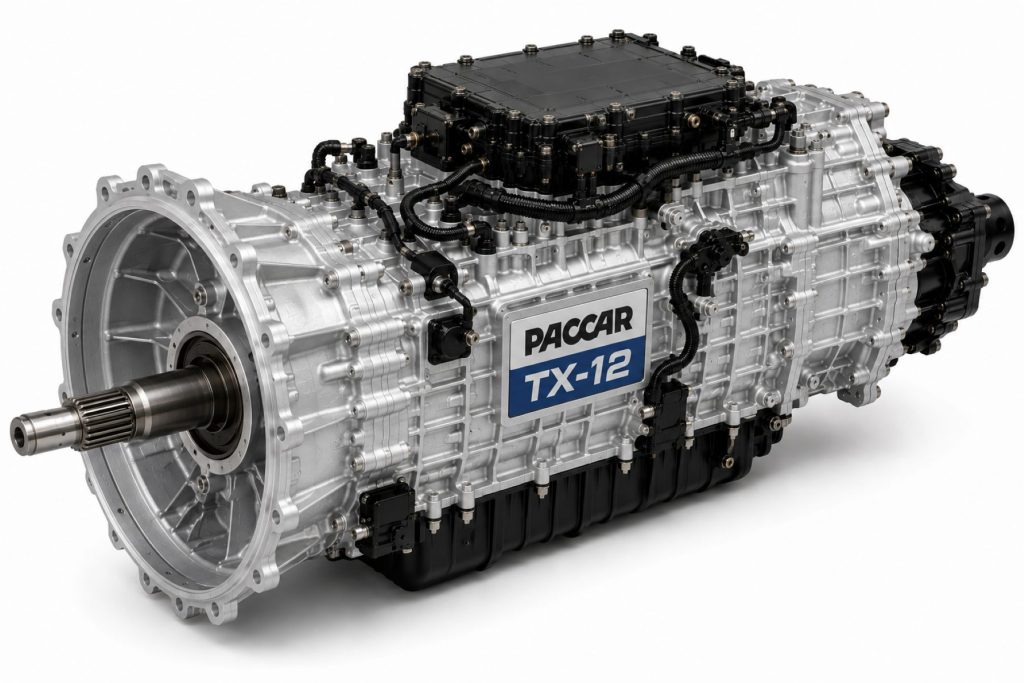
The PACCAR TX-12 is a 12-speed automated transmission designed for Kenworth and Peterbilt commercial trucks.
It combines mechanical gearing and a computer-controlled dry clutch with electronic shift controls. The driver receives two-pedal operation without having to operate a clutch pedal or manually shift through all 12 gears.
The standard TX-12 is primarily designed for line-haul, regional, intercity, highway-delivery, and car-hauler applications. It supports engines producing up to approximately 510 horsepower and 1,850 lb-ft of torque, with a maximum gross combination weight rating of approximately 110,000 pounds.
The PACCAR TX-12 PRO expands the transmission family into more demanding vocational applications. It uses an extreme-duty clutch, vocational shift programming, standard bottom and rear PTO provisions, and features designed for dump, municipal, tanker, construction, and vocational tractor service.
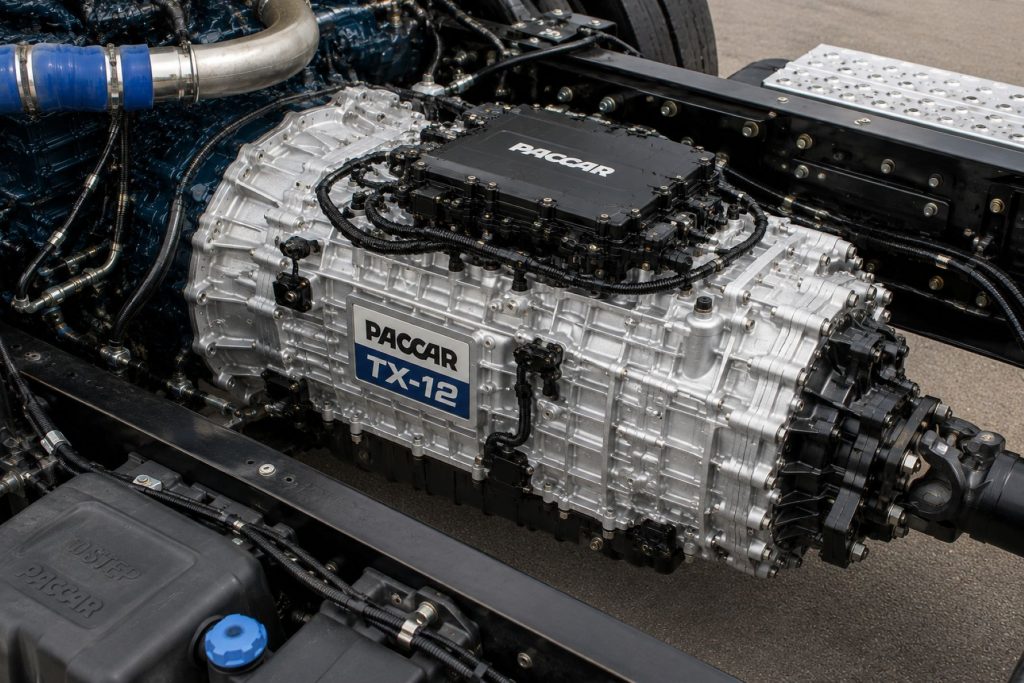
The TX-12 is closely integrated with PACCAR engines, truck electronics, cruise-control systems, engine brakes, and PACCAR axles. This integration allows the engine and transmission to coordinate torque delivery, clutch engagement, shift timing, and vehicle-speed control.
Its aluminum housing, cooler-less lubrication system, internal electrical routing, and approximately 16-pint oil capacity help reduce weight and maintenance complexity.
Key Characteristics
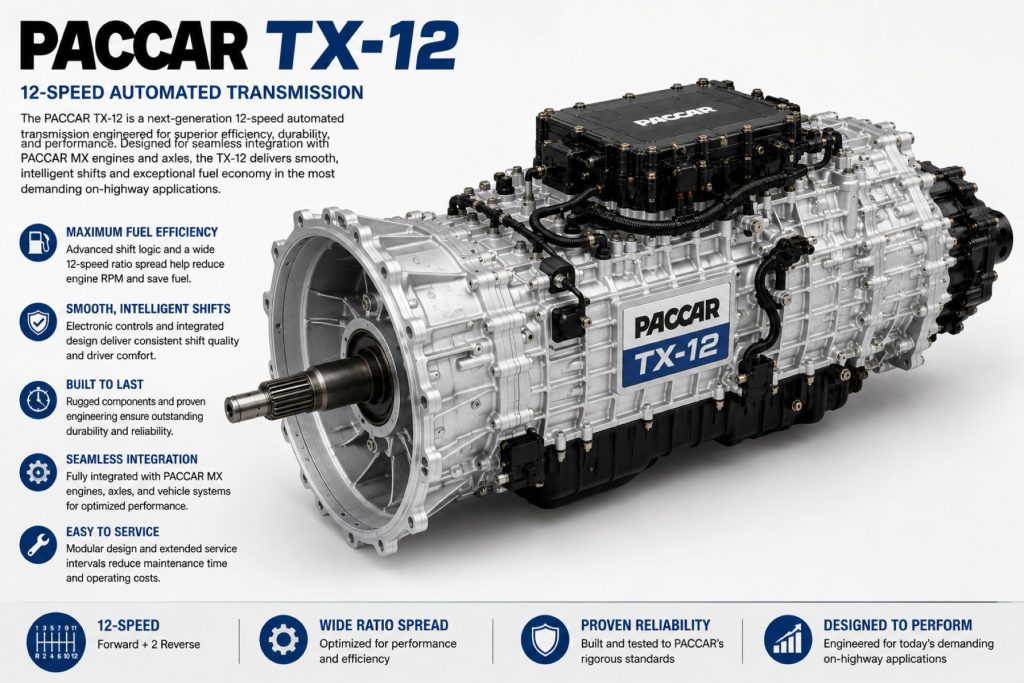
The PACCAR TX-12 provides 12 forward ratios and two reverse ratios. Its wide overall ratio coverage supports highway efficiency while maintaining low-speed maneuverability.
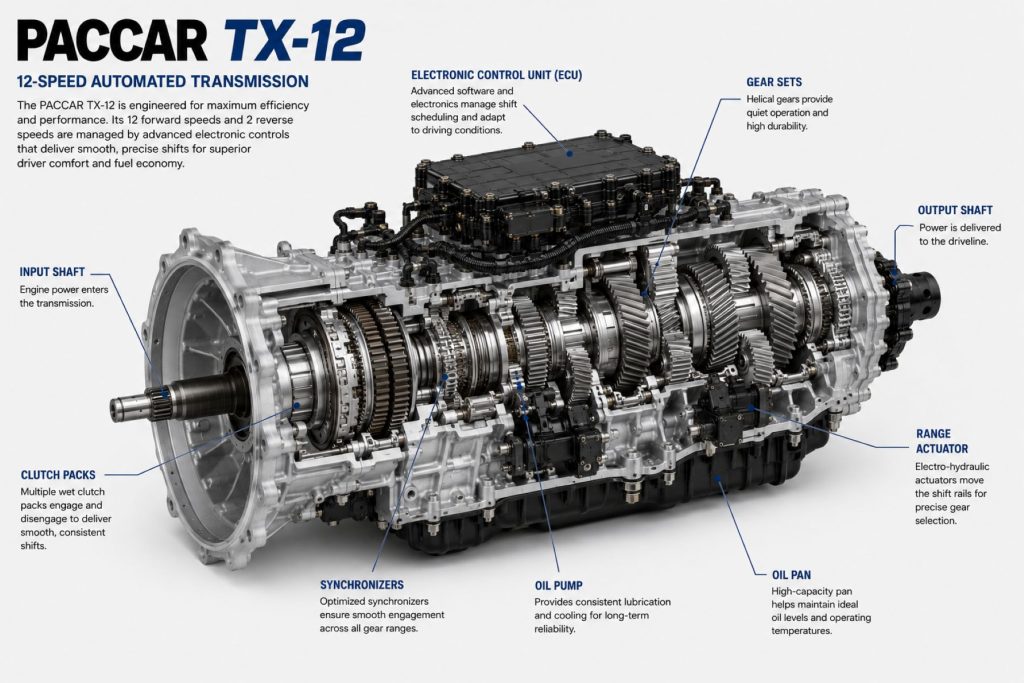
The transmission uses an automated dry clutch rather than a hydraulic torque converter. Once the clutch is engaged, engine power passes mechanically through the selected gears to the driveshaft.
Electronic controls monitor engine speed, engine torque, throttle position, vehicle speed, road grade, selected driving mode, and calculated vehicle weight. The transmission uses this information to select a starting gear and determine when to shift.
The TX-12 can skip gears when the truck is lightly loaded or operating conditions do not require every ratio. Under heavier loads or on steeper grades, it can use more intermediate gears to keep the engine within an efficient operating range.
Its 11th gear is direct drive at 1.00:1, while 12th gear provides a 0.77:1 overdrive ratio.
The transmission’s deep 16.92:1 first reverse ratio supports controlled low-speed backing. A second reverse ratio allows faster reverse movement when conditions permit.
The internal electrical system minimizes the exposure of wiring and connectors to moisture, corrosion, road debris, and other external conditions.
Oil-pressure and temperature sensors help warn the driver of lubrication problems before low oil pressure or excessive temperature causes serious gear and bearing damage.
How the Transmission Works
The TX-12 uses a computer-controlled clutch between the engine and transmission.
When the driver selects Drive and applies the accelerator, the transmission control system determines the appropriate starting gear. The clutch actuator then engages the dry clutch at a controlled rate.
Starting-gear selection depends on vehicle weight, road grade, engine torque, accelerator position, axle ratio, operating mode, and transmission programming.
During a shift, the transmission communicates with the engine control module and requests a temporary reduction in engine torque. This unloads the driveline and allows the current gear to disengage.
Internal actuators select the next gear while engine speed is adjusted to match the new ratio. Engine torque is then restored.
Because the TX-12 is mechanically connected through a dry clutch and gears, power is briefly interrupted during gear changes. This is normal for an automated transmission and differs from the nearly continuous power delivery of a torque-converter automatic.
The transmission can skip unnecessary ratios. For example, an empty or lightly loaded tractor may begin in a higher starting gear and skip one or more gears during acceleration.
A heavily loaded truck may begin in a lower gear and use more of the available ratios.
Manual mode allows the driver to request a gear or control the highest available gear. The electronic controls can reject a request that would overspeed the engine, lug the engine, damage the clutch, or place the drivetrain outside approved limits.
The TX-12 PRO adds vocational programming that changes how the clutch, engine, and gears respond during off-highway operation, difficult launches, rocking maneuvers, paving work, and PTO operation.
Common Specifications
Transmission Type
The PACCAR TX-12 is a purpose-built automated transmission using mechanical gears, a dry clutch, and electronic controls.
It provides automatic two-pedal operation but does not use a hydraulic torque converter like an Allison fully automatic transmission.
Forward Gears
Both the TX-12 and TX-12 PRO provide 12 forward gears.
Reverse Gears
Both configurations provide two reverse gears.
The deep first reverse ratio supports controlled maneuvering, while the second reverse ratio permits faster backing when appropriate.
Gear Ratios
Common PACCAR TX-12 ratios are:
- First Gear: 14.43:1
- Second Gear: 11.05:1
- Third Gear: 8.44:1
- Fourth Gear: 6.46:1
- Fifth Gear: 4.95:1
- Sixth Gear: 3.79:1
- Seventh Gear: 2.91:1
- Eighth Gear: 2.23:1
- Ninth Gear: 1.70:1
- Tenth Gear: 1.30:1
- Eleventh Gear: 1.00:1
- Twelfth Gear: 0.77:1
- First Reverse: 16.92:1
- Second Reverse: 12.95:1
- Overall Forward Ratio Coverage: Approximately 18.85
Specifications can change by model year. The transmission identification information and current PACCAR documentation should be used when exact ratios are required.
Direct and Overdrive Gears
Eleventh gear provides a direct 1.00:1 ratio.
Twelfth gear is a 0.77:1 overdrive ratio that reduces engine speed during highway operation.
TX-12 Torque Capacity
The standard TX-12 supports up to approximately 1,850 lb-ft of engine torque.
TX-12 Horsepower Capacity
The standard TX-12 supports engine ratings of up to approximately 510 horsepower.
TX-12 Maximum GCWR
The standard TX-12 supports gross combination weights reaching approximately 110,000 pounds in approved applications.
TX-12 PRO Torque Capacity
The TX-12 PRO supports up to approximately 1,700 lb-ft of engine torque.
When paired with the PACCAR PX-9 in certain medium-duty applications, its approved rating may be limited to approximately 1,250 lb-ft.
TX-12 PRO Horsepower Capacity
The TX-12 PRO supports up to approximately 455 horsepower.
TX-12 PRO Maximum GCWR
PACCAR lists a maximum GCWR of approximately 70,000 pounds for the TX-12 PRO.
Specific PX-9 applications may carry lower ratings, such as approximately 66,000 pounds.
Clutch System
The standard TX-12 uses a heavy-duty automated dry clutch.
The TX-12 PRO uses an extreme-duty clutch designed to provide greater durability and increased maneuvering time in difficult vocational conditions.
Neither configuration uses a driver-operated clutch pedal.
System Weight
- TX-12: Approximately 657 lbs
- TX-12 PRO: Approximately 665 lbs
These figures include the transmission system as specified by PACCAR. Installed weight can vary with the clutch, PTO equipment, output components, and truck configuration.
Transmission Housing
The transmission uses an aluminum housing to reduce overall powertrain weight.
Oil Capacity
Both configurations use approximately 16 pints of transmission lubricant.
The level should be checked according to PACCAR procedures rather than relying only on the listed capacity.
Lubrication System
The TX-12 uses a precision lubrication system designed to operate without a separate transmission oil cooler in approved applications.
The cooler-less design reduces hoses, connections, fluid capacity, potential leak points, and installation weight.
Oil-Pressure Sensor
An oil-pressure sensor monitors lubrication pressure and can warn the driver of a low-pressure condition before the gears and shafts experience major damage.
Oil-Temperature Sensor
Current TX-12 and TX-12 PRO configurations include an oil-temperature sensor.
The system can alert the driver when operating conditions create excessive transmission temperature.
Oil-Change Interval
The standard TX-12 has a published line-haul oil-change interval reaching approximately 750,000 miles under qualifying conditions.
The TX-12 PRO has a published standard-duty oil-change interval of approximately 250,000 miles.
Operating environment, vocation, idle time, contamination, lubricant specification, model year, and maintenance history can shorten these intervals.
Electrical System
Internal wiring helps protect electrical connections from road debris, moisture, salt, and corrosion.
The transmission control system communicates electronically with the engine, vehicle controller, engine brake, cruise-control system, and diagnostic network.
Shift Control
The TX-12 commonly uses a steering-column-mounted shift controller in Kenworth and Peterbilt trucks.
Controls normally include Drive, Neutral, Reverse, manual gear selection, and operating-mode functions.
PTO Provisions
The standard TX-12 includes a standard eight-bolt bottom PTO opening and can be equipped with an optional four-bolt rear PTO location.
The TX-12 PRO includes both the eight-bolt bottom and four-bolt rear PTO locations as standard equipment.
PTO Capacity
PACCAR lists a maximum combined PTO capacity of approximately 95 horsepower.
Actual capacity depends on PTO location, equipment speed, duty cycle, transmission gear, engine speed, and approved installation.
Mobile PTO
Mobile PTO operation is available on compatible TX-12 and TX-12 PRO configurations.
Split-shaft PTO operation is not listed as an approved capability for these models.
Maximum Cruise-Speed Engine Range
The standard TX-12 can support low engine-speed cruising, with current PACCAR information listing a lower cruise-speed limit of approximately 1,025 rpm.
The TX-12 PRO lists approximately 1,200 rpm.
The correct cruising range depends on engine, axle ratio, tire size, vehicle weight, terrain, and powertrain programming.
Installation Requirements
Installation requires compatible engine software, clutch and flywheel components, transmission mounts, driveshaft, air supply, electrical controls, shift selector, rear-axle gearing, and vehicle programming.
Common Applications
- Long-haul freight transportation
- Regional freight transportation
- Intercity freight operations
- Highway delivery
- Dry van transportation
- Refrigerated transportation
- Tanker transportation
- Flatbed transportation
- Car-hauler operations
- Pickup-and-delivery trucks
- Vocational tractors
- Dump trucks
- Municipal trucks
- Snowplow trucks
- Utility trucks
- Bucket and boom trucks
- Crane service trucks
- Paving operations
- Construction-support vehicles
- Light vocational Class 8 applications
Truck and Engine Compatibility
The standard PACCAR TX-12 is primarily used in Kenworth and Peterbilt highway and regional trucks.
Common applications include the Kenworth T680, Kenworth T880, Kenworth W990, Peterbilt 579, Peterbilt 567, and other approved PACCAR truck configurations.
The TX-12 PRO expands availability into heavier medium-duty and light Class 8 vocational trucks. Potential applications include the Kenworth T280 through T480 and Peterbilt Models 536, 537, and 548.
The transmission is designed to operate as part of the PACCAR integrated powertrain. Compatible engines include:
- PACCAR PX-9
- PACCAR MX-11
- PACCAR MX-13
The standard TX-12 supports the PACCAR PX-9, MX-11, and MX-13 within application-specific ratings.
The TX-12 PRO supports the PACCAR PX-9 and MX-11. It is intended for applications that require vocational features but do not need the higher torque and gross combination weight ratings of the PACCAR TX-18 Series.
Engine compatibility is determined by more than peak horsepower. Engine torque, torque curve, governed speed, chassis model, gross combination weight, axle ratio, tire size, duty cycle, PTO requirements, and electronic calibration must all be approved.
An individual Kenworth or Peterbilt model may be offered with several transmissions. TX-12 availability must be confirmed for the specific model year, engine, axle configuration, and vocation.
Advantages
- Provides automatic two-pedal operation
- Eliminates the driver-operated clutch pedal
- Reduces driver workload
- Can widen the available driver pool
- Provides 12 forward ratios
- Deep first and reverse ratios improve maneuverability
- Eleventh gear provides direct drive
- Twelfth gear provides highway overdrive
- Supports engines producing up to 510 horsepower
- Supports torque ratings reaching 1,850 lb-ft
- Standard TX-12 supports GCWR ratings reaching 110,000 pounds
- Lightweight aluminum housing supports payload efficiency
- Approximately 657-pound system weight
- Requires approximately 16 pints of transmission oil
- Cooler-less design reduces leak points
- Internal wiring helps protect electrical connections
- Oil-pressure sensor helps protect against lubrication failure
- Oil-temperature sensor provides additional protection
- Long line-haul lubrication interval
- Integrates with PACCAR engines and axles
- Column-mounted controls improve driver ergonomics
- TX-12 PRO adds vocational programming
- TX-12 PRO provides an extreme-duty clutch
- Multiple PTO mounting provisions are available
- Mobile PTO operation is supported
Limitations or Considerations
- Uses a wear-sensitive dry clutch
- Clutch replacement can be expensive
- Power is briefly interrupted during shifts
- Low-speed behavior differs from a torque-converter automatic
- Excessive creeping can accelerate clutch wear
- Repeated heavy backing can create clutch heat
- Shift quality depends on proper calibration
- The transmission is closely tied to PACCAR engines and electronics
- Used units may require reprogramming
- Electrical faults can prevent normal shifting
- Low air pressure can affect transmission operation
- Incorrect lubricant can damage internal components
- The long oil interval applies only under qualifying conditions
- The cooler-less design requires the lubrication system to remain in proper condition
- The standard model is primarily intended for highway and regional service
- The PRO version has lower torque and GCWR limits than the standard TX-12
- Neither version provides split-shaft PTO compatibility
- TX-12 PRO is not a replacement for the higher-capacity TX-18 PRO
- Improper rear-axle gearing can reduce performance and fuel economy
- Manual gear requests can be rejected by the control system
Driver and Operator Experience
The TX-12 gives the driver automatic operation without a clutch pedal.
The driver selects Drive, releases the service brake, and applies the accelerator. The transmission determines the starting gear and controls clutch engagement.
Starting gear depends on vehicle weight, road grade, accelerator position, engine torque, axle ratio, and transmission programming.
A lightly loaded truck may start in a higher gear and skip multiple ratios. A heavily loaded truck may select a lower starting gear and use more of the available gears.
The driver may notice a brief pause in power during shifts. This is normal because the transmission must temporarily unload the mechanical gears before selecting the next ratio.
Smooth accelerator inputs can improve shift quality. Sudden throttle changes during a shift may cause the transmission to change its planned gear or alter the shift timing.
Manual mode allows the driver to request or hold gears on hills, in traffic, at job sites, or during specialized operation. The transmission retains protective control and may deny an unsafe selection.
Low-speed maneuvering should be performed with the appropriate gear and controlled brake or accelerator input. Drivers should avoid prolonged clutch slipping.
The deep reverse ratio provides improved control when backing toward a loading dock, trailer, paver, or job-site position.
The TX-12 PRO provides specialized vocational functions that can improve control during difficult off-road or work-site operation.
Maintenance and Ownership Notes
The correct PACCAR-approved transmission lubricant must be used.
The transmission’s 16-pint oil capacity is substantially lower than many commercial transmissions. Even a moderate leak can therefore remove a meaningful percentage of the available lubricant.
Drivers should respond promptly to oil-pressure or oil-temperature warnings. Continuing to operate with inadequate lubrication can damage gears, shafts, bearings, and synchronizing components.
The standard line-haul oil interval can reach approximately 750,000 miles under approved conditions. This interval should not automatically be applied to vocational, contaminated, severe-duty, or unknown-history transmissions.
The TX-12 PRO uses a shorter published oil interval of approximately 250,000 miles for standard vocational operation.
The clutch is described as maintenance-free because it does not require routine manual adjustment. It remains a wear component and may eventually require replacement.
Clutch life depends on vehicle weight, number of starts, backing, road grade, driver behavior, calibration, and the amount of low-speed maneuvering.
Electrical connectors, batteries, grounds, charging-system voltage, air lines, and vehicle-network wiring should be inspected before internal transmission repairs are authorized.
PTO-equipped trucks require inspection of PTO gears, mounting fasteners, seals, controls, air lines, hydraulic hoses, and safety interlocks.
The driveshaft, universal joints, carrier bearings, output yoke, and axles and differentials should be included in the drivetrain maintenance program.
Common Transmission Problems
Clutch Wear
A worn clutch can cause slipping, shuddering, delayed engagement, poor launch performance, excessive engine speed, or clutch-related diagnostic codes.
Stop-and-go service, repeated backing, steep starts, heavy loads, and excessive creeping can accelerate wear.
Clutch Actuator Problems
A failed or improperly calibrated clutch actuator can prevent smooth engagement or complete clutch release.
Symptoms may include harsh launches, failure to select a gear, warning messages, or a truck that will not move.
Shift Actuator Problems
Shift actuators control internal gear selection. Mechanical, pneumatic, or electrical problems can cause missed shifts, failure to engage a gear, or emergency operating modes.
Low Air Pressure
The automated shift system depends on the truck’s air supply. Low air pressure, contaminated air, frozen lines, or leaks can interfere with normal shifting.
Low Oil Pressure
Low lubricant level, an internal leak, incorrect oil, or a lubrication-system problem can trigger a low-pressure warning.
The truck should not continue operating until the cause is identified.
Oil Leaks
Leaks may occur at housing joints, the input area, output seal, PTO openings, sensors, plugs, or other sealing points.
Because the transmission holds only approximately 16 pints, leaks deserve immediate attention.
Overheating
Excessive heat can result from low oil, clutch slipping, heavy maneuvering, incorrect operating technique, excessive loading, or internal damage.
Gear-Engagement Problems
Worn gears, forks, engagement components, or synchronizing parts may cause grinding, repeated shift attempts, abnormal noises, or transmission fault codes.
Speed Sensor Faults
The transmission relies on engine, input, and output-speed data. Failed sensors or damaged wiring can cause improper shifting or loss of normal operation.
Electrical Communication Faults
Problems between the engine, transmission, vehicle controller, engine brake, and shift selector can prevent gear selection or cause warning messages.
Battery voltage, grounds, connectors, and network wiring should be tested before major internal repairs.
Shift Selector Problems
A damaged column-mounted control, wiring connection, or vehicle-control input can prevent normal Drive, Neutral, Reverse, or manual functions.
PTO Problems
PTO faults may result from incorrect programming, failed interlocks, improper gear selection, excessive load, damaged wiring, lubrication problems, or an incorrectly matched PTO.
Improper Calibration
Incorrect clutch calibration, axle ratio, tire-size setting, engine programming, or transmission software can cause poor launch behavior and unsatisfactory shifting.
Buying Considerations
- Identify whether the transmission is a TX-12 or TX-12 PRO.
- Record the complete model and serial number.
- Confirm the engine horsepower and torque rating.
- Verify whether the transmission was built for a PX-9, MX-11, or MX-13.
- Confirm the truck model and model year.
- Determine the maximum required GCWR.
- Compare the intended application with the transmission’s approved vocation.
- Verify the rear-axle ratio and tire size.
- Confirm the 12-forward and two-reverse gear arrangement.
- Determine whether bottom-mounted or rear-mounted PTO capability is needed.
- Verify PTO horsepower, rotation, ratio, and operating requirements.
- Confirm whether mobile PTO operation is required.
- Inspect the clutch condition and available clutch-wear information.
- Review active and inactive diagnostic codes.
- Check transmission oil level and condition.
- Inspect the housing, seals, sensors, plugs, and PTO openings for leaks.
- Operate the truck from a cold start through normal operating temperature.
- Test forward engagement, reverse engagement, upshifts, downshifts, manual mode, and hill starts.
- Check for launch shudder or delayed clutch engagement.
- Listen for bearing, gear, or driveline noise.
- Review oil-change and clutch-replacement records.
- Confirm that the transmission control module, clutch actuator, shift selector, and wiring are included with a used unit.
- Determine whether electronic reprogramming is required.
- Verify dealer support, warranty eligibility, and parts availability.
Variants and Configurations
- PACCAR TX-12
- PACCAR TX-12 PRO
- TX-12 with PACCAR PX-9
- TX-12 with PACCAR MX-11
- TX-12 with PACCAR MX-13
- TX-12 PRO with PACCAR PX-9
- TX-12 PRO with PACCAR MX-11
- Highway Configuration
- Line-Haul Configuration
- Regional-Haul Configuration
- Car-Hauler Configuration
- Intercity Configuration
- Pickup-and-Delivery Configuration
- Dump-Truck Configuration
- Municipal Configuration
- Tanker Configuration
- Vocational Tractor Configuration
- Heavy-Duty Clutch Configuration
- Extreme-Duty Clutch Configuration
- Eight-Bolt Bottom PTO Configuration
- Four-Bolt Rear PTO Configuration
- Dual-PTO Configuration
- Mobile-PTO Configuration
- Secondary Calibration Configuration
Comparison to Similar Equipment
Compared with the Eaton Cummins Endurant HD, the PACCAR TX-12 has a similar 12-speed automated design and highway focus. The TX-12 is integrated with PACCAR engines, Kenworth trucks, and Peterbilt trucks, while Endurant HD is closely integrated with Cummins engines.
Compared with the Detroit DT12, the TX-12 provides similar two-pedal automated operation. The DT12 is designed around Detroit engines and Daimler truck electronics, while the TX-12 is integrated with the PACCAR powertrain.
Compared with the Volvo I-Shift, the TX-12 uses the same general automated mechanical approach. I-Shift is integrated with Volvo engines and Volvo trucks, while the TX-12 is used in Kenworth and Peterbilt products.
Compared with the Eaton UltraShift PLUS, the TX-12 uses a newer purpose-built automated design, lightweight aluminum housing, internal wiring, and cooler-less lubrication system. UltraShift PLUS remains available in numerous configurations and applications.
Compared with an Eaton Fuller manual transmission, the TX-12 eliminates the clutch pedal and performs shifts automatically. A manual transmission provides direct driver control but requires greater driver skill and creates more variation in shifting performance.
Compared with an Allison fully automatic transmission, the TX-12 uses an automated dry clutch rather than a hydraulic torque converter. Allison provides smoother uninterrupted power during launch and shifts, while the TX-12 is designed to provide lightweight highway efficiency.
Compared with the PACCAR TX-18, the TX-12 is lighter and designed for lower GCWR applications. The TX-18 provides additional forward and reverse ratios and greater capability for heavy-haul and demanding vocational work.
Best Fit For
- Kenworth highway fleets
- Peterbilt highway fleets
- Long-haul freight carriers
- Regional freight carriers
- Intercity transportation
- Highway delivery operations
- Car-hauler fleets
- Dry van transportation
- Refrigerated transportation
- Tanker operations within approved ratings
- Fleets using PACCAR MX engines
- Fleets seeking two-pedal operation
- Operations prioritizing low transmission weight
- Fleets seeking long line-haul maintenance intervals
- Vocational fleets using the TX-12 PRO
- Municipal operations
- Dump-truck applications within TX-12 PRO ratings
- Utility and bucket-truck operations
- Light Class 8 vocational tractors
- Applications requiring transmission-mounted PTO capability
Related Truck Types
- Sleeper Trucks
- Day Cab Trucks
- Vocational Trucks
- Heavy Haul Trucks
- Medium-Duty Trucks
- Car Hauler Trucks
- Regional-Haul Trucks
- Highway Tractors
Related Truck Models
- Kenworth T680
- Kenworth T880
- Kenworth W990
- Kenworth T280
- Kenworth T380
- Kenworth T480
- Peterbilt 579
- Peterbilt 567
- Peterbilt 536
- Peterbilt 537
- Peterbilt 548
Related Engines
- PACCAR PX-9
- PACCAR MX-11
- PACCAR MX-13
Related Transmission Types
- Automated Manual Transmissions
- Heavy-Duty Transmissions
- Medium-Duty Transmissions
- Overdrive Transmissions
- Highway Transmissions
- Vocational Transmissions
Related Equipment Systems
- Drivetrain Systems
- Automated Clutch Systems
- Clutch Actuators
- Transmission Control Modules
- Driveshafts
- Axles and Differentials
- PACCAR DX-40 Axles
- Transmission Lubrication Systems
- Transmission-Mounted PTO Systems
- PTO Systems
- Electronic Control Systems
- Predictive Cruise-Control Systems
Related Guides
- How Diesel Truck Engines Work
- Understanding Horsepower vs Torque
- How to Choose the Right Commercial Truck
Understand the operating principles in How Commercial Truck Transmissions Work, compare drivetrain designs in Manual vs Automated Manual vs Automatic Transmissions, and evaluate gearing, application, and compatibility in How to Choose a Commercial Truck Transmission.
Regulatory and Compliance Notes
The PACCAR TX-12 must be installed and programmed within the engine-power, torque, gross combination weight, clutch, driveline, and vocational limits approved by PACCAR and the truck manufacturer.
The transmission’s maximum GCWR does not authorize a truck to exceed federal, state, provincial, axle, tire, chassis, bridge-formula, or permit restrictions.
Electronic communication between the engine, transmission, brakes, cruise-control system, and vehicle controller must remain compatible with the truck’s certified configuration.
Unauthorized engine or transmission programming can affect drivability, emissions compliance, component protection, fuel economy, diagnostic functions, and warranty coverage.
PTO-driven equipment must include the proper controls and safety interlocks. PTO operation may be restricted by transmission gear, vehicle speed, parking-brake position, engine speed, or equipment status.
Replacement transmissions and electronic control modules must be programmed for the receiving truck. Installing incompatible hardware or software can prevent normal operation.
Real World Operating Notes
In highway service, the TX-12 reduces the physical workload associated with clutch operation and repeated gear changes.
The transmission automatically adjusts starting gear according to vehicle weight and road grade. An empty tractor may begin in a higher gear, while a loaded combination may use a lower ratio.
Drivers may feel a short pause during shifts because the transmission must reduce engine torque and unload the mechanical gears. This is normal automated-transmission behavior.
Smooth accelerator input generally produces the best shift quality. Aggressive or rapidly changing throttle commands can cause the transmission to reconsider its planned shift.
The deep first and reverse ratios provide useful low-speed control, but drivers should avoid using continuous clutch slipping to regulate speed.
In vocational service, the TX-12 PRO’s extreme-duty clutch provides additional maneuvering capability. It does not make the clutch immune to heat or wear.
Oil-pressure warnings require immediate attention. The transmission’s low fluid capacity is an advantage for weight and maintenance, but it also means a significant leak can quickly reduce the available lubricant.
The standard TX-12 is best suited to line-haul and regional operation. Fleets performing heavier vocational or off-highway work should compare the TX-12 PRO, TX-18, and TX-18 PRO before ordering.
Frequently Asked Questions
What is the PACCAR TX-12?
The PACCAR TX-12 is a 12-speed electronically controlled automated transmission used in compatible Kenworth and Peterbilt commercial trucks.
Is the PACCAR TX-12 an automatic transmission?
It provides automatic two-pedal operation, but mechanically it uses a dry clutch and geared transmission rather than a hydraulic torque converter.
How many gears does the TX-12 have?
It has 12 forward gears and two reverse gears.
How much torque can the TX-12 handle?
The standard TX-12 supports up to approximately 1,850 lb-ft. The TX-12 PRO supports up to approximately 1,700 lb-ft.
How much horsepower can the TX-12 handle?
The standard TX-12 supports engines producing up to approximately 510 horsepower. The TX-12 PRO supports up to approximately 455 horsepower.
What is the maximum GCWR?
The standard TX-12 supports approved combinations reaching approximately 110,000 pounds. The TX-12 PRO is rated up to approximately 70,000 pounds.
What engines work with the TX-12?
Current compatible engine families include the PACCAR PX-9, PACCAR MX-11, and PACCAR MX-13. The exact pairing depends on the TX-12 model and truck application.
What trucks use the TX-12?
Common applications include Kenworth T680, T880, W990, T280 through T480 and Peterbilt 579, 567, 536, 537, and 548 configurations.
Does the TX-12 have a clutch?
Yes. It uses a computer-controlled dry clutch, but the driver does not operate a clutch pedal.
What is the difference between the TX-12 and TX-12 PRO?
The standard TX-12 is primarily designed for line-haul and regional transportation. The TX-12 PRO adds an extreme-duty clutch, vocational programming, standard dual PTO provisions, and work-truck operating features.
Does the TX-12 require an oil cooler?
The transmission uses a cooler-less precision lubrication design in approved applications.
How much oil does the TX-12 hold?
Both the TX-12 and TX-12 PRO use approximately 16 pints of transmission lubricant.
What is the TX-12 oil-change interval?
The standard TX-12 can reach approximately 750,000 miles in qualifying line-haul service. The TX-12 PRO has a published interval of approximately 250,000 miles for standard vocational service.
Can the TX-12 operate a PTO?
Yes. It supports bottom and rear PTO installations with a maximum combined capacity of approximately 95 horsepower.
Is mobile PTO operation available?
Yes. Mobile PTO operation is available on compatible TX-12 and TX-12 PRO configurations.
Can a used TX-12 be installed in another truck?
Possibly, but the transmission model, engine, clutch, truck electronics, software, axle ratio, and application must be compatible. Reprogramming is generally required.
Availability and Where to Find
The PACCAR TX-12 remains available in compatible new Kenworth and Peterbilt trucks.
New availability depends on truck model, model year, engine, axle ratio, vocation, gross combination weight, and regional order options.
Replacement transmissions may be available through Kenworth and Peterbilt dealers, PACCAR Parts distributors, commercial transmission specialists, salvage operations, truck auctions, and used commercial-parts marketplaces.
Buyers should provide the truck identification number and transmission serial number when ordering a replacement transmission, clutch, actuator, control module, PTO, or internal component.
Current specifications for both configurations can be confirmed through the official PACCAR TX-12 and TX-12 PRO product page.
Support Trucking Families
Truck Equipment Atlas supports the mission of Grey Cross, a nonprofit dedicated to helping families of truck drivers who lose their lives while on the road. As the site grows, part of its mission is to bring awareness and support to these families.
Podcast or Video Section
Learn More Through Audio and Video
Truck Equipment Atlas will continue expanding with podcast episodes, interviews, and equipment breakdowns to help drivers and fleets better understand trucks and equipment.
Follow the Growth of Truck Equipment Atlas
Truck Equipment Atlas continues to expand with new truck profiles, trailer coverage, diesel engine pages, equipment system resources, manufacturer information, and educational guides.
Visit our Site Updates page to explore recent additions, project milestones, and upcoming resources as we continue building one of the industry’s growing commercial trucking equipment reference libraries.
View the Latest Site Updates: Truck Equipment Atlas Site Updates