
Eaton Fuller RTLO Series Transmission
Quick Facts
- Manufacturer: Eaton
- Brand Family: Eaton Fuller Roadranger
- Transmission Type: Heavy-Duty Manual Transmission
- Common Configurations: 13-Speed and 18-Speed
- Common Model Families: RTLO 13-Speed and RTLO 18-Speed
- Representative Models: RTLO-14613B, RTLO-14713A, RTLO-15613B, RTLO-16613A, RTLO-16913A, RTLO-18913A, RTLO-20913A, RTLO-14618B, RTLO-16618B, RTLO-16918B, RTLO-18918B, RTLO-20918B, and RTLO-22918B
- Forward Speeds: 13 or 18 depending on model
- Reverse Speeds: Multiple reverse ratios depending on model and range selection
- Maximum Input-Torque Range: Approximately 1,250 to 2,250 lb-ft depending on model
- Gear Design: Twin-Countershaft Main Section with Auxiliary Range and Splitter Section
- Top-Gear Configuration: Overdrive
- Shift Control: Driver-Operated Shift Lever with Air-Operated Range and Splitter Controls
- Clutch Type: Heavy-Duty Dry Clutch
- Synchronization: Non-Synchronized Main Gearbox
- PTO Compatibility: Available PTO provisions vary by model and case configuration
- Common Applications: Long-Haul, Heavy Haul, Logging, Dump, Construction, Tanker, Oilfield, and Severe-Service Trucks
- Common Truck Classes: Primarily Class 8
- Approximate Dry Weight: Commonly around 700 to 750 pounds depending on model and equipment
- Lubrication: Eaton-approved heavy-duty manual-transmission lubricant
- Production Status: Legacy family; several late RTLO models were discontinued during 2023 and 2024, but service parts and remanufactured transmissions remain available
Overview
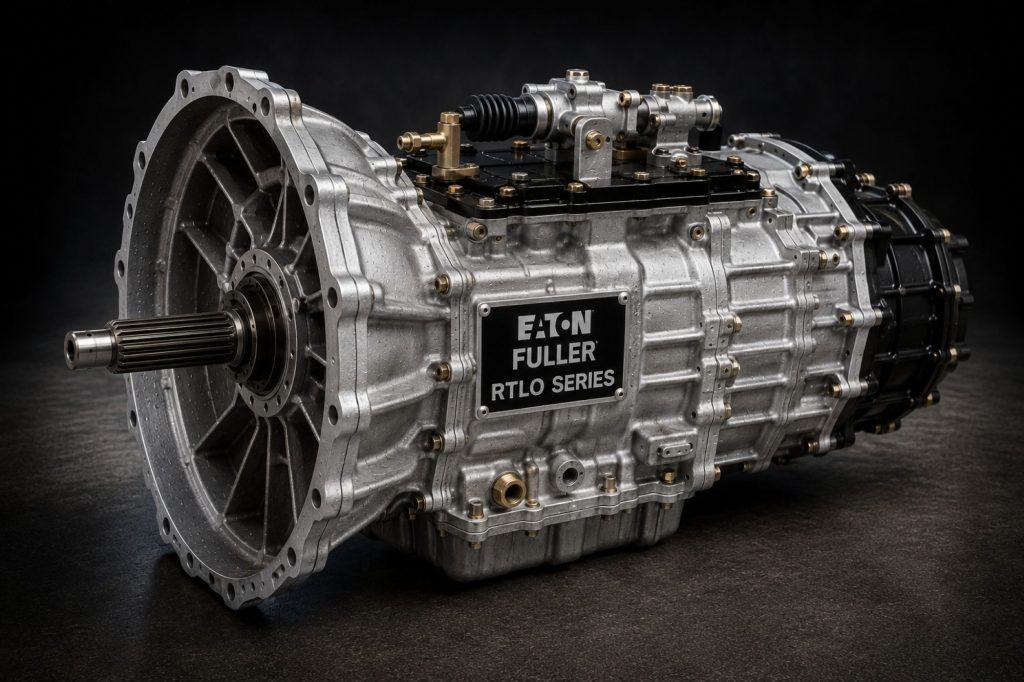
The Eaton Fuller RTLO Series is a family of heavy-duty manual transmissions developed for North American Class 8 trucks. It includes many of Eaton Fuller’s best-known 13-speed and 18-speed Roadranger transmissions.
RTLO transmissions were designed for applications requiring a wide selection of ratios, high input-torque capacity, dependable mechanical construction, and direct driver control. They were widely used in highway tractors, heavy-haul trucks, logging trucks, dump trucks, construction vehicles, tankers, and other demanding commercial applications.
The RTLO family uses a non-synchronized twin-countershaft main transmission combined with an auxiliary section containing range and splitter gearing. This design allows a relatively compact shift pattern to provide 13 or 18 progressive forward ratios.
The driver controls the main gearbox with the shift lever and operates the range selector and splitter button through an air-control system. Proper shifting requires the driver to coordinate engine speed, clutch operation, shift-lever movement, and the air-operated range and splitter controls.
The complete model number on the transmission identification tag must be used when ordering parts, selecting a clutch, determining lubricant requirements, or confirming compatibility.
Key Characteristics
The RTLO Series is recognized for its broad ratio coverage. A 13-speed version gives an experienced driver additional highway ratios without requiring every lower-range gear to be split.
An 18-speed version allows ratios in both the low and high ranges to be split. This provides greater control at low speeds, under heavy loads, and on steep grades.
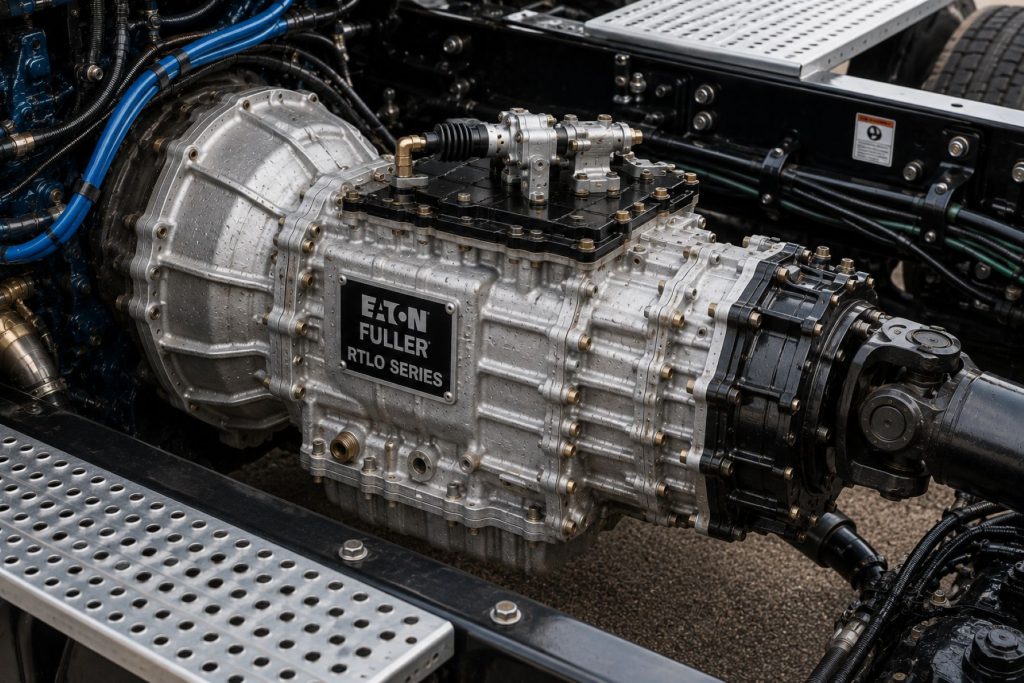
The transmission uses Eaton Fuller’s twin-countershaft architecture. Engine torque entering the transmission is divided between two countershafts, helping distribute the load across the internal geartrain.
Its low-inertia mainshaft design reduces rotating mass and helps the transmission respond more quickly when engine speed is matched correctly during a shift.
RTLO transmissions are non-synchronized. The driver must match engine and road speed during shifts rather than relying on synchronizers to equalize gear speeds automatically.
RTLO models use an overdrive top-gear configuration. Overdrive can reduce engine speed at highway cruising speeds when the transmission, rear-axle ratio, tire size, engine operating range, and vehicle weight are properly matched.
How the Transmission Works
Power enters the transmission through the clutch and input shaft. The input gearing transfers torque to two countershafts located on opposite sides of the mainshaft.
Both countershafts transmit torque to the selected mainshaft gear. Dividing the load between two countershafts helps the transmission handle the high torque produced by heavy-duty diesel engines.
The driver selects the primary shift positions through the shift lever. Because the main gearbox is not synchronized, the driver must reduce or increase engine speed until the engaging components are rotating at compatible speeds.
In a 13-speed RTLO transmission, the lower portion of the shift sequence is generally operated through the main shift positions and range control. The upper-range ratios can then be divided with the splitter control, producing smaller steps between the higher road gears.
In an 18-speed RTLO transmission, both the low- and high-range ratios can be split. This gives the driver more ratio choices when starting a heavy load, climbing a grade, traveling through soft terrain, or maintaining the engine within a narrow operating range.
The range selector changes the auxiliary section between low and high range. The driver normally preselects the desired range before moving the shift lever through neutral.
The splitter button selects the direct or overdrive side of a gear position. The driver preselects the split and briefly releases torque from the drivetrain, allowing the air-operated auxiliary section to complete the change.
The clutch disconnects engine power during starts and may be used during gear changes. Many experienced drivers double-clutch, while some shift without the clutch after the vehicle is moving. Eaton’s driver instructions and fleet policies should always be followed.
Common Specifications
Transmission Type
The RTLO Series consists of heavy-duty, driver-shifted manual transmissions designed primarily for Class 8 commercial trucks.
The main gearbox is non-synchronized, while air-operated controls manage the auxiliary range and splitter functions.
Gear Configurations
The two principal configurations are:
- 13-speed overdrive
- 18-speed overdrive
The 13-speed configuration provides closely spaced upper-range gears for highway and heavy-duty operation.
The 18-speed configuration provides split ratios in both the low and high ranges, giving the driver greater flexibility at low road speeds and under high gross combination weights.
Input-Torque Capacity
Torque capacity varies substantially across the RTLO family.
Common historical ratings include:
- 1,250 lb-ft
- 1,450 lb-ft
- 1,550 lb-ft
- 1,650 lb-ft
- 1,850 lb-ft
- 2,050 lb-ft
- 2,250 lb-ft
The exact rating must be obtained from the transmission identification tag, complete model designation, or Eaton documentation.
Gear Ratios
Exact gear ratios differ by model and ratio set.
Many RTLO 13-speed transmissions provide an overall ratio spread of approximately 12:1 to 13:1.
Many RTLO 18-speed transmissions provide an overall ratio spread of approximately 19:1 or greater, giving them substantially deeper starting capability.
Top gear is an overdrive ratio on RTLO models. Exact individual ratios must be verified from the specification sheet for the complete model number.
Reverse Ratios
RTLO transmissions provide multiple reverse selections through the main gearbox and auxiliary-section controls.
The number and depth of usable reverse ratios differ between 13-speed and 18-speed configurations.
Shift Pattern
A conventional Roadranger-style shift lever controls the primary gear positions.
A range selector changes between low and high range.
A splitter control divides the available gear positions into direct and overdrive ratios.
The correct shift-pattern label should remain visible in the cab.
Clutch System
RTLO transmissions are commonly paired with a heavy-duty dry clutch.
The exact clutch diameter, torque rating, number of friction plates, input-shaft spline, clutch-brake arrangement, and release mechanism depend on the truck and transmission model.
Countershaft Design
The RTLO uses a twin-countershaft design that divides torque between two countershafts.
Correct internal timing is essential during rebuilding. Improper countershaft timing can cause uneven gear loading and serious transmission damage.
Air-Control System
Compressed air operates the auxiliary range and splitter mechanisms.
The system includes shift-knob controls, air lines, valves, range components, splitter components, and internal actuating hardware.
Air leaks, contamination, restricted lines, or faulty valves can cause delayed or incomplete shifts.
PTO Compatibility
Many RTLO models were offered with one or more PTO openings.
PTO compatibility depends on the exact transmission case, mounting opening, drive-gear location, PTO ratio, direction of rotation, output requirement, and available clearance.
Lubrication System
RTLO transmissions use splash lubrication to distribute lubricant through the main and auxiliary sections.
Some installations may include an oil pump, cooler, or external filtration equipment depending on the model and duty cycle.
Only lubricant meeting the applicable Eaton specification should be used.
Transmission Weight
Many RTLO models weigh approximately 700 to 750 pounds without the clutch, lubricant, PTO, mounting hardware, or external cooling equipment.
Exact weight depends on the model and installed options.
Installation Requirements
Correct installation requires compatible:
- Engine flywheel housing
- Clutch and input shaft
- Pilot bearing
- Transmission mounts
- Driveshaft and yoke
- Air system
- Shift linkage or tower
- Speed-sensor arrangement
- PTO equipment
- Lubrication and cooling equipment
- Rear-axle ratio
- Engine torque and governed speed
Common Applications
- Long-haul sleeper tractors
- Regional highway tractors
- Heavy-haul tractors
- Logging trucks
- Dump trucks
- Construction trucks
- Oilfield trucks
- Mining-support trucks
- Tank trucks
- Agricultural transport trucks
- Lowboy and equipment-hauling tractors
- Severe-service vocational trucks
- High-gross-combination-weight operations
- Mountain and steep-grade operations
- Operations requiring precise low-speed control
Truck and Engine Compatibility
The Eaton Fuller RTLO family was used in a broad range of North American Class 8 trucks. Availability depended on the truck’s production year, engine, torque rating, clutch, drivetrain specification, and intended vocation.
Relevant truck platforms with live Truck Equipment Atlas pages include:
- Freightliner Cascadia
- Freightliner Classic
- Freightliner Coronado
- Freightliner 122SD
- Kenworth C500
- Kenworth T800
- Kenworth T880
- Kenworth W900
- Peterbilt 389
- Peterbilt 567
- International HX Series
- International HX620
- International LoneStar
- Volvo VNL
- Volvo VHD
- Western Star 4900
- Western Star 6900XD
Older RTLO-equipped platforms also included Freightliner Century Class, Freightliner Columbia, Freightliner FLD, Kenworth T600, Kenworth T660, Peterbilt 359, Peterbilt 379, Peterbilt 385, Peterbilt 386, International 9200, International 9400, International 9900, and International PayStar.
Common compatible engine families with live pages include:
- Detroit Series 60
- Detroit DD13
- Detroit DD15
- Detroit DD16
- Cummins N14
- Cummins ISM
- Cummins ISX15
- Cummins X12
- Cummins X15
- Caterpillar 3406 and 3406E
- Caterpillar C12
- Caterpillar C13
- Caterpillar C15
- PACCAR MX-13
- Mack MP8
- Volvo D13
The engine’s peak torque must not exceed the transmission’s approved input-torque rating. Compatibility must also account for clutch capacity, flywheel housing, input-shaft dimensions, engine governed speed, rear-axle gearing, cooling requirements, and vocation.
Advantages
- Wide selection of ratios
- Available in 13-speed and 18-speed configurations
- High input-torque capacity on larger models
- Strong suitability for Class 8 applications
- Excellent driver control over engine speed
- Deep starting ratios on 18-speed models
- Closely spaced highway ratios
- Useful for steep grades and changing terrain
- Suitable for high gross combination weights when properly specified
- Twin-countershaft construction distributes internal loading
- Overdrive top gear can reduce highway engine speed
- Extensive industry familiarity
- Large supply of used and remanufactured units
- Broad replacement-parts and service knowledge
- PTO capability on compatible models
- Mechanical operation without complex automated shifting electronics
Limitations or Considerations
- Requires manual-shifting skill
- Non-synchronized gearbox demands correct engine-speed matching
- More driver training than an automatic or automated manual transmission
- Improper shifting can damage gears and sliding clutches
- Incorrect range or splitter operation can damage the auxiliary section
- Clutch wear varies with driver technique and operating conditions
- More driver workload in congested traffic
- Heavy compared with newer transmission designs
- Air-system faults can interrupt range and splitter shifts
- Exact parts vary among similar-looking RTLO models
- Older models may require remanufactured or used major components
- Fuel economy depends heavily on driver technique and drivetrain gearing
- Incorrect lubricant can cause shifting problems and internal damage
- Overdrive gearing must be matched correctly to the axle ratio and tire size
- Some late RTLO models have been discontinued from new production
Driver and Operator Experience
An RTLO transmission gives the driver direct control over gear selection and engine speed. Skilled drivers can choose the exact ratio needed for grades, curves, traffic, soft ground, heavy starts, and changes in gross combination weight.
A 13-speed transmission generally requires fewer shift decisions than an 18-speed while still providing closely spaced upper-range ratios. It is well suited to highway applications and operations needing more flexibility than a conventional 10-speed.
The 18-speed offers more low-range control. Its additional split ratios are particularly useful when starting heavy loads, climbing steep grades, operating off highway, or maintaining momentum without making a large change in engine speed.
Drivers must learn the correct shift pattern and understand when to use the range selector and splitter button. Range and splitter changes should be preselected according to Eaton’s operating instructions.
Smooth shifts depend on engine-speed matching. If engine speed is too high or too low, the transmission may resist engagement or produce gear clash.
The clutch brake is intended to stop the input gearing when selecting a starting gear from a complete stop. It should not normally be used during moving shifts.
Progressive shifting can reduce fuel consumption and driveline stress. The driver does not need to accelerate the engine to governed speed before every upshift.
Maintenance and Ownership Notes
The transmission identification tag should be preserved and kept readable. The complete model and serial numbers are essential when ordering parts or obtaining service information.
Lubricant level should be checked at the fill opening with the vehicle parked on level ground. The transmission should not be filled based only on an estimated quantity.
Oil leaks should be corrected before the lubricant level falls low enough to damage bearings and gears. Common leak locations include the input area, shift-bar housing, PTO openings, rear seal, auxiliary housing, range cylinder, and case joints.
The air system should be inspected for damaged lines, loose fittings, contamination, and leaks. Slow range or splitter response can indicate an air-control problem rather than an internal gear failure.
Clutch adjustment affects shift quality and clutch-brake operation. A clutch with excessive free travel, inadequate release, or a worn clutch brake can make it difficult to select a starting gear.
Transmission mounts, driveline angles, U-joints, slip joints, yokes, and the driveshaft should be inspected regularly. Driveline vibration can damage the transmission output area and may be mistaken for an internal transmission problem.
PTO-equipped trucks require inspection of the PTO mounting, gasket, fasteners, lubricant flow, backlash, controls, pump, and driven equipment.
Common Transmission Problems
Gear Clash
Gear clash commonly results from incorrect engine-speed matching, incomplete clutch release, poor shifting technique, a damaged clutch brake, or internal wear.
Difficult Range Shifts
Slow or incomplete range shifts can be caused by air leaks, restricted air lines, a faulty shift-knob valve, contaminated air-system components, worn range hardware, or internal auxiliary-section damage.
Splitter Fails to Shift
A splitter that remains in direct or overdrive may have a control-valve problem, air leak, damaged line, worn piston seal, sticking component, or internal clutching failure.
Transmission Jumps Out of Gear
Jumping out of gear can indicate worn sliding-clutch teeth, damaged gears, excessive end play, worn shift forks, a bent shift rail, loose mounting, or external driveline forces.
Oil Leaks
Leakage may occur at the input seal, rear seal, PTO opening, shift-bar housing, auxiliary housing, range cylinder, or case seams.
Excessive Noise
Whining, growling, knocking, or rumbling can be caused by low lubricant, incorrect lubricant, bearing wear, damaged gears, improper internal timing, driveline vibration, or excessive shaft movement.
Hard Starting-Gear Engagement
Difficulty selecting a starting gear may result from clutch drag, incorrect clutch adjustment, a worn clutch brake, excessive idle speed, or input components that continue rotating after the clutch is released.
Auxiliary-Section Damage
Failure to preselect shifts correctly, shifting the range control at the wrong time, or repeatedly forcing the splitter can damage auxiliary gears, sliding clutches, forks, pistons, and actuating components.
Overheating
High lubricant temperature can result from low lubricant, excessive gross weight, sustained high-speed operation, improper gearing, restricted cooling equipment, excessive PTO duty, or the wrong lubricant.
Buying Considerations
- Locate and photograph the transmission identification tag.
- Confirm the complete model and serial numbers.
- Determine whether the transmission is a 13-speed or 18-speed configuration.
- Verify the input-torque rating.
- Confirm the exact gear ratios and overall ratio spread.
- Check whether the transmission has the required PTO opening.
- Match the input shaft and clutch splines.
- Confirm the output-yoke style and size.
- Check the flywheel-housing compatibility.
- Inspect the case for cracks, welding, and damaged mounting areas.
- Look for oil leakage around the input, rear seal, housings, and PTO covers.
- Inspect the lubricant for metal contamination when permitted.
- Check for excessive input- and output-shaft movement.
- Operate every gear, range, and split position during a road test.
- Listen for gear noise, bearing noise, and air leakage.
- Confirm that the transmission remains in gear under acceleration and deceleration.
- Inspect the clutch and clutch brake.
- Review rebuild records and remanufacturer documentation.
- Verify parts availability using the complete model number.
- Compare installation, clutch, driveshaft, control, and cooling costs with the purchase price.
Variants and Configurations
- RTLO 13-Speed
- RTLO 18-Speed
- Multiple input-torque ratings
- Multiple low-gear ratio sets
- Multiple reverse-ratio arrangements
- Different input shafts and clutch splines
- Different output yokes and flanges
- PTO-equipped configurations
- Oil-pump-equipped configurations
- Transmission-cooler configurations
- Line-haul specifications
- Heavy-haul specifications
- Vocational specifications
- Legacy AutoShift models based on RTLO architecture
- Remanufactured RTLO units
Comparison to Similar Equipment
Compared with the Eaton Fuller 10-Speed Manual Transmission, an RTLO 13-speed or 18-speed provides more closely spaced ratios and greater control under changing loads. The 10-speed is simpler to operate and requires fewer shifts.
Compared with the Eaton Fuller 13-Speed Manual Transmission, the RTLO Series covers the broader family that includes both 13-speed and 18-speed models.
Compared with the Eaton Fuller 18-Speed Manual Transmission, the RTLO family also includes less complex 13-speed configurations. The 18-speed provides the greatest ratio selection and low-speed flexibility.
Compared with an Eaton UltraShift or UltraShift PLUS automated manual transmission, the RTLO requires the driver to operate the clutch and shift lever. The automated transmission reduces driver workload but adds electronic controls, sensors, actuators, and diagnostic requirements.
Compared with the Eaton Cummins Endurant HD, the RTLO is heavier and requires substantially more driver involvement. The Endurant uses automated controls and fewer forward ratios, while the RTLO appeals to operators wanting direct manual control.
Compared with an Allison automatic transmission, the RTLO uses a mechanical clutch rather than a torque converter during normal operation. The Allison provides easier low-speed operation and uninterrupted power during shifts, while the RTLO offers direct driver-selected gear control.
Best Fit For
- Experienced manual-transmission drivers
- Long-haul owner-operators
- Heavy-haul carriers
- Logging operations
- Construction fleets
- Dump-truck operations
- Oilfield and mining-support fleets
- Tanker operations
- Mountain routes
- High-gross-combination-weight applications
- Fleets requiring a broad selection of ratios
- Vocational trucks requiring PTO compatibility
- Buyers maintaining older North American Class 8 trucks
- Operators preferring mechanical control over automated shifting
Related Truck Types
Related Truck Models
- Freightliner Cascadia
- Freightliner Classic
- Freightliner Coronado
- Freightliner 122SD
- Kenworth C500
- Kenworth T800
- Kenworth T880
- Kenworth W900
- Peterbilt 389
- Peterbilt 567
- International HX Series
- International HX620
- International LoneStar
- Volvo VNL
- Volvo VHD
- Western Star 4900
- Western Star 6900XD
Related Engines
- Detroit Series 60
- Detroit DD13
- Detroit DD15
- Detroit DD16
- Cummins N14
- Cummins ISM
- Cummins ISX15
- Cummins X12
- Cummins X15
- Caterpillar 3406 and 3406E
- Caterpillar C12
- Caterpillar C13
- Caterpillar C15
- PACCAR MX-13
- Mack MP8
- Volvo D13
Related Transmission Types
- Manual Transmissions
- Heavy-Duty Transmissions
- Vocational Transmissions
- Automated Manual Transmissions
Related Equipment Systems
- Clutch Systems
- Driveshafts
- Axles and Differentials
- Transmission Cooling Systems
- PTO Systems
- Air-Control Systems
- Drivetrain Mounting Systems
Related Guides
Understand the operating principles in How Commercial Truck Transmissions Work, compare drivetrain designs in Manual vs Automated Manual vs Automatic Transmissions, and evaluate gearing, application, and compatibility in How to Choose a Commercial Truck Transmission.
Regulatory and Compliance Notes
A replacement RTLO transmission must be compatible with the truck manufacturer’s approved drivetrain configuration, engine torque, clutch, flywheel housing, driveshaft, mounting system, axle ratings, and intended vocation.
The installation must not interfere with emissions-system communication, vehicle-speed sensing, engine-governor programming, cruise control, engine-brake operation, or other required vehicle systems.
PTO installations must use correctly rated components and suitable guarding, controls, hydraulic equipment, and operating procedures.
Changes to transmission ratios, rear-axle gearing, tire diameter, or speed-sensor equipment can affect speedometer accuracy and engine-control behavior.
The truck must remain within its gross vehicle weight rating, gross axle weight ratings, gross combination weight rating, and applicable federal and state weight limits.
Real World Operating Notes
An experienced driver can use the RTLO’s close ratio spacing to keep a diesel engine within its most productive operating range. This is particularly helpful when gross weight, road grade, wind, or terrain changes frequently.
The 13-speed is often preferred by highway operators who want additional flexibility without using every possible split in the low range.
The 18-speed is especially useful in heavy-haul and severe-service work because the driver can select smaller ratio changes at lower road speeds.
Drivers do not need to use every available ratio during every acceleration. A lightly loaded truck may skip gears, while a heavily loaded vehicle may require most or all available ratios.
The correct starting gear depends on gross weight, road grade, surface condition, axle gearing, and engine characteristics. Starting in an unnecessarily low gear adds shifts, while starting too high increases clutch heat and wear.
A well-maintained RTLO can deliver long service life, but its performance depends heavily on driver technique, lubricant condition, clutch adjustment, air-system condition, and correct drivetrain specification.
Frequently Asked Questions
What is an Eaton Fuller RTLO transmission?
It is a heavy-duty Eaton Fuller Roadranger manual transmission using a twin-countershaft main section, an auxiliary range section, splitter gearing, and an overdrive top ratio.
Is the RTLO Series a 13-speed or an 18-speed?
The RTLO family includes both 13-speed and 18-speed models. The complete model number identifies the configuration.
What does the RTLO model number tell you?
The model designation provides information about the transmission family, torque capacity, speed count, ratio set, and certain design or configuration features.
Is an RTLO transmission synchronized?
The main gearbox is not synchronized. The driver must match engine and road speed during shifts.
How much torque can an RTLO transmission handle?
Ratings vary by model. Historical models range from approximately 1,250 to 2,250 lb-ft. The exact limit must be confirmed from the complete model number.
What is the difference between an RTLO 13-speed and 18-speed?
The 13-speed splits the upper-range ratios, while the 18-speed provides splitter ratios in both the low and high ranges. The 18-speed therefore offers more low-speed and heavy-load flexibility.
Can an RTLO transmission operate a PTO?
Many RTLO models have PTO provisions, but compatibility depends on the case opening, drive gear, PTO ratio, rotation, clearance, and application.
What lubricant does an RTLO transmission use?
It requires a lubricant meeting the applicable Eaton specification. The correct fluid and service interval depend on the model, production date, vocation, and operating conditions.
Are new RTLO transmissions still available?
The family is now primarily considered a legacy product line. Eaton reports that several late RTLO 13-speed and 18-speed models were discontinued during 2023 and 2024. Remanufactured transmissions, service parts, and used units remain widely available.
Is an RTLO suitable for a modern high-torque engine?
It can be suitable only when the specific transmission’s input-torque rating, clutch, gearing, installation, and application requirements match the engine and truck.
Availability and Where to Find
Eaton Fuller RTLO transmissions can be found through Eaton-authorized distributors, commercial truck dealerships, heavy-duty transmission specialists, remanufacturers, salvage yards, truck-parts suppliers, and used-equipment marketplaces.
Buyers should identify the complete model and serial numbers before purchasing a replacement. Two RTLO transmissions with similar external appearances may have different ratios, torque capacities, input shafts, output arrangements, PTO provisions, or internal components.
Eaton maintains identification guidance, service publications, parts information, lubricant requirements, and technical support for many current and legacy Fuller transmissions.
Official information is available through Eaton’s RT-13 manual transmission page, RT-18 manual transmission page, and transmission-identification guide.
Support Trucking Families
Truck Equipment Atlas supports the mission of Grey Cross, a nonprofit dedicated to helping families of truck drivers who lose their lives while on the road. As the site grows, part of its mission is to bring awareness and support to these families.
Podcast or Video Section
Learn More Through Audio and Video
Truck Equipment Atlas will continue expanding with podcast episodes, interviews, and equipment breakdowns to help drivers and fleets better understand trucks and equipment.
Follow the Growth of Truck Equipment Atlas
Truck Equipment Atlas continues to expand with new truck profiles, trailer coverage, diesel engine pages, equipment system resources, manufacturer information, and educational guides.
Visit our Site Updates page to explore recent additions, project milestones, and upcoming resources as we continue building one of the industry’s growing commercial trucking equipment reference libraries.
View the Latest Site Updates: Truck Equipment Atlas Site Updates