
Allison 4000 Series Automatic Transmission
Quick Facts
- Manufacturer: Allison Transmission
- Transmission Type: Heavy-Duty Fully Automatic Transmission
- Transmission Family: Allison 4000 Series
- Common Models: 4000, 4200, 4430, 4440, 4500, 4600, 4700, 4800, and 4850 depending on market and vocation
- Common Vocational Designations: HS, RDS, EVS, SP, MH, TRV, and OFS
- Forward Speeds: 6 or 7 depending on model
- Reverse Speeds: 1 or 2 depending on model
- Input Power Range: Approximately 380 to 800 horsepower
- Maximum Input Torque: Up to approximately 2,360 lb-ft
- Maximum Published GVW: Up to approximately 242,550 lbs depending on model and approved configuration
- Launch System: Hydraulic Torque Converter
- Internal Design: Planetary Gearsets with Hydraulically Applied Wet Clutches
- Control Type: Electronic Transmission Control Module
- PTO Compatibility: Engine-Driven PTO Provisions on Compatible Models
- Retarder Availability: Optional Integral Hydraulic Output Retarder
- Primary Applications: Construction, Heavy Haul, Mining, Oilfield, Refuse, Fire and Emergency, Transit, Defense, and Severe Vocational Operations
- Production Status: Active Production
Overview
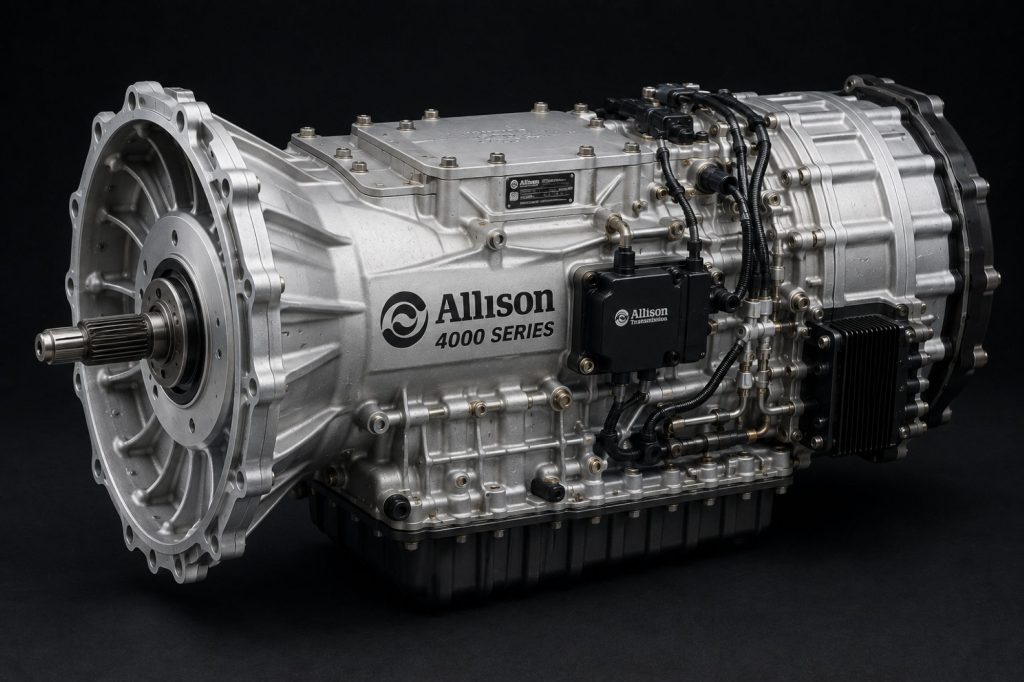
The Allison 4000 Series is a family of fully automatic heavy-duty transmissions developed for trucks and equipment requiring substantially more power, torque, and gross vehicle weight capability than the Allison 3000 Series.
It combines a hydraulic torque converter with planetary gearsets, wet clutch packs, electronic controls, available PTO provisions, and an optional integral hydraulic retarder.
Current Allison information lists power compatibility ranging from approximately 380 to 800 horsepower and torque capacity reaching approximately 2,360 lb-ft. Approved vehicle-weight ratings can reach approximately 242,550 pounds in specialized configurations.
The 4000 Series is used in heavy construction trucks, mining vehicles, oilfield equipment, refuse trucks, fire apparatus, heavy-haul tractors, transit buses, defense vehicles, and other severe-duty applications.
Depending on the model, the transmission provides six or seven forward ranges. Certain configurations also provide a second reverse ratio for improved low-speed control.
Key Characteristics
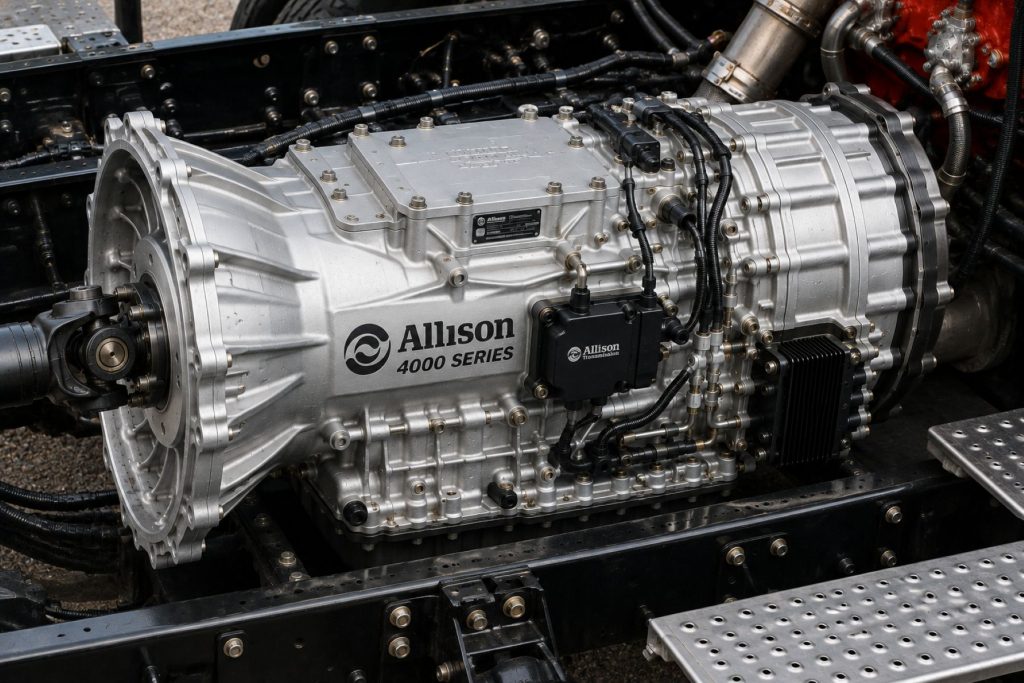
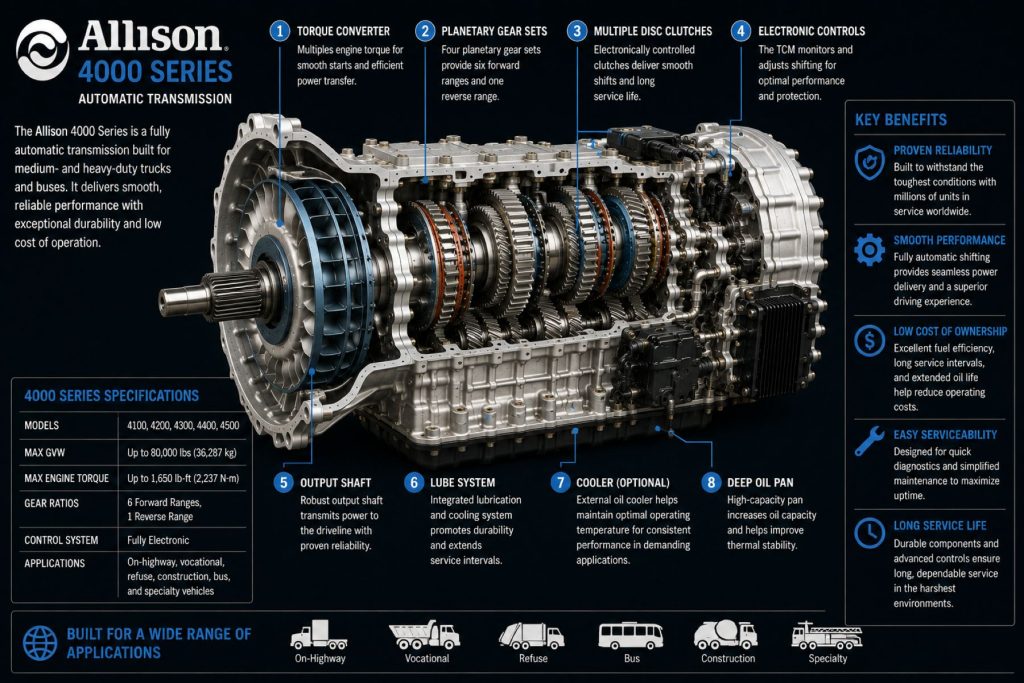
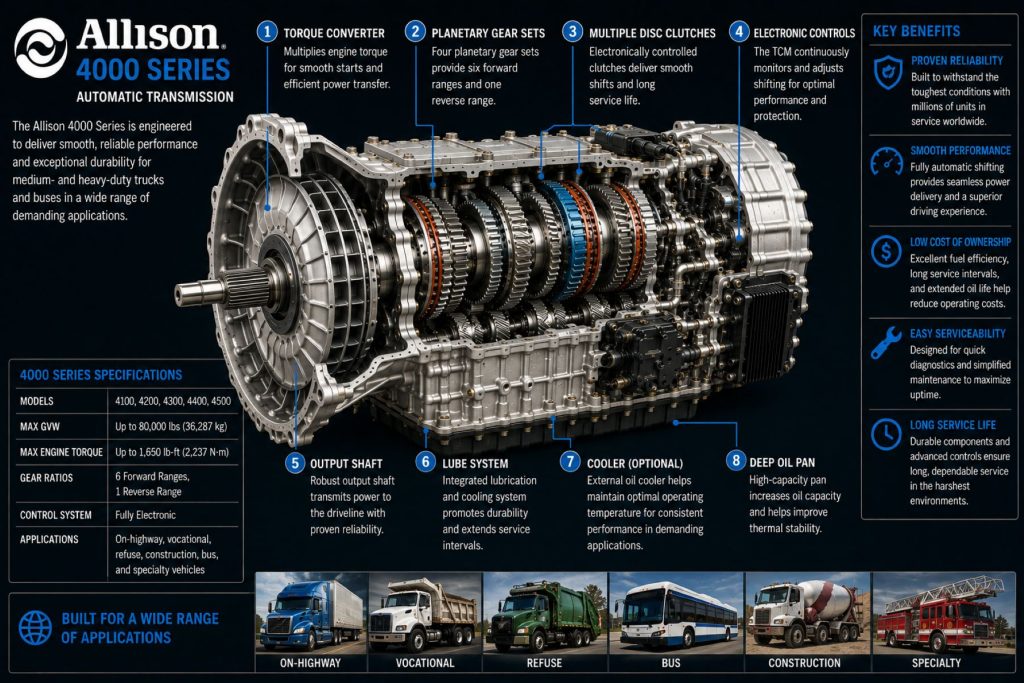
The torque converter provides smooth starts and hydraulic torque multiplication. This is especially useful when moving heavy loads, starting on grades, maneuvering off-road, or operating in stop-and-go vocational service.
Unlike a conventional manual or automated manual transmission, the Allison does not require a dry launch clutch. This eliminates clutch-pedal operation and avoids the repeated slipping of a dry clutch during low-speed work.
Multiple planetary gearsets and hydraulically applied wet clutches create the available forward and reverse ratios. Gear changes occur automatically without interrupting power delivery in the same way as many manual and automated manual transmissions.
The 4000 Series can be configured with an engine-driven PTO provision. Compatible models support hydraulic pumps and other vocational equipment used in dump, refuse, utility, fire, oilfield, and specialized applications.
An optional integral output retarder provides additional vehicle braking. This can reduce service-brake use and help control heavy vehicles on long descents.
How the Transmission Works
Engine power first enters the torque converter. The engine-driven impeller moves transmission fluid, which transfers torque to the turbine connected to the transmission input.
During launch, the converter multiplies torque and allows the engine to continue running while the vehicle is stopped in gear.
Once operating conditions permit, the torque-converter lockup clutch engages. Lockup creates a more direct mechanical connection, reducing heat and improving efficiency.
The transmission control module monitors engine load, accelerator position, vehicle speed, input speed, turbine speed, output speed, temperature, brake input, selected range, and other vehicle information.
The controller directs hydraulic pressure to the internal wet clutch packs. Different clutch combinations control the planetary gearsets and produce the required ratio.
During deceleration, the transmission can downshift to maintain performance or support engine braking. When equipped with an integral retarder, hydraulic resistance at the output section provides additional braking force.
PTO operation depends on the model, equipment, and programming. The control system may manage PTO engagement, engine speed, transmission range, vehicle movement, and safety interlocks.
Common Specifications
Transmission Type
The Allison 4000 Series is a fully automatic, torque-converter transmission with planetary gearing, wet clutch packs, and electronic controls.
Forward Speeds
Most configurations provide six forward ranges.
Applicable 4700, 4800, and related wide-ratio configurations can provide seven forward ranges by adding a deeper low gear.
Reverse Speeds
Most configurations provide at least one reverse ratio.
Applicable seven-speed and wide-ratio versions can provide a second reverse ratio for improved low-speed control.
Common Six-Speed Gear Ratios
A common close-ratio six-speed arrangement includes approximately:
- 1st: 3.51:1
- 2nd: 1.91:1
- 3rd: 1.43:1
- 4th: 1.00:1
- 5th: 0.74:1
- 6th: 0.64:1
- Reverse: Approximately 4.80:1
Exact ratios vary by model and application.
Seven-Speed Configuration
Applicable 4700 and related configurations add a deeper low forward ratio ahead of the standard operating gears.
The additional ratio improves startability and low-speed movement under heavy loads. It does not simply add another highway overdrive gear.
Direct Drive
Fourth gear is commonly the 1.00:1 direct-drive ratio on standard six-speed configurations.
The corresponding direct-drive position can shift within the range numbering on models with an additional low gear.
Overdrive
The transmission commonly provides two overdrive ratios. These ratios reduce engine speed during suitable highway operation.
Input Power
Current Allison ratings cover approximately 380 to 800 horsepower across the 4000 Series.
Individual models carry different ratings according to transmission construction, torque converter, engine speed, vocation, and vehicle configuration.
Input Torque
Maximum published torque capacity reaches approximately 2,360 lb-ft.
The exact approved torque may be lower for an individual model or vocation.
Vehicle-Weight Capability
Allison lists maximum supported gross vehicle weight reaching approximately 242,550 pounds for approved 4000 Series configurations.
This figure does not apply to every 4000 Series transmission or truck. The certified vehicle, axle, frame, tire, driveline, brake, and permit ratings remain controlling.
Torque Converter
Multiple converter models are available to match:
- Engine torque
- Engine operating speed
- Vehicle weight
- Axle ratio
- Tire size
- Desired startability
- Vocation
- Operating terrain
The wrong converter can produce poor acceleration, excessive heat, or unsuitable engine speed.
Lockup Clutch
An electronically controlled lockup clutch reduces converter slippage after launch.
Lockup can be applied in multiple ranges depending on the model and calibration.
Internal Clutches
The transmission uses hydraulically applied wet clutch packs. The clutch plates operate in transmission fluid, allowing repeated gear changes under demanding commercial conditions.
Electronic Controls
Current applications use Allison’s electronic control platform. Available functions can include:
- Automatic shift scheduling
- Torque-converter lockup control
- Engine communication
- Prognostics
- PTO controls
- Retarder controls
- Load-based shifting
- Temperature protection
- Diagnostic fault reporting
- Shift Energy Management
- FuelSense programming where applicable
Sixth-Generation Controls
Newer Allison configurations can use Sixth Generation Controls with updated cybersecurity, functional safety, diagnostic, and vehicle-integration capabilities.
Controls and software vary by production year and vehicle manufacturer.
PTO Provisions
Applicable transmissions can be ordered with engine-driven PTO provisions.
Common heavy-duty configurations use ten-bolt mounting pads positioned on the transmission housing. Exact pad location, drive ratio, rotation, and capacity vary.
A transmission ordered without the necessary internal PTO drive gear may not accept a PTO simply because the exterior case appears similar.
Integral Retarder
An optional integral hydraulic output retarder creates resistance in the transmission output section.
The retarder can reduce service-brake wear and improve downhill control, but it adds weight, heat, cooling demand, and maintenance considerations.
Cooling System
The 4000 Series requires substantial transmission cooling capacity.
Cooling requirements depend on:
- Torque-converter operation
- Vehicle weight
- Road speed
- Ambient temperature
- Retarder use
- PTO operation
- Terrain
- Duty cycle
The cooling system must be designed for the entire application.
Lubrication
Commercial on-highway configurations commonly use Allison-approved TES 668 or TES 295 automatic transmission fluid.
Other applications may require a different approved Allison fluid. The exact specification must be confirmed for the model and vocation.
Filter System
The transmission uses main and lubrication filters. High-capacity filter options support extended service intervals in compatible applications using approved fluid.
Transmission Weight
Weight varies substantially according to model, output section, PTO provisions, sump, converter, and retarder.
An Allison 4500 can weigh approximately 830 to more than 960 pounds depending on equipment. Larger seven-speed and retarder-equipped configurations can exceed 1,100 pounds.
The exact installed weight must be confirmed from the individual specification.
Installation Requirements
Installation requires a compatible engine, flywheel housing, flexplate, torque converter, cooling system, electronic controls, shift selector, wiring, mounts, driveshaft, axles, and vehicle programming.
Common Applications
- Heavy-haul tractors
- Dump trucks
- Concrete mixer trucks
- Off-road construction trucks
- Mining vehicles
- Oilfield service trucks
- Refuse trucks
- Roll-off trucks
- Fire apparatus
- Airport fire and rescue vehicles
- Transit buses
- Motor coaches
- Heavy recovery vehicles
- Military and defense vehicles
- Snow and ice control trucks
- Logging trucks
- Crane carriers
- Municipal severe-service trucks
- Specialized transport vehicles
- Energy-sector equipment
Truck and Engine Compatibility
The Allison 4000 Series is offered in selected heavy-duty and severe-service truck configurations. Availability varies significantly by model year, engine, chassis, vocation, and manufacturer.
Common truck platforms include:
- Freightliner 114SD
- Freightliner 122SD
- Western Star 47X
- Western Star 49X
- Western Star 4900
- Western Star 6900XD
- International HX Series
- International HX620
- Kenworth T800
- Kenworth T880
- Kenworth C500
- Peterbilt 567
- Peterbilt 520
- Mack Granite
- Mack TerraPro
- Mack Titan
- Volvo VHD
Common engine families include:
- Cummins X15
- Cummins ISX15
- Cummins X12
- Detroit DD13
- Detroit DD15
- Detroit DD16
- Caterpillar C13
- Caterpillar C15
- Caterpillar 3406
- Mack MP8
- Mack MP10
- Volvo D13
- Volvo D16
The engine’s exact horsepower, torque, governed speed, flywheel housing, electronics, and application rating must match the selected Allison model.
Not every engine or truck listed above was available with every 4000 Series variant. Compatibility must be verified for the individual truck build.
Advantages
- Smooth torque-converter launch performance
- Handles substantially more torque than the Allison 3000 Series
- Supports engines reaching approximately 800 horsepower
- Maximum torque capacity reaches approximately 2,360 lb-ft
- Suitable for very high vehicle weights
- No dry launch clutch
- Excellent low-speed maneuverability
- Strong startability under heavy loads
- Six- and seven-speed configurations are available
- A second reverse ratio is available on applicable models
- Engine-driven PTO provisions are available
- Integral hydraulic retarder is available
- Electronic controls provide consistent shifting
- Reduces driver workload
- Well suited to stop-and-go severe service
- Strong service and parts network
- Compatible with many heavy vocational applications
- Provides uninterrupted power through shifts
Limitations or Considerations
- Substantially heavier than many manual or automated manual transmissions
- Higher purchase cost
- Torque-converter operation generates heat
- Requires a large, effective cooling system
- Retarder use creates additional heat
- Not every model supports the maximum published ratings
- PTO configurations must be selected carefully
- Electronic diagnosis requires Allison-compatible equipment
- Internal repairs require specialized training and tools
- Fluid and filter service can be expensive because of capacity
- Incorrect converter selection can reduce performance
- High weight can reduce payload
- Not normally the most fuel-efficient choice for every highway application
- Physical size can complicate chassis packaging
- Used transmissions may require electronic reprogramming
Driver and Operator Experience
The Allison 4000 Series gives the driver two-pedal automatic operation. The driver selects Drive or Reverse and allows the transmission controller to manage gear selection.
Torque-converter launch produces smooth movement from a stop, even under heavy load. This can be particularly helpful on grades, loose surfaces, job sites, and in stop-and-go traffic.
Drivers should understand that the selected range shown on the control pad may represent the highest allowed gear rather than the actual gear currently engaged.
Manual range selection can help control the truck during steep descents or difficult terrain. The transmission will generally reject a shift that would overspeed the engine.
Retarder-equipped vehicles may use a hand control, brake-pedal integration, or automatic programming. Drivers should learn the retarder’s stages and understand how road conditions affect available traction.
The transmission-temperature gauge and warning system are especially important during prolonged low-speed operation, heavy towing, or retarder use.
Maintenance and Ownership Notes
Only Allison-approved transmission fluid should be used. TES 668 or TES 295 fluids are common in commercial on-highway service, but the exact specification depends on the model and application.
Fluid condition should be monitored for discoloration, burnt odor, water, coolant, debris, or excessive metal.
The main and lubrication filters must be changed at the appropriate interval. Allison high-capacity filters can support longer intervals in compatible configurations.
The transmission cooler, coolant circuit, hoses, fittings, and heat exchanger should be inspected regularly. Cooling problems can quickly damage a heavily loaded automatic transmission.
PTO mounting bolts, seals, drive components, pumps, hydraulic lines, and controls should be included in preventive maintenance.
Retarder-equipped transmissions need additional inspection of the retarder controls, cooling system, seals, and operating performance.
The TCM should be checked for active and stored fault codes. Allison prognostics can help track fluid life, filter life, and transmission health when enabled.
Common Transmission Problems
Transmission Overheating
Heavy loads, prolonged converter operation, restricted cooling, low fluid, or extended retarder use can cause excessive temperature.
Fluid Leaks
Leaks may occur around cooler lines, filters, seals, PTO openings, the retarder, output components, and transmission housing.
Harsh or Delayed Shifting
Possible causes include incorrect fluid level, solenoid faults, valve-body problems, speed-sensor failures, wiring issues, or internal clutch wear.
Delayed Drive or Reverse Engagement
Low fluid, worn clutch packs, hydraulic leakage, converter drain-back, filter restriction, or pump problems can delay engagement.
Torque-Converter Problems
Converter damage may cause overheating, poor acceleration, noise, vibration, contaminated fluid, or lockup problems.
Lockup-Clutch Shudder
Degraded fluid, incorrect calibration, converter-clutch wear, engine problems, or driveline vibration can cause shudder during lockup.
Limp Mode
The transmission may restrict operation to one range or a limited group of gears after detecting a serious electronic, hydraulic, or mechanical fault.
PTO Failure
Incorrect PTO selection, worn drive components, failed interlocks, wiring faults, hydraulic overload, or improper programming can prevent PTO operation.
Retarder Problems
A retarder may provide weak or erratic braking because of control faults, inadequate fluid flow, overheating, or internal wear.
Worn Internal Clutches
Overheating, contaminated fluid, excessive loading, or continued operation with a fault can damage wet clutch packs.
Sensor and Wiring Faults
Input, turbine, and output-speed sensors, harnesses, connectors, grounds, and vehicle-network problems can affect shift operation.
Buying Considerations
- Identify the complete Allison model number.
- Record the transmission serial number.
- Determine whether it is a 4000, 4500, 4700, 4800, or another variant.
- Confirm the vocational designation.
- Verify the number of forward and reverse ranges.
- Confirm engine horsepower and torque compatibility.
- Check the vehicle’s GVWR and GCWR.
- Identify the torque-converter model.
- Verify the transmission’s gear ratios.
- Confirm PTO provisions and mounting locations.
- Determine whether one or two PTOs are required.
- Verify PTO drive ratio, rotation, and capacity.
- Determine whether the transmission has an integral retarder.
- Inspect the transmission cooler and coolant circuit.
- Check fluid and filter condition.
- Scan the TCM for active and stored faults.
- Review transmission-temperature history.
- Test Drive and Reverse engagement.
- Road-test every available forward range.
- Test converter lockup.
- Test retarder operation where equipped.
- Review maintenance, rebuilding, and fluid-analysis records.
- Confirm parts and service availability.
Variants and Configurations
- Allison 4000 HS
- Allison 4000 RDS
- Allison 4000 EVS
- Allison 4000 SP
- Allison 4000 MH
- Allison 4000 TRV
- Allison 4200 RDS
- Allison 4430 RDS
- Allison 4440 RDS
- Allison 4500 HS
- Allison 4500 RDS
- Allison 4500 EVS
- Allison 4500 SP
- Allison 4500 OFS
- Allison 4600 RDS
- Allison 4700 RDS
- Allison 4700 EVS
- Allison 4700 SP
- Allison 4700 OFS
- Allison 4800 EVS
- Allison 4800 SP
- Allison 4850 EVS
- Six-Speed Configuration
- Seven-Speed Configuration
- Single-Reverse Configuration
- Dual-Reverse Configuration
- PTO-Equipped Configuration
- Integral-Retarder Configuration
Comparison to Similar Equipment
Compared with the Allison 3000 Series, the 4000 Series supports substantially greater horsepower, torque, and vehicle weight. The tradeoffs include greater size, weight, cost, fluid capacity, and cooling demand.
Compared with the Allison 4500 Series, the 4500 is a specific model group within the broader 4000 Product Family. Its separate page can focus on its ratings, six-speed gearing, PTO arrangements, and common vocational uses.
Compared with the Allison 4700 Series, the standard 4000 and 4500 configurations generally use six forward ranges. The 4700 adds a deeper low gear and can provide a second reverse ratio.
Compared with the Eaton Fuller 18-Speed Manual, the Allison provides automatic shifting and smooth torque-converter launch. The Eaton manual is lighter and gives the driver more direct control but requires clutch and shifting skill.
Compared with the Eaton Cummins Endurant XD Pro, the Allison provides continuous torque-converter launch performance and excellent low-speed control. Endurant XD Pro may offer lower weight and greater mechanical efficiency in suitable heavy-haul applications.
Compared with Mack mDRIVE HD, the Allison avoids a dry launch clutch and may perform better in continuous stop-and-go or low-speed operation. The mDRIVE HD can provide lower weight and a more direct mechanical power path.
Best Fit For
- Heavy-duty vocational fleets
- Construction operations
- Heavy-haul carriers
- Mining fleets
- Oilfield service companies
- Severe-duty dump trucks
- Concrete mixer fleets
- Refuse operations
- Fire and emergency fleets
- Heavy recovery vehicles
- Municipal severe-service trucks
- Logging operations
- Crane carriers
- Transit and specialty buses
- Defense vehicles
- Operations requiring strong PTO capability
- Applications requiring torque-converter launch performance
- Fleets needing an integral transmission retarder
Related Truck Types
Related Truck Models
- Freightliner 114SD
- Freightliner 122SD
- Western Star 47X
- Western Star 49X
- Western Star 4900
- Western Star 6900XD
- International HX Series
- International HX620
- Kenworth T800
- Kenworth T880
- Kenworth C500
- Peterbilt 567
- Peterbilt 520
- Mack Granite
- Mack TerraPro
- Mack Titan
- Volvo VHD
Related Engines
- Cummins X15
- Cummins ISX15
- Cummins X12
- Detroit DD13
- Detroit DD15
- Detroit DD16
- Caterpillar C13
- Caterpillar C15
- Caterpillar 3406
- Mack MP8
- Mack MP10
- Volvo D13
- Volvo D16
Related Transmission Types
- Fully Automatic Transmissions
- Heavy-Duty Transmissions
- Vocational Transmissions
- Heavy-Haul Transmissions
- Torque-Converter Transmissions
Related Equipment Systems
- Torque Converters
- Transmission Cooling Systems
- Integral Retarders
- Electronic Transmission Controls
- Driveshaft Systems
- PTO Systems
- Axles and Differentials
- Electrical Systems
- Brake Systems
Related Guides
Understand the operating principles in How Commercial Truck Transmissions Work, compare drivetrain designs in Manual vs Automated Manual vs Automatic Transmissions, and evaluate gearing, application, and compatibility in How to Choose a Commercial Truck Transmission.
Regulatory and Compliance Notes
The Allison 4000 Series must be installed and operated within the approved engine-power, torque, cooling, vehicle-weight, and vocational ratings for the exact model.
The maximum family rating does not apply to every transmission. Operators must verify the individual transmission specification and completed vehicle certification.
PTO-driven equipment requires approved mounting, properly rated shafts and pumps, guards, controls, and safety interlocks.
Retarder operation must be coordinated with vehicle braking systems. Excessive retarder use on slippery surfaces can reduce drive-axle traction.
Heavy-haul, oversized, or overweight vehicles remain subject to permits, axle-weight limits, bridge laws, route restrictions, escort requirements, and other regulations.
Real World Operating Notes
The 4000 Series is particularly effective in operations where a heavily loaded truck must start, stop, reverse, and maneuver repeatedly.
Its torque converter can provide smoother launch performance than a dry-clutch automated manual, especially on grades, loose surfaces, or confined job sites.
That advantage produces heat. A properly sized and maintained cooling system is essential for long-term reliability.
Retarders can substantially reduce brake wear on descents, but they transfer braking energy into heat that must be removed by the cooling system.
The seven-speed 4700 configuration is valuable where extra-low-speed control or startability is required. Fleets that do not need the additional low ratio may prefer a lighter and simpler six-speed model.
Frequently Asked Questions
What is the Allison 4000 Series?
It is a family of heavy-duty fully automatic transmissions designed for construction, heavy haul, mining, refuse, energy, fire, defense, and other severe applications.
How many gears does it have?
Depending on the model, it provides six or seven forward ranges and one or two reverse ranges.
How much horsepower can it handle?
Current family ratings range from approximately 380 to 800 horsepower.
How much torque can it handle?
Maximum family capacity reaches approximately 2,360 lb-ft.
Does it use a torque converter?
Yes. The converter provides smooth launch performance and torque multiplication.
What is the difference between the Allison 3000 and 4000?
The 4000 Series supports greater horsepower, torque, and vehicle weight but is larger, heavier, and more expensive.
Is the Allison 4500 part of the 4000 Series?
Yes. The 4500 is a model group within the broader Allison 4000 Product Family.
What is different about the Allison 4700?
The 4700 adds a deeper low forward ratio and can provide a second reverse ratio, giving it seven forward speeds and improved low-speed capability.
Can it operate a PTO?
Yes. Compatible models offer engine-driven PTO provisions. Exact pad location, rotation, ratio, and capacity must be confirmed.
Is an integral retarder available?
Yes. Applicable models can be ordered with an integral hydraulic output retarder.
Is the 4000 Series suitable for ordinary highway tractors?
It can be used in specialized highway or heavy-haul tractors, but its weight and operating characteristics make it most valuable in vocational and severe-duty applications.
What transmission fluid does it use?
Many on-highway applications use Allison-approved TES 668 or TES 295 fluid. The correct specification depends on the exact model and vocation.
Availability and Where to Find
New Allison 4000 Series transmissions are available through participating commercial truck manufacturers, authorized Allison distributors, and heavy-equipment manufacturers.
Replacement transmissions, torque converters, controllers, retarders, PTO components, filters, and service parts are available through Allison-authorized service locations, commercial drivetrain suppliers, remanufacturers, salvage operations, and used heavy-truck parts dealers.
A used transmission must be identified by its full model and serial number. Buyers should not rely only on the Allison 4000 Series name because ratings, gear ratios, PTO provisions, retarders, output sections, and electronic calibrations vary.
Before purchasing a replacement, verify the engine rating, torque converter, gear ratios, vehicle weight, PTO equipment, retarder, cooler, output arrangement, electronics, and application calibration.
Current product information and authorized support can be found through Allison Transmission’s official 4000 Series page.
Support Trucking Families
Truck Equipment Atlas supports the mission of Grey Cross, a nonprofit dedicated to helping families of truck drivers who lose their lives while on the road. As the site grows, part of its mission is to bring awareness and support to these families.
Podcast or Video Section
Learn More Through Audio and Video
Truck Equipment Atlas will continue expanding with podcast episodes, interviews, and equipment breakdowns to help drivers and fleets better understand trucks and equipment.
Follow the Growth of Truck Equipment Atlas
Truck Equipment Atlas continues to expand with new truck profiles, trailer coverage, diesel engine pages, equipment system resources, manufacturer information, and educational guides.
Visit our Site Updates page to explore recent additions, project milestones, and upcoming resources as we continue building one of the industry’s growing commercial trucking equipment reference libraries.
View the Latest Site Updates: Truck Equipment Atlas Site Updates