
Eaton Fuller 10-Speed Manual Transmission
Quick Facts
- Manufacturer: Eaton
- Transmission Family: Eaton Fuller FR Series
- Transmission Type: Heavy-Duty Non-Synchronized Manual Transmission
- Forward Speeds: 10
- Reverse Speeds: Two reverse ratios depending on model and range selection
- Basic Design: Five-speed main section with low and high ranges
- Drive Configurations: Direct Drive and Overdrive
- Maximum Input Torque: Up to 1,850 lb-ft depending on model
- Maximum Gross Combination Weight: Up to 140,000 lbs depending on model and approved application
- Common Models: FR-11210B, FR-12210B, FR-13210B, FR-14210B, FR-15210B, FR-16210B, FR-17210B, and FR-18210B
- Clutch Type: Driver-Operated Heavy-Duty Dry Clutch
- Shift Control: Floor-Mounted Shift Lever with Range Selector
- Synchronization: Non-Synchronized
- Common Lubricant: Eaton-Approved Synthetic Manual Transmission Lubricant
- PTO Compatibility: Available PTO openings for approved vocational equipment
- Approximate Weight: Generally 590–720 lbs depending on model and equipment
- Common Truck Class: Class 8
- Primary Applications: Linehaul, Regional Hauling, Vocational Trucking, Construction, Agriculture, Tanker, Flatbed, and Heavy-Duty Fleet Operations
- Production Status: Active Eaton FR Series transmission family
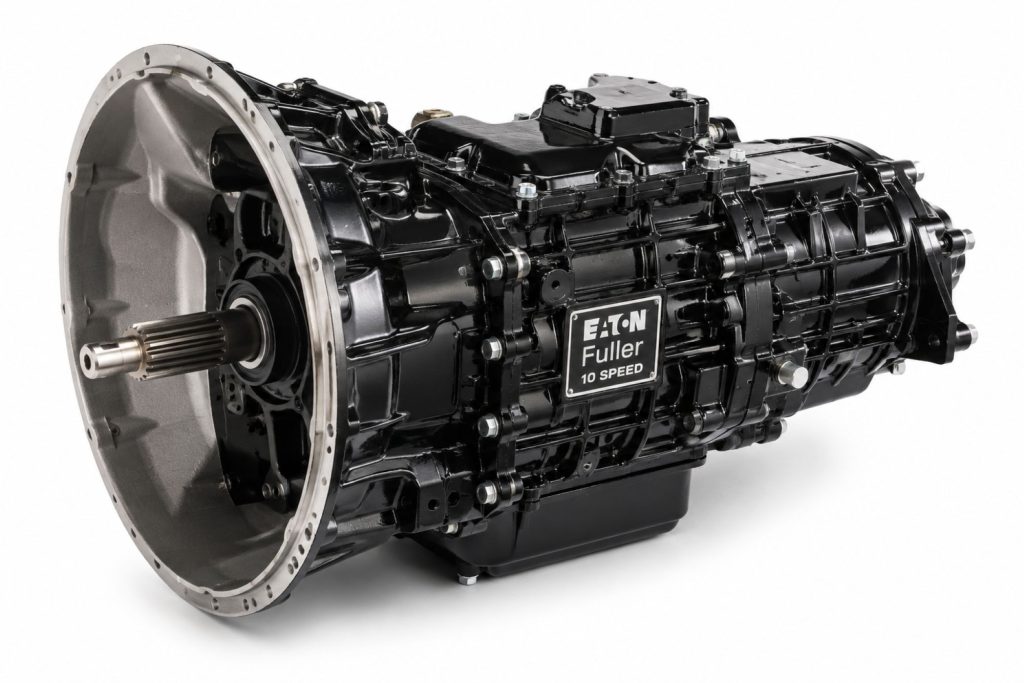
Overview
The Eaton Fuller 10-Speed Manual is one of the most recognizable heavy-duty transmissions used in North American commercial trucking. It has served linehaul fleets, owner-operators, construction companies, agricultural operations, regional carriers, and vocational fleets for decades.
The transmission uses a five-speed main section combined with low and high ranges to provide ten forward gears. The driver moves through the five low-range gears, changes the range selector, and repeats the shift pattern to access the five high-range gears.
Unlike a synchronized passenger-vehicle transmission, the Eaton Fuller 10-speed requires the driver to match engine speed with transmission and road speed. Drivers may use the traditional double-clutching method or, after developing sufficient experience, shift without the clutch by carefully matching engine rpm.
The Eaton Fuller 10-speed is available in several torque ratings and in direct-drive and overdrive configurations. This allows fleets to match the transmission to the engine, rear-axle ratio, tire size, operating weight, terrain, cruising speed, and intended application.
Its mechanical design, parts availability, repair familiarity, and straightforward shift pattern helped establish it as a standard transmission in many sleeper trucks, day cab trucks, and vocational trucks.
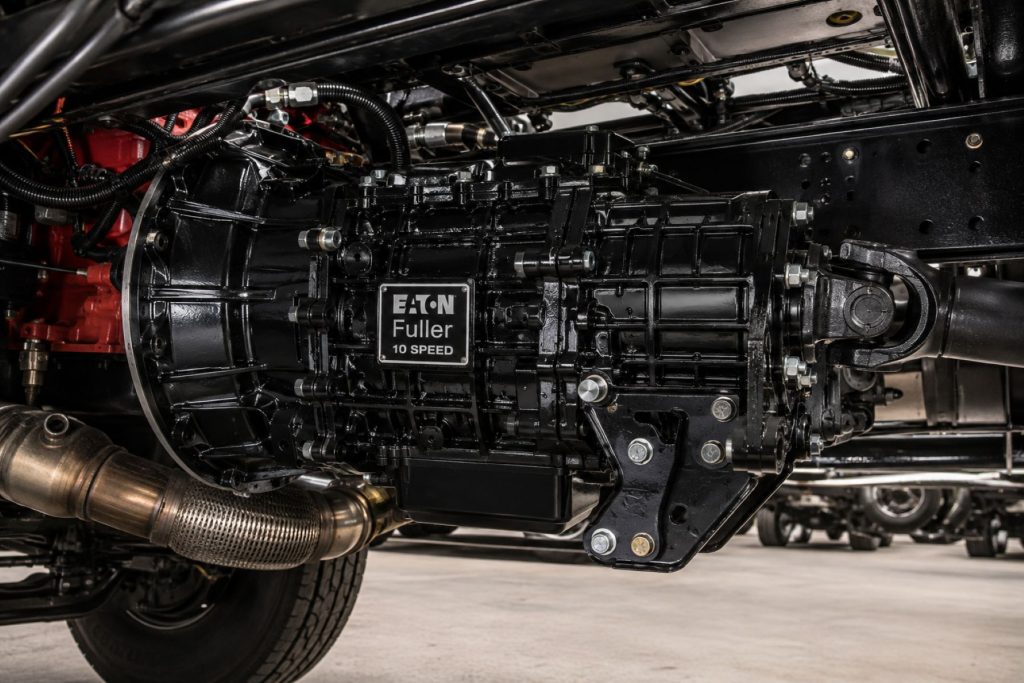
Key Characteristics
The Eaton Fuller 10-speed is a twin-countershaft, constant-mesh manual transmission. The twin-countershaft design divides torque between two countershafts, helping the transmission handle high engine torque without requiring excessively large internal gearing.
The transmission’s ten forward ratios are created by combining five main-section gear positions with low and high ranges. A range selector mounted on the gearshift knob allows the driver to prepare the transmission for the shift between fifth and sixth gears.
Because the transmission is non-synchronized, internal synchronizers do not automatically match gear speeds. The driver must control engine rpm during upshifts and downshifts so the selected gears can engage smoothly.
Most conventional Eaton Fuller 10-speeds use a traditional H-pattern. The same basic lever positions are used in both ranges, making the shift pattern relatively easy to understand compared with a 13-speed or 18-speed transmission.
Direct-drive models use a 1.00:1 top gear. Overdrive models provide a top gear below 1.00:1, reducing engine rpm at cruising speed when combined with an appropriate rear-axle ratio.
The FR Series is available in different torque capacities. Fleets must select a model whose approved input-torque rating meets or exceeds the engine’s maximum output.
How the Transmission Works
Engine power enters the transmission through the clutch and input shaft. The transmission’s internal gearing changes the relationship between engine speed and driveshaft speed before sending power through the output shaft to the driveshaft, drive axles, and wheels.
Lower gears multiply torque and help the truck begin moving with a heavy load. As the truck gains speed, the driver selects progressively higher gears. Each upshift reduces engine rpm while allowing road speed to increase.
The shift pattern is divided into low and high ranges. The driver normally begins in low range and moves through the first five forward gears. Before shifting from fifth to sixth, the driver moves the range selector into the high position. The range change occurs as the shift lever passes through neutral.
Once high range is engaged, the driver repeats the five-position shift pattern for gears six through ten. When slowing, the range selector is returned to low before moving from sixth to fifth.
During an upshift, the driver releases the accelerator, removes the transmission from gear, allows engine rpm to fall, and engages the next gear when engine speed matches the required road speed. Double-clutching divides this process into two clutch movements, one when leaving the original gear and another when entering the next gear.
During a downshift, the driver moves into neutral and briefly raises engine speed before engaging the lower gear. This throttle input helps match the faster input-shaft speed needed by the lower ratio.
Experienced drivers may float gears without using the clutch during normal shifts. However, improper floating can cause gear clash, damaged engagement teeth, and accelerated wear. The clutch is still normally used when starting, stopping, or making certain low-speed maneuvers.
Common Specifications
Transmission Type
The Eaton Fuller 10-speed is a heavy-duty, constant-mesh, non-synchronized manual transmission. It is primarily intended for Class 8 commercial trucks.
Gear Configuration
The transmission combines a five-speed main section with a two-range auxiliary section to provide ten forward ratios.
The driver uses the same basic shift-lever positions in low and high ranges.
Torque Capacity
FR Series models cover multiple torque ratings. Depending on the specific model, maximum input-torque ratings can range from approximately 1,100 to 1,850 lb-ft.
The transmission model must be matched to the engine’s approved torque output. Engine programming should not exceed the transmission’s published rating.
Gross Combination Weight
Certain FR Series configurations are approved for gross combination weights of up to approximately 140,000 pounds. Actual approval depends on the specific transmission model, truck configuration, gearing, duty cycle, and Eaton application guidelines.
Direct-Drive Configuration
A direct-drive transmission uses a 1.00:1 top gear. Direct-drive models can reduce internal power losses in top gear but normally require a faster rear-axle ratio to achieve the desired highway cruising speed.
Overdrive Configuration
An overdrive transmission uses a top-gear ratio below 1.00:1. This can reduce engine rpm during highway operation when properly matched to the rear axle and tire size.
Gear Ratios
Exact ratios vary by model and ratio set. A typical 10-speed uses a deep first gear for starting a loaded truck and progressively closer ratios as speed increases.
Buyers should use the full transmission model number to identify the correct ratio set rather than assuming all Eaton Fuller 10-speeds have identical gearing.
Clutch System
The transmission normally operates with a heavy-duty dry clutch controlled by a clutch pedal. Depending on the truck’s age and configuration, clutch actuation may be mechanical, hydraulic, or assisted.
The clutch brake helps stop the transmission input gearing when the truck is stationary, making it easier to select a starting gear. It is not intended to slow the truck or assist routine moving shifts.
Shift Controls
The driver operates the main gearbox through a floor-mounted gearshift lever. A range selector on the shift knob controls the low-to-high range change.
Air pressure is commonly used to operate the range-shift mechanism.
Synchronization
The Eaton Fuller 10-speed is non-synchronized. The driver must match engine speed, transmission speed, and road speed during every moving shift.
Lubrication System
The transmission uses approved manual transmission lubricant to protect the gears, bearings, shafts, and other internal components.
Correct lubricant type and oil level are essential. Using an unapproved lubricant can reduce shift quality, damage seals, increase wear, and affect warranty coverage.
Transmission Weight
Weight varies by torque capacity, case design, input configuration, PTO equipment, cooler provisions, and other options. Many Eaton Fuller 10-speed models weigh approximately 590 to 720 pounds without the clutch and installation hardware.
PTO Compatibility
PTO openings may be available for dump-body pumps, wet kits, blowers, compressors, winches, tank equipment, and other vocational systems.
The correct PTO must match the transmission model, opening, rotation, torque requirement, operating speed, and intended duty cycle.
Installation Requirements
Installation must account for engine torque, clutch capacity, flywheel housing, input shaft, driveshaft angles, rear-axle ratio, cooling needs, electronic speed signals, PTO requirements, and chassis packaging.
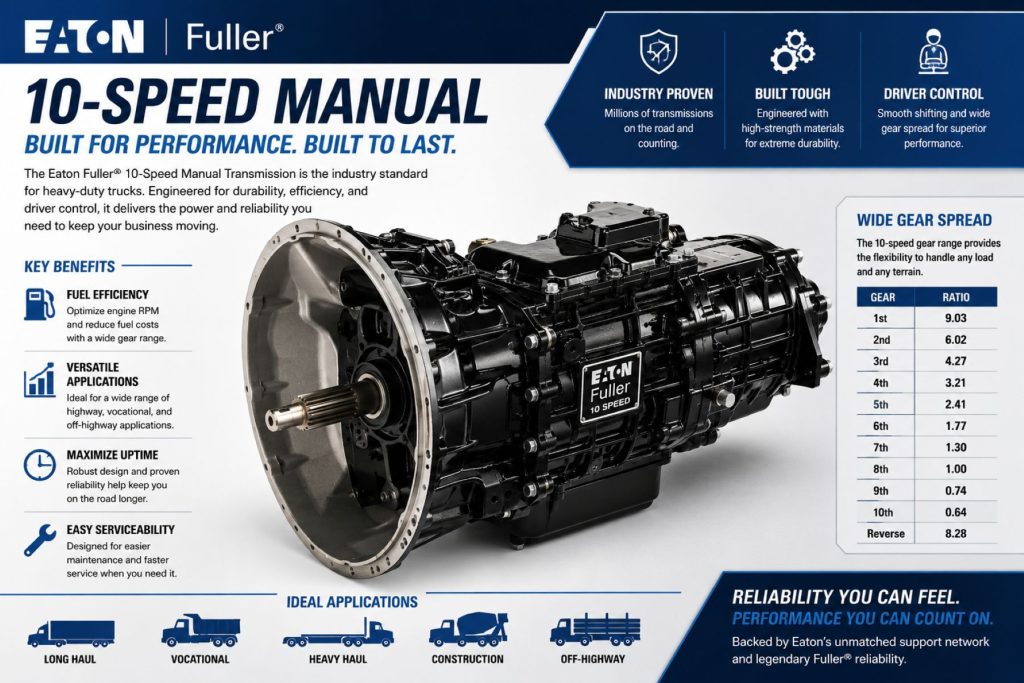
Common Applications
- Long-haul tractor-trailers
- Regional-haul trucks
- Day cab tractors
- Sleeper tractors
- Flatbed operations
- Tanker operations
- Dry van freight
- Refrigerated freight
- Agricultural hauling
- Construction trucks
- Dump trucks
- Bulk-haul operations
- Logging operations
- Heavy-duty service trucks
- Oilfield support trucks
- Municipal vehicles
- Vocational trucks requiring PTO capability
- Owner-operator highway tractors
Truck and Engine Compatibility
The Eaton Fuller 10-speed has been installed in Class 8 trucks from Freightliner, Peterbilt, Kenworth, International, Western Star, Mack, Volvo, Sterling, and other manufacturers.
Compatibility depends on the truck’s model year and original factory specification. A truck model offered with an Eaton Fuller transmission may also have been available with an automated manual or fully automatic transmission.
Common compatible truck platforms include the Peterbilt 389, Peterbilt 579, Kenworth W900, Kenworth W990, Freightliner Cascadia, Freightliner Coronado, Western Star 4900, and comparable highway and vocational trucks.
Vocational applications may include the Freightliner 114SD, Freightliner 122SD, Western Star 47X, and Mack Granite.
The transmission has historically been paired with engines from Cummins, Caterpillar, Detroit Diesel, PACCAR, International, Mack, Volvo, and Mercedes-Benz.
Common pairings include the Cummins ISX15, Cummins X15, Cummins ISM, Caterpillar 3406, Caterpillar C13, Caterpillar C15, Detroit Series 60, and other heavy-duty engines.
Engine torque is one of the most important compatibility factors. The transmission’s input-torque rating must equal or exceed the engine’s peak programmed torque. A lower-rated transmission should not be used with a higher-torque engine unless the engine is limited to an approved rating.
Rear-axle gearing is also important. A direct-drive transmission commonly works with a faster numerical axle ratio, while an overdrive transmission may use a slower numerical ratio. Tire diameter, loaded weight, terrain, and intended cruising speed must be included in the gearing calculation.
Advantages
- Proven heavy-duty design
- Ten forward ratios cover common highway applications
- Simpler shift pattern than most 13-speed and 18-speed transmissions
- Strong parts and service availability
- Available in several torque ratings
- Direct-drive and overdrive configurations are available
- Twin-countershaft design provides a strong torque-to-weight ratio
- Mechanical design avoids automated shifting actuators
- Provides direct driver control over gear selection
- Suitable for highway and regional operation
- Can support vocational PTO equipment
- Widely understood by experienced truck technicians
- Large supply of new, remanufactured, and used units
- Can provide long service life with proper operation
- Generally less expensive to repair than some automated alternatives
- Well suited to trucks with legacy diesel engines
Limitations or Considerations
- Requires manual-shifting experience
- Non-synchronized design requires accurate engine-speed matching
- Clutch operation can increase fatigue in heavy traffic
- Driver technique strongly affects transmission and clutch life
- Only ten forward ratios are available
- Larger ratio steps than many 13-speed and 18-speed transmissions
- Less ratio flexibility for extreme heavy-haul or mountain operation
- Improper shifting can damage engagement teeth and gears
- Clutch replacement adds maintenance expense
- Air-system faults can prevent proper range shifting
- Excessive engine torque can overload the transmission
- New drivers may require additional training
- Manual transmissions are becoming less common in fleet tractors
- Resale demand varies as fleets move toward automated transmissions
- Low-speed backing can require greater clutch control
Driver and Operator Experience
The Eaton Fuller 10-speed gives the driver direct control over clutch engagement, gear selection, and engine rpm. Experienced drivers often appreciate its predictable mechanical feel and the ability to choose a gear before entering a hill, curve, job site, or low-traction area.
The shift pattern is easier to learn than the splitter-based operation of a 13-speed or 18-speed. Smooth operation still requires practice because the gearbox is non-synchronized.
Drivers must learn the approximate rpm change between gears. During an upshift, engine speed must fall to the correct level before the next gear engages. During a downshift, the driver must raise engine rpm to match the lower ratio.
Starting-gear selection depends on vehicle weight, grade, axle gearing, and surface conditions. Starting in too high a gear can overheat and damage the clutch. Starting unnecessarily low adds extra shifts and slows acceleration.
The clutch pedal should be fully depressed against the clutch brake only when the truck is stationary or nearly stopped. Using the clutch brake during a moving shift can cause damage.
On grades, the driver should select a lower gear before engine speed falls too far. Missing a downshift on a steep grade can leave the truck without enough momentum to engage the desired gear.
Compared with an automated manual transmission, the Eaton Fuller 10-speed creates a more physically involved driving experience. In heavy urban traffic, repeated clutch use can become tiring. On an open highway, little shifting is required after the truck reaches cruising speed.
Maintenance and Ownership Notes
Transmission oil level should be checked at the specified service interval and whenever a leak is suspected. The truck should be parked on level ground and inspected according to Eaton’s service procedures.
Only an approved lubricant of the proper viscosity should be used. Mixing incompatible lubricants or substituting engine oil, axle lubricant, or unapproved transmission fluid can reduce service life.
Oil leaks commonly appear around seals, gaskets, PTO covers, shift-bar housings, range cylinders, and output components. Even a slow leak can eventually lower the lubricant level enough to damage gears and bearings.
The shift linkage, lever isolator, shift tower, range selector, air lines, and range cylinder should be inspected when shifting becomes loose, difficult, delayed, or inconsistent.
The clutch linkage or hydraulic clutch system must be adjusted and maintained correctly. Improper free play or a dragging clutch can make gear engagement difficult and accelerate internal wear.
The clutch brake should be inspected if the transmission grinds while selecting a starting gear with the truck stopped. Similar symptoms can also result from improper clutch adjustment or a clutch that does not release completely.
Driveshaft balance, universal-joint condition, driveline angles, engine mounts, and transmission mounts affect transmission life. Vibration should not automatically be blamed on the gearbox.
Owners should record the complete model and serial numbers from the transmission identification tag before ordering parts. Small differences in model designation can indicate different torque ratings, gear ratios, input shafts, or PTO provisions.
Common Transmission Problems
Gear Grinding
Grinding commonly occurs when the driver does not properly match engine speed with road speed. It may also indicate a dragging clutch, worn engagement teeth, damaged sliding clutches, linkage problems, or improper clutch-brake use.
Transmission Jumps Out of Gear
A transmission that disengages under power may have worn engagement components, excessive shaft movement, damaged bearings, bent shift components, or an incomplete shift.
Difficult Range Shifting
Failure to change between low and high ranges may result from low air pressure, leaking air lines, a faulty range selector, a damaged range cylinder, contamination, or internal auxiliary-section wear.
Clutch Drag
A clutch that does not release completely can make it difficult to select a starting gear and may cause grinding during shifts.
Possible causes include incorrect adjustment, linkage problems, hydraulic faults, a warped clutch disc, or damaged release components.
Clutch Brake Wear
A worn or damaged clutch brake can make it difficult to select first gear or reverse while the truck is stopped. The clutch brake should not be used during normal moving shifts.
Oil Leaks
Common leak areas include the input and output seals, PTO openings, shift-bar housing, range components, and transmission case joints.
The exact source should be identified before parts are replaced because air movement can spread oil across the case and make the leak appear to originate elsewhere.
Bearing Noise
Whining, rumbling, or growling can indicate worn bearings, damaged gears, low lubricant level, incorrect driveline angles, or related clutch and driveshaft problems.
Gear and Engagement-Tooth Wear
Repeated grinding, forced shifts, excessive engine torque, inadequate lubrication, and high-mileage operation can damage gears and engagement components.
Overheating
Low oil level, incorrect lubricant, excessive vehicle weight, unsuitable gearing, driveline problems, severe duty cycles, or inadequate cooling can raise transmission temperature.
Shift-Lever Vibration
Some shift-lever movement is normal. Excessive vibration may result from worn isolators, damaged mounts, driveline imbalance, incorrect driveline angles, or internal wear.
Range-Shift Air Leaks
Damaged hoses, fittings, valves, or seals can cause constant air leakage or slow range changes. A truck with insufficient system air pressure may also fail to complete the shift.
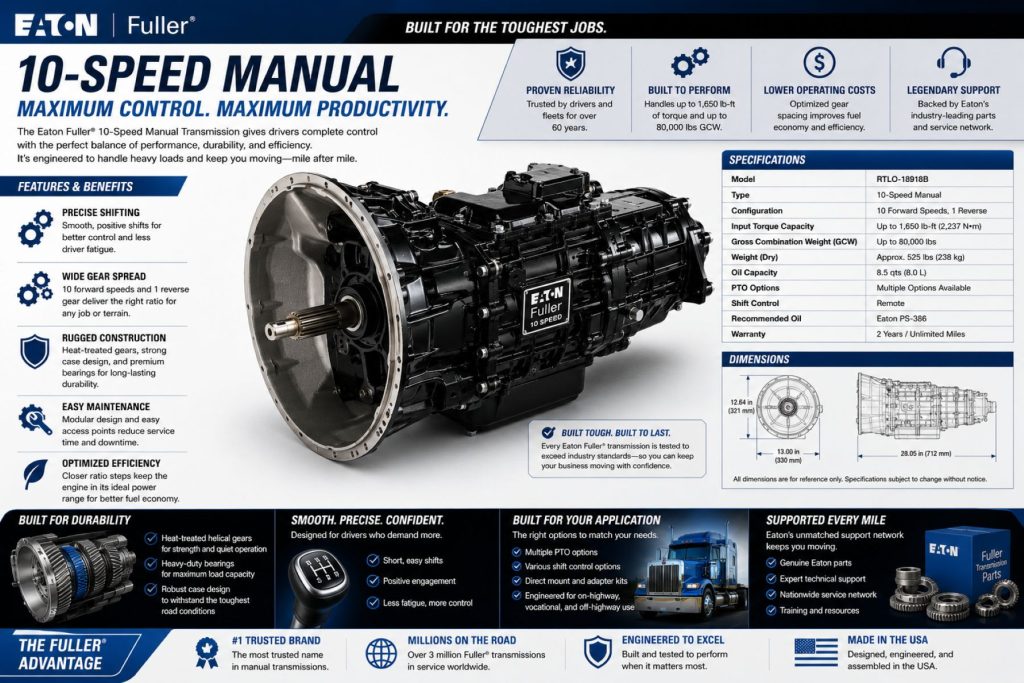
Buying Considerations
- Identify the complete Eaton transmission model number.
- Confirm whether the unit is direct drive or overdrive.
- Verify the maximum input-torque rating.
- Compare the rating with the engine’s programmed peak torque.
- Confirm the exact gear-ratio set.
- Check compatibility with the rear-axle ratio and tire size.
- Determine whether the gearing supports the desired highway cruising speed.
- Inspect the identification tag for model and serial information.
- Check for lubricant leaks around the case, seals, PTO covers, and range section.
- Inspect the lubricant for metal contamination or signs of overheating.
- Listen for bearing noise in neutral and while driving.
- Shift through every gear under load.
- Verify that the low-to-high range change occurs correctly.
- Check whether the transmission jumps out of gear.
- Inspect the clutch, clutch brake, linkage, and release mechanism.
- Review the condition of the shift lever, tower, and isolator.
- Confirm PTO compatibility for vocational applications.
- Inspect the transmission and engine mounts.
- Check the driveshaft and universal joints for vibration-related problems.
- Review service records when purchasing a used truck or transmission.
- Compare repair, remanufactured replacement, and conversion costs.
- Confirm the availability of qualified manual-transmission technicians.
Variants and Configurations
- Eaton Fuller FR Series 10-Speed
- Direct-Drive 10-Speed
- Overdrive 10-Speed
- FR-11210B
- FR-12210B
- FR-13210B
- FR-14210B
- FR-15210B
- FR-16210B
- FR-17210B
- FR-18210B
- Standard-Ratio Configuration
- High-Torque Configuration
- Linehaul Configuration
- Vocational Configuration
- PTO-Equipped Configuration
- Integral Oil-Pump Configuration
- Externally Cooled Configuration
- Older Eaton Fuller Roadranger 10-Speed Models
- Eaton Fuller Super 10
- Eaton Fuller Advantage Manual 10-Speed
Comparison to Similar Equipment
Compared with an Eaton Fuller 13-speed, the 10-speed has a simpler shift pattern and fewer driver controls. The 13-speed provides additional ratio choices in its upper range, allowing the driver to keep the engine closer to its preferred operating speed under changing terrain and load conditions.
Compared with an Eaton Fuller 18-speed, the 10-speed is easier to learn and normally provides enough gearing for conventional highway freight. The 18-speed provides deeper reduction and greater ratio flexibility for heavy-haul trucks, steep grades, off-highway operation, and specialized vocational work.
Compared with a 9-speed manual, the 10-speed provides one additional forward ratio and has become more familiar in many North American Class 8 applications. Exact starting and top-gear performance depend on the ratio set rather than speed count alone.
Compared with an Eaton UltraShift PLUS or Endurant automated manual, the Eaton Fuller 10-speed requires the driver to operate the clutch and select every gear. Automated transmissions reduce driver workload and can provide more consistent shifting, while the manual provides direct control and fewer electronic shifting components.
Compared with an Allison fully automatic transmission, the Eaton Fuller 10-speed does not rely on a torque converter during normal operation. An Allison can provide smoother launches and easier stop-and-go operation, while the Fuller manual provides a more direct mechanical connection and greater driver control.
Best Fit For
- Experienced professional drivers
- Owner-operators who prefer manual control
- Class 8 highway tractors
- Regional-haul fleets
- Long-haul freight operations
- Flatbed carriers
- Tanker carriers
- Agricultural hauling
- Construction fleets
- Vocational trucks requiring a PTO
- Fleets with manual-transmission maintenance experience
- Trucks operating primarily on open highways
- Applications within the selected model’s torque rating
- Operators seeking broad parts and service availability
- Used-truck buyers comfortable with clutch maintenance
Related Truck Types
- Sleeper Trucks
- Day Cab Trucks
- Vocational Trucks
- Heavy-Haul Trucks
- Class 8 Highway Tractors
- Construction Trucks
- Dump Trucks
- Tanker Trucks
- Agricultural Trucks
Related Truck Models
- Peterbilt 389
- Peterbilt 579
- Kenworth W900
- Kenworth W990
- Freightliner Cascadia
- Freightliner Coronado
- Freightliner 114SD
- Freightliner 122SD
- International LoneStar
- Western Star 47X
- Western Star 4900
- Mack Granite
Related Engines
- Cummins ISX15
- Cummins X15
- Cummins ISM
- Caterpillar 3406
- Caterpillar C13
- Caterpillar C15
- Detroit Series 60
- Detroit DD13
- Detroit DD15
- PACCAR MX-13
Related Transmission Types
- Manual Transmissions
- Heavy-Duty Transmissions
- 10-Speed Transmissions
- Direct-Drive Transmissions
- Overdrive Transmissions
- Linehaul Transmissions
- Vocational Transmissions
- Non-Synchronized Transmissions
Related Equipment Systems
- Clutch Systems
- Clutch Brakes
- Driveshafts
- Axles and Differentials
- Transmission Lubrication Systems
- Transmission Cooling Systems
- Range-Shift Air Systems
- Gearshift Linkages
- PTO Systems
Related Guides
Understand the operating principles in How Commercial Truck Transmissions Work, compare drivetrain designs in Manual vs Automated Manual vs Automatic Transmissions, and evaluate gearing, application, and compatibility in How to Choose a Commercial Truck Transmission.
Regulatory and Compliance Notes
The Eaton Fuller 10-speed must be installed and operated within the engine-torque, gross-combination-weight, and application limits approved for the specific model.
The transmission does not independently determine a truck’s legal operating weight. The vehicle must remain within its gross vehicle weight rating, gross combination weight rating, axle ratings, tire ratings, federal bridge-formula requirements, and applicable state limits.
Replacement transmissions should match the original application or be approved as part of a properly engineered drivetrain conversion. Changes to transmission ratios can affect engine speed, road speed, gradeability, speedometer accuracy, emissions-system operation, and overall vehicle performance.
Electronically controlled engines must be programmed within the transmission’s approved torque capacity. Raising engine output beyond that rating can cause premature failure and may affect warranties or regulatory compliance.
PTO installations must use properly rated equipment, guards, controls, and operating procedures. Installers must verify PTO speed, rotation, torque capacity, clearance, lubrication requirements, and compatibility with the powered equipment.
Maintenance and repairs should follow current Eaton service information for the exact model. The transmission identification tag should remain attached and readable.
Real World Operating Notes
In everyday highway service, drivers normally use the starting gear appropriate for the truck’s weight and grade rather than automatically beginning in the lowest available gear.
Progressive shifting can help reduce fuel consumption. The driver shifts at lower engine speeds in the lower gears and gradually allows a higher shift point as road speed and load increase.
The range selector should be preselected before the shift between fifth and sixth. The range change occurs as the shift lever passes through neutral.
A driver should never force the lever into gear. If a gear does not engage, engine speed may not be properly matched or a mechanical condition may need attention.
On steep grades, early gear selection is important. Waiting until engine rpm falls too low can make a successful downshift difficult and may require the truck to slow considerably before another gear can be selected.
In cold weather, lubricant drag can make the transmission feel stiff until it warms. Drivers should allow adequate warm-up time and avoid forcing shifts.
The 10-speed works especially well in applications where the truck spends long periods at highway speed. Operations involving continuous urban traffic, repeated backing, or frequent stops may benefit more from an automated manual or fully automatic transmission.
Frequently Asked Questions
Is the Eaton Fuller 10-speed synchronized?
No. It is a non-synchronized manual transmission. The driver must match engine speed with transmission and road speed during shifts.
How does the Eaton Fuller 10-speed provide ten gears?
It combines five main gear positions with low and high ranges. The driver uses the five-position pattern in low range and repeats it in high range.
What is the range selector used for?
The range selector changes the auxiliary section between low and high ranges. It is normally preselected before the shift between fifth and sixth gears.
Do drivers have to double-clutch the transmission?
Double-clutching is the traditional operating method. Experienced drivers sometimes float gears, but improper floating can damage internal engagement components.
What is the maximum torque capacity?
The highest-rated FR Series models can handle up to approximately 1,850 lb-ft. Lower-rated versions are also available, so the complete model number must be checked.
Can the Eaton Fuller 10-speed be used for heavy haul?
It can support some heavier applications within its approved ratings. However, 13-speed and 18-speed transmissions generally provide greater ratio flexibility for extreme heavy haul, steep grades, and specialized work.
What is the difference between direct drive and overdrive?
A direct-drive transmission uses a 1.00:1 top gear. An overdrive transmission turns the output shaft faster than the input shaft in top gear, reducing engine rpm when paired with the correct axle ratio.
Why does the transmission grind when shifting?
Common causes include incorrect rpm matching, a dragging clutch, improper clutch-brake use, worn engagement components, damaged shift linkage, or internal wear.
Why will the transmission not shift into high range?
Possible causes include low air pressure, leaking air lines, a faulty selector valve, a damaged range cylinder, contamination, or internal auxiliary-section problems.
Can a PTO be installed on an Eaton Fuller 10-speed?
Many models provide PTO openings. The PTO must match the exact transmission model, opening, rotation, speed, torque requirement, and equipment application.
How much does an Eaton Fuller 10-speed weigh?
Many configurations weigh approximately 590 to 720 pounds without the clutch and installation hardware. Exact weight depends on the model and equipment.
Is the Eaton Fuller 10-speed still available?
Yes. Eaton continues to list its FR Series 10-speed manual transmission for on-highway and vocational applications.
Availability and Where to Find
Eaton Fuller 10-speed manual transmissions are available through commercial truck dealers, Eaton-authorized service locations, drivetrain specialists, transmission rebuilders, heavy-truck salvage operations, parts suppliers, and used commercial equipment marketplaces.
New, factory-remanufactured, independently rebuilt, and used take-out transmissions may be available. Buyers should compare warranty coverage, core charges, model numbers, torque ratings, ratio sets, installation requirements, and PTO provisions before purchasing.
Because many Eaton Fuller 10-speed models look similar externally, a replacement should not be selected by appearance alone. The transmission identification tag and original truck specifications should be used to confirm compatibility.
Current specifications and technical resources are available through the official Eaton FR Series page.
Support Trucking Families
Truck Equipment Atlas supports the mission of Grey Cross, a nonprofit dedicated to helping families of truck drivers who lose their lives while on the road. As the site grows, part of its mission is to bring awareness and support to these families.
Podcast or Video Section
Learn More Through Audio and Video
Truck Equipment Atlas will continue expanding with podcast episodes, interviews, and equipment breakdowns to help drivers and fleets better understand trucks and equipment.
Follow the Growth of Truck Equipment Atlas
Truck Equipment Atlas continues to expand with new truck profiles, trailer coverage, diesel engine pages, equipment system resources, manufacturer information, and educational guides.
Visit our Site Updates page to explore recent additions, project milestones, and upcoming resources as we continue building one of the industry’s growing commercial trucking equipment reference libraries.
View the Latest Site Updates: Truck Equipment Atlas Site Updates