
Eaton Fuller 9ALL High-Reduction Manual Transmission
Quick Facts
- Manufacturer: Eaton
- Transmission Type: Heavy-Duty High-Reduction Manual Transmission
- Official Product Name: Eaton Fuller 9ALL
- Common Informal Name: Eaton Fuller 9LL
- Common Models: RTO-11909ALL, RTO-14909ALL, and RTO-16909ALL
- Regular Road Speeds: Eight
- Deep-Reduction Speeds: Three
- Total Forward Ratios: 11
- Reverse Ratios: Three
- Maximum Engine Torque: Up to 1,650 lb-ft
- Maximum GCWR: Up to approximately 110,000 lbs
- Overall Ratio Coverage: Approximately 35.71:1
- Lowest Forward Ratio: 26.08:1
- Top Gear: 0.73:1 Overdrive
- Control Type: Driver-Operated Manual with Air-Shifted Range and Deep-Reduction Controls
- Clutch Type: Heavy-Duty Dry Clutch
- Common Applications: Concrete Placement, Asphalt Spreading, Dump Trucks, Municipal Trucks, Construction Vehicles, and Specialized Low-Speed Equipment
- PTO Compatibility: Six-Bolt and Eight-Bolt PTO Provisions depending on configuration
- Transmission Weight: Approximately 671 to 698 lbs depending on model
- Transmission Length: Approximately 33.1 inches
- Recommended Lubricant: Eaton PS-386-approved lubricant
- Production Status: Current and Legacy Applications Supported
Overview
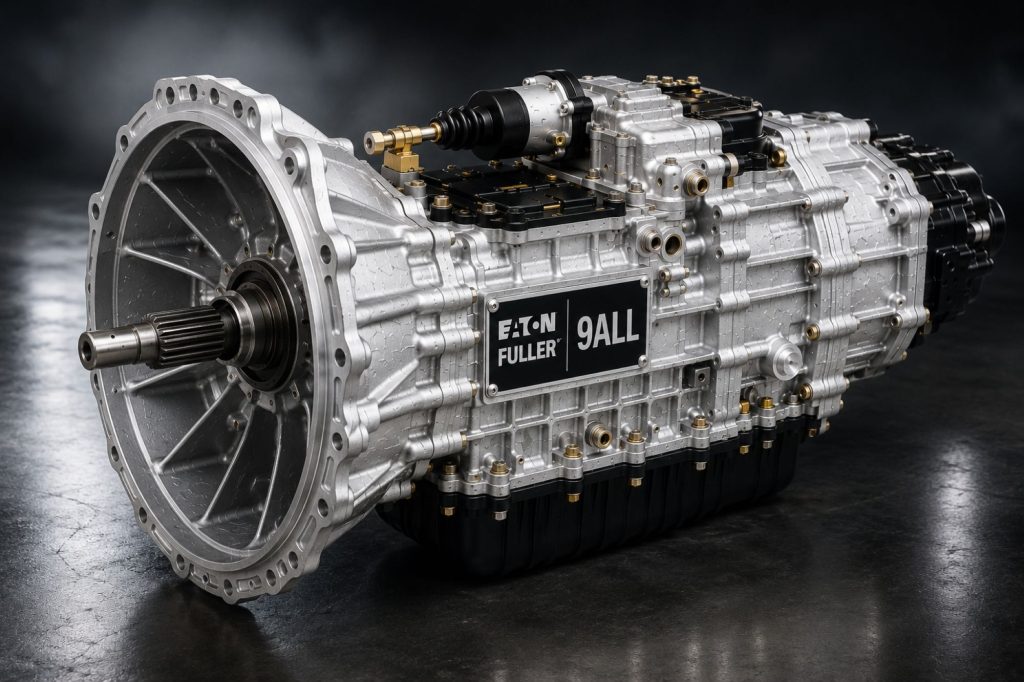
The Eaton Fuller 9ALL is a heavy-duty high-reduction manual transmission designed for trucks that require extremely slow, controlled vehicle movement.
Eaton identifies the transmission as the 9ALL, although drivers, equipment sellers, and even some training materials sometimes refer to it informally as a “9LL.” The official Eaton product name should be used for the page title and URL.
The transmission provides eight regular road-speed gears and three additional low-range or deep-reduction ratios. Eaton therefore lists it as having 11 usable forward ratios.
Its overall ratio coverage reaches approximately 35.71:1, substantially greater than the Eaton Fuller 8LL. This allows a truck to begin moving under heavy load and maintain very low road speeds during concrete placement, asphalt spreading, paving, construction, and similar operations.
Common models include the RTO-14909ALL, rated for up to approximately 1,450 lb-ft of engine torque, and the RTO-16909ALL, rated for up to approximately 1,650 lb-ft.
The transmission is intended primarily for specialized vocational trucks rather than conventional long-haul tractors. Its 0.73:1 overdrive top gear still allows trucks to travel efficiently between work sites.
Key Characteristics
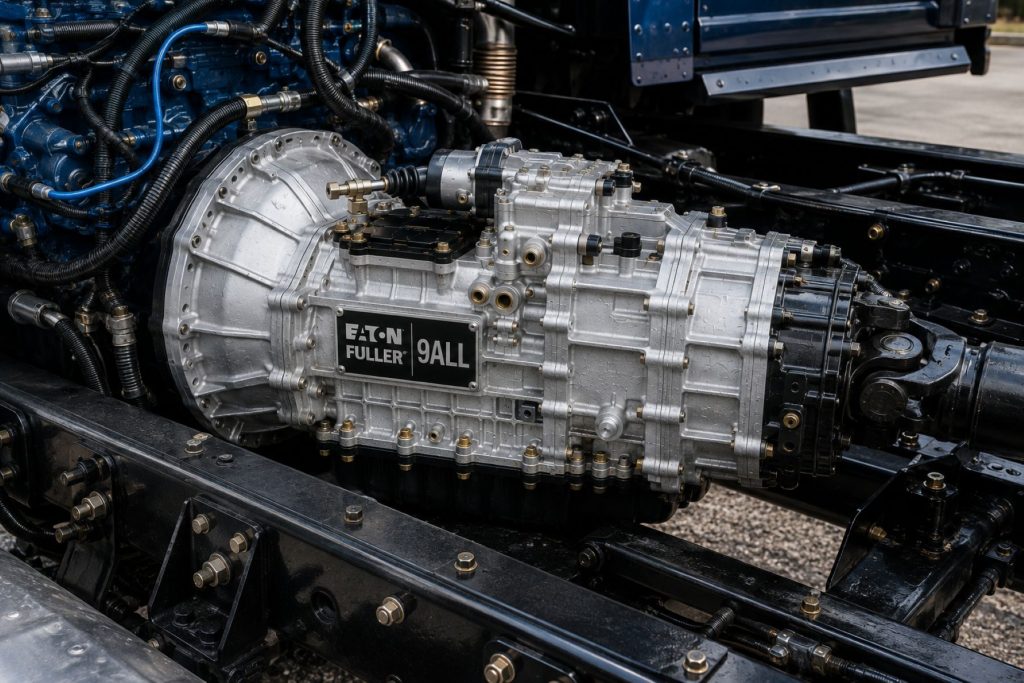
The defining characteristic of the Eaton Fuller 9ALL is its three deep-reduction forward ratios.
These ratios allow the truck to move slowly without controlling speed through continuous clutch slipping. Reducing clutch slip is important during paving, concrete placement, spreading, and construction operations that require a steady vehicle speed.
The lowest forward ratio is approximately 26.08:1. This is considerably deeper than the lowest ratio in most conventional road transmissions.
The transmission provides a repeat-style shift pattern. Once the truck moves beyond the deep-reduction ratios, the driver proceeds through the regular Low- and High-Range road gears.
Helical gears in the auxiliary section help reduce noise and improve durability.
High-capacity tapered roller bearings support the auxiliary countershafts and help the transmission withstand demanding vocational loads.
A heavy-duty synchronizer supports Low-to-High range changes. The primary transmission section remains a heavy-duty manual design requiring proper engine-speed matching.
How the Transmission Works
Engine power enters the transmission through a driver-operated dry clutch.
The clutch disconnects the engine when the driver starts, stops, or performs a double-clutch shift.
Inside the transmission, a twin-countershaft design divides engine torque between two countershafts. Each gear set carries a portion of the total load, allowing the transmission to support substantial torque.
The three deep-reduction ratios are used at the bottom of the operating range. They provide extremely slow vehicle movement and strong startability.
Once the truck has accelerated beyond the deep ratios, the driver transitions into the normal road-speed gearing.
An air-operated range system changes the auxiliary section between Low and High Range. The driver preselects the desired range before moving the shift lever through Neutral.
As the lever passes through Neutral, the auxiliary synchronizer completes the range change.
The driver continues through the road-speed ratios using the repeated shift pattern. The highest ratio is a 0.73:1 overdrive gear.
Because the primary transmission gears are not conventionally synchronized, the driver must match engine rpm with road speed and the selected ratio.
Common Specifications
Transmission Type
The Eaton Fuller 9ALL is a driver-operated heavy-duty manual transmission with air-controlled range and deep-reduction functions.
Official Naming
Eaton officially identifies the product as the 9ALL high-reduction manual transmission.
“9LL” is a commonly used informal description, but 9ALL is the correct name for the transmission family and page.
Forward Speeds
The transmission provides eight regular road-speed gears plus three deep-reduction ratios.
This creates 11 usable forward ratios.
Reverse Speeds
The transmission provides three reverse ratios:
- Low-Low Reverse: Approximately 20.84:1
- Low Reverse: Approximately 13.03:1
- High Reverse: Approximately 3.43:1
The deepest reverse ratios allow controlled backing during specialized work.
Common Models
Common model designations include:
- RTO-11909ALL: Approximately 1,150 lb-ft torque capacity
- RTO-14909ALL: Approximately 1,450 lb-ft torque capacity
- RTO-16909ALL: Approximately 1,650 lb-ft torque capacity
Legacy, forward-shift, and other application-specific versions may use additional prefixes or suffixes.
Maximum Torque Capacity
The highest-rated RTO-16909ALL supports engines producing up to approximately 1,650 lb-ft.
Engine peak torque must remain within the rating of the individual transmission.
Maximum GCWR
Eaton lists maximum gross combination weight of approximately 110,000 pounds for the current 9ALL family.
The permitted rating depends on the model, engine, chassis, driveline, axle configuration, cooling system, and application.
Forward Gear Ratios
Common 9ALL forward ratios include:
- Deep Reduction 1: 26.08:1
- Deep Reduction 2: 16.30:1
- Deep Reduction 3: 11.85:1
- First Road Gear: 7.41:1
- Second Road Gear: 5.23:1
- Third Road Gear: 3.79:1
- Fourth Road Gear: 2.77:1
- Fifth Road Gear: 1.95:1
- Sixth Road Gear: 1.38:1
- Seventh Road Gear: 1.00:1
- Eighth Road Gear: 0.73:1
The identification tag and Eaton documentation should be used to confirm ratios for a specific unit.
Overall Ratio Coverage
The 9ALL provides approximately 35.71:1 overall ratio coverage.
This wide range is its main advantage over standard road transmissions and the Eaton Fuller 8LL.
Top Gear
The highest gear is approximately 0.73:1 overdrive.
The truck’s rear-axle ratio and tire size must be matched to the overdrive top gear.
Shift Controls
The shift controls include:
- A mechanical gearshift lever
- An air-operated range selector
- A deep-reduction control
The arrangement varies with transmission generation, shift knob, and vehicle installation.
Clutch System
The transmission uses a driver-operated heavy-duty dry clutch.
A 15.5-inch twin-disc clutch is common in high-torque vocational applications, although the installed clutch depends on the engine and chassis.
Clutch Brake
The clutch brake slows the transmission input gearing when the vehicle is stationary.
It helps the driver select a starting or deep-reduction ratio without gear clash.
The clutch pedal should not be pushed fully to the floor during normal moving shifts because doing so can engage the clutch brake.
Twin-Countershaft Construction
The transmission divides torque between two countershafts.
This provides high torque capacity while controlling the size and weight of individual gears.
Auxiliary-Section Gearing
Helical gears are used in the auxiliary section to reduce operating noise and improve durability.
Range Synchronizer
A heavy-duty synchronizer supports range changes between the transmission’s Low and High sections.
The synchronizer does not make the entire transmission fully synchronized.
Transmission Length
Common RTO-14909ALL and RTO-16909ALL configurations are approximately 33.1 inches long.
Installation length can vary with the clutch housing, input shaft, output arrangement, and accessories.
Transmission Weight
Approximate dry weights include:
- RTO-14909ALL: Approximately 671 lbs
- RTO-16909ALL: Approximately 698 lbs
These figures generally exclude lubricant, clutch housing, clutch, output yoke, PTO equipment, and other installation-specific components.
Oil Capacity
Common 9ALL configurations hold approximately 28 pints, or about 13 liters, of transmission lubricant.
The final level must be checked at the fill opening according to Eaton procedures.
Recommended Lubricant
Eaton PS-386-approved lubricant is commonly specified for current service.
The correct fluid should be confirmed using the model, serial number, operating environment, and service information.
Transmission Cooling
An external transmission cooler may be recommended or required for higher-power, higher-torque, high-GCWR, or severe low-speed applications.
Continuous operation at low road speed can create heat because airflow around the transmission is reduced.
PTO Compatibility
Six-bolt and eight-bolt PTO openings are available on applicable configurations.
PTO location and filter or cooler equipment must be checked for interference.
Installation Requirements
Installation requires a compatible engine, clutch, flywheel housing, input shaft, mounts, driveshaft, air system, range controls, deep-reduction controls, rear-axle ratio, cooling equipment, and PTO.
Common Applications
- Concrete-placement trucks
- Concrete mixer trucks
- Asphalt-spreading trucks
- Paving-support vehicles
- Dump trucks
- Municipal trucks
- Road-maintenance equipment
- Utility trucks
- Construction trucks
- Material-spreading vehicles
- Oilfield-support equipment
- Agricultural trucks
- Snowplow trucks
- Heavy service vehicles
- Low-speed delivery equipment
- Specialized on-road and off-road vocational trucks
Truck and Engine Compatibility
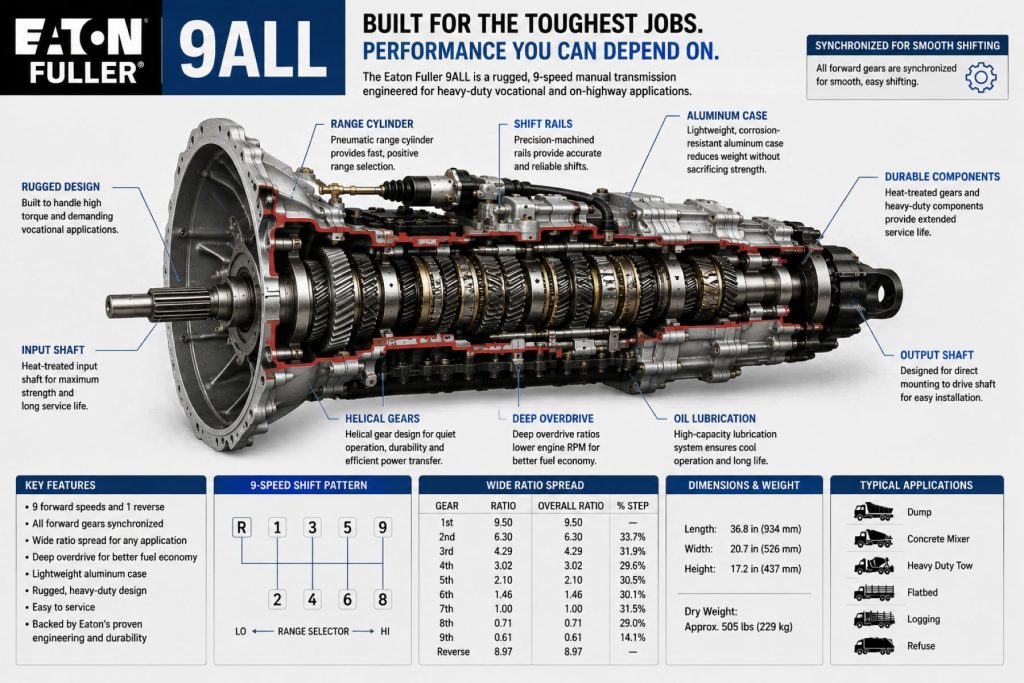
The Eaton Fuller 9ALL is designed primarily for heavy vocational truck platforms.
Potential applications include the Kenworth T800, Kenworth T880, Peterbilt 357, Peterbilt 365, Peterbilt 367, Peterbilt 567, Freightliner 114SD, International PayStar, International HX Series, Mack Granite, Volvo VHD, Western Star 4900, and Western Star 47X.
Exact availability differs by model year. The 9ALL is more commonly found in older vocational trucks because many newer trucks use automated manual or fully automatic transmissions.
Common engine pairings may include:
- Detroit Series 60
- Detroit DD13
- Detroit DD15
- Cummins ISM
- Cummins ISX
- Cummins X15
- Caterpillar C13
- Caterpillar C15
- PACCAR MX-11
- PACCAR MX-13
- Mack MP8
- Volvo D13
The engine’s peak torque must remain within the rating of the exact transmission model.
Advantages
- Three deep-reduction forward ratios
- Eleven total forward ratios
- Three reverse ratios
- Extremely wide 35.71:1 ratio coverage
- Excellent low-speed control
- Reduces the need for continuous clutch slipping
- Designed for concrete and asphalt spreading
- Supports specialized paving speeds
- Maximum torque capacity reaches 1,650 lb-ft
- Suitable for mixed on-road and off-road operation
- Overdrive top gear supports highway travel
- Twin-countershaft construction
- Helical auxiliary gears reduce noise
- Heavy-duty range synchronizer
- High-capacity auxiliary bearings
- Compatible with vocational PTO equipment
- Provides more usable ratios than an 8LL
- Driver retains direct control over gear selection
Limitations or Considerations
- Requires specialized driver training
- More complicated than a conventional manual transmission
- Uses a driver-operated clutch
- Primary road gears are generally nonsynchronized
- Deep-reduction controls must be used correctly
- Improper range shifting can damage the auxiliary section
- Incorrect low-range operation can cause gear damage
- Approximately 671-to-698-pound dry weight
- Clutch wear remains an ownership expense
- Repeated backing can create clutch heat
- Poor shift technique can damage engagement teeth
- Not primarily designed for long-haul operation
- Cooling may be required in severe low-speed service
- PTO installation may interfere with filters or other equipment
- Used units may have demanding construction or paving histories
- Parts availability can vary for older configurations
Driver and Operator Experience
The driver must understand which ratios are deep-reduction gears and which are regular road gears.
The lowest ratio is used for extremely difficult starts or very slow material-placement work. It should not be treated like an ordinary highway gear.
The next two deep ratios allow the truck to accelerate gradually without jumping immediately into the road-speed section.
Once sufficient speed is reached, the driver transitions into the regular road gears and continues through the repeated shift pattern.
The range selector should be preselected before the shift lever passes through Neutral.
Double-clutching is Eaton’s standard instructional method. The driver depresses the clutch once to leave the current gear and again to enter the next gear after matching engine speed.
Experienced drivers may float gears, but incorrect rpm matching can damage the transmission.
Drivers should avoid prolonged clutch slipping. The deep-reduction ratios are specifically provided to allow slow movement with the clutch fully engaged.
The clutch brake should be used only when selecting a starting gear while the truck is stationary.
Maintenance and Ownership Notes
The transmission should receive a maintenance program designed for severe vocational service.
Construction, asphalt, concrete, and municipal trucks may accumulate substantial engine and PTO hours without traveling high mileage.
Lubricant intervals should therefore consider operating hours, heat, contamination, PTO operation, and road conditions in addition to mileage.
The transmission should be inspected for leaks around the input shaft, output seal, countershaft bearing covers, auxiliary housing, shift-bar housing, PTO openings, oil pump, filter, cooler connections, fill plug, and drain plug.
Clean, dry air is essential to range and deep-reduction operation. Air-system moisture and contamination can damage valves, cylinders, and seals.
The clutch, clutch brake, release bearing, linkage, or hydraulic control system should be inspected regularly.
PTO-driven trucks require inspection of mounting bolts, gear backlash, seals, air controls, hydraulic hoses, pumps, and safety interlocks.
Cooling-system components should be checked when the transmission operates at low road speed for extended periods.
Common Transmission Problems
Deep-Reduction Shift Problems
Failure to enter or leave a deep-reduction ratio may result from air leaks, control-valve problems, worn seals, damaged gears, incorrect adjustment, or improper driver operation.
Range-Shift Failure
Low air pressure, contaminated air, leaking lines, failed range valves, or synchronizer damage can prevent Low-to-High or High-to-Low range changes.
Gear Grinding
Grinding commonly results from incorrect rpm matching, incomplete clutch release, improper technique, clutch drag, or worn engagement teeth.
Jumping Out of Gear
Possible causes include worn sliding clutches, damaged gear teeth, worn shift forks, bearing wear, excessive shaft movement, loose mounts, or linkage problems.
Clutch Brake Failure
A worn clutch brake can make it difficult to select the lowest ratio or Reverse while the truck is stationary.
Clutch Drag
A clutch that does not release completely can cause gear clash and difficult shifting.
Possible causes include incorrect adjustment, warped clutch discs, linkage problems, release-bearing wear, or pilot-bearing damage.
Range Synchronizer Wear
A worn range synchronizer can cause slow, incomplete, or failed auxiliary-section shifts.
Bearing Noise
Worn main-section or auxiliary-section bearings can produce whining, growling, rumbling, or vibration.
Oil Leaks
Common leak locations include input and output seals, bearing covers, PTO openings, housing joints, plugs, pumps, filters, and cooler fittings.
Overheating
Operating continually at low speed, low lubricant, incorrect oil, heavy engine torque, restricted airflow, PTO use, or inadequate cooling can cause overheating.
PTO Problems
PTO complaints can result from improper backlash, damaged gears, loose mounting, insufficient lubrication, failed air controls, excessive hydraulic load, or incompatible equipment.
Buying Considerations
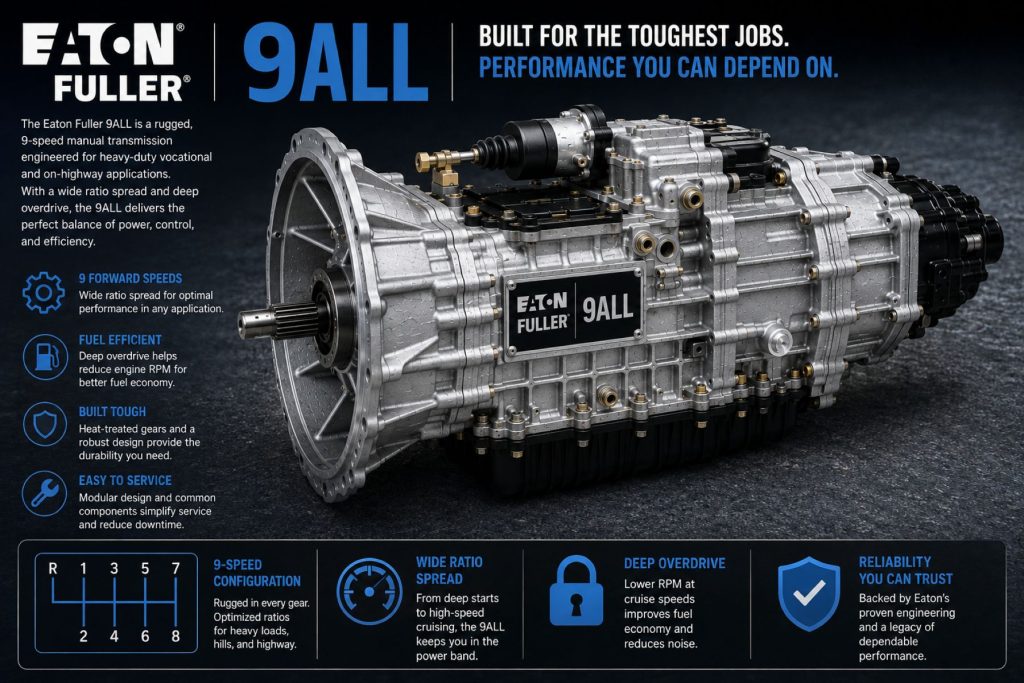
- Confirm that the transmission is officially a 9ALL.
- Do not rely only on a seller’s “9LL” description.
- Record the complete model and serial number.
- Determine whether it is an RTO-11909ALL, RTO-14909ALL, or RTO-16909ALL.
- Verify the maximum engine torque rating.
- Confirm the intended gross combination weight.
- Check compatibility with the engine, clutch, flywheel housing, and chassis.
- Verify all 11 forward ratios.
- Test all three reverse ratios.
- Test the complete deep-reduction system.
- Test Low-to-High and High-to-Low range changes.
- Listen for air leaks during range selection.
- Inspect the case for cracks, impact damage, or welding.
- Check the input and output shafts for excessive movement.
- Inspect the lubricant for metal, water, debris, or burned odor.
- Check the input seal, output seal, bearing covers, and PTO openings for leaks.
- Inspect the clutch, clutch brake, release system, and linkage.
- Determine whether six-bolt or eight-bolt PTO capability is required.
- Confirm cooling-system requirements.
- Review rebuild, clutch, PTO, and lubricant-service records.
- Consider the truck’s previous concrete, paving, construction, or municipal service.
Variants and Configurations
- Eaton Fuller RTO-11909ALL
- Eaton Fuller RTO-14909ALL
- Eaton Fuller RTO-16909ALL
- Eaton Fuller RTOF-11909ALL
- Eaton Fuller RTOF-14909ALL
- Eaton Fuller RTOF-16909ALL
- 1,150 lb-ft Configuration
- 1,450 lb-ft Configuration
- 1,650 lb-ft Configuration
- Eight Road-Speed Configuration
- Three Deep-Reduction Ratios
- Three-Reverse Configuration
- Overdrive Configuration
- Concrete-Placement Configuration
- Asphalt-Spreading Configuration
- Paving Configuration
- Municipal Configuration
- Construction Configuration
- Six-Bolt PTO Configuration
- Eight-Bolt PTO Configuration
- Oil-Pump Configuration
- External-Cooler Configuration
Comparison to Similar Equipment
Compared with the Eaton Fuller 8LL, the 9ALL provides three deep-reduction ratios instead of two and significantly wider overall ratio coverage. It is better suited to concrete placement, asphalt spreading, and other work requiring extremely slow speeds.
Compared with the Eaton Fuller 10-Speed Manual, the 9ALL is specialized for low-speed vocational work. The conventional 10-speed provides a simpler road-oriented shift pattern.
Compared with the Eaton Fuller 13-Speed Manual, the 9ALL provides deeper low-speed operation but fewer closely spaced highway ratios.
Compared with the Eaton Fuller 18-Speed Manual, the 9ALL provides excellent specialized low-speed control but less overall heavy-haul and highway flexibility.
Compared with an Allison automatic, the 9ALL gives the driver a direct mechanical connection and specialized gearing. The Allison eliminates manual clutch operation and usually provides smoother stop-and-go movement.
Compared with an automated vocational transmission, the 9ALL is mechanically simpler but requires greater driver involvement and skill.
Best Fit For
- Concrete-placement operations
- Concrete mixer fleets
- Asphalt-spreading contractors
- Paving operations
- Road-construction companies
- Municipal public-works departments
- Dump-truck fleets
- Utility companies
- Specialized low-speed applications
- Trucks requiring extremely deep reduction
- Mixed on-road and off-road operations
- Experienced vocational drivers
- Fleets with Eaton Fuller service knowledge
- PTO-driven vocational equipment
- Applications operating within 1,650 lb-ft and 110,000-pound ratings
Related Truck Types
- Vocational Trucks
- Day Cab Trucks
- Heavy Haul Trucks
- Concrete Mixer Trucks
- Asphalt Trucks
- Dump Trucks
- Municipal Trucks
- Construction Trucks
- Utility Trucks
Related Truck Models
- Kenworth T800
- Kenworth T880
- Peterbilt 357
- Peterbilt 365
- Peterbilt 367
- Peterbilt 567
- Freightliner 114SD
- International PayStar
- International HX Series
- Mack Granite
- Volvo VHD
- Western Star 4900
- Western Star 47X
Related Engines
- Detroit Series 60
- Detroit DD13
- Detroit DD15
- Cummins ISM
- Cummins ISX
- Cummins X15
- Caterpillar C13
- Caterpillar C15
- PACCAR MX-11
- PACCAR MX-13
- Mack MP8
- Volvo D13
Related Transmission Types
- Manual Transmissions
- Heavy-Duty Transmissions
- Vocational Transmissions
- High-Reduction Transmissions
- Deep-Reduction Transmissions
- Range-Shift Transmissions
- Overdrive Transmissions
Related Equipment Systems
- Heavy-Duty Clutches
- Clutch Brakes
- Air-Shift Range Systems
- Deep-Reduction Controls
- Driveshafts
- Axles and Differentials
- Transmission Lubrication Systems
- Transmission Oil Pumps
- Transmission Cooling Systems
- Six-Bolt and Eight-Bolt PTOs
- PTO Systems
- Concrete and Asphalt Delivery Systems
Related Guides
Understand the operating principles in How Commercial Truck Transmissions Work, compare drivetrain designs in Manual vs Automated Manual vs Automatic Transmissions, and evaluate gearing, application, and compatibility in How to Choose a Commercial Truck Transmission.
Regulatory and Compliance Notes
The Eaton Fuller 9ALL must be matched to the engine’s torque, gross combination weight, clutch, driveshaft, axle ratio, cooling system, and intended vocation.
The transmission’s 110,000-pound maximum GCWR does not override federal, state, provincial, axle, tire, chassis, bridge-formula, or permit restrictions.
PTO-driven equipment must be properly rated, guarded, installed, and controlled. Concrete, asphalt, hydraulic, and material-placement equipment may require safety interlocks.
Drivers must understand the transmission’s deep-reduction and range controls. Incorrect operation can damage the transmission and affect vehicle control.
Replacement transmissions must preserve proper mounting, driveline geometry, speedometer operation, reverse-light function, and PTO controls.
Real World Operating Notes
The Eaton Fuller 9ALL performs best in work where consistent, extremely low vehicle speed is more important than rapid acceleration.
During asphalt or concrete placement, the low ratios allow the truck to move slowly while keeping the clutch engaged.
The three deep ratios provide more gradual progression into the road-speed gears than an 8LL.
Operators should select the correct low ratio before beginning the maneuver. Attempting to change deep-reduction settings at an inappropriate speed can damage the auxiliary section.
Extended low-speed operation creates less cooling airflow around the transmission. Temperature and lubricant condition deserve particular attention.
Correct rear-axle gearing is important. The transmission already provides extremely deep low ratios, so unnecessarily deep axles can reduce highway efficiency.
Frequently Asked Questions
Is it called the Eaton Fuller 9LL or 9ALL?
Eaton’s official product name is the Eaton Fuller 9ALL. “9LL” is an informal name sometimes used by drivers and equipment sellers.
How many forward gears does the 9ALL have?
It provides eight regular road-speed gears and three deep-reduction ratios, creating 11 usable forward ratios.
How many reverse gears does it have?
The 9ALL provides three reverse ratios.
What is the lowest forward ratio?
The lowest forward ratio is approximately 26.08:1.
What is the overall ratio coverage?
The transmission provides approximately 35.71:1 overall ratio coverage.
How much torque can the 9ALL handle?
Depending on the model, it can support up to approximately 1,650 lb-ft.
What is the maximum GCWR?
Eaton lists a maximum GCWR of approximately 110,000 pounds for the 9ALL family.
What is the Eaton Fuller 9ALL used for?
It is designed for concrete placement, asphalt spreading, paving, construction, municipal work, and other extremely low-speed vocational applications.
Is the 9ALL suitable for highway travel?
Yes. Its 0.73:1 overdrive top gear allows highway operation between work sites.
Is the 9ALL synchronized?
The transmission uses a synchronized auxiliary range system, but the primary gearbox remains a heavy-duty manual requiring proper rpm matching.
How much does the transmission weigh?
Common models weigh approximately 671 to 698 pounds before lubricant and installation-specific equipment.
Can the 9ALL operate a PTO?
Yes. Applicable configurations support six-bolt and eight-bolt PTO installations.
What is the difference between the 8LL and 9ALL?
The 8LL has two deep-reduction ratios and approximately 19.58:1 overall coverage. The 9ALL has three deep ratios and approximately 35.71:1 coverage.
Is the 9ALL good for ordinary long-haul trucking?
It can travel at highway speed, but it is primarily designed for specialized vocational applications. A conventional 10-speed, 13-speed, or automated transmission is generally better suited to normal long-haul operation.
Availability and Where to Find
Eaton Fuller 9ALL transmissions are available through Eaton distributors, commercial truck dealers, vocational-equipment dealers, transmission rebuilders, salvage operations, truck auctions, and used-parts marketplaces.
Used units are commonly removed from concrete, asphalt, paving, dump, municipal, and construction trucks.
Buyers should search using both “9ALL” and the informal “9LL” description, but the identification tag must be used to confirm the actual model.
The condition of the deep-reduction section, range synchronizer, clutch, PTO openings, bearings, and lubricant deserves careful inspection because of the transmission’s demanding vocational applications.
Official product information can be found through Eaton’s 9ALL high-reduction manual transmission page.
Support Trucking Families
Truck Equipment Atlas supports the mission of Grey Cross, a nonprofit dedicated to helping families of truck drivers who lose their lives while on the road. As the site grows, part of its mission is to bring awareness and support to these families.
Podcast or Video Section
Learn More Through Audio and Video
Truck Equipment Atlas will continue expanding with podcast episodes, interviews, and equipment breakdowns to help drivers and fleets better understand trucks and equipment.
Follow the Growth of Truck Equipment Atlas
Truck Equipment Atlas continues to expand with new truck profiles, trailer coverage, diesel engine pages, equipment system resources, manufacturer information, and educational guides.
Visit our Site Updates page to explore recent additions, project milestones, and upcoming resources as we continue building one of the industry’s growing commercial trucking equipment reference libraries.
View the Latest Site Updates: Truck Equipment Atlas Site Updates