
Wilson Flatbed
Quick Facts
- Manufacturer: Wilson Trailer Company
- Trailer Type: Flatbed Trailer
- Common Models: Premier and Roadbrute
- Construction Options: All-Aluminum and Combination Steel-Aluminum
- Available Lengths: Approximately 40–53 ft
- Standard Width: Approximately 96 inches
- Optional Width: Approximately 102 inches
- Premier 48-Foot Base Weight: Approximately 8,000 lbs depending on configuration
- Maximum Distributed Load Capacity: Approximately 80,000 lbs on common configurations
- Premier Concentrated Load Rating: Approximately 52,000 lbs in 4 ft on applicable configurations
- Common Axle Configuration: Tandem Spread Axle
- Standard Axle Spread: Approximately 10 ft 1 in
- Typical Suspension: Hendrickson Air-Ride Suspension
- Floor Construction: Aluminum Flooring with Apitong Nailers
- Common Load Securement: Quick Tie System, Sliding Winches, Stake Pockets, Straps, Chains, and Binders
- Primary Applications: Lumber, Steel, Pipe, Building Materials, Machinery, Construction Equipment, Agricultural Equipment, and General Open-Deck Freight
- Production Status: Active Production
Overview
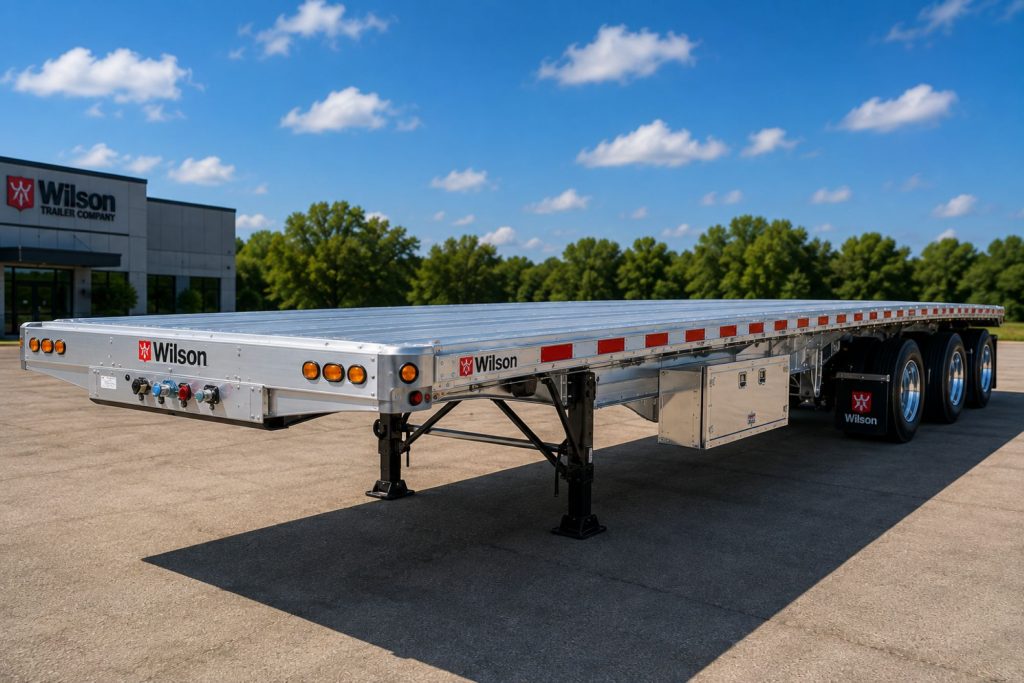
The Wilson Flatbed is an open-deck commercial trailer platform designed for flatbed freight, including lumber, steel, pipe, building materials, machinery, agricultural equipment, and construction products.
Wilson offers two primary flatbed families: the Premier and Roadbrute.
The Premier is an all-aluminum flatbed designed to reduce empty weight, resist corrosion, and provide substantial load capacity. A typical 48-foot Premier weighs approximately 8,000 pounds before optional equipment.
The Roadbrute combines high-strength steel main beams with aluminum flooring, side rails, and crossbars. This combination design balances structural durability, weight savings, repair familiarity, and purchase cost.
Both models incorporate Wilson’s cargo-securement systems, aluminum flooring, full-width crossbars, air-ride suspension, and multiple configuration options.
Key Characteristics
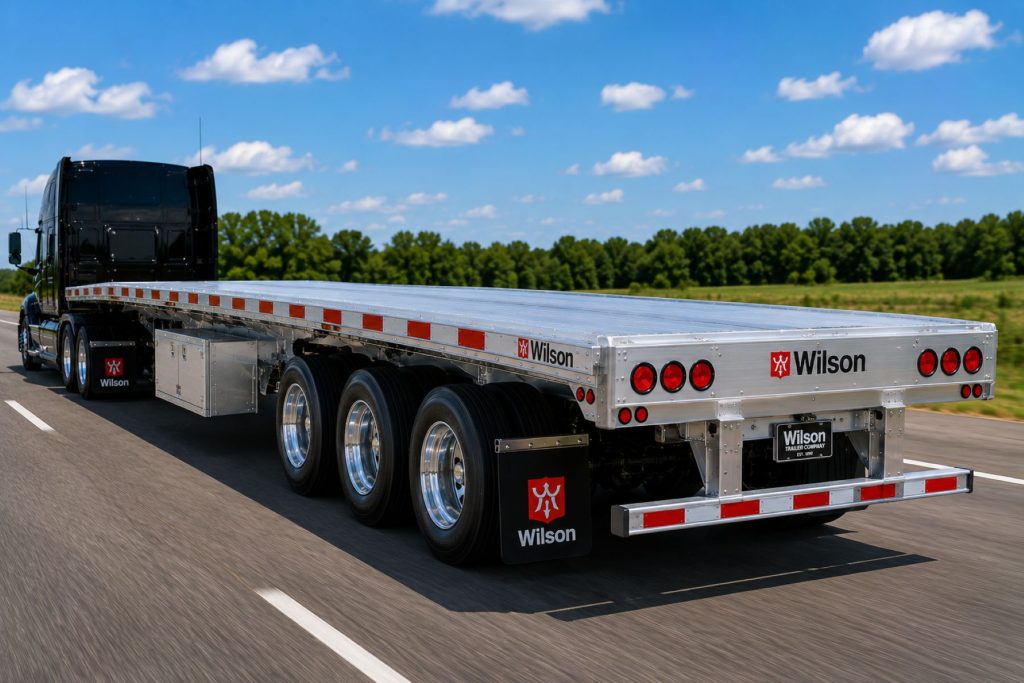
The Wilson Flatbed is designed around structural capacity, cargo versatility, securement flexibility, and long-term durability.
The open platform permits loading from either side, the rear, or overhead. This makes the trailer suitable for freight that cannot be loaded through the rear doors of an enclosed trailer.
Key characteristics include:
- Premier all-aluminum construction
- Roadbrute steel-aluminum combination construction
- Lengths ranging from approximately 40–53 feet
- Available 96-inch and 102-inch widths
- One-piece main-beam designs
- Aluminum flooring
- Full-length Apitong nailers
- Full-width aluminum crossbars
- Patented side-rail designs
- Quick Tie cargo-securement system
- Integrated sliding-winch track
- Stake pockets
- Tandem air-ride suspension
- Spread-axle configuration
- Multiple axle-spacing options
- LED lighting
- Sealed wiring harness
- Flatbed and drop-deck configurations
- Beavertail availability on applicable Roadbrute models
Common Specifications
Trailer Length
Wilson flatbeds are available in lengths ranging from approximately 40–53 feet in one-foot increments.
The 48-foot configuration is common for lumber, steel, pipe, building materials, machinery, and general open-deck freight.
The 53-foot configuration provides additional deck length for longer freight and loads requiring greater spacing.
Width
The standard width is approximately 96 inches.
An approximately 102-inch-wide configuration is available for operations requiring additional deck width.
Cargo exceeding the trailer’s legal width may require oversize permits, flags, lights, banners, escorts, or route restrictions.
Premier Construction
The Wilson Premier is an all-aluminum flatbed.
It uses aluminum main beams, crossbars, side rails, flooring, rear structures, and other major components to reduce weight and resist corrosion.
A common 48-foot Premier has an approximate base weight of 8,000 pounds, although installed options can increase empty weight.
Roadbrute Construction
The Wilson Roadbrute is a combination steel-aluminum flatbed.
Its high-strength steel main beams provide structural capacity, while aluminum crossbars, flooring, side rails, and other components reduce weight.
Protective treatments and material barriers help reduce corrosion where aluminum components meet steel structures.
Main-Beam Design
Wilson uses precision-cut, crowned main beams designed as mirror images of each other.
The main beams use continuous flanges and web sections without intermediate beam splices on applicable configurations.
Automatic welding helps produce consistent weld penetration and structural alignment.
Load Capacity
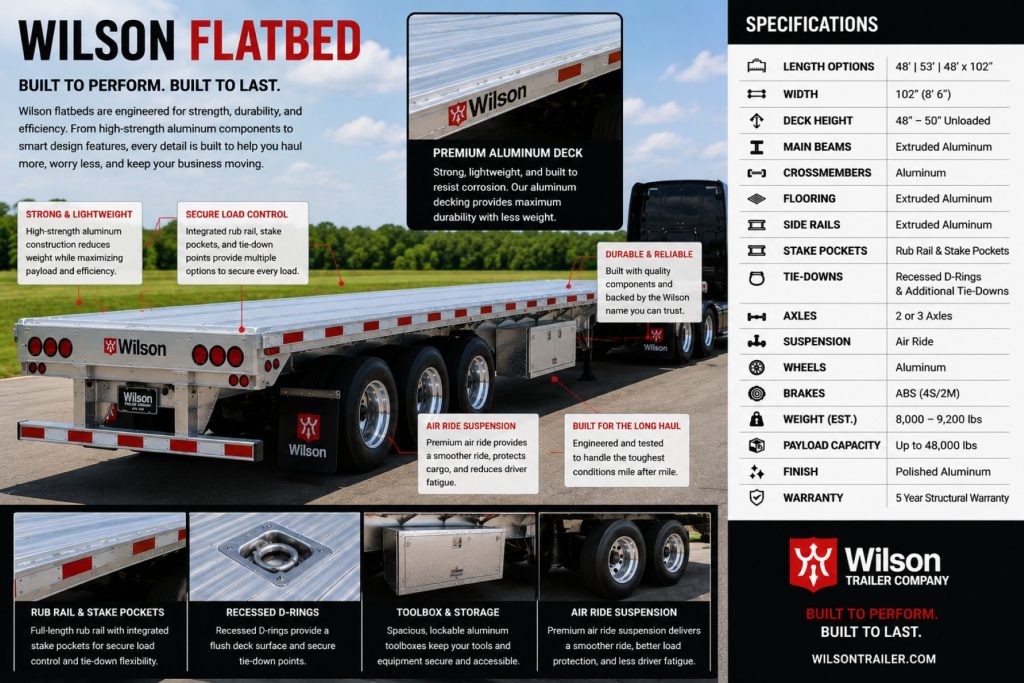
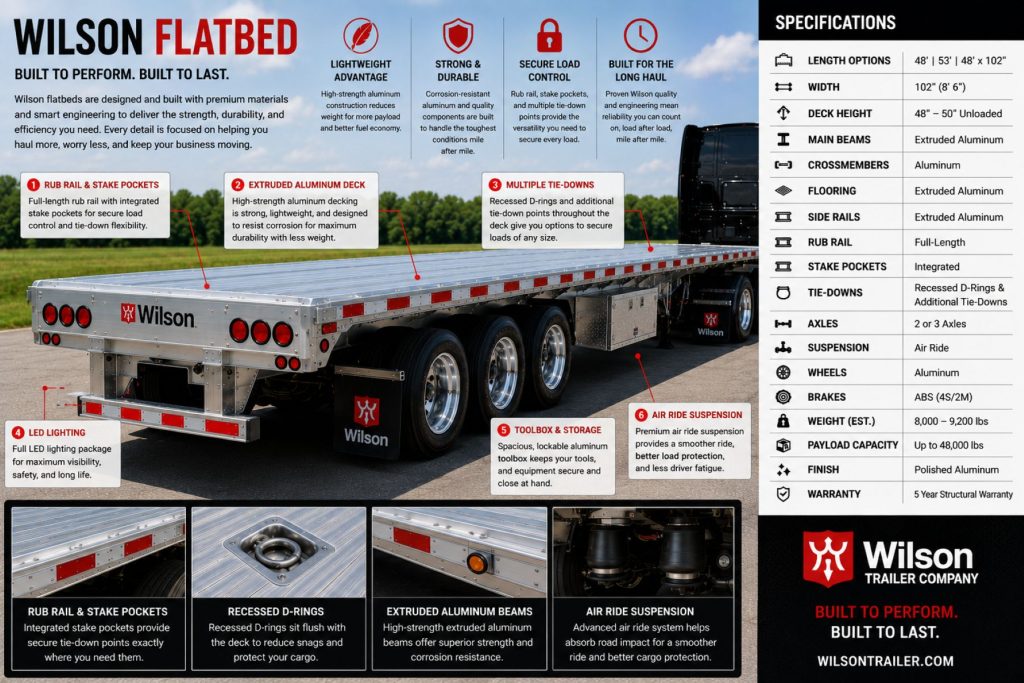
Common Wilson flatbed configurations provide up to approximately 80,000 pounds of evenly distributed structural capacity.
Applicable Premier models can support approximately 52,000 pounds concentrated within a four-foot section.
Higher-capacity Premier configurations may be available for operations involving steel coils and other concentrated loads.
Structural trailer ratings do not replace legal gross vehicle, axle, tire, wheel, or bridge-formula limits.
Side Rails
Wilson offers several aluminum side-rail designs, including TJ, C, and C+ configurations.
The TJ-style rail incorporates Wilson’s Quick Tie securement system, stake pockets, and an integrated double-L winch track.
Stake pockets are commonly placed on approximately 18-inch centers, with other spacing options available.
Quick Tie System
The Quick Tie system provides multiple cargo-securement positions along the side rail.
It supports straps, hooks, chains, and other compatible securement devices.
Multiple securement points allow operators to adjust equipment around different load widths, lengths, and shapes.
Flooring
The Wilson Flatbed uses approximately 1⅜-inch aluminum flooring with Apitong nailer strips.
Flooring and nailers extend along the trailer deck without intermediate splices on applicable configurations.
The flooring is fastened to the aluminum crossbars to create a stable deck and reduce side movement.
Crossbars
Heavy-duty extruded aluminum crossbars support the floor and connect the side rails to the main beams.
Crossbars are commonly positioned on approximately 18-inch centers.
Optional 12-inch or 15-inch spacing can provide additional deck support for applicable operations.
Suspension and Axles
A Hendrickson tandem air-ride suspension is common.
The standard axle spread is approximately 10 feet 1 inch, although other axle-spacing arrangements may be available.
Standard axles may be rated at approximately 20,000 pounds each, with higher ratings available depending on configuration.
More information is available through Suspension Systems and Axles and Differentials.
Braking System
Commercial trailer air brakes with ABS are standard on most highway configurations.
Applicable specifications may include extended-service brake packages and different drum or air-disc-brake options.
Additional information is available through Brake Systems and Air Brake Systems Explained.
Tires and Wheels
Wilson flatbeds can be equipped with commercial steel or aluminum wheels and multiple tire sizes.
Wheel and tire selection affects trailer height, empty weight, load rating, maintenance requirements, and replacement cost.
More information is available through Tires and Wheels.
Landing Gear
Two-speed landing gear supports the trailer when disconnected from the tractor.
Landing-gear specifications vary according to configuration, but commercial units commonly provide substantial lifting capacity and reinforced mounting.
Electrical and Lighting System
Wilson flatbeds use a sealed commercial wiring harness and LED exterior lights.
Lighting includes stop, tail, turn, marker, clearance, license-plate, and conspicuity equipment.
More information is available through Electrical Systems.
Rear Structure
An extruded aluminum rear structure with dock bumpers, stake pockets, lighting protection, and a rear-impact guard is common.
The rear structure should be inspected regularly for collision damage, cracked welds, bent components, and loose mounting hardware.
Common Applications
The Wilson Flatbed can transport numerous types of open-deck freight.
- Flatbed Freight
- Lumber
- Roofing materials
- Drywall
- Steel coils
- Steel plate
- Steel beams
- Pipe and tubing
- Building materials
- Construction equipment
- Industrial machinery
- Agricultural equipment
- Hay and agricultural products
- Manufactured products
- Crated equipment
- Precast materials
- Utility equipment
- Oversized freight
- Specialized loads
The correct Wilson model and configuration depend on cargo weight, concentrated-load requirements, dimensions, axle placement, and securement needs.
Advantages
The Wilson Flatbed offers several advantages.
- All-aluminum and combination-construction choices
- Available Premier and Roadbrute models
- Strong distributed-load capacity
- Concentrated-load capability
- Lengths ranging from approximately 40–53 feet
- Available 96-inch and 102-inch widths
- One-piece main-beam design
- Patented side-rail system
- Quick Tie cargo-securement system
- Full-length aluminum flooring
- Apitong nailer strips
- Air-ride suspension
- Multiple axle-spacing options
- Reduced corrosion on aluminum components
- Open loading from the sides, rear, or overhead
- Flatbed and drop-deck availability
- Beavertail availability on applicable models
- Sealed wiring and LED lighting
Limitations or Considerations
The Wilson Flatbed also has limitations and ownership considerations.
- Open cargo is exposed to weather and road debris
- Freight may require tarps or protective coverings
- Drivers must perform extensive cargo securement
- All-aluminum models can cost more than combination trailers
- Aluminum repairs require appropriate knowledge and equipment
- Steel components can corrode if protective coatings are damaged
- Spread axles can increase tire scrub
- Concentrated loads require careful positioning
- Oversized loads may require permits
- Coils require specialized securement procedures
- Tarping can be physically demanding
- Additional accessories increase empty weight
- Open-deck freight creates greater driver responsibility
- Structural capacity does not override legal highway limits
Driver and Operator Considerations
Operating a Wilson Flatbed requires careful load planning, securement, tarping, and route evaluation.
Drivers must position concentrated freight within the trailer’s approved loading areas.
Chains, binders, straps, edge protectors, blocking, coil racks, friction mats, dunnage, and tarps must be appropriate for the cargo.
Securement equipment should be inspected for cuts, stretching, cracks, bent components, damaged hooks, worn links, and missing identification.
Cargo securement should be checked shortly after beginning a trip and again at required intervals. Freight can settle, compress, or shift during transportation.
Spread-axle configurations require additional care during tight turns because the tires cannot follow the same path.
Drivers must also measure overall cargo height, width, length, and overhang before entering restricted routes.
Maintenance and Ownership Notes
Routine maintenance helps preserve structural capacity, reliability, and resale value.
Maintenance should include:
- Main-beam inspection
- Crossbar inspection
- Floor and fastener inspection
- Apitong-nailer inspection
- Coil-zone inspection
- Side-rail inspection
- Quick Tie system inspection
- Stake-pocket inspection
- Winch and strap inspection
- Chain-tie inspection
- Suspension inspection
- Axle-alignment checks
- Brake inspection and adjustment
- ABS warning-system inspection
- Tire-pressure and tread inspection
- Wheel-end and bearing service
- Landing-gear lubrication
- Kingpin and upper-coupler inspection
- Electrical and lighting-system testing
- Rear-impact-guard inspection
- Toolbox inspection when equipped
- Dunnage-rack inspection when equipped
- Bulkhead inspection when equipped
- Tarp-system inspection when equipped
Premier aluminum welds should be checked for cracking around suspension mounts, crossbars, load zones, rear structures, and other high-stress locations.
Roadbrute steel main beams should be checked for corrosion, cracks, damaged paint, improper repairs, and changes in trailer camber.
Buying Considerations
Before purchasing a Wilson Flatbed, buyers should compare the Premier and Roadbrute platforms.
Important considerations include:
- Premier or Roadbrute model
- All-aluminum or combination construction
- Required trailer length
- 96-inch or 102-inch width
- Expected concentrated-load weight
- Expected distributed-load weight
- Coil-hauling requirements
- Trailer empty weight
- Desired payload
- Axle spacing
- Suspension configuration
- Brake specifications
- Tire and wheel selection
- Side-rail style
- Quick Tie equipment
- Number and type of winches
- Chain-tie requirements
- Bulkhead requirements
- Toolbox requirements
- Dunnage storage
- Tarping system
- Beavertail requirements
- Dealer and parts support
- Used-trailer repair history
A general building-material carrier may not require the same structural configuration as a carrier regularly hauling steel coils, machinery, or permitted freight.
Used trailers should be inspected for beam damage, lost camber, cracked welds, corrosion, bent crossbars, damaged flooring, worn side rails, suspension wear, irregular tire wear, and improper repairs.
Common Brands or Manufacturers
Wilson Trailer competes with several established flatbed trailer manufacturers.
- Fontaine Trailer
- Reitnouer Trailers
- Transcraft Trailer
- Benson Trailers
- MAC Trailer
- Doonan Specialized Trailer
- East Manufacturing
- Utility Trailer Manufacturing Company
Variants and Related Configurations
Wilson offers multiple flatbed and related open-deck configurations.
Premier Flatbed
The Premier is an all-aluminum flatbed designed to reduce weight, resist corrosion, and provide substantial structural capacity.
A typical 48-foot Premier has a base weight of approximately 8,000 pounds.
Roadbrute Flatbed
The Roadbrute combines steel main beams with aluminum crossbars, flooring, side rails, and other components.
This design balances durability, weight savings, corrosion resistance, and repair familiarity.
Premier Drop Deck
The Premier Drop Deck uses an all-aluminum lower-deck configuration to provide additional vertical cargo clearance.
More information about this trailer category is available through Step Deck Trailers.
Roadbrute Drop Deck
The Roadbrute Drop Deck combines steel and aluminum construction with a lower main deck for taller cargo.
Beavertail Configuration
Applicable Roadbrute models can be equipped with a beavertail rear section for drive-on machinery and equipment.
Super-B Configuration
Wilson offers specialized multi-trailer configurations for applicable Canadian and regional operations.
Coil-Hauling Configuration
Higher-capacity beams, closer crossbar spacing, and specialized securement equipment can support steel-coil transportation.
Comparison to Similar Trailers
The Wilson Flatbed is commonly compared with the Fontaine Revolution Flatbed Trailer, Reitnouer MaxMiser Flatbed Trailer, and Transcraft Eagle II Flatbed Trailer.
Benson Aluminum Flatbed
MAC Aluminum Flatbed
Doonan Flatbed
Compared with the Fontaine Revolution, Wilson provides a choice between all-aluminum Premier construction and combination Roadbrute construction.
Compared with the Reitnouer MaxMiser, the Premier competes through its all-aluminum structure, one-piece main-beam design, and patented securement system.
Compared with the Transcraft Eagle II, the Roadbrute offers a similar combination-construction approach while emphasizing Wilson’s continuous beam and side-rail designs.
Compared with the Benson and MAC aluminum flatbeds, the Wilson Premier provides its own approach to aluminum beam construction, crossbars, flooring, and load securement.
The best trailer depends on construction preference, empty weight, concentrated-load requirements, axle spacing, securement equipment, dealer support, and acquisition cost.
Best Fit For
- Flatbed fleets
- Owner-operators
- Building-material carriers
- Lumber haulers
- Steel carriers
- Pipe and tubing transportation
- Machinery transport companies
- Construction-equipment haulers
- Industrial freight operations
- Agricultural-equipment carriers
- Hay transportation
- Coil haulers
- Regional flatbed operations
- Long-haul flatbed operations
- Fleets choosing between aluminum and combination construction
- Operators prioritizing securement flexibility
Related Equipment
- Brake Systems
- Suspension Systems
- Axles and Differentials
- Tires and Wheels
- Electrical Systems
- Safety Systems
- Telematics and ELD Systems
- Aerodynamics and Fairings
Related Freight Types
- Flatbed Freight
- Dedicated Flatbed Freight
- Regional Flatbed Freight
- Long-Haul Flatbed Freight
- Construction and Aggregate Freight
- Heavy Haul and Oversized Freight
- Specialty and Niche Freight
Related Trailer Types
Related Trailer Models
- Fontaine Revolution Flatbed Trailer
- Reitnouer MaxMiser Flatbed Trailer
- Transcraft Eagle II Flatbed Trailer
- Benson Aluminum Flatbed
- MAC Aluminum Flatbed
- Doonan Flatbed
Related Guides
- Complete Guide to Trailer Types
- Flatbed vs Step Deck vs Double Drop
- Choosing the Right Trailer for Your Freight
Regulatory and Compliance Notes
The Wilson Flatbed must comply with federal, state, provincial, and local regulations governing commercial trailers, dimensions, axle weights, cargo securement, brakes, lighting, tires, and vehicle condition.
Operators should monitor:
- Maximum legal trailer width
- Maximum legal cargo width
- Maximum vehicle and cargo height
- Trailer GVWR
- Actual loaded trailer weight
- Gross combination weight
- Individual axle weights
- Axle-spacing requirements
- Bridge-formula requirements
- Brake and ABS requirements
- Lighting and conspicuity requirements
- Tire and wheel ratings
- Cargo-securement requirements
- Rear-impact-guard condition
- Annual inspection requirements
- Oversize and overweight permit requirements
Freight extending beyond standard width, height, length, or weight limits may require permits, route surveys, escorts, flags, banners, lights, and travel-time restrictions.
Structural trailer capacity does not override legal highway-weight or axle-weight limits.
Real World Operating Notes
In real-world flatbed operations, Wilson’s two construction platforms allow buyers to choose between the weight and corrosion advantages of the Premier and the steel-beam durability of the Roadbrute.
The Premier can preserve payload capacity through all-aluminum construction. The Roadbrute can appeal to fleets that prefer steel main beams while still receiving weight savings from aluminum components.
Correct load placement remains essential. A trailer can remain within its structural capacity while exceeding legal tractor or trailer axle weights.
Drivers should understand normal beam camber and trailer flex. Unexpected sagging, uneven deck height, or visible cracking may indicate structural damage.
Flatbed cargo is exposed to weather and road debris. Loads may require tarps, shrink wrap, edge protectors, or other coverings.
Frequently Asked Questions
What models of Wilson Flatbed are available?
The two main Wilson flatbed models are the all-aluminum Premier and the combination steel-aluminum Roadbrute.
What is the difference between the Premier and Roadbrute?
The Premier uses all-aluminum construction. The Roadbrute uses steel main beams with aluminum flooring, crossbars, side rails, and other components.
How much does a Wilson Premier weigh?
A typical 48-foot Premier has a base weight of approximately 8,000 pounds before optional equipment.
What lengths are available?
Wilson flatbeds are available in lengths ranging from approximately 40–53 feet.
What widths are available?
The standard width is approximately 96 inches, with a 102-inch option available.
What is the Premier’s concentrated-load capacity?
Applicable configurations can support approximately 52,000 pounds concentrated within four feet.
Can a Wilson Flatbed haul steel coils?
Yes. Properly configured Premier and Roadbrute trailers can transport coils. The cargo must be positioned and secured according to trailer ratings and applicable regulations.
Does the Wilson Flatbed use a spread axle?
A tandem air-ride suspension with an approximately 10-foot-1-inch axle spread is common.
What is Wilson’s Quick Tie system?
Quick Tie is an integrated side-rail securement system providing multiple attachment positions for straps, chains, and compatible hooks.
Is the Wilson Flatbed suitable for long-haul operations?
Yes. Premier and Roadbrute flatbeds are used in both regional and long-haul open-deck freight operations.
Availability and Where to Find
New Wilson flatbeds are available through Wilson Trailer dealerships, authorized distributors, and commercial-trailer sales organizations.
Availability depends on Premier or Roadbrute construction, trailer length, width, beam rating, axle configuration, suspension, brakes, tires, wheels, and cargo-securement equipment.
Used Wilson flatbeds are available through trailer dealerships, fleet-retirement sales, equipment auctions, and online commercial-trailer marketplaces.
When evaluating a used Wilson Flatbed, buyers should inspect the main beams, camber, crossbars, floor, Apitong nailers, load zones, side rails, stake pockets, securement systems, suspension, axles, brakes, tires, wheel ends, landing gear, kingpin, electrical system, and rear-impact guard.
Repair history, previous cargo, evidence of overloading, cracked welds, corrosion, improper repairs, and irregular tire wear should also be reviewed before purchase.
Support Trucking Families
Truck Equipment Atlas supports the mission of Grey Cross, a nonprofit dedicated to helping families of truck drivers who lose their lives while on the road. As the site grows, part of its mission is to bring awareness and support to these families.
Podcast or Video Section
Learn More Through Audio and Video
Truck Equipment Atlas will continue expanding with podcast episodes, interviews, and equipment breakdowns to help drivers and fleets better understand trucks and equipment.
Follow the Growth of Truck Equipment Atlas
Truck Equipment Atlas continues to expand with new truck profiles, trailer coverage, diesel engine pages, equipment system resources, manufacturer information, and educational guides.
Visit our Site Updates page to explore recent additions, project milestones, and upcoming resources as we continue building one of the industry’s growing commercial trucking equipment reference libraries.
View the Latest Site Updates: Truck Equipment Atlas Site Updates