
MAC Step Deck
Quick Facts
- Manufacturer: MAC Trailer
- Trailer Type: Aluminum Step Deck / Drop Deck Trailer
- Construction: 6061-T6 Aluminum
- Common Lengths: 48 ft and 53 ft configurations
- Common Width: 102 inches
- Common Axle Configurations: Tandem Spread Axle, Sliding Rear Axle, and Multi-Axle Configurations
- Standard Suspension: Hendrickson Air Ride Tandem Suspension
- Flooring: Extruded Aluminum Flooring with Two Apitong Wood Nailers
- Primary Applications: Construction Equipment, Agricultural Machinery, Industrial Equipment, Building Materials, Steel, Pipe, and Oversized Freight
- Loading Methods: Side Loading, Rear Loading, Crane Loading, and Ramp Loading when properly equipped
- Production Status: Active Production
Overview
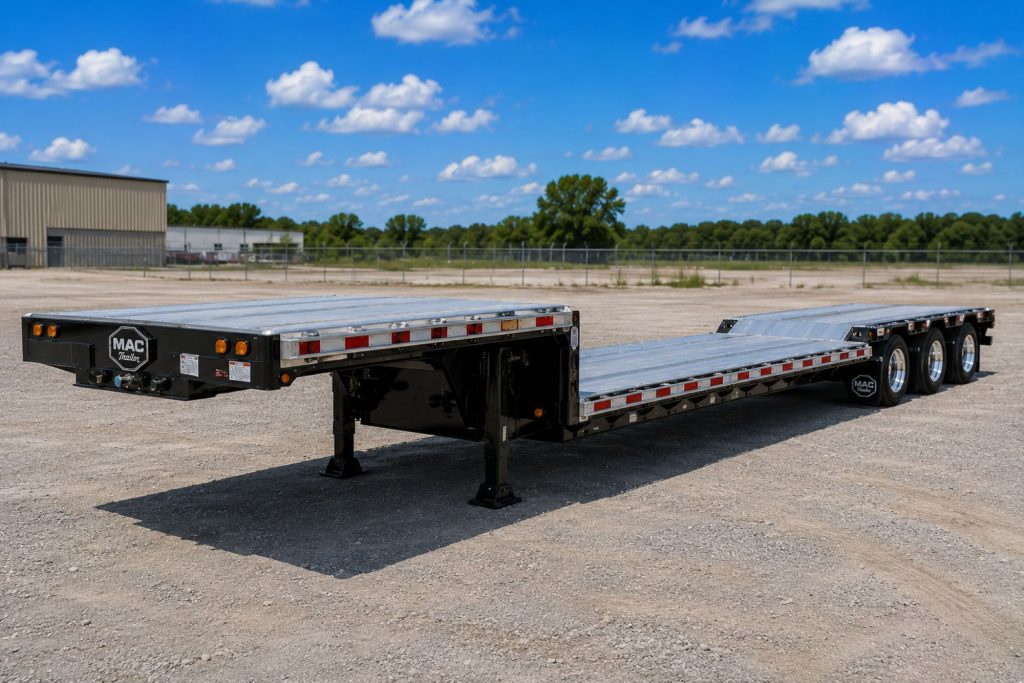
The MAC Step Deck, also marketed as the MAC aluminum drop deck trailer, is designed for loads that require more vertical clearance than a conventional flatbed trailer can provide. Its lowered main deck allows taller machinery, equipment, and industrial freight to remain closer to legal height limits.
The trailer uses aluminum construction to reduce empty weight while providing the strength required for demanding commercial applications. MAC also uses an aluminum transition and neck between the upper and lower decks, avoiding the mixed-metal construction found on some competing trailers.
The open-deck design allows freight to be loaded from the sides, rear, or overhead. Optional ramps expand its usefulness for transporting wheeled equipment and machinery.
Key Characteristics
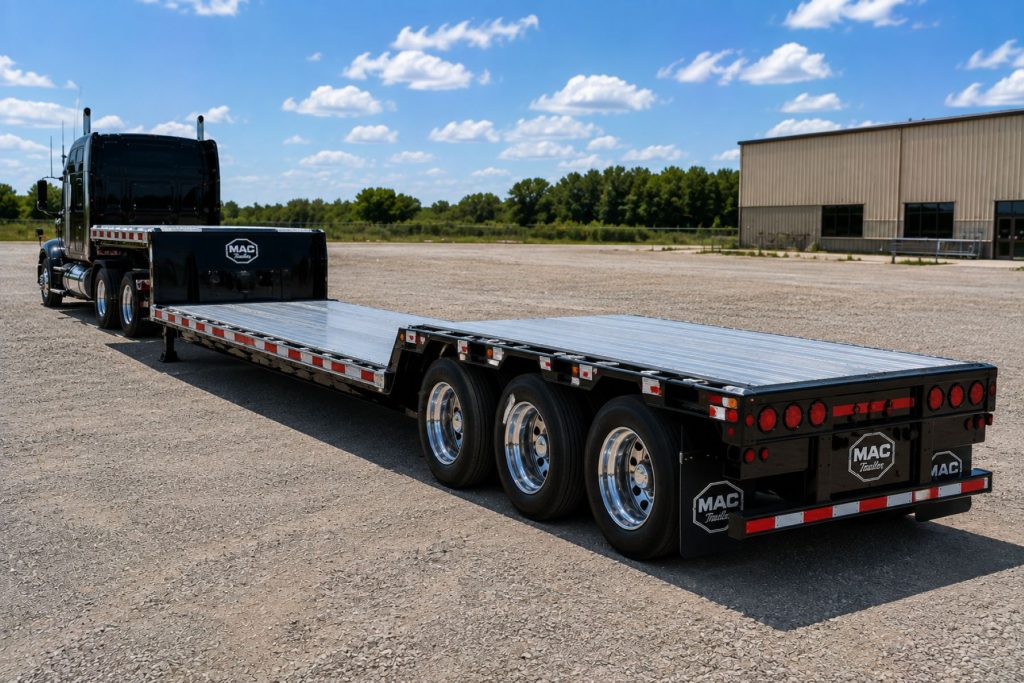
The defining characteristic of the MAC Step Deck is its two-level deck design. The short upper deck sits above the tractor’s drive tires, while the longer lower deck provides additional vertical clearance for taller freight.
Its aluminum construction can reduce trailer weight compared with many steel designs, potentially allowing operators to carry more payload while remaining within legal weight limits.
The open platform provides flexible loading access, while the lower deck makes the trailer particularly useful for construction, agriculture, machinery transport, and heavy haul or oversized freight.
Available equipment may include ramp kits, toolboxes, knee braces, sliding axles, additional axles, load-leveling equipment, winches, and specialized securement systems.
Common Specifications
Construction Material
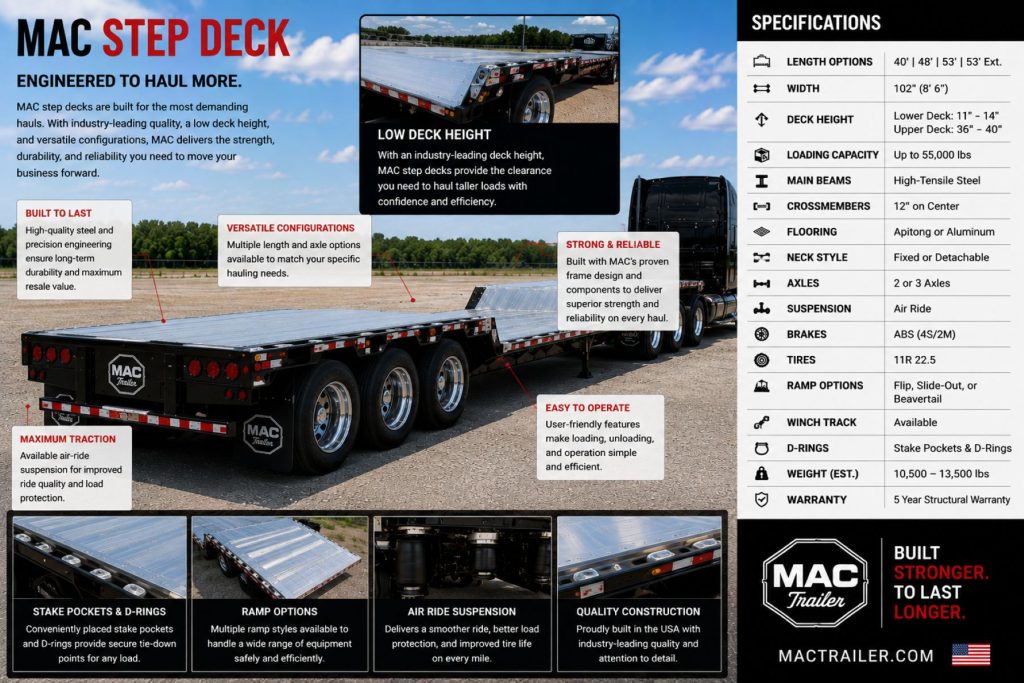
The MAC Step Deck is constructed primarily from 6061-T6 aluminum. The all-aluminum transition between the upper and lower decks is designed to provide structural strength while reducing corrosion concerns associated with joining aluminum and steel components.
Main Beam
MAC uses an extruded two-piece main beam assembled with a center-axis weld. The design is intended to manage stress through the trailer frame while supporting concentrated and distributed loads.
Side Rails
A 6¾-inch open-backed aluminum side rail is commonly used as standard equipment. A heavy-duty hollow-core side rail may be available for applications requiring additional structural capacity.
Flooring
The trailer commonly uses 1¼-inch extruded hollow-core aluminum flooring with two Apitong wood nailers positioned along the side rails. The nailers provide areas where operators can secure blocking, bracing, and other cargo-control materials.
Crossmembers
Five-inch aluminum channel crossmembers with standard 16-inch on-center spacing support the trailer deck.
Length and Width
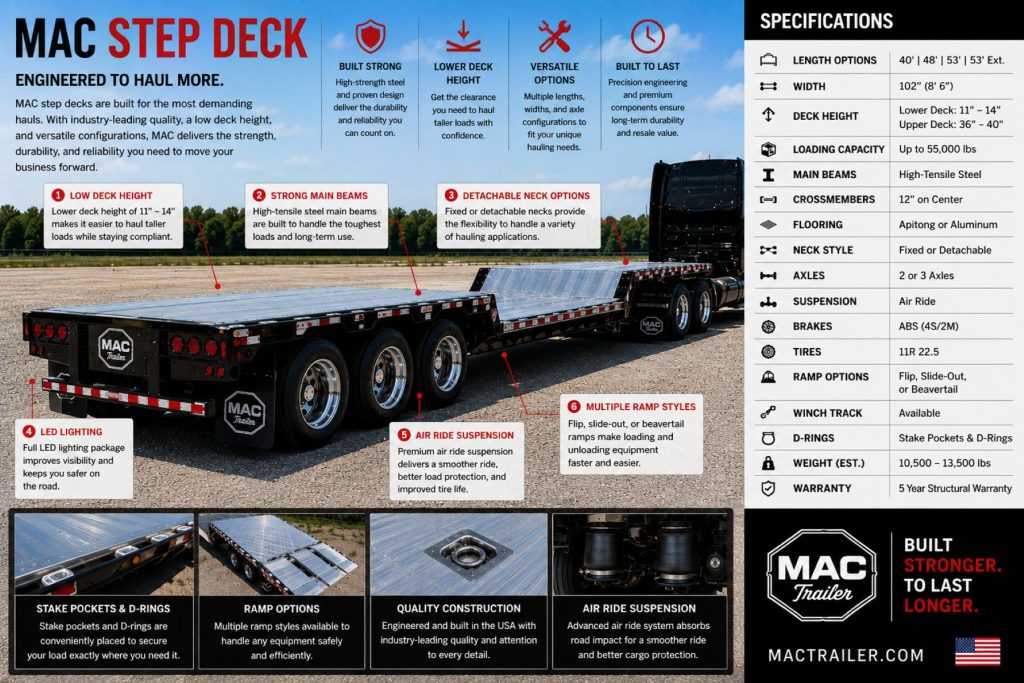
MAC Step Deck trailers are commonly found in 48-foot and 53-foot lengths with an overall width of 102 inches. Upper- and lower-deck dimensions vary according to the selected length and configuration.
Axle and Suspension Configurations
A common factory arrangement uses a Hendrickson tandem air-ride suspension with a 122-inch axle spread. Sliding rear axles and multi-axle configurations are available for specialized weight-distribution and regulatory requirements.
Landing Gear
Jost landing gear is commonly installed. The exact model and capacity can vary according to the trailer’s specifications and intended application.
Lighting
LED lighting and a sealed wiring harness are commonly used to improve visibility, electrical reliability, and service life.
Final specifications depend on the ordered configuration. Buyers should confirm measurements, beam ratings, axle capacities, deck ratings, and available options using MAC Trailer’s current drop-deck specifications.
Common Applications
- Construction machinery
- Agricultural equipment
- Industrial machinery
- Crated industrial components
- Steel products
- Pipe and tubing
- Building materials
- Fabricated structural components
- Wheeled equipment
- Tall freight requiring additional vertical clearance
- Flatbed freight
- Dedicated flatbed freight
- Regional flatbed freight
- Long haul flatbed freight
Advantages
- Lower main deck provides more vertical cargo clearance than a standard flatbed
- Aluminum construction helps reduce empty trailer weight
- Natural corrosion resistance can support a longer service life
- Open deck allows side, rear, and overhead loading
- Suitable for many types of machinery and industrial freight
- Optional ramp systems allow certain wheeled equipment to be loaded from the rear
- Available sliding-axle and multi-axle configurations
- Wood nailers provide practical attachment points for blocking and bracing
- Strong resale demand for well-maintained aluminum trailers
- Can transport taller freight without immediately requiring a lowboy or removable gooseneck trailer
Limitations or Considerations
- The two-level deck provides less uninterrupted loading space than a conventional flatbed
- Cargo remains exposed to weather unless properly covered
- Tall loads may still require permits and route planning
- Loading wheeled machinery may require optional ramps
- The fixed neck does not provide the drive-on loading access of an RGN or lowboy trailer
- Aluminum components require appropriate repair techniques
- Concentrated loads must remain within the trailer’s rated capacity
- Axle placement and load position can significantly affect legal weight distribution
- Lower-deck clearance can create challenges around steep entrances, railroad crossings, and uneven jobsites
- Some specialized configurations may cost considerably more than a standard flatbed
Driver and Operator Considerations
Operating a MAC Step Deck requires careful attention to cargo height, weight distribution, securement, and route restrictions. The lower deck provides additional clearance, but operators must still measure the loaded height before beginning a trip.
Drivers hauling machinery should verify that ramps are properly rated, positioned, and secured before loading. The trailer should be parked on stable, level ground whenever possible during equipment loading.
Operators must account for the different deck heights when positioning freight. Heavy components should be placed where their weight can be properly distributed across the trailer structure and axles.
Because the trailer has an open deck, drivers must regularly inspect chains, straps, binders, edge protectors, blocking, and tarps during transit.
Maintenance and Ownership Notes
Routine inspections should include the main beams, deck transition, crossmembers, side rails, flooring, suspension, axles, brakes, tires, lighting, and cargo-securement equipment.
The aluminum deck should be checked for cracks, impact damage, distortion, and wear around heavily used securement locations. Repairs to structural aluminum components should be performed by technicians familiar with aluminum trailer construction.
Wood nailers should be replaced when they become split, loose, or unable to hold blocking and fasteners securely.
Air lines, suspension components, wheel ends, brakes, and the trailer’s electrical system should be inspected according to the manufacturer’s maintenance schedule.
Ramp kits, toolboxes, sliding axles, winches, and other optional equipment introduce additional inspection and lubrication requirements.
Buying Considerations
- Confirm the trailer’s overall length and usable upper- and lower-deck dimensions
- Verify the main beam and concentrated-load ratings
- Match the axle configuration to the expected freight and operating region
- Determine whether a fixed spread or sliding rear axle is more suitable
- Inspect the frame and deck transition for structural damage or improper repairs
- Check the condition of the aluminum floor and Apitong nailers
- Inspect suspension components, brakes, wheel ends, and tires
- Verify that ramps are present and properly rated if machinery loading is planned
- Check the condition and placement of winches, tie-down points, and securement tracks
- Confirm the trailer’s empty weight and available payload capacity
- Review the VIN plate and manufacturer specifications
- Examine maintenance records when purchasing a used trailer
- Confirm whether the trailer’s configuration complies with the states and provinces where it will operate
Common Brands or Manufacturers
- MAC Trailer
- Fontaine Trailer
- Transcraft
- Wilson Trailer
- Doonan Specialized Trailer
- Reitnouer
- Great Dane
- Utility Trailer
- East Manufacturing
Variants and Related Configurations
- 48-foot tandem-axle step deck
- 53-foot tandem-axle step deck
- Fixed spread-axle configuration
- Sliding rear-axle configuration
- Tri-axle step deck
- Multi-axle heavy-haul configuration
- Step deck with ramp kit
- Step deck with load levelers
- Step deck with additional toolboxes
- Step deck with coil-hauling equipment
- Low-profile step deck configuration
Comparison to Similar Trailers
Compared with a standard flatbed trailer, the MAC Step Deck provides a lower main deck and additional vertical clearance. However, the raised upper deck reduces the amount of continuous level deck space.
Compared with a lowboy or RGN trailer, the MAC Step Deck is lighter and more versatile for general open-deck freight. A lowboy or RGN generally provides a lower deck and more convenient loading for heavy tracked or wheeled machinery.
Compared with a Conestoga trailer, the MAC Step Deck provides fully open loading access but does not include an integrated rolling tarp enclosure.
The MAC model competes with trailers such as the Fontaine Velocity Step Deck Trailer, Transcraft Eagle II Step Deck Trailer, and Wilson Step Deck Trailer.
Best Fit For
- Operators hauling tall freight that cannot fit efficiently on a standard flatbed
- Construction and agricultural equipment transport
- Industrial machinery hauling
- Open-deck carriers seeking a lightweight aluminum trailer
- Operations that load freight from the side or with a crane
- Carriers that occasionally need rear-loading ramps
- Regional and long-haul specialized freight operations
- Operators who need more cargo-height clearance without moving to a lowboy or RGN
Related Equipment
- Brake Systems
- Suspension Systems
- Axles and Differentials
- Tires and Wheels
- Electrical Systems
- Safety Systems
- Telematics and ELD Systems
- Aerodynamics and Fairings
Related Freight Types
- Flatbed Freight
- Dedicated Flatbed Freight
- Regional Flatbed Freight
- Long Haul Flatbed Freight
- Construction and Aggregate Freight
- Heavy Haul and Oversized Freight
- Specialty and Niche Freight
- Agricultural Equipment Freight
- Industrial Machinery Freight
- Building Materials Freight
Related Trailer Types
- Step Deck Trailers
- Flatbed Trailers
- Lowboy and RGN Trailers
- Conestoga Trailers
- Specialty Trailers
- Double Drop Trailers
- Extendable Step Deck Trailers
- Multi-Axle Step Deck Trailers
Related Trailer Models
- Fontaine Velocity Step Deck Trailer
- Transcraft Eagle II Step Deck Trailer
- Wilson Step Deck Trailer
- Doonan BlackGold Step Deck
- Reitnouer Step Deck
Related Guides
- Flatbed vs Step Deck vs Double Drop
- Oversize Load Transportation Guide
- Choosing the Right Trailer for Your Freight
Regulatory and Compliance Notes
The MAC Step Deck must comply with federal, state, provincial, and local regulations governing commercial trailers, axle weights, cargo securement, dimensions, lighting, brakes, tires, and annual inspections.
Although the lower deck provides additional vertical clearance, operators must measure the total loaded height. Overheight, overweight, overlength, or overwidth loads may require permits, escorts, restricted travel times, and an approved route.
Axle-spread regulations vary by jurisdiction. Sliding-axle and multi-axle configurations must be positioned and operated according to applicable bridge laws and regional requirements.
Cargo must be secured using equipment with sufficient working load limits. Machinery, structural materials, pipe, and other specialized loads may require additional chains, straps, blocking, bracing, or edge protection.
Real World Operating Notes
In daily operation, the MAC Step Deck combines much of the loading flexibility of a flatbed with additional clearance for taller freight. This makes it useful for carriers that transport changing combinations of machinery, building materials, and industrial components.
The aluminum construction can help maximize payload, but operators must still position concentrated loads carefully. A trailer’s overall capacity does not mean that every section of the deck can support that full weight.
Ramp-equipped trailers can handle certain wheeled machines, but loading angles, ramp capacity, ground conditions, and equipment weight must be evaluated before loading.
The open deck allows fast crane and forklift access. However, drivers may spend considerable time securing and tarping cargo, particularly when transporting machinery or materials that require protection from weather and road debris.
Frequently Asked Questions
What is the MAC Step Deck used for?
The MAC Step Deck is commonly used for construction equipment, agricultural machinery, industrial components, steel, pipe, building materials, and other tall or specialized freight.
Is the MAC Step Deck made from aluminum?
Yes. The current MAC drop-deck platform uses 6061-T6 aluminum construction, including an aluminum transition between the upper and lower decks.
What is the difference between a step deck and a flatbed?
A step deck has a raised upper deck and a lowered main deck. The lower section provides more vertical clearance than the single-level deck of a conventional flatbed.
Can machinery be driven onto a MAC Step Deck?
Certain wheeled machines can be loaded when the trailer has a properly rated ramp system. Ramp capacity, loading angle, equipment weight, and ground conditions must be verified before loading.
Is a MAC Step Deck the same as an RGN trailer?
No. A step deck normally has a fixed neck and requires ramps or lifting equipment for machinery loading. An RGN has a removable gooseneck that allows equipment to be driven onto the front of the trailer.
What axle configurations are available?
Common configurations include tandem spread axles, sliding rear axles, tri-axle arrangements, and other multi-axle designs. Availability depends on the trailer’s intended application and ordered specifications.
Can a MAC Step Deck haul oversized loads?
Yes, it can transport many oversized loads. Loads exceeding legal height, width, length, or weight limits may require permits, route surveys, escorts, and other special operating procedures.
What should buyers inspect on a used MAC Step Deck?
Buyers should inspect the main beams, deck transition, flooring, crossmembers, suspension, axles, brakes, tires, securement equipment, ramps, and any previous structural repairs.
Availability and Where to Find
New MAC Step Deck trailers are available through authorized MAC Trailer dealers. Configuration availability depends on production schedules, dealer inventory, axle requirements, deck dimensions, and selected options.
Used trailers can be found through commercial trailer dealerships, equipment auctions, fleet sales, and online truck-and-trailer marketplaces.
Before purchasing, buyers should confirm the VIN, model year, deck dimensions, axle configuration, empty weight, load ratings, maintenance history, and included equipment. A professional inspection is recommended when evaluating a used trailer with unknown service or repair history.
Support Trucking Families
Truck Equipment Atlas supports the mission of Grey Cross, a nonprofit dedicated to helping families of truck drivers who lose their lives while on the road. As the site grows, part of its mission is to bring awareness and support to these families.
Podcast or Video Section
Learn More Through Audio and Video
Truck Equipment Atlas will continue expanding with podcast episodes, interviews, and equipment breakdowns to help drivers and fleets better understand trucks and equipment.
Follow the Growth of Truck Equipment Atlas
Truck Equipment Atlas continues to expand with new truck profiles, trailer coverage, diesel engine pages, equipment system resources, manufacturer information, and educational guides.
Visit our Site Updates page to explore recent additions, project milestones, and upcoming resources as we continue building one of the industry’s growing commercial trucking equipment reference libraries.
View the Latest Site Updates: Truck Equipment Atlas Site Updates