
Peerless Log Trailer
Quick Facts
- Manufacturer: Peerless Trailers
- Trailer Type: Forestry / Log Trailer
- Primary Models: R3000SL, R4000, SW53, and SW53HD
- Available Configurations: Long Logger, Short Logger, Convertible Short-Long Logger, Hayrack, B-Train, and Super B-Train
- Construction: High-Tensile Steel
- Common Axle Configurations: Tri-Axle, Quad-Axle, and Multi-Axle
- Suspension Options: Walking Beam or Air Ride
- Common Brake System: Commercial Air Brakes with ABS
- Loading Methods: Self-Loading, Loader Loading, Tip-Off, and Lift-Off depending on configuration
- Primary Applications: Logs, Shortwood, Longwood, Full-Length Stems, Poles, and Forestry Products
- Operating Environment: Highway, Logging Roads, Forest Access Roads, and Off-Highway Sites
- Production Status: Active Production
Overview
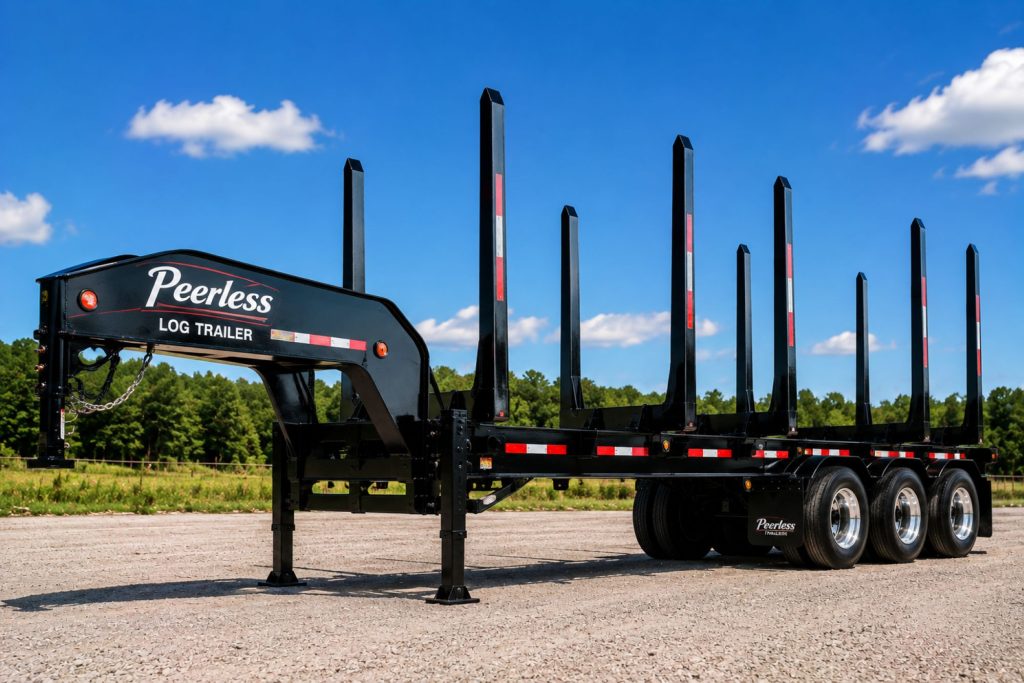
The Peerless Log Trailer is a specialized forestry trailer designed for transporting shortwood, long logs, full-length stems, poles, and other timber products. Peerless offers several configurations that can be matched to regional logging practices, log lengths, axle-weight regulations, and loading methods.
The R3000SL is a tri-axle convertible trailer capable of handling both short-log and long-log operations. The R4000 is a quad-axle shortwood trailer designed for tip-off or lift-off loading. Peerless also offers long-log trailers, 53-foot hayrack models, B-trains, Super B-trains, and specialized multi-axle forestry configurations.
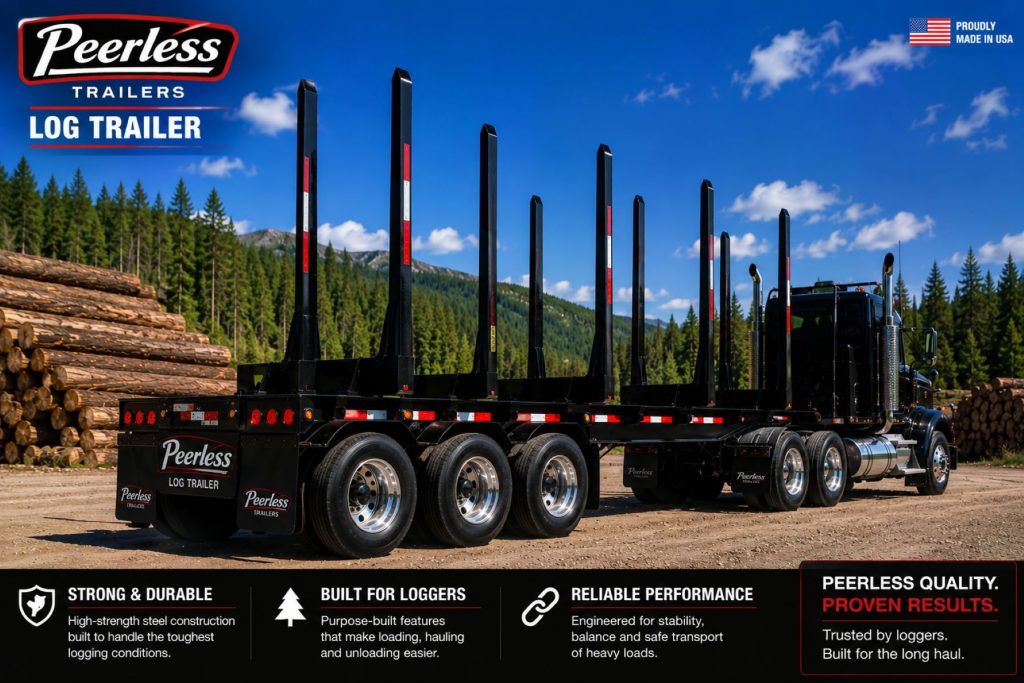
Heavy-duty bunks and stakes contain the timber, while chains or wrappers secure the load. Walking-beam suspension is available for severe logging-road conditions, while air ride can improve highway ride quality and load control.
Peerless designs its forestry equipment for operations where trailers regularly transition between public highways, gravel roads, forest access routes, and active logging sites.
Key Characteristics
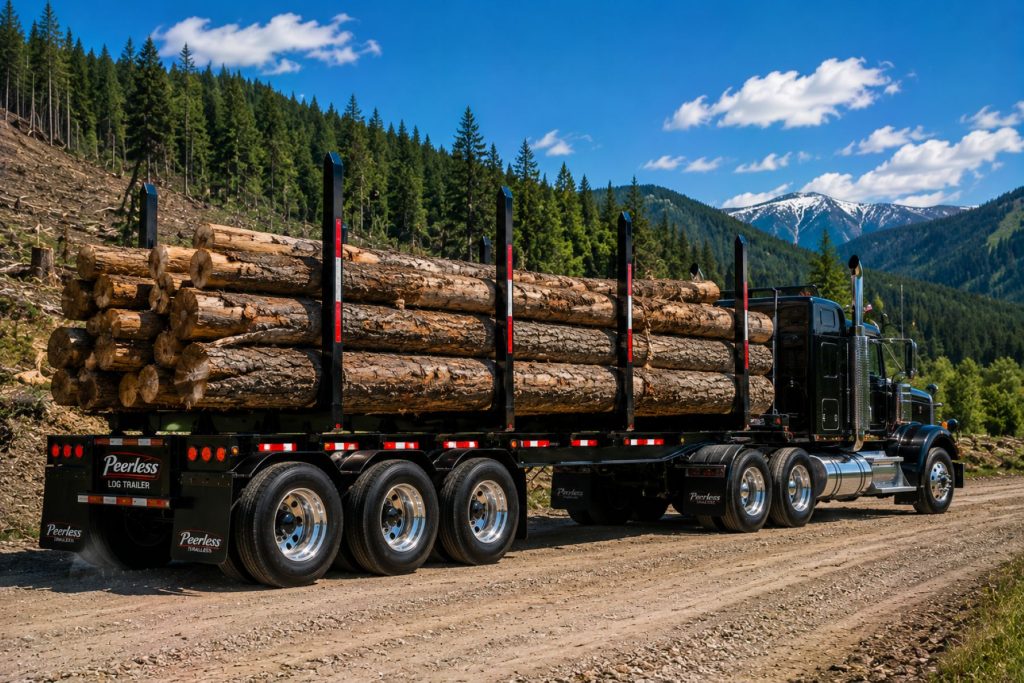
Peerless log trailers use high-tensile steel construction to withstand heavy loads, rough forestry roads, loading impacts, and repeated twisting forces.
The bunks support the logs across the trailer, while vertical stakes help contain the load. Replaceable stake pockets on certain models simplify repairs after wear or impact damage.
The R3000SL provides convertible short-log and long-log capability, allowing one trailer to serve multiple forestry applications.
The R4000 quad-axle model is designed specifically for shortwood hauling and can be configured for tip-off or lift-off unloading.
Long-log configurations use specialized geometry that supports full-length stems between the truck-mounted forward bunk and the trailer’s rear bunk.
Multi-axle and B-train configurations increase the number of load-distributing axles for jurisdictions that permit higher gross combination weights.
Common Specifications
Construction
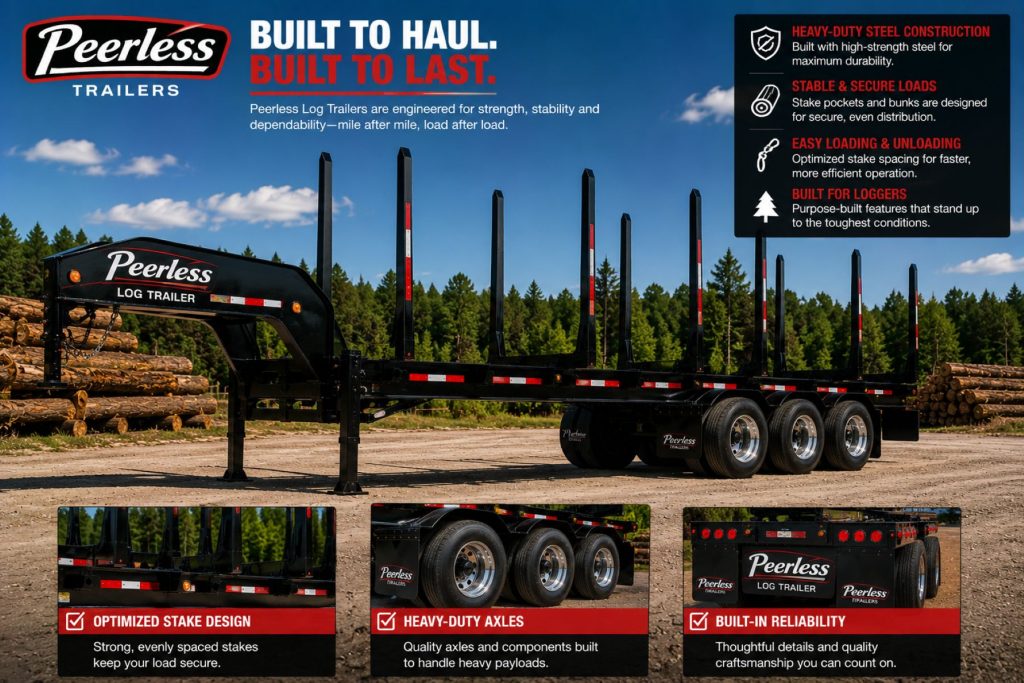
Peerless log trailers use heavy-duty, high-tensile steel structures designed for on-highway and off-highway forestry service.
Components exposed to heavy wear may include replaceable sections, pockets, bushings, rub surfaces, and attachment hardware.
Available Models
Representative Peerless forestry models include:
- R3000SL Tri-Axle Short-Long Logger
- R4000 Quad-Axle Short Logger
- SW53 Hayrack Shortwood Trailer
- SW53HD Heavy-Duty Hayrack
- Long Logger
- Super B-Train Shortwood
- Nine-Axle Super B-Train Shortwood
- Specialized forestry configurations
R3000SL Configuration
The R3000SL uses a tri-axle arrangement and can be converted between short-log and long-log hauling.
Common equipment includes:
- Walking-beam or air-ride suspension
- Heavy-duty steel bunks
- Replaceable stake pockets
- Aluminum or steel unimount wheels
- Clip-on chain hooks
- Wrapper hangers
- Optional swing-up lift or tip-off molly
R4000 Configuration
The R4000 is a quad-axle shortwood trailer designed for payload-focused forestry operations.
Available equipment includes:
- Walking-beam or air-ride suspension
- Aluminum or steel unimount wheels
- Static molly
- Swing-up lift or tip-off molly
- Wrapper hangers
- Mud-flap hanger assembly
- Tip-off or lift-off unloading capability
Hayrack Configuration
The SW53 and SW53HD are 53-foot hayrack-style shortwood trailers.
Representative specifications include:
- 53-foot overall length
- Standard-duty or heavy-duty configuration
- Air-ride suspension
- 60-inch axle spread on the SW53
- 54-inch axle spread on the SW53HD
- Adjustable kingpin setting
- Multiple commercial tire sizes
- Optional lift axles
Long-Log Configuration
Peerless long-log trailers are designed around full-length stem geometry.
Available equipment may include:
- Heavy-duty steel bunks
- Walking-beam suspension
- Air-ride suspension
- Tridem self-loading equipment
- Tri-axle jeep configurations
- Pike-pole mounting
- Reach and compensator components
Bunks and Stakes
Steel bunks support the log load, while vertical stakes help prevent the timber from moving laterally.
Bunk width, stake height, pocket design, and extension options depend on log dimensions and regional operating requirements.
Suspension
Walking-beam suspension provides articulation and load equalization on uneven logging roads.
Air-ride suspension can improve highway ride quality and may provide additional adjustment or lift-axle functionality.
Axles
Available arrangements include:
- Tri-axle
- Quad-axle
- Lift axle
- Steering lift axle
- B-train
- Super B-train
- Nine-axle Super B-train
Axle configuration depends on payload goals, route regulations, and operating region.
Brakes and ABS
Commercial air brakes and an antilock braking system are commonly installed.
The R3000SL and hayrack models commonly use a 2S/2M ABS configuration, although equipment varies by axle count and model.
Wheels and Tires
Available wheel choices include:
- Alcoa aluminum wheels
- Steel unimount wheels
- Mixed steel and aluminum arrangements
Common tire sizes include:
- 275/70R22.5
- 11R22.5
- 11R24.5
Loading and Unloading
Available methods include:
- Hydraulic loader loading
- Self-loading
- Tip-off unloading
- Lift-off unloading
- Fixed-load unloading
Loading and unloading equipment depends on the trailer and logging operation.
Specifications differ substantially among models. Buyers should confirm the exact configuration through Peerless Trailers’ current forestry lineup.
Common Applications
- Shortwood transportation
- Long-log transportation
- Full-length stem transportation
- Pole transportation
- Timber transportation
- Pulpwood transportation
- Saw-log transportation
- Forest-to-mill hauling
- Logging-site transportation
- Sawmill supply operations
- Plywood and veneer log transportation
- Forestry contractor operations
- Commercial timber hauling
- Canadian bush-road operations
- Western United States logging operations
Advantages
- Multiple shortwood and longwood configurations
- Convertible short-log and long-log model available
- High-tensile steel construction
- Designed for highway and logging-road operation
- Walking-beam suspension available for rough terrain
- Air-ride suspension available for highway operation
- Tri-axle and quad-axle models are available
- B-train and Super B-train configurations are available
- Heavy-duty bunks support concentrated log loads
- Replaceable stake pockets simplify selected repairs
- Lift-off and tip-off configurations are available
- Optional lift axles can reduce tire wear when unloaded
- Custom engineering is available
- Long history in Canadian forestry transportation
Limitations or Considerations
- Highly specialized for forestry freight
- Empty trailers may require special folding or lifting procedures
- Rough logging roads accelerate component wear
- Logs create concentrated and shifting loads
- Loading impacts can damage bunks and stakes
- Long-log configurations have different handling characteristics
- Multi-axle trailers require more maintenance
- Regional weight and length regulations vary significantly
- B-train and Super B-train operation requires additional training
- Off-highway use increases tire and suspension damage
- Cargo securement requires chains or wrappers rated for the load
- Trailer configuration may need to match specific mill and unloading equipment
Driver and Operator Considerations
Drivers must understand how log length, species, moisture content, diameter, and loading position affect trailer weight.
Freshly cut timber can be considerably heavier than dried material. Two loads with similar volume may have substantially different gross weights.
Logs should be positioned evenly across the bunks and centered between the stakes. Uneven loading can overload one side of the trailer or create unstable handling.
Chains and wrappers must remain tight enough to prevent the load from settling or shifting. Securement should be checked after leaving the loading area and periodically during transportation.
Drivers should reduce speed on curves, steep grades, forest roads, and uneven surfaces. A high log load can produce a high center of gravity.
Maintenance and Ownership Notes
Bunks, stakes, stake pockets, hinges, reach components, bolsters, and wrapper hangers should be inspected frequently.
Components exposed to log impacts should be checked for cracks, bending, deformation, and damaged welds.
Pivot points, molly assemblies, compensators, bushings, and lift mechanisms require regular lubrication.
Walking-beam suspension components should be inspected for worn bushings, cracks, loose fasteners, and damaged equalizing components.
Air-ride systems require inspection of air springs, valves, lines, height controls, and axle-lift equipment.
Axles, brakes, ABS equipment, tires, wheels, lighting, and the trailer’s electrical system require routine preventive maintenance.
Buying Considerations
- Determine whether shortwood, longwood, or convertible operation is required
- Identify the exact Peerless model
- Confirm the axle configuration
- Match the trailer to regional weight regulations
- Inspect all bunks and stakes
- Check replaceable stake pockets for wear
- Inspect the frame for cracks and twisting
- Examine high-impact loading areas
- Check the suspension type and condition
- Inspect all pivot points and bushings
- Operate lift, tip-off, or molly equipment
- Verify the brake and ABS configuration
- Inspect tires and wheels for off-road damage
- Review the trailer’s previous forestry application
- Check the wrapper and chain storage equipment
- Confirm compatibility with the loading system
- Verify the trailer’s empty weight
- Review maintenance and structural repair records
- Confirm all specifications using the VIN plate and build documents
Common Brands or Manufacturers
- Peerless Trailers
- Doepker
- Pitts Trailers
- Manac
- Deloupe
- Stellar Industries
- Viking Specialized Trailers
- General Trailer
- Merritt Trailers
- Great Lakes Manufacturing
Variants and Related Configurations
- R3000SL Tri-Axle Short-Long Logger
- R4000 Quad-Axle Short Logger
- SW53 Hayrack Shortwood Trailer
- SW53HD Heavy-Duty Hayrack
- Long Logger
- Short Logger
- Convertible Short-Long Logger
- Hayrack Log Trailer
- B-Train Shortwood Trailer
- Super B-Train Shortwood Trailer
- Nine-Axle Super B-Train
- Tridem Pole Trailer
- Self-loading log trailer
- Tip-off log trailer
- Lift-off log trailer
- Walking-beam forestry trailer
- Air-ride forestry trailer
Comparison to Similar Trailers
Compared with a flatbed trailer, the Peerless Log Trailer uses specialized bunks and stakes designed specifically for round timber. A flatbed trailer is more versatile but may require additional bunks, bolsters, and securement equipment for logs.
Compared with a hayrack trailer, a long logger is designed around full-length stems supported between widely separated bunks. A hayrack provides a continuous platform suitable for shortwood and bundled forest products.
Compared with a standard shortwood trailer, the R3000SL can convert between short-log and long-log operation. The convertible design adds flexibility but introduces additional components and operating procedures.
Compared with a walking-beam model, an air-ride log trailer generally provides a smoother highway ride. Walking-beam suspension can provide greater articulation and durability on severe logging roads.
Best Fit For
- Logging companies
- Forestry contractors
- Timber-hauling fleets
- Sawmill suppliers
- Pulp and paper companies
- Independent log haulers
- Shortwood operations
- Long-log operations
- Canadian forestry fleets
- Western United States forestry carriers
- Operators traveling on logging and forest-access roads
- Fleets requiring multi-axle forestry equipment
- Carriers requiring custom forestry configurations
Related Equipment
- Brake Systems
- Suspension Systems
- Axles and Differentials
- Tires and Wheels
- Electrical Systems
- Safety Systems
- Lift Axles
- Log Bunks and Stakes
- Walking-Beam Suspensions
- Load Scales
- Forestry Loaders
- Log Wrappers and Chains
Related Freight Types
- Logging Freight
- Timber Freight
- Shortwood Freight
- Longwood Freight
- Pulpwood Freight
- Saw-Log Freight
- Pole Freight
- Forestry Products Freight
- Sawmill Freight
- Paper Industry Freight
- Specialty and Niche Freight
Related Trailer Types
- Log Trailers
- Shortwood Trailers
- Long-Log Trailers
- Pole Trailers
- Hayrack Trailers
- B-Train Log Trailers
- Super B-Train Log Trailers
- Self-Loading Log Trailers
- Flatbed Trailers
- Specialty Trailers
Related Trailer Models
- Peerless R3000SL Short-Long Logger
- Peerless R4000 Quad-Axle Short Logger
- Peerless SW53 Hayrack
- Peerless Long Logger
- Pitts Log Trailer
- Manac Log Trailer
- Deloupe Log Trailer
Related Guides
- Complete Guide to Trailer Types
- Choosing the Right Trailer for Your Freight
- Heavy Haul Freight Guide
Regulatory and Compliance Notes
The Peerless Log Trailer must comply with federal, provincial, state, and local regulations governing trailer dimensions, axle weights, brakes, ABS equipment, tires, lighting, and cargo securement.
Log transportation regulations can include specific requirements for bunks, stakes, tiedowns, wrappers, load height, overhang, warning devices, and periodic securement checks.
Requirements vary according to log length, loading orientation, trailer configuration, jurisdiction, and whether the operation occurs on a public highway or private forestry road.
B-train and Super B-train configurations are permitted only in jurisdictions and on routes that authorize their dimensions and axle arrangements.
Structural trailer capacity does not determine legal highway payload. Legal capacity depends on axle spacing, tire ratings, route restrictions, seasonal weight limits, bridge laws, and applicable permits.
Real World Operating Notes
Peerless Log Trailers are designed for the demanding transition between loading sites, rough forestry roads, regional highways, and mill yards.
Walking-beam suspension can be particularly useful where the trailer regularly encounters deep ruts, uneven terrain, mud, and steep forest roads.
Air ride can improve highway performance and may allow lift-axle functionality, but air lines and suspension components require protection from branches, debris, and off-road impacts.
Logs often settle after the trailer begins moving. Drivers should stop and recheck the wrappers and chains shortly after leaving the loading site.
Frequently Asked Questions
What does a Peerless Log Trailer carry?
It transports shortwood, long logs, full-length stems, poles, pulpwood, saw logs, and other forestry products.
What is the R3000SL?
The R3000SL is a tri-axle Peerless trailer that can convert between short-log and long-log hauling.
What is the R4000?
The R4000 is a quad-axle shortwood trailer designed for tip-off or lift-off loading.
Does Peerless offer a 53-foot log trailer?
Yes. The SW53 and SW53HD are 53-foot hayrack-style shortwood trailers.
What suspension options are available?
Walking-beam and air-ride suspension are available on selected models.
What is the difference between a short logger and a long logger?
A short logger carries shorter sections of timber supported by several bunks or a platform. A long logger carries full-length stems between widely separated forward and rear bunks.
Can one Peerless trailer haul both short and long logs?
The R3000SL is designed to convert between short-log and long-log operation.
Are multi-axle configurations available?
Yes. Peerless offers tri-axle, quad-axle, lift-axle, B-train, Super B-train, and specialized multi-axle configurations.
What should buyers inspect on a used Peerless Log Trailer?
Buyers should inspect the frame, bunks, stakes, stake pockets, reach components, suspension, axles, brakes, tires, lift mechanisms, and cargo-securement equipment.
Availability and Where to Find
New Peerless Log Trailers are available directly through Peerless Trailers and its sales network. Forestry models can be configured around log length, loading method, axle requirements, route restrictions, and regional regulations.
Peerless markets its primary forestry trailers under the Peerless name in Canada. The company also supports specialized equipment across Canada and the United States.
Used Peerless trailers can be found through forestry-equipment dealers, commercial trailer dealerships, logging companies, equipment auctions, and specialized truck-and-trailer marketplaces.
Before purchasing, buyers should verify the model, VIN, axle configuration, suspension, bunk and stake dimensions, empty weight, regional compliance, maintenance history, and previous logging application.
Support Trucking Families
Truck Equipment Atlas supports the mission of Grey Cross, a nonprofit dedicated to helping families of truck drivers who lose their lives while on the road. As the site grows, part of its mission is to bring awareness and support to these families.
Podcast or Video Section
Learn More Through Audio and Video
Truck Equipment Atlas will continue expanding with podcast episodes, interviews, and equipment breakdowns to help drivers and fleets better understand trucks and equipment.
Follow the Growth of Truck Equipment Atlas
Truck Equipment Atlas continues to expand with new truck profiles, trailer coverage, diesel engine pages, equipment system resources, manufacturer information, and educational guides.
Visit our Site Updates page to explore recent additions, project milestones, and upcoming resources as we continue building one of the industry’s growing commercial trucking equipment reference libraries.
View the Latest Site Updates: Truck Equipment Atlas Site Updates