
JET Hopper Trailer
Quick Facts
- Manufacturer: JET Company
- Trailer Type: Hopper Bottom Trailer
- Model: JET Hopper Trailer
- Common Lengths: 40 ft, 42 ft, 43 ft, 45 ft, 48 ft, 50 ft, 53 ft
- Common Width: 96 to 102 inches
- Trailer Construction: Aluminum
- Common Axle Configurations: Tandem Axle, Spread Axle, Tri-Axle
- Typical Capacity: Approximately 900 to 1,700+ Cubic Feet
- Primary Applications: Grain Hauling, Agricultural Commodities, Feed, Fertilizer, Seed Products
- Common Freight Types: Corn, Soybeans, Wheat, Feed Ingredients, Fertilizer, Distillers Grain, Agricultural Commodities
- Hopper Configuration: Dual Hopper Bottom Design
- Gate Options: Manual, Electric, or Pneumatic Hopper Gates
- Suspension Options: Air Ride or Spring Ride
- Production Status: In Production
Overview
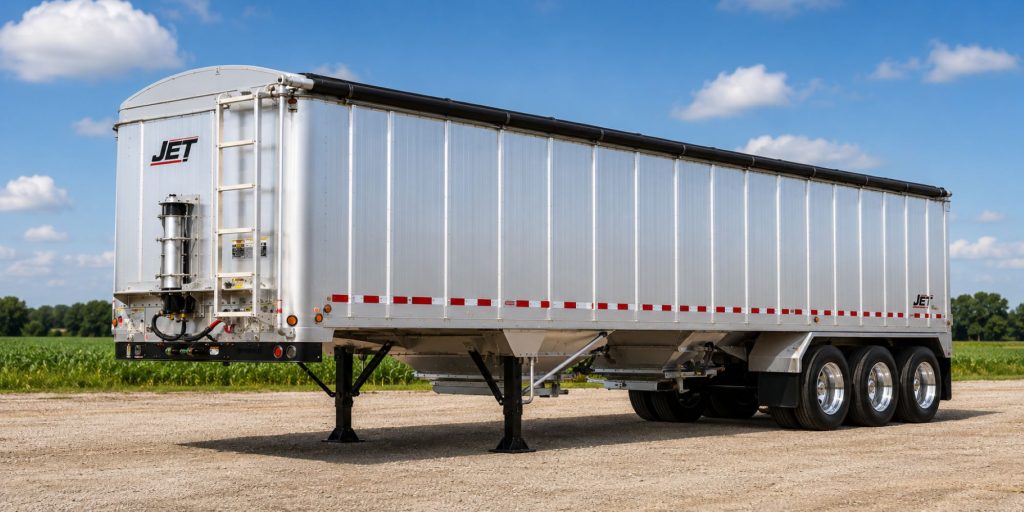
JET Company has been manufacturing hopper bottom trailers for decades and has established a strong reputation within the agricultural transportation industry. The JET Hopper Trailer is designed to provide high payload capacity, dependable durability, and efficient unloading performance for grain and bulk commodity haulers.
Widely used throughout North America’s agricultural regions, JET hopper trailers serve farmers, grain companies, feed mills, agricultural cooperatives, commodity brokers, and owner-operators hauling bulk products.
Built primarily from aluminum, JET hopper trailers offer excellent corrosion resistance while maximizing payload capacity. Multiple configurations, capacities, and axle options allow operators to customize the trailer to meet specific transportation requirements.
Known for practical design and dependable operation, JET remains a respected name in agricultural trailer manufacturing.
Key Characteristics
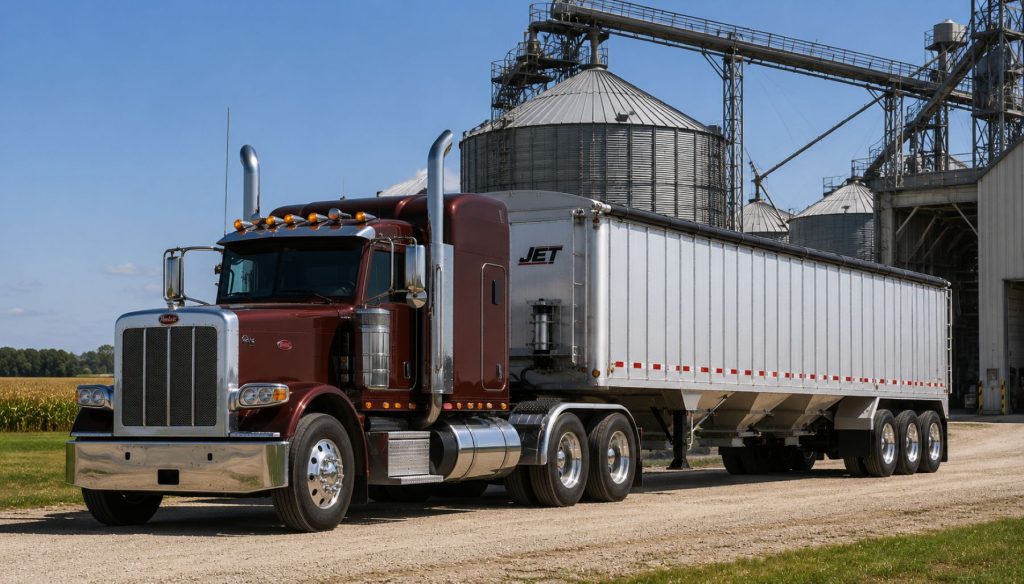
JET hopper trailers are engineered to maximize payload efficiency while providing reliable performance throughout demanding agricultural operations.
The lightweight aluminum construction helps operators increase cargo capacity while maintaining structural durability and corrosion resistance. Smooth interior surfaces promote efficient unloading and reduce commodity hang-up during discharge.
JET trailers are known for dependable gate systems, durable structural design, and long-term ownership value, making them popular among both independent operators and larger agricultural fleets.
Common Specifications
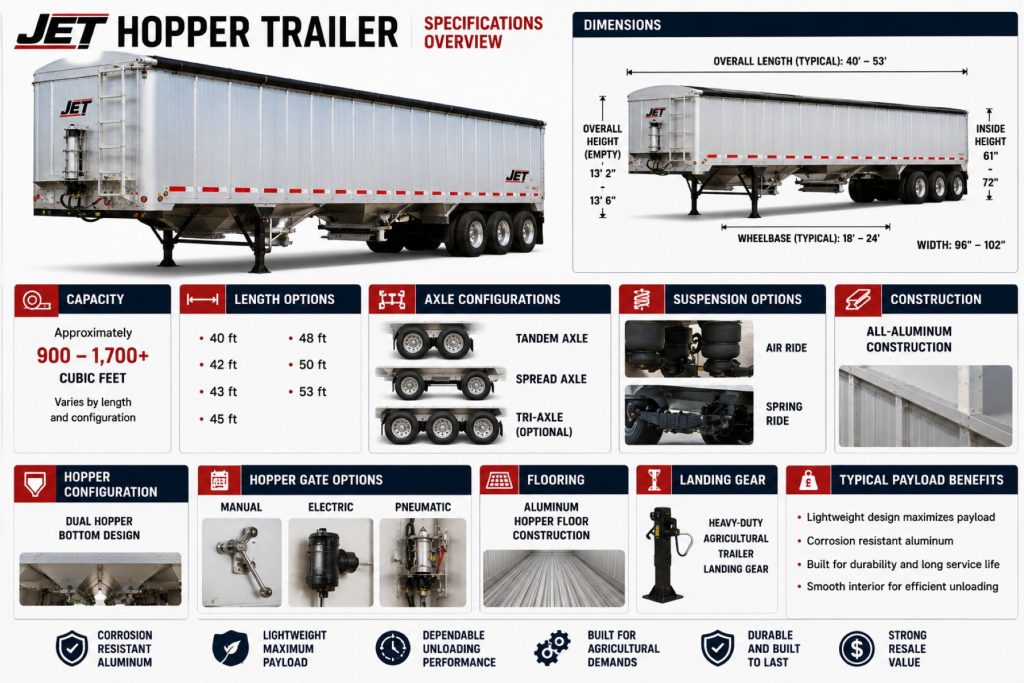
Overall Length
Typically ranges from 40 to 53 feet.
Width
96 to 102 inches.
Construction
All-aluminum construction.
Capacity
Approximately 900 to 1,700+ cubic feet depending on configuration.
Axle Configurations
Tandem axle, spread axle, and tri-axle configurations.
Suspension
Air ride or spring ride systems.
Hopper Configuration
Dual hopper bottom design.
Gate Options
Manual, electric, or pneumatic gate systems.
Flooring
Aluminum hopper floor construction.
Landing Gear
Heavy-duty agricultural trailer landing gear.
Common Applications
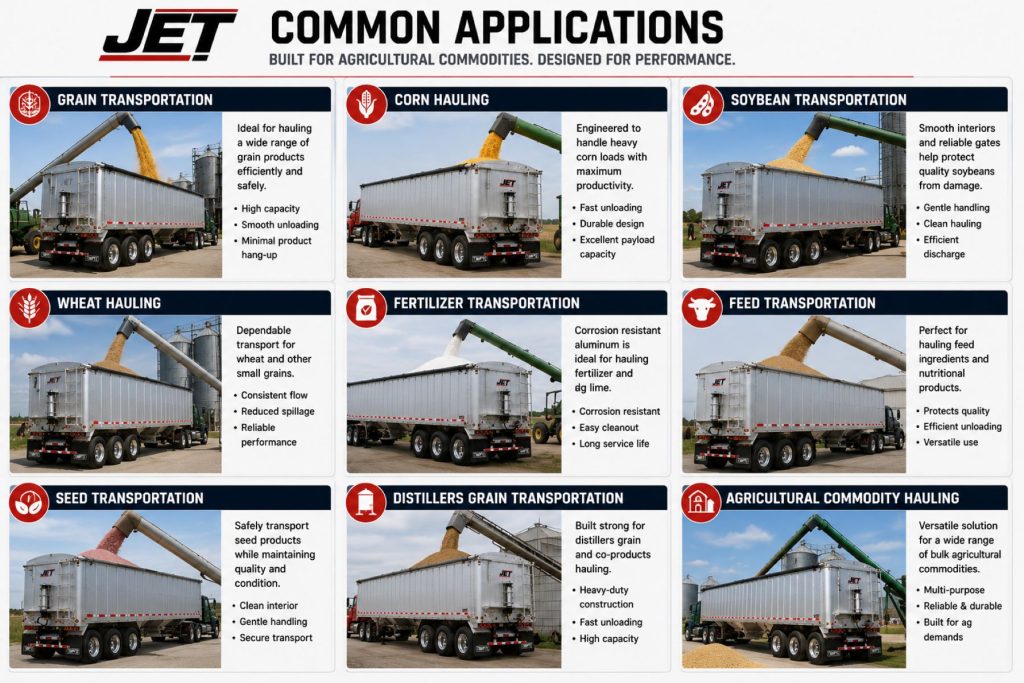
- Grain Transportation
- Corn Hauling
- Soybean Transportation
- Wheat Hauling
- Feed Transportation
- Seed Transportation
- Distillers Grain Transportation
- Agricultural Commodity Hauling
- Bulk Product Transportation
- Fertilizer Transportation
Advantages
- Lightweight aluminum construction
- Excellent payload capacity
- Corrosion resistance
- Efficient unloading design
- Strong durability
- Good resale value
- Reliable gate systems
- Long service life
Limitations or Considerations
- Limited to bulk commodity freight
- Not suitable for palletized cargo
- Requires cleanout between some loads
- Seasonal agricultural demand fluctuations
- Potential moisture contamination concerns
- Specialized commodity-hauling application
Driver and Operator Considerations
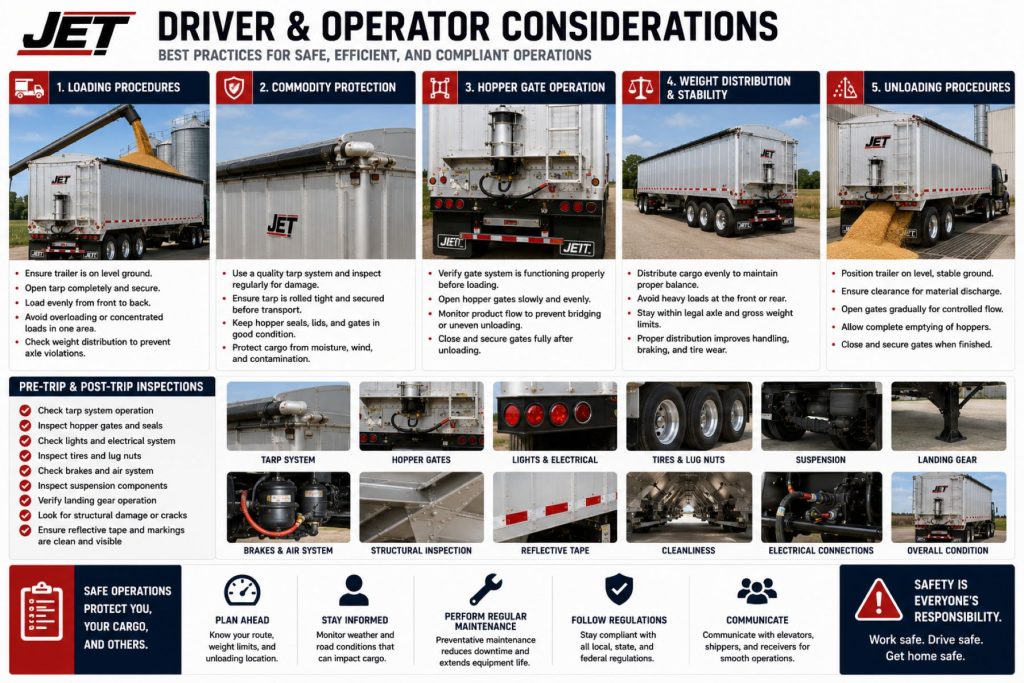
Operating a JET Hopper Trailer requires attention to loading procedures, weight distribution, cargo protection, and safe unloading practices.
Drivers must ensure cargo is loaded evenly throughout the trailer to prevent axle weight violations and maintain vehicle stability. Proper loading practices help maximize payload while remaining compliant with state and federal regulations.
During unloading, operators should position the trailer on level, stable ground whenever possible. Hopper gates should be opened gradually and monitored to ensure smooth product flow and prevent bridging or uneven unloading.
Routine inspections of hopper gates, tarp systems, seals, suspension components, tires, brakes, and structural members help reduce downtime and improve safety.
Because agricultural commodities can be affected by contamination and moisture, maintaining a clean trailer is essential for protecting cargo quality.
Maintenance and Ownership Notes
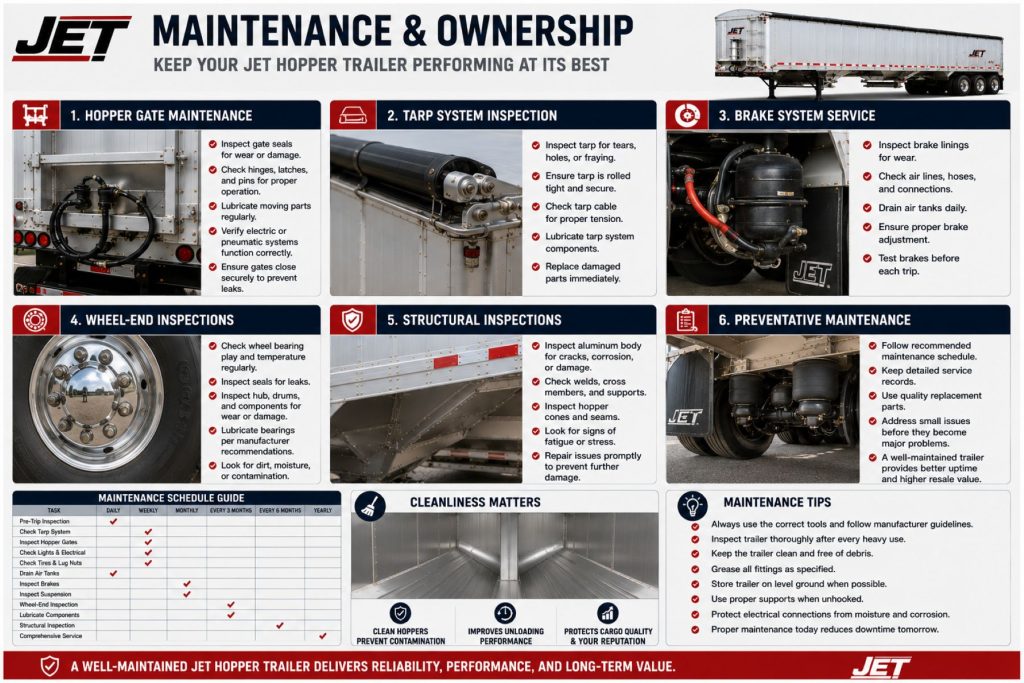
JET Hopper Trailers are designed for long service life, but routine preventative maintenance remains important for maximizing performance and resale value.
Regular inspections should focus on hopper gates, tarp systems, suspension components, wheel ends, brakes, electrical systems, tires, and structural welds.
Operators should inspect the aluminum body for cracks, corrosion, impact damage, and signs of fatigue caused by repeated loading and unloading cycles.
Cleaning hopper compartments and discharge systems regularly helps maintain efficient unloading performance and prevents commodity contamination.
Proper maintenance can allow a JET Hopper Trailer to remain productive for decades.
Buying Considerations
- Determine required cubic capacity
- Verify axle configuration needs
- Inspect hopper gate condition
- Check tarp system operation
- Review suspension condition
- Inspect aluminum structure
- Check wheel-end maintenance records
- Verify brake system condition
- Review tire wear patterns
- Inspect landing gear operation
- Evaluate resale value
- Consider dealer support availability
Common Brands or Manufacturers
- JET Company
- Timpte Trailers
- Wilson Trailer
- Merritt Trailers
- Neville Built
- Travis Body & Trailer
- Cornhusker Trailer
- Hopper Walker
- Dakota Trailers
- Stoughton Trailers
Variants and Related Configurations
- Standard Hopper Bottom Trailer
- Ag Hopper Trailer
- Spread Axle Hopper Trailer
- Tri-Axle Hopper Trailer
- Electric Gate Hopper
- High Capacity Hopper Trailer
- Commodity Hopper Trailer
- Lightweight Hopper Trailer
- Farm Hopper Trailer
- Bulk Agricultural Trailer
Comparison to Similar Trailers
The JET Hopper Trailer is commonly compared to the Timpte Super Hopper, Wilson Pacesetter Hopper, Merritt Hopper Trailer, and Neville Built hopper models.
JET has built a reputation for durable construction, practical design, reliable unloading systems, and long-term ownership value.
While Timpte and Wilson often dominate market share, JET remains a highly respected alternative that offers dependable performance and competitive specifications.
Many operators appreciate JET trailers for their balance of durability, payload capacity, and ease of maintenance.
Best Fit For
- Grain Haulers
- Farm Operations
- Agricultural Fleets
- Owner Operators
- Commodity Transportation Companies
- Feed Mills
- Grain Elevators
- Seed Distributors
- Agricultural Cooperatives
- Bulk Commodity Carriers
Related Equipment
- Truck Tractors
- Trailer Axles
- Trailer Suspension Systems
- Trailer Brake Systems
- Tarp Systems
- Electric Hopper Gates
- Commodity Loading Equipment
- Agricultural Scales
- Grain Augers
- Bulk Commodity Handling Systems
Related Freight Types
- Grain Freight
- Corn Freight
- Soybean Freight
- Wheat Freight
- Feed Freight
- Seed Freight
- Agricultural Commodity Freight
- Bulk Commodity Freight
- Fertilizer Freight
- Distillers Grain Freight
Related Trailer Types
- Hopper Bottom Trailers
- Grain Trailers
- Belt Trailers
- Walking Floor Trailers
- Dump Trailers
- Pneumatic Dry Bulk Trailers
Related Trailer Models
- Timpte Super Hopper
- Wilson Pacesetter Hopper
- Merritt Hopper Trailer
- Neville Built Hopper
- Travis Hopper Trailer
Related Guides
- Choosing the Right Trailer for Your Freight
- Complete Guide to Trailer Types
- Complete Guide to Freight Types
Regulatory and Compliance Notes
JET Hopper Trailers operate under standard commercial transportation regulations and agricultural commodity transportation requirements throughout North America.
Operators must comply with federal and state axle weight limits, cargo securement regulations, inspection requirements, and equipment maintenance standards. Proper weight distribution remains critical because hopper trailers can easily exceed axle limits if improperly loaded.
Agricultural commodities may also be subject to food safety requirements, contamination prevention standards, and customer-specific handling procedures.
Drivers should ensure hopper gates, tarp systems, brakes, lighting, tires, suspension systems, and safety equipment remain in proper working condition before every trip.
Routine inspections and preventative maintenance help improve safety, reduce violations, and protect cargo quality.
Real World Operating Notes
JET Hopper Trailers are commonly found throughout grain-producing regions across the United States and Canada.
These trailers are used by farmers, grain elevators, feed companies, agricultural cooperatives, seed distributors, and owner-operators transporting bulk agricultural products.
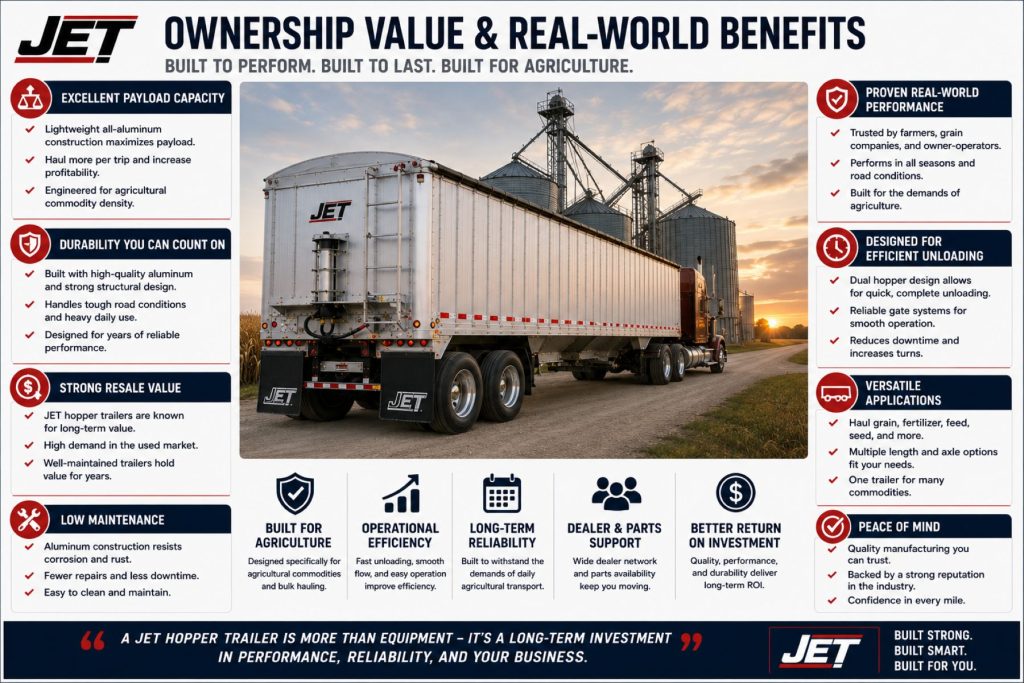
Many operators choose JET because of its reputation for durable construction, dependable performance, practical design, and competitive operating costs.
JET has maintained a loyal customer base within agriculture for decades and remains a respected manufacturer in the hopper trailer market.
Frequently Asked Questions
What is a JET Hopper Trailer?
A JET Hopper Trailer is an aluminum hopper bottom trailer designed for transporting grain, agricultural commodities, fertilizer, feed products, distillers grain, and other bulk materials.
Is the JET Hopper Trailer still in production?
Yes. JET continues to manufacture hopper bottom trailers in multiple lengths, capacities, and configurations.
What products can a JET Hopper Trailer haul?
Common cargo includes corn, soybeans, wheat, feed ingredients, fertilizer, seed products, distillers grain, and various agricultural commodities.
What makes a hopper bottom trailer different from a dump trailer?
Hopper trailers unload through gravity-fed hopper gates beneath the trailer, while dump trailers use a hydraulic system to raise the trailer body and discharge cargo.
Are JET hopper trailers made from aluminum?
Yes. Most JET hopper trailers utilize aluminum construction to maximize payload capacity while providing corrosion resistance.
What axle configurations are available?
JET offers tandem axle, spread axle, and tri-axle configurations depending on customer requirements and regional regulations.
Why are JET hopper trailers popular?
They are known for durable construction, dependable unloading systems, good payload capacity, practical design, and long-term reliability.
How long can a JET Hopper Trailer last?
With proper maintenance, many JET hopper trailers remain in service for decades.
Availability and Where to Find
JET Hopper Trailers are available through authorized JET dealers, agricultural equipment dealerships, commercial trailer brokers, fleet resale programs, transportation equipment auctions, and used trailer marketplaces throughout North America.
Availability varies based on trailer length, axle configuration, capacity, age, condition, and regional demand.
Support Trucking Families
Truck Equipment Atlas supports the mission of Grey Cross, a nonprofit dedicated to helping families of truck drivers who lose their lives while on the road. As the site grows, part of its mission is to bring awareness and support to these families.
Podcast or Video Section
Learn More Through Audio and Video
Truck Equipment Atlas will continue expanding with podcast episodes, interviews, and equipment breakdowns to help drivers and fleets better understand trucks and equipment.
Follow the Growth of Truck Equipment Atlas
Truck Equipment Atlas continues to expand with new truck profiles, trailer coverage, diesel engine pages, equipment system resources, manufacturer information, and educational guides.
Visit our Site Updates page to explore recent additions, project milestones, and upcoming resources as we continue building one of the industry’s growing commercial trucking equipment reference libraries.
View the Latest Site Updates: Truck Equipment Atlas Site Updates