
MAC Aluminum Flatbed
Quick Facts
- Manufacturer: MAC Trailer
- Trailer Type: Aluminum Flatbed Trailer
- Common Model: Road Warrior
- Common Lengths: 48 ft and 53 ft
- Common Width: 102 inches
- Construction Material: 6061-T6 Aluminum
- Common Beam Rating: Approximately 52,000 lbs concentrated in 4 ft, depending on configuration
- Typical GVWR: Up to approximately 80,000 lbs combined vehicle weight, subject to configuration and applicable regulations
- Common Axle Configuration: Tandem Spread Axle
- Typical Axle Spread: Approximately 122 inches
- Typical Suspension: Hendrickson Air-Ride Suspension
- Floor Construction: Extruded Aluminum Flooring with Apitong Nailers
- Common Load Securement: Sliding Winches, Straps, Stake Pockets, Pipe Spools, J-Hooks, Chains, and Binders
- Primary Applications: Lumber, Steel, Pipe, Building Materials, Machinery, Construction Equipment, Industrial Products, and Agricultural Equipment
- Production Status: Active Production
Overview
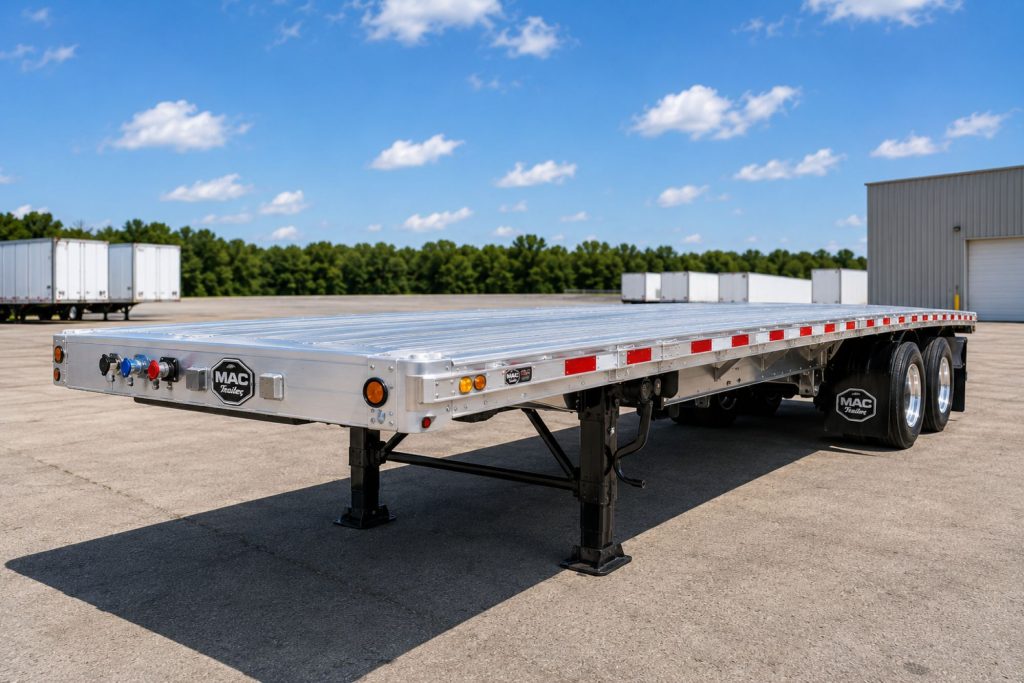
The MAC Aluminum Flatbed is a lightweight commercial flatbed trailer designed to transport lumber, steel, pipe, building materials, machinery, construction equipment, industrial products, and other open-deck freight.
MAC Trailer’s standard aluminum platform is built from 6061-T6 aluminum and can be configured with different beam sizes, axle arrangements, cargo-securement systems, and specialized equipment.
The MAC Road Warrior is a fleet-focused version designed to provide dependable open-deck capability with a relatively straightforward specification package. Common Road Warrior configurations include 48-foot and 53-foot trailers with approximately 52,000-pound concentrated-load beam ratings.
The trailer’s aluminum construction helps reduce empty weight, resist corrosion, and preserve payload capacity. Its open deck provides loading access from the sides, rear, or overhead.
Key Characteristics
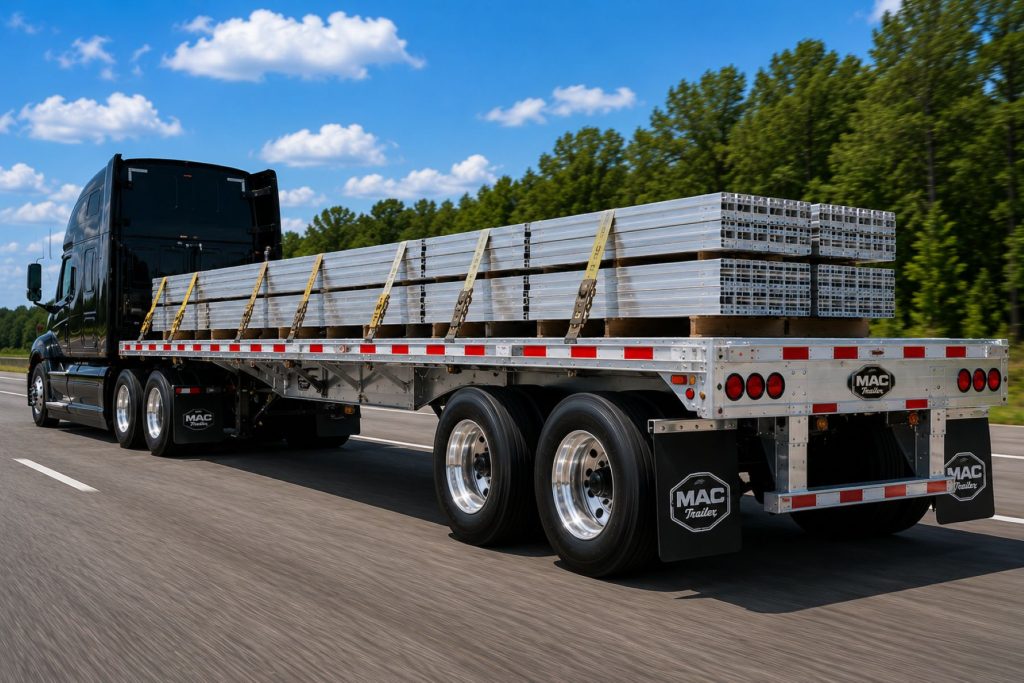
The MAC Aluminum Flatbed is designed around lightweight construction, cargo versatility, corrosion resistance, and concentrated-load capability.
The trailer can be configured for general flatbed freight or customized for steel coils, lumber, building materials, machinery, portable forklifts, sliding tarp systems, and other specialized applications.
Key characteristics include:
- 6061-T6 aluminum construction
- 48-foot and 53-foot configurations
- Approximately 102-inch width
- Multiple main-beam ratings
- Road Warrior fleet configuration
- Extruded aluminum flooring
- Apitong wood nailers
- Aluminum crossmembers
- Reinforced coil-package availability
- Tandem spread-axle suspension
- Available rear-axle slide
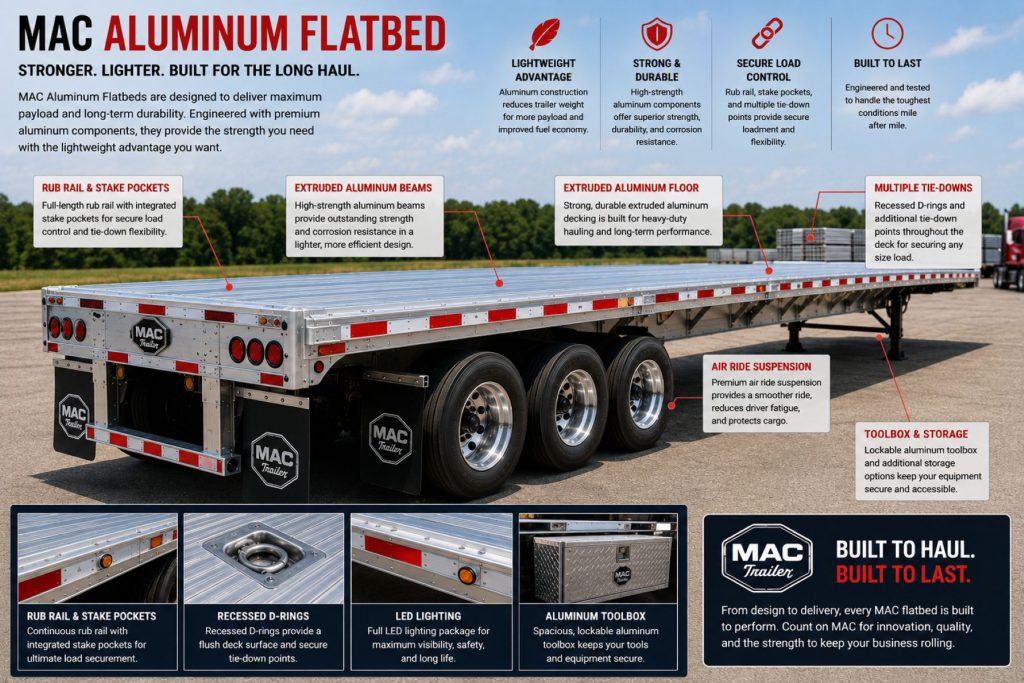
- Integrated stake pockets and pipe spools
- Sliding winches and strap systems
- Bulkhead availability
- Toolbox availability
- Dunnage-rack availability
- Moffett forklift kit availability
- Rear-entry stairway availability
- LED lighting
- Automatic tire-inflation-system availability
Common Specifications
Trailer Length
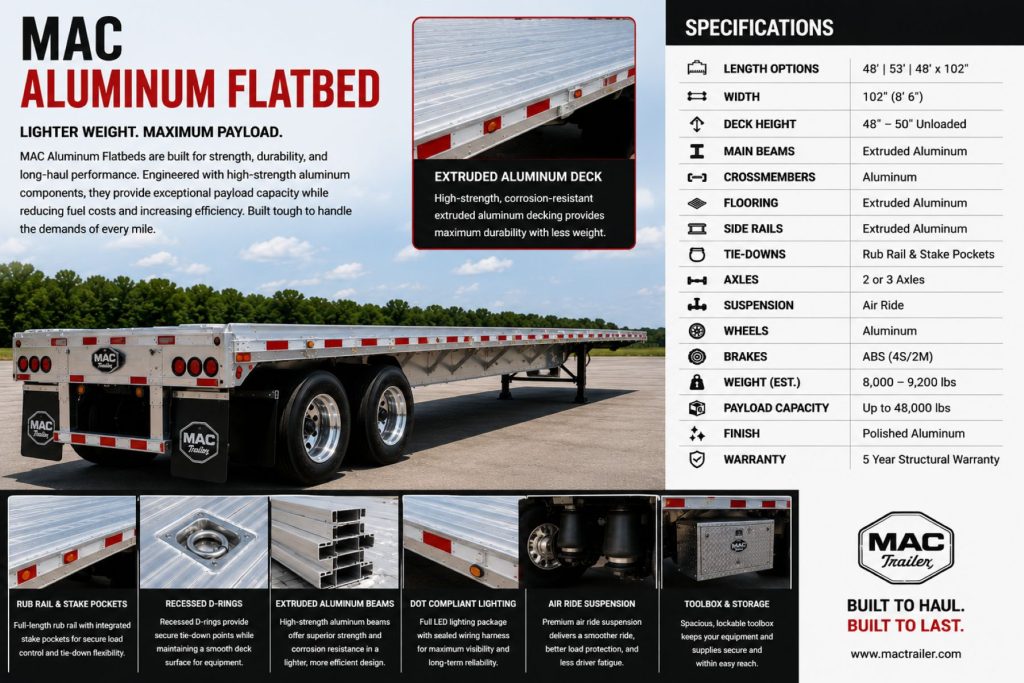
The MAC Aluminum Flatbed is commonly available in 48-foot and 53-foot highway configurations.
The 48-foot configuration is widely used for general flatbed freight, lumber, steel, pipe, machinery, and building materials.
The 53-foot configuration provides additional deck length for longer freight and loads requiring greater separation between cargo components.
Width
A standard highway configuration is approximately 102 inches wide.
Cargo extending beyond the trailer’s legal width may require permits, flags, banners, lights, escorts, or route restrictions.
Drivers must measure the complete load rather than relying only on the trailer’s width.
Construction Material
The MAC Aluminum Flatbed uses 6061-T6 aluminum in its main structural and deck components.
Aluminum reduces trailer empty weight and resists rust, but it requires appropriate inspection and repair procedures.
Steel remains present in applicable high-stress components, running gear, coupler assemblies, fasteners, and other equipment.
Main-Beam Design
The trailer uses two-piece extruded aluminum T-sections assembled with a center-axis weld.
This design positions the weld near the beam’s neutral axis to reduce stress on the main frame.
Multiple beam sizes are available so the trailer can be configured for different concentrated and distributed loads.
Beam Rating
A common Road Warrior configuration uses an approximately 52,000-pound beam rating for freight concentrated within a four-foot section.
Heavier beam options may be available for operations involving steel coils, machinery, construction equipment, and other concentrated loads.
Structural beam capacity does not override federal, state, provincial, axle, tire, or gross vehicle weight limitations.
Side Rails
The standard side rail is an approximately 6¾-inch-tall open-backed aluminum extrusion.
A heavier-duty seven-inch hollow-core side rail may be available.
Side rails can include stake pockets, pipe spools, rub rails, winch tracks, and other cargo-securement provisions.
Flooring
The standard floor uses approximately 1¼-inch extruded hollow-core aluminum sections with a textured upper surface.
Apitong wood nailers are positioned along the deck to provide attachment and friction surfaces for cargo protection and securement.
The floor should be inspected for cracks, damaged welds, impact damage, worn nailers, and distortion caused by concentrated loads.
Crossmembers
Aluminum channel crossmembers are commonly positioned on approximately 16-inch centers.
The crossmembers are designed to support the floor while transferring freight weight into the main beams.
Additional reinforcement can be installed in the coil-loading area or other high-load sections.
Coil Package
A reinforced coil package is available for operations transporting steel coils and similar concentrated freight.
A common Road Warrior specification includes a coil package paired with an approximately 52,000-pound main-beam rating.
Coils must be positioned within the approved loading zone and secured with appropriate cradles, chains, binders, blocking, friction materials, and edge protection.
Suspension and Axles
A common configuration uses a Hendrickson tandem air-ride suspension with an approximately 122-inch axle spread.
Spread axles can improve weight distribution but produce additional tire scrub during tight turns.
A rear-axle slide may be available for operations requiring different axle spacing in certain jurisdictions.
More information is available through Suspension Systems and Axles and Differentials.
Braking System
Commercial trailer air brakes with ABS are standard on most highway configurations.
Air-disc brakes may be available for fleets seeking different braking performance and maintenance characteristics.
Additional information is available through Brake Systems and Air Brake Systems Explained.
Tires and Wheels
The MAC Aluminum Flatbed can be configured with steel wheels, aluminum wheels, or a combination of steel inner and aluminum outer wheels.
Commercial 22.5-inch tires are common.
Automatic tire-inflation systems may be installed to help maintain tire pressure and reduce tire-related downtime.
More information is available through Tires and Wheels.
Landing Gear
The trailer commonly uses two-speed landing gear rated for commercial trailer loads.
The landing gear supports the trailer when it is disconnected from the tractor.
Landing-gear legs, mounting brackets, braces, crank mechanisms, and feet should be inspected regularly.
Electrical and Lighting System
The MAC Aluminum Flatbed uses a sealed commercial wiring harness and LED lighting.
Multiple side-marker lights and rear lights improve trailer visibility and help surrounding motorists recognize braking and turning movements.
More information is available through Electrical Systems.
Cargo-Securement Equipment
Available securement equipment includes sliding winches, straps, stake pockets, pipe spools, J-hooks, chain ties, binders, bulkheads, and rub rails.
Cargo-securement equipment must be selected according to freight weight, dimensions, shape, movement potential, and applicable regulations.
Common Applications
The MAC Aluminum Flatbed can transport numerous forms of open-deck freight.
- Flatbed Freight
- Lumber
- Roofing materials
- Drywall
- Steel coils
- Steel plate
- Steel beams
- Pipe and tubing
- Building materials
- Construction equipment
- Industrial machinery
- Agricultural equipment
- Manufactured products
- Crated equipment
- Precast materials
- Utility equipment
- Palletized freight
- Oversized freight
- Specialized loads
The correct configuration depends on freight weight, concentrated-load requirements, dimensions, axle placement, loading method, and cargo-securement needs.
Advantages
The MAC Aluminum Flatbed offers several advantages.
- Lightweight aluminum construction
- Strong corrosion resistance
- Potentially greater payload than heavier trailers
- Multiple main-beam sizes
- 48-foot and 53-foot configurations
- Fleet-focused Road Warrior option
- Strong concentrated-load capability
- Coil-package availability
- Open loading from the sides, rear, or overhead
- Integrated cargo-securement equipment
- Tandem spread-axle availability
- Rear-axle-slide availability
- Aluminum floor with Apitong nailers
- Bulkhead availability
- Moffett-kit availability
- Toolbox and dunnage-rack options
- LED lighting
- Automatic tire-inflation-system availability
Limitations or Considerations
The MAC Aluminum Flatbed also has limitations and ownership considerations.
- Higher acquisition cost than many steel trailers
- Aluminum repairs require appropriate training and equipment
- Open cargo is exposed to weather and road debris
- Freight may require tarps or protective coverings
- Cargo securement requires significant driver responsibility
- Spread axles can increase tire scrub
- Heavy concentrated loads require careful positioning
- Aluminum components can crack around high-stress areas
- Dissimilar-metal contact can contribute to corrosion
- Coil hauling requires specialized securement
- Tarping can be physically demanding
- Oversized loads may require permits
- Additional equipment increases empty weight
- Rear-axle-slide systems require additional inspection
- Structural load ratings do not override legal highway limits
Driver and Operator Considerations
Operating a MAC Aluminum Flatbed requires careful attention to cargo placement, weight distribution, securement, tarping, and route restrictions.
Drivers must confirm that concentrated freight is positioned within the trailer’s approved loading area.
Chains, binders, straps, edge protectors, blocking, coil racks, friction mats, dunnage, and tarps must be appropriate for the cargo.
Securement equipment should be inspected for cuts, stretching, cracks, bent components, damaged hooks, worn chain links, and missing identification.
Cargo securement should be checked shortly after beginning a trip and again at required intervals. Loads can settle, shift, or compress as the vehicle travels.
Spread-axle trailers require care during tight turns because the tires cannot follow the same path. Excessive pivoting can increase tire wear and suspension stress.
Drivers must also monitor cargo height, width, length, and overhang before entering restricted routes.
Maintenance and Ownership Notes
Preventive maintenance is important for preserving the trailer’s structural capacity and long-term value.
Routine maintenance should include:
- Main-beam inspection
- Crossmember inspection
- Floor-weld inspection
- Apitong-nailer inspection
- Coil-zone inspection
- Side-rail inspection
- Stake-pocket inspection
- Pipe-spool inspection
- Rub-rail inspection
- Winch and strap inspection
- Chain-tie inspection
- Suspension inspection
- Axle-alignment checks
- Brake inspection and adjustment
- ABS warning-system inspection
- Tire-pressure and tread inspection
- Wheel-end and bearing service
- Landing-gear lubrication
- Kingpin and upper-coupler inspection
- Electrical and lighting-system testing
- Rear-impact-guard inspection
- Tire-inflation-system inspection when equipped
- Toolbox inspection
- Dunnage-rack inspection
- Bulkhead inspection
- Tarp-system inspection when equipped
Aluminum welds should be checked for cracking around suspension mounts, crossmembers, coil zones, rear structures, side rails, and other high-stress areas.
Areas where aluminum contacts steel should be inspected for corrosion and material deterioration.
Buying Considerations
Before purchasing a MAC Aluminum Flatbed, buyers should identify the heaviest and most concentrated freight they expect to transport.
- Important considerations include:
- 48-foot or 53-foot trailer
- Required main-beam rating
- Expected concentrated-load weight
- Expected distributed-load weight
- Coil-hauling requirements
- Trailer empty weight
- Desired payload
- Fixed or sliding rear axle
- Axle spacing
- Suspension configuration
- Brake specifications
- Tire and wheel selection
- Automatic tire-inflation system
- Cargo-securement equipment
- Number and type of winches
- Stake pockets and pipe spools
- Chain-tie requirements
- Bulkhead requirements
- Moffett forklift requirements
- Toolbox requirements
- Dunnage storage
- Tarping system
- Conestoga-style enclosure
- Dealer and parts support
- Used-trailer repair history
A general building-material carrier may not require the same beam specification as a fleet regularly hauling steel coils, industrial machinery, or permitted freight.
Used trailers should be inspected for damaged main beams, lost camber, cracked welds, bent crossmembers, worn flooring, damaged side rails, suspension wear, irregular tire wear, and improper repairs.
Common Brands or Manufacturers
MAC Trailer competes with several established flatbed trailer manufacturers.
- Benson Trailers
- Fontaine Trailer
- Reitnouer Trailers
- Transcraft Trailer
- Wilson Trailer
- Doonan Specialized Trailer
- East Manufacturing
- Utility Trailer Manufacturing Company
Variants and Related Configurations
MAC offers several aluminum flatbed configurations.
Road Warrior
The Road Warrior is a fleet-focused aluminum platform designed for dependable service, reduced maintenance, and straightforward operation.
Common configurations include 48-foot and 53-foot trailers with an approximately 52,000-pound main-beam rating and a standard coil package.
Standard Aluminum Flatbed
The standard aluminum flatbed can be customized with different beam sizes, axle arrangements, securement systems, and accessories.
MLP-8 Low-Profile Flatbed
The MAC MLP-8 uses a lower-profile deck and an eight-inch neck to provide additional vertical cargo clearance.
It can be paired with a sliding tarp system for protected freight and greater interior height.
Coil-Hauling Configuration
A reinforced coil package supports concentrated steel-coil loading in the trailer’s designated load zone.
Moffett Configuration
A Moffett kit allows the trailer to carry a rear-mounted portable forklift for operations requiring independent unloading.
Rear-Axle-Slide Configuration
A sliding rear axle can adjust axle spacing for different regulatory and operational requirements.
Conestoga-Style Configuration
A rolling tarp enclosure can provide weather protection while preserving side and overhead loading access.
Multi-Axle Configuration
Additional axle configurations may be available for operations involving permitted freight or specialized weight-distribution requirements.
Comparison to Similar Trailers
The MAC Aluminum Flatbed is commonly compared with the Fontaine Revolution Flatbed Trailer, Reitnouer MaxMiser Flatbed Trailer, and Transcraft Eagle II Flatbed Trailer.
Benson Aluminum Flatbed
Wilson Flatbed
Doonan Flatbed
Compared with heavier steel flatbeds, the MAC Aluminum Flatbed provides reduced empty weight and greater corrosion resistance.
Compared with the Fontaine Revolution, MAC emphasizes all-aluminum construction, multiple beam sizes, and extensive customization.
Compared with the Reitnouer MaxMiser, MAC provides its own main-beam design, floor construction, securement systems, and Road Warrior fleet package.
Compared with the Transcraft Eagle II, the MAC focuses on aluminum weight savings, coil-package availability, and specialized options such as the Moffett kit and rear-axle slide.
The best trailer depends on empty weight, beam rating, concentrated-load requirements, securement equipment, axle configuration, dealer support, repair familiarity, and acquisition cost.
Best Fit For
- Flatbed fleets
- Owner-operators
- Building-material carriers
- Lumber haulers
- Steel carriers
- Pipe and tubing transportation
- Machinery transport companies
- Construction-equipment haulers
- Industrial freight operations
- Agricultural-equipment carriers
- Coil haulers
- Regional flatbed operations
- Long-haul flatbed operations
- Carriers prioritizing lower trailer weight
- Fleets seeking corrosion-resistant construction
- Operators requiring extensive customization
- Businesses using portable forklifts
Related Equipment
- Brake Systems
- Suspension Systems
- Axles and Differentials
- Tires and Wheels
- Electrical Systems
- Safety Systems
- Telematics and ELD Systems
- Aerodynamics and Fairings
Related Freight Types
- Flatbed Freight
- Dedicated Flatbed Freight
- Regional Flatbed Freight
- Long-Haul Flatbed Freight
- Construction and Aggregate Freight
- Heavy Haul and Oversized Freight
- Specialty and Niche Freight
Related Trailer Types
Related Trailer Models
- Fontaine Revolution Flatbed Trailer
- Reitnouer MaxMiser Flatbed Trailer
- Transcraft Eagle II Flatbed Trailer
- Benson Aluminum Flatbed
- Wilson Flatbed
- Doonan Flatbed
Related Guides
- Complete Guide to Trailer Types
- Flatbed vs Step Deck vs Double Drop
- Choosing the Right Trailer for Your Freight
Regulatory and Compliance Notes
The MAC Aluminum Flatbed must comply with federal, state, provincial, and local regulations governing commercial trailers, dimensions, axle weights, cargo securement, brakes, lighting, tires, and overall vehicle condition.
Operators should monitor:
- Maximum legal trailer width
- Maximum legal cargo width
- Maximum vehicle and cargo height
- Trailer GVWR
- Actual loaded trailer weight
- Gross combination weight
- Individual axle weights
- Axle-spacing requirements
- Bridge-formula requirements
- Brake and ABS requirements
- Lighting and conspicuity requirements
- Tire and wheel ratings
- Cargo-securement requirements
- Rear-impact-guard condition
- Annual inspection requirements
- Oversize and overweight permit requirements
Freight extending beyond standard width, height, length, or weight limits may require permits, route surveys, escorts, flags, banners, lights, and travel-time restrictions.
Structural trailer capacity does not override legal highway-weight or axle-weight limits.
Real World Operating Notes
In real-world flatbed operations, the MAC Aluminum Flatbed provides a combination of reduced trailer weight, cargo versatility, and customizable structural capacity.
The lightweight aluminum construction can preserve payload capacity, especially when the tractor and trailer are both configured around weight reduction.
Correct load placement remains essential. A trailer can remain within its structural beam rating while exceeding legal axle weights.
Aluminum trailers flex under load, and operators should understand normal camber and loaded appearance. Unexpected sagging, cracking, or uneven deck height may indicate structural damage.
Flatbed cargo is exposed to weather and road debris. Loads may require tarps, shrink wrap, edge protectors, or other coverings.
Tarping and securement create physical risks. Drivers should use safe working methods, avoid climbing on unsecured freight, and use fall-protection equipment when appropriate.
Frequently Asked Questions
What is the MAC Aluminum Flatbed?
It is a lightweight aluminum flatbed trailer designed to transport lumber, steel, pipe, machinery, building materials, and other open-deck freight.
What is the MAC Road Warrior?
The Road Warrior is MAC Trailer’s fleet-focused aluminum flatbed configuration designed for dependable service and reduced ownership complexity.
What lengths are available?
Common MAC Aluminum Flatbed lengths include approximately 48 feet and 53 feet.
What type of aluminum is used?
The trailer uses 6061-T6 aluminum in its main structural and floor components.
What is the common beam rating?
A common Road Warrior configuration uses an approximately 52,000-pound main-beam rating for a concentrated load positioned within four feet.
Can the MAC Aluminum Flatbed haul steel coils?
Yes. Properly equipped configurations include reinforced coil packages. Coils must be positioned and secured according to the trailer’s ratings and applicable regulations.
Does the MAC Flatbed use a spread axle?
A tandem air-ride suspension with an approximately 122-inch axle spread is common.
Can the rear axle slide?
A rear-axle-slide option is available for applicable configurations.
Can the trailer carry a portable forklift?
Yes. A Moffett kit can be installed to support a rear-mounted portable forklift.
Can the MAC Flatbed use a rolling tarp system?
Yes. Applicable configurations can support Conestoga-style sliding tarp systems.
Availability and Where to Find
New MAC Aluminum Flatbeds are available through authorized MAC Trailer dealers, commercial-trailer distributors, and fleet-purchasing programs.
Availability depends on trailer length, beam rating, axle configuration, suspension, brakes, tires, wheels, cargo-securement equipment, coil package, and specialized options.
Used MAC flatbeds are available through trailer dealerships, fleet-retirement sales, equipment auctions, and online commercial-trailer marketplaces.
When evaluating a used MAC Aluminum Flatbed, buyers should inspect the main beams, camber, crossmembers, floor welds, Apitong nailers, coil zone, side rails, stake pockets, rub rails, suspension, axles, brakes, tires, wheel ends, landing gear, kingpin, electrical system, and rear-impact guard.
Repair history, previous cargo, evidence of overloading, cracked aluminum welds, improper repairs, corrosion around dissimilar metals, and irregular tire wear should also be reviewed before purchase.
Support Trucking Families
Truck Equipment Atlas supports the mission of Grey Cross, a nonprofit dedicated to helping families of truck drivers who lose their lives while on the road. As the site grows, part of its mission is to bring awareness and support to these families.
Podcast or Video Section
Learn More Through Audio and Video
Truck Equipment Atlas will continue expanding with podcast episodes, interviews, and equipment breakdowns to help drivers and fleets better understand trucks and equipment.
Follow the Growth of Truck Equipment Atlas
Truck Equipment Atlas continues to expand with new truck profiles, trailer coverage, diesel engine pages, equipment system resources, manufacturer information, and educational guides.
Visit our Site Updates page to explore recent additions, project milestones, and upcoming resources as we continue building one of the industry’s growing commercial trucking equipment reference libraries.
View the Latest Site Updates: Truck Equipment Atlas Site Updates