
Reitnouer Step Deck
Quick Facts
- Manufacturer: Reitnouer, Inc.
- Model Family: DropMiser
- Trailer Type: Aluminum Step Deck / Drop Deck Trailer
- Construction: Aluminum Main Structure with High-Strength Steel Gooseneck
- Common Lengths: Up to 53 ft
- Available Widths: 96 inches and 102 inches
- Rear Deck Height: Approximately 40 inches
- Common Upper Deck Length: Approximately 10 ft 8 in, depending on configuration
- Common Axle Configurations: Tandem, Spread Axle, Sliding Axle, Lift Axle, and Triple Axle
- Common Suspension: Hendrickson Intraax Air-Ride Suspension
- Primary Applications: Machinery, Construction Equipment, Agricultural Equipment, Steel, Pipe, Building Materials, and Oversized Freight
- Production Status: Active Production
Overview
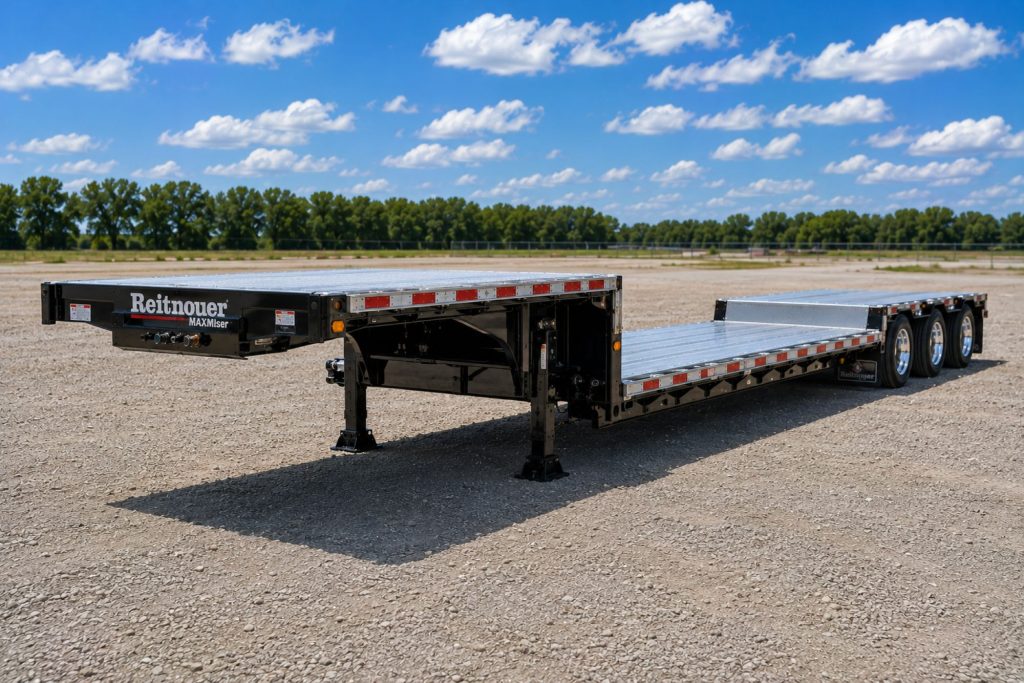
The Reitnouer Step Deck, officially offered as the DropMiser, is a lightweight aluminum drop-deck trailer designed for tall, specialized, and open-deck freight. Its lowered rear deck provides approximately 40 inches of deck height, allowing operators to transport taller cargo than can normally fit on a conventional flatbed trailer.
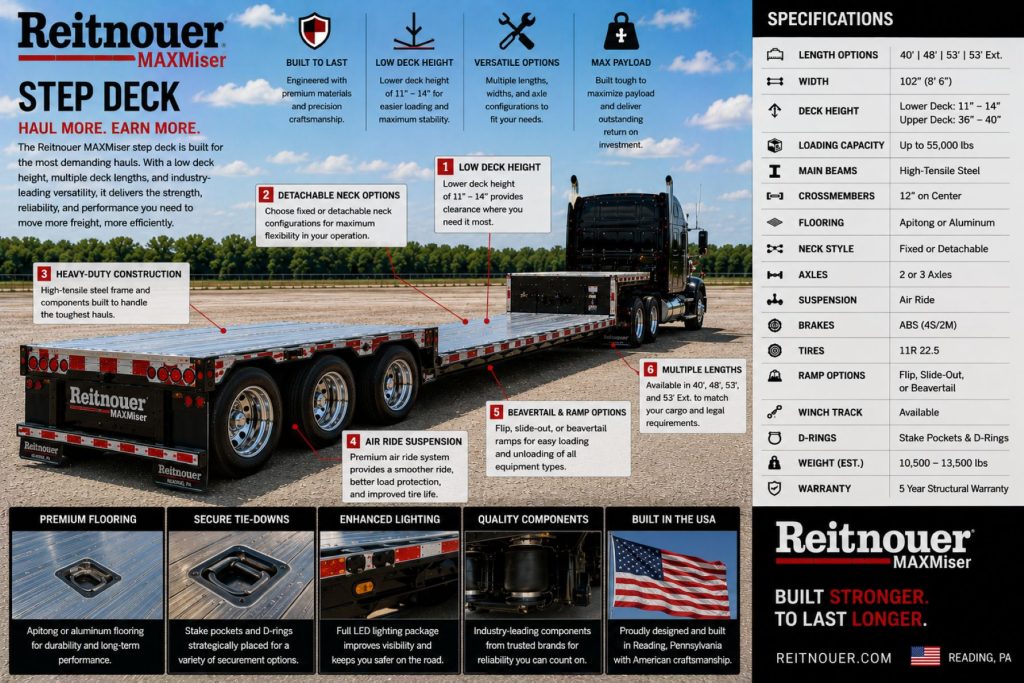
Reitnouer combines an aluminum rear trailer section with a high-strength steel gooseneck. The steel forward section is bolted to the aluminum structure to provide strength around the fifth-wheel and upper-deck area while reducing the fatigue concerns that can occur with some aluminum gooseneck designs.
The DropMiser is available with several structural capacities, axle arrangements, deck dimensions, and cargo-control options. This flexibility makes it suitable for general step-deck freight, machinery transport, coil hauling, and certain heavy haul and oversized freight operations.
Key Characteristics
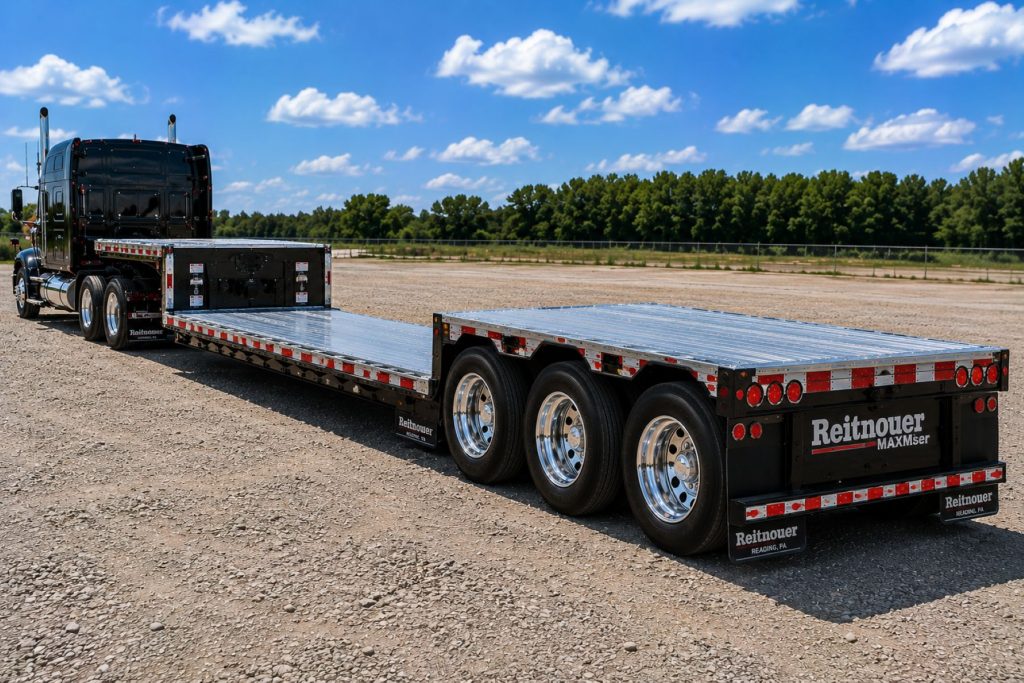
The Reitnouer Step Deck uses a two-level platform consisting of a short upper deck above the tractor drive tires and a longer, lower rear deck. The approximately 40-inch rear deck height provides additional vertical clearance for machinery, equipment, and tall industrial freight.
A defining feature is Reitnouer’s bolted aluminum construction. The main beams, crossmembers, flooring, and related structural components work together without relying entirely on conventional welded assembly.
The trailer’s steel gooseneck is designed to handle stresses around the kingpin and upper deck. An improved rear transition connects the raised and lowered portions of the trailer while eliminating the traditional splice plate used in some designs.
Reitnouer offers DropMiser versions based on several of its established flatbed capacity platforms, including the MaxMiser, Big Bubba, and Bigger Bubba families.
Common Specifications
Construction
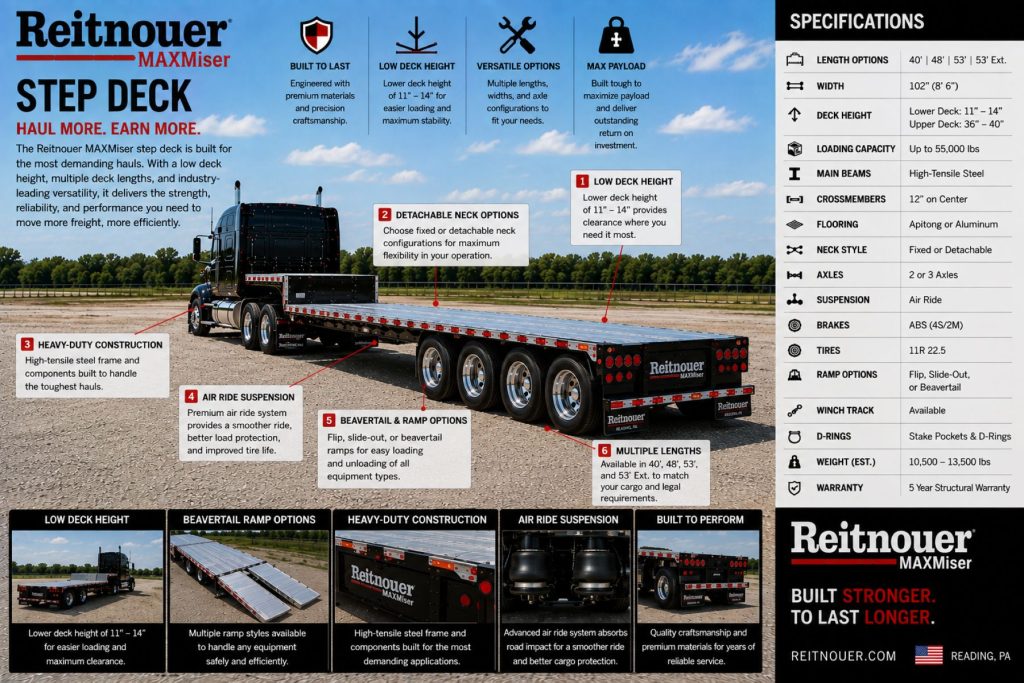
The DropMiser uses 6061-T6 aluminum for its primary rear structural components. A high-strength steel gooseneck is bolted to the aluminum rear section.
Steel components receive corrosion-protection treatments, while the main aluminum structure remains naturally corrosion resistant.
Main Beams
The main rails use a two-piece extruded aluminum design that is bolted and bonded near the center of the beam. This construction places the connection in an area where structural stresses can be managed effectively.
Crossmembers
One-piece, five-inch aluminum crossmembers use a reinforced modified-channel design. Standard spacing is commonly approximately 15 inches on center, although alternative spacing may be available for specialized configurations.
Flooring
The trailer commonly uses interlocking aluminum safety-tread flooring with three Apitong wood nailers. Four-nailer arrangements and additional center securement tracks may be available for coils and other specialized freight.
Deck Dimensions
The upper deck is commonly approximately 10 ft 8 in long, although different upper-deck dimensions and kingpin settings are available.
The rear deck length depends on the trailer’s total length and upper-deck configuration.
The transition between the upper and lower decks creates an approximate 23-inch drop.
Rear Deck Height
The standard rear deck height is approximately 40 inches. Alternative deck heights may be available to provide a lower center of gravity or additional cargo clearance.
Length and Width
Reitnouer Step Deck trailers are available in overall lengths through 53 ft.
Available widths commonly include 96 inches and 102 inches.
Capacity Ratings
Capacity depends on the selected DropMiser model and configuration.
DropMiser configurations may be rated around 90,000 pounds GVWR.
DropMiser HD configurations may be rated around 100,000 pounds GVWR.
DropMiser SD configurations may be rated around 110,000 pounds GVWR.
Specialized versions based on Reitnouer’s heavier flatbed platforms may provide additional concentrated-load capacity. The ordered trailer specification and certification plate should always be used to determine the actual legal and structural capacity.
Axle Configurations
Available arrangements include fixed tandem axles, spread axles, sliding axles, lift axles, and triple-axle configurations.
A two-position rear slider is available for operators who travel through jurisdictions with different axle-spacing regulations.
Suspension
Hendrickson Intraax air-ride suspension is commonly installed. Other suspension arrangements may be available depending on the trailer configuration.
Landing Gear
Jost aluminum landing gear is commonly used, with alternative landing-gear options available.
Brakes and ABS
Commercial air brakes and an antilock braking system are standard requirements. Brake size, ABS configuration, and wheel-end equipment depend on the ordered specification.
Cargo-Control Equipment
Available cargo-control equipment may include winch tracks, sliding winches, tie-down tracks, double spools, stake pockets, rope hooks, load levelers, coil packages, toolboxes, and dunnage racks.
Specifications vary substantially by model and order. Buyers should confirm the exact configuration through Reitnouer’s current DropMiser information.
Common Applications
- Construction machinery
- Agricultural equipment
- Industrial machinery
- Manufacturing equipment
- Steel coils
- Steel plate
- Pipe and tubing
- Structural steel
- Building materials
- Crated industrial components
- Wheeled equipment
- Tall freight requiring additional vertical clearance
- Flatbed freight
- Dedicated flatbed freight
- Regional flatbed freight
- Long haul flatbed freight
Advantages
- Approximately 40-inch rear deck provides additional vertical clearance
- Aluminum construction helps reduce empty trailer weight
- Multiple structural capacity levels are available
- Steel gooseneck strengthens the upper deck and kingpin area
- Bolted construction can simplify certain structural repairs
- Open deck allows side, rear, and overhead loading
- Available sliding-axle configurations support multi-jurisdiction operation
- Tandem, spread, lift, and triple-axle configurations are available
- Three standard wood nailers provide cargo-blocking flexibility
- Optional coil packages support concentrated steel loads
- Toolboxes and dunnage racks can be installed in several locations
- Aluminum components provide natural corrosion resistance
- Well-maintained aluminum trailers can retain strong resale value
Limitations or Considerations
- The two-level platform provides less continuous flat deck space than a standard flatbed
- The steel gooseneck requires corrosion inspection and maintenance
- Open freight remains exposed to weather and road debris
- Wheeled machinery may require portable or integrated ramps
- The fixed gooseneck does not provide the loading access of an RGN or lowboy trailer
- Not every DropMiser configuration has the same concentrated-load rating
- Axle settings must comply with regulations in each operating jurisdiction
- Cargo taller than legal limits may require permits and route planning
- Aluminum components require appropriate repair procedures
- Low deck clearance requires additional care around railroad crossings, steep driveways, and uneven jobsites
- Specialized high-capacity configurations can cost considerably more than general freight models
Driver and Operator Considerations
Drivers must understand the capacity of the specific DropMiser configuration they are operating. The model family includes several structural ratings, and the total GVWR does not indicate how much weight can be concentrated in one small section of the deck.
Cargo height should be measured after loading. The lowered rear deck creates additional clearance, but especially tall freight can still exceed legal limits.
Operators should carefully position heavy machinery and concentrated freight in relation to the main beams, suspension, and axles. Incorrect placement can overload a section of the trailer even when the total combination weight remains legal.
When using a sliding or lift-axle configuration, drivers must understand how axle position affects weight distribution, turning characteristics, tire wear, and compliance.
Chains, straps, binders, winches, blocking, edge protection, and tarps should be inspected before departure and during the trip.
Maintenance and Ownership Notes
The bolted trailer structure should be inspected according to Reitnouer’s maintenance procedures. Main beams, crossmembers, flooring, fasteners, and structural connections should be checked for movement, damage, distortion, and corrosion.
The steel gooseneck and other coated steel parts should be inspected for chips, rust, and deterioration of their protective finishes.
Aluminum flooring should be checked for cracks, impact damage, worn safety tread, and deformation around concentrated-load areas.
Wood nailers should remain securely installed and should be replaced when split, loose, excessively worn, or unable to hold cargo-blocking materials.
Suspension components, air lines, brakes, ABS equipment, wheel ends, tires, lights, and the trailer’s electrical system require regular inspection.
Rear axle sliders, lift axles, ramps, load levelers, winches, toolboxes, and other optional equipment introduce additional maintenance points.
Structural repairs should be completed by technicians familiar with Reitnouer’s bolted aluminum construction and approved repair procedures.
Buying Considerations
- Identify the exact DropMiser capacity model
- Confirm the trailer’s GVWR and concentrated-load ratings
- Verify the overall length and width
- Measure the usable upper- and lower-deck areas
- Confirm the loaded and unloaded deck heights
- Determine whether the trailer has fixed, sliding, spread, or lift axles
- Check whether the axle arrangement is legal in the intended operating states and provinces
- Inspect the steel gooseneck for corrosion, damage, and previous repairs
- Examine the aluminum main beams and transition area
- Inspect structural bolts and connections
- Check the aluminum flooring and wood nailers
- Review the condition of the suspension, brakes, ABS, wheel ends, and tires
- Verify that ramps and load levelers have suitable capacity ratings
- Inspect winch tracks, tie-downs, stake pockets, and cargo-control equipment
- Confirm whether the trailer includes a coil package
- Review maintenance and repair records
- Compare the trailer’s empty weight with the expected payload requirements
- Verify all specifications using the VIN plate and manufacturer documentation
Common Brands or Manufacturers
- Reitnouer
- MAC Trailer
- Fontaine Trailer
- Transcraft
- Wilson Trailer
- Doonan Specialized Trailer
- East Manufacturing
- Great Dane
- Utility Trailer
Variants and Related Configurations
- DropMiser
- DropMiser HD
- DropMiser SD
- MaxMiser drop-deck configuration
- Big Bubba drop-deck configuration
- Bigger Bubba drop-deck configuration
- 48-foot step deck
- 53-foot step deck
- Fixed tandem-axle configuration
- Fixed spread-axle configuration
- Two-position sliding-axle configuration
- Lift-axle configuration
- Triple-axle configuration
- Multi-axle heavy-haul configuration
- Coil-hauling configuration
- Step deck with load levelers
- Step deck with machinery ramps
Comparison to Similar Trailers
Compared with a standard flatbed trailer, the Reitnouer Step Deck provides a lower rear platform for taller cargo. The tradeoff is that its raised upper deck interrupts the continuous loading surface.
Compared with a lowboy or RGN trailer, the DropMiser is generally lighter and more practical for mixed open-deck freight. However, lowboy and RGN trailers provide lower deck heights and better loading access for heavy tracked or wheeled machinery.
Compared with a Conestoga trailer, the Reitnouer Step Deck provides unrestricted overhead loading but does not have an integrated rolling tarp enclosure.
The Reitnouer model competes with the Fontaine Velocity Step Deck Trailer, Transcraft Eagle II Step Deck Trailer, and Wilson Step Deck Trailer.
Unlike the all-aluminum transition used by some competitors, Reitnouer uses a high-strength steel gooseneck bolted to its aluminum rear structure.
Best Fit For
- Open-deck carriers transporting tall freight
- Construction equipment haulers
- Agricultural machinery transporters
- Industrial machinery carriers
- Steel and coil-hauling operations
- Fleets requiring multiple trailer capacity options
- Operators who travel through jurisdictions with different axle-spacing laws
- Carriers seeking an aluminum trailer with a reinforced steel gooseneck
- Regional and long-haul specialized freight operations
- Operators who need more cargo clearance than a standard flatbed provides
Related Equipment
- Brake Systems
- Suspension Systems
- Axles and Differentials
- Tires and Wheels
- Electrical Systems
- Safety Systems
- Telematics and ELD Systems
- Aerodynamics and Fairings
Related Freight Types
- Flatbed Freight
- Dedicated Flatbed Freight
- Regional Flatbed Freight
- Long Haul Flatbed Freight
- Construction and Aggregate Freight
- Heavy Haul and Oversized Freight
- Specialty and Niche Freight
- Agricultural Equipment Freight
- Industrial Machinery Freight
- Steel and Coil Freight
- Building Materials Freight
Related Trailer Types
- Step Deck Trailers
- Flatbed Trailers
- Lowboy and RGN Trailers
- Conestoga Trailers
- Specialty Trailers
- Double Drop Trailers
- Extendable Step Deck Trailers
- Multi-Axle Step Deck Trailers
Related Trailer Models
- Fontaine Velocity Step Deck Trailer
- Transcraft Eagle II Step Deck Trailer
- Wilson Step Deck Trailer
- Reitnouer MaxMiser Flatbed Trailer
- MAC Step Deck
- Doonan BlackGold Step Deck
Related Guides
Regulatory and Compliance Notes
The Reitnouer Step Deck must comply with federal, state, provincial, and local regulations governing trailer dimensions, axle weights, brakes, ABS equipment, lighting, tires, cargo securement, and inspections.
Operators must verify the loaded height even when freight is placed on the lower deck. Overheight, overwidth, overweight, or overlength loads may require permits, restricted travel times, escort vehicles, and approved routes.
Fixed-spread, sliding, and lift-axle configurations are subject to different regulations. A setting that is legal in one jurisdiction may not comply with the requirements of another.
Cargo-control equipment must have sufficient working load limits for the freight being transported. Machinery, steel coils, pipe, and structural components may require specialized blocking, bracing, chains, binders, straps, or edge protection.
The trailer’s structural capacity does not override legal axle, tire, bridge-formula, or gross combination weight limits.
Real World Operating Notes
The Reitnouer Step Deck is particularly useful for operations that combine general open-deck freight with occasional tall or concentrated loads. Its multiple structural capacity levels allow fleets to select a trailer that better matches their typical freight.
The approximately 40-inch rear deck provides more vertical clearance than a standard flatbed while maintaining side and overhead loading access.
Sliding-axle models can provide greater regulatory flexibility, but the driver must correctly position and secure the axle before travel. Moving the axle changes weight distribution and affects the trailer’s handling and turning characteristics.
The bolted design requires maintenance practices that differ from those used on conventional welded trailers. Operators should follow Reitnouer’s inspection and repair procedures rather than treating the trailer like a standard welded aluminum platform.
Frequently Asked Questions
What is the Reitnouer Step Deck called?
Reitnouer markets its primary step-deck and drop-deck trailer family under the DropMiser name.
How high is the lower deck?
The DropMiser commonly has a rear deck height of approximately 40 inches. Exact height depends on the tires, suspension, axle arrangement, and ordered configuration.
Is the Reitnouer Step Deck completely aluminum?
The main rear trailer structure is aluminum, but the DropMiser uses a high-strength steel gooseneck bolted to the aluminum section.
What lengths are available?
Reitnouer offers drop-deck trailers in overall lengths through 53 ft. Specific deck dimensions depend on the total length, upper-deck length, and kingpin setting.
What axle configurations are available?
Available arrangements include fixed tandem, spread axle, sliding axle, lift axle, and triple-axle configurations.
Can the Reitnouer Step Deck haul steel coils?
Yes, when the trailer is properly configured with an appropriate coil package and has sufficient concentrated-load capacity for the intended coil.
Can machinery be driven onto the trailer?
Certain wheeled machines can be loaded using properly rated ramps and load-leveling equipment. The ramp capacity, loading angle, equipment weight, and ground conditions must be evaluated first.
Is a DropMiser the same as an RGN trailer?
No. The DropMiser has a fixed gooseneck and normally requires ramps or lifting equipment for machinery loading. An RGN provides a detachable front connection that allows equipment to be driven onto the deck from the front.
What should buyers inspect on a used Reitnouer Step Deck?
Buyers should inspect the steel gooseneck, aluminum beams, deck transition, structural bolts, crossmembers, flooring, nailers, axles, suspension, brakes, tires, and cargo-control equipment.
Availability and Where to Find
New Reitnouer Step Deck trailers are available through authorized Reitnouer dealers in the United States and Canada. Availability depends on production schedules, dealer inventory, capacity rating, axle arrangement, deck dimensions, and selected equipment.
Used models can be found through commercial trailer dealerships, equipment auctions, fleet sales, and online truck-and-trailer marketplaces.
Buyers should verify the exact DropMiser model, VIN, GVWR, concentrated-load ratings, deck dimensions, axle configuration, empty weight, maintenance history, and included options before completing a purchase.
Support Trucking Families
Truck Equipment Atlas supports the mission of Grey Cross, a nonprofit dedicated to helping families of truck drivers who lose their lives while on the road. As the site grows, part of its mission is to bring awareness and support to these families.
Podcast or Video Section
Learn More Through Audio and Video
Truck Equipment Atlas will continue expanding with podcast episodes, interviews, and equipment breakdowns to help drivers and fleets better understand trucks and equipment.
Follow the Growth of Truck Equipment Atlas
Truck Equipment Atlas continues to expand with new truck profiles, trailer coverage, diesel engine pages, equipment system resources, manufacturer information, and educational guides.
Visit our Site Updates page to explore recent additions, project milestones, and upcoming resources as we continue building one of the industry’s growing commercial trucking equipment reference libraries.
View the Latest Site Updates: Truck Equipment Atlas Site Updates