
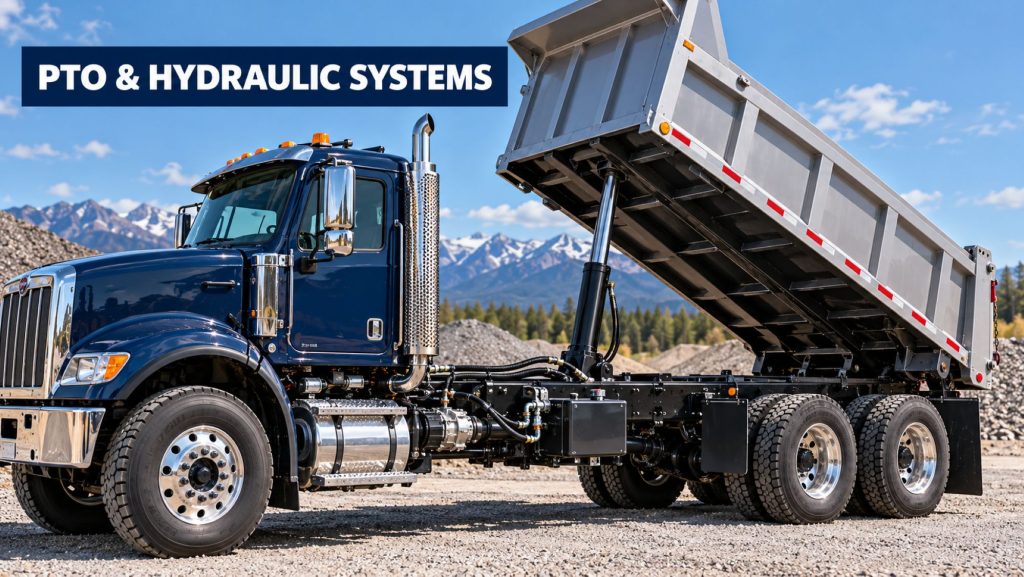
Commercial truck PTO and hydraulic systems transfer engine or transmission power to equipment such as dump bodies, walking-floor trailers, lowboys, wreckers, refuse bodies, cranes, snowplows, utility equipment, concrete mixers, and other vocational machinery.
Truck Equipment Atlas covers power take-offs, hydraulic pumps and motors, wet kits, cylinders, dump hoists, valves, controls, reservoirs, hoses, fittings, filtration equipment, and complete mobile hydraulic systems used throughout medium-duty, heavy-duty, vocational, construction, agricultural, municipal, and specialized commercial vehicle applications.
The PTO & Hydraulic Systems Library includes individual product profiles, equipment categories, manufacturer coverage, operating characteristics, installation requirements, maintenance considerations, compatibility information, and educational resources designed to help readers understand how truck-mounted hydraulic equipment works.
Explore PTO & Hydraulic System Categories
Commercial truck PTO and hydraulic equipment can be classified by power source, pump design, system configuration, operating pressure, flow requirements, mounting position, and intended application. Explore the major PTO and hydraulic-system categories on Truck Equipment Atlas:
Power Take-Off Systems
Power take-off systems transfer mechanical power from an engine or transmission to a hydraulic pump, generator, blower, winch, compressor, or other auxiliary equipment.
This category covers transmission-mounted, engine-mounted, side-mount, rear-mount, clutch-shift, hot-shift, constant-mesh, reversible, and application-specific PTO configurations.
Hydraulic Pumps & Motors
Hydraulic pumps convert mechanical input from a PTO, engine, or electric motor into hydraulic flow that powers cylinders, motors, hoists, and other equipment.
This category includes gear pumps, piston pumps, vane pumps, dump pumps, tandem pumps, twin-flow pumps, bidirectional pumps, hydraulic motors, pump adapters, and mounting equipment.
Wet Kits & Complete Hydraulic Systems
Wet kits combine the components needed for a tractor or truck to supply hydraulic power to a trailer, body, or mounted piece of equipment.
This category covers single-line, two-line, three-line, dump-trailer, walking-floor, lowboy, combination, and application-specific hydraulic systems.
Hydraulic Cylinders & Dump Hoists
Hydraulic cylinders convert fluid pressure into linear force used to raise, lower, extend, retract, tilt, stabilize, or position truck bodies and equipment.
This category includes front-mounted telescopic cylinders, underbody cylinders, multistage cylinders, double-acting cylinders, conversion hoists, stabilizing systems, and complete dump-body hoists.
Hydraulic Valves, Controls & Reservoirs
Hydraulic valves and controls direct fluid through the system, regulate pressure and flow, and allow the operator to control powered equipment.
This category covers directional-control valves, relief valves, flow-control valves, proportional controls, air-shift controls, electric controls, cab controls, reservoirs, tanks, breathers, sight gauges, and related accessories.
Hydraulic Hoses, Fittings & Filtration
Hydraulic hoses, fittings, and filtration components carry fluid throughout the system while helping control leaks, contamination, pressure loss, and component damage.
This category includes pressure hoses, suction hoses, return lines, quick-connect couplers, fittings, adapters, filters, strainers, breathers, seals, clamps, and contamination-control equipment.
PTO & Hydraulic System Guides
The PTO & Hydraulic System Guides section provides educational resources covering PTO operation, hydraulic power, pump selection, wet-kit configurations, system compatibility, inspection, maintenance, troubleshooting, and equipment selection.
Commercial Truck PTO and Hydraulic Products on Truck Equipment Atlas
Truck Equipment Atlas includes a growing library of individual PTO, hydraulic pump, wet-kit, cylinder, hoist, valve, and mobile hydraulic-system profiles from leading manufacturers serving the commercial trucking and vocational-equipment industries.
Explore the PTO and hydraulic products and families being added to the library:
Parker Chelsea
- Parker Chelsea 280 Series Power Take-Off
- Parker Chelsea 442 Series Power Take-Off
- Parker Chelsea 489 Series Power Take-Off
- Parker Chelsea 590 Series Power Take-Off
- Parker Chelsea 870 Series Power Take-Off
- Parker F1 Hydraulic Pump
- Parker F2 Twin-Flow Hydraulic Pump
- Parker Chelsea Wetline Hydraulic System
Muncie Power Products
- Muncie TG Series Power Take-Off
- Muncie CS6 Series Power Take-Off
- Muncie FR6Q Power Take-Off
- Muncie E Series Hydraulic Pump
- Muncie WETLINE Hydraulic System
- Muncie V Series Hydraulic Directional Control Valve
Permco
Bezares
Hyva
Mailhot
Custom Hoists
Additional PTOs, pumps, motors, wet kits, cylinders, hoists, valves, reservoirs, controls, hoses, fittings, and filtration products will be added as the Truck Equipment Atlas PTO & Hydraulic Systems Library continues to expand.
PTO & Hydraulic System Guides on Truck Equipment Atlas
Truck Equipment Atlas is also developing educational guides that explain how commercial truck PTO and hydraulic systems work and how they affect equipment performance, power requirements, installation, maintenance, troubleshooting, and component selection.
- How Commercial Truck PTO and Hydraulic Systems Work
- Commercial Truck Power Take-Off Types Explained
- How to Choose a PTO and Hydraulic Pump
- Commercial Truck Wet Kits Explained
- How to Inspect and Maintain Truck Hydraulic Systems
Understanding PTO and Hydraulic System Types
Commercial truck hydraulic systems are available in several fundamentally different configurations. The correct arrangement depends on the truck, transmission, powered equipment, required flow, operating pressure, duty cycle, and available mounting space.
Power Take-Off Systems
A power take-off connects to an engine or transmission gear and provides a mechanical output that can drive auxiliary equipment. Many truck-mounted PTOs use an output shaft, flange, or direct-mounted pump connection.
The PTO ratio determines how quickly the output rotates relative to engine speed. The ratio, torque rating, rotation direction, mounting opening, duty cycle, and transmission compatibility must match the intended equipment.
Hydraulic Pumps and Motors
A hydraulic pump draws fluid from the reservoir and supplies flow to the system. Resistance to that flow creates pressure, allowing cylinders and hydraulic motors to perform work.
Gear pumps are widely used for dump bodies, wet kits, snowplows, and general vocational applications. Piston pumps can provide higher pressure, variable displacement, or more efficient operation for demanding applications. Hydraulic motors reverse the energy conversion by using pressurized fluid to produce rotary movement.
Wet Kits and Complete Hydraulic Systems
A wet kit normally combines a PTO, hydraulic pump, reservoir, hoses, fittings, controls, valves, filtration components, and trailer connections into one working system.
Wet-kit design changes according to the trailer or equipment being powered. A dump trailer may use a different circuit than a walking-floor trailer, liquid-bulk trailer, lowboy, live-bottom trailer, or hydraulic detachable gooseneck.
Hydraulic Cylinders and Dump Hoists
A hydraulic cylinder uses pressurized fluid acting against a piston or telescopic stages to create linear movement. Cylinders may be single-acting or double-acting depending on whether hydraulic power moves the cylinder in one or both directions.
Dump bodies commonly use front-mounted telescopic cylinders or underbody hoists. Cylinder capacity, stroke, mounting geometry, tipping angle, body length, load placement, and chassis stability must be considered together.
Hydraulic Valves, Controls and Reservoirs
Directional valves route hydraulic fluid to the required actuator. Relief valves protect the system against excessive pressure, while flow-control valves regulate actuator speed and system behavior.
The reservoir stores hydraulic fluid, allows heat to dissipate, gives air and contaminants time to separate, and supplies the pump under changing operating conditions.
Hoses, Fittings and Filtration
Hydraulic hoses and fittings must withstand the system’s operating pressure, pressure spikes, temperature, vibration, flexing, fluid type, and environmental exposure.
Filters, strainers, and breathers help prevent contamination from damaging pumps, valves, cylinders, motors, seals, and other precision components.
Common PTO and Hydraulic System Configurations
Commercial PTO and hydraulic systems vary according to the truck, transmission, powered equipment, duty cycle, and operating environment.
Common configurations include:
- Transmission-mounted PTO with a direct-mounted gear pump
- Transmission-mounted PTO with a remote-mounted pump and driveshaft
- Engine-mounted PTO with continuous hydraulic capability
- Clutch-shift PTO for engagement while the engine is operating
- Hot-shift PTO for compatible automatic transmissions
- Constant-mesh PTO with air, hydraulic, or electric activation
- Single-line dump-trailer wet kit
- Two-line hydraulic wet kit
- Three-line hydraulic wet kit
- Combination dump and walking-floor wet kit
- High-pressure low-flow hydraulic system
- Low-pressure high-flow hydraulic system
- Fixed-displacement gear-pump system
- Variable-displacement piston-pump system
- Front-mounted telescopic dump cylinder
- Underbody dump hoist
- Double-acting hydraulic cylinder system
- Hydraulic motor drive system
- Open-center hydraulic circuit
- Closed-center hydraulic circuit
- Load-sensing hydraulic system
- Electric-over-hydraulic power unit
System type alone does not determine whether the equipment will operate correctly. PTO speed, pump displacement, fluid flow, operating pressure, reservoir capacity, line size, component ratings, equipment load, and installation quality must also be considered.
PTO Speed, Torque and Horsepower
A PTO must provide the correct speed, torque, and horsepower for the driven equipment. These requirements are related but should not be treated as interchangeable.
PTO output speed depends on engine speed and the selected PTO ratio. A faster PTO ratio increases output speed but can also affect pump speed, noise, heat generation, and component life.
The PTO, pump, mounting hardware, shafting, and transmission opening must all withstand the required torque. Excessive torque, shock loading, improper engagement, or operating beyond the PTO’s rating can damage gears, bearings, shafts, housings, and the transmission.
Equipment specifications should be used to determine the required operating speed and power before a PTO is selected.
Hydraulic Flow and Pressure
Hydraulic flow influences how quickly a cylinder extends or a hydraulic motor turns. Hydraulic pressure reflects the resistance created by the load and determines the amount of force or torque the system can produce.
System performance can be affected by:
- PTO output speed
- Pump displacement
- Engine operating speed
- Hydraulic fluid viscosity
- Reservoir capacity
- Suction-line size
- Pressure-line size
- Return-line size
- Hose length and routing
- Fitting restrictions
- Valve capacity
- Filter condition
- Relief-valve setting
- Cylinder dimensions
- Hydraulic motor displacement
- System temperature
- Internal leakage
A larger pump does not automatically improve performance. Excessive flow can cause high operating speed, fluid aeration, heat, noise, control problems, and component damage.
Hydraulic Fluid, Heat and Contamination
Hydraulic fluid transfers power, lubricates components, carries heat, protects internal surfaces, and helps seal clearances inside pumps, valves, motors, and cylinders.
Excessive heat can reduce fluid viscosity, damage seals, accelerate oxidation, decrease lubrication, and shorten component life. Heat may be caused by excessive pressure, undersized lines, restricted filters, incorrect valves, continuous relief-valve operation, internal leakage, or an undersized reservoir.
Contamination can include dirt, metal particles, water, air, degraded fluid, seal material, and other debris. Even small contaminants can damage precision hydraulic components.
Clean fluid, sealed storage and transfer equipment, correct filtration, proper reservoir maintenance, and careful component replacement are essential for dependable hydraulic operation.
Heavy-Duty and Medium-Duty Applications
PTO and hydraulic requirements change significantly according to vehicle class, transmission, chassis layout, duty cycle, and powered equipment.
Heavy-duty dump trucks, refuse vehicles, concrete mixers, heavy-haul tractors, oilfield trucks, and recovery vehicles may require high PTO torque, large pumps, substantial reservoir capacity, high system pressure, continuous-duty operation, and additional cooling.
Medium-duty delivery trucks, utility vehicles, landscape trucks, service bodies, tow trucks, snowplows, and municipal equipment may use smaller PTOs, pumps, reservoirs, cylinders, and electrohydraulic systems.
Component selection should be based on the complete vehicle and equipment application rather than one advertised flow, pressure, or horsepower rating.
Vocational PTO and Hydraulic Applications
Vocational trucks depend on PTO and hydraulic systems to operate many different types of equipment.
Common applications include:
- Dump trucks
- Dump trailers
- Walking-floor trailers
- Live-bottom trailers
- Lowboy and detachable-gooseneck trailers
- Refuse trucks
- Roll-off trucks
- Hooklift trucks
- Concrete mixers
- Concrete pump trucks
- Utility trucks
- Bucket trucks
- Crane trucks
- Tow and recovery vehicles
- Snowplows and salt spreaders
- Logging trucks
- Grapple and loader trucks
- Vacuum trucks
- Tank trucks
- Liquid-bulk trailers
- Oilfield and energy-sector trucks
- Fire and emergency vehicles
- Municipal road-maintenance equipment
- Agricultural trucks and trailers
- Specialized vocational equipment
PTO and hydraulic selection for these applications may depend on required flow, pressure, operating speed, equipment cycle time, load, terrain, ambient temperature, transmission type, chassis space, reservoir location, and whether the vehicle must operate while stationary or moving.
Advantages of Modern PTO and Hydraulic Systems
Modern PTO and hydraulic technologies can provide several operational advantages:
- Efficient transfer of engine power to auxiliary equipment
- High force from compact components
- Variable equipment speed and movement
- Remote operation of truck and trailer equipment
- Ability to power multiple hydraulic functions
- Application-specific PTO ratios
- Direct-mounted pump options
- Clutch-shift and hot-shift PTO engagement
- High-pressure hydraulic capability
- Proportional electronic controls
- Load-sensing pump operation
- Improved diagnostic information
- Integrated safety interlocks
- Programmable engine-speed control
- Application-specific wet-kit packages
- Improved equipment productivity
The actual benefits depend on proper component selection, system design, installation quality, vehicle compatibility, operating environment, maintenance condition, and operator practices.
PTO and Hydraulic System Limitations and Considerations
No single PTO, pump, wet kit, cylinder, or hydraulic-system configuration is suitable for every truck or application.
Important considerations include:
- Transmission make and model
- Available PTO openings
- PTO ratio
- Output rotation
- Torque and horsepower rating
- Pump displacement
- Required hydraulic flow
- Maximum operating pressure
- Duty cycle
- Reservoir capacity
- Hydraulic fluid specification
- Hose and fitting size
- Valve capacity
- Filtration requirements
- System cooling
- Chassis mounting space
- Driveshaft and exhaust clearance
- Fuel-tank and battery-box location
- Body and equipment clearance
- Electrical and air-control compatibility
- Equipment cycle time
- Installation weight
- Maintenance access
- Replacement-parts availability
A hydraulic system designed for a dump trailer may not be appropriate for a walking floor, lowboy, crane, refuse body, concrete mixer, recovery vehicle, or continuously operating hydraulic motor.
Driver and Operator Considerations
PTO and hydraulic-system operation can affect engine speed, transmission loading, vehicle stability, equipment movement, fluid temperature, and surrounding personnel.
Drivers and operators should understand the PTO switch, engagement indicator, transmission requirements, engine-speed controls, hydraulic controls, equipment interlocks, emergency-stop procedures, and safe operating limits.
Operators should monitor for:
- PTOs that do not engage or disengage correctly
- Unexpected gear noise
- Hydraulic fluid leaks
- Slow or erratic equipment movement
- Excessive hydraulic noise
- Fluid foaming or aeration
- High hydraulic-fluid temperature
- Low reservoir level
- Damaged hoses or fittings
- Loose mounting hardware
- Cylinders that drift or bind
- Dump bodies that raise unevenly
- Controls that stick or respond incorrectly
- Abnormal vibration
- Burning odors or smoke
- Warning lights or diagnostic faults
A significant change in PTO or hydraulic operation should be inspected before the equipment returns to service.
Maintenance and Ownership
Commercial PTO and hydraulic systems require regular inspection and maintenance to provide dependable operation.
Important maintenance areas can include:
- PTO mounting and fastener inspection
- PTO backlash or installation inspection
- Shift-system inspection
- Output-shaft and flange inspection
- Pump mounting inspection
- Pump and driveshaft alignment
- Reservoir fluid-level checks
- Hydraulic fluid condition
- Filter replacement
- Reservoir breather service
- Suction-line inspection
- Pressure- and return-line inspection
- Hose and fitting inspection
- Leak detection
- Relief-valve testing
- Control-valve inspection
- Cylinder rod and seal inspection
- Hoist mounting inspection
- Electrical wiring and switch inspection
- Air-line and air-control inspection
- Hydraulic temperature monitoring
- System-pressure and flow testing
- Contamination control
Maintenance requirements vary significantly between manufacturers and system designs. Owners and technicians should follow the service procedures specified for the exact PTO, pump, valve, cylinder, reservoir, truck, transmission, trailer, and application.
Major PTO and Hydraulic-System Manufacturers
Truck Equipment Atlas covers PTO and hydraulic products from manufacturers and suppliers that play important roles throughout the commercial trucking and vocational-equipment industries.
Current and planned coverage includes:
- Parker Chelsea
- Muncie Power Products
- Bezares
- Permco
- Hyva
- Mailhot Industries
- Custom Hoists
- Commercial Intertech
- Eaton
- Danfoss
- Hydreco
- Buyers Products
- Monarch Hydraulics
- Rugby Manufacturing
- Champion Hoist
- Prince Manufacturing
- Force America
- Gresen
- Gates
- Aeroquip
- Donaldson
- Stucchi
Manufacturer coverage will continue expanding as additional PTOs, pumps, motors, wet kits, cylinders, hoists, valves, reservoirs, controls, filters, hoses, fittings, and complete hydraulic systems are added.
Related Truck Equipment Resources
A PTO or hydraulic system is only one part of the complete commercial truck, transmission, chassis, body, trailer, and equipment package.
Explore related Truck Equipment Atlas resources:
- Commercial Trucks
- Commercial Trailers
- Diesel Engines
- Commercial Truck Transmissions
- Axles & Differentials
- Suspension Systems
- Brake Systems
- Fifth Wheels & Coupling Equipment
- Tires & Wheels
- Electrical Systems
- Safety Systems
- Equipment Systems
- Equipment System Guides
Understanding how the engine, transmission, PTO, hydraulic pump, valves, cylinders, chassis, truck body, trailer, electrical controls, air controls, and operating application work together is essential when evaluating mobile hydraulic equipment.
How to Use the PTO & Hydraulic Systems Library
Individual Truck Equipment Atlas PTO and hydraulic-system profiles provide deeper information about specific products, models, and component families.
Depending on the equipment, these pages may include:
- Product and system overview
- Manufacturer information
- PTO, pump, cylinder, valve, or system type
- Operating design
- Common specifications
- Speed, torque, and horsepower information
- Hydraulic pressure and flow information
- Transmission compatibility
- Pump and mounting compatibility
- Reservoir and hydraulic-line requirements
- Truck and trailer applications
- Control and electronic features
- Installation considerations
- Driver and operator considerations
- Maintenance information
- Common problems
- Safety precautions
- Ownership considerations
- Availability and replacement considerations
Readers can begin with one of the PTO and hydraulic-system categories above or explore individual product profiles by manufacturer.
PTO & Hydraulic Systems Library Expansion
The Truck Equipment Atlas PTO & Hydraulic Systems Library will continue growing with additional power take-offs, hydraulic pumps, motors, wet kits, cylinders, hoists, directional valves, relief valves, reservoirs, filters, hoses, fittings, control systems, and complete hydraulic-system profiles.
Future development will also expand the connections between PTO and hydraulic systems and the trucks, transmissions, trailers, dump bodies, vocational equipment, manufacturers, and applications in which they are used.
The goal is to build an organized commercial mobile-power reference that helps drivers, owner-operators, fleets, technicians, students, equipment buyers, body builders, installers, and industry professionals understand how these systems work and where different products fit within the trucking industry.
Follow the Growth of Truck Equipment Atlas
Truck Equipment Atlas continues to expand with new trucks, trailers, diesel engines, transmissions, axles, differentials, suspensions, brake systems, PTO and hydraulic systems, manufacturer information, freight resources, and educational guides.