
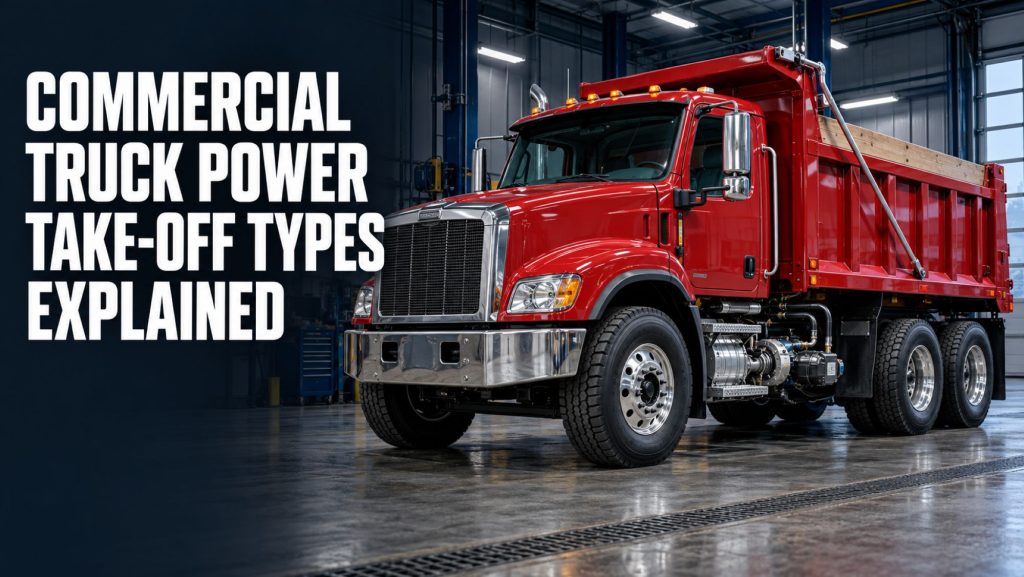
A commercial truck power take-off, commonly called a PTO, transfers engine power to auxiliary equipment that performs work beyond moving the vehicle. PTO systems operate hydraulic pumps, dump bodies, wreckers, cranes, refuse equipment, vacuum pumps, blowers, mixers, aerial lifts, utility equipment, and many other vocational systems.
Although PTOs share the same basic purpose, they are not all designed or operated the same way. They can differ by mounting location, internal design, engagement method, torque capacity, speed ratio, rotation direction, and whether they can operate while the truck is moving.
This guide explains the major commercial truck power take-off types, how each design receives power, where different PTOs are installed, and why the truck’s transmission, hydraulic system, and operating application must be considered together.
What Is a Commercial Truck PTO?
A power take-off is a mechanical device that redirects power from the truck’s engine or drivetrain to auxiliary equipment.
In many vocational trucks, the PTO is mounted to an opening on the transmission. Gears inside the PTO engage a transmission gear and rotate an output shaft. That output can drive a hydraulic pump directly or transfer power through a shaft to remotely mounted equipment.
A simplified hydraulic PTO power path is:
Engine → Transmission → PTO → Hydraulic Pump → Control Valve → Hydraulic Cylinder or Motor
Not every PTO-driven system is hydraulic. A PTO may also drive a mechanical shaft, blower, compressor, generator, product pump, or other rotating equipment.
Why Commercial Trucks Use Different PTO Types
Commercial truck applications place very different demands on a PTO.
A dump truck may need high torque for a relatively short operating cycle while the vehicle is stationary. A refuse truck may operate its hydraulic system repeatedly throughout the day. A road-maintenance truck may need hydraulic power while traveling. A vacuum truck, bulk hauler, or concrete mixer may require continuous power at a carefully controlled speed.
These differences affect the PTO’s required:
- Mounting location
- Input gear compatibility
- Output speed
- Speed ratio
- Torque capacity
- Horsepower capacity
- Rotation direction
- Operating duration
- Engagement system
- Stationary or mobile operating capability
- Hydraulic pump compatibility
The correct PTO is therefore selected for a specific truck, transmission, driven component, and duty cycle rather than by truck size alone.
Transmission-Mounted PTOs
The transmission-mounted PTO is one of the most common designs used on vocational commercial trucks.
The PTO attaches to a manufacturer-provided opening on the transmission case. Its input gear meshes with a compatible gear inside the transmission. When engaged, the PTO transfers rotational power to its output shaft or a directly mounted hydraulic pump.
Transmission-mounted PTOs are commonly used for:
- Dump bodies
- Dump trailers
- Wreckers and rollbacks
- Refuse trucks
- Hook-lift trucks
- Roll-off trucks
- Utility trucks
- Snow and ice equipment
- Hydraulic cranes
- Vacuum equipment
- Tank and bulk-product pumps
The available PTO opening and compatible gear arrangement depend on the exact transmission model. Two transmissions that appear similar may require different PTO housings, input gears, installation kits, controls, or output arrangements.
Side-Mount PTOs
A side-mount PTO attaches to an opening on the side of the transmission. Depending on the transmission, an opening may be available on the left side, right side, or both sides.
This design is widely used because it can provide a compact and direct way to drive a hydraulic pump. However, frame rails, exhaust components, fuel tanks, air tanks, driveshafts, wiring, and other chassis equipment can limit the available installation space.
The side of the transmission does not by itself determine output rotation. Rotation must be confirmed from the transmission drive gear, PTO gear arrangement, and PTO manufacturer’s application information.
Bottom-Mount PTOs
Some transmissions provide a PTO opening on the bottom of the case. A bottom-mount PTO can offer useful packaging options when side clearance is limited.
Ground clearance, driveline location, road debris, service access, and hydraulic pump position must be considered carefully. A component mounted too low may be vulnerable in construction, refuse, logging, or off-highway operation.
Rear-Mount PTOs
A rear-mount PTO attaches at or near the rear of a compatible transmission. This arrangement can be useful when side openings are unavailable, occupied, or difficult to access.
Rear-mounted PTO arrangements may support direct-mounted pumps or driveline connections, depending on the transmission and PTO design. Clearance around the driveshaft, crossmembers, exhaust system, and other chassis components remains important.
Clutch-Dependent PTOs
A clutch-dependent PTO receives power through a drivetrain arrangement that is affected by the truck’s main clutch.
On a traditional manual transmission, pressing the clutch pedal interrupts the flow of engine power into the transmission. This also interrupts power to a PTO driven through the transmission input or countershaft system.
A typical engagement sequence may require the operator to:
- Stop the vehicle and secure it against movement.
- Place the transmission in the required position.
- Depress the clutch and allow rotating parts to slow.
- Engage the PTO using the approved control.
- Release the clutch gradually.
- Set the required engine or PTO operating speed.
The exact procedure varies by transmission, PTO, controls, and truck application. The manufacturer’s operating instructions must always take priority over a general sequence.
Clutch-dependent PTOs are well suited to many stationary applications. However, they may not be appropriate when uninterrupted auxiliary power is required during clutch operation or vehicle movement.
Clutch-Independent PTOs
A clutch-independent PTO can receive power without depending on the normal engaged position of the vehicle’s main clutch.
Depending on the truck and transmission architecture, this capability may allow auxiliary equipment to continue operating when the vehicle is stopped, when the drivetrain is disengaged, or during certain mobile operations.
Clutch-independent operation is important in applications such as:
- Refuse collection
- Street sweeping
- Snow and ice control
- Road maintenance
- Concrete mixing
- Mobile hydraulic equipment
- Continuous pumping
- Equipment requiring uninterrupted hydraulic flow
The term clutch independent describes how auxiliary power is supplied. It does not automatically mean that the PTO can be engaged at any vehicle speed or under any load. Approved engagement conditions must still be followed.
Engine-Driven PTOs
An engine-driven PTO receives power directly from the engine or from an engine gear train instead of depending entirely on a conventional transmission PTO opening.
Because the engine can continue running independently of the vehicle drivetrain, this design can provide power while the truck is stationary and may support continuous or mobile operation when the vehicle is properly configured.
Engine-driven PTO arrangements are often used when the application requires:
- Continuous hydraulic power
- High power capacity
- Operation while the vehicle is moving
- Power that is independent of transmission gear selection
- Special chassis or equipment packaging
Availability depends on the engine, transmission, chassis, and vehicle manufacturer. The engine accessory drive, gear train, cooling system, control system, and equipment load must all be capable of supporting the application.
Flywheel and Sandwich PTOs
A flywheel PTO receives power near the rear of the engine. A sandwich-style PTO is installed within the powertrain connection area, commonly between major drivetrain components in a manufacturer-approved arrangement.
These designs can provide substantial power and may operate independently of normal transmission gearing. They can be valuable for equipment requiring high torque, continuous operation, or an installation that cannot rely on a conventional transmission opening.
Possible applications include:
- Large vacuum pumps
- High-capacity hydraulic systems
- Concrete equipment
- Blowers and compressors
- Specialty pumping equipment
- Oilfield and severe-service machinery
These systems require careful engineering because they can affect powertrain length, component spacing, torsional loading, driveline alignment, cooling, service access, and chassis packaging.
Split-Shaft PTOs
A split-shaft PTO is installed in the vehicle driveline rather than on a normal transmission PTO opening.
The unit can redirect power from the truck’s driveline to auxiliary equipment. In many installations, the vehicle remains stationary while engine power is routed through the transmission and split-shaft unit to the driven equipment.
Split-shaft systems are often used when an application requires more power than a conventional transmission-mounted PTO can provide or when suitable transmission openings are unavailable.
Common applications can include:
- Large fire apparatus pumps
- Vacuum trucks
- Industrial pumping equipment
- Specialty drilling equipment
- High-capacity blowers
- Other power-intensive vocational systems
A split-shaft system must be engineered around the truck’s driveline angles, transmission ratios, output speed, torque limits, parking provisions, chassis layout, and equipment requirements.
Transfer-Case PTOs
Some all-wheel-drive, off-highway, military, emergency, and specialized commercial vehicles can use a PTO associated with the transfer case.
The transfer case distributes power between driven axles, and a compatible PTO provision may allow it to power auxiliary equipment. This arrangement is specialized and depends heavily on the transfer-case design and approved operating modes.
Transfer-case PTO applications may be useful where the vehicle requires both specialized mobility and powered equipment, but installation and operation must follow the vehicle and component manufacturers’ requirements.
Mechanical-Shift PTOs
A mechanical-shift PTO uses a cable, lever, linkage, or similar mechanical control to move the PTO into and out of engagement.
Mechanical controls can be simple and durable, but they require correct adjustment and a clear path between the operator control and PTO. A damaged cable, misadjusted linkage, or incomplete engagement can cause difficult operation, gear damage, or unintended disengagement.
Mechanical-shift PTOs are commonly associated with older trucks and straightforward stationary applications, although their suitability depends on the specific PTO design.
Air-Shift PTOs
An air-shift PTO uses compressed air to move its engagement mechanism. It is common on trucks that already have an air system and can allow convenient control from the cab or another approved operating station.
A typical air-shift system can include:
- Dash-mounted PTO control
- Air supply
- Control valve or solenoid
- Air lines
- PTO shift cylinder
- Engagement indicator or position switch
Low air pressure, leaking lines, contaminated valves, damaged cylinders, and incorrect adjustment can prevent complete engagement or disengagement.
Electric-Shift PTOs
An electric-shift PTO uses an electric actuator or solenoid-controlled system to engage the PTO.
Electric controls are especially useful when PTO operation must be integrated with vehicle electronics, safety interlocks, remote controls, engine-speed management, or body-equipment controllers.
Depending on the truck, the control system may monitor conditions such as:
- Parking brake application
- Transmission range
- Vehicle speed
- Engine speed
- Clutch position
- Neutral status
- Body or equipment position
- PTO engagement confirmation
Electrical diagnosis may require checking fuses, switches, wiring, connectors, grounds, relays, solenoids, control modules, programming, and diagnostic fault codes.
Hydraulically Shifted PTOs
Some PTO designs use hydraulic pressure to control engagement. These systems may be integrated with automatic transmissions or specialized drivetrain arrangements.
Correct pressure, fluid condition, temperature, seals, control valves, and electronic commands can all be important to reliable operation. A problem elsewhere in the transmission or control system may affect PTO engagement even when the PTO itself is mechanically sound.
Sliding-Gear PTOs
A sliding-gear PTO engages by physically moving a gear into mesh with the driving gear.
This is a traditional and relatively straightforward PTO design commonly used in stationary applications. Engagement generally requires the relevant gears to stop or slow enough to mesh without grinding.
Attempting to engage a sliding-gear PTO while the gears are rotating too quickly can damage the gear teeth and shift mechanism. Operators must follow the approved clutch, transmission, and engine-speed procedure.
Constant-Mesh PTOs
In a constant-mesh PTO, the PTO input gearing remains meshed with the transmission drive gear. A separate internal clutch or engagement mechanism controls whether power is delivered to the PTO output.
This design can provide smoother engagement and may support operating capabilities that are not available with a basic sliding-gear unit. However, constant mesh does not mean the PTO can always be engaged at any speed or under any load.
The approved engagement speed and operating conditions depend on the exact PTO, transmission, clutch system, and control strategy.
Hot-Shift PTOs
A hot-shift PTO is designed to engage using an internal clutch pack or similar mechanism while certain components are rotating.
Hot-shift designs are frequently used with automatic transmissions and applications that require easier or more frequent engagement. Depending on the approved configuration, they may support engagement without shutting down the engine or manually stopping all transmission gear movement.
Hot-shift capability does not eliminate operating limits. Engagement may still require:
- A specific transmission range
- A maximum engine speed
- A maximum vehicle speed
- Parking brake application
- Reduced equipment load
- Electronic approval from the vehicle or transmission controller
Engaging outside the approved conditions can damage the PTO clutch pack, transmission, pump, or driven equipment.
Stationary PTO Operation
A stationary PTO system is intended to operate auxiliary equipment while the truck is stopped and secured.
Stationary operation is common with:
- Dump bodies
- Roll-off hoists
- Wreckers
- Truck-mounted cranes
- Aerial devices
- Tank pumps
- Vacuum systems
- Service-truck equipment
The parking brake, transmission position, wheel chocks, stabilizers, body supports, and work-area conditions may all be part of the required operating procedure.
Mobile PTO Operation
A mobile PTO system can power auxiliary equipment while the vehicle is moving within approved operating limits.
Mobile operation may be required for:
- Refuse collection
- Street sweeping
- Snowplowing and material spreading
- Road-striping equipment
- Concrete mixers
- Road-maintenance trucks
- Specialized agricultural or off-highway equipment
A mobile PTO application requires close coordination among vehicle speed, transmission range, engine speed, PTO speed, hydraulic flow, pump limitations, and driven-equipment speed.
A stationary PTO should never be assumed suitable for mobile use. The PTO, transmission, chassis, controls, pump, and body equipment must all be approved for the intended operating mode.
Direct-Mount PTO Pump Systems
In a direct-mount system, the hydraulic pump attaches directly to the PTO output.
This arrangement can reduce the number of shafts, couplings, support bearings, and guards required. It can also create a compact installation with fewer driveline-alignment concerns.
Direct mounting still requires verification of:
- PTO output type
- Pump input type
- Mounting flange
- Shaft size and spline
- Rotation direction
- Pump weight and support requirements
- Operating angle and clearance
- Hose routing
- Allowable bending moment
A heavy pump may require additional support. The PTO housing should not be assumed capable of carrying unlimited pump weight or hose load.
Remote-Mount PTO Systems
A remote-mount system uses a driveshaft, coupling, or other mechanical connection between the PTO and the driven component.
This arrangement can be useful when a pump or other device cannot fit directly beside the transmission. It also allows the driven equipment to be positioned where mounting space, service access, or weight distribution is more favorable.
Remote installations introduce additional considerations, including:
- Driveshaft alignment
- Operating angles
- Universal-joint phasing
- Shaft speed
- Critical speed
- Support bearings
- Guards
- Lubrication
- Vibration
- Chassis movement
Exposed rotating shafts and couplings must be properly guarded to protect operators and service personnel.
Understanding PTO Speed Ratios
A PTO does not necessarily rotate at the same speed as the engine. Its operating speed depends on the PTO gear ratio, transmission design, selected transmission condition, and engine speed.
PTO ratios may be described as a percentage of engine speed or as a gear ratio. For example, a PTO rated at 80 percent of engine speed would theoretically rotate at approximately 800 RPM when its driving member is operating at 1,000 RPM, assuming the stated relationship applies under those conditions.
A faster PTO can produce greater pump flow at the same pump displacement, but it can also exceed the pump or driven equipment’s maximum speed. A slower PTO may reduce flow and make the equipment operate too slowly.
The selected PTO speed must remain within the approved speed range of every driven component.
PTO Rotation Direction
Hydraulic pumps and other PTO-driven components are often designed for a particular rotation direction.
Rotation is normally identified while viewing the shaft from a specified direction. Because viewing direction matters, terms such as clockwise and counterclockwise can be misunderstood unless the manufacturer’s reference viewpoint is used.
An incorrect rotation can prevent a pump from operating properly and may cause immediate damage. Never determine compatibility from physical appearance alone.
PTO Torque and Horsepower Capacity
A PTO must be capable of handling the torque and horsepower required by the driven equipment.
Torque describes twisting force. Horsepower describes the rate at which work is performed and depends on both torque and rotational speed.
A PTO that has adequate speed but insufficient torque capacity can be overloaded. Likewise, a PTO with a high torque rating can still exceed its horsepower or thermal limits when operated at high speed or for an extended period.
Selection should consider:
- Peak torque
- Continuous torque
- Operating speed
- Peak horsepower
- Continuous horsepower
- Shock loading
- Duty cycle
- Ambient temperature
- Transmission limitations
- Driven-equipment demand
The lowest-rated approved component in the power path can limit the complete system.
Intermittent and Continuous-Duty PTOs
An intermittent-duty PTO operates for limited periods followed by time to cool. A dump-body lifting cycle is a common example of intermittent operation.
A continuous-duty PTO may operate for extended periods and must manage sustained mechanical and thermal loads. Continuous applications can include blowers, vacuum pumps, mixers, generators, compressors, and long-duration hydraulic systems.
A PTO suitable for a short dump cycle may not be suitable for hours of uninterrupted operation, even when the initial torque requirement appears similar.
How Transmission Type Affects PTO Selection
The truck’s transmission has a major effect on PTO compatibility and operation.
Manual Transmissions
Manual transmissions commonly use transmission-mounted PTOs driven through gears inside the transmission. Engagement may depend on clutch operation, gear position, and whether the PTO is sliding gear or constant mesh.
Automated Manual Transmissions
Automated manual transmissions use a mechanically geared powertrain with electronic clutch and shift control. PTO operation may require specific programming, transmission modes, interlocks, and engine-control settings.
Automatic Transmissions
Commercial automatic transmissions commonly use hot-shift or clutch-type PTO arrangements. PTO speed and operating capability can be affected by torque-converter behavior, converter lockup, transmission range, turbine speed, vehicle speed, and electronic controls.
The truck builder, transmission manufacturer, PTO manufacturer, and equipment installer may all publish requirements that must be considered during specification and installation.
Common PTO Applications
Different applications often favor different PTO arrangements.
| Truck application | Typical powered equipment | Common operating requirement |
|---|---|---|
| Dump truck | Hydraulic pump and hoist cylinder | High torque during short stationary cycles |
| Wrecker or rollback | Winches, wheel lift, boom, and carrier hydraulics | Stationary hydraulic power with precise control |
| Refuse truck | Compactor, arms, lifters, and body hydraulics | Frequent or mobile hydraulic operation |
| Snow and ice truck | Plow, spreader, and hydraulic accessories | Hydraulic power while moving |
| Vacuum truck | Vacuum pump or blower | Sustained power at controlled speed |
| Concrete mixer | Hydraulic pump or mixer drive | Continuous or mobile operation |
| Utility truck | Boom, outriggers, tools, and accessories | Controlled stationary hydraulic operation |
| Bulk hauler | Blower, compressor, or product pump | Steady PTO speed during unloading |
These are general examples. The exact PTO type must be selected from the actual truck, transmission, equipment load, and manufacturer-approved application data.
PTO Safety Interlocks and Controls
Modern PTO systems may use mechanical, pneumatic, hydraulic, and electronic controls together.
Safety and operating interlocks may prevent engagement unless required conditions are satisfied. They may also disengage the PTO or limit engine speed when the system detects an unsafe condition.
Possible interlock inputs include:
- Parking brake status
- Transmission range
- Clutch position
- Vehicle speed
- Engine speed
- Service-brake application
- Outrigger position
- Body or hoist position
- Operator-presence controls
- Emergency-stop circuits
Bypassing an interlock can create an uncontrolled vehicle or equipment movement hazard. Problems with an interlock should be diagnosed and repaired rather than bypassed.
Common PTO Selection Mistakes
A PTO may physically attach to a transmission and still be incorrect for the application.
Common specification and installation mistakes include:
- Selecting the wrong input gear
- Using an incompatible transmission opening
- Choosing the wrong output rotation
- Exceeding the PTO’s torque or horsepower rating
- Operating a pump above its maximum speed
- Producing insufficient hydraulic flow
- Ignoring continuous-duty requirements
- Assuming stationary and mobile operation are interchangeable
- Failing to account for chassis clearance
- Placing excessive pump weight on the PTO
- Using incorrect backlash or mounting procedures
- Failing to program electronic controls correctly
Correct PTO selection requires more than matching a bolt pattern. The complete power and control system must work together.
Basic PTO Inspection Areas
Inspection requirements vary by design, but common areas include:
- Mounting hardware
- Transmission-to-PTO gasket area
- Lubricant or hydraulic leaks
- Unusual gear noise
- Excessive vibration
- Shift cable or linkage condition
- Air lines and fittings
- Electrical wiring and connectors
- Engagement indicator operation
- Output shaft and pump connection
- Remote driveshafts and guards
- Hydraulic pump support
- Hose routing and abrasion
Grinding, delayed engagement, disengagement under load, excessive heat, oil leakage, or a change in operating speed should be investigated before the truck continues working.
Choosing the Correct PTO Type
The correct PTO begins with a clear description of what the equipment must do.
Important questions include:
- What is the exact transmission make, model, and specification?
- Which PTO openings are available?
- What component will the PTO drive?
- How much torque and horsepower are required?
- What operating speed is required?
- What rotation direction is required?
- Will the equipment operate while stationary, moving, or both?
- Is the duty cycle intermittent or continuous?
- How will the PTO be engaged?
- Will the pump be directly or remotely mounted?
- Are electronic programming and interlocks required?
- Is adequate mounting and service clearance available?
PTO and hydraulic components should be selected using current manufacturer application data. Assumptions based on another truck—even one with the same model name—can lead to incorrect gearing, rotation, controls, or capacity.
Major Commercial Truck PTO Types at a Glance
| PTO type | Power source or design | Typical advantage |
|---|---|---|
| Transmission mounted | Transmission drive gear | Common and adaptable for vocational equipment |
| Clutch dependent | Power flow affected by the main clutch | Suitable for many stationary applications |
| Clutch independent | Auxiliary power not interrupted by normal clutch use | Supports continuous or certain mobile operations |
| Engine driven | Engine or engine gear train | Power independent of normal transmission gearing |
| Flywheel or sandwich | Rear-engine powertrain connection | High-capacity specialized power |
| Split shaft | Vehicle driveline | Can serve high-power stationary equipment |
| Transfer case | Compatible transfer-case drive | Useful in specialized all-wheel-drive vehicles |
| Sliding gear | Gear moved directly into mesh | Simple design for appropriate stationary work |
| Constant mesh | Input gears remain meshed | Smoother clutch-controlled engagement |
| Hot shift | Internal clutch engages while components rotate | Convenient engagement in approved conditions |
Continue Learning About PTO and Hydraulic Systems
This guide provides a foundation for understanding the different ways commercial trucks transfer power to auxiliary equipment.
Continue with the other Truck Equipment Atlas PTO and Hydraulic System Guides:
- How Commercial Truck PTO and Hydraulic Systems Work
- How to Choose a PTO and Hydraulic Pump
- Commercial Truck Wet Kits Explained
- How to Inspect and Maintain Truck Hydraulic Systems
Visit the PTO & Hydraulic System Guides page to explore the complete educational guide library.
Manufacturer Technical References
Always use current model-specific application data, installation instructions, operating procedures, and maintenance requirements. These manufacturer resources provide additional technical information:
- Eaton Power Take-Off Products
- Parker Chelsea Products Division
- Muncie Power Products Power Take-Offs
Final Thoughts
A commercial truck PTO is the connection between the truck’s powertrain and the equipment that allows the vehicle to perform useful work.
Transmission-mounted PTOs serve a wide range of vocational trucks, while engine-driven, flywheel, split-shaft, and transfer-case systems address more specialized operating requirements. Sliding-gear, constant-mesh, and hot-shift designs provide different engagement characteristics, and mechanical, air, electric, or hydraulic controls determine how the operator commands the system.
No single PTO type is best for every truck. The correct choice depends on the transmission, equipment load, operating speed, rotation, torque, horsepower, duty cycle, mounting space, control system, and whether the equipment must operate while the vehicle is stationary or moving.
Understanding these differences helps truck owners, equipment installers, fleet managers, technicians, and operators evaluate PTO systems more accurately and avoid costly compatibility or performance problems.
Truck Equipment Atlas will continue expanding its PTO, wet-kit, hydraulic-system, and vocational-truck resources as the equipment library grows.