
Quick Facts
- Manufacturer: Muncie Power Products
- Product Type: Complete commercial-truck wet-line hydraulic system
- System Configurations: Two-line, three-line, and application-specific combination systems
- Primary Components: Power take-off, hydraulic pump, reservoir, controls, hoses, fittings, filtration, and mounting hardware
- Reservoir Materials: Steel, aluminum, or polyethylene
- Common Reservoir Capacities: Approximately 25 to 100 gallons
- Common Applications: End-dump trailers, dump trucks, dump bodies, and vocational hydraulic equipment
- Pump Options: Application-specific dump, gear, or piston pumps
- PTO Options: Light-, medium-, and heavy-duty PTOs for compatible manual, automated, and automatic transmissions
- Control Options: Air, electric, hydraulic, or manual controls depending on the package
- Primary Benefit: Provides the tractor or truck with a complete hydraulic power source for operating body or trailer equipment
- Production Status: Current configurable product family; final specifications depend on the truck and application
Overview
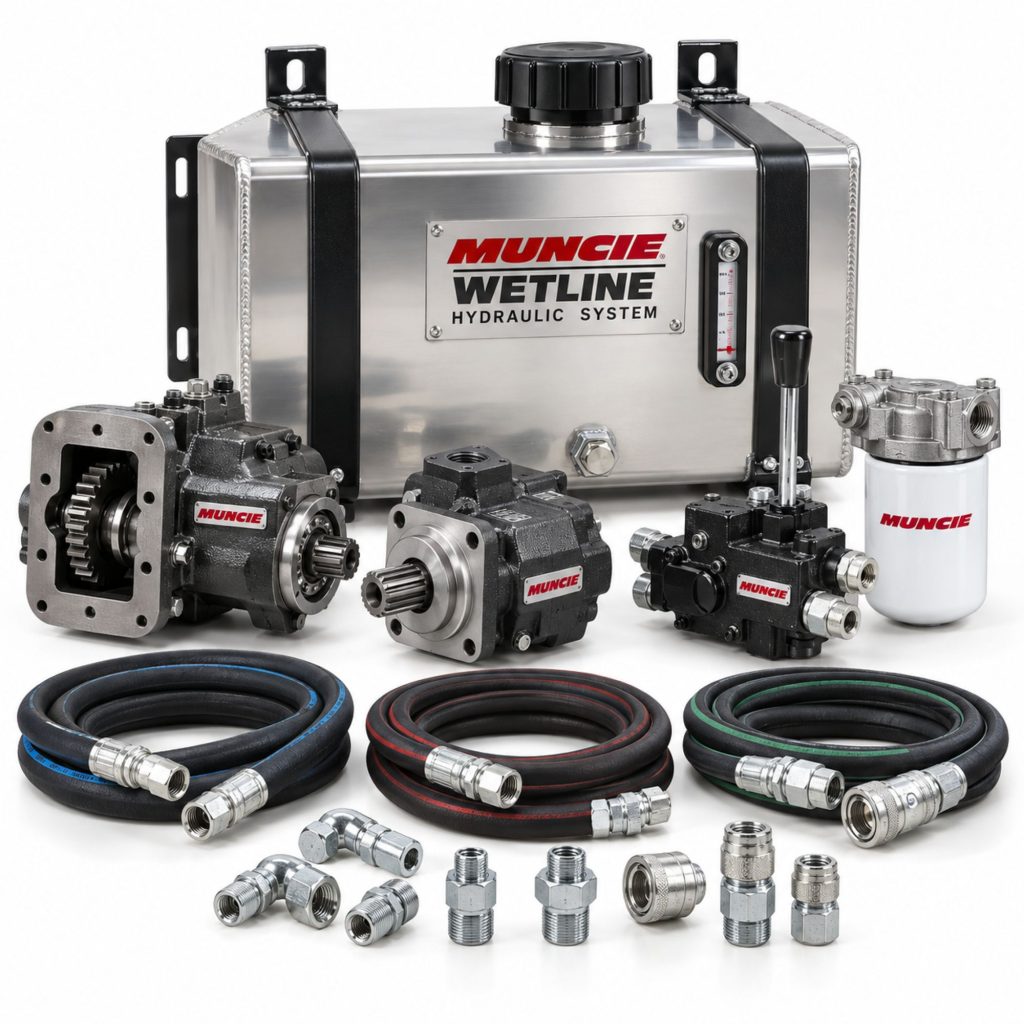
The Muncie WETLINE Hydraulic System is a configurable hydraulic package for commercial trucks and tractors that operate dump trailers, dump bodies, and other hydraulically powered vocational equipment.
Rather than requiring the installer to source each component separately, a Muncie wet-line package can combine the transmission power take-off, hydraulic pump, reservoir, controls, hoses, fittings, filtration equipment, and mounting hardware needed for the intended application.
Muncie offers two-line and three-line dump systems along with application-specific combination kits. The final package must be matched to the transmission, trailer or body, hydraulic-cylinder requirements, operating pressure, required flow, duty cycle, and available chassis space.
Muncie states that it began packaging wet-line kits nearly four decades ago and helped introduce polyethylene reservoirs to this market. Current reservoir choices include steel, aluminum, and polyethylene designs in multiple shapes and capacities.
Key Characteristics
- Complete configurable hydraulic-system package
- Two-line and three-line dump-system options
- Application-specific combination systems
- Transmission-mounted power take-off
- Hydraulic pump selected for required flow, pressure, and duty cycle
- Steel, aluminum, or polyethylene reservoirs
- Reservoir capacities commonly ranging from 25 to 100 gallons
- Different reservoir shapes and mounting arrangements
- Air, electric, hydraulic, or manual control options
- Application-specific hoses and fittings
- Available hydraulic filtration
- Wet Line Kit Builder available through Muncie Power Products
- Designed for commercial trucks, tractors, bodies, and trailers
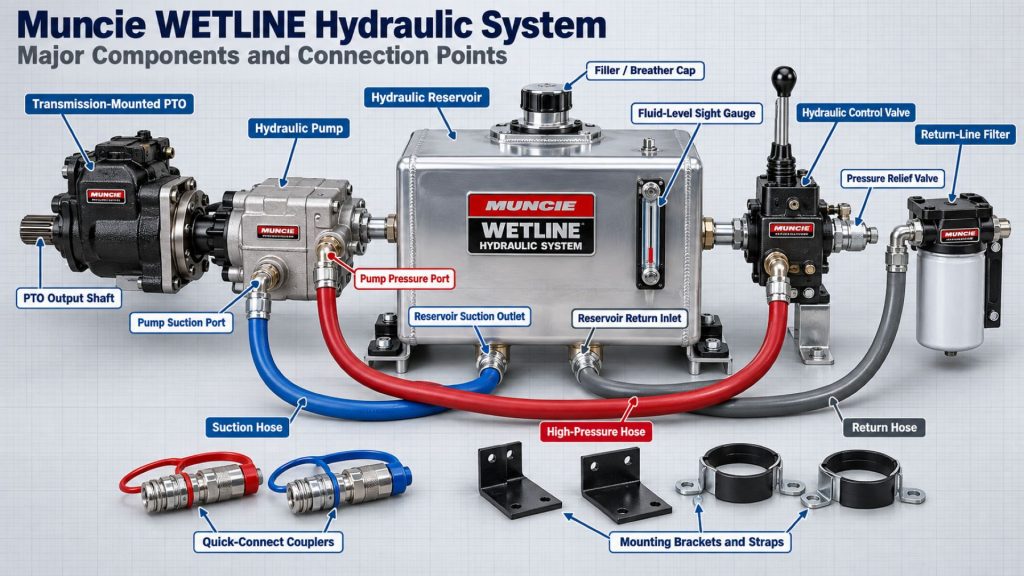
Major Components
- Transmission power take-off
- PTO shift system
- Hydraulic dump pump, gear pump, or piston pump
- Hydraulic-fluid reservoir
- Reservoir mounting brackets and straps
- Fill cap and reservoir breather
- Suction hose
- Pressure hose
- Return hose on three-line systems
- Hydraulic fittings and adapters
- Quick-disconnect couplers
- Directional-control valve
- Pressure-relief valve
- Return-line filter where specified
- Cab-mounted operating controls
- Air lines, wiring, or control cables
- Pressure and temperature monitoring equipment where specified
- Installation hardware
Product Type and Construction
The Muncie WETLINE Hydraulic System is a collection of matched components rather than one single pump or control unit. Each package is configured around the truck’s transmission and the hydraulic demands of the connected body or trailer.
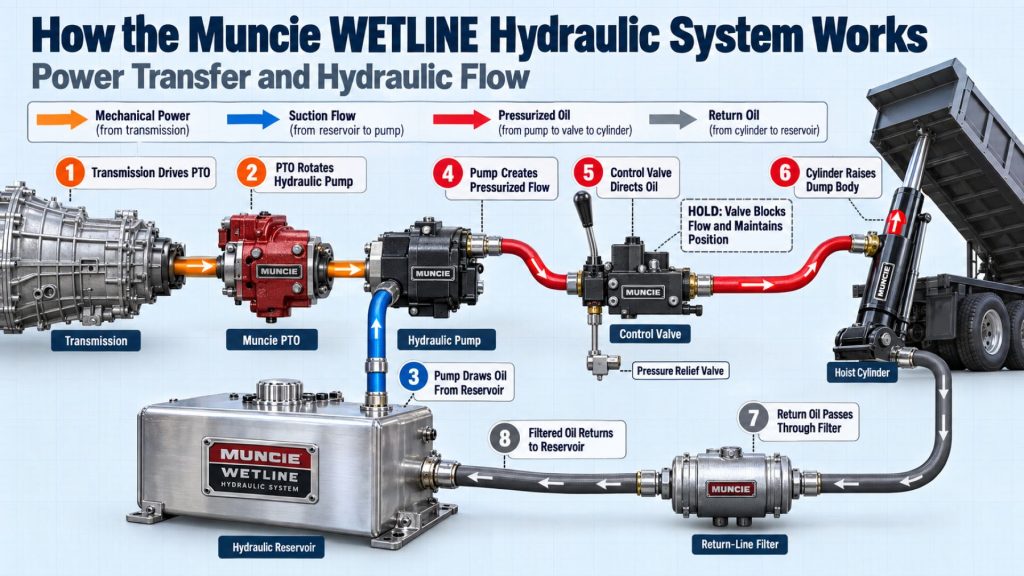
The PTO transfers mechanical power from the transmission to the hydraulic pump. The pump draws fluid from the reservoir and supplies pressurized flow to the trailer or body. Hoses, valves, controls, couplers, filters, and safety devices complete the hydraulic circuit.
Muncie reservoirs may be constructed from steel, aluminum, or polyethylene. Available reservoir styles can include round, upright, box, and other application-specific configurations.
How the Wet-Line Hydraulic System Works
When the PTO is engaged, transmission power rotates the hydraulic pump. The pump draws hydraulic fluid from the reservoir through the suction line and sends pressurized flow toward the truck body or trailer.
In a typical end-dump application, the control valve directs pump flow to a single-acting telescopic cylinder. The cylinder extends and raises the trailer or body. A load-check function helps prevent pressurized oil from flowing backward while the body is raised.
When the operator selects lower, gravity retracts the cylinder as hydraulic fluid returns to the reservoir. The plumbing route depends on whether the truck uses a two-line or three-line system.
The system pressure depends on the load and resistance encountered by the hydraulic equipment. A correctly adjusted relief valve limits excessive pressure and helps protect the pump, hoses, valves, cylinder, and connected equipment.
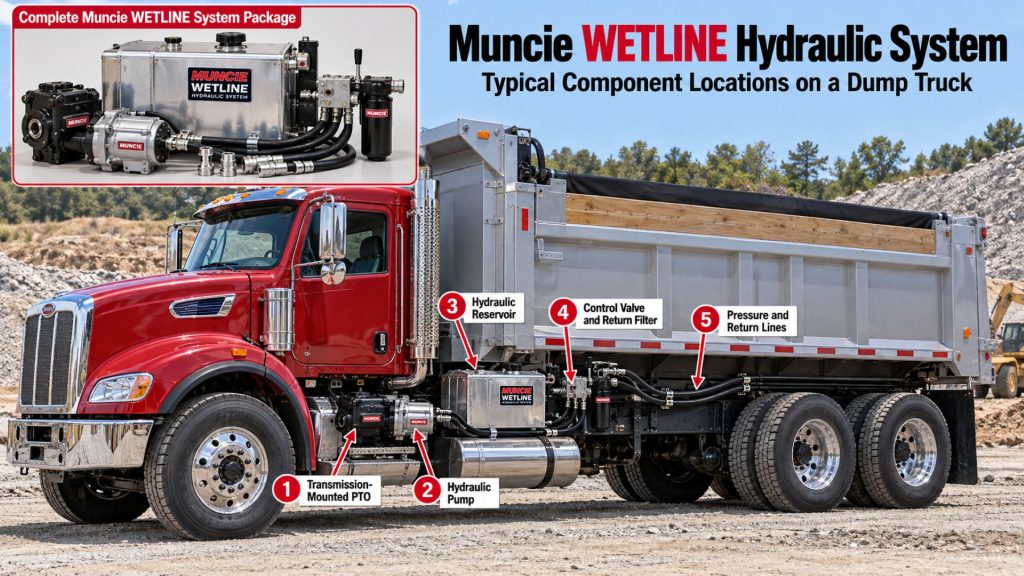
Position and Function Within the Vehicle
The PTO is mounted to a compatible transmission opening. The hydraulic pump may attach directly to the PTO or be remotely mounted and driven through a short pump driveshaft.
The reservoir is normally secured to the frame behind the cab or along a frame rail. Its position must provide sufficient clearance from the exhaust, driveline, suspension, tires, fuel tanks, air reservoirs, and trailer equipment.
Pressure, return, and suction hoses connect the system components. Tractors operating hydraulic trailers commonly use frame- or deck-mounted quick-disconnect couplers to connect the wet line to the trailer.
Common Specifications
- System Type: Complete commercial-truck hydraulic wet-line package
- Hydraulic Circuit: Two-line, three-line, or application-specific combination circuit
- Power Source: Transmission-mounted power take-off
- PTO Mounting Options: Application-specific 6-, 8-, or 10-bolt arrangements where supported by the transmission
- Pump Type: Dump, gear, or piston pump selected for the application
- Reservoir Materials: Steel, aluminum, or polyethylene
- Reservoir Capacity Range: Commonly approximately 25 to 100 gallons
- Reservoir Configurations: Round, upright, box, and application-specific designs
- Control Types: Air, electric, hydraulic, or manual
- Filtration: Return-line or other application-specific filtration where required
- Hose Lengths: Selected according to truck dimensions and component placement
- Primary Applications: Dump trucks, end-dump trailers, and compatible vocational hydraulic equipment
Flow, pressure, PTO ratio, reservoir capacity, hose size, relief setting, and duty-cycle ratings depend on the selected components. The complete Muncie build specification must be reviewed before installation.
Flow, Pressure, and Operating Capacity
A Muncie wet-line system does not have one universal flow or pressure rating. Its capacity depends on the selected pump displacement, PTO ratio, engine speed, control valve, hoses, fittings, reservoir, and connected hydraulic equipment.
The pump must provide enough flow to operate the cylinder or hydraulic motor at an acceptable speed without exceeding the flow capacity of the valves, filters, hoses, and couplers.
Pressure requirements are established by the hydraulic load. Every system component must be rated above the maximum expected operating pressure, and the relief valve must be adjusted to protect the lowest-rated component.
Continuous-duty applications usually require different pumps, reservoirs, valves, cooling capacity, and filtration than an intermittent end-dump system.
Two-Line and Three-Line System Design
A two-line dump system uses one hose between the reservoir and pump and one pressure-and-return connection between the pump and trailer cylinder. It can operate effectively when used correctly, but leaving the PTO and pump operating with the valve in neutral causes fluid to recirculate internally and generate heat.
A three-line system adds a dedicated return line from the pump or control circuit to the reservoir. This lets returning fluid reach the reservoir without being forced back through the inlet circuit.
Muncie identifies several advantages of a correctly designed three-line system:
- Faster dump-body or trailer lowering cycles
- Reduced hydraulic restriction during return flow
- Lower system operating temperature
- Easier integration of return-line filtration
- Reduced likelihood of heat-related pump failure
A three-line system does not raise a dump trailer faster solely because it has an additional hose. Its cycle-time advantage normally appears while the body is lowering and oil is returning to the reservoir.
PTO, Pump, and Transmission Integration
The PTO must match the transmission model, PTO opening, mounting position, available clearance, required rotation, desired pump speed, torque demand, and intended duty cycle.
Muncie offers PTOs for many manual, automated manual, and automatic transmissions. Depending on the transmission, the system may use air, electric-over-air, electric, hydraulic, or mechanical PTO engagement.
The PTO ratio determines pump speed relative to engine or transmission speed. An incorrect ratio can produce insufficient flow, overspeed the pump, create excessive equipment speed, or overload the PTO and transmission.
The pump’s required rotation, shaft, mounting flange, displacement, and pressure rating must match the PTO and hydraulic system.
Reservoir Design and Capacity
Muncie offers hydraulic reservoirs in aluminum, steel, and polyethylene. Common capacities range from approximately 25 to 100 gallons, with the correct size depending on cylinder volume, system flow, duty cycle, cooling needs, and available chassis space.
The reservoir must contain enough usable oil to extend the cylinder without uncovering the suction outlet. It also requires additional space for fluid returning from the equipment, thermal expansion, air separation, and fluid movement.
Reservoir design may include:
- Fill cap and breather
- Suction and return ports
- Internal diffuser
- Fluid-level indicator
- Temperature indicator
- Drain port
- Return-line filter mounting
- Mounting brackets and straps
- Internal baffles where specified
The reservoir must be securely mounted without creating excessive frame stress or allowing movement that damages the tank, brackets, hoses, or nearby equipment.
Hoses, Fittings, and Quick-Disconnect Couplers
Wet-line hoses must be sized for the expected flow, pressure, temperature, fluid, and routing conditions. Muncie offers braided, spiral, suction, large-bore, and application-specific hose products.
Available fitting styles can include JIC 37-degree, ORFS, NPTF, NPSM, SAE boss, BSP, Code 61, Code 62, and other configurations. The fitting must match both the hose and connected component.
Quick-disconnect couplers allow tractors to connect and disconnect from hydraulic trailers. Couplers must be pressure-rated, flow-compatible, clean, fully engaged, and correctly identified to prevent reversed connections.
Hoses should be protected from abrasion, excessive heat, crushing, twisting, sharp bends, tire contact, suspension movement, and trailer articulation.
Controls and Electronic Integration
Wet-line controls may be installed in the cab, on the chassis, at the reservoir, or near the hydraulic equipment. The exact arrangement depends on the PTO, pump, valve, body, trailer, and fleet operating requirements.
Available functions may include:
- PTO engage and disengage
- Hydraulic raise, neutral, and lower
- Engine-speed control
- Pressure selection
- Low-fluid warning
- High-temperature warning
- PTO status indicator
- Body-raised warning
- Transmission interlock
- Parking-brake interlock
- Remote operating controls
- Emergency stop
Electronic or pneumatic controls must be installed so the operator can positively identify PTO and hydraulic-valve status.
Filtration, Cooling, and Fluid Management
Hydraulic contamination can damage pumps, valves, cylinders, motors, and seals. A three-line wet kit provides a convenient location for return-line filtration because returning oil travels through a dedicated hose to the reservoir.
The filter must be rated for the maximum expected return flow. Oil can return from a lowering dump cylinder at a higher instantaneous rate than the pump’s normal output, making an undersized filter a serious restriction.
Muncie offers return-line filters in different configurations and flow capacities. Filter-condition indicators can help establish service intervals based on actual restriction.
Systems with long operating cycles may require increased reservoir capacity, additional cooling, or a different pump-and-valve arrangement. A standard intermittent-duty dump system should not be assumed suitable for continuous-duty equipment.
Duty Cycle and Application Requirements
Standard end-dump wet-line systems normally operate intermittently. The pump runs long enough to raise the body, and hydraulic power is then discontinued after the body returns to its transport position.
Moving-floor, live-bottom, ejector, lowboy, tanker, and other specialized trailers may require longer operating cycles, different pressures, bidirectional flow, or hydraulic motors. These applications require a system designed specifically for their demands.
Muncie’s Combo Kit II is one example of a system intended to support both a standard dump trailer and equipment such as a walking-floor, live-bottom, or ejector trailer. It uses a continuous-duty pump, 50-gallon steel reservoir, high-volume filter, and reservoir-mounted directional valve.
Mounting and Installation
Installation begins with confirming the transmission model, PTO opening, PTO mounting position, pump requirements, reservoir location, hose routing, control system, and trailer connections.
The PTO must be installed with correct backlash, fasteners, seals, and transmission-clearance checks. Direct-mount pumps require sufficient support and clearance, while remote-mounted pumps require an aligned and guarded driveshaft.
The reservoir brackets must support the full weight of the tank and hydraulic fluid under road shock, frame movement, braking, and cornering. Drilling, welding, or modifying the frame must follow approved vehicle-manufacturer procedures.
The completed system must be filled, primed, bled, pressure-tested, inspected for leaks, and operated through its full range before the truck enters service.
Vehicle, Transmission, and Trailer Compatibility
Compatibility depends on the truck manufacturer, model, engine, transmission, PTO opening, frame layout, exhaust position, fuel-tank placement, air-system components, wheelbase, and intended trailer or body.
Trailer compatibility depends on:
- Required hydraulic flow
- Maximum operating pressure
- Cylinder displacement
- Single- or double-acting circuit
- Two-line or three-line plumbing
- Quick-coupler size and type
- Pressure and return connection locations
- Hydraulic-fluid compatibility
- Required duty cycle
- Control-valve requirements
A wet-line system should not be selected solely because it physically connects to the trailer. The complete hydraulic specifications must be compatible.
Common Applications
- End-dump trailers
- Dump trucks
- Dump bodies
- Dump inserts
- Transfer trailers
- Walking-floor trailers with an appropriate continuous-duty system
- Live-bottom trailers with an appropriate combination system
- Ejector trailers with an appropriate combination system
- Lowboy and equipment trailers
- Tanker and liquid-transfer equipment
- Roll-off trucks
- Vocational truck bodies
- Specialized hydraulic trailers
Advantages
- Provides a complete matched hydraulic package
- Reduces the need to source components from multiple manufacturers
- Can include the PTO, pump, reservoir, controls, hoses, and fittings
- Configurable for different trucks and transmissions
- Two-line and three-line options are available
- Multiple reservoir materials and capacities are available
- Three-line configurations can reduce system heat
- Three-line systems can support faster lowering cycles
- Return-line filtration can improve fluid cleanliness
- Different pump types support different pressures and duty cycles
- Online configuration tools assist with component selection
- Muncie offers replacement parts and technical support
Limitations or Considerations
- Every system requires application-specific configuration
- Incorrect PTO ratios can overspeed or underdrive the pump
- Two-line systems can generate excessive heat if left in neutral
- Reservoir and hose sizing directly affect performance
- Hydraulic-system installation adds weight to the truck
- Reservoir placement reduces available frame space
- Quick couplers introduce potential restriction and contamination points
- Continuous-duty equipment requires a suitable pump and cooling capacity
- Trailer hydraulic requirements are not standardized
- Incorrectly connected pressure and return lines can damage equipment
- Hydraulic leaks can create safety and environmental hazards
- Installation should be completed by a qualified PTO and hydraulic-equipment specialist
Driver and Operator Experience
A correctly configured wet-line system should provide predictable trailer or body movement at the designated engine speed. The operator should be able to identify PTO engagement and hydraulic-control position clearly.
Drivers should monitor the system for unusual pump noise, slow operation, jerky movement, excessive hydraulic temperature, leaking couplers, damaged hoses, warning indicators, and unexpected equipment movement.
The PTO should be disengaged when hydraulic power is no longer needed. The truck must not be driven with a dump body or trailer raised unless a specifically approved operating procedure requires limited movement.
Connecting and Operating the Wet-Line System
Operators must follow the instructions supplied by the truck, transmission, PTO, wet-line, body, and trailer manufacturers. A general operating sequence includes:
- Park the tractor and trailer on firm, level ground when possible.
- Apply the parking brakes and secure the vehicle.
- Inspect the hoses and clean the quick-disconnect couplers.
- Connect each pressure and return hose to its correct coupling.
- Confirm that the couplers are fully engaged.
- Check the reservoir fluid level and inspect for leaks.
- Place the transmission and engine controls in the specified operating condition.
- Engage the PTO using the approved procedure.
- Operate the hydraulic control smoothly while monitoring the body or trailer.
- Return the control to neutral when the desired position is reached.
- Lower the equipment fully before disengaging the PTO.
- Relieve trapped pressure before disconnecting the hydraulic couplers.
This overview does not replace manufacturer instructions, operator training, fleet procedures, or jobsite safety requirements.
Inspection and Wear Points
- PTO housing, fasteners, and seals
- PTO shift components
- Hydraulic-pump housing and shaft seal
- Remote pump driveshaft and guard where equipped
- Reservoir body, brackets, and straps
- Reservoir fill cap and breather
- Fluid-level and temperature indicators
- Suction hose and fittings
- Pressure and return hoses
- Quick-disconnect couplers
- Directional-control valve
- Pressure-relief valve
- Filter housing and restriction indicator
- Air lines, wiring, and control cables
- Trailer cylinder and hydraulic connections
- Body hinges, pivots, and mechanical supports
Lubrication and Hydraulic-Fluid Requirements
The hydraulic fluid lubricates the pump, valves, cylinders, and other internal components. The system must use a fluid with the viscosity, temperature range, oxidation resistance, anti-wear performance, and seal compatibility required by Muncie and the equipment manufacturer.
The pump must not be operated dry. The suction line and pump should be primed according to the installation instructions before initial operation or after major service.
Remote pump driveshafts, universal joints, control pivots, and other external components should be lubricated according to their individual maintenance schedules.
Maintenance and Ownership Notes
Routine maintenance includes checking hydraulic-fluid level, inspecting for leaks, cleaning the reservoir breather, servicing filters, examining hoses, testing controls, and checking PTO and pump mounting.
Quick-disconnect couplers should be cleaned before connection and protected with caps when disconnected. Dirt introduced through couplers can circulate through the pump, valve, and cylinder.
The reservoir should be inspected internally when contaminated fluid, component failure, or repeated filter restriction is found. Replacing a failed pump without cleaning the remaining system can quickly damage the replacement.
Keep records of the PTO, pump, reservoir, filter, valve, hose, and coupler part numbers. A wet-line system contains multiple application-specific components that may have different replacement intervals.
Common Wet-Line and Hydraulic-System Problems
- Hydraulic equipment will not operate: An unengaged PTO, low fluid level, disconnected coupler, incorrect valve position, failed pump, broken drive, or obstructed hose may prevent operation.
- Slow hydraulic operation: Low pump speed, incorrect PTO ratio, worn pump, cold fluid, restricted hoses, clogged filter, internal leakage, or an overloaded body may reduce performance.
- Excessive hydraulic heat: Prolonged two-line neutral operation, continuous relief-valve operation, restricted return flow, undersized reservoir, incorrect pump selection, or internal leakage may create heat.
- Pump noise or cavitation: Low fluid level, restricted suction flow, collapsed hose, clogged breather, cold fluid, excessive pump speed, or air entering the inlet line may cause noise.
- Oil leaking at the quick couplers: Damaged seals, contamination, incompatible couplers, trapped pressure, loose fittings, or hose stress may cause leakage.
- Oil spraying from the reservoir breather: Overfilling, excessive aeration, incorrect return-line routing, reversed tank connections, or a restricted diffuser may force oil through the breather.
- Body or trailer drifts downward: Cylinder leakage, control-valve leakage, load-check failure, hose leakage, or damaged seals may allow movement.
- PTO will not engage: Insufficient air pressure, electrical failure, control problems, incorrect transmission status, damaged shift components, or PTO internal failure may be responsible.
- Filter repeatedly enters bypass: Contaminated fluid, undersized filtration, excessive return flow, cold oil, an incorrect filter element, or internal component wear may create excessive restriction.
Safety and Service Precautions
Never work beneath a raised body or trailer unless it is secured with an approved mechanical support. Hydraulic pressure alone must never be trusted to support raised equipment.
Disengage the PTO, shut down the engine, secure the vehicle, lower or support the equipment, and relieve stored hydraulic pressure before opening the system.
Never search for a hydraulic leak with a hand. High-pressure fluid can penetrate skin and requires immediate emergency medical treatment.
Keep clear of PTO shafts, pump driveshafts, couplings, and other rotating equipment. All exposed rotating components require proper guards.
Do not raise dump equipment near overhead power lines, on unstable ground, or where the load can shift and overturn the vehicle.
Identification Information
A Muncie wet-line system should be identified by its complete build information rather than by the general wet-line name alone.
- Truck manufacturer, model, and model year
- Vehicle identification number
- Transmission manufacturer and model
- Muncie PTO series and complete model number
- PTO ratio and shift type
- Hydraulic-pump model and displacement
- Pump rotation and mounting type
- Reservoir material, shape, and capacity
- Directional-control valve model
- Filter model and element number
- Hose sizes and pressure ratings
- Quick-coupler type and size
- Two-line, three-line, or combination configuration
- Hydraulic-fluid type
- Trailer or body hydraulic requirements
- Muncie Wet Line Kit Builder identification number when available
Buying Considerations
- Identify the exact truck transmission
- Confirm the available PTO opening and mounting position
- Determine the required hydraulic flow
- Determine the maximum operating pressure
- Confirm the equipment duty cycle
- Choose a two-line, three-line, or combination system
- Select the correct PTO ratio
- Match pump rotation, displacement, and mounting
- Calculate the required reservoir capacity
- Select steel, aluminum, or polyethylene construction
- Determine available frame space
- Size the suction, pressure, and return hoses
- Match the trailer’s quick-disconnect couplers
- Select adequate filtration and cooling
- Confirm hydraulic-fluid compatibility
- Choose the correct controls and interlocks
- Verify that all components share compatible ratings
- Use a qualified Muncie distributor or hydraulic-system installer
Variants and Configurations
- Two-line end-dump wet-line system
- Three-line end-dump wet-line system
- Combo Kit II multi-application system
- Direct-mount hydraulic pump
- Remote-mount hydraulic pump
- Dump-pump configuration
- Gear-pump configuration
- Piston-pump configuration
- Steel reservoir
- Aluminum reservoir
- Polyethylene reservoir
- Round reservoir
- Upright reservoir
- Box-style reservoir
- Different reservoir capacities from approximately 25 to 100 gallons
- Air, electric, hydraulic, or manual controls
- Application-specific hose and fitting packages
Comparison to Similar Equipment
Compared with the Parker Chelsea Wetline Hydraulic System, the Muncie package provides an alternative complete system built around Muncie PTOs, pumps, reservoirs, controls, hoses, and selection tools.
Compared with the Permco DM-640 Dump Pump, the Muncie WETLINE system includes the broader hydraulic package. The DM-640 is an individual pump-and-valve assembly that still requires a compatible PTO, reservoir, hoses, controls, and installation components.
Compared with the Muncie E Series Hydraulic Pump, the WETLINE system includes the supporting components needed to create a complete truck hydraulic circuit.
Compared with a collection of independently sourced components, a packaged wet-line system can simplify specification and purchasing. The installer must still verify that every selected component matches the exact truck and application.
Best Fit For
- Tractors that regularly pull end-dump trailers
- Dump trucks and vocational bodies
- Fleets seeking a matched PTO and hydraulic package
- Operators needing two-line or three-line configurations
- Applications requiring configurable reservoir capacity
- Trucks requiring steel, aluminum, or polyethylene reservoirs
- Installations using Muncie PTO and hydraulic components
- Specialized applications requiring a combination wet-line system
- Fleets with access to qualified hydraulic-system service
Related Vehicle and Trailer Types
- Complete Guide to Semi Truck Types
- Class 6 vs Class 7 vs Class 8 Trucks
- Dump Trucks
- Dump Trailers
- End-Dump Trailers
- Live-Bottom Trailers
- Walking-Floor Trailers
- Lowboy Trailers
- Vocational Trucks
Related Truck and Trailer Models
- Mack Granite
- Kenworth T880
- Peterbilt 567
- International HX Series
- Western Star 47X
- Western Star 49X
- Volvo VHD
- Freightliner 114SD
- Travis Dump Trailer
- MAC Dump Trailer
- Trail King Hydraulic RGN
Related PTO and Hydraulic System Types
- Power Take-Off Systems
- Hydraulic Pumps & Motors
- Wet Kits & Complete Hydraulic Systems
- Hydraulic Cylinders & Dump Hoists
- Hydraulic Valves, Controls & Reservoirs
- Hydraulic Hoses, Fittings & Filtration
- Two-Line Wet Kits
- Three-Line Wet Kits
- Continuous-Duty Hydraulic Systems
Related PTO and Hydraulic Products
- Parker Chelsea Wetline Hydraulic System
- Muncie E Series Hydraulic Pump
- Permco DM-640 Dump Pump
- Permco P5151 Hydraulic Pump
- Parker F1 Hydraulic Pump
- Parker F2 Twin-Flow Hydraulic Pump
- Bezares BEZA Lightweight Hydraulic Pump
- Muncie TG Series Power Take-Off
- Muncie CS6 Series Power Take-Off
- Muncie FR6Q Power Take-Off
Related Equipment Systems
- PTO & Hydraulic Systems
- Transmissions
- Electrical Systems
- Suspension Systems
- Axles & Differentials
- Brake Systems
- Tires & Wheels
Related Guides
- PTO & Hydraulic System Guides
- How Commercial Truck PTO and Hydraulic Systems Work
- Commercial Truck Power Take-Off Types Explained
- How to Choose a PTO and Hydraulic Pump
- Commercial Truck Wet Kits Explained
- How to Inspect and Maintain Truck Hydraulic Systems
- Two-Line vs Three-Line Hydraulic Systems
- How Dump Truck Hydraulic Systems Work
Regulatory and Compliance Notes
Installing a wet-line system does not increase the vehicle’s certified gross vehicle weight rating, gross axle weight ratings, payload capacity, or legal road-weight limits.
The installation must preserve safe operation of the transmission, driveline, brakes, steering, suspension, fuel system, exhaust system, electrical equipment, and vehicle frame.
Frame drilling, welding, reinforcement, and reservoir mounting must follow approved vehicle-manufacturer and body-builder procedures. Hydraulic hoses and components must meet applicable pressure, temperature, and fluid-compatibility requirements.
Hydraulic-fluid leaks and spills may be subject to workplace and environmental regulations. Operators and fleets should maintain appropriate spill-control equipment and reporting procedures.
Real World Operating Notes
Many wet-line problems are caused by mismatched components rather than a defective pump. A high-output pump paired with small hoses, restrictive couplers, or an undersized filter can create slow operation, heat, and excessive pressure loss.
Drivers should not assume that every hydraulic trailer can connect safely to the same tractor. Two trailers may use similar-looking couplers while requiring different flow, pressure, return plumbing, fluid, or duty cycles.
A three-line conversion should include the complete return circuit, proper pump or valve changes, correctly sized hoses, suitable filtration, and the correct reservoir connection. Adding a third hose without configuring the remaining components does not create a properly operating three-line system.
When oil sprays from the reservoir breather after a three-line installation, pressure and return lines should be checked for incorrect routing or reversal before the system is operated again.
Frequently Asked Questions
What is a Muncie wet-line system?
It is a configurable commercial-truck hydraulic package that can include a PTO, pump, reservoir, controls, hoses, fittings, filtration, and installation components.
What equipment can a wet-line system operate?
Common applications include dump trailers, dump bodies, and other vocational hydraulic equipment. Specialized trailers require application-specific systems.
What is the difference between a two-line and three-line wet kit?
A three-line system adds a dedicated return hose to the reservoir. This reduces return-flow restriction and can help the system run cooler than a comparable two-line arrangement.
Does a three-line system raise a dump trailer faster?
Not necessarily. Muncie explains that the main cycle-time benefit occurs while lowering because the dedicated return line reduces restriction.
What reservoir materials are available?
Muncie offers steel, aluminum, and polyethylene reservoirs in different capacities and shapes.
How large are Muncie wet-line reservoirs?
Common Muncie reservoir capacities range from approximately 25 to 100 gallons, although the correct size depends on the specific hydraulic application.
Can one wet kit operate different trailer types?
Only when the system is designed for the flow, pressure, controls, and duty cycles required by each trailer. Muncie offers combination systems for certain multi-application requirements.
Why does a wet-line system become hot?
Common causes include leaving a two-line pump operating in neutral, running over the relief valve, restricted hoses or filters, incorrect pump sizing, internal leakage, low fluid level, or inadequate reservoir capacity.
Can a standard dump wet kit operate a walking-floor trailer?
Not automatically. Walking-floor systems typically require a continuous-duty hydraulic package selected for their pressure, flow, filtration, cooling, and operating-time requirements.
How is the correct Muncie wet-line system identified?
Use the truck, transmission, PTO, pump, reservoir, valve, hose, coupler, and trailer specifications along with the Muncie build information.
Availability and Where to Find
Muncie wet-line systems and replacement components are available through Muncie Power Products distributors, commercial-truck equipment dealers, hydraulic-system installers, trailer dealers, body builders, and heavy-duty parts suppliers.
Availability and pricing depend on the transmission, PTO, pump, reservoir, control, hose, fitting, filtration, and mounting requirements. Buyers should obtain a complete application-specific build rather than ordering a generic wet kit.
Current system information and configuration resources are available through the Muncie Wet Line Kit product page and the Muncie Wet Line Kit Builder.
Support Trucking Families
Truck Equipment Atlas supports the mission of Grey Cross, a nonprofit dedicated to helping families of truck drivers who lose their lives while on the road. As the site grows, part of its mission is to bring awareness and support to these families.
Podcast or Video Section
Learn More Through Audio and Video
Truck Equipment Atlas will continue expanding with podcast episodes, interviews, and equipment breakdowns to help drivers and fleets better understand trucks and equipment.
Follow the Growth of Truck Equipment Atlas
Truck Equipment Atlas continues to expand with new truck profiles, trailer coverage, diesel engine pages, equipment system resources, manufacturer information, and educational guides.
Visit our Site Updates page to explore recent additions, project milestones, and upcoming resources as we continue building one of the industry’s growing commercial trucking equipment reference libraries.
View the Latest Site Updates: Truck Equipment Atlas Site Updates