
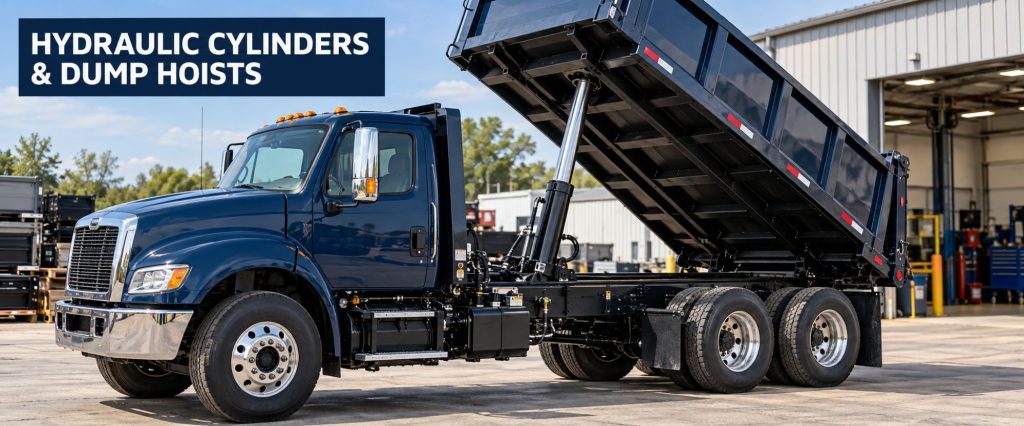
Hydraulic cylinders and dump hoists convert hydraulic pressure and flow into the linear movement needed to lift, lower, tilt, extend, position, and stabilize commercial truck bodies, trailers, platforms, and vocational equipment.
These systems are widely used on dump trucks, dump trailers, refuse vehicles, roll-off trucks, hooklift systems, lowboy trailers, utility equipment, recovery vehicles, and other commercial applications requiring controlled lifting force.
Truck Equipment Atlas covers telescopic cylinders, front-end cylinders, underbody hoists, scissor hoists, multistage cylinders, and related hydraulic-lifting systems used throughout the commercial trucking industry.
Hydraulic Cylinders and Dump Hoists on Truck Equipment Atlas
Explore the hydraulic cylinders and dump-hoist systems currently covered on Truck Equipment Atlas:
- Hyva Alpha Series Front-End Cylinder
- Mailhot G3 Telescopic Hydraulic Cylinder
- Custom Hoists 500 Series Underbody Hoist
Additional telescopic cylinders, underbody hoists, scissor hoists, stabilization cylinders, hydraulic rams, and manufacturer product families will be added as the Truck Equipment Atlas PTO & Hydraulic Systems Library continues to expand.
How Hydraulic Cylinders Work
A hydraulic cylinder converts pressurized fluid into linear force and movement. Hydraulic fluid enters the cylinder and acts against a piston, plunger, or telescoping stage.
The pressure acting over the effective area of the cylinder creates force. The amount of movement depends on the volume of fluid supplied and the cylinder’s internal dimensions.
A typical hydraulic-cylinder assembly can include:
- Cylinder barrel
- Piston
- Piston rod or plunger
- Telescoping stages where equipped
- Head and base
- Hydraulic ports
- Seals and wear rings
- Rod wiper
- Mounting eyes, trunnions, pins, or brackets
- Hydraulic hoses and fittings
The cylinder must be matched to the required force, stroke, mounting arrangement, pressure, operating angle, equipment geometry, and expected duty cycle.
How Dump Hoists Work
A dump hoist uses one or more hydraulic cylinders and a structural lifting mechanism to raise a truck or trailer body around its rear hinge.
When hydraulic fluid enters the cylinder, the cylinder extends and raises the body. Depending on the design, the cylinder may act directly against the body or move a scissor, linkage, or lever mechanism.
When the body is lowered, hydraulic fluid returns to the reservoir. Gravity commonly provides the lowering force, although some systems use double-acting cylinders for powered movement in both directions.
The complete dump-hoist system can include:
- Truck or trailer frame
- Dump body
- Rear hinge assembly
- Hydraulic cylinder
- Hoist frame or lifting linkage
- Mounting brackets and pivot pins
- Power take-off
- Hydraulic pump
- Hydraulic reservoir
- Control valve
- Hoses and fittings
- Body-prop or safety-support system
The hoist, body, frame, hinge, cylinder, pump, valves, and hydraulic circuit must be engineered as a complete lifting system.
Common Hydraulic Cylinder Types
Commercial trucks and trailers use several hydraulic-cylinder designs.
Common types include:
- Single-acting cylinders
- Double-acting cylinders
- Single-stage cylinders
- Multistage telescopic cylinders
- Front-end dump cylinders
- Underbody cylinders
- Inverted telescopic cylinders
- Rod-style cylinders
- Plunger cylinders
- Stabilizer and outrigger cylinders
- Steering cylinders
- Liftgate cylinders
- Compactor cylinders
- Hooklift and roll-off cylinders
The correct cylinder design depends on required stroke, available installation space, lifting geometry, force, operating pressure, speed, environment, and equipment movement.
Telescopic Hydraulic Cylinders
A telescopic hydraulic cylinder contains multiple nested stages that extend in sequence. This design provides a long working stroke from a relatively compact retracted length.
Telescopic cylinders are commonly used where the body or equipment must travel a substantial distance but available chassis space is limited.
Common applications include:
- Dump trucks
- End-dump trailers
- Transfer trailers
- Refuse equipment
- Roll-off systems
- Specialized lifting equipment
The stages must remain clean, straight, adequately lubricated, and free from dents, scoring, corrosion, or side loading that can damage seals and bearing surfaces.
Front-End Dump Cylinders
A front-end cylinder is mounted near the front of the dump body and extends upward to raise the body around its rear hinge.
Front-end telescopic cylinders are frequently used on heavy-duty dump trucks and end-dump trailers because they can provide a long stroke and high lifting force.
Proper installation requires:
- Correct cylinder capacity
- Approved mounting geometry
- Strong frame and body mounting structures
- Correct rear-hinge placement
- Adequate clearance through the complete lifting range
- Correct hose length and routing
- Protection against excessive side loading
- Proper body alignment
The cylinder should remain aligned with the intended lifting path as the body rises and lowers.
Underbody Dump Hoists
An underbody hoist is installed beneath the dump body between the body and vehicle frame. The system can use a hydraulic cylinder with a scissor, lever, or linkage mechanism to raise the body.
Underbody hoists are commonly used on:
- Medium-duty dump trucks
- Landscape bodies
- Contractor dump bodies
- Municipal trucks
- Agricultural bodies
- Material-handling bodies
- Small and medium dump trailers
The hoist model must match the body length, body overhang, mounting height, load distribution, maximum dumping angle, chassis dimensions, and required lifting capacity.
Scissor Hoists
A scissor hoist uses pivoting structural arms connected to a hydraulic cylinder. As the cylinder extends, the arms open and raise the dump body.
The geometry of the scissor mechanism can provide substantial lifting force near the beginning of the dumping cycle, when the body and payload place high demand on the hoist.
Scissor-hoist performance depends on:
- Hoist length and design
- Cylinder bore and stroke
- Pivot-point placement
- Body length and overhang
- Payload weight and distribution
- Frame mounting
- Rear-hinge location
- Hydraulic-system pressure
A visually similar scissor hoist should not be substituted without confirming its complete engineering specifications.
Single-Acting and Double-Acting Cylinders
A single-acting cylinder uses hydraulic pressure to move in one direction. Gravity, equipment weight, or a mechanical force returns the cylinder in the opposite direction.
Many dump-body and dump-trailer cylinders use single-acting operation because hydraulic power raises the body and gravity lowers it.
A double-acting cylinder uses hydraulic pressure to move in both directions. Separate ports direct fluid to opposite sides of the piston.
Double-acting cylinders may be used where equipment must be positively extended and retracted, including:
- Outriggers
- Stabilizers
- Hooklift systems
- Roll-off equipment
- Liftgates
- Refuse bodies
- Recovery equipment
- Specialized trailer systems
Cylinder Force, Stroke, and Operating Pressure
Hydraulic-cylinder performance depends on the relationship between operating pressure, effective piston area, stroke, equipment geometry, and load.
Important specifications include:
- Cylinder bore
- Rod diameter
- Number of telescopic stages
- Retracted length
- Extended length
- Total stroke
- Maximum operating pressure
- Rated lifting capacity
- Mounting style
- Port size and location
- Operating angle
- Required hydraulic-fluid volume
Cylinder force alone does not determine how much payload a dump body can safely lift. Body geometry, pivot placement, load position, frame strength, hinge design, hoist structure, and vehicle stability must also be considered.
Dump Angle and Body Geometry
The dump angle affects how easily material leaves the body. Different materials require different body designs, floor surfaces, sidewall shapes, and dumping angles.
Dump-body geometry includes:
- Body length
- Body height
- Body overhang
- Rear-hinge location
- Cylinder mounting position
- Hoist pivot locations
- Maximum cylinder extension
- Chassis mounting height
- Tailgate design
- Payload center of gravity
Changing the body, hinge position, hoist mounting point, or cylinder position can significantly affect lifting force, stability, and structural loading.
Vehicle Stability During Dumping
Raising a loaded dump body moves the combined center of gravity upward and can reduce vehicle or trailer stability.
Conditions that can increase rollover or equipment-damage risk include:
- Uneven or soft ground
- Side slopes
- Unevenly distributed material
- Material frozen or stuck inside the body
- A load hanging in the upper body
- High winds
- Damaged suspension or tires
- Incorrect tire pressure
- Misaligned body or hoist components
- Excessive payload
- Sudden or uncontrolled body movement
The vehicle should be positioned according to the equipment manufacturer’s instructions before the body is raised.
Common Applications
Hydraulic cylinders and dump hoists are used throughout commercial trucking and vocational equipment.
Common applications include:
- Dump trucks
- End-dump trailers
- Side-dump trailers
- Transfer trailers
- Landscape trucks
- Contractor dump bodies
- Municipal trucks
- Refuse vehicles
- Roll-off trucks
- Hooklift trucks
- Liftgates
- Utility and service trucks
- Truck-mounted cranes
- Tow trucks and recovery vehicles
- Detachable-gooseneck trailers
- Agricultural trucks and trailers
- Specialized transport equipment
Each application requires a cylinder and lifting system matched to its specific load, movement, geometry, pressure, and operating environment.
Advantages of Hydraulic Cylinders and Dump Hoists
Depending on the application, hydraulic cylinders and hoists can provide several advantages:
- High lifting force from compact components
- Controlled lifting and lowering
- Long stroke from telescopic designs
- Flexible component placement
- Compatibility with truck and trailer hydraulic systems
- Wide selection of sizes and mounting arrangements
- Ability to lift heavy bodies and payloads
- Support for multiple vocational applications
- Established service and replacement-parts networks
These characteristics make hydraulic cylinders a primary source of linear force throughout commercial truck and trailer equipment.
Limitations and Considerations
Hydraulic cylinders and dump hoists also have important limitations and operating considerations:
- Cylinder capacity does not replace complete hoist engineering
- Side loading can damage cylinder stages and seals
- Contaminated fluid can cause internal wear
- Damaged rods or stages can destroy seals
- Incorrect mounting geometry can overload components
- Hydraulic leaks can reduce lifting performance
- Raised bodies create stability risks
- Improper body support can create fatal service hazards
- Overloading can damage the body, frame, hinge, or hoist
- Material can stick and unload unevenly
- Replacement cylinders must match the original specifications
The complete body, hoist, cylinder, frame, hydraulic circuit, and vehicle application must be evaluated together.
Driver and Operator Considerations
Drivers and equipment operators should understand the complete lifting procedure before operating a dump body, hoist, cylinder, liftgate, outrigger, or other hydraulic equipment.
Operators should monitor:
- Ground condition and slope
- Payload weight and distribution
- Overhead clearance
- Body alignment
- Tailgate operation
- PTO engagement
- Engine speed
- Hydraulic pressure
- Unusual cylinder movement
- Hydraulic leaks
- Body-up warning indicators
- People and equipment around the vehicle
Personnel should remain clear of raised bodies, moving equipment, pinch points, hydraulic leaks, and the discharge area.
Maintenance and Ownership
Hydraulic cylinders and dump hoists require regular inspection because their structural and hydraulic components carry substantial loads.
Important maintenance areas include:
- Cylinder barrels, rods, and telescopic stages
- Hydraulic seals and wipers
- Hydraulic hoses and fittings
- Cylinder mounting points
- Hoist frame and structural members
- Pivot pins and bushings
- Rear hinge assembly
- Body mounting structure
- Chassis attachment points
- Hydraulic-fluid level and condition
- Control valve and pressure-relief system
- Body prop or safety support
- Body-up warning system
- Signs of corrosion, cracking, bending, or misalignment
Jerky movement, drifting, leaking seals, bent stages, damaged pivots, structural cracks, uneven lifting, or unusual noise should be investigated before the equipment is returned to service.
Cylinder and Dump-Hoist Manufacturers
Hydraulic cylinders and dump hoists are produced by manufacturers serving commercial trucks, trailers, mobile hydraulics, refuse equipment, construction, agriculture, and specialized transportation.
Manufacturers represented in the expanding Truck Equipment Atlas library include:
- Hyva
- Mailhot Industries
- Custom Hoists
- Commercial Intertech
- Delhoist
- Champion Hoist
- Harsh
- Crysteel
Available cylinders and hoists vary by body size, application, capacity, mounting geometry, pressure, stroke, geographic market, and equipment manufacturer.
Related PTO and Hydraulic Categories
Explore additional commercial PTO and hydraulic-equipment categories:
- Power Take-Off Systems
- Hydraulic Pumps & Motors
- Wet Kits & Complete Hydraulic Systems
- Hydraulic Valves, Controls & Reservoirs
- Hydraulic Hoses, Fittings & Filtration
Related PTO and Hydraulic Guides
Explore educational resources covering PTO operation, hydraulic-system selection, wet kits, inspection, and maintenance:
- How Commercial Truck PTO and Hydraulic Systems Work
- Commercial Truck Power Take-Off Types Explained
- How to Choose a PTO and Hydraulic Pump
- Commercial Truck Wet Kits Explained
- How to Inspect and Maintain Truck Hydraulic Systems
Visit the PTO & Hydraulic System Guides page to explore the complete educational guide collection.
Explore the Complete PTO & Hydraulic Systems Library
Hydraulic cylinders and dump hoists represent one part of the larger commercial truck hydraulic and vocational-equipment system.
Visit the Truck Equipment Atlas PTO & Hydraulic Systems Library to explore power take-offs, pumps, motors, wet kits, cylinders, hoists, valves, controls, reservoirs, hoses, fittings, filters, and complete hydraulic systems.
Additional cylinder profiles, dump-hoist systems, application guides, and educational resources will be added as Truck Equipment Atlas continues to expand.
Support Trucking Families
Truck Equipment Atlas supports the mission of Grey Cross, a nonprofit dedicated to helping families of truck drivers who lose their lives while on the road. As the site grows, part of its mission is to bring awareness and support to these families.
Follow the Growth of Truck Equipment Atlas
Truck Equipment Atlas continues to expand with new truck profiles, trailer coverage, diesel engine pages, equipment-system resources, manufacturer information, and educational guides.
Visit our Site Updates page to explore recent additions, project milestones, and upcoming resources as we continue building one of the industry’s growing commercial trucking equipment reference libraries.