
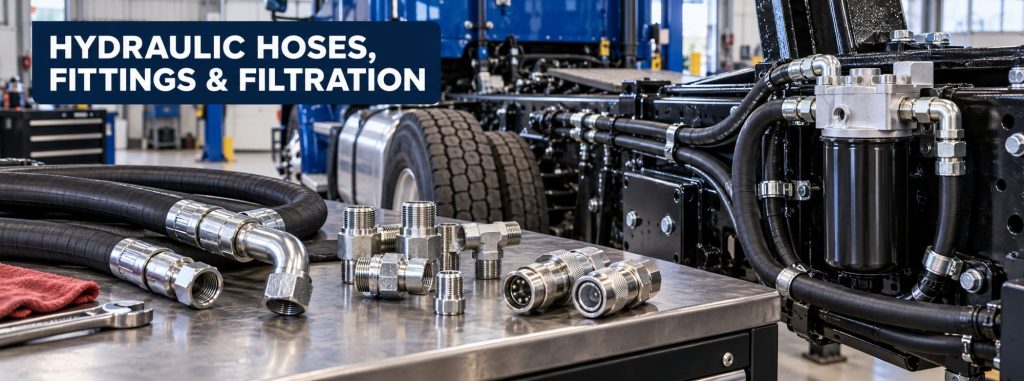
Hydraulic hoses, fittings, and filtration components carry, connect, clean, and protect the hydraulic fluid used throughout commercial-truck and trailer hydraulic systems.
These components operate between the hydraulic reservoir, pump, control valves, cylinders, motors, and other equipment. Correct selection and installation are essential for reliable performance, pressure containment, fluid cleanliness, and equipment safety.
Truck Equipment Atlas covers hydraulic hoses, tubes, fittings, couplers, adapters, filters, strainers, breathers, and related fluid-management products used throughout commercial trucking and vocational equipment.
Hydraulic Hose, Fitting, and Filtration Products on Truck Equipment Atlas
Truck Equipment Atlas is building a library of individual hydraulic hose, fitting, coupling, filtration, and fluid-management product profiles.
Future product coverage will include:
- High-pressure hydraulic hoses
- Low-pressure suction and return hoses
- Thermoplastic hydraulic hoses
- Hydraulic hose-end fittings
- Reusable hydraulic fittings
- Hydraulic quick couplers
- Hydraulic adapters and tube fittings
- Return-line hydraulic filters
- Pressure-line hydraulic filters
- Suction strainers
- Reservoir breathers
- Filter-condition indicators
Individual product links will be added as the Truck Equipment Atlas PTO and Hydraulic Systems Library continues to expand.
How Hydraulic Hoses and Fittings Work
Hydraulic hoses and rigid tubes carry fluid between the reservoir, hydraulic pump, valves, cylinders, motors, and other system components.
When a hydraulic pump creates flow, the system’s hoses and tubes must contain the resulting pressure while allowing fluid to reach the selected equipment.
Hydraulic fittings connect hoses and tubes to pumps, valves, reservoirs, cylinders, motors, filters, and manifolds. The fitting type, thread standard, sealing method, pressure rating, and material must match the complete hydraulic system.
For a broader explanation of the complete hydraulic circuit, read How Commercial Truck PTO and Hydraulic Systems Work.
Common Hydraulic Hose Types
Commercial-truck hydraulic systems use different hose constructions based on pressure, fluid, temperature, flexibility, and equipment movement.
Common hydraulic hose types include:
- Wire-braid hydraulic hose
- Spiral-wire hydraulic hose
- Textile-braid hydraulic hose
- Thermoplastic hydraulic hose
- Suction hose
- Return-line hose
- High-temperature hydraulic hose
- Low-temperature hydraulic hose
- Abrasion-resistant hydraulic hose
- Specialty hose for fire-resistant or biodegradable fluids
Hose construction must match the maximum working pressure, pressure spikes, required bend radius, fluid compatibility, temperature range, and operating environment.
Pressure, Suction, and Return Lines
A hydraulic system normally includes pressure, suction, and return lines with different operating requirements.
Pressure lines carry fluid from the pump toward control valves and working equipment. These hoses must withstand normal operating pressure, pressure spikes, vibration, and repeated equipment movement.
Suction lines carry fluid from the reservoir to the pump inlet. They must resist collapse while allowing unrestricted flow. Air entering through a damaged or loose suction connection can cause cavitation, foaming, noise, heat, and pump damage.
Return lines carry fluid back toward the reservoir. Although return pressure is usually lower than pressure-line pressure, return hoses and filters must still be sized to prevent excessive restriction and heat.
Hydraulic Hose Construction
A hydraulic hose normally includes several layers designed to contain fluid and withstand pressure.
Major hose layers can include:
- Inner tube compatible with the hydraulic fluid
- Wire, textile, or synthetic reinforcement
- Protective outer cover
- Additional abrasion or fire-resistant covering where required
The reinforcement provides pressure strength, while the outer cover protects the hose from abrasion, weather, oil, heat, chemicals, and environmental exposure.
Hydraulic Fittings and Adapters
Hydraulic fittings connect flexible hoses and rigid tubes to pumps, valves, reservoirs, cylinders, motors, filters, manifolds, and other system components.
Common hydraulic fitting and connection types include:
- JIC 37-degree flare fittings
- SAE O-ring boss fittings
- O-ring face-seal fittings
- NPT pipe-thread fittings
- SAE flange connections
- BSPP and BSPT fittings
- Metric hydraulic fittings
- Compression tube fittings
- Crimped hose ends
- Reusable hose fittings
- Straight, elbow, tee, and bulkhead adapters
Fittings that appear similar may use different threads, sealing surfaces, dimensions, and pressure ratings. Components should never be forced together or selected by appearance alone.
Hydraulic Quick Couplers
Hydraulic quick couplers allow hoses and equipment circuits to be connected and disconnected without removing threaded fittings.
They are used in applications requiring interchangeable trailers, detachable equipment, temporary hydraulic connections, or frequent attachment changes.
Quick couplers must match the required flow, pressure, fluid, connection profile, and operating environment. Mismatched coupler halves may not connect properly or may create excessive flow restriction.
Flat-face couplers can help reduce fluid loss and contamination during connection and disconnection. Other coupler designs may be selected for higher flow, lower restriction, or specialized equipment requirements.
How Hydraulic Filtration Works
Hydraulic filters remove particles and contaminants that can damage pumps, valves, cylinders, motors, seals, and other precision components.
Fluid contamination can enter the system during installation, component replacement, reservoir filling, hose failure, equipment operation, or normal component wear.
A properly designed filtration system maintains fluid cleanliness without creating excessive restriction. Filter size, media, micron rating, pressure capacity, flow rating, bypass setting, and installation location must match the hydraulic circuit.
Common Hydraulic Filter Types
Commercial-truck hydraulic systems can use several types of filtration equipment.
Common examples include:
- Return-line filters
- Pressure-line filters
- Suction strainers
- Spin-on hydraulic filters
- In-tank filter assemblies
- Offline or kidney-loop filters
- Magnetic contamination collectors
- Reservoir breather filters
- Water-removal filter elements
- Filter-condition indicators
The appropriate filtration arrangement depends on component sensitivity, required cleanliness, pump design, equipment duty cycle, operating environment, and hydraulic-fluid specification.
Return-Line Filtration
Return-line filters clean hydraulic fluid before it reenters the reservoir.
This arrangement can capture contamination generated by cylinders, motors, valves, and equipment operation before the fluid is used again.
The filter must be sized for the maximum possible return flow rather than normal pump flow alone. Certain cylinder and accumulator arrangements can temporarily produce return flow that exceeds the pump’s output.
Pressure-Line Filtration
Pressure-line filters are installed downstream from the hydraulic pump and are designed to withstand full system pressure.
They can provide additional protection for sensitive valves, servo components, proportional controls, hydraulic motors, and other precision equipment.
Pressure filters require housings and elements rated for the system’s maximum pressure, flow, temperature, and expected pressure spikes.
Reservoir Breathers and Suction Strainers
A reservoir breather allows air to enter and leave the hydraulic tank as fluid level changes. Filtered breathers help prevent airborne dust, moisture, and debris from entering the reservoir.
Suction strainers may be installed inside the reservoir or within the pump inlet circuit to prevent large debris from entering the pump.
An overly restrictive breather, suction strainer, or suction hose can reduce pump inlet flow and contribute to cavitation. System design must balance contamination control with unrestricted pump supply.
Dump Truck and Trailer Applications
Dump trucks and hydraulic dump trailers use hoses and fittings to connect the pump, reservoir, control valve, and hoist cylinder.
These hoses must accommodate chassis movement, body movement, vibration, changing temperatures, and repeated hydraulic cycles.
Many dump applications operate as part of a wet kit or complete hydraulic system. Hose size, coupler selection, reservoir filtration, and routing can significantly affect hoist speed and system temperature.
Walking-Floor and Bulk-Unloading Applications
Walking-floor trailers and other high-flow unloading systems may require large-diameter hoses, high-flow couplers, unrestricted return circuits, and substantial filtration capacity.
Undersized hoses or restrictive couplers can slow unloading, increase pressure loss, and create excessive hydraulic heat.
The tractor wet kit and trailer hydraulic system must use compatible pressure, return, and coupler arrangements.
Refuse, Utility, and Recovery Applications
Refuse trucks, utility vehicles, tow trucks, and recovery equipment can use numerous hoses to operate cylinders, hydraulic motors, booms, winches, outriggers, lifts, and other equipment.
These applications may require flexible hose routing through moving joints, hose carriers, protective guards, swivels, and articulated equipment structures.
Hoses must be protected from crushing, abrasion, excessive bending, hot exhaust components, sharp edges, and contact with moving equipment.
Advantages of Proper Hose and Filtration Selection
Correctly selected hydraulic hoses, fittings, and filtration components can provide several benefits:
- Reliable containment of hydraulic pressure
- Efficient fluid flow
- Reduced hydraulic heat
- Protection against fluid contamination
- Longer pump and valve life
- Improved cylinder and motor reliability
- Reduced leakage
- Improved equipment response
- Easier service and component replacement
- Improved connection between tractors and hydraulic trailers
These benefits depend on correct component sizing, assembly, routing, installation, inspection, and maintenance.
Limitations and Considerations
Hydraulic hoses, fittings, and filters also introduce important operating and ownership considerations.
These can include:
- Hose aging and fatigue
- Abrasion and impact damage
- Pressure-related hose failure
- Fluid leakage
- Incorrect fitting identification
- Improper hose assembly
- Excessive flow restriction
- Filter-element replacement requirements
- Contamination introduced during service
- Limited clearance around chassis equipment
- Different thread and sealing standards
A hose or fitting should never be selected only because it appears to fit. Pressure rating, size, material, fluid compatibility, temperature range, and connection standard must all be confirmed.
Hose Routing and Installation
Proper routing helps protect hydraulic hoses from premature failure.
Installation should account for:
- Minimum bend radius
- Hose length and movement
- Twisting during installation
- Abrasion against frames and brackets
- Clearance from exhaust components
- Clearance from tires and driveline components
- Suspension and articulation movement
- Body and hoist movement
- Secure clamps and supports
- Access for inspection and replacement
Protective sleeves, guards, clamps, bulkhead fittings, and hose carriers may be required in areas exposed to abrasion or repeated movement.
Inspection and Maintenance
Hydraulic hoses, fittings, and filters require regular inspection to identify deterioration before it causes leakage, contamination, equipment failure, or personal injury.
Important inspection areas include:
- Hose cuts, cracks, blisters, and exposed reinforcement
- Abrasion and flattened sections
- Loose, corroded, or damaged fittings
- Fluid leakage around connections
- Improper hose bends or twisting
- Damaged clamps and protective sleeves
- Quick-coupler condition and contamination
- Filter-condition indicators
- Filter-element service intervals
- Reservoir breather condition
- Hydraulic-fluid cleanliness
Read How to Inspect and Maintain Truck Hydraulic Systems for a broader overview of commercial-truck hydraulic maintenance.
Flexible Hose vs. Rigid Hydraulic Tubing
Flexible hydraulic hose accommodates equipment movement, vibration, changing alignment, and installation around chassis components.
Rigid hydraulic tubing can provide a compact and durable fluid path in areas where components remain stationary. Properly installed tubing may also reduce hose movement and improve routing along the frame.
Many commercial-truck hydraulic systems use both rigid tubing and flexible hose. Tubing may handle long stationary runs, while flexible hose connects moving components or isolates vibration.
The correct arrangement depends on pressure, flow, equipment movement, chassis layout, vibration, service access, and manufacturer requirements.
Related PTO and Hydraulic System Categories
Explore additional commercial-truck PTO and hydraulic system categories:
- Power Take-Off Systems
- Hydraulic Pumps & Motors
- Wet Kits & Complete Hydraulic Systems
- Hydraulic Cylinders & Dump Hoists
- Hydraulic Valves, Controls & Reservoirs
Related PTO and Hydraulic System Guides
Explore educational resources covering PTO operation, hydraulic-system selection, wet kits, maintenance, and equipment compatibility:
- How Commercial Truck PTO and Hydraulic Systems Work
- Commercial Truck Power Take-Off Types Explained
- How to Choose a PTO and Hydraulic Pump
- Commercial Truck Wet Kits Explained
- How to Inspect and Maintain Truck Hydraulic Systems
Visit PTO & Hydraulic System Guides to explore the complete educational guide library.
Explore the Complete PTO and Hydraulic Systems Library
Hydraulic hoses, fittings, and filtration components represent one part of the complete commercial-truck hydraulic power system.
Visit the Truck Equipment Atlas PTO & Hydraulic Systems Library to explore power take-offs, hydraulic pumps, motors, wet kits, cylinders, dump hoists, valves, controls, reservoirs, hoses, fittings, filtration systems, product profiles, and educational guides.
Additional hydraulic hose families, fittings, quick couplers, filtration products, replacement components, and technical resources will be added as Truck Equipment Atlas continues to expand.