
Quick Facts
- Manufacturer: Muncie Power Products
- Product Series: E Series
- Product Type: Fixed-displacement, unidirectional dump hydraulic pump
- Pump Construction: Three-piece cast-iron gear-pump design
- Available Models: E-23 and E-27
- Displacement Range: 5.20 to 6.37 cubic inches per revolution
- Theoretical Flow at 1,000 RPM: Approximately 22.5 to 27.6 gallons per minute
- Maximum Operating Pressure: 2,500 psi or approximately 172 to 173 bar
- Maximum Operating Speed: 2,500 rpm
- Minimum Recommended Speed: 800 rpm
- Hydraulic Circuit Options: Two-line or three-line dump hydraulic systems
- Mounting Options: Direct-mount and remote-mount configurations
- Primary Applications: Tandem-axle dump trucks, tri-axle dump trucks, and dump trailers with high-volume hydraulic cylinders
- Duty Classification: Intermittent dump-body service
- Production Status: Current product family
Overview
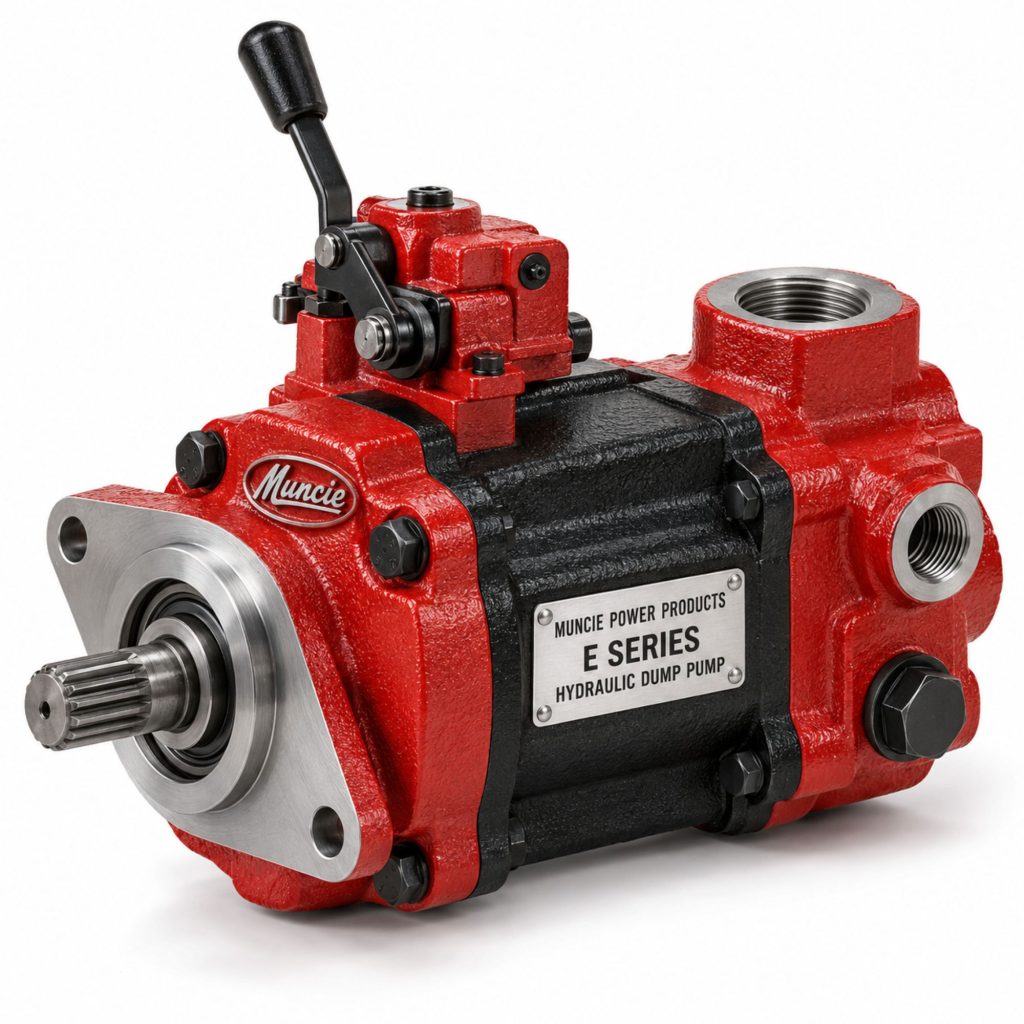
The Muncie E Series is a heavy-duty dump hydraulic pump designed primarily for tandem-axle and tri-axle dump trucks and dump trailers equipped with large-volume hydraulic cylinders. It combines a high-displacement gear-pump section with an integrated directional-control arrangement for raising and lowering dump bodies.
The E Series is available in two principal sizes. The E-23 provides 5.20 cubic inches of displacement and approximately 22.5 gallons per minute at 1,000 pump rpm. The larger E-27 provides 6.37 cubic inches of displacement and approximately 27.6 gallons per minute at 1,000 rpm.
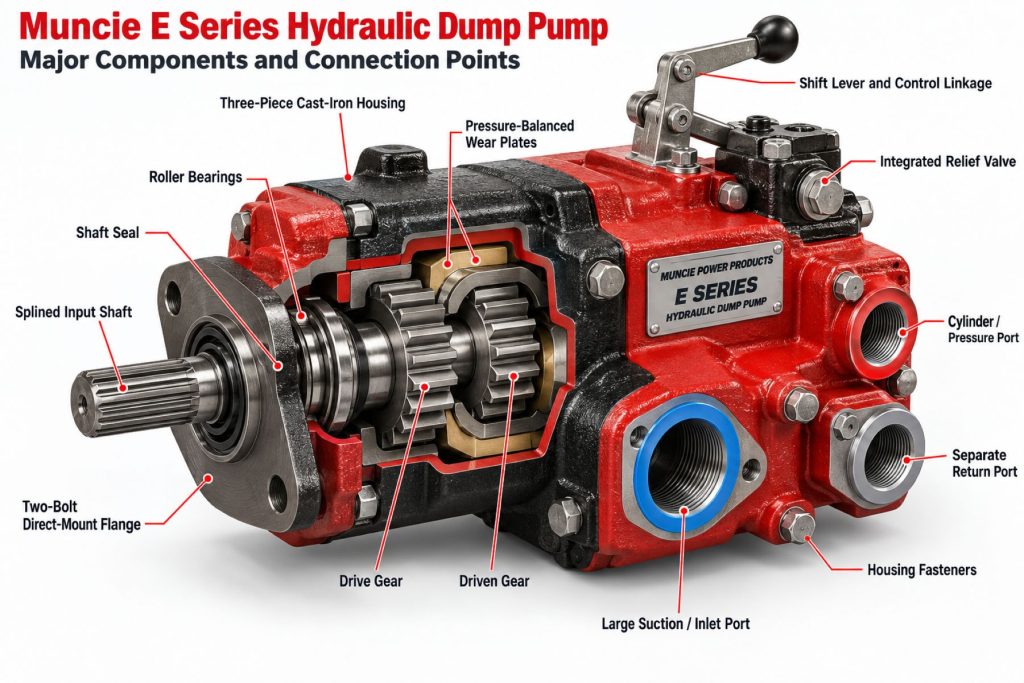
Three-piece cast-iron construction, heavy-duty roller bearings, and pressure-balanced wear plates support durability, efficiency, and rebuildability. The pump can be configured for direct mounting to a compatible PTO or remote mounting through an approved driveshaft arrangement.
The E Series is intended for intermittent dump cycles. Muncie does not recommend it for ejector, conveyor, moving-floor, or other applications requiring continuous hydraulic operation.
Key Characteristics
- Designed specifically for dump-body hydraulic systems
- Fixed-displacement external-gear pump
- Unidirectional flow design
- Two available displacement sizes
- Three-piece cast-iron construction
- Heavy-duty roller bearings
- Pressure-balanced wear plates
- Integrated raise, hold, and lower control
- Two-line and three-line system options
- Direct-mount and remote-mount configurations
- Maximum pressure of 2,500 psi
- Maximum speed of 2,500 rpm
- Designed for high-volume dump cylinders
- Heavy-duty and rebuildable construction
- Intended for intermittent operating cycles
Major Components
- Cast-iron pump housing
- Front bearing cover
- Rear valve housing
- Drive gear
- Driven gear
- Heavy-duty roller bearings
- Pressure-balanced wear plates
- Input shaft
- Shaft seal
- Integrated directional-control valve
- Raise, hold, and lower spool
- Pressure-relief valve
- Air-shift or cable-control components
- Suction inlet port
- Cylinder pressure port
- Return port
- Mounting flange
- Housing seals and fasteners
Product Type and Construction
The E Series is a fixed-displacement external-gear dump pump. Its drive gear and driven gear rotate inside a close-fitting cast-iron housing, carrying hydraulic fluid from the inlet side to the pressure side of the pump.
Unlike a general-purpose hydraulic gear pump, the E Series incorporates directional-control functions specifically for a dump-body circuit. The integrated control arrangement directs fluid toward the cylinder during the raise cycle and controls return flow during lowering.
The pump’s three-piece cast-iron construction is designed for demanding dump-truck service and permits the assembly to be repaired or rebuilt when appropriate. Pressure-balanced wear plates help maintain internal sealing and hydraulic efficiency as operating pressure changes.
How the Hydraulic Pump Works
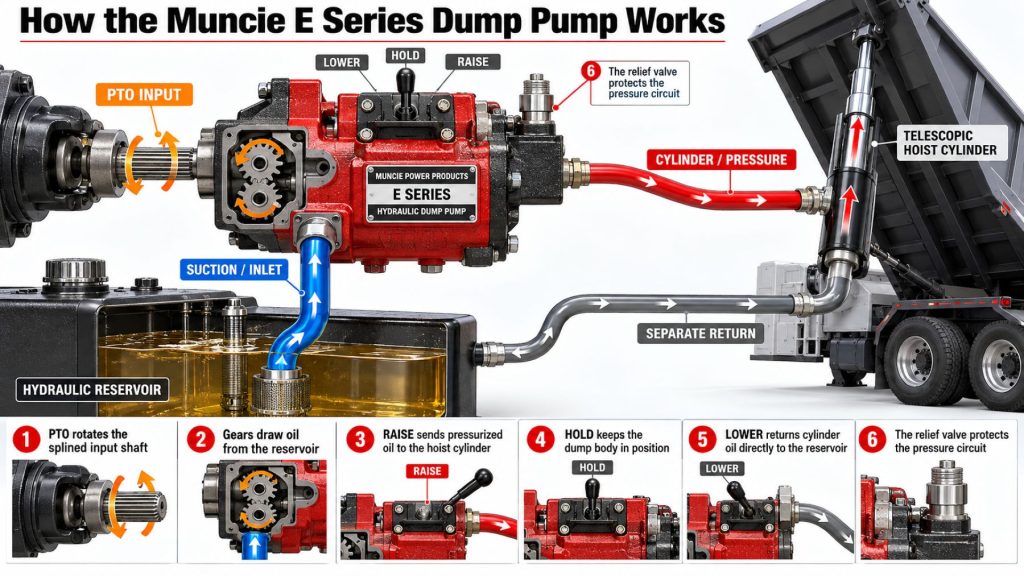
A transmission-mounted PTO or approved remote driveline rotates the E Series input shaft. The shaft turns the pump gears, drawing oil from the hydraulic reservoir through the suction port.
During the raise cycle, the integrated control valve directs pressurized oil from the pump toward the dump cylinder. As oil enters the cylinder, the cylinder extends and raises the dump body.
When the control is moved to hold, the valve blocks or controls the cylinder circuit so the body remains at the selected position. The exact internal oil path depends on whether the system uses two-line or three-line plumbing.
During lowering, the valve allows oil to return from the cylinder to the reservoir. Gravity normally lowers the dump body while the pump and control circuit manage the returning hydraulic fluid.
Position and Function Within the Vehicle
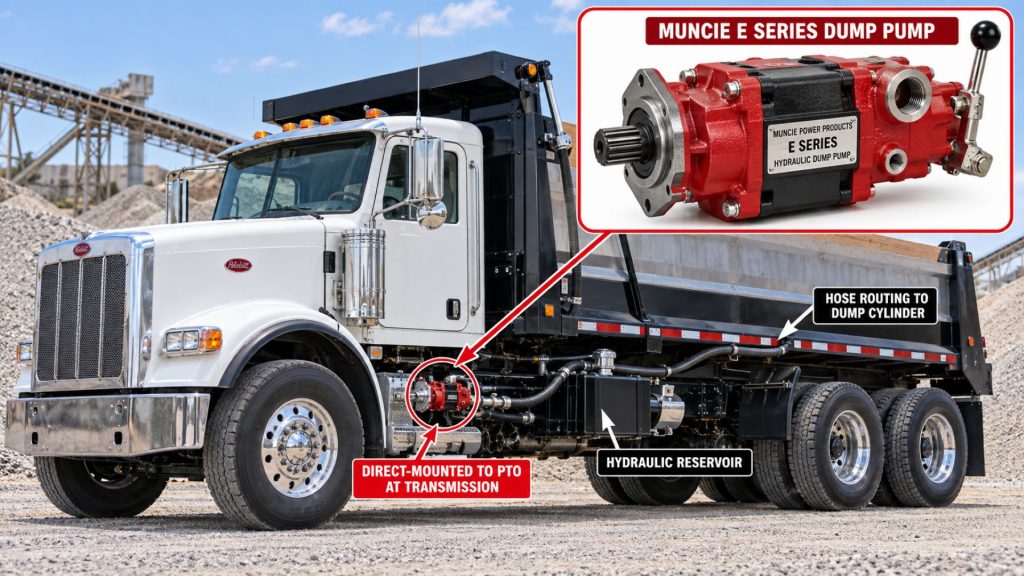
The E Series normally mounts to a compatible transmission PTO or to the truck frame in a remote-drive installation. It is connected to the hydraulic reservoir, dump cylinder, and return circuit.
Its primary function is to provide the high-volume hydraulic flow required to extend a large telescopic dump cylinder. The integrated valve also controls whether the body raises, holds, or lowers.
The pump is normally installed beneath the cab, body, or frame area. Clearance must be maintained from driveshafts, suspension components, exhaust equipment, frame crossmembers, tanks, and the moving dump-body structure.
Common Specifications
- E-23 theoretical flow at 1,000 rpm: Approximately 22.5 gallons or 85.2 liters per minute.
- E-23 displacement: 5.20 cubic inches or approximately 85.2 cubic centimeters per revolution.
- E-23 approximate weight: 67 pounds or 30.4 kilograms.
- E-27 theoretical flow at 1,000 rpm: Approximately 27.6 gallons or 104.5 liters per minute.
- E-27 displacement: 6.37 cubic inches or approximately 104.4 cubic centimeters per revolution.
- E-27 approximate weight: 69 pounds or 31.3 kilograms.
- Maximum operating pressure: 2,500 psi or approximately 172 to 173 bar.
- Maximum operating speed: 2,500 rpm.
- Minimum recommended operating speed: 800 rpm.
- Inlet port: 1-1/4-inch NPT.
- Cylinder port: 1-inch NPT.
- Return port: 1-inch NPT.
- Hydraulic circuits: Two-line or three-line installation.
- Duty cycle: Intermittent dump operation.
Specifications must be confirmed using the complete pump model, mounting arrangement, control type, hydraulic circuit, PTO, and vehicle application.
Displacement, Flow, Pressure, and Operating Capacity
The E-23 moves approximately 5.20 cubic inches of oil during each pump revolution, while the E-27 moves approximately 6.37 cubic inches. At the same pump speed, the E-27 produces more flow and normally raises a compatible dump cylinder more quickly.
Theoretical flow increases directly with pump speed. The E-23 produces approximately 22.5 gallons per minute at 1,000 rpm, while the E-27 produces approximately 27.6 gallons per minute at the same speed.
Both models have a published maximum pressure of 2,500 psi. System pressure depends on cylinder size, dump-body weight, load placement, mechanical geometry, friction, and the force required to begin lifting.
The pump, PTO, transmission, input shaft, hydraulic hoses, cylinder, reservoir, and fittings must all remain within their approved ratings.
Dump-Pump and Control-Valve Design
The E Series combines the hydraulic pump and essential dump-body directional-control functions in one assembly. This reduces the need for a separate external directional valve in many conventional dump installations.
The integrated control provides raise, hold, and lower positions. The operator changes the spool position using the installed pneumatic, cable, or application-specific control system.
The control should return to the correct position when commanded. A sticking spool, damaged linkage, contaminated air control, or internal wear can prevent normal raising, holding, or lowering.
Two-Line and Three-Line Hydraulic Systems
The E Series can be installed in either a two-line or three-line dump hydraulic system. The correct arrangement depends on the vehicle, operating practices, filtration requirements, and equipment-builder specification.
A two-line system uses one suction line between the reservoir and pump and one combined pressure-and-return line between the pump and cylinder. This arrangement uses fewer hoses and is common in basic dump systems.
A three-line system uses separate suction, cylinder-pressure, and return lines. The dedicated return line can improve return-flow routing, permit return filtration, and reduce the need to route returning cylinder oil through the same path used for pressure flow.
The pump must be configured and plumbed for the selected circuit. Incorrect conversion or hose routing can cause overheating, pump damage, uncontrolled body movement, or reservoir overflow.
Raise, Hold, and Lower Operation
In the raise position, pump flow is directed toward the dump cylinder. Pressure builds as necessary to extend the cylinder and lift the body.
In the hold position, the valve controls the cylinder circuit so the body can remain at a selected height. The body should still be mechanically blocked before anyone works beneath it.
In the lower position, hydraulic oil returns from the cylinder toward the reservoir as gravity lowers the body. The rate of descent depends on the cylinder, valve, plumbing, oil temperature, body geometry, and load.
The PTO and pump should be operated only as specified for the system. Keeping the pump driven unnecessarily can create heat and increase wear.
PTO Speed and Pump Rotation
The E Series uses a unidirectional pump design. The selected pump rotation must match the PTO output and installation orientation.
Pump speed depends on engine rpm, transmission PTO-drive gearing, and the PTO’s internal ratio. The correct PTO should produce adequate dump-cycle speed without exceeding the pump’s 2,500-rpm maximum.
The published minimum speed is 800 rpm. Operating too slowly may reduce flow and extend the raising cycle, while excessive speed can cause inlet restriction, cavitation, heat, and premature wear.
Hydraulic Circuit and Equipment Integration
A complete E Series dump hydraulic system may include:
- Transmission-mounted PTO
- Muncie E Series dump pump
- Hydraulic reservoir
- Suction hose
- Cylinder pressure hose
- Dedicated return hose on three-line systems
- Return filter where specified
- Telescopic hydraulic cylinder
- Air or cable pump control
- Pressure-relief protection
- Reservoir breather and filler
- Hydraulic fittings and adapters
- Body-up warning or limit controls
All components must be sized for the E Series pump’s flow and pressure. A reservoir, hose, or fitting suitable for a smaller pump may restrict an E-23 or E-27 installation.
Inlet, Cylinder, and Return Port Design
The E Series uses a 1-1/4-inch NPT inlet port to supply oil from the reservoir. The suction hose should be large, short, properly routed, and resistant to collapse.
The 1-inch NPT cylinder port carries pressurized oil toward the dump cylinder during the raising cycle. The hose, fittings, cylinder, and adapters must be rated for at least the maximum system pressure and expected pressure spikes.
The 1-inch NPT return port is used in a three-line installation. The return circuit should flow freely to the reservoir and must not create excessive back pressure.
Controls and Electronic Integration
The E Series pump may use pneumatic, cable-operated, or application-specific control hardware to move the integrated valve between raise, hold, and lower positions.
Additional vehicle and equipment controls may include:
- Cab-mounted PTO switch
- PTO-engaged indicator
- Raise, hold, and lower control
- Body-up warning light
- Engine-speed control
- Tailgate interlock
- Parking-brake interlock
- Transmission-range interlock
- Hydraulic-pressure switch
- Upper-limit control
The controls should prevent unintended pump engagement and body movement. Their exact design depends on the truck, PTO, dump body, cylinder, and operating requirements.
Efficiency, Heat, and Lubrication
Pressure-balanced wear plates help maintain internal sealing and hydraulic efficiency as pressure changes. Wear, contaminated oil, excessive clearance, or damaged surfaces can increase internal leakage and reduce pump performance.
Hydraulic oil lubricates the gears, bearings, wear plates, and valve components. The pump must receive clean oil immediately after startup.
Heat can result from excessive engine speed, continuous relief-valve operation, restricted hoses, improper valve position, low oil level, or using the pump in an application requiring continuous operation.
The E Series is intended for intermittent dump cycles. Allowing it to operate continuously can overheat the hydraulic system and shorten component life.
Duty Cycle and Operating Conditions
The E Series is designed for intermittent raise-and-lower dump cycles. It is not recommended for ejector trailers, conveyor systems, moving floors, or other equipment that demands extended continuous flow.
Cold hydraulic oil increases inlet restriction and pump torque. The system should be operated slowly and at reduced load until the fluid warms sufficiently.
Dumping on uneven or unstable ground can create side loads and unsafe body movement unrelated to pump capacity. The vehicle should be positioned according to the dump-body and fleet operating procedures.
Heavy, frozen, or unevenly distributed loads may require more cylinder pressure and can create sudden load shifts. The pump’s pressure rating does not make unsafe dumping conditions acceptable.
Mounting and Installation
The E Series may be mounted directly to a compatible PTO or installed remotely and driven through an approved shaft. The selected mounting arrangement must support the pump’s weight and operating torque.
The installer should verify:
- Correct E-23 or E-27 displacement
- Correct direction of rotation
- Compatible PTO output shaft and flange
- Adequate PTO torque and horsepower rating
- Appropriate PTO ratio
- Direct- or remote-mount requirements
- Two-line or three-line plumbing
- Correct pump-control system
- Reservoir size and placement
- Suction-hose size and routing
- Pressure- and return-hose ratings
- Dump-cylinder compatibility
- Frame and driveline clearance
- Proper system priming
The pump should not be operated until the hydraulic system has been filled, primed, inspected, and tested according to Muncie and equipment-manufacturer procedures.
PTO and Vehicle Compatibility
The E Series can be paired with a compatible Muncie, Parker Chelsea, or other approved PTO when the output shaft, mounting flange, rotation, speed, torque, and horsepower ratings match.
Compatibility depends on:
- Transmission manufacturer and model
- PTO series and ratio
- PTO output rotation
- Pump mounting arrangement
- Required hydraulic flow
- Dump-cylinder size
- Maximum system pressure
- Vehicle frame clearance
- Driveshaft and exhaust location
- Reservoir and hose placement
- Dump-body design and capacity
Physical fit alone does not confirm compatibility. The PTO and transmission must be capable of supplying the torque required by the selected E Series pump at maximum system pressure.
Hydraulic Fluid, Filtration, and Reservoir Compatibility
The hydraulic fluid must provide the viscosity, lubrication, anti-wear protection, and temperature performance required by the pump, cylinder, valve, and operating environment.
The reservoir must contain enough usable oil to extend the dump cylinder without uncovering the suction outlet. It must also provide space for returning oil, thermal expansion, and air separation.
A three-line system can accommodate a return filter more easily because cylinder return oil follows a dedicated route to the reservoir. The filter must be sized for the full return flow without creating excessive back pressure.
The reservoir breather should be maintained so air can enter and leave as the fluid level changes without introducing excessive contamination.
Common Applications
- Tandem-axle dump trucks
- Tri-axle dump trucks
- Dump trailers
- Transfer dump equipment
- Construction dump trucks
- Aggregate-hauling trucks
- Asphalt dump trucks
- Municipal dump trucks
- Heavy landscaping trucks
- Farm and agricultural dump vehicles
- High-volume telescopic-cylinder systems
- Intermittent dump-body hydraulic circuits
Advantages
- Designed specifically for dump-truck operation
- High displacement for large dump cylinders
- Integrated raise, hold, and lower control
- Three-piece cast-iron construction
- Heavy-duty roller bearings
- Pressure-balanced wear plates
- Rebuildable design
- Two displacement options
- Two-line and three-line compatibility
- Direct- and remote-mount configurations
- Maximum pressure of 2,500 psi
- Established use in tandem- and tri-axle dump equipment
- Current manufacturer support and service literature
Limitations or Considerations
- Designed for intermittent dump cycles
- Not recommended for moving-floor systems
- Not recommended for ejector equipment
- Not recommended for conveyor applications
- Maximum pressure limited to 2,500 psi
- Unidirectional rotation must match the PTO
- Large displacement creates substantial PTO torque demand
- Incorrect hose routing can cause cavitation or overheating
- Two-line and three-line systems require different plumbing
- Continuous PTO operation can generate excessive heat
- Pump size must match the cylinder and desired cycle time
- Added pump and wet-kit weight reduces available payload
- Raised dump bodies create major stability and safety risks
Driver and Operator Experience
The driver normally engages the PTO and uses a cab-mounted air or cable control to select raise, hold, or lower. Pump speed and hydraulic flow increase as engine speed rises.
A properly matched E Series system should raise the dump body smoothly and predictably. Slow lifting, jerking, excessive noise, overheating, or inability to lift the load may indicate a hydraulic or mechanical problem.
The operator should monitor the surrounding area, overhead clearance, ground stability, trailer position, tailgate operation, load release, and body alignment throughout the dumping cycle.
PTO Engagement and Dumping Procedure
The exact procedure depends on the truck, PTO, pump, dump body, and fleet rules. A general operating sequence may include:
- Position the vehicle on firm, level, and stable ground.
- Confirm adequate overhead and side clearance.
- Secure the truck and apply the parking brake.
- Place the transmission in the required PTO operating mode.
- Reduce engine speed to the approved engagement range.
- Engage the PTO.
- Select the raise position.
- Increase engine speed only as necessary and within the approved range.
- Monitor the body, load, cylinder, vehicle stability, and hydraulic system.
- Move the control to hold when the desired height is reached.
- Select lower when unloading is complete and the area is clear.
- Confirm the body is fully lowered.
- Return the control to its approved travel position.
- Disengage the PTO before driving away unless the system specifically requires another procedure.
This overview does not replace the instructions provided by the vehicle, PTO, pump, dump-body, cylinder, or trailer manufacturer.
Inspection and Wear Points
- Pump housing
- PTO mounting flange
- Input shaft and spline
- Remote driveshaft where equipped
- Mounting fasteners
- Shaft seal
- Suction hose and fittings
- Cylinder pressure hose
- Return hose on three-line systems
- Valve spool and control linkage
- Air-control lines or cable
- Pressure-relief valve
- Reservoir level and condition
- Return filter where equipped
- Telescopic cylinder
- Body hinges, mounts, and safety props
Lubrication Requirements
The E Series gears, bearings, wear plates, and valve components are lubricated by the hydraulic fluid flowing through the pump.
The pump and suction line must be filled or primed according to Muncie’s installation instructions. The pump should never be started without an adequate supply of hydraulic oil.
The fluid level should be checked with the dump body in the position specified by the equipment manufacturer, normally fully lowered. Overfilling can cause the reservoir to overflow when the cylinder retracts.
Maintenance and Ownership Notes
Inspect the pump and hydraulic system regularly for leaks, loose fasteners, damaged hoses, contaminated oil, control problems, abnormal noise, and excessive temperature.
The reservoir breather, filler screen, and return filter should be serviced at the required intervals. Clean hydraulic fluid helps preserve the pump, cylinder, and valve components.
Control linkage and air-shift components should move freely through raise, hold, and lower. A control that does not fully reach the intended position can cause heating, incomplete cylinder movement, or pressure problems.
Before installing a replacement pump, inspect the PTO, cylinder, hoses, reservoir, valve controls, and relief setting. An uncorrected system problem can damage the replacement unit.
Common Pump and Hydraulic-System Problems
- Dump body will not raise: A disengaged PTO, incorrect valve position, low oil level, blocked suction line, broken pump drive, failed pump, relief-valve problem, or overloaded body may prevent lifting.
- Dump body raises slowly: Low pump speed, pump wear, suction restriction, cold oil, internal cylinder leakage, relief-valve leakage, or an undersized pump may slow the cycle.
- Pump makes excessive noise: Cavitation, aerated oil, an undersized suction hose, clogged breather, low oil level, excessive speed, bearing wear, or PTO problems may cause noise.
- Hydraulic oil overheats: Continuous PTO operation, incorrect valve position, relief-valve bypass, restricted plumbing, unsuitable fluid, or using the pump in a continuous-duty application may create heat.
- Dump body will not hold: Internal cylinder leakage, valve-spool leakage, damaged seals, plumbing problems, or external leakage may allow the body to drift downward.
- Dump body will not lower: A stuck control, blocked return line, damaged valve spool, mechanical binding, cylinder damage, or improper hose connection may prevent lowering.
- Shaft-seal leakage: Seal wear, misalignment, excessive heat, a damaged shaft, contaminated fluid, or unsupported pump weight may cause leakage.
- PTO failure: Excessive pressure, incorrect PTO ratio, oversized pump displacement, pump seizure, or shock loading may overload the PTO.
Safety and Service Precautions
Never install or service the pump with the engine running. Disengage the PTO, remove the ignition key, secure the truck, and chock the wheels.
Never work beneath a raised dump body unless it is supported by approved mechanical body props or blocking. Hydraulic pressure alone must never be trusted to hold the body.
Lower the dump body and release hydraulic pressure before disconnecting hoses, fittings, controls, or pump components. High-pressure hydraulic fluid can penetrate skin and cause severe injury.
Keep personnel away from the dumping area, tailgate, hoist, hinges, cylinder, and moving body. Dumping should stop immediately if the truck leans, the load hangs up, or the body begins moving unevenly.
Identification Information
The complete pump model and identification information should be recorded before ordering a replacement pump, valve component, control, or rebuild part.
- Muncie E Series designation
- Complete pump model number
- E-23 or E-27 displacement
- Direction of rotation
- Direct- or remote-mount configuration
- Input-shaft specification
- Mounting-flange configuration
- Two-line or three-line plumbing
- Control type
- PTO manufacturer and model
- Maximum system pressure
- Dump-cylinder bore, stages, and capacity
- Reservoir capacity
- Vehicle and dump-body information
Similar-looking E and EH Series pumps may use different ports, flows, controls, or components. Replacement parts should be selected using the complete identification information.
Buying Considerations
- Confirm whether an E-23 or E-27 is required.
- Determine the dump-cylinder oil volume.
- Calculate the desired raising time.
- Confirm maximum system pressure.
- Select the correct pump rotation.
- Choose direct or remote mounting.
- Match the PTO flange and output shaft.
- Verify PTO torque and horsepower capacity.
- Select an appropriate PTO ratio.
- Choose two-line or three-line plumbing.
- Confirm the control type.
- Size the reservoir for the cylinder and return volume.
- Use correctly sized suction, pressure, and return hoses.
- Check chassis and driveshaft clearance.
- Confirm that the application uses intermittent dump cycles.
- Use an installer experienced with dump hydraulic systems.
Variants and Configurations
- E-23 dump pump
- E-27 dump pump
- Direct PTO-mount configuration
- Remote driveshaft-mount configuration
- Two-line hydraulic system
- Three-line hydraulic system
- Air-shift control
- Cable-operated control
- Application-specific control packages
- Different input-shaft arrangements
- Different mounting-flange arrangements
- Truck wet-kit installations
- Tractor-to-dump-trailer wet-kit installations
Comparison to Similar Equipment
Compared with the future Permco DM-640 Dump Pump, the Muncie E Series provides an alternative heavy-duty dump-pump design with Muncie-specific controls, mounting, parts, and application support.
Compared with the future Muncie S Series Hoist Pump, the E Series offers greater displacement and flow for tandem-axle, tri-axle, and dump-trailer systems using high-volume cylinders. The S Series is commonly used on smaller dump and hoist applications.
Compared with the Parker F1 Hydraulic Pump, the E Series is a cast-iron gear-type dump pump with integrated directional control. The Parker F1 is a high-pressure bent-axis piston pump intended for a broader range of mobile hydraulic systems.
Compared with the Parker F2 Twin-Flow Hydraulic Pump, the E Series supplies one principal dump-cylinder circuit. The F2 provides two hydraulic flows for equipment requiring separate or simultaneous functions.
Best Fit For
- Tandem-axle dump trucks
- Tri-axle dump trucks
- Dump trailers with high-volume cylinders
- Construction and aggregate-hauling trucks
- Conventional raise, hold, and lower dump systems
- Two-line dump hydraulic circuits
- Three-line dump hydraulic circuits
- Applications requiring 22.5 to 27.6 gallons per minute at 1,000 rpm
- Systems operating at no more than 2,500 psi
- Intermittent dump cycles
- Fleets wanting a rebuildable cast-iron dump pump
- Vehicles with a properly matched PTO and reservoir
Related Vehicle and Trailer Types
- Complete Guide to Semi Truck Types
- Class 6 vs Class 7 vs Class 8 Trucks
- Dump Trucks
- Dump Trailers
- End Dump Trailers
- Transfer Dump Trucks
- Construction Trucks
- Municipal Trucks
Related Truck and Trailer Models
- Mack Granite
- Kenworth T880
- Peterbilt 567
- Freightliner 114SD
- Freightliner 122SD
- International HX Series
- Western Star 47X
- Western Star 49X
- Volvo VHD
- Travis Dump Trailer
Related PTO and Hydraulic System Types
- Hydraulic Pumps & Motors
- Power Take-Off Systems
- Wet Kits & Complete Hydraulic Systems
- Hydraulic Cylinders & Dump Hoists
- Hydraulic Valves, Controls & Reservoirs
- Hydraulic Hoses, Fittings & Filtration
Related PTO and Hydraulic Products
- Muncie S Series Hoist Pump
- Muncie WETLINE Hydraulic System
- Muncie V Series Hydraulic Directional Control Valve
- Muncie CS6 Series Power Take-Off
- Muncie TG Series Power Take-Off
- Muncie FR6Q Power Take-Off
- Permco DM-640 Dump Pump
- Permco P5151 Hydraulic Pump
- Parker F1 Hydraulic Pump
- Parker F2 Twin-Flow Hydraulic Pump
Related Equipment Systems
- PTO & Hydraulic Systems
- Transmissions
- Suspension Systems
- Axles & Differentials
- Brake Systems
- Electrical Systems
Related Guides
- PTO & Hydraulic System Guides
- How Commercial Truck PTO and Hydraulic Systems Work
- Commercial Truck Power Take-Off Types Explained
- How to Choose a PTO and Hydraulic Pump
- Commercial Truck Wet Kits Explained
- How to Inspect and Maintain Truck Hydraulic Systems
Regulatory and Compliance Notes
The E Series installation must comply with applicable vehicle, hydraulic-equipment, workplace-safety, body-builder, hose-routing, and final-stage manufacturing requirements.
Hydraulic hoses, fittings, reservoirs, cylinders, and controls must be rated for the system’s maximum pressure, flow, temperature, and operating environment.
Dump bodies may require body-up warning systems, mechanical safety props, tailgate controls, conspicuity equipment, and other safety devices. Vehicle weight and axle ratings remain in effect after the wet kit and dump equipment are installed.
Real World Operating Notes
The larger E-27 can provide faster cylinder movement than the E-23 at the same pump speed, but it also requires more PTO torque and moves oil through the suction, pressure, and return circuits more quickly.
A pump should not be selected only to obtain the shortest possible lifting time. Excessive flow can make body movement abrupt, increase heat, overload the PTO, and exceed the capacity of the hoses, valve, cylinder, or reservoir.
Many apparent pump failures are caused by low oil, suction restrictions, clogged breathers, incorrect valve positions, cylinder problems, overloaded bodies, or improper PTO operation.
The E Series should not be substituted for a continuous-duty pump on moving-floor, ejector, or conveyor equipment. Those applications require a hydraulic system designed for sustained operation.
Frequently Asked Questions
What is the Muncie E Series Hydraulic Pump?
The E Series is a fixed-displacement cast-iron dump pump with an integrated directional-control system for raising, holding, and lowering dump bodies.
What vehicles use the Muncie E Series?
It is commonly used on tandem-axle and tri-axle dump trucks and on tractor wet kits operating dump trailers with high-volume cylinders.
What is the difference between the E-23 and E-27?
The E-23 has 5.20 cubic inches of displacement and produces approximately 22.5 gallons per minute at 1,000 rpm. The E-27 has 6.37 cubic inches of displacement and produces approximately 27.6 gallons per minute at 1,000 rpm.
What is the maximum pressure of the E Series?
The published maximum operating pressure is 2,500 psi.
Can the E Series use a three-line hydraulic system?
Yes. The E Series supports both two-line and three-line dump hydraulic arrangements when properly configured and plumbed.
Can the E Series operate a moving-floor trailer?
No. Muncie does not recommend the E Series for moving-floor, ejector, conveyor, or other continuous-duty applications.
Can the E Series mount directly to a PTO?
Yes. Direct-mount configurations are available when the PTO flange, shaft, rotation, speed, and capacity match. Remote-mount configurations are also available.
Why does an E Series pump make a loud whining sound?
Possible causes include cavitation, low oil, an undersized suction hose, cold fluid, excessive pump speed, a clogged reservoir breather, aeration, or internal wear.
Why does the dump body raise slowly?
Low pump speed, suction restriction, cold oil, pump wear, relief-valve leakage, internal cylinder leakage, or an overloaded body may slow the raising cycle.
How is the correct replacement pump identified?
Use the complete Muncie model number, E-23 or E-27 displacement, rotation, mounting type, shaft, control configuration, and two-line or three-line system information.
Availability and Where to Find
Muncie E Series dump pumps, control components, installation kits, wet-kit components, reservoirs, filters, hoses, and service parts are available through Muncie Power Products distributors, commercial-truck equipment dealers, dump-body installers, hydraulic specialists, and heavy-duty parts suppliers.
Availability depends on the selected displacement, rotation, shaft, mounting arrangement, control type, and two-line or three-line hydraulic configuration.
Current product information, specifications, installation instructions, service literature, and distributor resources are available through the Muncie E Series Dump Pump product page.
Support Trucking Families
Truck Equipment Atlas supports the mission of Grey Cross, a nonprofit dedicated to helping families of truck drivers who lose their lives while on the road. As the site grows, part of its mission is to bring awareness and support to these families.
Podcast or Video Section
Learn More Through Audio and Video
Truck Equipment Atlas will continue expanding with podcast episodes, interviews, and equipment breakdowns to help drivers and fleets better understand trucks and equipment.
Follow the Growth of Truck Equipment Atlas
Truck Equipment Atlas continues to expand with new truck profiles, trailer coverage, diesel engine pages, equipment system resources, manufacturer information, and educational guides.
Visit our Site Updates page to explore recent additions, project milestones, and upcoming resources as we continue building one of the industry’s growing commercial trucking equipment reference libraries.
View the Latest Site Updates: Truck Equipment Atlas Site Updates