
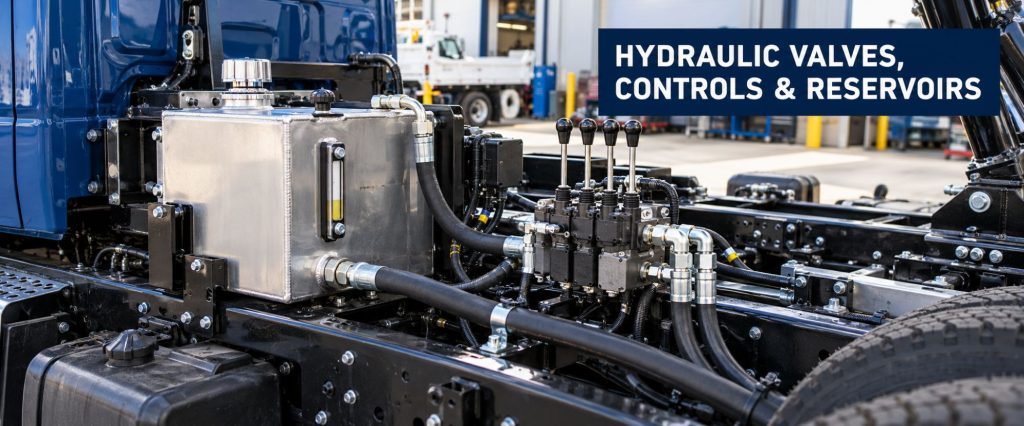
Hydraulic valves, controls, and reservoirs are essential parts of commercial-truck hydraulic systems, directing pressurized fluid, regulating system operation, storing hydraulic oil, and allowing drivers or equipment operators to control truck-mounted equipment.
These components are used throughout dump trucks, refuse vehicles, roll-off trucks, tow trucks, utility equipment, snow-and-ice vehicles, truck-mounted cranes, car haulers, tank trucks, and other vocational applications.
Truck Equipment Atlas covers hydraulic valves, operator controls, reservoirs, manifolds, and related components used throughout commercial-truck and trailer hydraulic systems.
Hydraulic Valve, Control, and Reservoir Products on Truck Equipment Atlas
Explore the commercial-truck hydraulic valve, control, and reservoir products currently covered on Truck Equipment Atlas:
Additional directional-control valves, hydraulic manifolds, operator controls, reservoirs, filters, breathers, and fluid-management products will be added as the Truck Equipment Atlas PTO and Hydraulic Systems Library continues to expand.
How Hydraulic Valves and Controls Work
A commercial-truck hydraulic system uses pressurized fluid to operate cylinders, motors, hoists, booms, and other equipment.
The hydraulic pump draws fluid from the reservoir and sends it toward a directional-control valve. When the operator moves a lever, activates a switch, or uses a joystick or remote control, the valve directs hydraulic fluid toward the selected cylinder or motor.
Fluid leaving the actuator returns through the valve and hydraulic return circuit before flowing back into the reservoir.
For a broader explanation of the complete hydraulic power circuit, read How Commercial Truck PTO and Hydraulic Systems Work.
Common Hydraulic Valve Types
Commercial-truck hydraulic systems can use several types of valves to control equipment operation.
Common examples include:
- Directional-control valves
- Pressure-relief valves
- Pressure-reducing valves
- Flow-control valves
- Check valves
- Pilot-operated check valves
- Counterbalance valves
- Load-holding valves
- Sequence valves
- Selector and diverter valves
- Cartridge valves
- Valve manifolds
The correct valve depends on the pump flow, operating pressure, circuit design, actuator type, equipment function, and required level of operator control.
Directional-Control Valves
Directional-control valves determine where pressurized hydraulic fluid travels within the system.
Depending on the valve and equipment design, the operator may use the valve to raise, lower, extend, retract, rotate, hold, or reverse a hydraulic function.
Directional valves may use a monoblock body, sectional construction, cartridge-style components, or an integrated manifold. They may also be designed for single-acting cylinders, double-acting cylinders, hydraulic motors, or systems containing several different actuators.
Pressure and Flow Control
Pressure-control valves help protect the hydraulic system and regulate how force is applied to working equipment.
A pressure-relief valve limits maximum system pressure by allowing fluid to bypass when pressure reaches its established setting. Pressure-reducing and sequence valves perform more specialized functions within multi-function hydraulic circuits.
Flow-control valves regulate the amount of fluid traveling toward a cylinder or motor. Because hydraulic flow influences actuator speed, these valves can help control how quickly equipment raises, lowers, extends, retracts, or rotates.
Load-Holding and Counterbalance Valves
Load-holding valves help prevent a hydraulic cylinder or elevated piece of equipment from moving unexpectedly if pressure is lost or a hose fails.
Counterbalance valves help control loads that may attempt to move faster than the hydraulic system can safely manage. These valves are particularly important in systems that raise bodies, booms, platforms, or other heavy equipment.
The correct valve design and adjustment depend on the actuator, load, equipment geometry, operating pressure, and manufacturer requirements.
Hydraulic Control Options
Commercial-truck hydraulic systems can use several methods to operate their control valves.
Common control arrangements include:
- Direct mechanical levers
- Push-pull control cables
- Air-operated cab controls
- Electric switches
- Solenoid-operated valves
- Electrohydraulic joysticks
- Proportional electronic controls
- Wired pendant controls
- Wireless remote controls
- Programmable equipment controllers
Mechanical controls may provide simple and direct operation, while electronic proportional controls can provide smoother movement, programmable functions, system monitoring, and integration with vehicle safety systems.
Hydraulic Reservoirs
A hydraulic reservoir stores the fluid required by the complete hydraulic system.
The reservoir also provides space for fluid expansion, allows entrained air to separate from the oil, helps contaminants settle, and supports heat dissipation before the fluid returns to the pump.
Commercial-truck reservoirs may be constructed from aluminum, steel, stainless steel, or other application-specific materials. They may be mounted beside the frame, behind the cab, beneath body equipment, or inside a combined hydraulic-system enclosure.
Common Reservoir Configurations
Hydraulic reservoirs are available in numerous shapes and mounting arrangements.
Common configurations include:
- Side-mounted rectangular reservoirs
- Frame-mounted reservoirs
- Behind-cab upright reservoirs
- Cab-guard reservoirs
- Saddle-style reservoirs
- Round hydraulic tanks
- Compact power-unit reservoirs
- Combination fuel-and-hydraulic tanks
Reservoir size, port placement, mounting position, filtration, breathing, and service access must be matched to the pump, actuator displacement, duty cycle, operating temperature, and available chassis space.
Dump Truck and Trailer Applications
Dump trucks and hydraulic dump trailers commonly use directional-control valves to operate single-acting or double-acting hoist cylinders.
The valve controls the raising and lowering of the dump body, while the reservoir stores the fluid displaced as the cylinder extends and retracts.
These systems may be part of a wet kit or complete hydraulic system designed specifically for dump operation.
Refuse and Municipal Applications
Refuse trucks and municipal vehicles often require hydraulic systems capable of controlling several equipment functions.
These applications may use sectional valves or integrated hydraulic manifolds to operate packer panels, container lifts, arms, tailgates, plows, spreaders, and other equipment.
Electronic controls, position sensors, pressure monitoring, and safety interlocks are increasingly common in equipment requiring coordinated or automated hydraulic movement.
Utility, Crane, and Recovery Applications
Utility trucks, truck-mounted cranes, and recovery vehicles often require precise control over several hydraulic cylinders and motors.
Proportional controls can allow operators to vary equipment speed rather than simply switching hydraulic flow on or off. Load-holding and counterbalance valves help control booms, outriggers, winches, wheel lifts, and other equipment operating under significant loads.
The hydraulic valve and control system must be matched to the equipment manufacturer’s operating and safety requirements.
Advantages of Modern Hydraulic Controls
Depending on the equipment and control design, modern commercial-truck hydraulic systems can provide several advantages:
- Precise control of equipment movement
- Operation of multiple hydraulic functions
- Protection against excessive system pressure
- Improved load control
- Remote equipment operation
- Integration with safety interlocks
- Electronic monitoring and diagnostics
- Compact manifold arrangements
- Reduced external hydraulic plumbing
The value of each feature depends on the application, equipment complexity, operating environment, and service capabilities of the fleet.
Limitations and Considerations
Hydraulic valves, controls, and reservoirs also introduce important installation and ownership considerations.
These can include:
- Hydraulic-fluid contamination
- Fluid leakage
- Incorrect valve sizing
- Improper pressure adjustment
- Excessive system heat
- Valve spool or cartridge wear
- Control-cable wear
- Electrical and solenoid failures
- Reservoir mounting requirements
- Limited chassis space
- Additional inspection and maintenance requirements
The valve, controls, reservoir, pump, hoses, filtration, and working equipment must be selected as parts of one complete hydraulic system.
Operator Controls and Equipment Operation
Operators must understand how the hydraulic controls affect equipment movement, vehicle stability, and surrounding personnel.
Important operating considerations include:
- Correct control identification
- Equipment movement and clearance
- Hydraulic-system pressure
- Engine and PTO speed
- Load position and vehicle stability
- Overhead and side clearance
- Safety interlocks
- Emergency-stop procedures
- Remote-control range and visibility
Operators should be able to observe the equipment and work area whenever practical. Controls should only be used according to the vehicle, body, and hydraulic-equipment manufacturers’ instructions.
Maintenance and Ownership
Hydraulic valves, controls, and reservoirs require regular inspection and maintenance to provide reliable equipment operation.
Important areas include:
- Hydraulic-fluid level and condition
- Reservoir condition
- Reservoir mounting brackets and straps
- Fill caps and breathers
- Fluid-level and temperature indicators
- Valve bodies and manifolds
- Pressure-relief settings
- Control cables and mechanical linkages
- Solenoids, switches, and electrical connectors
- Hydraulic filters
- Hoses, tubes, fittings, and seals
Slow operation, erratic movement, excessive heat, drifting equipment, unusual noise, foaming fluid, or visible leakage should be investigated before the equipment is returned to normal service.
Read How to Inspect and Maintain Truck Hydraulic Systems for a broader overview of hydraulic-system service considerations.
Mechanical vs. Electronic Hydraulic Controls
Mechanical hydraulic controls use physical levers, cables, or linkages to move the hydraulic valve. These systems can provide direct operation with relatively few electrical components.
Electronic hydraulic controls use switches, sensors, solenoids, joysticks, control modules, or wireless remotes to command hydraulic functions.
Electronic controls can support proportional movement, automated sequences, diagnostics, and safety interlocks. Mechanical controls may be simpler to diagnose and repair in applications that do not require advanced system integration.
The correct choice depends on equipment complexity, operating precision, environmental exposure, service support, and fleet preferences.
Related PTO and Hydraulic System Categories
Explore additional commercial-truck PTO and hydraulic system categories:
- Power Take-Off Systems
- Hydraulic Pumps & Motors
- Wet Kits & Complete Hydraulic Systems
- Hydraulic Cylinders & Dump Hoists
- Hydraulic Hoses, Fittings & Filtration
Related PTO and Hydraulic System Guides
Explore educational resources covering PTO operation, hydraulic-system selection, wet kits, maintenance, and equipment compatibility:
- How Commercial Truck PTO and Hydraulic Systems Work
- Commercial Truck Power Take-Off Types Explained
- How to Choose a PTO and Hydraulic Pump
- Commercial Truck Wet Kits Explained
- How to Inspect and Maintain Truck Hydraulic Systems
Visit PTO & Hydraulic System Guides to explore the complete educational guide library.
Explore the Complete PTO and Hydraulic Systems Library
Hydraulic valves, controls, and reservoirs represent one part of the complete commercial-truck hydraulic power system.
Visit the Truck Equipment Atlas PTO & Hydraulic Systems Library to explore power take-offs, hydraulic pumps, motors, wet kits, cylinders, dump hoists, valves, reservoirs, hoses, fittings, filtration systems, product profiles, and educational guides.
Additional hydraulic valve families, control systems, reservoir designs, replacement components, and technical resources will be added as Truck Equipment Atlas continues to expand.