
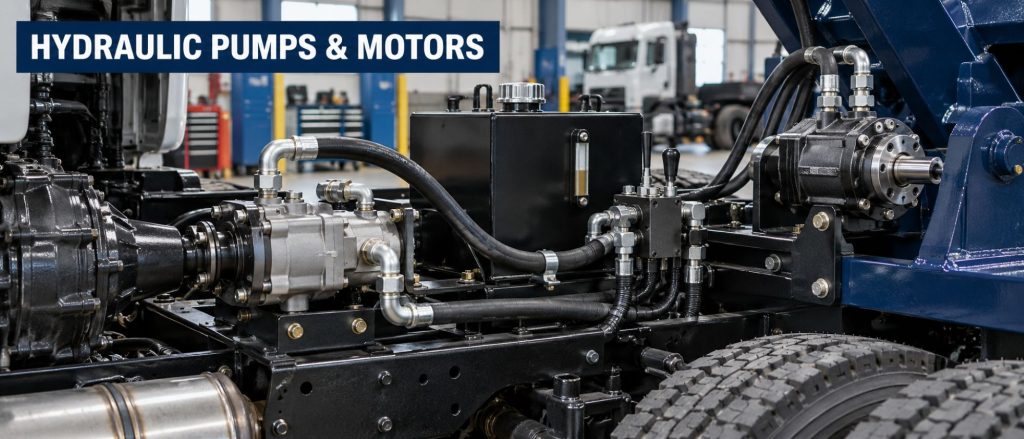
Hydraulic pumps and motors convert mechanical and hydraulic energy into the force needed to operate commercial truck bodies, trailers, lifting systems, winches, conveyors, compactors, cranes, and other vocational equipment.
A hydraulic pump receives mechanical power from a power take-off, engine drive, electric motor, or other power source and creates fluid flow. A hydraulic motor performs the reverse function by using pressurized hydraulic fluid to produce rotary mechanical motion.
Truck Equipment Atlas covers hydraulic pumps, motors, dump pumps, tandem pumps, variable-displacement pumps, and related components used throughout commercial truck and trailer applications.
Hydraulic Pumps and Motors on Truck Equipment Atlas
Explore the commercial truck hydraulic pumps currently covered on Truck Equipment Atlas:
- Parker F1 Hydraulic Pump
- Parker F2 Twin-Flow Hydraulic Pump
- Muncie E Series Hydraulic Pump
- Permco P5151 Hydraulic Pump
- Permco DM-640 Dump Pump
- Bezares BEZA Lightweight Hydraulic Pump
Additional hydraulic pumps, motors, integrated pump systems, and manufacturer product families will be added as the Truck Equipment Atlas PTO & Hydraulic Systems Library continues to expand.
How Hydraulic Pumps Work
A hydraulic pump receives mechanical power from a PTO, engine, electric motor, or other drive system. The pump draws fluid from a reservoir and moves it into the pressure side of the hydraulic circuit.
The pump creates flow rather than directly creating pressure. Resistance to that flow from a cylinder, hydraulic motor, valve, load, or restriction causes system pressure to rise.
Hydraulic fluid then travels through valves, hoses, fittings, cylinders, motors, and other components before returning to the reservoir.
A complete pump circuit can include:
- Power take-off or other mechanical drive
- Hydraulic pump
- Suction line
- Hydraulic reservoir
- Pressure line
- Directional-control valve
- Pressure-relief valve
- Hydraulic cylinder or motor
- Return line
- Filters and breathers
- Hydraulic fluid cooler where required
Every component must be properly sized for the required flow, pressure, fluid type, temperature, operating speed, and duty cycle.
How Hydraulic Motors Work
A hydraulic motor uses pressurized fluid to produce rotary motion. Fluid enters the motor and acts on internal gears, vanes, pistons, or other rotating components.
The motor’s output shaft can power:
- Winches
- Conveyors
- Augers
- Blowers
- Mixers
- Fans
- Reels
- Sweepers
- Compactors
- Specialized trailer equipment
Hydraulic motors are selected according to required torque, speed, displacement, pressure, flow, mounting arrangement, shaft design, rotation, and operating environment.
Common Hydraulic Pump Types
Commercial truck hydraulic systems use several major pump designs.
Common pump types include:
- External gear pumps
- Internal gear pumps
- Piston pumps
- Vane pumps
- Dump pumps
- Fixed-displacement pumps
- Variable-displacement pumps
- Single-section pumps
- Tandem pumps
- Twin-flow pumps
- Bi-rotational pumps
- Clutch pumps
- Electric hydraulic power units
The correct pump type depends on the required flow, pressure, control method, equipment function, available power, installation space, and expected operating cycle.
Gear Pumps
Gear pumps are widely used in commercial truck hydraulic systems because of their relatively simple construction, compact size, broad availability, and suitability for many intermittent-duty applications.
As the pump gears rotate, fluid is carried from the inlet side around the outside of the gears and discharged through the outlet.
Gear pumps are commonly used for:
- Dump bodies
- Utility equipment
- Snow and ice equipment
- Lift systems
- Service trucks
- Recovery equipment
- Agricultural applications
- General vocational hydraulics
Gear pumps normally provide fixed displacement, meaning that theoretical output is directly related to pump speed.
Piston Pumps
Piston pumps use reciprocating pistons to move hydraulic fluid. Depending on their design, they can support high operating pressures, efficient power transfer, variable displacement, and continuous-duty applications.
Piston pumps are commonly associated with equipment requiring:
- Higher hydraulic pressure
- Continuous operation
- Variable flow
- Load-sensing controls
- Efficient operation across changing demands
- Precise equipment control
- Multiple hydraulic functions
These pumps may be used on cranes, refuse equipment, concrete equipment, utility vehicles, heavy recovery trucks, specialized trailers, and other demanding applications.
Dump Pumps
Dump pumps are designed for hydraulic circuits used to raise and lower dump bodies or trailers. Many combine pumping and directional-control functions in one compact assembly.
Depending on the system, a dump pump may provide raise, neutral, hold, and lower functions. It must be matched to the reservoir, cylinder, control system, hydraulic lines, and intended trailer or body.
Dump-pump selection can depend on:
- Single-line or multi-line circuit design
- Required hydraulic flow
- Maximum system pressure
- Pump rotation
- Port size and location
- Control method
- PTO speed
- Reservoir capacity
- Cylinder displacement
- Required raising time
A dump pump should not be used for an application or circuit arrangement that has not been approved by the pump and equipment manufacturers.
Single, Tandem, and Twin-Flow Pumps
A single-section pump supplies one primary hydraulic circuit. This arrangement is common when the truck operates one main piece of equipment or when several functions share the same flow source.
Tandem and twin-flow pumps contain separate pumping sections that can supply two hydraulic circuits or combine their output under approved operating conditions.
Multiple pump sections may support:
- Separate high-flow and low-flow circuits
- Independent equipment functions
- Steering and work circuits
- Crane and stabilizer functions
- Refuse-body functions
- Combined flow for faster operation
The two sections may have different displacements, pressure ratings, and operating requirements.
Fixed-Displacement and Variable-Displacement Pumps
A fixed-displacement pump moves approximately the same theoretical volume of fluid during each revolution. System flow therefore changes primarily with pump speed.
A variable-displacement pump can change the amount of fluid moved during each revolution. Depending on its controls, it can adjust output according to system demand, pressure, or load.
Variable-displacement pumps can provide advantages in applications requiring:
- Changing hydraulic demand
- Multiple equipment functions
- Load-sensing operation
- Improved energy efficiency
- Reduced heat generation
- Precise flow control
- Continuous-duty operation
Variable-displacement systems are typically more complex and must be properly integrated with the control valves, load-sensing circuit, reservoir, filtration, and equipment controls.
Hydraulic Flow and Pressure
Hydraulic flow and pressure perform different functions within the system.
Flow determines how quickly a cylinder extends or how fast a hydraulic motor turns. Pressure reflects the resistance created by the load and influences the amount of force or torque the system can produce.
Hydraulic-system performance depends on correctly matching:
- Pump displacement
- Pump speed
- Required flow rate
- Maximum operating pressure
- PTO speed ratio
- Engine operating speed
- Hose and fitting sizes
- Valve capacity
- Cylinder or motor displacement
- Reservoir capacity
- Filtration and cooling
Increasing engine or PTO speed to compensate for an undersized pump can exceed pump-speed limits and create excessive heat, noise, aeration, cavitation, and premature wear.
Pump Rotation and Mounting
Hydraulic pumps may be designed for clockwise, counterclockwise, or approved bi-rotational operation. Rotation is determined by viewing the pump from the specified reference position established by the manufacturer.
The pump’s required rotation must match the PTO output. Operating a directional pump backward can prevent normal lubrication and fluid delivery or cause serious damage.
Common mounting arrangements include:
- Direct mounting to the PTO
- Remote mounting with a driveshaft
- Frame-mounted pump systems
- Engine-driven pump mounting
- Front-crankshaft-driven systems
- Belt-driven clutch pumps
- Electric hydraulic power units
Installation must provide proper alignment, support, clearance, hose routing, shaft protection, and access for inspection and service.
Common Hydraulic Pump and Motor Applications
Hydraulic pumps and motors are used throughout commercial trucking and vocational equipment.
Common applications include:
- Dump trucks
- Dump trailers
- Walking-floor trailers
- Lowboy and detachable-gooseneck trailers
- Refuse trucks
- Roll-off and hooklift trucks
- Tow trucks and recovery vehicles
- Utility and service trucks
- Truck-mounted cranes
- Concrete mixers
- Vacuum trucks
- Snow and ice equipment
- Street sweepers
- Bulk-material blowers
- Forestry equipment
- Oilfield service vehicles
- Agricultural equipment
- Fire and emergency apparatus
Each application requires a pump or motor matched to its operating speed, pressure, flow, duty cycle, environment, and powered equipment.
Advantages of Hydraulic Pumps and Motors
Depending on the application, hydraulic pumps and motors can provide several advantages:
- High power density
- Flexible component placement
- Remote power transmission through hoses and tubing
- Strong low-speed force and torque
- Smooth and controllable equipment movement
- Ability to power multiple functions
- Wide selection of pump and motor designs
- Compatibility with truck-mounted and trailer-mounted equipment
- Compact components relative to available output
- Established parts and service support
These characteristics make hydraulic power well suited to commercial vehicles that must lift, rotate, pull, push, compact, convey, or position heavy equipment and loads.
Limitations and Considerations
Hydraulic pumps and motors also have important limitations and operating considerations:
- Fluid contamination can cause rapid wear
- Leaks can reduce performance and create environmental hazards
- Incorrect pump speed can cause damage
- Improper suction plumbing can cause cavitation
- Excessive pressure can damage components
- Continuous operation can create substantial heat
- Incorrect fluid can affect lubrication and seal life
- Poor alignment can damage shafts, bearings, and couplings
- Cold fluid can restrict flow during startup
- Hydraulic systems require careful hose and fitting selection
- Stored hydraulic pressure can create serious service hazards
The pump or motor must be selected as part of the complete hydraulic circuit rather than as an isolated component.
Maintenance and Ownership
Hydraulic pump and motor life depends heavily on clean fluid, proper plumbing, correct operating speed, suitable pressure settings, and adequate cooling.
Important maintenance areas include:
- Hydraulic-fluid level and condition
- Reservoir cleanliness
- Suction hoses and clamps
- Pressure and return lines
- Filters and strainers
- Reservoir breathers
- Pump and motor seals
- Mounting fasteners
- Shaft alignment
- Couplings and driveshafts
- Hydraulic-fluid temperature
- Operating pressure
- Unusual noise or vibration
- Slow or erratic equipment operation
Whining, knocking, foaming fluid, overheating, slow movement, pressure loss, seal leakage, or unusual vibration should be investigated before the system is returned to normal operation.
Hydraulic Pump and Motor Manufacturers
Hydraulic pumps, motors, and related components are produced by manufacturers serving the commercial vehicle, mobile hydraulic, industrial, and vocational-equipment markets.
Manufacturers represented in the expanding Truck Equipment Atlas library include:
- Parker Hannifin
- Muncie Power Products
- Permco
- Bezares
- Commercial Intertech
- Danfoss
- Hydro Leduc
- Rexroth
- Sunfab
Available pump and motor models vary by application, geographic market, hydraulic circuit, power source, and equipment manufacturer.
Related PTO and Hydraulic Categories
Explore additional commercial PTO and hydraulic-equipment categories:
- Power Take-Off Systems
- Wet Kits & Complete Hydraulic Systems
- Hydraulic Cylinders & Dump Hoists
- Hydraulic Valves, Controls & Reservoirs
- Hydraulic Hoses, Fittings & Filtration
Related PTO and Hydraulic Guides
Explore educational resources covering hydraulic-system operation, pump selection, wet kits, inspection, and maintenance:
- How Commercial Truck PTO and Hydraulic Systems Work
- Commercial Truck Power Take-Off Types Explained
- How to Choose a PTO and Hydraulic Pump
- Commercial Truck Wet Kits Explained
- How to Inspect and Maintain Truck Hydraulic Systems
Visit the PTO & Hydraulic System Guides page to explore the complete educational guide collection.
Explore the Complete PTO & Hydraulic Systems Library
Hydraulic pumps and motors represent one part of the larger commercial truck hydraulic and vocational-equipment system.
Visit the Truck Equipment Atlas PTO & Hydraulic Systems Library to explore power take-offs, pumps, motors, wet kits, cylinders, hoists, valves, controls, reservoirs, hoses, fittings, filters, and complete hydraulic systems.
Additional pump and motor profiles, hydraulic-system components, application guides, and educational resources will be added as Truck Equipment Atlas continues to expand.
Support Trucking Families
Truck Equipment Atlas supports the mission of Grey Cross, a nonprofit dedicated to helping families of truck drivers who lose their lives while on the road. As the site grows, part of its mission is to bring awareness and support to these families.
Follow the Growth of Truck Equipment Atlas
Truck Equipment Atlas continues to expand with new truck profiles, trailer coverage, diesel engine pages, equipment-system resources, manufacturer information, and educational guides.
Visit our Site Updates page to explore recent additions, project milestones, and upcoming resources as we continue building one of the industry’s growing commercial trucking equipment reference libraries.