
Quick Facts
- Manufacturer: Muncie Power Products
- Product Series: TG Series
- Product Type: Mechanical-shift power take-off
- PTO Design: Modular double-gear, constant-mesh input design
- Mounting Patterns: Six-bolt and eight-bolt transmission openings
- Housing Material: Die-cast aluminum
- Available Speed Ratios: Ten
- Available Shift Types: Thirteen
- Available Output Options: Ten primary output-shaft options
- Available Input Gears: Eleven primary input-gear families, with additional application-specific input configurations
- Maximum Standard Intermittent Torque: Up to 285 lb-ft, depending on ratio and application
- Maximum Standard Continuous Torque: Up to 200 lb-ft, depending on ratio and application
- Approximate Weight: 22 pounds for six-bolt models and 25 pounds for eight-bolt models
- Primary Applications: Dump trucks, utility trucks, wreckers, cranes, refuse equipment, snow-and-ice vehicles, and other vocational trucks
- Production Status: Current product family
Overview
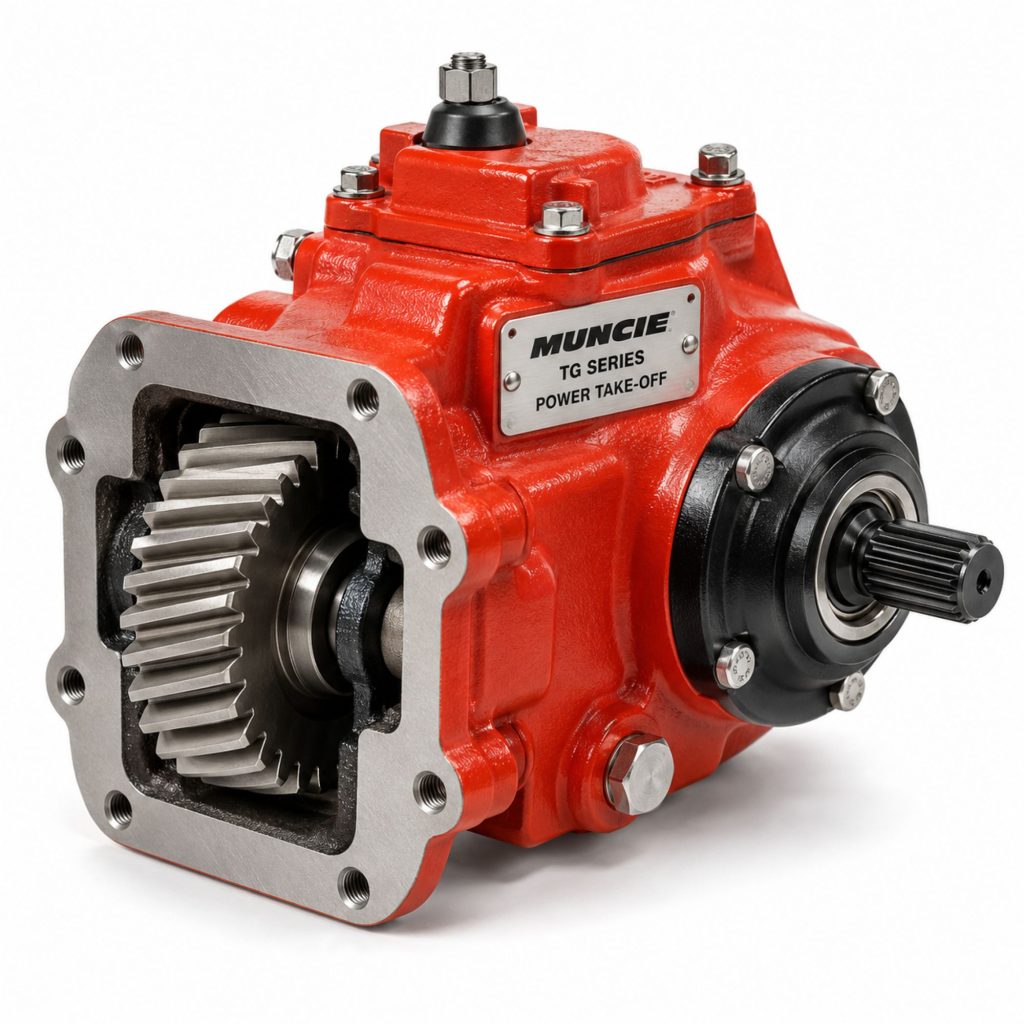
The Muncie TG Series Power Take-Off is a modular mechanical-shift PTO designed for a wide range of commercial-truck transmissions and vocational applications. Muncie describes it as one of the industry’s most versatile and widely used double-gear PTO designs.
The TG Series can be configured with six- or eight-bolt mounting, ten speed ratios, thirteen shift types, multiple input gears, and direct-pump or driveline outputs. This flexibility allows one product family to serve many manual and application-specific automatic transmission installations.
A die-cast aluminum housing reduces weight while improving heat dissipation. Its modular construction also allows the transmission input gear, ratio gears, shift system, output, and special features to be selected for the individual vehicle.
Correct configuration is essential. Torque, speed, rotation, mounting depth, input gearing, shift type, pump interface, and transmission compatibility must all be confirmed before the PTO is ordered or installed.
Key Characteristics
- Mechanical-shift PTO
- Double-gear modular architecture
- Constant-mesh input gear
- Six- and eight-bolt mounting configurations
- Die-cast aluminum housing
- Ten available speed ratios
- Thirteen shift types
- Multiple transmission input gears
- Direct-pump and driveline outputs
- Four primary assembly arrangements
- Standard- and deep-mount configurations
- Optional pressure lubrication
- High-torque configurations for selected ratios
- Compact installation envelope
- Large shift-cover opening for backlash inspection
- Modular construction simplifies repair and conversion
Major Components
- Die-cast aluminum housing
- Transmission input gear
- Input ratio gear
- Output gear
- Idler gear and shaft
- Output shaft
- Bearings and thrust washers
- Sliding clutch or shift collar
- Shift fork and shift rail
- Shift cover
- Air cylinder, cable, or hydraulic shift components
- Output bearing cap
- Pump-mount flange or driveline output
- Oil seals and O-rings
- Mounting gaskets and shims
- Mounting studs and fasteners
- Pressure-lubrication components when equipped
- Engagement indicator or pressure switch when specified
Product Type and Construction
The TG Series is a mechanical-shift PTO with a modular double-gear design. Its input gear remains meshed with the transmission PTO drive gear, while an internal sliding component connects or disconnects the output gear and shaft.
This constant-mesh input arrangement isolates the transmission drive gear from many engagement errors associated with older sliding-input designs. The output still must be engaged according to the instructions for the transmission and shift system.
The die-cast aluminum housing reduces weight, helps dissipate heat, and can reduce transmitted gear noise. Muncie offers the housing in numerous standard, nonstandard, deep-mount, metric-stud, and transmission-specific configurations.
How the Power Take-Off Works
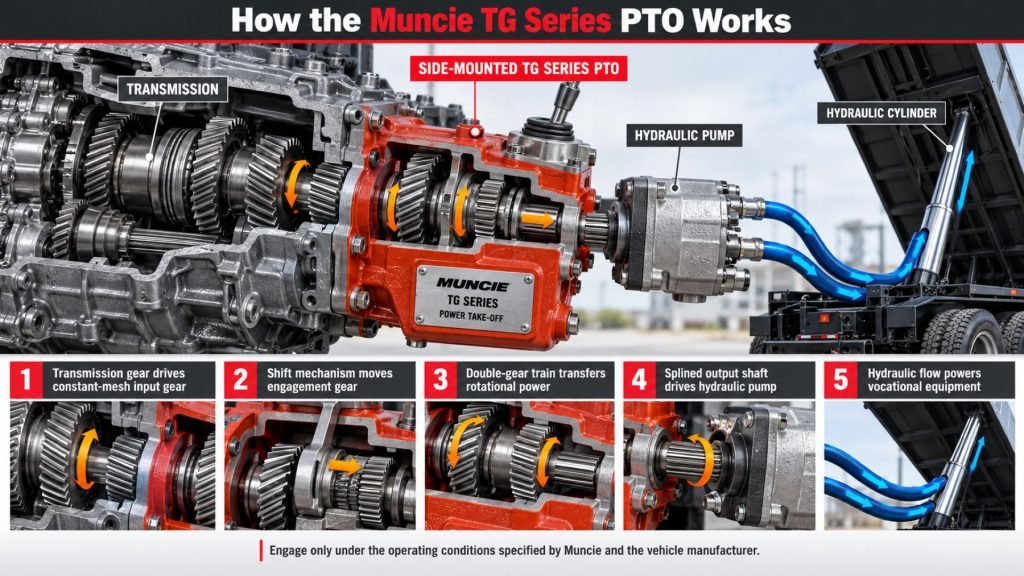
The TG Series mounts over a compatible six- or eight-bolt opening in the transmission. Its input gear meshes continuously with the transmission’s PTO drive gear whenever the transmission gear is rotating.
When the operator activates the PTO control, the shift system moves the internal shift collar or sliding gear into the engaged position. Power then travels through the input gear, ratio gears, and output shaft.
The output shaft powers a directly mounted hydraulic pump or transfers power through an auxiliary driveline. The selected ratio determines whether the output operates slower than, close to, or faster than the speed provided by the transmission PTO drive gear.
When the PTO is disengaged, the internal shift mechanism disconnects the output while the input gear remains in mesh with the transmission drive gear.
Position and Function Within the Vehicle
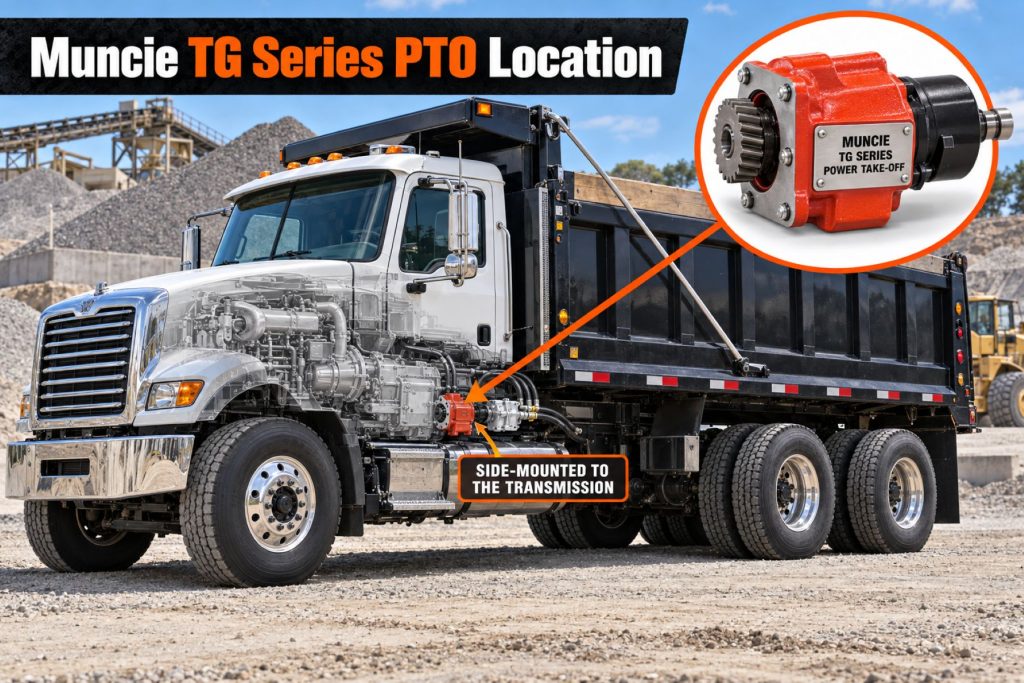
The TG Series installs on a compatible side or bottom PTO opening on the transmission. Mounting position depends on the transmission design, truck chassis, body equipment, required output rotation, and available clearance.
The PTO can supply mechanical power for:
- Hydraulic pumps
- Dump-body hoists
- Utility and aerial equipment
- Wrecker and recovery equipment
- Hydraulic cranes
- Refuse bodies
- Snowplows and spreaders
- Air compressors
- Vacuum equipment
- Liquid-transfer pumps
- Winches
- Live-floor trailers
- Other vocational equipment
Common Specifications
- PTO Type: Modular mechanical-shift power take-off
- Mounting Patterns: SAE six-bolt and eight-bolt openings
- Housing Material: Die-cast aluminum
- Approximate Six-Bolt Weight: 22 pounds or 10 kilograms
- Approximate Eight-Bolt Weight: 25 pounds or 11.34 kilograms
- Available Ratio Codes: 04, 05, 06, 07, 08, 09, 12, 13, 15, and 18
- Published Internal Ratio Range: Approximately 0.361:1 to 1.720:1
- Maximum Standard Intermittent Torque: 285 lb-ft or 386 N-m
- Maximum Standard Continuous Torque: 200 lb-ft or approximately 270 N-m
- Maximum Standard Intermittent Power at 1,000 Output RPM: 54 horsepower or 40 kilowatts
- Approximate Maximum Advertised Output Speed: 2,500 RPM, subject to application limitations
- Shift Systems: Cable, manual air, electric-over-air, hydraulic, electric-hydraulic, Lectra Shift, and application-specific controls
- Output Types: Keyed shafts, companion flanges, SAE pump mounts, DIN outputs, and special application-specific configurations
- Lubrication: Transmission splash lubrication or optional pressure lubrication, depending on application
Torque, horsepower, speed, and continuous-duty ratings may be reduced by the transmission, input gear, adapter, output, or application. Final specifications must be confirmed for the complete model number.
Power, Torque, Speed, and Operating Capacity
The TG Series has ratio-dependent intermittent and continuous ratings. Standard published ratings range from 175 to 285 lb-ft for intermittent operation and from 123 to 200 lb-ft for continuous operation.
Published standard ratings by ratio include:
- 04 ratio: 285 lb-ft intermittent and 200 lb-ft continuous
- 05 ratio: 270 lb-ft intermittent and 189 lb-ft continuous
- 06 ratio: 245 lb-ft intermittent and 172 lb-ft continuous
- 07 ratio: 230 lb-ft intermittent and 161 lb-ft continuous
- 08 ratio: 230 lb-ft intermittent and 161 lb-ft continuous
- 09 ratio: 205 lb-ft intermittent and 144 lb-ft continuous
- 12 high-torque ratio: 210 lb-ft intermittent and 147 lb-ft continuous
- 13 high-torque ratio: 210 lb-ft intermittent and 147 lb-ft continuous
- 15 high-torque ratio: 195 lb-ft intermittent and 137 lb-ft continuous
- 18 high-torque ratio: 175 lb-ft intermittent and 123 lb-ft continuous
Some transmission applications, adapters, outputs, and special configurations require lower ratings. The application-specific rating always takes precedence over the general series rating.
Intended Transmission and Mounting Position
The TG Series supports an extensive range of commercial-truck transmissions. Application-specific input gears have been offered for transmissions from manufacturers including Aisin, Allison, Clark, Eaton, Fuller, Mack, Mercedes, New Process, New Venture, Nissan, Spicer, Tremec, Warner, and ZF.
Available mounting configurations include:
- SAE six-bolt standard mount
- SAE six-bolt nonstandard or deep mount
- SAE six-bolt metric-stud mount
- SAE six-bolt transmission-specific mount
- SAE eight-bolt standard mount
- SAE eight-bolt nonstandard or deep mount
- SAE eight-bolt extra-deep mount
- SAE eight-bolt metric-stud mount
- Application-specific Eaton Endurant mount
The complete transmission model and specification must be identified before the input gear, housing depth, spacer, adapter, and mounting kit are selected.
PTO Engagement and Shift System
The TG Series is available with multiple shift systems to accommodate different trucks, air supplies, electrical systems, and operator-control requirements.
Published shift types include:
- 12-volt manual air shift
- 24-volt manual air shift
- Cable shift
- 12-volt electric-over-air shift
- 24-volt electric-over-air shift
- 12-volt hydraulic shift
- 24-volt hydraulic shift
- Electric-hydraulic shift
- Lectra Shift
- Manual air without installation components
- Constant-mesh configuration
- Application-specific Allison controls
- Application-specific special shift systems
The operator must follow the engagement procedure for the exact transmission and shift system. Mechanical PTOs should not be shifted while transmission gears are rotating unless the approved application instructions specifically permit that operation.
Power Transfer and Output Design
The TG Series can power a directly mounted hydraulic pump or auxiliary equipment through a driveline output.
Available output families include:
- 1¼-inch round keyed shaft
- 1410 Series companion flange
- DIN 100 companion flange
- DIN 5462 pump output
- SAE A pump mounts
- SAE B pump mounts
- SAE BB pump mounts
- SAE C shaft configurations
- Special low-box pump mounts
- Application-specific splined outputs
The selected output must match the pump or driven equipment’s flange, pilot, shaft, spline, rotation, speed, and torque requirements.
Modular Gearing and Configuration Changes
The TG Series was designed so the PTO can be adapted to a different approved transmission by changing the transmission input gear. Output speed can be changed by replacing the matched input-ratio and output-gear pair.
Ratio gears must be installed as approved matched pairs. Combining unmatched gears can create incorrect tooth contact, output speed, center distance, or mechanical interference.
A configuration change must include a complete review of:
- Transmission compatibility
- Input-gear design
- Housing mounting depth
- Required spacers or adapters
- Gear backlash
- Output speed
- Output rotation
- Torque and horsepower rating
- Continuous-duty capability
- Pump or driveline compatibility
Hydraulic Circuit and Equipment Integration
When the TG Series drives a hydraulic pump, output speed, pump displacement, engine speed, hydraulic pressure, required flow, and duty cycle must be evaluated together.
A typical system may include:
- Direct-mounted or remotely driven hydraulic pump
- Hydraulic reservoir
- Suction hose
- Pressure and return lines
- Directional-control valve
- Pressure-relief valve
- Hydraulic cylinder or motor
- Return filtration
- Reservoir breather
- Hydraulic-oil cooler
- Pressure and temperature monitoring
- PTO and body-control interlocks
An incorrect pump displacement, relief setting, PTO ratio, or engine speed can overload the PTO or produce excessive hydraulic heat.
Housing, Shaft, Bearing, and Gear Design
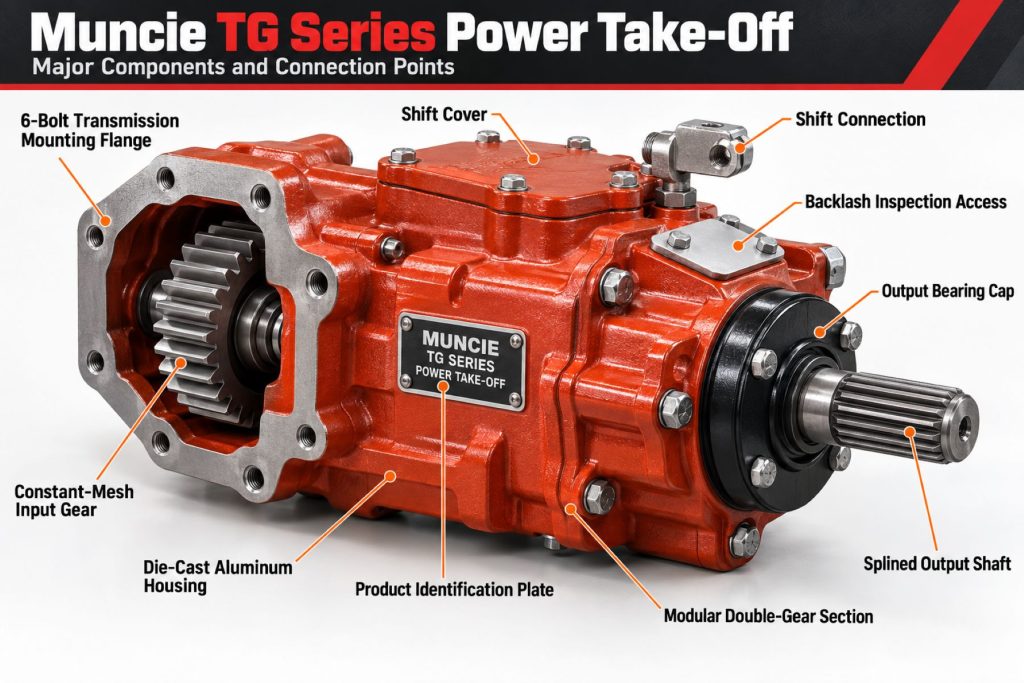
The TG Series uses a lightweight die-cast aluminum housing with an extra-large shift-cover opening. Removing the cover provides access for inspecting the shift mechanism and checking PTO-to-transmission gear backlash.
The internal design includes a transmission input gear, ratio gear, output gear, shift components, bearings, shafts, and an application-specific output assembly.
Optional greaseable output shafts, high-torque gearing, pressure lubrication, clearance idler caps, and remote pressure switches are available in selected configurations.
Controls and Electronic Integration
Control complexity depends on the selected shift type. A basic cable-shift PTO may use a mechanical handle and engagement indicator, while electric-air or electric-hydraulic versions require wiring, switches, valves, and vehicle power.
Possible control components include:
- Mechanical cable and control knob
- Manual air valve
- Electric air solenoid
- Hydraulic shift valve
- Electric-hydraulic actuator
- Dash-mounted PTO switch
- Engagement indicator
- Pressure switch
- Neutral or clutch interlock
- Parking-brake interlock
- Engine-speed control
- Body-equipment interlock
Controls must match the PTO, transmission, electrical voltage, vehicle air system, and completed body equipment.
Efficiency, Heat, and Lubrication
The aluminum housing helps dissipate heat, but correct gear backlash, lubricant level, ratio selection, loading, and output speed remain essential.
Many TG Series configurations receive lubrication from the transmission. Pressure lubrication is optional or required in certain applications, mounting positions, and operating conditions.
Excessive backlash, insufficient backlash, low lubricant, incorrect oil, overspeed, overload, or extended operation beyond the approved rating can create heat and accelerated wear.
Duty Cycle and Operating Conditions
Muncie defines intermittent maximum-load service as five minutes or less within a fifteen-minute operating period. Operation beyond that interval should be evaluated as continuous duty.
Continuous-duty applications commonly require a 30-percent reduction from the intermittent torque and horsepower ratings. Applications operating above 2,000 PTO output RPM should also be treated as continuous duty regardless of operating duration.
Application suitability depends on:
- Selected ratio
- Transmission-specific rating
- Operating torque
- Peak and shock loads
- Output speed
- Length of each operating cycle
- Hydraulic-system pressure
- Ambient and oil temperature
- Pump weight and support
- Adapter use
- Vehicle movement during operation
- Driven-equipment duty cycle
Mounting and Installation
Installation requires matching the TG Series housing and input gear to the transmission, installing the required gaskets or spacers, and establishing the correct gear backlash.
The installer must verify:
- Correct transmission application
- Correct six- or eight-bolt housing
- Correct input gear
- Required standard or deep mounting depth
- Required adapter, spacer, and stud kit
- Correct ratio gears
- Proper assembly arrangement
- Correct gear backlash
- Output rotation
- Pump or driveline clearance
- Shift-system installation
- Pressure-lubrication connections when required
- Fastener torque
- Transmission-fluid level after installation
Muncie recommends supporting direct-mounted hydraulic pumps when the combined pump, fittings, hose, and oil weight reaches 40 pounds. Operating conditions may require support at a lower weight.
Transmission and Vehicle Compatibility
The TG Series has broad transmission coverage, but every PTO must be configured for a specific transmission and vehicle.
Compatibility depends on:
- Transmission manufacturer
- Transmission model and specification
- PTO-opening location
- Six- or eight-bolt mounting pattern
- Drive-gear pitch and pressure angle
- Input-gear helix and rotation
- Required mounting depth
- Output-speed requirement
- Output rotation
- Shift-system compatibility
- Lubrication requirements
- Frame and exhaust clearance
- Body and equipment layout
A PTO should not be selected from the bolt pattern or physical appearance alone.
Pump, Driveshaft, and Driven-Equipment Compatibility
A direct-mounted hydraulic pump must match the PTO’s output flange, pilot, shaft size, spline, rotation, torque rating, and operating-speed range.
Driveline-powered equipment requires a correctly sized output shaft or companion flange, driveshaft, universal joints, guards, slip connection, and support bearings where required.
The PTO, output shaft, pump, driveshaft, and driven equipment must all support the required operating and peak torque. The lowest-rated component limits the system.
Hydraulic Fluid, Filtration, and Reservoir Compatibility
The TG Series normally receives lubricant from the transmission or an approved pressure-lubrication circuit. A PTO-driven hydraulic pump uses a separate hydraulic-fluid circuit.
The hydraulic reservoir, suction hose, return line, filter, breather, cooler, and fluid must support the required pump flow and operating temperature.
Contaminated, aerated, overheated, or incorrect hydraulic fluid can damage the pump and increase the power demand placed on the PTO.
Common Applications
- Dump trucks
- Dump trailers
- Utility trucks
- Aerial-lift vehicles
- Service trucks
- Wreckers and tow trucks
- Hydraulic-crane trucks
- Refuse vehicles
- Snowplows
- Salt and material spreaders
- Winch trucks
- Liquid-transfer equipment
- Live-floor systems
- Municipal vehicles
- Specialized vocational trucks
Advantages
- Broad transmission coverage
- Six- and eight-bolt mounting options
- Ten speed ratios
- Thirteen shift types
- Multiple input gears
- Direct-pump and driveline outputs
- Lightweight aluminum housing
- Improved heat dissipation
- Compact installation envelope
- Modular construction
- Input gear can be changed for approved transmission conversions
- Ratio gears can be changed as matched pairs
- Large shift-cover opening simplifies backlash inspection
- Optional high-torque and pressure-lube configurations
- Long-established parts and service support
Limitations or Considerations
- Exact transmission matching is required
- Torque capacity varies by ratio and application
- Continuous service requires lower ratings in many applications
- Gear backlash must be correctly established
- Incorrect engagement can damage PTO components
- Adapters may reduce torque and horsepower capacity
- Some adapters are not approved for continuous duty
- Adapters can create frame or exhaust interference
- Heavy pumps require structural support
- Incorrect ratio selection can overspeed or underspeed equipment
- Input and ratio gears must not be mismatched
- Pressure lubrication may be required
- Six- and eight-bolt models are not automatically interchangeable
Driver and Operator Experience
Operator experience depends on the shift system. Cable-shift models use a mechanical control, while air, electric-air, hydraulic, and electric-hydraulic versions can provide remote or dash-mounted engagement.
Operators should monitor:
- PTO engagement confirmation
- Engine and PTO speed
- Abnormal gear noise
- Hydraulic pressure and temperature
- Slow equipment operation
- Air, transmission-fluid, or hydraulic leaks
- Difficulty engaging or disengaging
- Pump or driveline vibration
- Unexpected disengagement
- Control-system warning indicators
PTO Engagement and Operating Procedure
The engagement procedure depends on the transmission and shift system. Operators should follow Muncie’s instructions and the completed vehicle manufacturer’s procedures.
A typical manual-transmission procedure requires the vehicle to be stopped, the parking brake applied, the clutch depressed, and the transmission gears allowed to stop before the PTO is engaged.
After engagement, the clutch can be released according to the approved procedure and engine speed increased only to the level required by the equipment.
Mechanical PTOs should not be forced into engagement. Gear clash, grinding, incomplete engagement, or repeated jumping out of gear indicates a problem that should be corrected before operation continues.
Inspection and Wear Points
- PTO housing and mounting surface
- Mounting studs, nuts, and cap screws
- Mounting gaskets and shims
- Transmission input gear
- Ratio and output gears
- Gear backlash
- Bearings and thrust washers
- Shift fork, rail, collar, and detents
- Shift cover and gasket
- Output shaft and splines
- Pump flange and pilot
- Cable, air, hydraulic, or electrical controls
- Pressure-lube lines when equipped
- Pump support bracket
- Auxiliary driveline and guards
- Oil seals and O-rings
Lubrication Requirements
The TG Series must receive the correct transmission lubricant at the required level. Some applications rely on splash lubrication, while others require or benefit from pressure lubrication.
The transmission-fluid level should be rechecked after PTO installation because the additional housing can change the total lubricant requirement.
Pressure-lubrication lines should be inspected for leaks, restrictions, abrasion, incorrect routing, and damage. Greaseable output configurations must be serviced according to the instructions for the exact output.
Maintenance and Ownership Notes
Routine maintenance should include checking mounting fasteners, lubricant level, output-shaft play, shift operation, gear noise, pump support, control lines, wiring, and auxiliary-driveline components.
Newly installed or serviced PTOs should be rechecked after their initial operating period. Gasket compression, vibration, and thermal cycling can affect mounting-fastener retention and backlash.
The TG Series’ modular design allows many components and configurations to be serviced or converted. Any conversion must use the approved input gear, matched ratio gears, output components, and application instructions.
Common PTO and Hydraulic-System Problems
- PTO will not engage: A misadjusted cable, insufficient air or hydraulic pressure, failed solenoid, damaged shift fork, worn collar, incorrect interlock status, or internal damage may prevent engagement.
- PTO will not disengage: A binding cable, trapped air or hydraulic pressure, sticking valve, damaged shift components, or internal gear damage may keep the PTO engaged.
- Gear whine: Insufficient backlash, incorrect input gearing, bearing problems, or an overly tight installation can produce a whining sound.
- Gear clatter: Excessive backlash, loose mounting hardware, worn gears, or an installation that is too loose can produce clattering.
- PTO jumps out of gear: Worn shift-rail detents, a damaged shift fork, incorrect linkage adjustment, incomplete engagement, or worn gear teeth may cause disengagement.
- Transmission-fluid leakage: Damaged gaskets, loose fasteners, worn seals, cracked housing components, or excessive case pressure may allow leakage.
- Overheating: Excessive speed, overloading, incorrect backlash, low lubricant, restricted pressure lubrication, or continuous operation beyond the approved rating may generate heat.
- Slow hydraulic operation: Incorrect PTO ratio, low engine speed, worn pump components, suction restriction, low hydraulic-fluid level, or internal leakage may reduce system performance.
- Housing or transmission damage: Unsupported pump weight, driveline misalignment, loose fasteners, an incorrect adapter, or chassis interference may overload the PTO installation.
Safety and Service Precautions
Before servicing the PTO or hydraulic equipment, shut down the engine, secure the vehicle, relieve hydraulic and pneumatic pressure, and prevent the powered equipment from moving.
Never work beneath a raised dump body, hoist, crane, aerial device, or hydraulically supported component without the manufacturer’s approved mechanical blocking or support system.
Rotating PTO shafts and auxiliary drivelines must be properly guarded. Hands, clothing, tools, and loose objects must be kept away from rotating components.
PTO installation, backlash adjustment, gear conversion, and transmission work should be completed by qualified personnel using current Muncie instructions for the exact model and application.
Identification Information
The complete Muncie model number identifies the PTO series, mounting configuration, transmission input gear, ratio, shift system, assembly arrangement, output, and special features.
Record the following information before ordering a PTO or replacement parts:
- Complete Muncie PTO model number
- PTO tag and serial information
- Vehicle identification number
- Truck manufacturer and model
- Transmission manufacturer
- Complete transmission model and specification
- Six- or eight-bolt mounting configuration
- Input-gear designation
- Ratio code
- Shift-type code
- Assembly arrangement
- Output-option code
- Special-feature code
- Adapter, spacer, and mounting-kit information
- Hydraulic-pump model
- Driven-equipment requirements
Do not identify a replacement TG Series PTO by appearance or bolt pattern alone.
Buying Considerations
- Verify the exact transmission model and specification
- Confirm the correct six- or eight-bolt mounting arrangement
- Select the approved input gear
- Determine the required output speed
- Calculate intermittent and continuous torque
- Confirm the driven-equipment duty cycle
- Choose the correct output rotation
- Match the pump flange and shaft
- Select the required shift system
- Determine whether pressure lubrication is required
- Identify required adapters, spacers, and stud kits
- Check frame, exhaust, and body clearance
- Evaluate direct-mounted pump weight
- Install a pump support bracket when required
- Confirm the effect of any adapter on the PTO rating
- Use Muncie’s PTO Builder or an authorized distributor
- Choose an experienced PTO and hydraulic-system installer
Variants and Configurations
- Six-bolt standard-mount models
- Six-bolt deep- and nonstandard-mount models
- Eight-bolt standard-mount models
- Eight-bolt deep- and extra-deep-mount models
- Metric-stud configurations
- Ten ratio options
- Multiple transmission input gears
- Four assembly arrangements
- Cable-shift models
- Manual-air models
- Electric-over-air models
- Hydraulic-shift models
- Electric-hydraulic models
- Lectra Shift models
- Constant-mesh configuration
- Pressure-lubricated models
- High-torque models
- Greaseable output-shaft configurations
- Keyed and companion-flange driveline outputs
- SAE and DIN direct-pump outputs
Comparison to Similar Equipment
Compared with the Muncie CS6 Series Power Take-Off, the TG Series is primarily a mechanically shifted PTO. The CS6 uses an internal clutch and drag brake for controlled engagement in compatible applications.
Compared with the Muncie FR6Q Power Take-Off, the TG Series supports a much broader range of transmission families, mounting arrangements, ratios, and controls. The FR6Q is designed specifically for selected Ford TorqShift applications.
Compared with the Parker Chelsea 442 Series Power Take-Off, both are versatile mechanical PTO families available with numerous ratios, shifts, and outputs. Their model numbers, gears, mounting components, controls, and replacement parts are manufacturer-specific.
Compared with the Parker Chelsea 489 Series Power Take-Off, the TG Series offers both six- and eight-bolt housing configurations. The Chelsea 489 primarily uses a one-piece eight-bolt housing.
Best Fit For
- Manual-transmission vocational trucks
- Approved six- and eight-bolt transmission applications
- Dump trucks and trailers
- Utility and aerial equipment
- Wrecker and recovery trucks
- Hydraulic-crane trucks
- Snow-and-ice-control vehicles
- Refuse and municipal equipment
- Applications requiring multiple speed choices
- Fleets wanting a modular and serviceable PTO
- Direct-mounted hydraulic pumps
- Auxiliary-driveline applications
Related Vehicle and Trailer Types
- Dump Trucks
- Utility Trucks
- Service Trucks
- Tow Trucks
- Refuse Trucks
- Vocational Trucks
- Dump Trailers
- Live-Floor Trailers
Related Truck and Trailer Models
- Freightliner M2 106
- Freightliner 114SD
- International HV Series
- Kenworth T280
- Kenworth T880
- Peterbilt 548
- Peterbilt 567
- Mack Granite
Related PTO and Hydraulic System Types
- Power Take-Off Systems
- Hydraulic Pumps & Motors
- Wet Kits & Complete Hydraulic Systems
- Hydraulic Cylinders & Dump Hoists
- Hydraulic Valves, Controls & Reservoirs
- Hydraulic Hoses, Fittings & Filtration
Related PTO and Hydraulic Products
- Muncie CS6 Series Power Take-Off
- Muncie FR6Q Power Take-Off
- Muncie E Series Hydraulic Pump
- Muncie WETLINE Hydraulic System
- Muncie V Series Hydraulic Directional Control Valve
- Parker Chelsea 280 Series Power Take-Off
- Parker Chelsea 442 Series Power Take-Off
- Parker Chelsea 489 Series Power Take-Off
- Parker Chelsea 590 Series Power Take-Off
- Parker Chelsea 870 Series Power Take-Off
Related Equipment Systems
- PTO & Hydraulic Systems
- Transmissions
- Electrical Systems
- Brake Systems
- Suspension Systems
- Axles & Differentials
Related Guides
- PTO & Hydraulic System Guides
- How Commercial Truck PTO and Hydraulic Systems Work
- Commercial Truck Power Take-Off Types Explained
- How to Choose a PTO and Hydraulic Pump
- Commercial Truck Wet Kits Explained
- How to Inspect and Maintain Truck Hydraulic Systems
Regulatory and Compliance Notes
PTO and hydraulic-system installations must preserve the vehicle’s braking, steering, transmission, driveline, electrical, exhaust, emissions, fuel-system, and structural integrity.
The completed vehicle must remain within its axle, frame, tire, wheel, transmission, driveline, and gross vehicle weight ratings. Installing a PTO does not increase any certified vehicle rating.
Rotating shafts, hydraulic hoses, raised bodies, cranes, outriggers, and other powered equipment may be subject to workplace-safety, inspection, guarding, and operating requirements.
The final-stage manufacturer or equipment installer is responsible for ensuring that the completed vehicle complies with applicable regulations and certification requirements.
Real World Operating Notes
The TG Series is highly configurable, but that flexibility makes the complete model number especially important. Two TG units may have different housings, input gears, ratios, controls, outputs, and ratings.
Backlash should be checked after the PTO is mounted. A noticeable whine can indicate insufficient backlash, while clatter can indicate excessive backlash.
Gear adapters can solve rotation, clearance, or mounting-depth problems, but they may move the PTO closer to frame or exhaust components and may reduce its torque capacity.
When changing ratios, both gears in the approved ratio pair must be replaced. Changing only one ratio gear can create an incompatible internal gear combination.
Frequently Asked Questions
What is the Muncie TG Series PTO?
It is a modular mechanical-shift power take-off available for numerous six- and eight-bolt commercial-truck transmission applications.
Is the TG Series a six-bolt or eight-bolt PTO?
It is available in both six- and eight-bolt configurations, including standard, deep, nonstandard, and transmission-specific mounting arrangements.
How many speed ratios are available?
Muncie offers ten primary TG Series ratio codes ranging from approximately 0.361:1 to 1.720:1.
How much torque can the TG Series handle?
The highest standard published rating is 285 lb-ft for intermittent operation and 200 lb-ft for continuous operation. Actual ratings depend on the ratio, transmission, adapter, output, and application.
Can the TG Series directly mount a hydraulic pump?
Yes. Multiple SAE and DIN direct-pump outputs are available. The pump flange, shaft, rotation, weight, and operating requirements must match the PTO.
Can it power equipment through a driveshaft?
Yes. Keyed shafts and companion-flange outputs are available for properly designed auxiliary-driveline systems.
Does the TG Series require backlash adjustment?
Yes. Correct backlash must be established between the transmission drive gear and PTO input gear during installation.
Can the PTO ratio be changed?
Yes, in approved configurations. The matched input-ratio gear and output gear must be replaced together, and the complete application must be rechecked.
Is the TG Series suitable for continuous operation?
It may be used in approved continuous-duty applications at the applicable reduced rating. Muncie commonly requires a 30-percent reduction from the intermittent rating.
How is the correct TG Series PTO identified?
Use the complete Muncie model number, transmission identification, mounting configuration, input gear, ratio, shift system, assembly arrangement, output, and special-feature code.
Availability and Where to Find
Muncie TG Series PTOs, installation kits, input gears, ratio gears, shift controls, output components, adapters, and service parts are available through Muncie Power distributors, commercial-truck dealers, hydraulic-equipment suppliers, body builders, and vocational-truck installers.
Availability depends on the transmission, mounting pattern, input gear, ratio, shift system, assembly arrangement, output, and special features.
Current product information, application assistance, configuration tools, technical literature, and distributor resources are available through the Muncie Power Products website.
Support Trucking Families
Truck Equipment Atlas supports the mission of Grey Cross, a nonprofit dedicated to helping families of truck drivers who lose their lives while on the road. As the site grows, part of its mission is to bring awareness and support to these families.
Podcast or Video Section
Learn More Through Audio and Video
Truck Equipment Atlas will continue expanding with podcast episodes, interviews, and equipment breakdowns to help drivers and fleets better understand trucks and equipment.
Follow the Growth of Truck Equipment Atlas
Truck Equipment Atlas continues to expand with new truck profiles, trailer coverage, diesel engine pages, equipment system resources, manufacturer information, and educational guides.
Visit our Site Updates page to explore recent additions, project milestones, and upcoming resources as we continue building one of the industry’s growing commercial trucking equipment reference libraries.
View the Latest Site Updates: Truck Equipment Atlas Site Updates