
Quick Facts
- Manufacturer: Parker Hannifin Chelsea Products Division
- Product Series: Chelsea 280 Series
- Product Type: Hydraulic PowerShift power take-off
- Mounting Type: Transmission-mounted 10-bolt PTO
- Shift Type: Hydraulic hot-shift operation
- Electrical Options: 12-volt or 24-volt hydraulic-shift configurations
- Continuous Torque Capacity: Up to 390 pound-feet, depending on ratio and configuration
- Speed Options: Nine available ratio families
- Common Transmission Applications: Approved automatic transmissions with a compatible 10-bolt PTO opening, including application-specific Allison and Caterpillar configurations
- Primary Function: Transfers transmission power to a hydraulic pump or auxiliary driveline
- Primary Applications: Refuse, vacuum, fire and rescue, utility, municipal, construction, and specialized vocational vehicles
- Approximate Weight: Approximately 49 pounds, depending on configuration
- Production Status: Current application and availability must be confirmed with Parker Chelsea
Overview
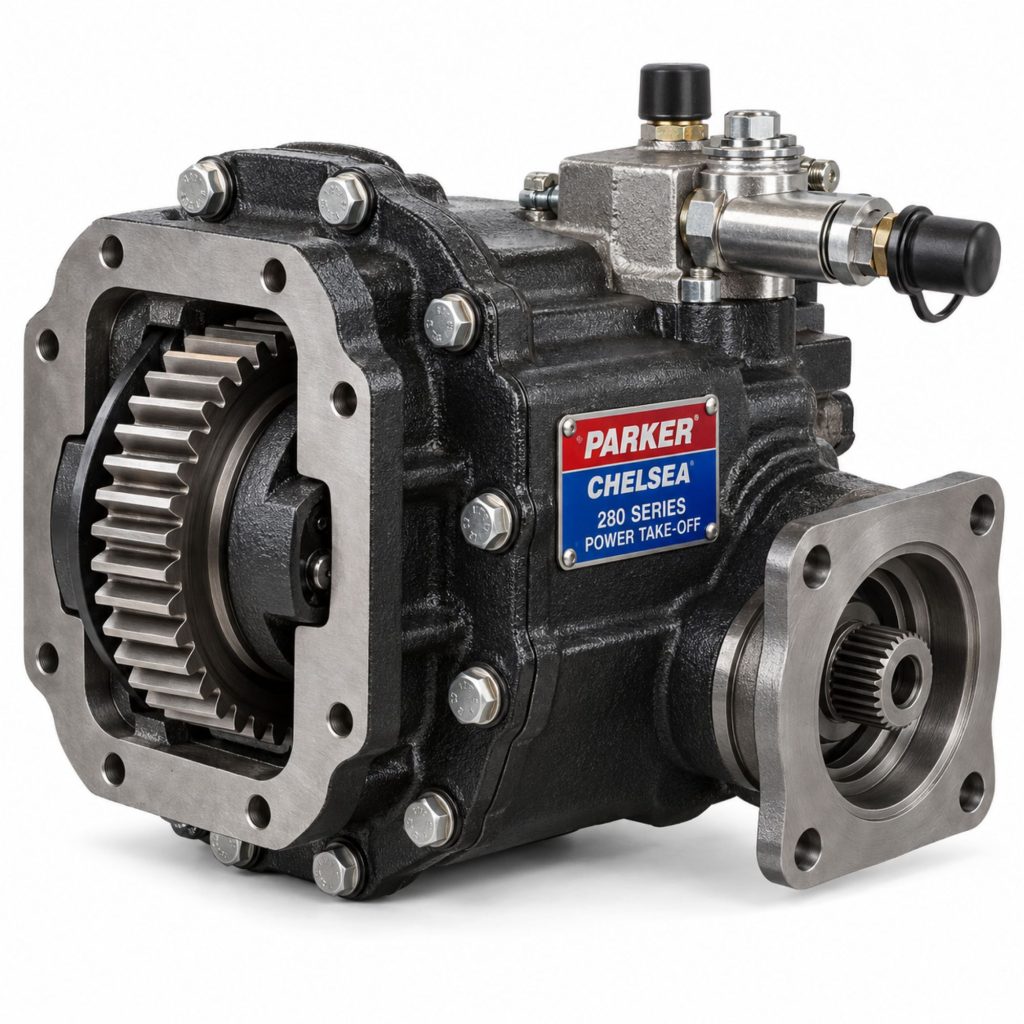
The Parker Chelsea 280 Series is a hydraulically shifted PowerShift power take-off designed for compatible automatic transmissions with a 10-bolt PTO opening. It transfers power from the transmission to a hydraulic pump, auxiliary driveshaft, or other vocational equipment.
The 280 Series is offered with multiple gear ratios and output configurations to support applications with different speed, torque, pump-mounting, and packaging requirements. Its continuous torque capacity can reach 390 pound-feet in approved configurations.
Available features can include rotatable pump flanges, wet-spline outputs, Smart Start technology, Electronic Overspeed Control, remote hydraulic-valve arrangements, and driveline outputs. The exact combination depends on the complete Parker Chelsea model number and transmission application.
The 280 Series replaced earlier Chelsea 277 and 278 Series applications. Replacement selection must still be based on the transmission, vehicle, hydraulic requirements, output speed, rotation, mounting arrangement, and complete Parker application data.
Key Characteristics
- Hydraulically shifted PowerShift PTO
- Designed for compatible 10-bolt automatic-transmission openings
- Continuous torque ratings up to 390 pound-feet
- Nine available speed-ratio families
- 12-volt and 24-volt shift options
- Direct pump-mount and driveline-output configurations
- Rotatable output-flange options
- Wet-spline options designed to reduce spline fretting
- Smart Start options for high-torque startup conditions
- Electronic Overspeed Control options
- Application-specific remote hydraulic-valve options
- Designed for medium- and heavy-duty vocational equipment
Major Components
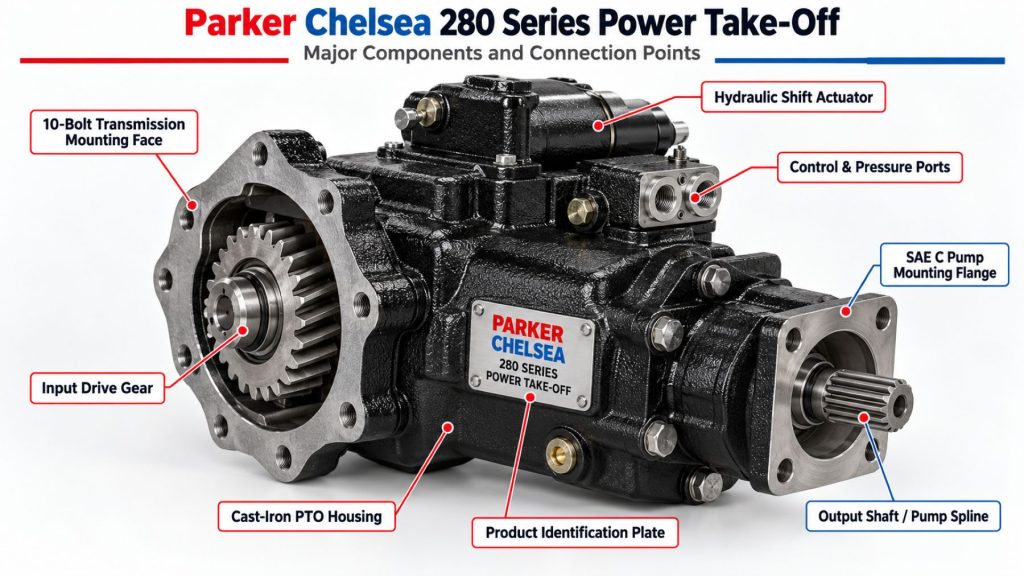
- PTO housing
- Input or driven gear
- Internal gearset
- Output shaft or pump-drive spline
- Bearings and bearing caps
- Hydraulic clutch or engagement assembly
- Shift piston and related seals
- Hydraulic shift valve
- Electrical solenoid and wiring where equipped
- Pressure switch or engagement indicator
- Pump-mounting flange or driveline output
- Wet-spline lubrication components where equipped
- Mounting studs, nuts, and gaskets
- Control switch and installation hardware
- Optional Smart Start components
- Optional Electronic Overspeed Control components
Product Type and Construction
The Chelsea 280 Series is a transmission-mounted, hydraulically shifted PTO built around a heavy-duty geared housing. It mounts to an approved 10-bolt PTO opening on the transmission.
The housing supports the internal gears, shafts, bearings, hydraulic engagement components, and selected output arrangement. Different assembly positions and output options allow the PTO and driven equipment to be packaged around the transmission, frame, exhaust, suspension, and body equipment.
The 280 Series may be configured with a direct-mounted hydraulic pump or an output shaft that drives remotely mounted equipment. The selected construction must match the intended torque, speed, rotation, mounting, and duty-cycle requirements.
How the Power Take-Off Works
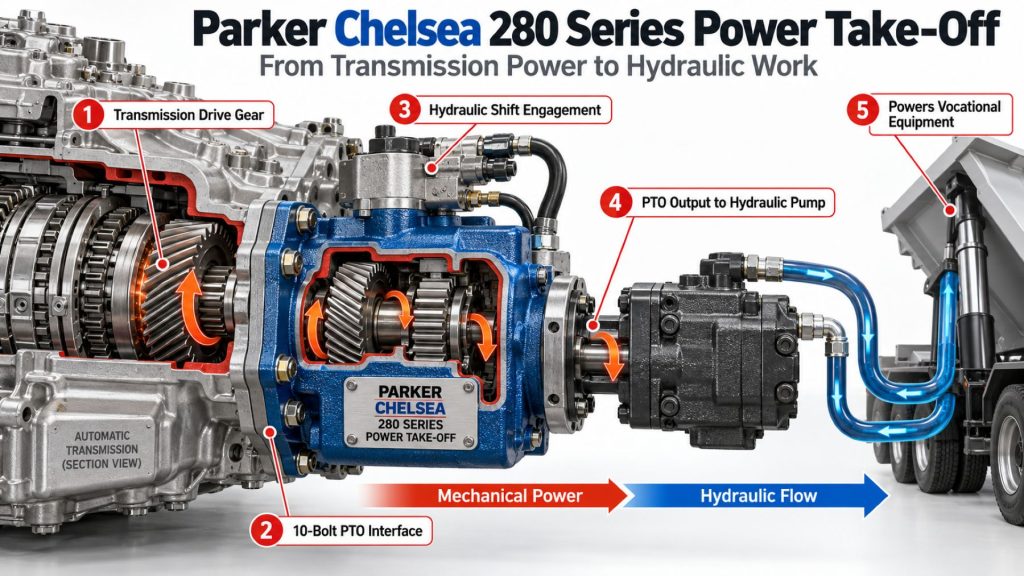
The transmission provides the mechanical power that drives the PTO’s input gear. When the operator commands PTO engagement, hydraulic pressure moves the internal engagement components and connects the PTO gearset to the output.
The PTO then transfers torque through its selected gear ratio to a hydraulic pump or auxiliary driveline. The output speed is determined by transmission input speed and the PTO’s gear ratio.
When the PTO is disengaged, the hydraulic shift system releases the internal clutch or engagement mechanism. The driven equipment should then stop receiving power, although cold fluid, internal drag, or equipment inertia may cause temporary movement under some conditions.
Learn more about the complete power path in How Commercial Truck PTO and Hydraulic Systems Work.
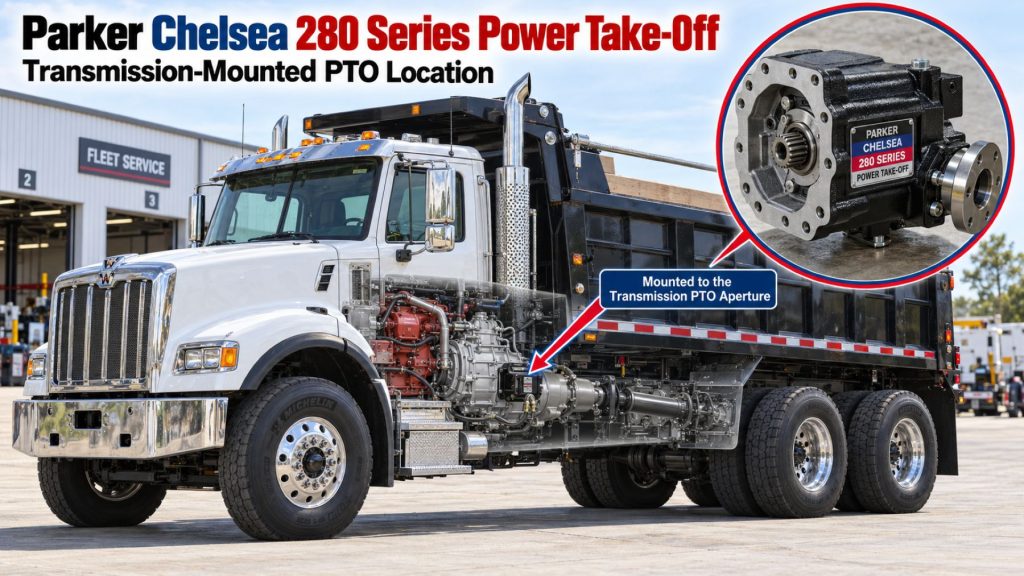
Position and Function Within the Vehicle
The Chelsea 280 Series mounts directly to a compatible 10-bolt opening on the vehicle’s automatic transmission. Its exact installation position depends on the transmission model, PTO aperture, selected assembly arrangement, and available chassis clearance.
Its function is to divert a portion of the engine power passing through the transmission and make that power available to auxiliary equipment.
Depending on the completed vehicle, the PTO may power:
- Hydraulic refuse equipment
- Vacuum pumps
- Fire and rescue equipment
- Truck-mounted cranes
- Utility booms and outriggers
- Hydraulic winches
- Municipal equipment
- Dump bodies and hoists
- Specialized pumps and compressors
Common Specifications
- PTO Type: Hydraulic PowerShift power take-off
- Transmission Opening: Application-specific 10-bolt PTO aperture
- Shift System: Hydraulic hot-shift engagement
- Electrical Supply: 12-volt or 24-volt configurations
- Continuous Torque: From approximately 240 to 390 pound-feet, depending on the selected ratio
- Maximum Published Continuous Torque: 390 pound-feet or 529 newton-meters
- Ratio Families: Nine gear-ratio options across applicable assembly arrangements
- Continuous Power at 500 Output RPM: Approximately 23 to 37 horsepower, depending on ratio
- Continuous Power at 1,000 Output RPM: Approximately 46 to 74 horsepower, depending on ratio
- Approximate Weight: Approximately 49 pounds or 22 kilograms
- Output Options: Direct pump mount, keyed shaft, companion flange, and application-specific DIN flange configurations
- Available Technologies: Wet Spline, Smart Start, drag-brake, and Electronic Overspeed Control options, depending on configuration
Exact ratings must be confirmed using the complete PTO model number, transmission application, output option, gear ratio, operating speed, and Parker Chelsea application data.
Power, Torque, Speed, and Operating Capacity
The Chelsea 280 Series has continuous torque ratings that vary according to the selected gear ratio. Published ratings extend from approximately 240 to 390 pound-feet.
The B ratio is rated at approximately 300 pound-feet. The C and D ratios can reach 390 pound-feet. Other available ratios decrease progressively from approximately 360 to 240 pound-feet as output-speed relationships change.
Published continuous power ratings can reach approximately 74 horsepower at 1,000 output RPM in approved configurations. Actual allowable power depends on the PTO ratio, transmission, output arrangement, duty cycle, driven equipment, and operating speed.
The PTO must not be operated above its approved torque, speed, power, or duty-cycle limits. Shock loading and rapid changes in equipment demand can impose forces greater than normal steady-state calculations suggest.
Installation Position and Equipment Function
The PTO’s assembly arrangement determines how the housing and output are positioned relative to the transmission. Different arrangements may place the output in locations better suited to direct pump mounting, driveline operation, or restricted chassis packaging.
Installation planning must consider transmission clearance, frame rails, crossmembers, exhaust equipment, driveshafts, suspension components, air tanks, hydraulic reservoirs, body equipment, and service access.
The PTO should be selected for the actual equipment function rather than installed simply because it physically fits the transmission opening.
PTO Engagement and Power Source
The Chelsea 280 Series receives mechanical power from the transmission’s PTO drive gear. Hydraulic pressure controls the PowerShift engagement mechanism, while a 12-volt or 24-volt electrical circuit typically commands the hydraulic shift valve.
Because the 280 Series is designed as a hydraulic hot-shift PTO, approved configurations can provide engagement without the same manual gear-meshing procedure used by conventional mechanically shifted PTOs.
Hot-shift capability does not eliminate the need to follow Parker Chelsea and vehicle-manufacturer engagement procedures. Engine speed, transmission state, vehicle movement, equipment condition, and system interlocks must still be correct before engagement.
Power Transfer and Hydraulic Operation
The PTO transfers mechanical torque from the transmission to its output. When a hydraulic pump is directly mounted, the PTO output spline drives the pump shaft.
The pump converts that mechanical rotation into hydraulic flow. Hydraulic pressure develops when the system resists that flow through cylinders, motors, valves, hoses, and working equipment.
The PTO determines available input speed and torque, while the hydraulic pump’s displacement determines how much fluid it moves per revolution. Correct PTO ratio and pump selection are therefore closely connected.
Use How to Choose a PTO and Hydraulic Pump when evaluating output speed, pump flow, torque demand, and duty cycle.
Hydraulic Circuit and Fluid Routing
The PTO itself transfers mechanical power, but it commonly operates as the first powered component in a complete truck hydraulic circuit.
A typical circuit includes:
- Hydraulic reservoir
- Suction hose or tube
- PTO-driven hydraulic pump
- Pressure hose
- Directional and pressure-control valves
- Hydraulic cylinders or motors
- Return-line filtration
- Return hose to the reservoir
Hoses and fittings must be routed so they do not place excessive force on the PTO, pump, or shift components. They must also remain clear of exhaust heat, rotating driveline parts, suspension movement, and sharp frame edges.
Housing, Shaft, Gear, and Structural Design
The 280 Series housing supports the PTO gearset, shafts, bearings, engagement system, and output components while attaching the assembly to the transmission.
Parker Chelsea introduced an enhanced bearing-cap fastening design for later 280 Series production. The update included larger Grade 8 bolts, hex-flange-head fasteners, and improved bearing-cap contact surfaces intended to improve fatigue resistance and bolt-torque retention in severe vocational service.
Internal gears and bearings must remain properly lubricated through the approved transmission and PTO lubrication arrangement. Output shafts, pump splines, and companion flanges must match the driven equipment.
Materials and Component Construction
The PTO uses a heavy-duty metal housing, hardened gears, supported shafts, bearings, seals, fasteners, and hydraulic engagement components designed for vocational power transfer.
Output construction varies between keyed shafts, companion flanges, DIN flanges, and SAE direct-pump-mount arrangements. Wet-spline configurations provide lubrication at the pump-to-PTO spline connection to reduce fretting and wear.
Replacement gears, shafts, bearings, seals, valves, and output components must match the complete PTO model and production configuration.
Control, Valve, and Electronic Integration
The 280 Series may use electrical switches, solenoids, hydraulic valves, pressure switches, indicator lights, and vehicle interlocks to control and confirm PTO engagement.
Available control-related options may include:
- 12-volt electric-over-hydraulic controls
- 24-volt electric-over-hydraulic controls
- Remote hydraulic shift valves
- PTO engagement indicator switches
- Electronic Overspeed Control
- Smart Start engagement management
- Transmission or vehicle-control-module interlocks
- Body-equipment safety interlocks
Control wiring and hydraulic plumbing must follow the approved diagram for the exact transmission, PTO, and completed vehicle.
Efficiency, Heat, and Power Demand
The PTO consumes engine power whenever it drives auxiliary equipment. The amount of power required depends on hydraulic pressure, pump flow, mechanical losses, equipment load, and operating speed.
An incorrectly selected ratio can cause the engine to run faster than necessary, drive the pump outside its efficient range, or fail to produce enough hydraulic flow at the intended engine speed.
Excessive hydraulic restriction, continuous relief-valve operation, undersized hoses, incorrect pump selection, or prolonged high-load operation can generate heat throughout the hydraulic system.
Duty Cycle and Operating Conditions
The 280 Series is designed for continuous-duty torque within the published rating of the selected configuration. That rating does not mean every PTO, transmission, pump, or driven-equipment combination can operate continuously at the highest listed value.
Operating conditions that affect PTO life include:
- Continuous or intermittent equipment demand
- Engine and transmission speed
- Hydraulic pressure and pump displacement
- Shock loading
- Cold-weather fluid viscosity
- Transmission and hydraulic-fluid temperature
- Vehicle vibration
- Pump weight and mounting leverage
- Contamination and lubrication condition
Mounting and Installation
The Chelsea 280 Series must be installed on an approved transmission opening using the correct mounting hardware, gaskets, fastener torque, backlash or installation procedure, and control components.
The installer must verify:
- Exact transmission model and PTO aperture
- Correct PTO model and input gear
- Approved assembly arrangement
- Correct output rotation and speed
- Pump or driveline clearance
- Proper gasket and mounting installation
- Correct electrical and hydraulic controls
- Adequate lubrication
- Safe hose and wiring routing
- Required pump support brackets
Parker Chelsea guidance calls for pump support when combined pump, fitting, hose, and oil weight exceeds applicable limits or when the PTO-and-pump assembly creates excessive length and leverage. The exact installation must follow the current owner’s manual and application instructions.
Alignment, Driveline, and Mounting Geometry
Direct-mounted pumps must align correctly with the PTO output spline and mounting flange. The pump should not be forced into position or supported by a bracket that places a side load on the PTO housing.
Remote equipment driven by an auxiliary shaft requires correct shaft length, balance, joint selection, operating angles, guarding, and slip movement.
Misalignment can cause vibration, spline wear, bearing damage, housing stress, seal leakage, driveline failure, and shortened PTO life.
Vehicle, Transmission, and Equipment Compatibility
The 280 Series must be matched to the exact transmission rather than selected only by its 10-bolt mounting pattern.
Compatibility depends on:
- Truck manufacturer and model
- Vehicle model year
- Transmission manufacturer and model
- Transmission serial number and build information
- PTO opening location and drive gear
- Required output speed and rotation
- Continuous and intermittent torque demand
- Pump-mounting or driveline-output requirement
- Electrical voltage
- Control-system integration
- Available chassis clearance
Final selection should be made using current Parker Chelsea application data or an authorized distributor familiar with the exact transmission and vocational equipment.
PTO, Pump, and Hydraulic-System Compatibility
The PTO output must match the hydraulic pump’s shaft, mounting flange, rotation, maximum speed, input torque, and required horsepower.
Pump displacement should be selected so the system produces the required flow at a reasonable engine and PTO speed. An oversized pump can overload the PTO or produce excessive flow, while an undersized pump may require unnecessarily high engine speed.
The reservoir, hoses, filters, valves, cylinders, motors, and cooling equipment must also support the required flow, pressure, temperature, and duty cycle.
Explore compatible component categories through Hydraulic Pumps & Motors and Wet Kits & Complete Hydraulic Systems.
Hydraulic Fluid and Filtration Requirements
The PTO’s internal lubrication requirements are separate from the hydraulic fluid used by the PTO-driven pump. Both systems must use the correct approved lubricant or fluid.
The hydraulic system should use fluid with the viscosity, temperature range, additive package, and equipment compatibility required by the pump and body-equipment manufacturers.
Clean fluid, an appropriate reservoir breather, properly sized suction plumbing, and correctly rated filtration help protect the pump and reduce the load placed on the PTO.
Learn more through Hydraulic Hoses, Fittings & Filtration.
Common Applications
- Refuse trucks
- Vacuum trucks
- Fire apparatus
- Rescue vehicles
- Utility trucks
- Truck-mounted cranes
- Municipal maintenance trucks
- Dump trucks
- Concrete and construction equipment
- Tank and liquid-transfer trucks
- Sewer-cleaning equipment
- Hydraulic winch applications
- Specialized vocational vehicles
Advantages
- High continuous-duty torque capacity for its size
- Hydraulic PowerShift engagement
- Nine ratio families for different speed requirements
- Direct pump-mount and driveline-output choices
- Rotatable output options improve installation flexibility
- Wet-spline options can reduce spline fretting
- Smart Start options support demanding startup conditions
- Electronic Overspeed Control can help protect driven equipment
- Suitable for demanding vocational applications
- Established Parker Chelsea parts and distributor network
Limitations or Considerations
- Must be matched to the exact transmission application
- Not every ratio carries the maximum 390-pound-foot rating
- Requires hydraulic and electrical engagement controls
- Incorrect ratio selection can overspeed or underdrive the pump
- Heavy or long pumps may require additional support brackets
- Improper installation can damage the PTO and transmission
- Wet-spline systems require correct lubrication and maintenance
- Chassis packaging can limit output and pump choices
- Cold hydraulic fluid can increase startup load
- Vehicle and body controls may require additional interlocks
Driver and Operator Experience
A correctly selected 280 Series PTO should engage predictably and provide stable power to the connected equipment. The operator may hear a change in engine load or notice a change in engine speed when the hydraulic system begins working.
Operators should monitor the PTO indicator, engine speed, hydraulic response, equipment movement, warning lights, fluid temperature, and unusual noise or vibration.
Slow equipment response, unexpected PTO disengagement, harsh engagement, warning indicators, excessive heat, vibration, or unusual gear noise should be reported and inspected.
Operating Speed and Engagement Management
The PTO should be engaged and operated according to the approved procedure for the transmission, vehicle, and equipment.
For stationary PowerShift operation, engagement is commonly performed with the engine at idle and the vehicle secured. The equipment should not begin operating until engagement has been confirmed and the system has had appropriate warm-up time.
Engine speed should only be increased after the PTO and driven equipment are ready. The operator must remain within the approved PTO, pump, and equipment speed limits.
Cold-weather operation requires additional care because thick fluid and internal drag can increase starting torque and may contribute to temporary output movement.
Control Setup and System Calibration
Control setup may include configuring engagement switches, indicator circuits, hydraulic shift pressure, overspeed protection, transmission permissions, engine-speed controls, and body-equipment interlocks.
Electronic Overspeed Control must be configured for the approved equipment speed. Incorrect settings may allow the equipment to exceed its limit or may cause unnecessary PTO interruption.
After installation, the complete system should be tested under controlled conditions to verify engagement, disengagement, indicator operation, pump rotation, hydraulic flow, equipment response, and leak-free operation.
Inspection and Wear Points
- PTO-to-transmission mounting surface
- Mounting studs, nuts, and bolts
- PTO housing and bearing caps
- Oil seals and gasket surfaces
- Output shaft and pump splines
- Wet-spline lubrication system
- Hydraulic shift hoses and fittings
- Solenoid and electrical connections
- Pressure switch and indicator circuit
- Pump flange and mounting fasteners
- Pump support brackets
- Auxiliary driveline and guards where equipped
- Transmission lubricant level and condition
Lubrication Requirements
The PTO gearset and bearings depend on the approved transmission and PTO lubrication arrangement. Lubricant level, type, cleanliness, temperature, and circulation all affect component life.
Wet-spline versions require the specified lubrication arrangement at the PTO-to-pump spline connection. The system should be inspected for restricted lines, leakage, damaged fittings, and inadequate lubricant supply.
Lubricants and hydraulic fluids should never be substituted solely because they appear similar. The current Parker Chelsea, transmission, pump, and equipment requirements should be followed.
Component Service Life and Rebuildability
PTO service life depends on correct application, installation, lubrication, engagement practices, torque loading, speed, vibration, pump support, and preventive maintenance.
The 280 Series can be serviced using configuration-specific bearings, seals, gears, shafts, clutch components, shift parts, output components, and installation hardware.
Rebuild decisions should consider housing condition, gear wear, shaft wear, bearing condition, clutch damage, spline condition, parts availability, labor cost, and the operating demands of the vehicle.
Housing, Gear, and Shaft Service Life
Housing cracks, damaged mounting surfaces, loose bearing caps, worn gears, bearing noise, and damaged output shafts can indicate serious PTO deterioration.
Repeated overloads, unsupported pump weight, misaligned auxiliary drivelines, low lubrication, contamination, and loose mounting hardware can shorten structural and rotating-component life.
A damaged housing or gearset should be evaluated by a qualified PTO service facility before the unit is returned to operation.
Hose, Seal, Valve, and Electronic Service Life
Hydraulic shift hoses, seals, solenoids, valves, switches, wiring, and connectors are wear or service components that can deteriorate from heat, vibration, contamination, corrosion, and repeated cycling.
Fluid leakage, slow engagement, intermittent operation, warning-light faults, damaged wiring, or contaminated connectors should be corrected before PTO operation continues.
Replacement electrical and hydraulic parts must match the PTO’s voltage, shift system, transmission application, and complete model configuration.
Maintenance and Ownership Notes
Inspect the PTO, pump, hydraulic controls, and mounting system as part of the vehicle’s normal preventive-maintenance program.
- Check for transmission and PTO oil leakage
- Inspect and tighten mounting hardware to specification
- Check pump and output-shaft splines
- Verify wet-spline lubrication where equipped
- Inspect hydraulic shift lines and fittings
- Test PTO switches and indicator circuits
- Inspect pump brackets and mounting alignment
- Listen for abnormal gear or bearing noise
- Check auxiliary driveline guards where equipped
- Verify the driven equipment does not overload the PTO
Maintenance should follow the current Parker Chelsea owner’s manual and the instructions supplied by the transmission, pump, body, and vehicle manufacturers.
Common PTO and Hydraulic-System Problems
- PTO will not engage: Low shift pressure, a failed solenoid, wiring problems, incorrect transmission conditions, damaged internal components, or a control interlock may prevent engagement.
- PTO will not disengage: A sticking valve, contaminated hydraulic circuit, damaged clutch components, electrical failure, or cold-fluid drag may be responsible.
- Slow hydraulic equipment: Incorrect PTO ratio, low engine speed, worn pump, restricted suction plumbing, valve problems, or hydraulic leakage may reduce flow.
- Excessive noise: Gear damage, bearing wear, incorrect installation, low lubrication, pump cavitation, or driveline misalignment may cause abnormal noise.
- Oil leakage: Damaged seals, loose fasteners, failed gaskets, housing damage, or excessive shaft movement may allow lubricant to escape.
- Spline wear: Misalignment, inadequate lubrication, pump vibration, excessive weight, or unsupported mounting can damage pump and PTO splines.
- Repeated fastener loosening: Vibration, incorrect torque, damaged threads, poor bracket alignment, or excessive pump leverage may affect mounting hardware.
- Hydraulic overheating: Excessive system pressure, continuous relief-valve operation, undersized plumbing, incorrect pump selection, or prolonged high-speed operation may generate heat.
Safety and Service Precautions
Rotating PTO shafts, hydraulic pressure, elevated equipment, and moving vehicle components can cause severe injury or death.
- Shut off the engine before working on the PTO or driven equipment
- Keep away from exposed rotating shafts
- Install approved guards around auxiliary drivelines
- Lower or mechanically support raised equipment
- Relieve stored hydraulic pressure before opening the system
- Secure the vehicle against unintended movement
- Do not exceed approved torque or speed ratings
- Never search for hydraulic leaks with bare hands
- Follow lockout and tagout procedures where applicable
- Use trained personnel for installation and repair
Identification Information
The PTO identification tag and complete model number provide the information needed to identify its mounting, ratio, assembly arrangement, shift system, and output configuration.
Record the following information before ordering parts or a replacement PTO:
- Complete Chelsea PTO model number
- PTO serial number
- Vehicle identification number
- Truck manufacturer, model, and model year
- Transmission manufacturer and model
- Transmission serial number
- PTO gear ratio
- Assembly arrangement
- Output-shaft or pump-flange option
- 12-volt or 24-volt shift system
- Wet-spline, Smart Start, drag-brake, or overspeed-control options
- Hydraulic-pump manufacturer and model
Do not identify a replacement PTO only by appearance or the number of mounting bolts.
Buying Considerations
- Confirm the exact transmission model and serial number
- Verify the approved 10-bolt PTO application
- Calculate required output torque and horsepower
- Select the correct PTO speed ratio
- Confirm output rotation
- Choose direct pump mount or driveline output
- Verify pump shaft and flange compatibility
- Select 12-volt or 24-volt controls
- Determine whether Wet Spline is needed
- Review Smart Start and overspeed-control requirements
- Measure transmission and chassis clearance
- Determine whether pump support brackets are required
- Confirm parts and service availability
- Use current Parker Chelsea application data
Variants and Configurations
- Nine gear-ratio families
- Application-specific assembly positions
- 12-volt hydraulic shift
- 24-volt hydraulic shift
- Keyed round output shaft
- 1410 Series companion-flange output
- DIN flange outputs
- SAE direct-pump-mount outputs
- Rotatable pump-flange arrangements
- Wet-spline output options
- Smart Start configurations
- Drag-brake configurations
- Electronic Overspeed Control options
- Remote hydraulic-valve options
Comparison to Similar Equipment
Compared with the Parker Chelsea 442 Series Power Take-Off, the 280 Series uses a different mounting platform and serves different transmission and torque applications.
Compared with the Parker Chelsea 489 Series Power Take-Off, the 280 Series is designed around compatible 10-bolt automatic-transmission applications rather than the 489 Series application range.
Compared with the Parker Chelsea 870 Series Power Take-Off, the 280 Series has a lower maximum continuous torque rating. The 870 Series is intended for applications requiring greater power capacity.
Compared with the Muncie CS6 Series Power Take-Off, the Chelsea 280 Series represents an alternative hydraulic-shift PTO platform with different transmission applications, ratios, controls, and output options.
Best Fit For
- Compatible automatic transmissions with 10-bolt PTO openings
- Refuse vehicles requiring continuous hydraulic power
- Vacuum trucks and sewer-cleaning equipment
- Fire and rescue apparatus
- Utility and municipal equipment
- Direct-mounted hydraulic-pump applications
- Applications requiring multiple ratio choices
- Operations needing hydraulic hot-shift engagement
- Vocational vehicles requiring up to 390 pound-feet of continuous PTO torque
- Installations benefiting from Wet Spline or Smart Start options
Related Vehicle and Trailer Types
- Complete Guide to Semi Truck Types
- Class 6 vs Class 7 vs Class 8 Trucks
- Refuse trucks
- Vacuum trucks
- Fire apparatus
- Utility trucks
- Municipal trucks
- Dump trucks
- Crane trucks
- Tank trucks
- Specialized vocational vehicles
Related Truck and Trailer Models
- Mack Granite
- Kenworth T880
- Peterbilt 567
- Freightliner 114SD
- Freightliner 122SD
- International HX Series
- Western Star 47X
- Western Star 49X
- Volvo VHD
Related PTO and Hydraulic System Types
- Power Take-Off Systems
- Hydraulic Pumps & Motors
- Wet Kits & Complete Hydraulic Systems
- Hydraulic Cylinders & Dump Hoists
- Hydraulic Valves, Controls & Reservoirs
- Hydraulic Hoses, Fittings & Filtration
- Hydraulic PowerShift PTOs
- Constant-mesh PTOs
- Direct-mount pump PTOs
- Driveline-output PTOs
Related PTO and Hydraulic Products
- Parker Chelsea 442 Series Power Take-Off
- Parker Chelsea 489 Series Power Take-Off
- Parker Chelsea 590 Series Power Take-Off
- Parker Chelsea 870 Series Power Take-Off
- Muncie TG Series Power Take-Off
- Muncie CS6 Series Power Take-Off
- Muncie FR6Q Power Take-Off
- Parker F1 Hydraulic Pump
- Parker F2 Twin-Flow Hydraulic Pump
- Parker Chelsea Wetline Hydraulic System
Related Equipment Systems
- PTO & Hydraulic Systems
- Transmissions
- Electrical Systems
- Suspension Systems
- Brake Systems
- Tires & Wheels
Related Guides
- PTO & Hydraulic System Guides
- How Commercial Truck PTO and Hydraulic Systems Work
- Commercial Truck Power Take-Off Types Explained
- How to Choose a PTO and Hydraulic Pump
- Commercial Truck Wet Kits Explained
- How to Inspect and Maintain Truck Hydraulic Systems
Regulatory and Compliance Notes
PTO and hydraulic-system installation must preserve the vehicle’s compliance with applicable safety, braking, emissions, electrical, noise, body-equipment, and final-stage manufacturing requirements.
The installation must not interfere with exhaust aftertreatment equipment, brake lines, steering components, driveline operation, suspension travel, or required vehicle clearances.
Exposed rotating shafts require appropriate guarding. Hydraulic equipment must include the safety devices, body props, load controls, warning labels, and operator instructions required by the equipment manufacturer and applicable regulations.
Real World Operating Notes
The highest published torque rating does not apply to every 280 Series ratio. The complete model must be checked before determining available power.
PTO ratio selection is one of the most important parts of the installation. A PTO that turns too slowly may not provide sufficient hydraulic flow, while one that turns too quickly can overspeed the pump and driven equipment.
Pump support is especially important on vehicles exposed to severe vibration, rough terrain, and frequent chassis movement. A pump that appears secure while parked can impose significant leverage on the PTO during operation.
Wet-spline technology can reduce spline wear, but it does not correct pump misalignment, excessive weight, poor bracketing, or incorrect installation.
Frequently Asked Questions
What is the Parker Chelsea 280 Series?
It is a hydraulically shifted PowerShift PTO designed for approved automatic transmissions with a compatible 10-bolt PTO opening.
How much torque can the Chelsea 280 Series handle?
Published continuous torque ratings reach up to 390 pound-feet, but the actual rating depends on the selected gear ratio and configuration.
How many ratios are available?
The 280 Series is offered with nine ratio families for different output-speed requirements.
Is the 280 Series a hot-shift PTO?
Yes. It uses hydraulic PowerShift engagement for approved automatic-transmission applications.
Can it directly mount a hydraulic pump?
Yes. Application-specific direct-pump-mount configurations are available, along with driveline-output and flange options.
What is a wet-spline PTO output?
A wet-spline output supplies lubrication to the PTO-and-pump spline connection to help reduce fretting and wear.
Does every 10-bolt automatic transmission accept the 280 Series?
No. Compatibility must be confirmed using the exact transmission model, PTO drive gear, opening position, required ratio, output, and current Parker Chelsea application data.
Why does the hydraulic pump need a support bracket?
A heavy or long pump assembly can place damaging leverage and vibration loads on the PTO housing and transmission mounting surface.
What replaced the Chelsea 277 and 278 Series?
The Chelsea 280 Series was introduced as the replacement platform for applicable 277 and 278 Series installations. Exact replacement compatibility must still be verified.
How can the correct replacement PTO be identified?
Use the complete Chelsea model and serial numbers, vehicle VIN, transmission model and serial number, ratio, assembly arrangement, output type, voltage, pump information, and installed options.
Availability and Where to Find
Parker Chelsea 280 Series PTOs, replacement components, control kits, output assemblies, wet-spline parts, and installation hardware may be available through Parker Chelsea distributors, commercial-truck dealers, hydraulic-equipment installers, vocational body builders, PTO specialists, and heavy-duty parts suppliers.
Availability depends on the transmission, ratio, assembly arrangement, output, voltage, controls, and optional technologies required by the installation.
Current product information, application assistance, technical support, and distributor resources are available through the Parker Hannifin website.
Support Trucking Families
Truck Equipment Atlas supports the mission of Grey Cross, a nonprofit dedicated to helping families of truck drivers who lose their lives while on the road. As the site grows, part of its mission is to bring awareness and support to these families.
Podcast or Video Section
Learn More Through Audio and Video
Truck Equipment Atlas will continue expanding with podcast episodes, interviews, and equipment breakdowns to help drivers and fleets better understand trucks and equipment.
Follow the Growth of Truck Equipment Atlas
Truck Equipment Atlas continues to expand with new truck profiles, trailer coverage, diesel engine pages, equipment system resources, manufacturer information, and educational guides.
Visit our Site Updates page to explore recent additions, project milestones, and upcoming resources as we continue building one of the industry’s growing commercial trucking equipment reference libraries.
View the Latest Site Updates: Truck Equipment Atlas Site Updates