
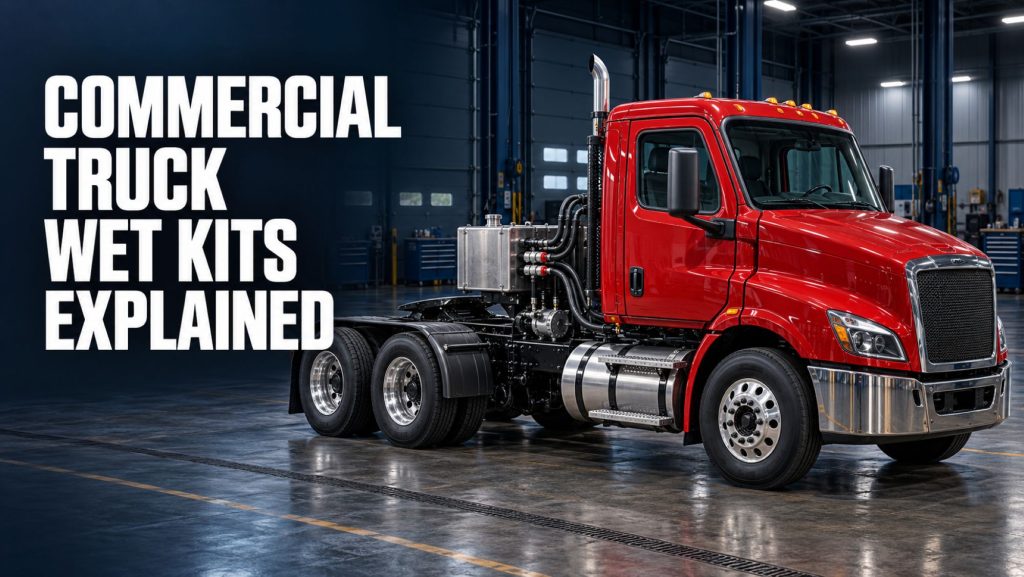
A commercial truck wet kit is a collection of hydraulic components that allows a tractor or vocational truck to power external equipment. Wet kits are commonly installed on trucks that operate dump trailers, walking-floor trailers, live-bottom trailers, lowboys, tank pumps, hydraulic motors, and other hydraulically powered equipment.
The term wet kit generally refers to the complete hydraulic system installed on the truck rather than one individual component. A typical system includes a power take-off, hydraulic pump, reservoir, control valve, hoses, fittings, filters, and operator controls.
Wet kits can appear relatively simple, but the system must be matched to the truck, transmission, trailer, hydraulic equipment, required flow, system pressure, and operating duty cycle.
This guide explains how commercial truck wet kits work, the differences among one-line, two-line, three-line, and combination systems, the components they use, and what truck owners should consider when selecting, operating, and maintaining a wet kit.
What Is a Commercial Truck Wet Kit?
A wet kit is a truck-mounted hydraulic power system that uses mechanical power from the engine or transmission to move hydraulic fluid.
The hydraulic fluid transfers that power to a cylinder, hydraulic motor, pump, conveyor, hoist, or other piece of equipment.
A typical wet-kit power path can be simplified as:
Engine → Transmission → PTO → Hydraulic Pump → Hydraulic Fluid → Trailer or Body Equipment
The PTO receives mechanical power from the truck’s powertrain. The hydraulic pump converts that mechanical power into hydraulic flow. Pressure develops as the equipment resists the flow and performs work.
After performing work, the hydraulic fluid returns to the reservoir so it can be used again.
Why Is It Called a Wet Kit?
The system is called a wet kit because it includes the hydraulic-fluid components needed to operate the equipment.
A truck may already have a PTO provision, but a PTO alone does not create a complete hydraulic system. The wet kit adds the pump, reservoir, hoses, valves, fittings, controls, and hydraulic fluid required to transfer power to the trailer or body equipment.
The name is commonly used in trucking and trailer operations, especially when discussing tractor-mounted hydraulic systems used to operate interchangeable trailers.
Major Wet-Kit Components
Wet-kit configurations vary, but most systems contain several major components.
Power Take-Off
The power take-off, commonly called the PTO, transfers mechanical power from the truck’s transmission or another approved drivetrain location.
The PTO must be compatible with the exact transmission and capable of providing the required speed, rotation, torque, and horsepower.
Hydraulic Pump
The hydraulic pump converts mechanical rotation from the PTO into hydraulic flow.
Dump-trailer wet kits commonly use a gear-type dump pump. Walking-floor, live-bottom, ejector, or other continuous-duty systems may require a different pump type or displacement.
Hydraulic Reservoir
The reservoir stores the hydraulic fluid used by the system.
It also provides space for fluid expansion, allows entrained air to separate from the oil, helps contaminants settle, and assists with heat transfer.
Control Valve
The control valve directs hydraulic flow to the equipment or back to the reservoir.
Depending on the system, the valve may provide raise, hold, lower, neutral, forward, reverse, or other equipment functions.
Hydraulic Hoses and Fittings
Hydraulic hoses and fittings carry fluid between the reservoir, pump, valve, trailer connections, cylinders, and motors.
Each hose must be correctly sized and rated for its pressure, temperature, fluid, bend radius, movement, and operating environment.
Filters and Strainers
Filters remove contaminants from the hydraulic fluid. Some systems also use an inlet strainer or reservoir-mounted screen.
Filtration is especially important because contamination can damage pumps, valves, cylinders, and hydraulic motors.
Operator Controls
Wet-kit controls may include PTO switches, air controls, electric switches, cable controls, remote controls, warning lights, and engine-speed controls.
Modern trucks may also use electronic interlocks that prevent PTO engagement unless specific operating conditions are satisfied.
Quick-Connect Couplers
Tractor wet kits commonly use hydraulic quick-connect couplers at the rear of the cab or frame. These couplers allow the tractor’s hydraulic system to connect to a compatible trailer.
The pressure and return connections should be clearly identified to prevent incorrect connection.
Common Wet-Kit Applications
Commercial truck wet kits are used with many types of truck and trailer equipment.
- End-dump trailers
- Side-dump trailers
- Dump bodies
- Walking-floor trailers
- Live-bottom trailers
- Ejector trailers
- Lowboy and removable-gooseneck trailers
- Hydraulic tail trailers
- Tank and liquid-transfer equipment
- Bulk trailers
- Car-hauling equipment
- Wreckers and rollbacks
- Hydraulic cranes
- Utility equipment
- Specialized vocational trailers
The hydraulic requirements can differ dramatically among these applications. A wet kit designed for an end-dump trailer should not automatically be assumed suitable for a walking-floor or live-bottom trailer.
One-Line Wet Kits
A one-line wet kit uses a single working hose connection between the tractor and trailer.
In a typical one-line dump arrangement, the same line carries pressurized fluid to the trailer cylinder during the raise cycle and allows fluid to return during the lowering cycle.
One-line systems can be simple and economical, but their operation depends heavily on the particular pump, valve, reservoir, and trailer-cylinder arrangement.
Possible advantages include:
- Fewer external hose connections
- Relatively simple trailer connection
- Lower initial component count
- Suitability for certain basic dump applications
Possible limitations include:
- Limited application flexibility
- Shared pressure and return flow path
- Potentially slower return operation
- Greater sensitivity to correct pump and valve operation
- Reduced suitability for continuous-flow equipment
A one-line system should only be used with equipment specifically designed for that hydraulic arrangement.
Two-Line Wet Kits
A two-line dump-trailer wet kit commonly uses one large line from the reservoir to the pump and one working line from the pump to the trailer.
During the raise cycle, the pump draws hydraulic oil from the reservoir and sends pressurized fluid through the working line to the trailer cylinder.
During the lower cycle, oil from the cylinder returns through the working line and pump arrangement toward the reservoir.
Two-line systems can function effectively in many intermittent dump applications when they are correctly installed and operated.
However, leaving some two-line dump pumps operating in neutral can circulate oil through a restrictive internal path. This can generate excessive heat and contribute to pump failure.
Operators must follow the pump manufacturer’s instructions and disengage the PTO when hydraulic power is no longer required.
Three-Line Wet Kits
A three-line wet kit adds a dedicated return line from the pump or valve system to the reservoir.
The three primary lines are generally:
- A suction line from the reservoir to the pump
- A pressure or work line from the pump to the trailer
- A dedicated return line back to the reservoir
The separate return path can reduce restriction and avoid forcing returning hydraulic fluid through the same path used by a simpler two-line arrangement.
Potential three-line system benefits can include:
- Improved oil circulation
- Reduced heat generation
- Faster down cycles in compatible applications
- Easier installation of return-line filtration
- Improved pump protection
- Better suitability for frequent operation
A three-line system does not eliminate the need for correct PTO operation, proper reservoir size, clean fluid, and adequate hose sizing. It simply provides a more direct return path when the system is designed to use one.
Two-Line Versus Three-Line Dump Wet Kits
| Feature | Two-line dump system | Three-line dump system |
|---|---|---|
| Reservoir-to-pump line | Yes | Yes |
| Pressure or work line | Yes | Yes |
| Dedicated return line | No | Yes |
| Return restriction | Can be higher depending on design | Generally reduced with correct installation |
| Return filtration | Can be more difficult to incorporate | Dedicated return line supports filtration |
| Heat management | More sensitive to neutral operation | Can provide improved circulation and cooling |
| Initial complexity | Fewer lines | Additional hose and return connection |
| Typical use | Intermittent dump applications | Dump applications benefiting from dedicated return flow |
The correct choice depends on the pump, trailer, operating cycle, flow requirement, and manufacturer recommendations. Hose count alone does not determine whether a system is properly designed.
Walking-Floor Wet Kits
A walking-floor trailer uses hydraulically powered floor slats to move material into or out of the trailer.
Unlike a dump trailer, the trailer remains level while the floor mechanism cycles repeatedly. This can improve unloading stability and allow operation in areas with limited overhead clearance.
Walking-floor wet kits generally require:
- Continuous hydraulic flow
- A dedicated pressure line
- A dedicated return line
- Proper return filtration
- A pump matched to the trailer’s required flow
- Adequate reservoir capacity
- Effective heat management
Because walking-floor equipment can operate for extended periods, the PTO, pump, reservoir, filters, and hoses must be suitable for continuous or high-duty-cycle operation.
A conventional intermittent-duty dump wet kit may not provide the correct flow, cooling, filtration, or continuous-duty capacity.
Live-Bottom Wet Kits
A live-bottom trailer uses a hydraulically driven conveyor or moving floor to unload material.
These trailers commonly transport asphalt, aggregates, agricultural products, refuse, and other bulk materials.
A live-bottom wet kit may require:
- High hydraulic flow
- Sustained hydraulic pressure
- Continuous-duty pump operation
- Large pressure and return hoses
- Return-line filtration
- Adequate reservoir capacity
- Hydraulic cooling
- Carefully controlled PTO and engine speed
The exact flow and pressure requirements must come from the trailer or equipment manufacturer.
Combination Wet Kits
A combination wet kit is designed to operate more than one type of hydraulic trailer or equipment system.
For example, one tractor may need to operate both:
- A conventional dump trailer
- A walking-floor trailer
- A live-bottom trailer
- An ejector trailer
These applications can require different flow rates, pressures, valve positions, hose connections, and operating procedures.
A combination kit may use specialized valves and controls that allow the operator to select the correct hydraulic circuit or operating mode.
Combination systems require careful labeling and operator training. Using the wrong mode can overspeed equipment, create excessive pressure, overheat the oil, or damage the trailer’s hydraulic system.
Dump-Trailer Wet Kits
A dump-trailer wet kit powers the hydraulic cylinder that raises the trailer body.
During the raise cycle, hydraulic fluid enters the cylinder and extends it. The expanding cylinder lifts the trailer body.
During the lower cycle, the cylinder retracts as the trailer body returns to the frame. Hydraulic oil flows back toward the reservoir through the system’s approved return path.
Dump-trailer systems commonly operate intermittently, but they can require substantial hydraulic volume and pressure during the lift cycle.
Important selection factors include:
- Cylinder displacement
- Required lifting pressure
- Desired raise time
- Desired lowering time
- Trailer manufacturer flow limits
- Pump displacement
- PTO speed ratio
- Reservoir usable capacity
- Two-line or three-line configuration
Lowboy and Detachable-Gooseneck Wet Kits
Hydraulic lowboys and removable-gooseneck trailers can use tractor-mounted wet kits to operate the gooseneck, ramps, suspension controls, or other hydraulic functions.
These systems may require lower flow than some walking-floor applications but still need sufficient pressure and precise control.
The wet kit must match the trailer manufacturer’s requirements for:
- Flow
- Pressure
- Reservoir capacity
- Coupler type
- Valve arrangement
- Required hydraulic functions
How a Wet Kit Operates
The exact operating procedure varies by truck, transmission, PTO, pump, controls, and trailer. A simplified stationary operating sequence may include:
- Position the truck and trailer on a suitable operating surface.
- Apply the parking brake and secure the vehicle.
- Place the transmission in the required range or neutral position.
- Reduce engine speed to the approved engagement level.
- Engage the PTO using the manufacturer-approved procedure.
- Confirm that the PTO engagement indicator is active.
- Set the approved engine or PTO operating speed.
- Operate the hydraulic control for the required function.
- Monitor equipment movement, pressure, temperature, and surrounding conditions.
- Return the controls to the approved neutral position.
- Reduce engine speed and disengage the PTO when operation is complete.
This sequence is only a general explanation. The operating instructions for the exact truck, PTO, pump, and trailer must always be followed.
Wet-Kit Hydraulic Flow
Hydraulic flow affects how quickly a cylinder moves or a hydraulic motor rotates.
Flow is normally measured in gallons per minute, or GPM.
Pump flow depends primarily on the pump displacement and operating speed.
A simplified theoretical flow formula is:
Flow in GPM = Pump Displacement in Cubic Inches per Revolution × Pump RPM ÷ 231
Actual flow is normally lower because of internal pump leakage and volumetric efficiency.
Too little flow can make equipment operate slowly. Too much flow can create excessive equipment speed, pressure loss, heat, hydraulic shock, and component damage.
Wet-Kit Operating Pressure
Pressure develops when the equipment resists the pump’s flow.
The system pressure must be high enough to perform the required work but remain within the ratings of the pump, hoses, valves, fittings, cylinders, motors, filters, and trailer equipment.
A pressure relief valve limits maximum system pressure. However, operating continuously against the relief valve creates heat and wastes power.
A wet kit that cannot perform the required work should be diagnosed rather than operated at the relief setting for extended periods.
Wet-Kit Reservoir Types
Hydraulic reservoirs are available in several materials and mounting configurations.
Steel Reservoirs
Steel reservoirs are durable and widely available. They can provide strong mounting structures but may be heavier and can corrode if protective coatings are damaged.
Aluminum Reservoirs
Aluminum reservoirs can reduce weight and resist corrosion. They are often selected where appearance and weight are important, but mounting and fatigue considerations still require attention.
Polyethylene Reservoirs
Polyethylene reservoirs can provide corrosion resistance and reduced weight. They must be installed with approved mounting hardware and protected from heat, impact, and chassis interference.
The reservoir material should be selected for the truck’s application, mounting space, operating temperature, fluid compatibility, service environment, and manufacturer requirements.
Reservoir Mounting Locations
Wet-kit reservoirs may be installed in several locations depending on available chassis space.
- Behind the cab
- Beside the frame
- Between frame rails
- Under the cab or body in approved applications
- Integrated with other wet-kit components
The selected location must provide adequate clearance from exhaust heat, tires, suspension movement, driveshafts, trailer swing, and other chassis components.
The reservoir should also remain accessible for checking fluid level, servicing filters, inspecting the breather, and cleaning the system.
Reservoir Capacity
The reservoir must hold enough usable hydraulic fluid to complete the equipment’s full operating cycle.
When a large dump cylinder extends, a substantial amount of oil leaves the reservoir. The remaining fluid level must stay above the pump inlet to prevent the pump from drawing air.
The reservoir must also provide enough empty space for returning oil and fluid expansion.
Reservoir selection should consider:
- Cylinder oil volume
- Pump flow
- Operating time
- Duty cycle
- Fluid expansion
- Cooling requirements
- Reservoir shape
- Usable capacity rather than total capacity alone
The equipment manufacturer’s reservoir requirement should be used when available.
Wet-Kit Hose Connections
Wet-kit hoses are not interchangeable simply because their fittings appear similar.
Different lines perform different functions:
- Suction line: Carries low-pressure oil from the reservoir to the pump.
- Pressure line: Carries pressurized oil from the pump to the equipment.
- Return line: Carries returning oil back to the reservoir.
- Case-drain line: Returns internal leakage from certain pump or motor designs.
Suction lines are commonly larger because the pump must receive oil with minimal restriction. A restricted inlet can cause cavitation and rapid pump damage.
Pressure lines require the appropriate pressure and impulse rating. Return lines must be large enough to prevent excessive backpressure.
Quick-Connect Coupler Considerations
Quick-connect couplers allow the tractor wet kit to connect to different compatible trailers.
Couplers should be selected for:
- Maximum system pressure
- Required flow
- Hydraulic fluid compatibility
- Operating temperature
- Connection style
- Pressure and return identification
- Environmental protection
A partially connected or undersized coupler can restrict flow, generate heat, prevent equipment movement, or trap pressure.
Couplers should be kept clean and capped when disconnected. Dirt introduced through trailer connections can circulate throughout the complete hydraulic system.
Wet-Kit Filtration
Hydraulic contamination is a major cause of pump, valve, cylinder, and motor wear.
A wet kit may use:
- Return-line filters
- Pressure-line filters in specialized systems
- Reservoir breathers
- Filler screens
- Magnetic drain plugs
- Inlet strainers where approved
A three-line system can make return-line filtration easier because returning fluid has a dedicated path to the reservoir.
Filters must be correctly sized for the maximum flow and cold-fluid conditions. A filter that is too restrictive can create excessive backpressure or allow the bypass valve to open.
Hydraulic Fluid Selection
The correct hydraulic fluid depends on the pump, trailer equipment, temperature range, seals, and manufacturer specifications.
Important fluid characteristics include:
- Viscosity
- Temperature performance
- Anti-wear protection
- Oxidation resistance
- Foam control
- Water separation
- Seal compatibility
- Cold-weather performance
Fluid that is too thick during cold weather can restrict the pump inlet and cause cavitation. Fluid that becomes too thin at high temperature can reduce lubrication and increase internal leakage.
Different hydraulic fluids should not be mixed unless compatibility has been confirmed.
Wet-Kit Cooling and Heat Control
Heat is created whenever hydraulic energy is lost through restriction, internal leakage, friction, or relief-valve operation.
Common causes of excessive wet-kit temperature include:
- Leaving a two-line dump pump operating in neutral
- Operating continuously against the relief valve
- Undersized hoses or fittings
- Restricted quick-connect couplers
- Blocked or undersized filters
- Insufficient reservoir capacity
- Excessive pump speed
- Incorrect valve configuration
- High return-line backpressure
- Continuous operation with an intermittent-duty system
A hydraulic oil cooler may be required in continuous-duty or high-heat applications. The need for cooling should be calculated from the complete system rather than added only after overheating occurs.
Wet-Kit Controls and Interlocks
Wet-kit controls can range from a basic mechanical PTO control to an electronically integrated system.
A modern system may monitor:
- Parking brake status
- Transmission range
- Vehicle speed
- Engine speed
- Clutch position
- PTO engagement
- Hydraulic temperature
- Equipment position
- Trailer connection status
Interlocks can prevent PTO engagement or equipment operation when conditions are unsafe.
These systems should be diagnosed and repaired when faults occur. Bypassing an interlock can create uncontrolled truck, trailer, or equipment movement.
Selecting the Correct Wet Kit
Wet-kit selection should begin with the trailer or equipment requirements.
Important information includes:
- Truck make and model
- Engine model
- Exact transmission model and specification
- Available PTO opening
- Trailer or equipment type
- Required hydraulic flow
- Normal and maximum pressure
- Pump speed
- PTO speed ratio
- Required pump rotation
- Reservoir capacity
- One-line, two-line, or three-line configuration
- Intermittent or continuous duty
- Stationary or mobile operation
- Hose and coupler requirements
- Available chassis mounting space
The complete wet kit should be selected as a coordinated system rather than as a collection of unrelated components.
Wet-Kit Selection by Application
| Application | Typical hydraulic characteristic | Important consideration |
|---|---|---|
| End-dump trailer | High-volume intermittent cylinder operation | Correct cylinder volume and reservoir capacity |
| Side-dump trailer | Controlled cylinder operation | Trailer-specific flow and pressure limits |
| Walking-floor trailer | Continuous or extended hydraulic flow | Cooling, filtration, and return-line capacity |
| Live-bottom trailer | Hydraulic motor operating under sustained load | Continuous-duty pump and correct motor flow |
| Ejector trailer | Large-cylinder or moving-wall operation | Fluid volume, pressure, and cycle time |
| Lowboy or RGN trailer | Multiple controlled hydraulic functions | Pressure, valve control, and coupler compatibility |
| Bulk or tank equipment | Motor, compressor, or product-pump operation | Steady speed and continuous power requirements |
| Combination operation | Different trailers with different requirements | Correct mode selection and operator training |
Common Wet-Kit Problems
Wet-kit problems can originate in the PTO, pump, reservoir, hoses, valves, controls, or connected equipment.
Equipment Operates Slowly
Possible causes include:
- Low engine or PTO speed
- Incorrect PTO ratio
- Worn hydraulic pump
- Low fluid level
- Restricted suction line
- Blocked filter
- Internal cylinder or valve leakage
- Undersized pump
Hydraulic System Overheats
Possible causes include:
- Incorrect neutral operation
- Relief valve operating continuously
- Excessive pump speed
- Restricted return line
- Undersized hoses or couplers
- Insufficient reservoir capacity
- Incorrect hydraulic fluid
- Inadequate cooling
Pump Is Noisy
Possible causes include:
- Cavitation
- Air entering the suction line
- Low reservoir level
- Cold or overly viscous fluid
- Restricted inlet strainer
- Incorrect pump speed
- Worn bearings or internal components
PTO Will Not Engage
Possible causes include:
- Low air pressure
- Electrical fault
- Damaged shift cable or linkage
- Transmission not in the required range
- Parking brake interlock not satisfied
- Vehicle programming issue
- Damaged PTO shift components
Cylinder Will Not Raise the Load
Possible causes include:
- Insufficient system pressure
- Overloaded trailer or body
- Relief valve set too low or malfunctioning
- Worn pump
- Internal cylinder leakage
- Incorrect valve position
- Damaged or restricted hose
- Mechanical obstruction
Wet-Kit Safety
Wet kits operate equipment capable of producing substantial force. Hydraulic pressure can remain trapped even after the engine and PTO have been shut off.
Important safety practices include:
- Follow the truck, PTO, pump, and equipment manufacturers’ instructions.
- Secure the truck against movement before stationary operation.
- Keep people clear of raised bodies and moving equipment.
- Never work beneath a raised body without an approved mechanical support.
- Never use hands to search for a high-pressure hydraulic leak.
- Relieve hydraulic pressure before disconnecting hoses.
- Keep clear of leaking hoses and fittings.
- Do not exceed the trailer’s maximum flow or pressure.
- Do not bypass safety interlocks.
- Disengage the PTO when hydraulic power is no longer required.
High-pressure hydraulic fluid can penetrate skin and cause a serious medical emergency. Suspected injection injuries require immediate professional medical attention.
Wet-Kit Inspection
Routine inspections can identify leaks, wear, contamination, and mounting problems before they lead to equipment failure.
Common inspection areas include:
- PTO mounting hardware
- PTO and transmission gasket area
- Hydraulic pump mounting
- Pump support brackets
- Reservoir mounts and straps
- Fluid level and condition
- Reservoir breather
- Hoses and fittings
- Hose abrasion points
- Quick-connect couplers
- Filters and restriction indicators
- Control valves
- Air lines and electrical wiring
- PTO engagement indicator
- Unusual noise, vibration, or heat
Any hose showing exposed reinforcement, blistering, crushing, cracking, severe abrasion, or leakage should be removed from service according to the applicable maintenance procedure.
Wet-Kit Maintenance
Maintenance intervals vary by component, hydraulic fluid, operating environment, and duty cycle.
Common maintenance tasks include:
- Checking hydraulic fluid level
- Inspecting fluid for contamination or discoloration
- Changing filters at the required interval
- Cleaning or replacing reservoir breathers
- Inspecting suction, pressure, and return hoses
- Checking reservoir mounts
- Checking PTO and pump mounting hardware
- Inspecting electrical and pneumatic controls
- Cleaning quick-connect couplers
- Checking for unusual noise or temperature
- Verifying relief-valve operation using approved procedures
- Following fluid sampling and replacement requirements
Hydraulic fluid and filters should be changed according to the equipment manufacturers’ requirements rather than by appearance alone.
Common Wet-Kit Selection and Installation Mistakes
Many wet-kit failures result from incorrect component selection or installation.
- Using a dump wet kit for continuous-duty equipment
- Selecting the wrong PTO for the transmission
- Choosing an incorrect PTO speed ratio
- Using the wrong pump rotation
- Operating the pump above its maximum speed
- Installing an undersized suction hose
- Using restrictive quick-connect couplers
- Selecting a reservoir with insufficient usable capacity
- Failing to support a heavy direct-mounted pump
- Placing hoses near exhaust components
- Allowing hoses to rub against the chassis
- Connecting pressure and return lines incorrectly
- Failing to provide adequate filtration
- Ignoring continuous-duty heat generation
- Failing to program electronic PTO controls
The truck, transmission, PTO, pump, reservoir, trailer, and hydraulic components should be evaluated as one complete operating system.
Wet-Kit Types at a Glance
| Wet-kit type | General configuration | Common application |
|---|---|---|
| One-line | Single trailer work line | Compatible basic dump applications |
| Two-line dump | Reservoir suction line and trailer work line | Intermittent dump-trailer operation |
| Three-line dump | Suction, pressure or work, and dedicated return lines | Dump operation with improved return flow |
| Walking floor | Continuous pressure and return circuit | Hydraulically powered moving-floor trailers |
| Live bottom | Continuous-flow hydraulic-motor circuit | Conveyor-style bulk trailers |
| Combination | Selectable circuits or operating modes | Tractors operating several trailer types |
| Lowboy or RGN | Controlled pressure and return lines | Goosenecks, ramps, and trailer functions |
Questions to Ask Before Ordering a Wet Kit
Before ordering a wet kit, confirm the following:
- What exact transmission is installed?
- Which PTO openings are available?
- What trailer or equipment will the system operate?
- Does the equipment require one, two, or three hydraulic connections?
- What flow does the equipment require?
- What is the normal and maximum pressure?
- Is operation intermittent or continuous?
- Will the truck be stationary or moving?
- What pump type and displacement are required?
- What pump rotation is required?
- How much usable reservoir capacity is needed?
- Are hydraulic cooling and return filtration required?
- What quick-connect couplers does the trailer use?
- Where can the reservoir and pump be mounted?
- What electronic programming and interlocks are required?
Providing complete information helps the component supplier avoid assumptions that can lead to poor performance or incompatible equipment.
Continue Learning About PTO and Hydraulic Systems
Understanding wet kits helps explain how a tractor or vocational truck supplies hydraulic power to trailers and body equipment.
Continue with the other Truck Equipment Atlas PTO and Hydraulic System Guides:
- How Commercial Truck PTO and Hydraulic Systems Work
- Commercial Truck Power Take-Off Types Explained
- How to Choose a PTO and Hydraulic Pump
- How to Inspect and Maintain Truck Hydraulic Systems
Visit the PTO & Hydraulic System Guides page to explore the complete educational guide library.
Manufacturer Technical References
Always use current model-specific application data, installation instructions, operating procedures, and maintenance requirements for the exact wet-kit components and trailer equipment.
- Muncie Power Products Wet Line Kits
- Muncie Power Wet Line Kit Information
- Muncie Power Combination Wet Line Kits
- Parker Chelsea Power Take-Off Products
Final Thoughts
A commercial truck wet kit is the complete hydraulic link between the truck’s powertrain and the trailer or equipment it operates.
The PTO transfers mechanical power from the truck. The pump creates hydraulic flow. The reservoir stores and conditions the fluid. Hoses, valves, filters, controls, and couplers direct that fluid to the equipment and return it to the system.
One-line, two-line, and three-line wet kits serve different hydraulic arrangements. Walking-floor, live-bottom, combination, and lowboy systems can require different flow rates, pressures, reservoirs, valves, filtration, cooling, and duty-cycle capabilities.
The correct wet kit cannot be selected from trailer type or hose count alone. The exact truck, transmission, PTO, pump, hydraulic demand, operating time, mounting space, and trailer specifications must all be considered.
A properly matched and maintained wet kit can provide predictable equipment speed, manageable operating temperature, reliable trailer operation, and longer component life. An incorrectly specified system can produce slow operation, excessive heat, cavitation, contamination, repeated pump failures, and costly downtime.
Truck Equipment Atlas will continue expanding its PTO, wet-kit, hydraulic-system, and vocational-truck resources as the equipment library grows.