
Quick Facts
- Manufacturer: Custom Hoists, Inc.
- Product Series: 5000 Series
- Product Type: Single-acting telescopic hydraulic cylinder
- Construction: Hybrid North American tube-size design with European-style proportions
- Number of Stages: Three, four, or five, depending on model
- Published Stroke Range: Approximately 120.38 to 279.88 inches
- Largest Published Moving Stage: 6, 7, 8, or 9 inches, depending on model
- Primary Applications: Dump trucks, dump trailers, transfer trailers, and specialized vocational equipment
- Primary Function: Raises a dump body through an extended tipping range
- Production Status: Current product family
Overview
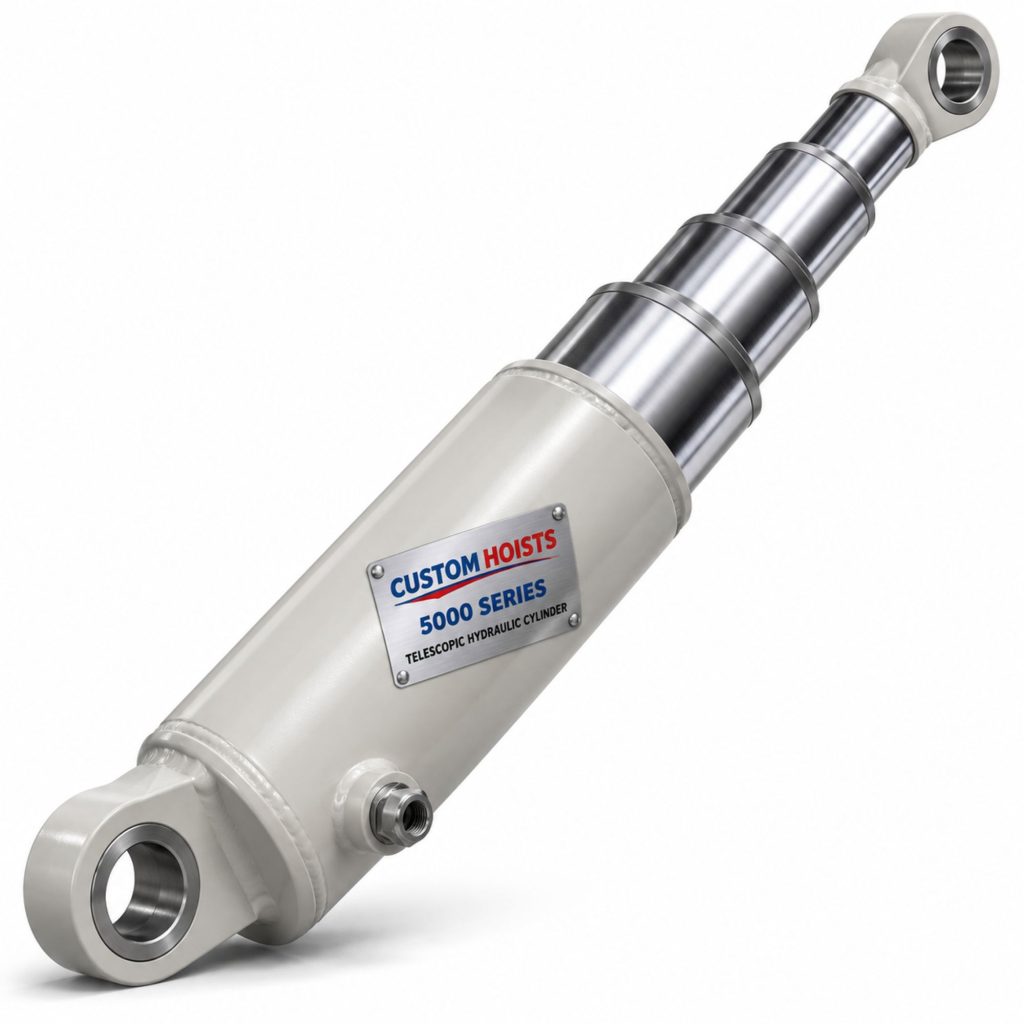
The Custom Hoists 5000 Series is a family of single-acting telescopic hydraulic cylinders developed for dump trucks, dump trailers, and other mobile equipment requiring a long working stroke from a compact retracted package.
Custom Hoists describes the 5000 Series as a hybrid design that combines large North American tube sizes with a European-style cylinder profile. Published models use three, four, or five telescopic stages and cover a wide range of stroke lengths for different truck and trailer body configurations.
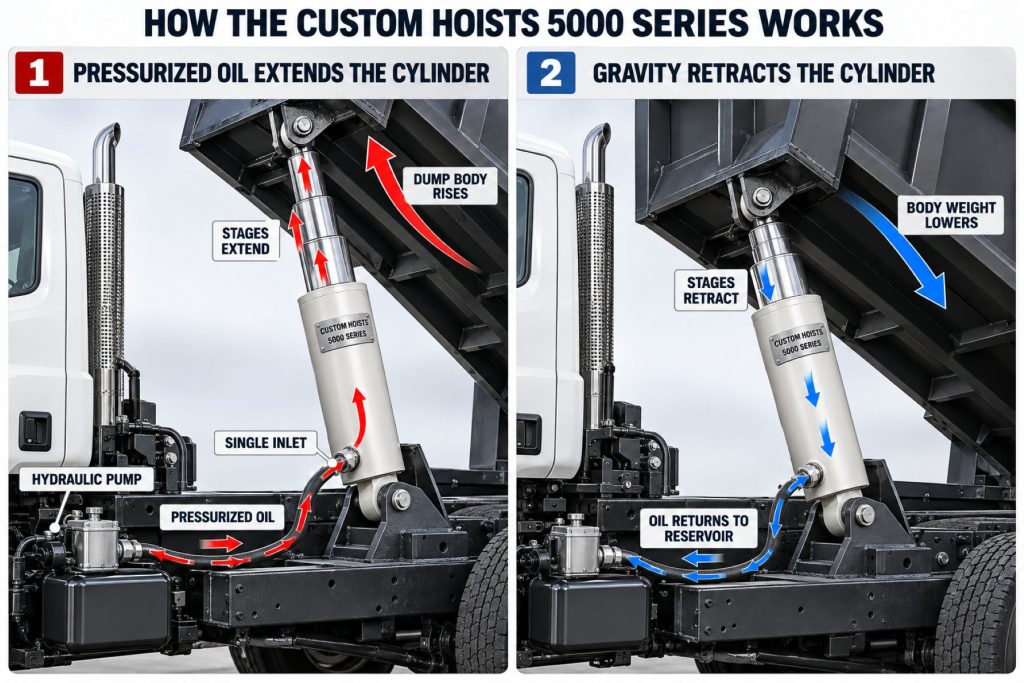
The cylinder extends when pressurized hydraulic oil enters the assembly. When the control valve is moved to the lowering position, the weight of the dump body retracts the stages and returns the oil to the reservoir.
Key Characteristics
- Single-acting telescopic hydraulic design
- Hybrid construction using large North American tube sizes
- Compact European-style cylinder profile
- Three-, four-, and five-stage models
- Published strokes from approximately 120 to 280 inches
- First moving stages from 6 to 9 inches, depending on model
- Single high-performance U-cup sealing system
- V-packing configurations available
- Heavy-duty wiper design
- Compact closed length relative to total extension
- Designed for mobile hydraulic applications
- Multiple models for different body lengths and mounting requirements
Major Components
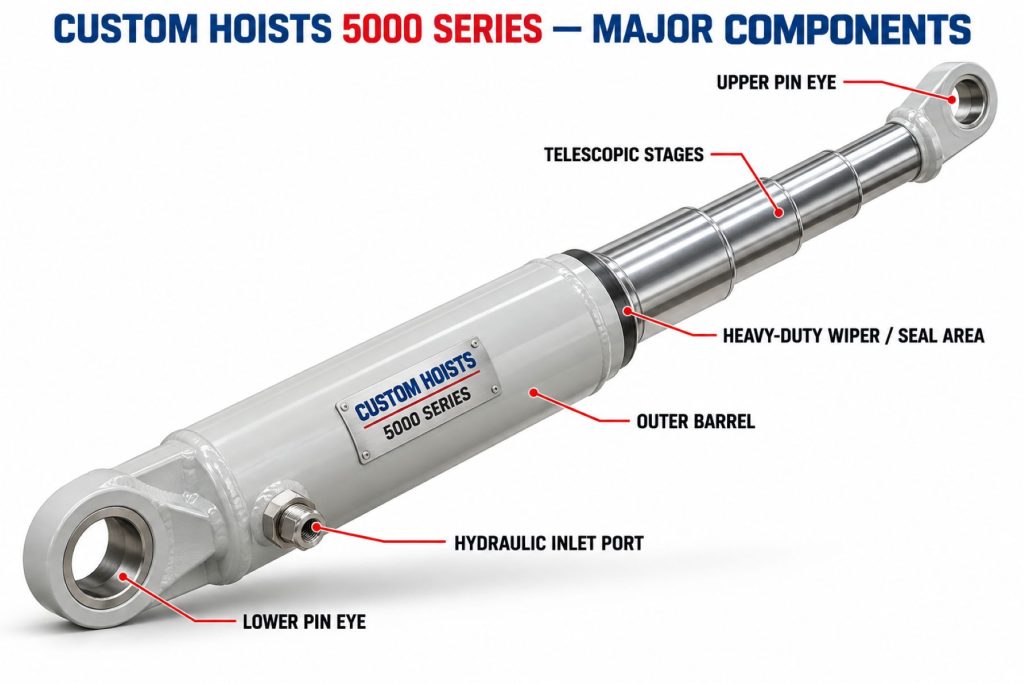
- Outer cylinder body
- Nested telescopic stages
- Final plunger stage
- Base mounting assembly
- Upper plunger mounting eye
- Hydraulic inlet port
- High-performance U-cup seals
- Optional V-packing arrangement
- Heavy-duty stage wipers
- Stage bearings and guides
- Head nuts
- Retaining components
- Bleeding provisions
- Mounting pins and retainers
Product Type and Construction
The 5000 Series uses multiple tubular stages that nest inside the main cylinder body when retracted. This construction allows the cylinder to produce a working stroke several times longer than its closed length.
The series uses a hybrid design intended to combine the dimensional and service characteristics associated with North American mobile cylinders with the compact appearance of European-style front-end telescopic cylinders.
Custom Hoists identifies a single high-performance U-cup seal as standard construction, with V-packing available for applications requiring that sealing arrangement. Heavy-duty wipers help limit the entry of dirt, moisture, and abrasive material as the stages retract.
How the Telescopic Hydraulic Cylinder Works
When the operator engages the power take-off and selects the raise function, the hydraulic pump draws oil from the reservoir and delivers it through the control valve to the cylinder.
Hydraulic pressure acts against the internal area of the largest moving stage. That stage normally extends first. As it reaches the end of its travel, the next smaller stage begins extending. This process continues until the required body angle or full cylinder extension is reached.
Moving the control to lower opens the return path to the reservoir. The weight of the dump body forces the cylinder stages to retract in sequence. Because the standard cylinder is single-acting, hydraulic power raises the body while gravity supplies the primary retracting force.
Position and Function Within the Vehicle
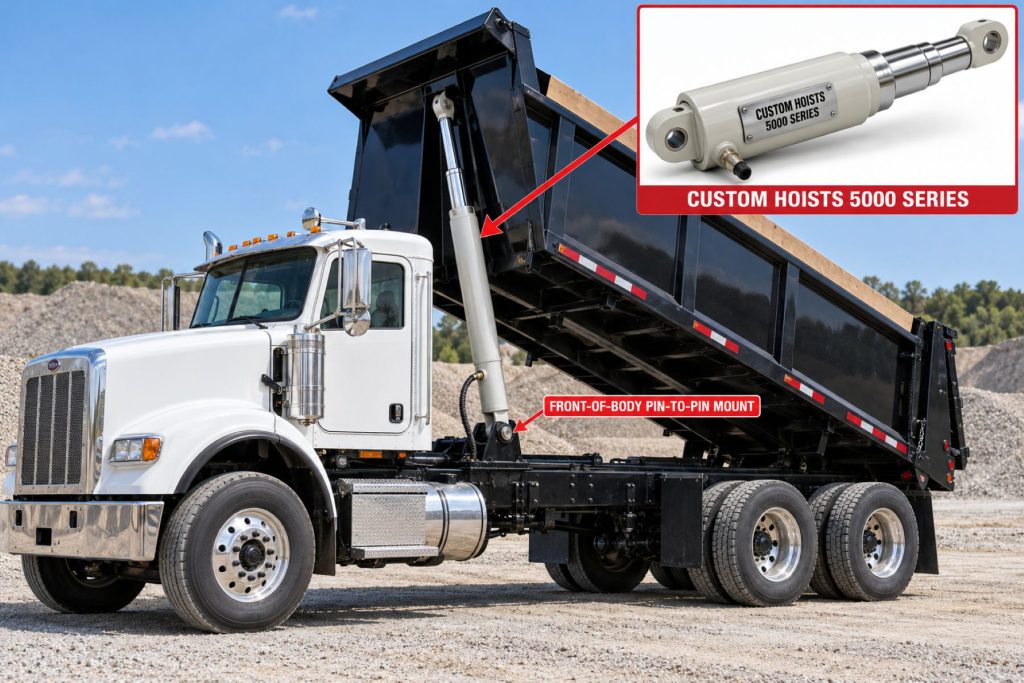
The 5000 Series is normally installed between the truck or trailer structure and the forward portion of the dump body. The base attaches to an engineered lower mounting structure, while the upper end connects to the body.
As the cylinder extends, it raises the front of the body while the body rotates around its rear hinge. The cylinder mounting points must allow the assembly to follow the body’s changing angle without binding or creating damaging lateral forces.
The cylinder provides lifting force only. It is not a substitute for a mechanical body prop and must never be relied upon as the sole support for a raised dump body.
Common Specifications
- Cylinder Type: Single-acting telescopic hydraulic cylinder
- Available Stage Counts: Three, four, or five
- Published Stroke Range: 120.38 to 279.88 inches
- Published Closed-Length Range: 48.25 to 78.63 inches
- Published Extended-Length Range: 173.38 to 358.50 inches
- First Moving Stage: 6, 7, 8, or 9 inches, depending on model
- Seal Design: High-performance U-cup with V-packing available
- Wiper Design: Heavy-duty stage wipers
- Retraction Method: Gravity-powered body lowering
- Hydraulic Supply: Application-matched PTO, pump, reservoir, control valve, hoses, and filtration
- Mounting: Model- and application-specific base and upper mounts
Stroke, Stage Count, and Operating Capacity
The 5000 Series includes models covering a substantial range of dump-body and trailer requirements. Current published configurations include:
- Three-stage models with approximately 120.38- and 140.62-inch strokes
- Four-stage models with approximately 134.69- to 166.06-inch strokes
- Five-stage models with approximately 168.56- to 279.88-inch strokes
- Six-inch first stages on published three-stage models
- Seven-inch first stages on published four-stage models
- Eight- and nine-inch first stages on published five-stage models
Stroke and stage count do not independently determine whether a cylinder can lift a particular body. Capacity depends on hydraulic pressure, moving-stage area, mounting position, body-hinge geometry, payload distribution, initial lift angle, and the changing mechanical relationship between the cylinder and body.
Hydraulic Pressure, Flow, and Cycle Speed
System pressure determines the force available from the cylinder. Hydraulic flow determines how quickly the cylinder fills and extends. Both must remain within the ratings established for the exact cylinder, pump, valve, hoses, fittings, reservoir, and body installation.
Excessive flow can produce overly rapid extension, harsh stage transitions, hydraulic heat, or poor operator control. Insufficient flow can make the lifting cycle unreasonably slow. Pump displacement and PTO speed must be selected for the required cylinder oil volume and intended cycle time.
The pressure-relief valve must be correctly selected and adjusted. Increasing relief pressure is not an acceptable solution for an overloaded body, poor mounting geometry, or an undersized cylinder.
Hydraulic Circuit and System Integration
A complete hydraulic system supporting the 5000 Series commonly includes:
- Transmission-mounted power take-off
- Hydraulic pump
- Hydraulic reservoir
- Raise, hold, and lower control valve
- Pressure-relief protection
- Hydraulic supply and return hoses
- Properly rated fittings
- Reservoir breather
- Hydraulic filtration
- In-cab or remote controls
- Custom Hoists 5000 Series cylinder
Custom Hoists offers wet-kit components, including pumps, reservoirs, tipping valves, and pneumatic hoist controls. Each component must be matched to the selected cylinder and completed vehicle application.
Controls and Operating Functions
The cylinder normally operates through a three-position raise, hold, and lower control. Depending on the installation, the valve may be operated through a mechanical cable, pneumatic control, electric switch, or electronically managed body-control system.
The hold position interrupts normal oil flow and temporarily maintains the body position. It must not be treated as a safety lock. Internal leakage, external leakage, hose failure, valve movement, or component damage can allow the body to descend unexpectedly.
Mounting and Installation
The cylinder must be installed according to the geometry approved for the dump body, trailer, subframe, and chassis. The base and upper mounting points must remain aligned through the complete lifting cycle and allow the cylinder to pivot without binding.
The mounting structure must distribute cylinder forces into the body and frame without concentrating stress in unsupported areas. Pins, brackets, crossmembers, and reinforcements must match the loads produced by the selected cylinder.
Hydraulic hoses require enough movement for the body’s full range of travel. Routing must protect them from abrasion, heat, crushing, pinching, stretching, and contact with moving stages or body components.
Vehicle Frame and Body Compatibility
Compatibility depends on:
- Truck or trailer frame construction
- Subframe strength
- Dump-body length and design
- Rear-hinge location
- Body and payload center of gravity
- Available closed-cylinder space
- Required stroke and dump angle
- Base and upper mounting dimensions
- Hydraulic pressure and flow
- Reservoir capacity
- Hose-routing clearance
- Cab, exhaust, driveline, and equipment clearance
- Vehicle axle and gross weight ratings
A cylinder should not be substituted solely because it has a similar stroke or stage count. Closed length, mounting centers, stage diameters, port arrangement, oil requirements, extended length, and hoist geometry must also be confirmed.
Common Applications
- Construction dump trucks
- Municipal dump trucks
- Severe-service dump trucks
- End-dump trailers
- Transfer trailers
- Aggregate-hauling equipment
- Demolition and debris-hauling vehicles
- Road-construction vehicles
- Mining-support equipment
- Specialized vocational trucks and trailers
Advantages
- Long working stroke from a compact closed length
- Three-, four-, and five-stage configurations
- Wide selection of published stroke lengths
- Large moving-stage options for different lifting requirements
- Hybrid North American and European-style construction
- High-performance U-cup sealing design
- V-packing available for applicable configurations
- Heavy-duty wipers help resist contamination
- Compatible with properly engineered truck and trailer wet kits
- Manufacturer technical and service resources are available
Limitations or Considerations
- Requires application-specific cylinder and mounting selection
- Cannot safely tolerate significant side loading
- Requires clean hydraulic oil and effective contamination control
- Depends on gravity and body weight for normal retraction
- Long stages can be damaged by misalignment or body movement
- Incorrect pressure or flow can damage the cylinder and structure
- Model numbers with similar strokes may not be interchangeable
- Cold hydraulic oil can slow cylinder operation
- A raised body requires an approved mechanical support
- Improper loading or unstable ground can create rollover risk
Driver and Operator Experience
A correctly installed 5000 Series cylinder should raise the body smoothly and predictably. The operator may notice changes in speed as different stages extend because each stage has a different effective hydraulic area.
Operators should stop the lifting cycle immediately if the body leans, the cylinder binds, the stages move violently, the vehicle becomes unstable, or the load fails to release evenly.
The vehicle should be positioned on firm, reasonably level ground with adequate overhead and rear clearance before the body is raised. Loads that are frozen, wet, or concentrated on one side require particular caution.
Operating Procedure
A general operating sequence includes the following steps. The instructions supplied with the vehicle, body, PTO, pump, valve, and cylinder take priority.
- Park on firm and stable ground.
- Apply the parking brake and follow the vehicle’s operating procedure.
- Check overhead, side, and rear clearance.
- Confirm that the load is evenly distributed and suitable for dumping.
- Engage the power take-off according to its operating instructions.
- Move the hydraulic control to raise while monitoring the body and vehicle.
- Stop immediately if the body leans, binds, or moves abnormally.
- Discharge the load without exceeding the approved body angle or cylinder travel.
- Move the control to lower and allow the body to descend smoothly.
- Confirm that the body is fully seated before disengaging the PTO.
Inspection and Wear Points
- Telescopic stages for scoring, dents, corrosion, or contamination
- U-cup seals or V-packing for leakage
- Heavy-duty wipers for damage or displacement
- Stage bearings and guides for excessive movement
- Head nuts and retaining components
- Cylinder body for impact damage or distortion
- Base and upper mounting pins
- Mounting brackets and crossmembers
- Hydraulic port and fittings
- Hydraulic hoses for cracking, abrasion, or blistering
- Body hinge and subframe
- Reservoir oil level and condition
Lubrication Requirements
Use hydraulic oil meeting the requirements established for the complete wet kit and expected operating temperature. The oil must be compatible with the cylinder seals, pump, valve, hoses, and filtration components.
Mounting pins, dump-body hinges, and other external grease points should be lubricated according to the equipment manufacturer’s schedule. Do not coat exposed stages with heavy grease unless specifically instructed because grease can retain abrasive contamination and interfere with stage wipers.
Maintenance and Ownership Notes
Routine maintenance includes inspecting the telescopic stages, checking for leakage, confirming secure mounting hardware, servicing the hydraulic fluid and filtration system, and examining the dump-body structure and hinges.
Custom Hoists notes that a light film of hydraulic oil can appear on a plunger during normal operation. A small accumulation after repeated cycles should be evaluated according to the manufacturer’s service guidance rather than automatically being treated as packing failure.
If internal damage requires complete disassembly, Custom Hoists recommends inspecting all components and installing the appropriate major repair kit. Major cylinder repair should be performed by Custom Hoists or a qualified service facility with suitable lifting and cylinder-handling equipment.
Common Hydraulic Cylinder Problems
- Cylinder will not extend: A disengaged PTO, low reservoir level, failed pump, blocked hose, incorrect valve position, excessive load, or hydraulic failure may prevent operation.
- Slow cylinder operation: Low pump flow, cold oil, restricted plumbing, low engine speed, air in the system, contamination, or internal wear may reduce cycle speed.
- Cylinder will not retract: A restricted return circuit, valve problem, mechanical interference, bent stage, poor alignment, or insufficient body weight can prevent gravity retraction.
- External oil leakage: Damaged seals, worn packing, scored stages, loose fittings, or damaged hoses may allow oil to escape.
- Stages bind or extend unevenly: Misalignment, contamination, damaged bearings, bent stages, side loading, or structural movement may interfere with normal sequencing.
- Body drifts downward: Internal cylinder bypass, valve leakage, hose failure, or an external leak may allow the body to descend.
- Hydraulic system overheats: Excessive pump speed, prolonged relief-valve operation, restricted lines, insufficient reservoir capacity, or contaminated oil may generate excessive heat.
- Mounting damage: Loose pins, cracked brackets, worn bushings, misalignment, overloading, or improper body geometry can damage the mounting structure.
Safety and Service Precautions
- Never work beneath a raised body supported only by the hydraulic cylinder.
- Install the approved body prop or blocking system before service.
- Relieve stored hydraulic pressure before disconnecting components.
- Keep personnel clear of the body, cylinder, hinges, tailgate, and pinch points.
- Do not use bare hands to search for hydraulic leaks.
- Treat hydraulic fluid-injection injuries as medical emergencies.
- Do not exceed the pressure rating of any system component.
- Do not operate a bent, scored, leaking, or misaligned cylinder.
- Do not raise a loaded body on unstable or severely sloped ground.
- Use suitable lifting equipment when removing or servicing the cylinder.
- Follow lockout, tagout, and stored-energy procedures.
Identification Information
Custom Hoists places model and serial information on the cylinder body or an attached identification plate. Record:
- Complete model or part number
- Serial number
- Number of stages
- Stroke length
- Closed length
- Extended length
- First moving-stage diameter
- Base mounting dimensions
- Upper mounting dimensions
- Hydraulic-port size and location
- Seal or packing configuration
- Truck, trailer, and body information
Cylinders manufactured during different periods may carry identification in different locations. Older cylinders may have the model and serial number stamped directly into the outside diameter of the body, while later units may use a welded identification plate.
Buying Considerations
- Confirm the complete model and serial number.
- Verify the required stage count.
- Match the stroke and closed length.
- Confirm the extended length and intended body angle.
- Match the first moving-stage diameter.
- Verify base and upper mounting dimensions.
- Confirm hydraulic-port size and orientation.
- Determine the required seal or packing configuration.
- Match the cylinder to the dump-body geometry.
- Verify hydraulic pressure, pump flow, and reservoir capacity.
- Inspect the frame, subframe, hinges, and mounting structure.
- Confirm repair-kit and replacement-parts availability.
- Use a qualified truck-equipment installer.
Variants and Configurations
- Three-stage, six-inch first-stage models
- Four-stage, seven-inch first-stage models
- Five-stage, eight-inch first-stage models
- Five-stage, nine-inch first-stage models
- Stroke lengths from approximately 120 to 280 inches
- Different closed and extended lengths
- High-performance U-cup sealing
- Available V-packing configurations
- Application-specific mounting arrangements
- Different hydraulic-port and installation requirements
Published models include 63-5402, 74-5401, 85-5402, and 95-5461 configurations. The complete model suffix identifies the specific stroke and dimensional arrangement.
Comparison to Similar Equipment
Compared with the Mailhot G3 Telescopic Hydraulic Cylinder, the Custom Hoists 5000 Series uses a different model structure, seal design, dimensional range, and mounting arrangement. Compatibility must be established using complete engineering specifications.
Compared with the Hyva Alpha Series Front-End Cylinder, the 5000 Series offers a Custom Hoists hybrid design with published three-, four-, and five-stage configurations. Neither cylinder should be substituted based only on nominal stroke or body length.
Compared with an underbody scissor hoist, the 5000 Series is a telescopic cylinder that normally lifts the forward portion of the body directly. An underbody hoist uses a cylinder and mechanical linkage mounted beneath the body.
Best Fit For
- Vehicles originally engineered for a Custom Hoists 5000 Series cylinder
- Dump trucks requiring long telescopic extension
- End-dump trailers
- Transfer trailers
- Construction and aggregate-hauling equipment
- Applications needing three-, four-, or five-stage configurations
- Installations requiring a compact closed length
- Fleets with access to qualified hydraulic service support
Related Vehicle and Trailer Types
- Commercial Trucks
- Vocational Trucks
- Dump Trailers
- End Dump Trailers
- Transfer Trailers
- Municipal Trucks
- Heavy-Haul Equipment
Related Truck and Trailer Models
- Mack Granite
- Kenworth T880
- Peterbilt 567
- Freightliner 114SD
- International HX Series
- Western Star 47X
- Western Star 49X
- Volvo VHD
Related PTO and Hydraulic System Types
- Power Take-Off Systems
- Hydraulic Pumps & Motors
- Wet Kits & Complete Hydraulic Systems
- Hydraulic Cylinders & Dump Hoists
- Hydraulic Valves, Controls & Reservoirs
- Hydraulic Hoses, Fittings & Filtration
Related PTO and Hydraulic Products
- Mailhot G3 Telescopic Hydraulic Cylinder
- Hyva Alpha Series Front-End Cylinder
- Permco DM-640 Dump Pump
- Permco P5151 Hydraulic Pump
- Parker F1 Hydraulic Pump
- Parker F2 Twin-Flow Hydraulic Pump
- Muncie E Series Hydraulic Pump
- Muncie V Series Hydraulic Directional Control Valve
- Muncie WETLINE Hydraulic System
- Parker Chelsea Wetline Hydraulic System
Related Equipment Systems
- PTO & Hydraulic Systems
- Transmissions
- Suspension Systems
- Axles & Differentials
- Brake Systems
- Electrical Systems
- Tires & Wheels
Related Guides
- PTO & Hydraulic System Guides
- How Commercial Truck PTO and Hydraulic Systems Work
- Commercial Truck Power Take-Off Types Explained
- How to Choose a PTO and Hydraulic Pump
- Commercial Truck Wet Kits Explained
- How to Inspect and Maintain Truck Hydraulic Systems
- How Dump Truck Hydraulic Systems Work
- Front-End Cylinder vs Underbody Hoist
- How to Select a Dump Truck Hydraulic Cylinder
Regulatory and Compliance Notes
Installing a 5000 Series cylinder does not increase the truck or trailer’s certified gross vehicle weight rating, axle ratings, frame rating, tire capacity, wheel capacity, or legal payload.
The completed installation must preserve required braking, lighting, conspicuity, stability, clearance, fuel-system, electrical, and exhaust-system performance. Frame and body modifications must follow approved engineering and final-stage manufacturing procedures.
Employers and operators must follow applicable workplace-safety requirements governing raised bodies, stored hydraulic energy, lockout procedures, and hydraulic fluid-injection hazards.
Real World Operating Notes
Dump-body stability depends on ground conditions, suspension movement, tire support, load distribution, and how freely the material exits the body. A powerful cylinder cannot compensate for unstable ground or a load concentrated on one side.
Cold hydraulic oil can slow the lifting cycle and increase system resistance. Operators should follow the approved warm-up procedure instead of increasing engine speed or pressure beyond system limits.
Stage scoring or repeated seal failure often points to contamination, poor alignment, or side loading rather than a seal problem alone. The complete body, hinge, mounting, and hydraulic system should be inspected before replacing seals repeatedly.
Frequently Asked Questions
What is the Custom Hoists 5000 Series?
It is a family of single-acting telescopic hydraulic cylinders designed for dump trucks, dump trailers, and other mobile hydraulic applications.
Is it an underbody hoist?
No. The 5000 Series is a telescopic hydraulic cylinder. It is different from an underbody scissor or linkage-type hoist mounted beneath the dump body.
How many stages are available?
Current published models include three-, four-, and five-stage configurations.
What stroke lengths are available?
Published models range from approximately 120.38 to 279.88 inches of stroke. Exact availability should be confirmed using the current Custom Hoists model table.
Is the 5000 Series single-acting?
Yes. Hydraulic pressure extends the cylinder, and the weight of the dump body normally retracts it.
Does it use U-cup seals or V-packing?
Custom Hoists identifies a single high-performance U-cup seal as the primary design and states that V-packing is available.
Can one 5000 Series model replace another?
Not automatically. The stroke, closed length, extended length, stage count, moving-stage diameter, mounting dimensions, hydraulic port, and body geometry must all be compatible.
Why does the cylinder extend slowly?
Possible causes include low pump flow, cold oil, low engine or PTO speed, restricted plumbing, insufficient oil, air in the circuit, contamination, or internal wear.
Can the raised body be supported by the cylinder during service?
No. The approved mechanical body prop or blocking system must be installed before anyone works beneath a raised body.
How is the correct replacement cylinder identified?
Use the complete Custom Hoists model number, serial number, stage count, stroke, closed length, mounting dimensions, port information, and original vehicle or body build records.
Availability and Where to Find
Custom Hoists 5000 Series cylinders, replacement seals, packing, repair kits, and technical support may be available through Custom Hoists, authorized hydraulic distributors, truck-equipment dealers, trailer manufacturers, body builders, and qualified cylinder-repair facilities.
Availability depends on the model, stroke, stage count, mounting arrangement, and production status. Provide the complete model and serial number before ordering replacement components.
Current model specifications, distributor information, technical resources, and service guidance are available through the Custom Hoists 5000 Series product page.
Support Trucking Families
Truck Equipment Atlas supports the mission of Grey Cross, a nonprofit dedicated to helping families of truck drivers who lose their lives while on the road. As the site grows, part of its mission is to bring awareness and support to these families.
Podcast or Video Section
Learn More Through Audio and Video
Truck Equipment Atlas will continue expanding with podcast episodes, interviews, and equipment breakdowns to help drivers and fleets better understand trucks and equipment.
Follow the Growth of Truck Equipment Atlas
Truck Equipment Atlas continues to expand with new truck profiles, trailer coverage, diesel engine pages, equipment system resources, manufacturer information, and educational guides.
Visit our Site Updates page to explore recent additions, project milestones, and upcoming resources as we continue building one of the industry’s growing commercial trucking equipment reference libraries.
View the Latest Site Updates: Truck Equipment Atlas Site Updates