
Heavy-Duty Transmissions
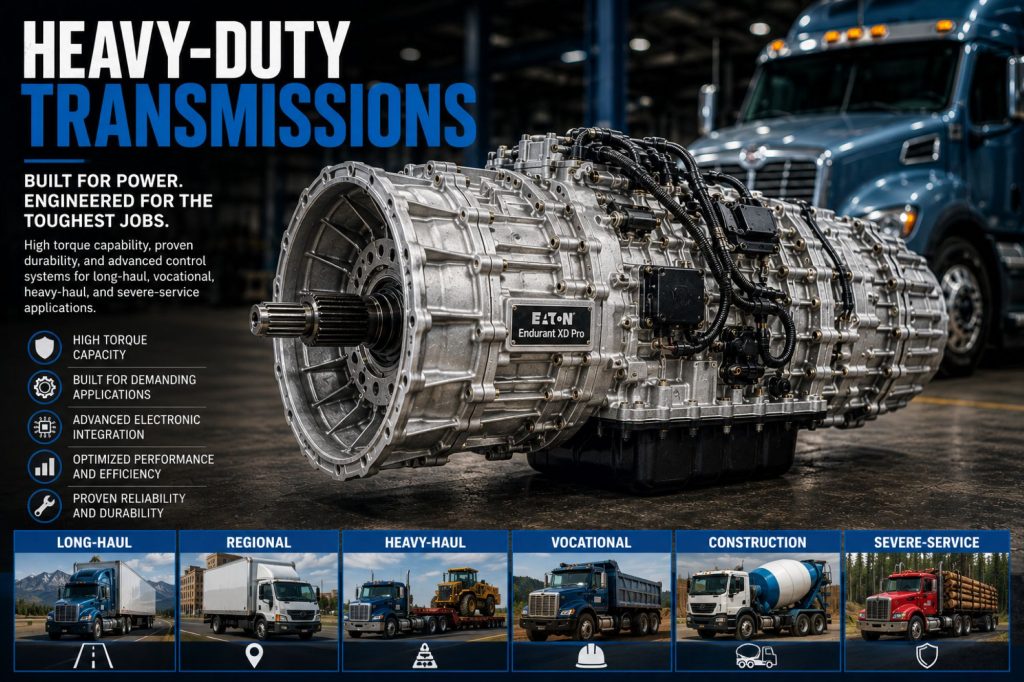
Heavy-duty transmissions are engineered to handle the high torque, vehicle weight, demanding duty cycles, and operating conditions associated with Class 8 commercial trucks and other heavy-duty equipment.
These transmissions are used throughout long-haul, regional, vocational, construction, heavy-haul, severe-service, logging, and specialized trucking applications.
Heavy-duty transmission technology includes traditional manual transmissions, automated manual transmissions, and fully automatic transmissions. The appropriate design depends on the truck, engine, gross vehicle weight, terrain, gearing requirements, and intended application.
Truck Equipment Atlas covers a growing selection of heavy-duty transmission models and families from major commercial drivetrain manufacturers.
Heavy-Duty Transmission Models on Truck Equipment Atlas
Explore the heavy-duty transmissions currently covered on Truck Equipment Atlas:
Allison Transmission
Detroit
Eaton and Eaton Cummins
- Eaton AutoShift
- Eaton Cummins Endurant HD
- Eaton Cummins Endurant HD V
- Eaton Cummins Endurant XD
- Eaton Cummins Endurant XD Pro
- Eaton Fuller 10-Speed Manual
- Eaton Fuller 13-Speed Manual
- Eaton Fuller 18-Speed Manual
- Eaton Fuller 8LL
- Eaton Fuller 9ALL
- Eaton Fuller RT Series
- Eaton Fuller RTLO Series
- Eaton Fuller Super 10
- Eaton UltraShift
- Eaton UltraShift PLUS
International
Mack
PACCAR
Volvo
Additional heavy-duty transmission models and families will be added as the Truck Equipment Atlas Transmission Library continues to expand.
What Makes a Transmission Heavy-Duty?
A heavy-duty transmission is designed to operate behind engines producing substantial torque while moving trucks and combinations that can operate at high gross vehicle weights.
Heavy-duty applications can place significant stress on transmission gears, shafts, bearings, clutches, lubrication systems, electronic controls, and other drivetrain components.
Transmission design must account for factors such as:
- Engine torque
- Gross vehicle weight
- Gross combination weight
- Vehicle application
- Axle gearing
- Tire size
- Startability
- Gradeability
- Operating speed
- Terrain
- Duty cycle
- PTO requirements
A transmission suitable for a standard highway tractor may require different gearing or specifications when used in heavy-haul or severe-service applications.
Heavy-Duty Transmission Types
Heavy-duty commercial trucks use several transmission technologies.
Manual Transmissions
Traditional heavy-duty manual transmissions provide direct driver control over clutch operation and gear selection.
Manual transmissions have historically dominated Class 8 trucking and remain important in heavy-haul, vocational, construction, logging, and other specialized applications.
Explore Manual Transmissions.
Automated Manual Transmissions
Automated manual transmissions use a geared mechanical architecture while automating clutch operation and shifting through electronic controls and actuators.
AMTs have become widely used in modern Class 8 highway tractors and are increasingly available in vocational and heavy-haul applications.
Explore Automated Manual Transmissions.
Automatic Transmissions
Fully automatic transmissions are particularly important in vocational and severe-duty applications requiring frequent starts, low-speed operation, maneuverability, and smooth power delivery.
Heavy-duty platforms such as the Allison 3000 and 4000 Series demonstrate the role of automatic transmissions in demanding commercial applications.
Explore Automatic Transmissions.
Compare clutch operation, launch behavior, and application tradeoffs in Manual vs Automated Manual vs Automatic Transmissions.
Long-Haul Applications
Long-haul tractors require transmissions capable of efficiently transferring power during extended highway operation.
Important considerations can include:
- Highway gearing
- Fuel efficiency
- Engine integration
- Overdrive ratios
- Grade performance
- Gross combination weight
- Driver workload
- Reliability
- Service availability
Modern 12-speed AMTs such as the Detroit DT12, Eaton Cummins Endurant HD, PACCAR TX-12, Mack mDRIVE, and Volvo I-Shift have become important platforms in long-haul trucking.
Traditional 10-speed, 13-speed, and 18-speed manuals also remain widely represented throughout the existing heavy-duty truck population.
Regional Applications
Regional trucks can experience a different operating cycle from long-haul tractors.
These trucks may combine highway operation with:
- More frequent stops
- Urban traffic
- Distribution centers
- Repeated acceleration
- Shorter routes
- Changing terrain
- More frequent backing and maneuvering
Transmission selection must balance highway efficiency with the additional shifting and low-speed operation associated with regional work.
Heavy-Haul Applications
Heavy-haul trucking places some of the greatest demands on a commercial truck transmission.
Extremely high gross combination weights can require:
- Deep reduction gearing
- High torque capacity
- Broad ratio coverage
- Strong startability
- Closely spaced ratios
- Low-speed control
- Effective grade performance
- Heavy-duty clutch systems
- Specialized transmission programming
Traditional 18-speed manuals remain strongly associated with heavy-haul trucking, while modern heavy-duty AMTs such as the Endurant XD and XD Pro, PACCAR TX-18 and TX-18 Pro, and other specialized platforms are expanding automated transmission options for demanding applications.
Vocational and Severe-Service Applications
Heavy-duty transmissions are also used throughout vocational and severe-service trucking.
Applications can include:
- Dump trucks
- Logging trucks
- Concrete trucks
- Refuse vehicles
- Construction trucks
- Heavy-haul tractors
- Oilfield trucks
- Municipal equipment
- Severe-service vehicles
- Specialized transport equipment
These trucks may spend significant portions of their operating time away from normal highway conditions.
Transmission specifications may therefore prioritize low-speed control, deep reduction gearing, PTO capability, startability, durability, and specialized operating modes.
Explore Vocational Transmissions for additional information.
Gear Ratios and Transmission Selection
Gear ratios determine how engine torque and speed are transferred through the drivetrain.
Lower gears provide greater mechanical advantage for starting heavy loads and climbing grades.
Higher gears allow the truck to operate efficiently at road speed.
Heavy-duty transmissions can use a wide range of gear configurations, including:
- 8-speed
- 9-speed
- 10-speed
- 12-speed
- 13-speed
- 14-speed
- 18-speed
The number of gears alone does not determine transmission capability.
Overall ratio spread, first gear ratio, top gear ratio, axle gearing, engine characteristics, tire size, and vehicle weight must all be considered together.
For a step-by-step explanation of power flow and gear reduction, read How Commercial Truck Transmissions Work.
Use How to Choose a Commercial Truck Transmission to check engine compatibility, working weight, axle gearing, tires, PTO needs, and service requirements together.
Pair this with Commercial Truck Axle Ratios Explained to evaluate final-drive gearing and engine RPM.
Engine and Transmission Integration
Modern heavy-duty trucks increasingly use integrated powertrains.
The engine and transmission can communicate electronically to coordinate:
- Engine speed
- Gear selection
- Engine torque
- Cruise control
- Engine braking
- Grade response
- Acceleration
- Fuel-efficiency strategies
Manufacturers can optimize engines and transmissions as complete powertrain systems rather than treating each component independently.
Examples include Detroit powertrains using the DT12, Volvo powertrains using I-Shift, Mack powertrains using mDRIVE, and PACCAR powertrains using PACCAR transmissions.
Direct Drive vs. Overdrive
Heavy-duty transmissions can be configured with direct-drive or overdrive top gears.
In a direct-drive configuration, the transmission’s top gear typically provides a 1:1 relationship through the main gearing.
An overdrive configuration allows the transmission output to rotate faster relative to engine speed in the selected overdrive gear.
Neither configuration is automatically superior.
The correct choice depends on:
- Engine operating range
- Axle ratio
- Tire size
- Highway speed
- Vehicle weight
- Terrain
- Fuel economy strategy
- Application
Transmission and axle gearing should be specified as a complete drivetrain system.
Advantages of Modern Heavy-Duty Transmissions
Modern heavy-duty transmission technology can provide several advantages:
- High torque capacity
- Broad gearing options
- Improved powertrain integration
- Application-specific programming
- Reduced driver workload with AMTs and automatics
- Improved consistency between drivers
- Specialized vocational configurations
- Improved highway efficiency
- Advanced diagnostic capabilities
The actual benefits depend on the transmission and how well it is matched to the truck.
Maintenance and Ownership
Heavy-duty transmissions operate under substantial mechanical loads and require proper maintenance.
Important areas can include:
- Transmission lubricant
- Fluid and filter service
- Clutch condition
- Shift actuators
- Clutch actuators
- Electronic controls
- Transmission cooling
- Seals and gaskets
- Transmission mounts
- Driveshafts
- Universal joints
- Diagnostic fault codes
- Software and calibration
Maintenance requirements vary considerably between manual, automated manual, and automatic transmissions.
Owners should follow the manufacturer’s service requirements for the specific transmission model and application.
Choosing a Heavy-Duty Transmission
Selecting a heavy-duty transmission requires evaluating the complete truck specification.
Important factors include:
- Engine
- Engine torque
- Vehicle weight
- Trailer type
- Freight
- Gross combination weight
- Terrain
- Highway versus vocational operation
- Heavy-haul requirements
- Axle ratio
- Tire size
- PTO requirements
- Driver experience
- Maintenance capabilities
- Service network
There is no single best transmission for every Class 8 truck.
The best transmission is the one properly matched to the engine, drivetrain, vehicle configuration, and work the truck is expected to perform.
Related Transmission Categories
Explore additional commercial transmission categories:
- Manual Transmissions
- Automated Manual Transmissions
- Automatic Transmissions
- Medium-Duty Transmissions
- Vocational Transmissions
Explore the Complete Transmission Library
Heavy-duty transmissions represent one of the largest and most diverse areas of commercial drivetrain technology.
Visit the Truck Equipment Atlas Transmission Library to explore individual manual, automated manual, automatic, heavy-duty, medium-duty, and vocational transmission profiles.
Additional heavy-duty transmission models, manufacturers, historical platforms, and educational resources will be added as Truck Equipment Atlas continues to expand its Transmission Library.