
Commercial Truck Axle Ratios Explained
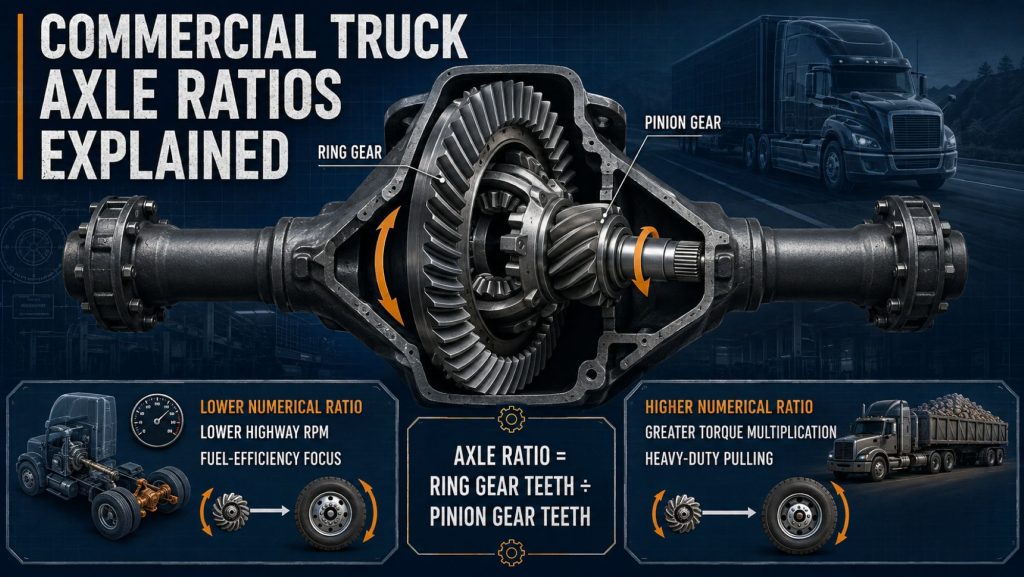
A commercial truck’s axle ratio affects engine speed, wheel torque, pulling ability, grade performance, fuel efficiency, acceleration, and maximum geared road speed.
The axle ratio is created by the ring-and-pinion gears inside the drive axle. It describes how many times the driveshaft must rotate to turn the drive wheels one complete revolution.
A numerically lower axle ratio can reduce engine rpm during highway operation, while a numerically higher ratio provides greater torque multiplication at the wheels. Neither is automatically better. The correct ratio must be matched to the engine, transmission, tires, vehicle weight, terrain, and intended duty cycle.
This guide explains how commercial truck axle ratios work and how they influence real-world vehicle performance.
What Is an Axle Ratio?
The axle ratio compares the number of teeth on the differential’s ring gear with the number of teeth on its drive pinion.
The ratio is calculated using this formula:
For example, if the ring gear has 41 teeth and the pinion gear has 11 teeth:
The axle ratio is therefore approximately 3.73:1.
This means the driveshaft rotates approximately 3.73 times for every complete rotation of the drive wheels.
Common Commercial Truck Axle Ratios
Commercial truck axle ratios vary considerably by vehicle class and application.
Examples may include:
- 2.26:1
- 2.47:1
- 2.64:1
- 2.79:1
- 2.85:1
- 3.08:1
- 3.25:1
- 3.36:1
- 3.42:1
- 3.55:1
- 3.70:1
- 3.73:1
- 3.90:1
- 4.10:1
- 4.30:1
- 4.56:1
- 4.88:1
- 5.29:1
The availability of a particular ratio depends on the axle manufacturer, axle model, vehicle manufacturer, transmission, tire size, and application.
Lower ratios are increasingly used in fuel-efficiency-focused highway trucks, while vocational and heavy-haul vehicles generally use higher ratios.
Numerically Lower Axle Ratios
A numerically lower axle ratio uses fewer driveshaft rotations for each wheel rotation.
Examples include:
- 2.26:1
- 2.47:1
- 2.64:1
- 2.79:1
These ratios are sometimes called faster, taller, or higher-speed gearing.
Potential benefits include:
- Lower engine rpm at highway speed
- Reduced engine noise
- Lower fuel consumption in suitable applications
- Reduced driveshaft speed multiplication
- Compatibility with direct-drive transmission strategies
- Efficient operation on relatively flat highway routes
Potential limitations include:
- Less torque multiplication at the wheels
- Reduced startability under heavy loads
- Greater demand on the clutch or transmission during launch
- More frequent downshifting on grades
- Reduced low-speed control
- Poorer performance if incorrectly matched to the engine
A low numerical ratio is not automatically fuel-efficient. If the engine is forced to operate below its efficient speed range or downshift frequently, fuel consumption and performance can suffer.
Numerically Higher Axle Ratios
A numerically higher axle ratio requires more driveshaft rotations for each wheel rotation.
Examples include:
- 3.90:1
- 4.10:1
- 4.56:1
- 4.88:1
- 5.29:1
These ratios are sometimes called slower, deeper, or lower gearing.
Potential benefits include:
- Greater torque multiplication
- Improved startability
- Better low-speed control
- Stronger grade performance
- Reduced clutch stress during launch
- Better suitability for heavy loads
- Improved performance in vocational and off-highway work
Potential limitations include:
- Higher engine rpm at highway speed
- Increased fuel consumption during high-speed operation
- More engine noise
- Lower maximum geared road speed
- Greater driveline speed at a given vehicle speed
Numerically higher ratios are commonly used in heavy-haul, construction, logging, mining, refuse, oilfield, and severe-service applications.
How Axle Ratio Multiplies Torque
The axle ratio multiplies the torque delivered through the driveshaft before it reaches the wheels.
If the driveshaft delivers 1,000 pound-feet of torque to an axle with a 3.73 ratio, the theoretical torque after the ring-and-pinion gearset is:
This calculation does not account for mechanical losses, tire radius, differential operation, or how torque is divided among the drive wheels.
A 4.56 ratio would theoretically produce:
The higher numerical ratio produces more wheel torque from the same driveshaft input.
The transmission ratio also multiplies torque. Total drivetrain multiplication depends on both the selected transmission gear and the axle ratio.
Transmission Ratio and Axle Ratio
The transmission and drive axle work together as one gearing system.
Overall gear reduction can be estimated using:
If first gear is 12.00:1 and the axle ratio is 3.73:1:
The total theoretical reduction is 44.76:1 before accounting for other drivetrain factors.
If the transmission’s top gear is 0.73:1 overdrive:
The overall top-gear ratio is approximately 2.72:1.
This is why axle ratios cannot be evaluated without considering the transmission.
For the transmission side of the calculation, see How Commercial Truck Transmissions Work. Use How to Choose a Commercial Truck Transmission to evaluate the combined engine, transmission, axle, and tire specification.
Direct-Drive Transmissions and Axle Ratios
A direct-drive transmission has a top gear close to 1.00:1. The input and output shafts rotate at approximately the same speed in top gear.
A direct-drive transmission may be paired with a numerically lower axle ratio to obtain the desired cruising engine speed.
Potential benefits of a direct-drive powertrain include:
- Fewer gear meshes transmitting power in top gear
- Reduced internal transmission losses
- Efficient highway operation
- Lower cruising rpm when properly specified
This approach is sometimes associated with downsped powertrains.
A direct-drive transmission with an excessively low axle ratio can create poor startability, excessive clutch loading, frequent downshifting, and weak grade performance.
Overdrive Transmissions and Axle Ratios
An overdrive gear has a ratio below 1.00:1. The transmission’s output shaft rotates faster than its input shaft.
An overdrive transmission may be paired with a numerically higher axle ratio while still maintaining an acceptable highway engine speed.
Potential benefits include:
- Greater flexibility across different operating speeds
- Stronger low-speed torque multiplication when properly matched
- Compatibility with heavy or varied duty cycles
- Useful performance in rolling or mountainous terrain
An overdrive transmission does not automatically improve fuel economy. Efficiency depends on the entire powertrain and how the truck is operated.
Axle Ratio and Engine RPM
Axle ratio directly affects engine speed at a particular road speed.
Cruising rpm is influenced by:
- Vehicle speed
- Tire revolutions per mile
- Axle ratio
- Transmission top-gear ratio
A simplified calculation is:
For example, assume:
- Vehicle speed: 65 mph
- Tire revolutions per mile: 500
- Axle ratio: 3.36:1
- Top gear: 0.73:1
The calculation is:
The estimated engine speed is approximately:
Actual engine rpm may vary because of tire wear, tire growth, drivetrain losses, clutch or torque-converter slip, and differences between published and operating tire dimensions.
Axle Ratio and Tire Size
Tire size changes the effective relationship between the axle ratio and road speed.
A larger-diameter tire travels farther during each revolution. It lowers engine rpm at a given road speed and effectively makes the gearing taller.
A smaller-diameter tire travels less distance per revolution. It raises engine rpm at the same road speed and effectively makes the gearing deeper.
Axle-ratio calculations should use the tire manufacturer’s published revolutions-per-mile specification whenever possible.
Two tires with the same general size designation can have different:
- Loaded radius
- Overall diameter
- Revolutions per mile
- Tread depth
- Load characteristics
Replacing tires with a meaningfully different diameter can affect engine rpm, speedometer accuracy, transmission shift programming, cruise control, ABS, and drivetrain performance.
Axle Ratio and Startability
Startability describes a truck’s ability to begin moving from a stop, particularly when heavily loaded or positioned on a grade.
Startability depends on:
- Engine launch torque
- Clutch or torque-converter characteristics
- Transmission starting gear
- Axle ratio
- Tire radius
- Vehicle weight
- Road grade
- Rolling resistance
- Surface traction
A numerically higher axle ratio improves torque multiplication and generally makes it easier to start a heavy vehicle.
A numerically lower ratio may place greater demand on the clutch, transmission, and engine during launch.
Startability is especially important for:
- Heavy-haul tractors
- Dump trucks
- Concrete mixers
- Logging trucks
- Refuse trucks
- Oilfield vehicles
- Trucks operating on steep grades
- Vehicles that start frequently under heavy load
Axle Ratio and Gradeability
Gradeability describes a vehicle’s ability to climb a grade at a particular weight and speed.
A higher numerical axle ratio generally improves low-speed grade performance by multiplying more torque at the wheels.
However, the transmission can downshift to provide additional reduction. The correct specification must balance:
- Required climbing speed
- Engine power and torque
- Available transmission gears
- Axle ratio
- Tire size
- Gross combination weight
- Cooling capacity
- Operating terrain
A truck that frequently downshifts on modest grades may have an axle ratio, transmission, engine, or load specification that is poorly matched to its operation.
Axle Ratio and Fuel Efficiency
A lower cruising engine speed can reduce fuel use when the engine remains within its efficient operating range.
Fuel-efficiency-focused specifications may use:
- Low-speed diesel engines
- Direct-drive automated transmissions
- Numerically low axle ratios
- Low-rolling-resistance tires
- Aerodynamic equipment
- Predictive cruise control
- Engine and transmission integration
The lowest available axle ratio is not always the most efficient choice.
A ratio that is too low can cause:
- Frequent downshifts
- Excessive time in lower gears
- Poor response
- Engine lugging
- Higher exhaust temperatures
- Increased drivetrain stress
- Reduced driver control
- Increased fuel use in difficult terrain
The most efficient ratio allows the engine to operate within its intended speed and load range during the truck’s normal duty cycle.
Axle Ratio and Maximum Geared Speed
Maximum geared speed is the theoretical road speed produced at a particular engine rpm, transmission ratio, axle ratio, and tire size.
A lower numerical axle ratio generally increases theoretical road speed at a given engine rpm.
A higher numerical axle ratio generally reduces theoretical road speed.
Actual maximum speed may be limited by:
- Electronic road-speed governor
- Engine governor
- Tire speed rating
- Vehicle programming
- Transmission controls
- Safety requirements
- Fleet policy
- Road conditions
- Legal speed limits
Axle ratio should never be selected merely to obtain a higher theoretical top speed.
Highway Axle Ratios
Highway tractors generally use ratios designed to balance cruising rpm, fuel economy, grade performance, startability, and payload.
A highway specification may favor a lower numerical ratio when the truck:
- Operates primarily on paved roads
- Travels at consistent highway speeds
- Uses an integrated engine and transmission package
- Pulls predictable weights
- Operates on relatively moderate terrain
- Uses the recommended tire size
- Has sufficient low-speed transmission gearing
Regional and mountainous highway operations may require different gearing from long-distance routes across flatter terrain.
Vocational Axle Ratios
Vocational trucks frequently use higher numerical axle ratios because they operate under heavy loads, at lower speeds, or on poor surfaces.
Applications include:
- Dump trucks
- Concrete mixers
- Refuse trucks
- Logging trucks
- Heavy wreckers
- Snowplows
- Oilfield trucks
- Mining vehicles
- Construction trucks
- Off-highway equipment
Vocational specifications prioritize:
- Startability
- Low-speed control
- Gradeability
- Durability
- Traction
- Performance under load
Fuel efficiency remains important, but the truck must first be able to perform its work reliably.
Heavy-Haul Axle Ratios
Heavy-haul tractors require powertrain specifications built around exceptional combination weights and demanding operating conditions.
These trucks may use deeper axle ratios to provide:
- High wheel torque
- Controlled launches
- Reduced clutch loading
- Low-speed maneuverability
- Improved grade performance
- Better control during specialized hauling
The axle ratio must be coordinated with:
- Engine torque
- Transmission starting ratio
- Number of transmission speeds
- Auxiliary transmission when equipped
- Tire size
- Number of drive axles
- Gross combination weight
- Permit requirements
- Route grades
- Required operating speed
A heavy-haul specification intended for low-speed operation may not be efficient or suitable for extended highway use.
Tandem-Axle Ratio Matching
Both drive axles in a conventional tandem must use matching axle ratios.
If the forward-rear and rear-rear axles have different ratios, they attempt to turn at different speeds while being mechanically connected.
A ratio mismatch can cause:
- Driveline windup
- Inter-axle differential damage
- Power-divider damage
- Excessive heat
- Tire scrubbing
- Gear and bearing wear
- Driveshaft stress
- Complete axle failure
Replacement differential carriers must be verified carefully before installation.
The identification tags, carrier numbers, gear markings, service records, and manufacturer specifications should all be checked to confirm the ratio.
How to Identify an Axle Ratio
An axle ratio may be identified through:
- Axle identification tag
- Differential carrier tag
- Vehicle specification sheet
- Build sheet
- Manufacturer data plate
- Electronic service information
- Ring-and-pinion tooth counts
- Component part numbers
- Fleet maintenance records
The ratio may also be determined by comparing driveshaft and wheel rotations, but this method may be less precise and can be affected by differential type and testing procedure.
The ratio should be positively verified before ordering or installing replacement components.
Changing an Axle Ratio
Changing the axle ratio normally requires replacement of the ring-and-pinion gearset or the complete differential carrier.
A ratio change may also require:
- Reprogramming the engine or transmission
- Updating speedometer calibration
- Confirming transmission compatibility
- Reviewing driveshaft speed
- Checking cruise-control operation
- Checking ABS and stability-system programming
- Confirming startability
- Recalculating engine rpm
- Recalculating maximum geared speed
- Matching both axles in a tandem
- Verifying warranty coverage
Ring-and-pinion replacement requires precise adjustment of pinion depth, bearing preload, backlash, and tooth-contact pattern.
These repairs should be performed with the manufacturer’s service information and appropriate tools.
Choosing the Right Commercial Truck Axle Ratio
The correct axle ratio depends on the complete vehicle and its intended operation.
Important considerations include:
- Engine model
- Engine horsepower
- Engine torque
- Recommended engine operating range
- Transmission model
- Starting-gear ratio
- Direct-drive or overdrive top gear
- Number of transmission speeds
- Tire size
- Tire revolutions per mile
- Truck configuration
- Single- or tandem-drive axles
- Gross vehicle weight
- Gross combination weight
- Highway speed
- Operating terrain
- Maximum grade
- Startability requirements
- Gradeability requirements
- Highway or vocational duty cycle
- Fuel-efficiency goals
- Required low-speed control
A long-haul tractor operating on relatively flat interstate routes may need a substantially different ratio from a dump truck, refuse vehicle, logging truck, or heavy-haul tractor.
The axle manufacturer, truck manufacturer, engine supplier, and transmission supplier may provide approved gearing calculations for a particular vehicle specification.
Related Axle and Differential Categories
- Commercial Truck Drive Axles
- Truck Differentials
- Commercial Truck Steer Axles
- Lift Axles and Auxiliary Axles
- Electric Drive Axles
Related Equipment Resources
Explore More Axle and Differential Guides
Visit Axle and Differential Guides to explore additional resources covering axle operation, single- and tandem-axle trucks, differential types, axle identification, and common axle and differential problems.