
Quick Facts
- Manufacturer: Muncie Power Products
- Product Series: FR6Q Series
- Product Type: Transmission-mounted clutch-shift power take-off
- Transmission Application: Ford 6R140 TorqShift six-speed automatic transmission
- Vehicle Applications: Application-specific Ford F-250, F-350, F-450, F-550, F-650, and F-750 trucks
- Mounting Type: Ford six-bolt PTO opening
- Engagement Type: Solenoid-activated electric-over-hydraulic clutch shift
- Speed Ratio: 0.90:1
- Stationary Intermittent Rating: 200 lb-ft and 39 horsepower at 1,000 PTO rpm
- Stationary Continuous Rating: 140 lb-ft
- Mobile Operating Rating: 120 lb-ft and 22 horsepower at 1,000 PTO rpm
- Approximate Weight: 35 pounds
- Output Options: Direct-mounted hydraulic-pump and round-shaft configurations
- Primary Applications: Utility, towing, recovery, dump, snow and ice, service, and construction equipment
- Production Status: Current application-specific product family
Overview
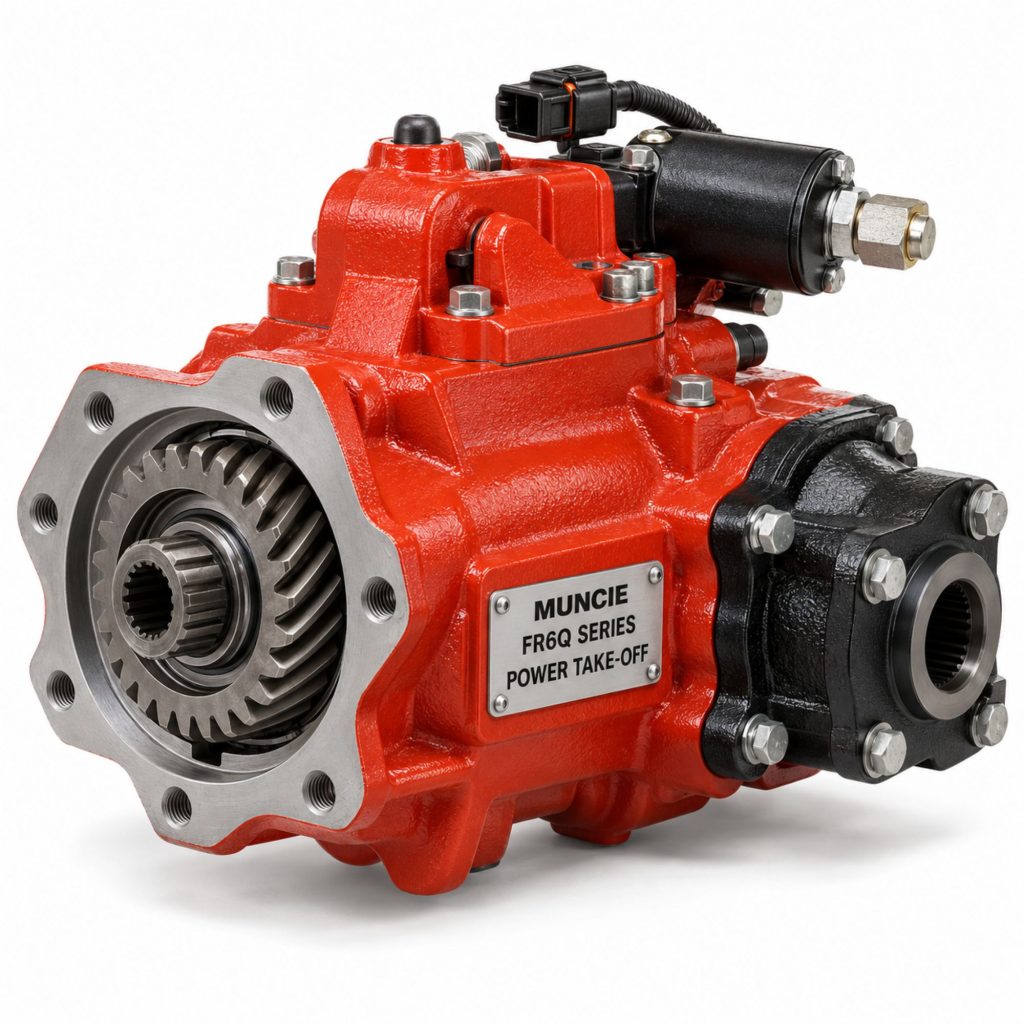
The Muncie FR6Q is a clutch-shift power take-off developed specifically for Ford trucks equipped with the 6R140 TorqShift six-speed automatic transmission. It transfers engine and transmission power to a hydraulic pump or another auxiliary component used by vocational equipment.
The FR6Q is designed for applicable Ford Super Duty and medium-duty trucks. Depending on the vehicle’s model year, engine, transmission calibration, chassis configuration, and factory PTO provisions, installations may include Ford F-250 through F-550 trucks and certain F-650 and F-750 models.
A patented noise-abatement design helps reduce the gear-rattle noise that can occur in transmission-driven PTO systems. The FR6Q also uses solenoid-controlled clutch engagement and an application-specific wiring harness designed to simplify integration with compatible Ford vehicle controls.
Configurations are available for stationary operation and, where approved, mobile use. Stationary and mobile ratings differ substantially, so the PTO must be selected and operated according to the intended application.
Key Characteristics
- Designed specifically for the Ford 6R140 TorqShift transmission
- Ford six-bolt transmission mounting configuration
- Clutch-shift engagement
- Solenoid-activated operation
- Patented noise-abatement technology
- Single 0.90:1 speed ratio
- Stationary and approved mobile configurations
- Direct-mount hydraulic-pump capability
- Round-shaft output availability
- Application-specific wiring harness
- Gasoline- and diesel-engine configurations
- Designed for vocational Ford truck applications
Major Components
- PTO housing
- F12 transmission input gear
- Internal gear train
- Multidisc clutch pack
- Hydraulic engagement piston
- Return springs
- Output shaft
- Output-shaft bearings
- Direct-mount pump flange where specified
- Solenoid valve
- Pressure switch
- Seals and gaskets
- Mounting studs and fasteners
- Preconfigured wiring harness
- Cab-mounted rocker switch
- Application-specific connectors and control components
Product Type and Construction
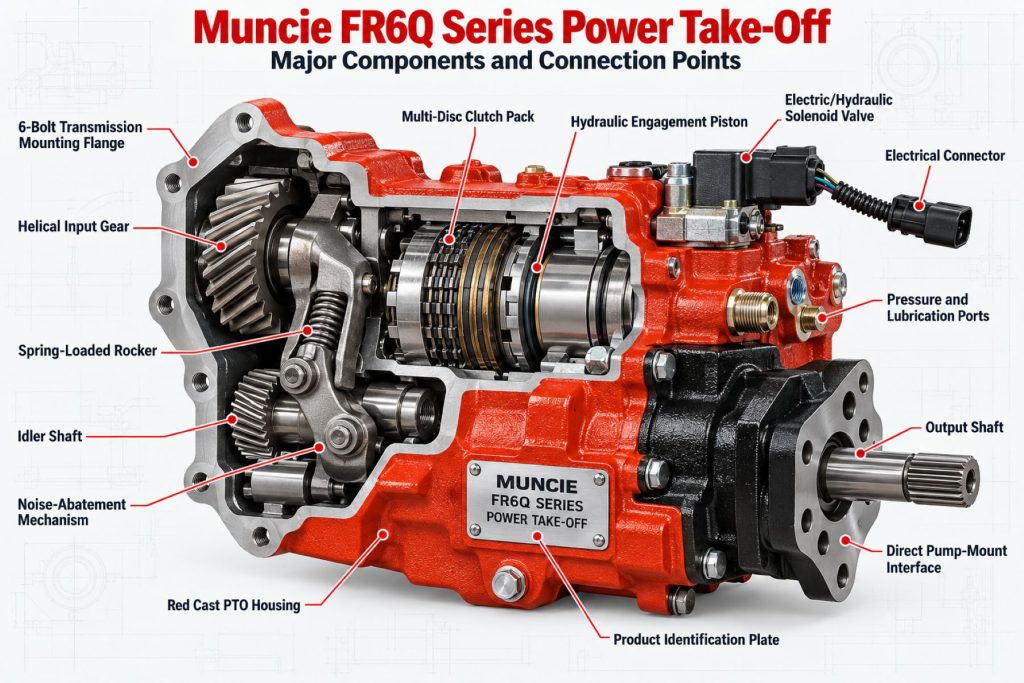
The FR6Q is a transmission-driven, six-bolt clutch-shift PTO. Its housing contains the input gear, internal gearing, clutch pack, shift piston, bearings, seals, and output assembly required to transfer power from the Ford 6R140 transmission.
The clutch-shift design engages the output through an internally applied clutch rather than moving a sliding gear into mesh. This provides electrically controlled engagement through the vehicle and PTO control system.
The FR6Q is offered with application-specific outputs for direct-mounted hydraulic pumps or remotely driven equipment. The selected configuration must match the pump, vehicle drivetrain, driven equipment, and available chassis clearance.
How the Power Take-Off Works
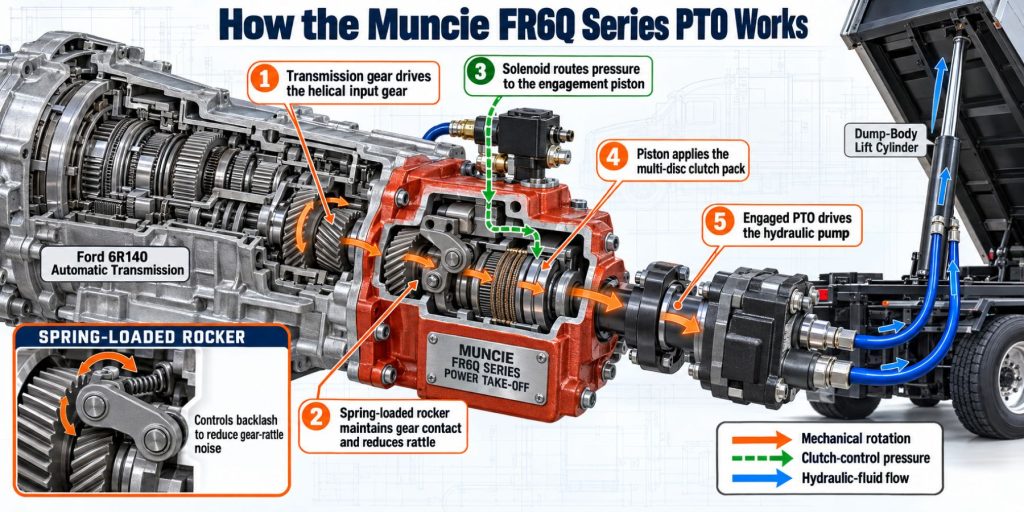
The Ford 6R140 transmission drives the FR6Q input gear whenever the applicable transmission power path is rotating. With the PTO switched off, the internal clutch remains released and usable torque is not transferred to the output.
When the operator activates the PTO switch and the vehicle’s required interlocks are satisfied, the control system energizes the solenoid. Hydraulic pressure applies the clutch pack, connecting the transmission-driven input section to the PTO output.
The output then rotates a directly mounted hydraulic pump or transfers mechanical power through a round shaft to remote equipment. When the operator switches the PTO off, apply pressure is released and the clutch disengages.
Position and Function Within the Vehicle
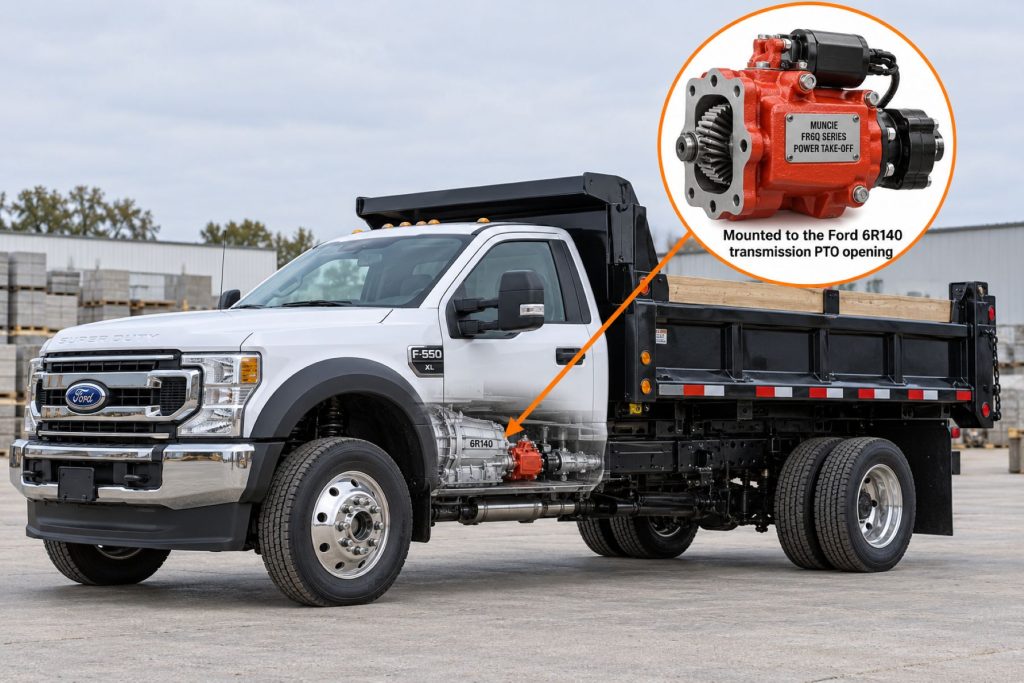
The FR6Q mounts to the factory PTO opening on a compatible Ford 6R140 automatic transmission. Its position places the PTO and pump beneath the truck, where frame, exhaust, transfer-case, driveshaft, suspension, and body-equipment clearance must be considered.
The PTO supplies mechanical power for vocational equipment without requiring a separate auxiliary engine. When connected to a hydraulic pump, it allows the truck engine to operate cylinders, motors, winches, booms, hoists, and other hydraulically powered systems.
The FR6Q does not increase the amount of power available from the engine or transmission. The PTO and driven system must remain within the ratings established for the complete vehicle.
Common Specifications
- Transmission application: Ford 6R140 TorqShift six-speed automatic transmission.
- Mounting configuration: Ford six-bolt PTO opening.
- Transmission input-gear code: F12.
- Speed-ratio code: 09.
- Nominal internal speed ratio: 0.90:1.
- Engagement: Solenoid-activated electric-over-hydraulic clutch shift.
- Stationary intermittent power: 39 horsepower at 1,000 PTO rpm.
- Stationary intermittent torque: 200 lb-ft.
- Stationary continuous torque: 140 lb-ft.
- Mobile operating power: 22 horsepower at 1,000 PTO rpm.
- Mobile operating torque: 120 lb-ft.
- Output arrangements: Application-specific direct pump mount or round-shaft output.
- Approximate weight: 35 pounds.
Exact compatibility, shift code, output configuration, special-feature code, and control requirements must be confirmed for the vehicle model year, engine, transmission, and intended operating mode.
Power, Torque, Speed, and Operating Capacity
For stationary applications, the FR6Q has a published intermittent rating of 200 lb-ft and 39 horsepower at 1,000 PTO rpm. Its published stationary continuous-torque rating is 140 lb-ft.
For approved mobile applications, the published FR6Q limit is 120 lb-ft and 22 horsepower at 1,000 PTO rpm. Muncie identifies the mobile torque value as both the continuous and intermittent limit for that operating mode.
The PTO rating does not override limits imposed by the transmission, engine, pump, output shaft, hydraulic system, vehicle controls, or driven equipment. The lowest applicable rating determines the safe operating capacity.
Ford 6R140 Transmission Application
The FR6Q was engineered around the PTO provisions of the Ford 6R140 TorqShift six-speed automatic transmission. The application includes the F12 transmission input gear and a 0.90:1 internal PTO ratio.
Compatibility depends on the Ford truck’s model year, engine, transmission calibration, PTO-prep equipment, drivetrain, and chassis. Gasoline and diesel models can require different shift codes, wiring, and installation components.
Later Ford trucks using the 10R140 transmission require a different PTO family. The FR6Q should not be installed on a 10R140 merely because the vehicle belongs to the same Ford model series.
PTO Engagement and Shift System
The FR6Q uses electric-over-hydraulic clutch engagement. A cab-mounted switch sends an engagement request through the approved control circuit. When the vehicle’s operating conditions are correct, the solenoid directs pressure to the PTO clutch piston.
Application-specific shift configurations are available for different Ford model years and gasoline or diesel engines. The correct shift code must be selected because wiring, connectors, pressure control, and vehicle logic can differ.
The PTO may fail to engage if a required condition involving the parking brake, transmission range, engine speed, vehicle speed, or another programmed interlock has not been satisfied.
Noise-Abatement Technology
The FR6Q incorporates Muncie’s patented noise-abatement technology to reduce the gear-rattle noise that can occur between a PTO and transmission. This feature is particularly useful in utility, service, recovery, and residential work environments where excessive driveline noise can be disruptive.
Noise-abatement technology does not make the PTO silent. Normal gear, pump, engine, and hydraulic-system sounds may still be present during operation.
Grinding, knocking, rapid gear chatter, bearing noise, or a sudden change in sound should be investigated. Those symptoms may indicate a mounting, lubrication, clutch, bearing, pump, or transmission problem rather than normal PTO operation.
Stationary and Mobile Operation
Stationary FR6Q operation is performed with the truck secured and the transmission and vehicle controls placed in the required PTO mode. This operating mode supports the product’s higher published intermittent and continuous ratings.
Mobile operation allows approved equipment to function while the vehicle is moving. It requires the correct FR6Q special-feature configuration, vehicle programming, safety interlocks, transmission control strategy, and body-equipment design.
A stationary-only FR6Q configuration must not be assumed suitable for mobile operation. Mobile use is limited to 120 lb-ft and 22 horsepower at 1,000 PTO rpm and must be approved for the complete vehicle.
Power Transfer and Output Design
The transmission drives the FR6Q input gear, while the internal clutch controls whether that power reaches the output. The fixed 0.90:1 ratio causes the output to rotate at approximately 90 percent of the applicable PTO input-gear speed.
A direct-mount output connects an approved hydraulic pump directly to the PTO. This creates a compact installation and eliminates a separate remote driveshaft.
A round-shaft output permits power to be transferred to remotely mounted equipment. Remote systems require suitable shafting, alignment, support, operating angles, speed control, and guarding.
Hydraulic Circuit and Equipment Integration
When paired with a hydraulic pump, the FR6Q supplies mechanical power to a circuit that may include:
- Hydraulic reservoir
- Suction hose
- Pressure and return hoses
- Hydraulic pump
- Directional-control valves
- Pressure-relief valve
- Hydraulic filters
- Cylinders or hydraulic motors
- Oil cooler where required
- Pressure and temperature monitoring
- Equipment controls and safety interlocks
Pump displacement, PTO speed, and engine speed determine hydraulic flow. Hydraulic pressure and flow determine the power demanded from the PTO. The circuit must be designed so the pump cannot overload the FR6Q in stationary or mobile operation.
Housing, Shaft, Bearing, and Clutch Design
The FR6Q housing supports its input gear, internal gearing, clutch pack, output shaft, bearings, engagement components, and pump-mounting structure. The mounting arrangement must maintain proper alignment with the Ford transmission.
The clutch pack transfers torque when hydraulic pressure applies the shift piston. Repeated high-speed engagement, inadequate pressure, excessive load, or contaminated fluid can create heat and accelerate clutch wear.
The output assembly must match the pump or remote-driven component. Using an incorrect shaft, flange, adapter, or pump rotation can damage the PTO and connected equipment.
Controls and Electronic Integration
The FR6Q is designed to work with application-specific Ford electrical and transmission controls. A preconfigured wiring harness and rocker switch can simplify installation, but correct vehicle programming and interlock operation remain essential.
Control functions may include:
- PTO enable and disengage switch
- PTO-engaged indicator
- Parking-brake interlock
- Transmission-range interlock
- Vehicle-speed limitation
- Engine-speed control
- Remote throttle operation
- Mobile-mode control
- Body-equipment interlocks
- Hydraulic-system enable controls
Incorrect wiring, mismatched harnesses, poor grounds, or incomplete programming can prevent engagement or cause improper operation.
Efficiency, Heat, and Lubrication
The FR6Q relies on the approved transmission-fluid system for lubrication and clutch operation. Fluid type, level, cleanliness, temperature, and pressure affect PTO performance.
Heat can be generated by gear contact, bearing friction, clutch slippage, the hydraulic pump, and the transmission. Excessive heat may indicate overloading, restricted hydraulic plumbing, low fluid, a failing pump, or improper clutch application.
The correct Ford-specified transmission fluid must be used. Hydraulic fluid used by the driven equipment is maintained as a separate system according to the pump and equipment manufacturers’ requirements.
Duty Cycle and Operating Conditions
The FR6Q’s allowable duty cycle depends on whether the PTO is operating in stationary or approved mobile service. Stationary intermittent operation permits higher short-duration torque, while continuous stationary and mobile operation use lower limits.
Cold hydraulic fluid increases pump-input torque and can place additional load on the PTO. The engine, transmission, PTO, pump, and hydraulic system should be allowed to warm before the system is placed under heavy load.
High ambient temperature, long operating cycles, elevated hydraulic pressure, and restricted airflow can increase system temperature. Oil cooling may be required for demanding applications.
Mounting and Installation
The FR6Q should be installed using the current instructions for the exact Ford truck, engine, model year, and 6R140 transmission application. Required components may include mounting hardware, a gasket, pump-mounting parts, wiring harnesses, switches, connectors, and hydraulic fittings.
The installer should verify:
- Vehicle model and model year
- Engine type
- Ford 6R140 transmission identification
- Factory PTO-prep equipment
- Correct FR6Q shift code
- Stationary or mobile operating requirements
- Output and pump compatibility
- Frame and exhaust clearance
- Transfer-case and driveshaft clearance on four-wheel-drive trucks
- Hydraulic-hose routing
- Electrical connections and programming
- Pump-support requirements
- Correct fastener torque
Direct-mounted pumps and associated components weighing 40 pounds or more generally require appropriate support according to Muncie installation guidance.
Transmission and Vehicle Compatibility
The FR6Q is limited to approved Ford 6R140 transmission applications. Compatibility depends on the truck’s model year, engine, drivetrain, transmission calibration, PTO preparation, electrical architecture, and intended stationary or mobile operation.
Two-wheel-drive and four-wheel-drive chassis can have different clearance restrictions. The transfer case, front driveline, exhaust system, crossmembers, and suspension components must be inspected before selecting the output and pump arrangement.
Ford trucks equipped with a 10R140 transmission require a different PTO series, such as an application-specific Muncie F20 or F22. Transmission identification should be confirmed before ordering.
Pump, Driveshaft, and Driven-Equipment Compatibility
A direct-mounted hydraulic pump must have the correct mounting interface, pilot, shaft, rotation, displacement, speed range, pressure rating, and torque capacity.
Remote equipment requires a compatible round-shaft output and properly engineered driveline. Shaft length, balance, phasing, operating angle, slip movement, support, guarding, and critical speed must be evaluated.
The pump or driven component must not require more than 200 lb-ft during approved intermittent stationary use, 140 lb-ft during continuous stationary operation, or 120 lb-ft during approved mobile use.
Hydraulic Fluid, Filtration, and Reservoir Compatibility
The hydraulic system should use fluid approved for the pump, valves, cylinders, motors, and operating environment. Fluid viscosity must remain suitable across the vehicle’s expected temperature range.
The reservoir should provide adequate fluid capacity, cooling, air separation, contamination control, and space for thermal expansion. Suction plumbing must allow unrestricted flow to the pump.
Filters should provide the cleanliness required by the hydraulic components without creating excessive restriction. A clogged filter, undersized suction line, or low fluid level can cause cavitation and increase PTO load.
Common Applications
- Utility trucks
- Service trucks
- Aerial-lift trucks
- Tow trucks
- Recovery vehicles
- Dump trucks
- Snowplows
- Salt and material spreaders
- Construction trucks
- Hydraulic cranes
- Hydraulic winches
- Mobile-maintenance vehicles
- Fire and rescue support vehicles
- Landscaping and municipal trucks
Advantages
- Designed specifically for the Ford 6R140 transmission
- Clutch-shift engagement
- Solenoid-controlled operation
- Patented noise-abatement technology
- Application-specific wiring harness
- Direct-mounted hydraulic-pump options
- Round-shaft output availability
- Stationary and approved mobile configurations
- Gasoline- and diesel-engine applications
- Compact one-piece installation
- Support for many vocational Ford trucks
- Current manufacturer literature and service support
Limitations or Considerations
- Designed only for approved Ford 6R140 applications
- Not compatible with Ford 10R140 transmissions
- Uses a single 0.90:1 speed ratio
- Mobile ratings are lower than stationary ratings
- Correct model-year and engine-specific shift code is required
- Vehicle programming and interlocks may be necessary
- Four-wheel-drive chassis can restrict pump clearance
- Hydraulic-pump selection must remain within PTO ratings
- Heavy direct-mounted pumps may require additional support
- Cold hydraulic fluid can substantially increase starting load
- Improper wiring can prevent engagement
- Stationary-only models cannot automatically be used in mobile operation
Driver and Operator Experience
A properly installed FR6Q provides controlled engagement through a cab-mounted rocker switch or an approved equipment control. Vehicle interlocks determine whether the engagement request is accepted.
The noise-abatement system helps reduce normal PTO gear rattle. Operators should still become familiar with the normal sound of the engine, transmission, PTO, pump, and hydraulic equipment.
Delayed engagement, abnormal noise, hydraulic overheating, warning messages, slipping, or unexpected equipment movement should be reported and investigated before the truck returns to service.
PTO Engagement and Operating Procedure
The approved procedure depends on the Ford truck, model year, PTO configuration, and body equipment. A general stationary operating sequence may include:
- Position the truck on a suitable surface.
- Apply the parking brake and secure the vehicle.
- Place the transmission in the required range or PTO operating mode.
- Allow the powertrain and hydraulic system to warm when necessary.
- Keep engine speed within the approved engagement range.
- Activate the PTO switch.
- Confirm PTO engagement through the indicator and equipment response.
- Operate the hydraulic equipment within approved speed and load limits.
- Monitor hydraulic pressure, temperature, sound, and equipment movement.
- Return the system to the required disengagement speed.
- Stop the driven equipment.
- Switch off the PTO and confirm disengagement.
Mobile operation requires its own approved procedure and safety controls. This overview does not replace the instructions supplied with the vehicle, PTO, or driven equipment.
Inspection and Wear Points
- PTO housing
- Transmission mounting surface
- Mounting studs and fasteners
- Gasket and sealing surfaces
- Output shaft or pump interface
- Output bearings
- Clutch-pack operation
- Solenoid valve
- Pressure switch
- Wiring harness and connectors
- Rocker switch and indicator
- Hydraulic-pump fasteners
- Pump-support brackets
- Remote driveline and guards
- Hydraulic hoses and fittings
- Transmission-fluid condition
Lubrication Requirements
The FR6Q receives lubrication from the Ford 6R140 transmission-fluid system. The transmission must contain the correct fluid at the specified level.
Low fluid, incorrect fluid, contamination, excessive temperature, or internal transmission problems can reduce lubrication and affect PTO engagement.
The hydraulic pump and driven equipment use their own hydraulic fluid and maintenance schedule. Any remote driveline joints may also require separate lubrication.
Maintenance and Ownership Notes
Inspect the FR6Q regularly for leaks, loose fasteners, damaged wiring, connector corrosion, abnormal noise, excessive heat, and changes in engagement behavior.
Maintain the Ford transmission according to the vehicle manufacturer’s fluid and filter schedule. Transmission-related faults can affect PTO operation even when the PTO itself is mechanically sound.
The hydraulic system should be maintained so a failing pump, restricted filter, collapsed suction hose, or improper relief setting does not overload the PTO.
Replacement parts should be selected using the complete FR6Q model code and the vehicle’s model year, engine, and transmission information.
Common PTO and Hydraulic-System Problems
- PTO will not engage: An unmet Ford interlock, faulty switch, damaged wiring, failed solenoid, low apply pressure, incorrect programming, or internal clutch problem may prevent engagement.
- Delayed engagement: Cold or low transmission fluid, low pressure, a restricted circuit, a leaking piston seal, or clutch wear may delay engagement.
- PTO slips under load: Excessive hydraulic demand, inadequate clutch pressure, worn friction discs, pump failure, or operation above the stationary or mobile rating can cause slippage.
- Excessive noise: Loose mounting hardware, bearing wear, gear damage, low fluid, an overloaded pump, or remote-driveline problems may produce abnormal noise.
- Oil leakage: Damaged seals, a failed gasket, loose fasteners, worn sealing surfaces, or excessive internal pressure may cause leakage.
- Hydraulic equipment moves slowly: Low engine speed, pump wear, suction restriction, low hydraulic-fluid level, valve leakage, or excessive load may reduce performance.
- Hydraulic system overheats: Excess pressure, continuous relief-valve operation, an undersized reservoir, restricted plumbing, pump wear, or an excessive duty cycle may increase temperature.
- Mobile mode does not operate: The PTO may lack the required stationary-and-mobile feature, vehicle programming, speed signal, wiring, or body-equipment interlock.
Safety and Service Precautions
Never install or service the FR6Q while the engine is running. Remove the ignition key, secure the truck, chock the wheels, and prevent anyone from starting the vehicle while personnel are underneath it.
Raised dump bodies, booms, hoists, platforms, and other equipment must be mechanically blocked before service. Hydraulic pressure alone must not be trusted to support raised equipment.
Keep personnel away from rotating shafts, pumps, and driven equipment. Remote PTO drivelines require proper guarding wherever contact is possible.
Hydraulic pressure must be released before hoses or components are disconnected. Fluid escaping through a pinhole can penetrate skin and cause severe injury.
Identification Information
The complete FR6Q model number identifies the transmission gear, speed ratio, shift configuration, assembly arrangement, output, and special features. An example model-number structure is FR6Q-F12-09-D-3-Q-X.
- FR6Q series designation
- F12 Ford 6R140 input-gear code
- 09 speed-ratio code
- Shift-option code
- Assembly-arrangement number
- Output code
- Special-feature code
- Ford vehicle model and model year
- Gasoline or diesel engine
- Transmission identification
- Stationary or mobile operating requirement
- Hydraulic-pump manufacturer and model
Do not identify a replacement PTO only by its external appearance. FR6Q units may use different wiring, shift components, outputs, and special features.
Buying Considerations
- Confirm that the truck uses a Ford 6R140 transmission.
- Record the vehicle model, model year, and engine type.
- Verify factory PTO preparation.
- Determine whether operation will be stationary or mobile.
- Calculate hydraulic flow, pressure, and power requirements.
- Verify that the 0.90:1 ratio produces the required pump speed.
- Choose a direct-mount or round-shaft output.
- Match the hydraulic-pump shaft, flange, rotation, and displacement.
- Select the correct shift code and wiring harness.
- Check two-wheel-drive or four-wheel-drive clearance.
- Confirm pump-support requirements.
- Include the correct mounting and control components.
- Verify vehicle programming requirements.
- Use an experienced PTO and hydraulic-equipment installer.
Variants and Configurations
- Diesel-engine shift configurations
- Gasoline-engine shift configurations
- Earlier Ford model-year applications
- Later Ford model-year applications
- F-250 through F-550 applications
- Application-specific F-650 and F-750 configurations
- Stationary-only operation
- Stationary-and-mobile operation
- Direct-mounted hydraulic-pump output
- Round-shaft remote-drive output
- Two-wheel-drive installations
- Four-wheel-drive installations
- Application-specific wiring and control packages
Comparison to Similar Equipment
Compared with the Muncie CS6 Series Power Take-Off, the FR6Q is specifically designed for the Ford 6R140 transmission. The CS6 covers a broader range of selected automatic and manual transmissions and offers multiple ratios and outputs.
Compared with the Muncie TG Series Power Take-Off, the FR6Q uses clutch-shift engagement and vehicle-integrated solenoid controls. The TG Series is a mechanically shifted PTO offered for a wider range of transmission applications.
Compared with the future Muncie F20 Series Power Take-Off, the FR6Q is designed for the Ford 6R140 six-speed transmission. The F20 is designed for applicable Ford trucks using the 10R140 ten-speed transmission and has a higher published torque capacity.
Compared with the future Muncie F22 Series Power Take-Off, the FR6Q supports selected 6R140 applications. The F22 serves specified later F-650 and F-750 trucks equipped with the 10R140 heavy-duty transmission.
Best Fit For
- Compatible Ford trucks using the 6R140 transmission
- Ford Super Duty vocational trucks
- Utility and service-body applications
- Tow and recovery vehicles
- Dump-body installations
- Snow and ice equipment
- Hydraulic cranes and winches
- Vehicles needing a direct-mounted hydraulic pump
- Applications needing reduced PTO gear rattle
- Approved stationary hydraulic operation
- Properly configured mobile hydraulic operation
- Fleets seeking a Ford-specific clutch-shift PTO
Related Vehicle and Trailer Types
- Class 6 vs Class 7 vs Class 8 Trucks
- Dump Trucks
- Utility Trucks
- Service Trucks
- Tow Trucks
- Snowplow Trucks
- Crane Trucks
- Fire Trucks
Related Truck and Trailer Models
- Ford F-250 Super Duty
- Ford F-350 Super Duty
- Ford F-450 Super Duty
- Ford F-550 Super Duty
- Ford F-650
- Ford F-750
Related PTO and Hydraulic System Types
- Power Take-Off Systems
- Hydraulic Pumps & Motors
- Wet Kits & Complete Hydraulic Systems
- Hydraulic Cylinders & Dump Hoists
- Hydraulic Valves, Controls & Reservoirs
- Hydraulic Hoses, Fittings & Filtration
Related PTO and Hydraulic Products
- Muncie CS6 Series Power Take-Off
- Muncie TG Series Power Take-Off
- Muncie F20 Series Power Take-Off
- Muncie F22 Series Power Take-Off
- Muncie E Series Hydraulic Pump
- Muncie WETLINE Hydraulic System
- Muncie V Series Hydraulic Directional Control Valve
- Parker Chelsea 280 Series Power Take-Off
- Parker Chelsea 442 Series Power Take-Off
- Parker Chelsea 590 Series Power Take-Off
Related Equipment Systems
- PTO & Hydraulic Systems
- Transmissions
- Electrical Systems
- Axles & Differentials
- Suspension Systems
- Brake Systems
Related Guides
- PTO & Hydraulic System Guides
- How Commercial Truck PTO and Hydraulic Systems Work
- Commercial Truck Power Take-Off Types Explained
- How to Choose a PTO and Hydraulic Pump
- Commercial Truck Wet Kits Explained
- How to Inspect and Maintain Truck Hydraulic Systems
- How Commercial Truck Transmissions Work
Regulatory and Compliance Notes
The PTO and hydraulic installation must comply with applicable vehicle, workplace-safety, equipment-guarding, electrical, hydraulic, and final-stage manufacturing requirements.
Installation must not interfere with the truck’s steering, braking, driveline, exhaust, emissions, fuel, electrical, or stability systems. Gross vehicle and axle weight ratings remain in effect after vocational equipment is installed.
Mobile PTO operation requires properly engineered controls and interlocks. Equipment movement must not create an unsafe condition while the truck is being driven.
Real World Operating Notes
The FR6Q’s single 0.90:1 ratio makes pump selection especially important. Pump displacement must be chosen so the required hydraulic flow can be produced without excessive engine speed or PTO load.
A mobile-capable configuration should not be operated at the higher stationary rating while the truck is moving. The published mobile limit is 120 lb-ft and 22 horsepower at 1,000 PTO rpm.
Four-wheel-drive trucks should receive a thorough clearance inspection. A pump arrangement suitable for a two-wheel-drive truck may interfere with the transfer case or front driveline on a four-wheel-drive chassis.
Before replacing a failed FR6Q, inspect the hydraulic pump and relief settings. A binding or overloaded pump can quickly damage a replacement PTO.
Frequently Asked Questions
What is the Muncie FR6Q?
The FR6Q is a clutch-shift power take-off designed for compatible Ford trucks equipped with the 6R140 TorqShift automatic transmission.
What transmission does the FR6Q fit?
It is designed for approved Ford 6R140 six-speed automatic-transmission applications.
Does the FR6Q fit a Ford 10R140 transmission?
No. Applicable 10R140 transmissions require another PTO family, such as a properly specified Muncie F20 or F22.
What is the FR6Q speed ratio?
The FR6Q uses a 0.90:1 internal ratio, identified by the 09 ratio code.
How much torque can the FR6Q handle?
Published ratings include 200 lb-ft for intermittent stationary operation, 140 lb-ft for continuous stationary operation, and 120 lb-ft for approved mobile operation.
Can the FR6Q operate while the truck is moving?
Properly configured stationary-and-mobile models may support mobile operation when the vehicle programming, controls, equipment, and safety interlocks are approved for it.
Can a hydraulic pump mount directly to the FR6Q?
Yes. Application-specific direct-mounted hydraulic-pump configurations are available. The pump must match the PTO output, rotation, capacity, and chassis-clearance requirements.
Why is the FR6Q quieter than some PTOs?
It incorporates Muncie’s patented noise-abatement technology to reduce normal PTO gear-rattle noise.
Why will the FR6Q not engage?
Possible causes include an unmet vehicle interlock, incorrect programming, faulty switch, wiring problem, failed solenoid, low apply pressure, or internal clutch damage.
How is the correct replacement FR6Q identified?
Use the complete PTO model number along with the Ford truck’s model year, engine, drivetrain, and 6R140 transmission information.
Availability and Where to Find
Muncie FR6Q power take-offs, installation kits, wiring components, service parts, hydraulic pumps, and related equipment are available through Muncie Power Products distributors, Ford commercial-truck equipment dealers, body builders, hydraulic specialists, and vocational-equipment installers.
Availability depends on the truck’s model year, engine, drivetrain, 6R140 transmission, shift code, output, stationary or mobile requirement, and hydraulic-pump configuration.
Current specifications, installation information, service literature, and distributor resources are available through the Muncie FR6Q Series Power Take-Off product page.
Support Trucking Families
Truck Equipment Atlas supports the mission of Grey Cross, a nonprofit dedicated to helping families of truck drivers who lose their lives while on the road. As the site grows, part of its mission is to bring awareness and support to these families.
Podcast or Video Section
Learn More Through Audio and Video
Truck Equipment Atlas will continue expanding with podcast episodes, interviews, and equipment breakdowns to help drivers and fleets better understand trucks and equipment.
Follow the Growth of Truck Equipment Atlas
Truck Equipment Atlas continues to expand with new truck profiles, trailer coverage, diesel engine pages, equipment system resources, manufacturer information, and educational guides.
Visit our Site Updates page to explore recent additions, project milestones, and upcoming resources as we continue building one of the industry’s growing commercial trucking equipment reference libraries.
View the Latest Site Updates: Truck Equipment Atlas Site Updates