
Class 6 vs Class 7 vs Class 8 Trucks
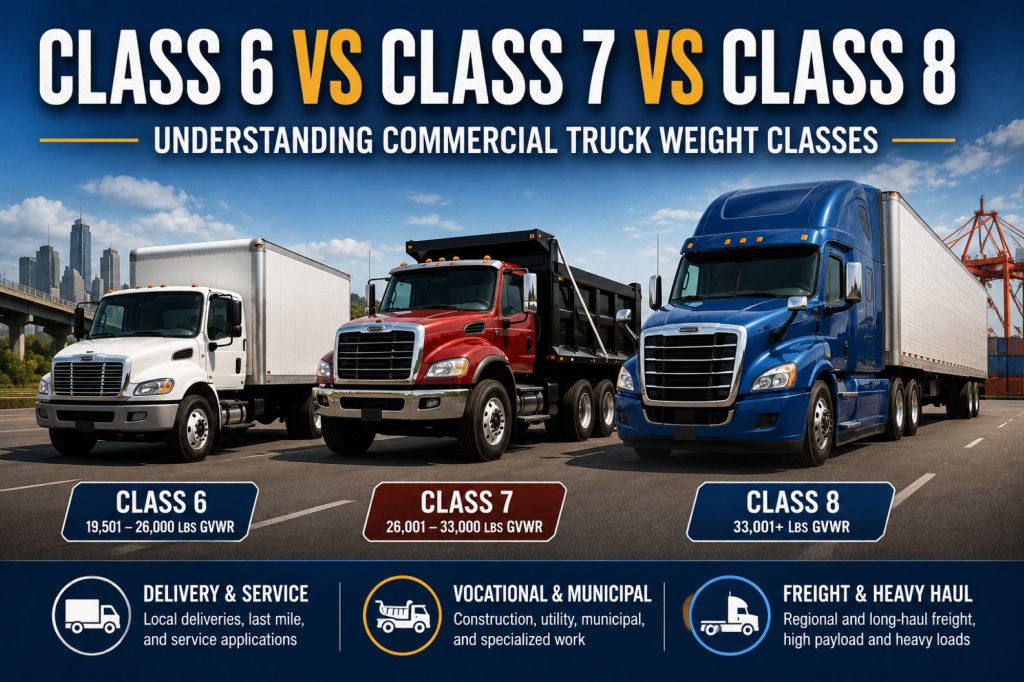
Commercial trucks are classified by Gross Vehicle Weight Rating (GVWR), a system that helps determine a vehicle’s intended use, payload capability, licensing requirements, and operating costs. While many people refer to all commercial trucks simply as “trucks” or “semis,” significant differences exist between Class 6, Class 7, and Class 8 vehicles.
Understanding these differences can help owner-operators, fleet managers, and business owners select the right equipment for their operation.
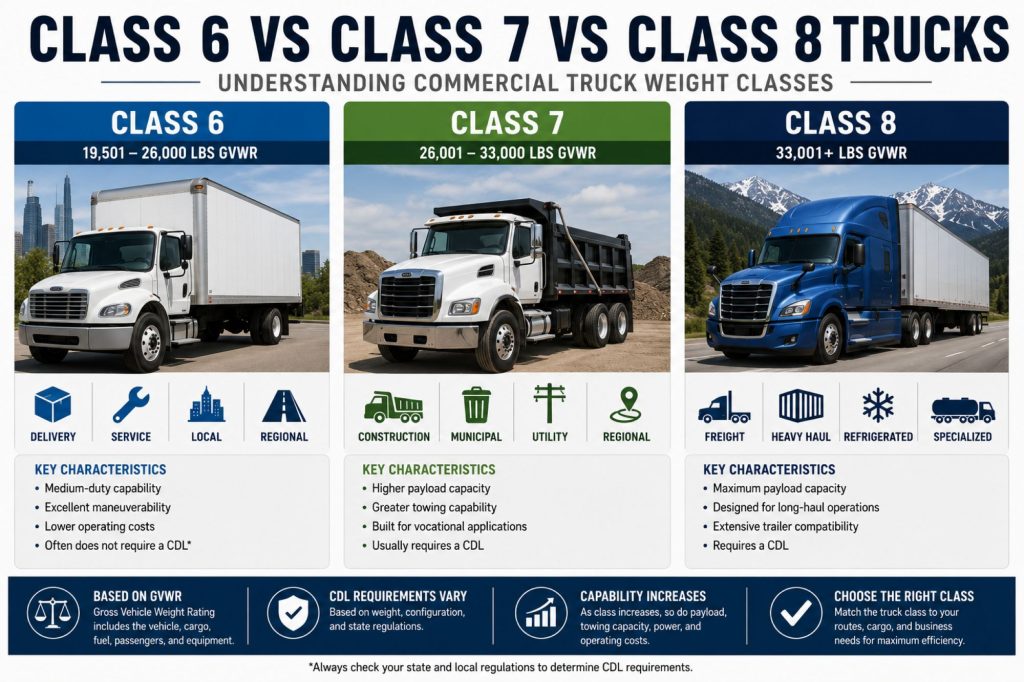
Understanding Truck Weight Classes
The Federal Highway Administration classifies commercial vehicles according to their Gross Vehicle Weight Rating (GVWR).
GVWR includes:
- Vehicle weight
- Fuel
- Driver and passengers
- Cargo
- Equipment and accessories
As truck classes increase, payload capacity, towing capability, engine size, and operating costs generally increase as well.
Class 6
GVWR: 19,501–26,000 pounds
Class 7
GVWR: 26,001–33,000 pounds
Class 8
GVWR: 33,001 pounds and above
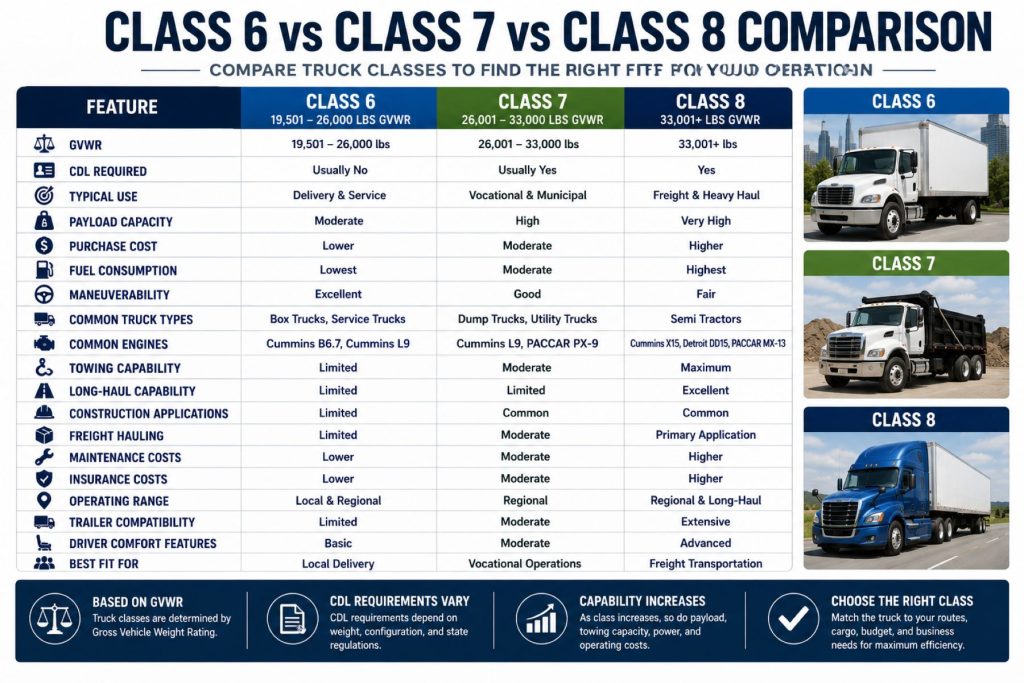
Class 6 vs Class 7 vs Class 8 Comparison
| Feature | Class 6 | Class 7 | Class 8 |
|---|---|---|---|
| GVWR | 19,501–26,000 lbs | 26,001–33,000 lbs | 33,001+ lbs |
| Typical Use | Delivery & Service | Vocational & Municipal | Freight & Heavy Haul |
| CDL Required | Usually No | Usually Yes | Yes |
| Payload Capacity | Moderate | High | Very High |
| Purchase Cost | Lower | Moderate | Higher |
| Fuel Consumption | Lowest | Moderate | Highest |
| Maneuverability | Excellent | Good | Fair |
| Common Truck Types | Box Trucks, Service Trucks | Dump Trucks, Utility Trucks | Semi Tractors |
| Common Engines | Cummins B6.7, Cummins L9 | Cummins L9, PACCAR PX-9 | Cummins X15, Detroit DD15, PACCAR MX-13 |
| Towing Capability | Limited | Moderate | Maximum |
| Long-Haul Capability | Limited | Limited | Excellent |
| Construction Applications | Limited | Common | Common |
| Freight Hauling | Limited | Moderate | Primary Application |
| Maintenance Costs | Lower | Moderate | Higher |
| Insurance Costs | Lower | Moderate | Higher |
| Operating Range | Local & Regional | Regional | Regional & Long-Haul |
| Trailer Compatibility | Limited | Moderate | Extensive |
| Driver Comfort Features | Basic | Moderate | Advanced |
| Best Fit For | Local Delivery | Vocational Operations | Freight Transportation |
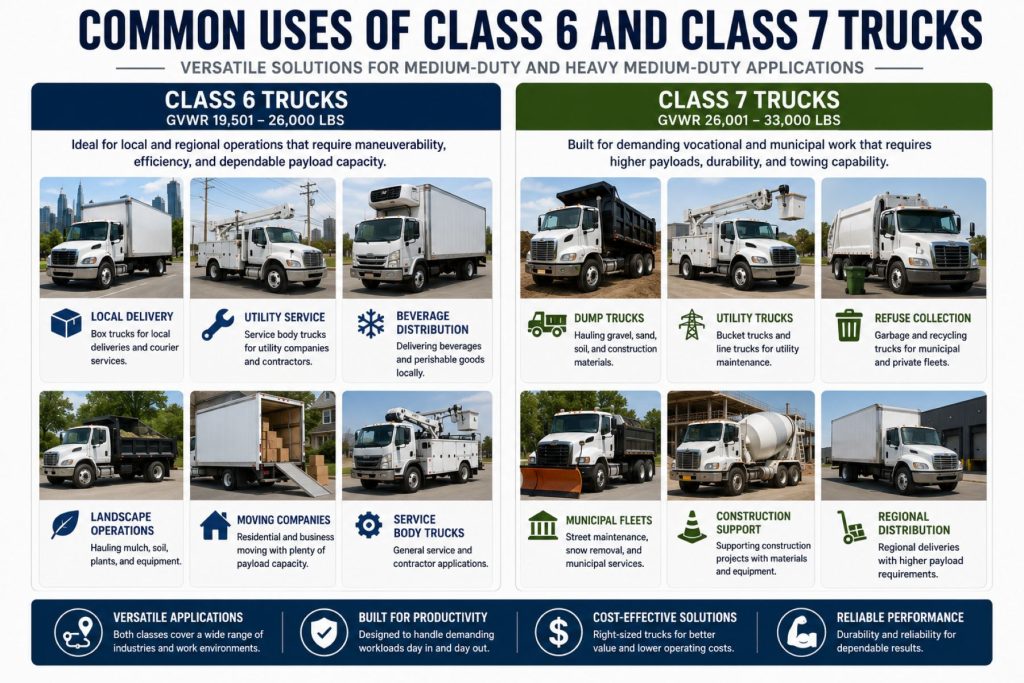
Common Class 6 Truck Applications
Class 6 trucks are often used in operations that require substantial payload capacity while maintaining good maneuverability and lower operating costs.
Common applications include:
- Box truck delivery
- Beverage distribution
- Utility fleets
- Service body trucks
- Landscape operations
- Local freight delivery
- Moving companies
Advantages of Class 6 Trucks
- Lower acquisition costs
- Better fuel economy
- Easier urban operation
- Lower maintenance expenses
- Excellent maneuverability
- Often simpler licensing requirements
Common Class 7 Truck Applications
Class 7 trucks serve as a bridge between medium-duty and heavy-duty equipment. They are commonly found in vocational and municipal fleets.
Common applications include:
- Dump trucks
- Utility trucks
- Refuse trucks
- Municipal fleets
- Construction support vehicles
- Regional straight trucks
- Beverage distribution
Advantages of Class 7 Trucks
- Higher payload capacity
- Strong towing capability
- Vocational versatility
- Excellent durability
- Good balance of cost and capability
- Well suited for construction environments
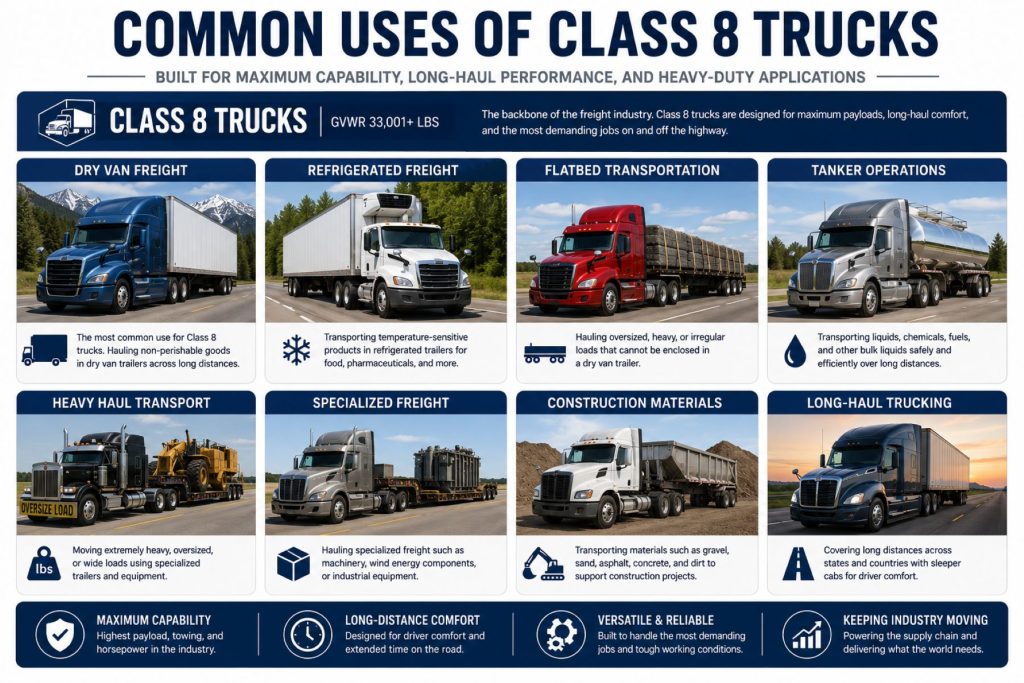
Common Class 8 Truck Applications
Class 8 trucks are the largest commercial trucks commonly operating on public highways and represent the backbone of the freight transportation industry.
Common applications include:
- Dry van freight
- Refrigerated freight
- Flatbed transportation
- Tanker operations
- Heavy haul transportation
- Specialized freight
- Long-haul trucking
Advantages of Class 8 Trucks
- Maximum towing capability
- Highest payload capacity
- Long-distance operating capability
- Extensive trailer compatibility
- Powerful engine options
- Industry-standard freight platform
CDL Requirements by Truck Class
Licensing requirements often increase as truck weight increases.
Class 6
Many Class 6 trucks can be operated without a CDL depending on vehicle configuration and state requirements.
Class 7
Most Class 7 trucks exceed CDL thresholds and require appropriate licensing.
Class 8
Class 8 trucks almost always require a Commercial Driver License due to their weight and operating characteristics.
Always verify federal, state, and local requirements before operating commercial equipment.
Cost and Operating Considerations
When choosing a truck class, purchase price is only one factor.
Fuel Economy
Class 6 trucks typically provide the best fuel economy.
Class 7 trucks generally fall in the middle.
Class 8 trucks consume the most fuel due to their size and power output.
Maintenance Costs
Maintenance expenses generally increase as vehicle size, weight, and complexity increase.
Insurance Costs
Insurance premiums often rise with vehicle value, payload capability, and operating risk.
Operating Environment
Class 6 trucks excel in urban environments.
Class 7 trucks are commonly used in vocational operations.
Class 8 trucks dominate freight transportation and trailer hauling.
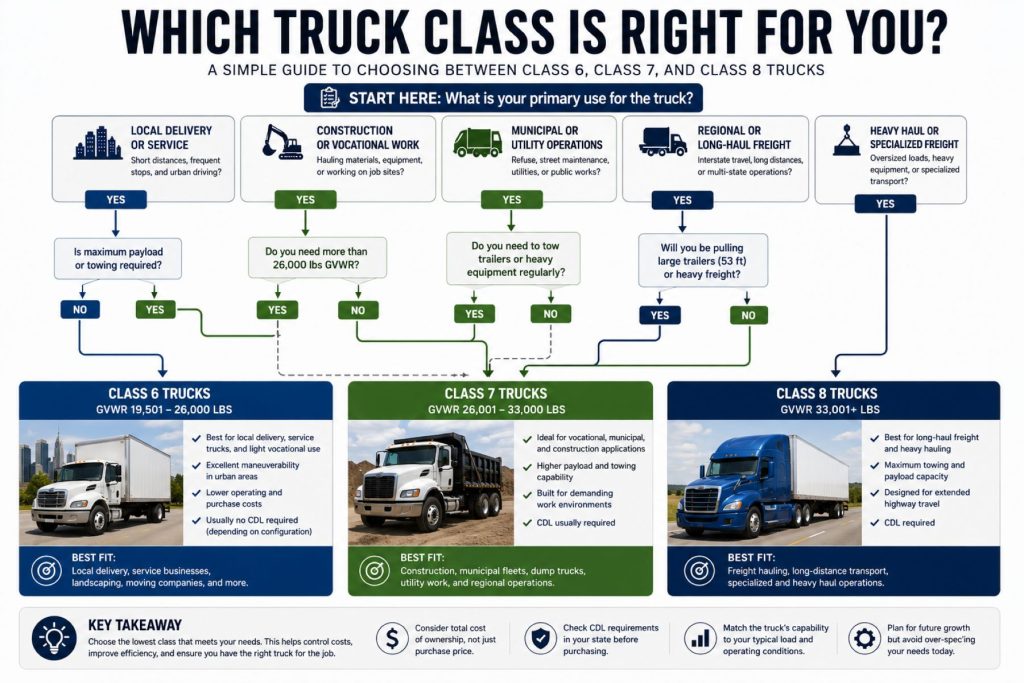
Choosing the Right Truck Class
Choose Class 6 If:
- Local delivery is your primary operation
- Fuel economy is important
- Urban maneuverability is critical
- Lower acquisition costs are preferred
- Heavy towing is not required
Choose Class 7 If:
- Vocational work is your primary focus
- Construction or municipal applications are common
- Higher payloads are needed
- Moderate towing capability is required
- You need more capacity than a Class 6 truck provides
Choose Class 8 If:
- Freight hauling is your primary business
- Maximum towing capability is required
- Long-haul operations are common
- Trailer hauling is essential
- Heavy-duty performance is a priority
After choosing the weight class, compare manual, automated manual, and automatic transmissions and select a transmission for the truck’s actual work.
Frequently Asked Questions
What does GVWR mean?
GVWR stands for Gross Vehicle Weight Rating and represents the maximum allowable operating weight of a vehicle.
Does every Class 6 truck require a CDL?
No. Some Class 6 trucks can be operated without a CDL depending on vehicle configuration and applicable regulations.
Which truck class is used for semi tractors?
Most semi tractors fall into the Class 8 category.
Which class is best for construction work?
Class 7 and Class 8 trucks are commonly used in construction depending on payload requirements.
Which truck class is best for local delivery?
Class 6 trucks are often the most cost-effective option for local delivery operations.
Bottom Line
Class 6, Class 7, and Class 8 trucks each fill important roles within the commercial transportation industry.
Class 6 trucks excel in local delivery and service applications. Class 7 trucks provide excellent vocational versatility and higher payload capacity. Class 8 trucks dominate freight transportation, heavy hauling, and long-distance operations.
Selecting the right truck class depends on your payload requirements, operating environment, budget, and long-term business goals.