
Dump Trucks
Overview
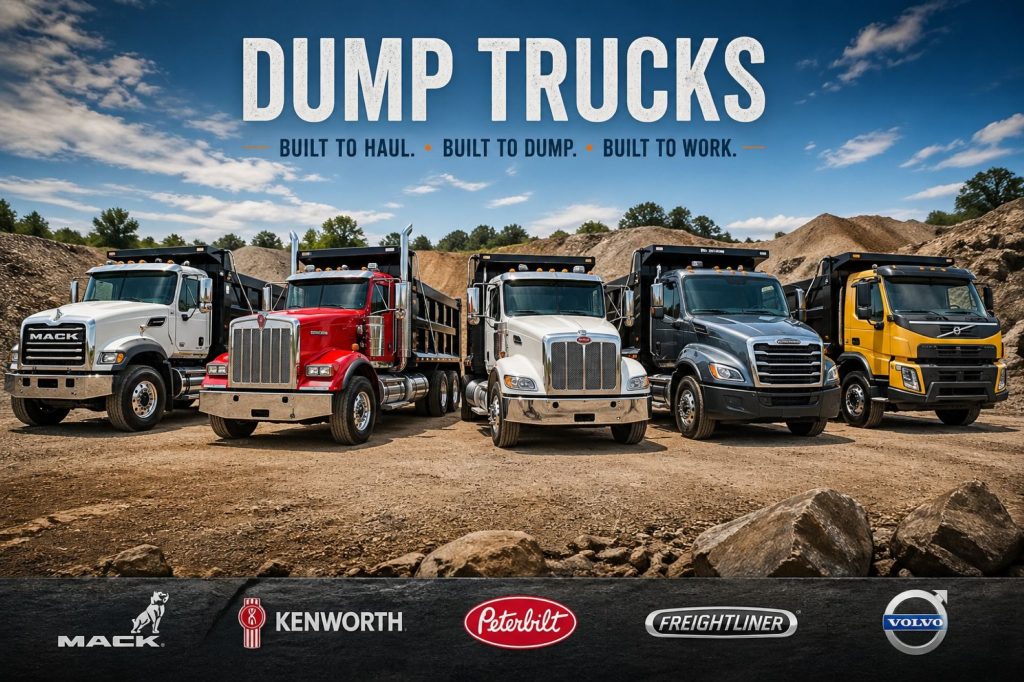
Dump trucks are designed for hauling and unloading loose materials such as gravel, sand, dirt, and construction debris. Built with a hydraulic lift system, these trucks can quickly raise the bed and discharge material, making them essential for high-frequency job site operations.
Unlike standard freight trucks, dump trucks are focused on short-haul efficiency, durability, and the ability to operate in demanding environments such as construction zones, quarries, and infrastructure projects.
These trucks play a critical role in industries where fast loading, transport, and unloading of bulk materials is required.
Key Characteristics
Dump trucks share several defining features that support heavy-duty material hauling and repeated dump cycles.
Designed to operate on rough or uneven terrain
- Hydraulic dump bed for rapid unloading
- Reinforced steel or aluminum body construction
- High ground clearance for job site access
- Multiple axle configurations for increased payload
- Built for stop-and-go, high-cycle operations
Common Configurations
Dump trucks are available in several configurations depending on the type of work and environment.
- Standard rear dump for general construction use
- Articulated dump trucks for off-road and uneven terrain
- Transfer dump trucks for increased hauling capacity
- Side dump trucks for improved stability during unloading
- Super dump trucks with additional axles for higher legal payloads
Each configuration is designed to optimize performance for specific hauling conditions and job site requirements.
Common Uses
Dump trucks are used in industries that require continuous movement of loose materials.
- Landscaping and site development
- Construction and infrastructure projects
- Road building and maintenance
- Aggregate hauling (gravel, sand, stone)
- Demolition and debris removal
- Mining and quarry operations
Advantages
Dump trucks provide several operational benefits in heavy-duty applications.
- Versatile across multiple industries
- Fast and efficient unloading with minimal labor
- High payload capacity for bulk materials
- Durable construction for demanding environments
- Ability to operate in confined or rugged job sites
Limitations
While highly effective in their role, dump trucks are not suited for all types of hauling.
- Increased fuel consumption under load
- Limited to loose or bulk material transport
- Not ideal for long-distance freight hauling
- Risk of tipping if improperly loaded or operated
- Higher maintenance due to heavy-duty usage
Driver and Operator Considerations
Operating a dump truck requires attention to safety, load balance, and terrain conditions.
Drivers must ensure proper weight distribution to reduce the risk of tipping, especially during unloading. Awareness of ground conditions, overhead clearance, and job site activity is critical.
Operators should also understand hydraulic system controls and be prepared for frequent stops, starts, and dump cycles throughout the day.
Maintenance and Ownership Notes
Dump trucks are exposed to heavy wear due to constant loading and unloading.
- Hydraulic systems require regular inspection and maintenance
- Dump bed hinges and lift components should be monitored
- Suspension and axle wear is common under heavy loads
- Tires wear faster due to weight and terrain conditions
- Frame and structural integrity should be checked regularly
Consistent maintenance is essential to ensure reliability and prevent costly downtime.
Dump Truck Models
The following trucks covered by Truck Equipment Atlas can be configured with dump bodies for construction, aggregate, landscaping, agricultural, municipal, or severe-duty applications. Dump body and axle availability may vary by model year and chassis specifications.
Chevrolet Dump Trucks
Ford Dump Trucks
Freightliner Dump Trucks
Hino Dump Trucks
International Dump Trucks
Isuzu Dump Trucks
Kenworth Dump Trucks
Mack Dump Trucks
Peterbilt Dump Trucks
Volvo Dump Trucks
Western Star Dump Trucks
Freight & Industry Sectors
• Construction & Aggregate Freight
• Bulk & Pneumatic Freight
• Specialty & Niche Freight
Related Trailer Types
• Dump Trailers
• Flatbed Trailers
• Lowboy / RGN Trailers
Related Equipment
• Engines
• Transmissions
• Axles & Differentials
• Suspension Systems
• Brake Systems
Related Truck Types
How to Use This Section
Each truck type page is designed to provide a structured overview of its role, configurations, and real-world applications.
As the site expands, additional details such as specifications, comparisons, and deeper breakdowns will be added to help users better understand how each truck type fits into different operations.
What You’ll Find on Dump Truck Pages
Each dump truck page will follow a consistent format to provide clear and useful information.
This includes:
- Overview and real-world use
- Key characteristics and configurations
- Advantages and limitations
- Driver and operator considerations
- Maintenance and ownership insights
- Related equipment and applications
This structure allows users to quickly evaluate how dump trucks compare to other equipment types.
Looking Ahead
The dump truck section will continue to expand as new configurations, use cases, and equipment variations are added.
Future content may include:
- Real-world performance insights
- Detailed configuration breakdowns
- Comparisons between dump truck types
- Application-specific recommendations
Stay Connected
As new truck types and configurations are added, this section will continue to evolve into a comprehensive resource for vocational and construction-focused trucking equipment.