
How Diesel Truck Engines Work
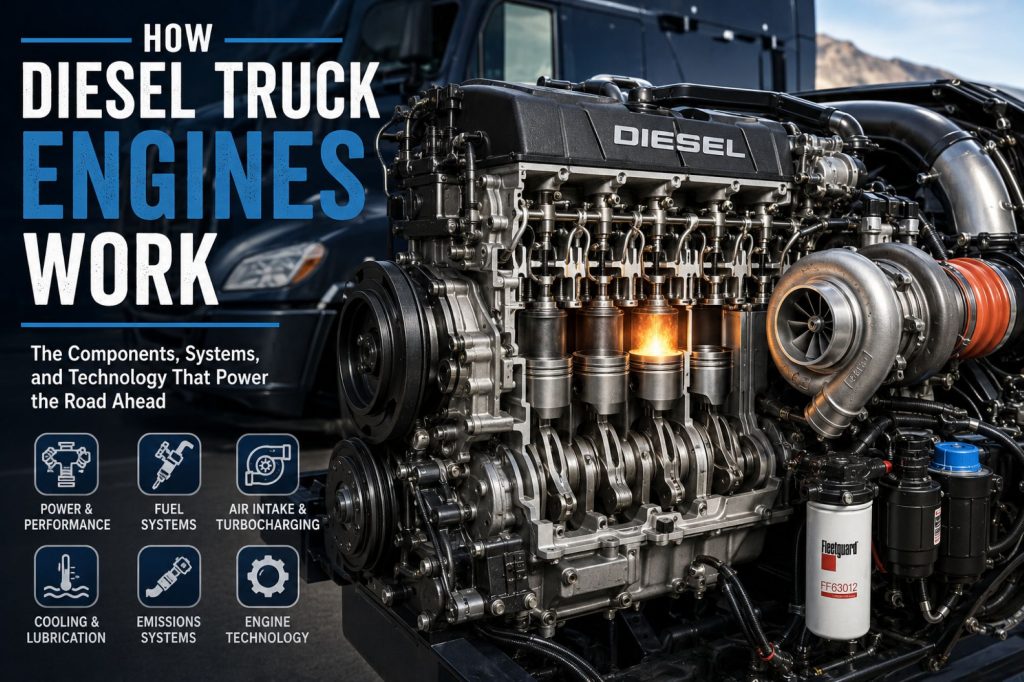
Diesel engines are the heart of the commercial trucking industry. From long-haul freight transportation and regional delivery operations to heavy haul, construction, agriculture, and vocational trucking, diesel engines provide the power and durability needed to move goods across North America every day.
Modern diesel engines are engineering marvels capable of producing tremendous torque, delivering excellent fuel efficiency, and operating reliably for hundreds of thousands or even millions of miles when properly maintained. Understanding how these engines work can help drivers, owner-operators, fleet managers, students, and equipment buyers make informed decisions regarding equipment selection, maintenance, and operations.
This guide explains the major components, systems, and operating principles that allow diesel truck engines to power the transportation industry.
What Is a Diesel Engine?
A diesel engine is an internal combustion engine that converts the chemical energy stored in diesel fuel into mechanical energy that powers a truck.
Unlike gasoline engines that use spark plugs for ignition, diesel engines rely on compression ignition. Air is compressed inside the cylinder until it becomes extremely hot. Diesel fuel is then injected into the compressed air, causing spontaneous combustion that pushes the piston downward and generates power.
This process makes diesel engines exceptionally efficient and well suited for heavy-duty transportation applications.
Why Diesel Engines Dominate Commercial Trucking
Diesel engines have remained the preferred power source for commercial trucking because they offer several significant advantages.
High Torque Output
Diesel engines produce substantial torque at relatively low engine speeds. This makes them ideal for moving heavy loads, climbing grades, and maintaining performance under demanding conditions.
Fuel Efficiency
Diesel fuel contains more energy per gallon than gasoline, helping diesel engines deliver excellent fuel economy.
Durability
Heavy-duty diesel engines are built to withstand demanding operating conditions and long service intervals.
Longevity
Many modern truck engines are capable of operating for one million miles or more with proper maintenance.
Versatility
Diesel engines power a wide variety of equipment, including:
- Sleeper Trucks
- Day Cab Trucks
- Heavy Haul Trucks
- Dump Trucks
- Concrete Mixer Trucks
- Logging Trucks
Major Diesel Engine Components
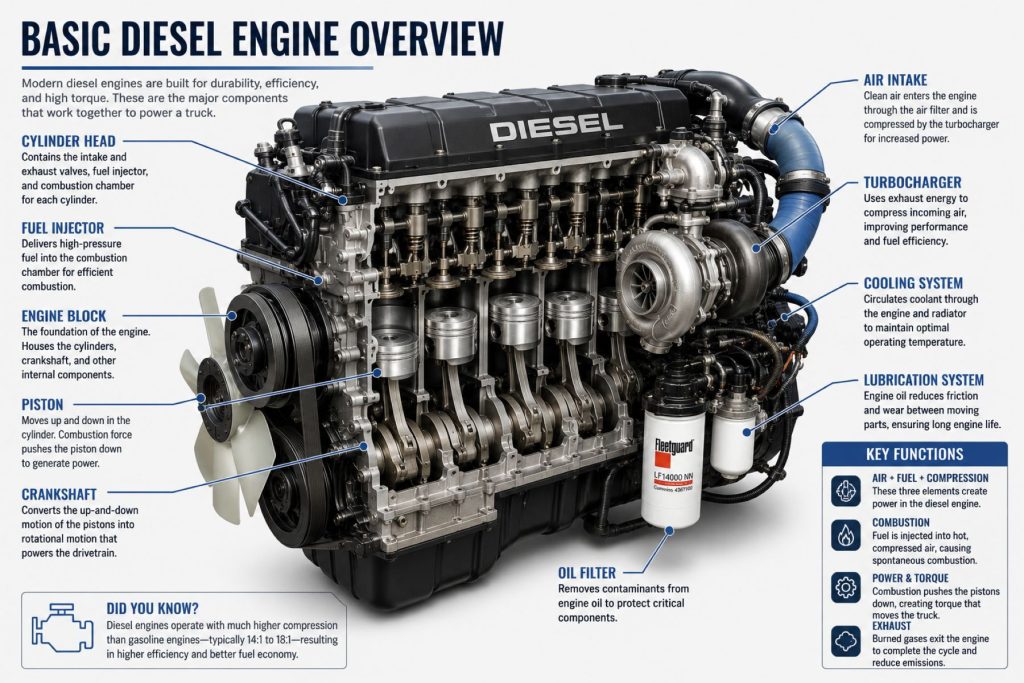
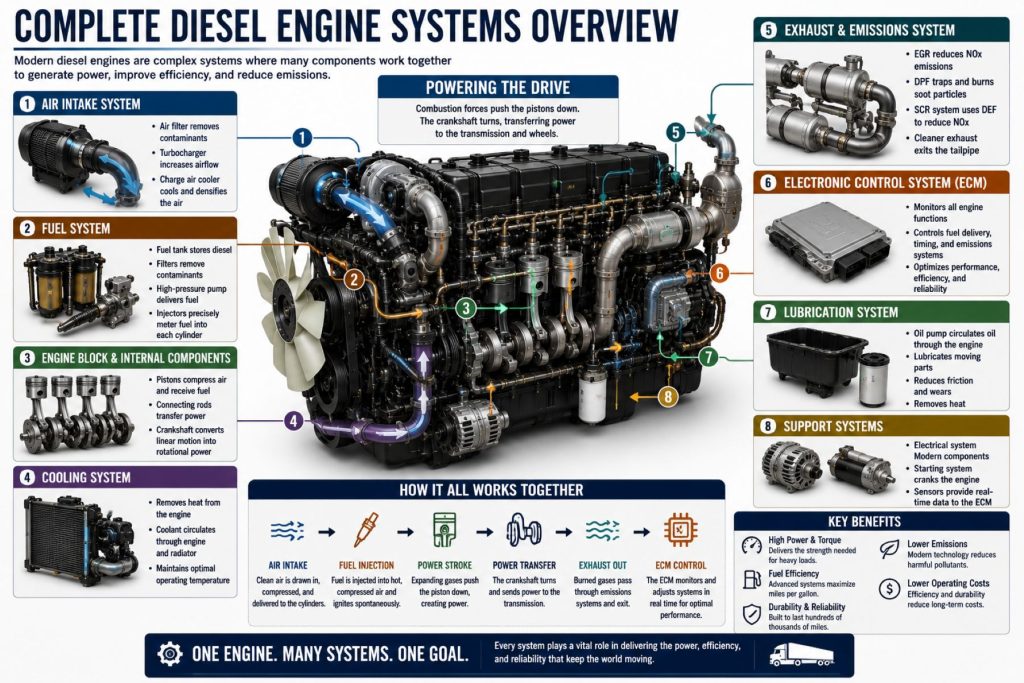
Modern truck engines contain numerous components working together to generate power efficiently.
Engine Block
The engine block forms the structural foundation of the engine.
It houses:
- Cylinders
- Coolant passages
- Oil passages
- Crankshaft supports
Most heavy-duty diesel engine blocks are constructed from cast iron for maximum strength and durability.
Pistons
Pistons move up and down within the engine cylinders during combustion.
The force generated by combustion pushes the pistons downward, creating usable power.
Connecting Rods
Connecting rods link the pistons to the crankshaft and transfer combustion forces.
Crankshaft
The crankshaft converts the pistons’ up-and-down motion into rotational motion that ultimately powers the drivetrain.
Cylinder Head
The cylinder head contains:
- Intake valves
- Exhaust valves
- Fuel injectors
- Combustion chambers
Camshaft
The camshaft controls valve timing and helps regulate airflow through the engine.
The Four-Stroke Diesel Cycle
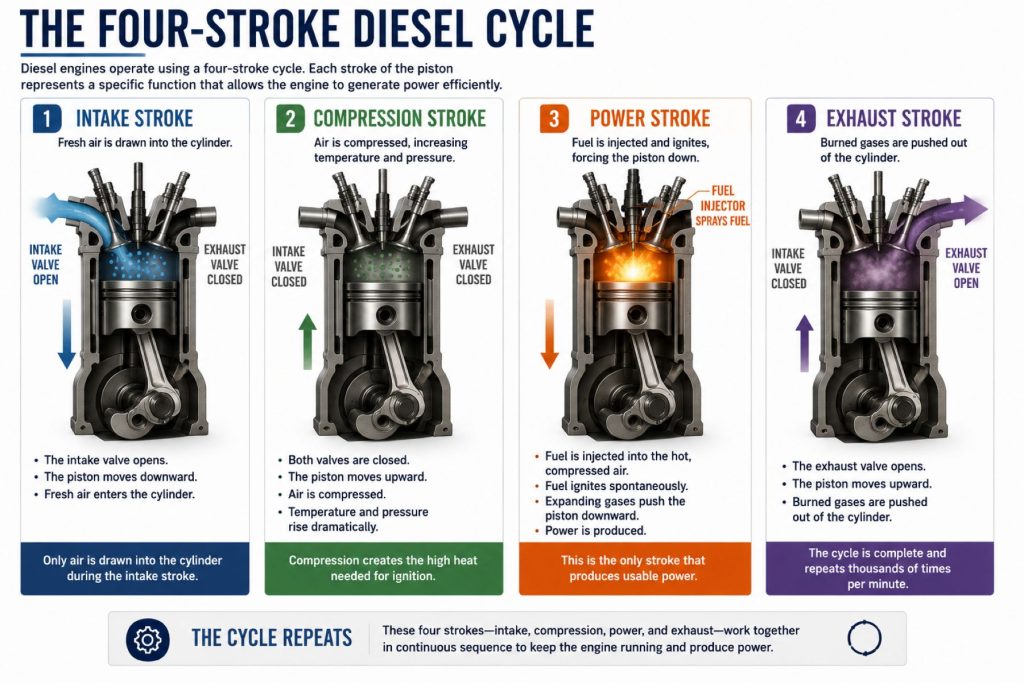
Most truck engines operate using a four-stroke combustion cycle.
Intake Stroke
During the intake stroke:
- The intake valve opens.
- The piston moves downward.
- Fresh air enters the cylinder.
Unlike gasoline engines, only air enters the cylinder during this stage.
Compression Stroke
The piston moves upward and compresses the air.
Compression causes:
- Extremely high pressure
- Extremely high temperatures
Temperatures can exceed 1,000°F inside the combustion chamber.
Power Stroke
Near the top of the compression stroke:
- Fuel is injected into the hot compressed air.
- Combustion occurs.
- Expanding gases force the piston downward.
This is the stroke that generates power.
Exhaust Stroke
The exhaust valve opens.
The piston moves upward, forcing exhaust gases from the cylinder.
The cycle then repeats thousands of times every minute.
Air Intake and Turbocharging
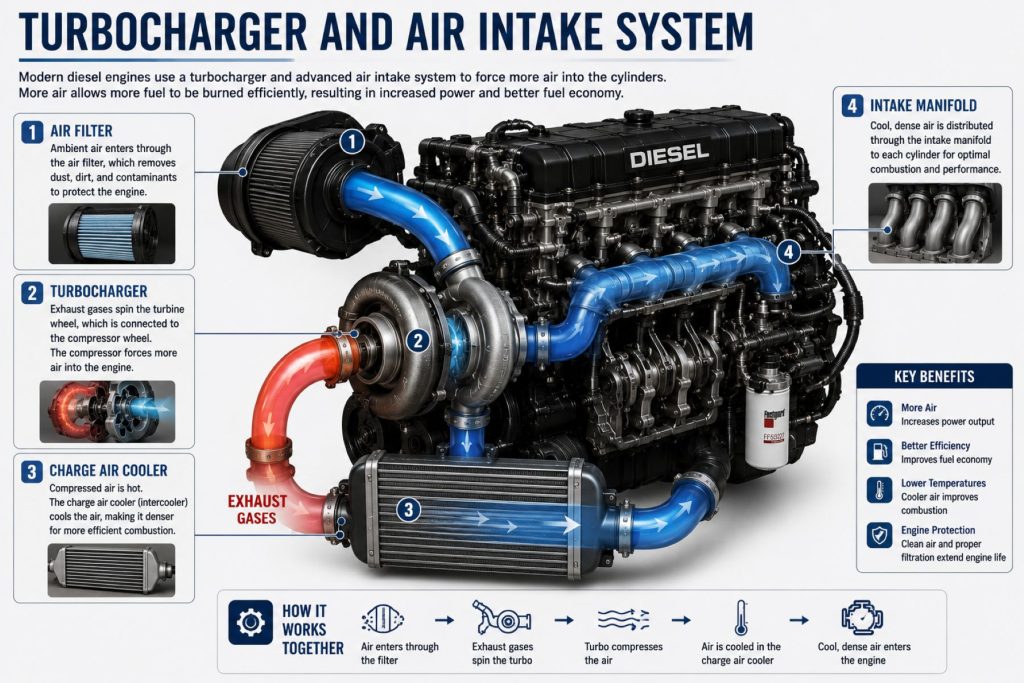
Airflow is critical to diesel engine performance.
Air Filter
The air filter removes contaminants before air enters the engine.
Clean air is essential for efficient combustion.
Turbocharger
Most modern truck engines use turbochargers.
Turbochargers:
- Increase airflow
- Improve power output
- Improve fuel efficiency
- Reduce emissions
The turbocharger uses exhaust energy that would otherwise be wasted.
Charge Air Cooler
Compressing air increases its temperature.
The charge air cooler lowers air temperature before it enters the engine.
Cooler air is denser and improves combustion efficiency.
Intake Manifold
The intake manifold distributes air evenly to each cylinder.
Fuel Delivery Systems
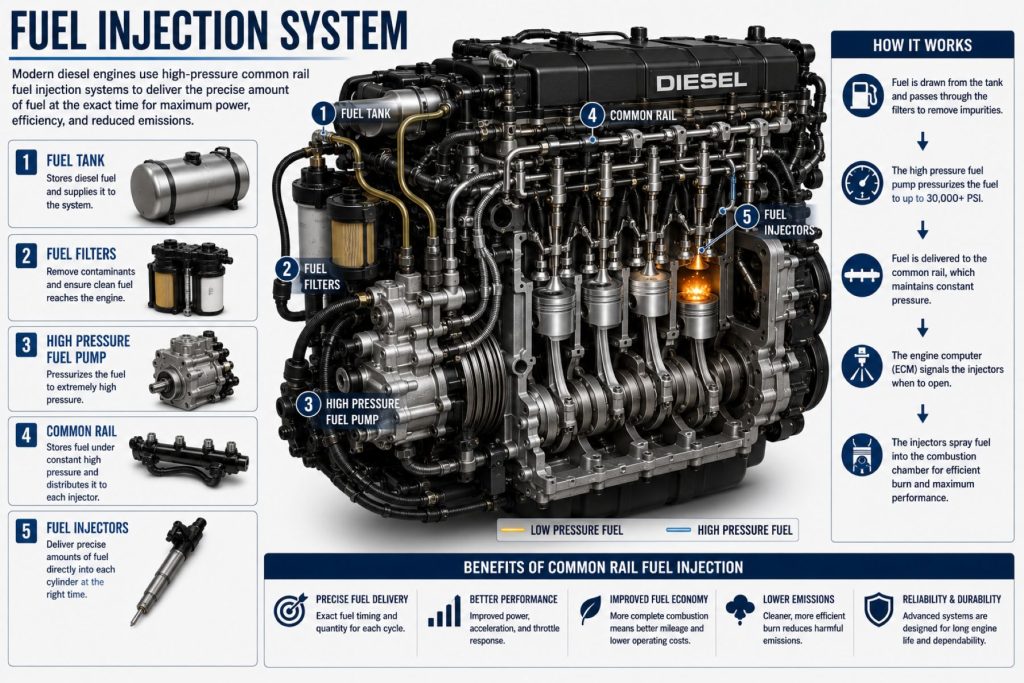
Modern diesel engines rely on highly advanced fuel systems.
Fuel Tanks
Diesel fuel is stored in chassis-mounted fuel tanks.
Fuel Filters
Fuel filters remove contaminants that could damage sensitive components.
High Pressure Fuel Pump
The fuel pump pressurizes diesel fuel before it reaches the injectors.
Common Rail Injection Systems
Most modern engines use common rail fuel systems.
Benefits include:
- Precise fuel delivery
- Improved fuel economy
- Reduced emissions
- Better engine performance
Fuel Injectors
Fuel injectors deliver carefully measured amounts of fuel directly into each cylinder.
Modern injectors can perform multiple injection events during a single combustion cycle.
Cooling and Lubrication Systems
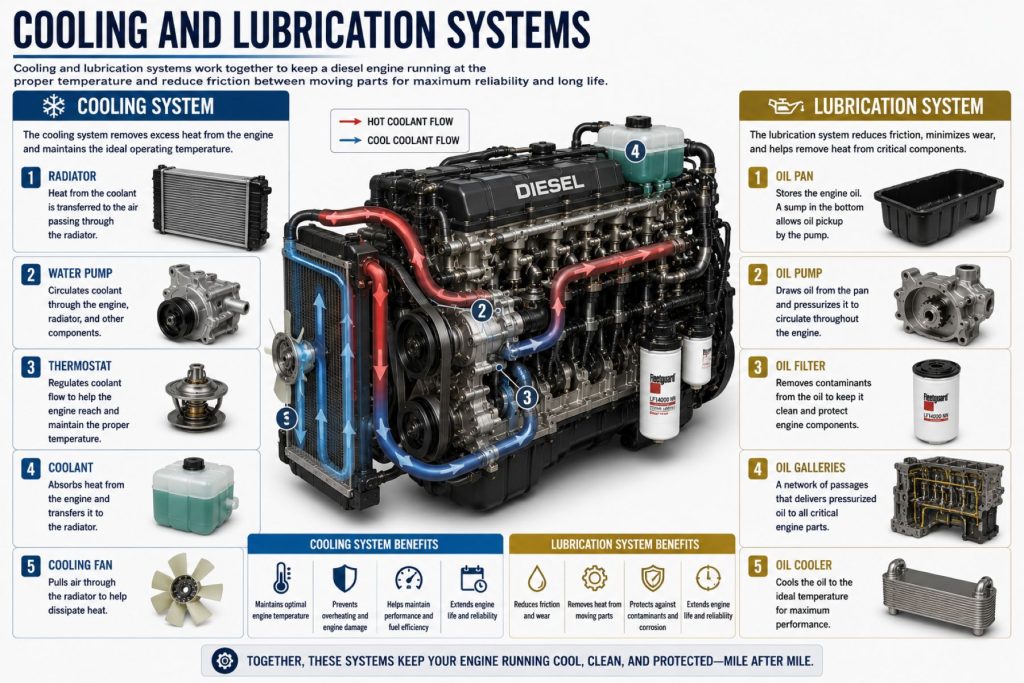
Truck engines generate significant heat and rely on sophisticated support systems.
Cooling System
The cooling system prevents overheating.
Major components include:
- Radiator
- Water pump
- Thermostat
- Cooling fan
- Coolant passages
Proper cooling is critical for reliability and engine longevity.
Lubrication System
The lubrication system reduces friction and wear.
Major components include:
- Engine oil
- Oil pump
- Oil filter
- Oil cooler
Lubrication protects internal components from damage and extends engine life.
Modern Diesel Emissions Systems
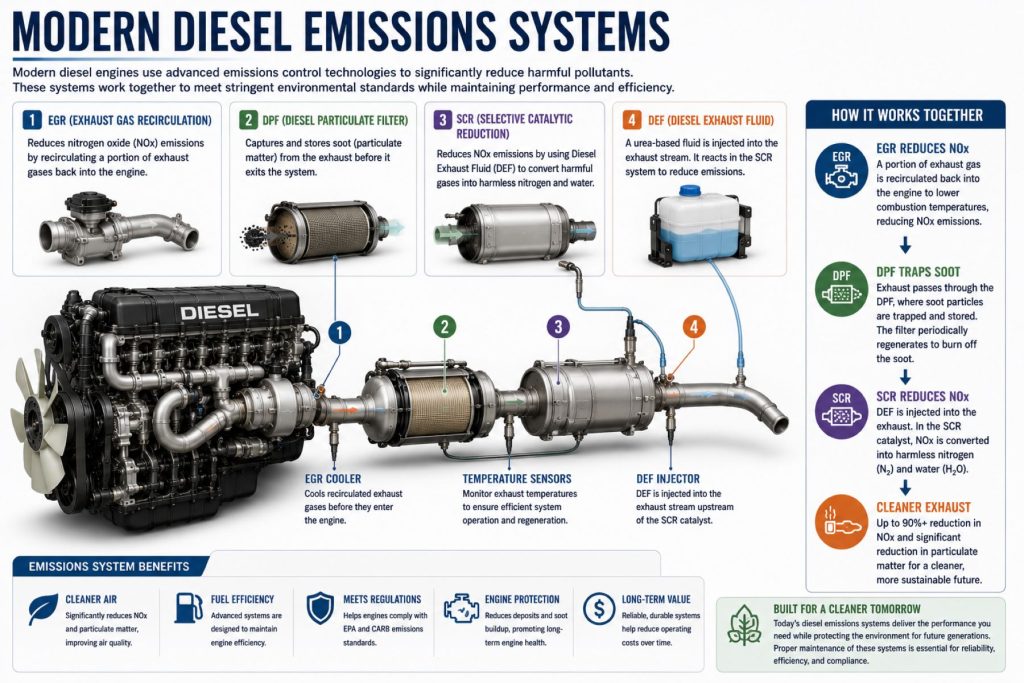
Environmental regulations have dramatically changed diesel engine technology.
Modern engines use several emissions-control systems.
Exhaust Gas Recirculation (EGR)
EGR systems recirculate a portion of exhaust gases back into the engine.
This helps reduce nitrogen oxide emissions.
Diesel Particulate Filter (DPF)
The DPF captures soot particles before they exit the exhaust system.
Periodic regeneration burns accumulated soot from the filter.
Selective Catalytic Reduction (SCR)
SCR systems reduce emissions using Diesel Exhaust Fluid.
Diesel Exhaust Fluid (DEF)
DEF is injected into the exhaust stream where it helps convert harmful emissions into harmless nitrogen and water vapor.
These technologies have significantly reduced diesel emissions while maintaining performance.
Understanding Horsepower and Torque
Two performance measurements are commonly used when evaluating truck engines.
Horsepower
Horsepower measures how quickly work can be performed.
Higher horsepower often improves:
- Acceleration
- Highway performance
- Overall responsiveness
Torque
Torque measures rotational force.
Higher torque improves:
- Pulling power
- Grade climbing ability
- Loaded acceleration
- Heavy haul performance
In commercial trucking, torque is often more important than peak horsepower.
See how a commercial truck transmission uses engine torque and how to match a transmission to the engine and duty cycle.
Common Diesel Engine Manufacturers
Several manufacturers produce engines used throughout the trucking industry.
Cummins
Popular engines include:
Detroit Diesel
Popular engines include:
PACCAR
Popular engines include:
Volvo
Popular engines include:
Mack
Popular engines include:
Caterpillar
Legacy engines include:
International
Popular platforms include:
Common Diesel Engine Problems
Even the most reliable engines can experience issues.
Overheating
Often caused by cooling system failures or restricted airflow.
Fuel System Problems
Contaminated fuel or worn components can reduce performance.
Turbocharger Failures
Turbochargers operate under extreme temperatures and stress.
Emissions System Issues
DPF, SCR, EGR, and DEF systems require regular maintenance and proper operation.
Diesel Engine Maintenance Basics
Proper maintenance is essential for maximizing engine life.
Oil Changes
Regular oil changes help protect internal components.
Fuel Filter Replacement
Fuel filters should be changed at recommended intervals.
Coolant Maintenance
Coolant condition should be monitored regularly.
Air Filter Service
Restricted airflow reduces performance and efficiency.
Preventive Maintenance
Routine inspections can identify problems before major failures occur.
Frequently Asked Questions
Why do trucks use diesel engines?
Diesel engines provide exceptional torque, durability, fuel efficiency, and longevity compared to most gasoline alternatives.
How long do diesel truck engines last?
Many heavy-duty diesel engines are capable of operating for one million miles or more with proper maintenance.
What is a turbocharger?
A turbocharger uses exhaust energy to compress incoming air and improve engine performance.
What does DEF do?
Diesel Exhaust Fluid helps reduce emissions within modern SCR systems.
Why do diesel engines produce more torque?
Diesel engines use higher compression ratios and combustion characteristics that naturally generate significant low-speed torque.
Related Truck Equipment Atlas Resources
Continue exploring Truck Equipment Atlas:
- Commercial Truck Engines
- Truck Types
- Trailer Types
- Equipment Systems
- Engine Guides
- Buying Guides
- Cummins X15
- Detroit DD15
- PACCAR MX-13
- Caterpillar C15
- International A26
Related Truck Types
Related Guides
- Complete Guide to Semi Truck Types
- Complete Guide to Trailer Types
- Complete Guide to Freight Types
- Day Cab vs Sleeper Truck
- Class 6 vs Class 7 vs Class 8 Trucks
- Dry Van vs Refrigerated Trailer
- Air Brake Systems Explained
- How Commercial Truck Transmissions Work
- How to Choose the Right Commercial Truck
- Choosing the Right Trailer for Your Freight
Final Thoughts
Diesel engines remain the dominant power source for commercial transportation because they provide the torque, durability, efficiency, and reliability needed to move freight under demanding conditions. Understanding how diesel engines operate helps drivers, owner-operators, fleet managers, and equipment buyers make informed decisions regarding equipment selection, maintenance practices, and long-term ownership.
As engine technology continues to evolve, modern diesel engines are becoming cleaner, more efficient, and more capable while continuing to power the trucks that keep the transportation industry moving.