
Quick Facts
- Manufacturer: SAF-HOLLAND
- Product Series: HOLLAND Mushroom Series
- Product Type: Weld-in semitrailer kingpin
- Coupling Type: SAE fifth-wheel and kingpin coupling
- Available Kingpin Sizes: 2-inch and 3.5-inch models
- Installation Type: Permanent weld-in installation
- Material: AISI 8630H alloy steel
- Published Hardness: 302–363 BHN
- Upper-Coupler Compatibility: Model-specific plate thickness
- Primary Applications: Semitrailers, commercial trailers, OEM production, and aftermarket kingpin replacement
- Quality Control: Inspected for internal and external integrity
- Production Status: Current product series; model availability should be confirmed with SAF-HOLLAND
Overview
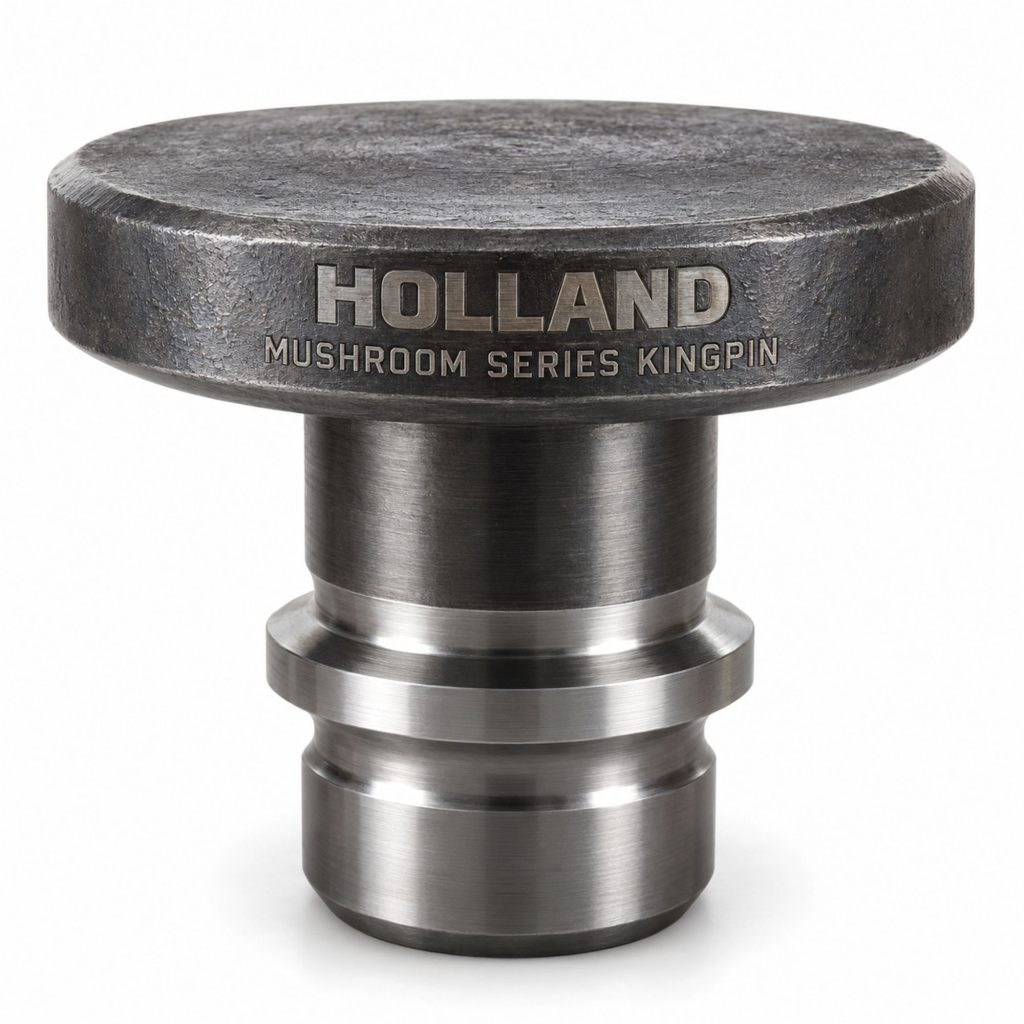
The HOLLAND Mushroom Series is a family of traditional weld-in kingpins used to connect semitrailers with compatible commercial-truck fifth wheels. The kingpin is permanently incorporated into the trailer’s upper-coupler structure and enters the fifth-wheel throat during coupling.
SAF-HOLLAND offers Mushroom Series kingpins in standard 2-inch and heavy-duty 3.5-inch configurations. Model selection depends on the fifth wheel, trailer design, upper-coupler thickness, operating capacity, and intended service.
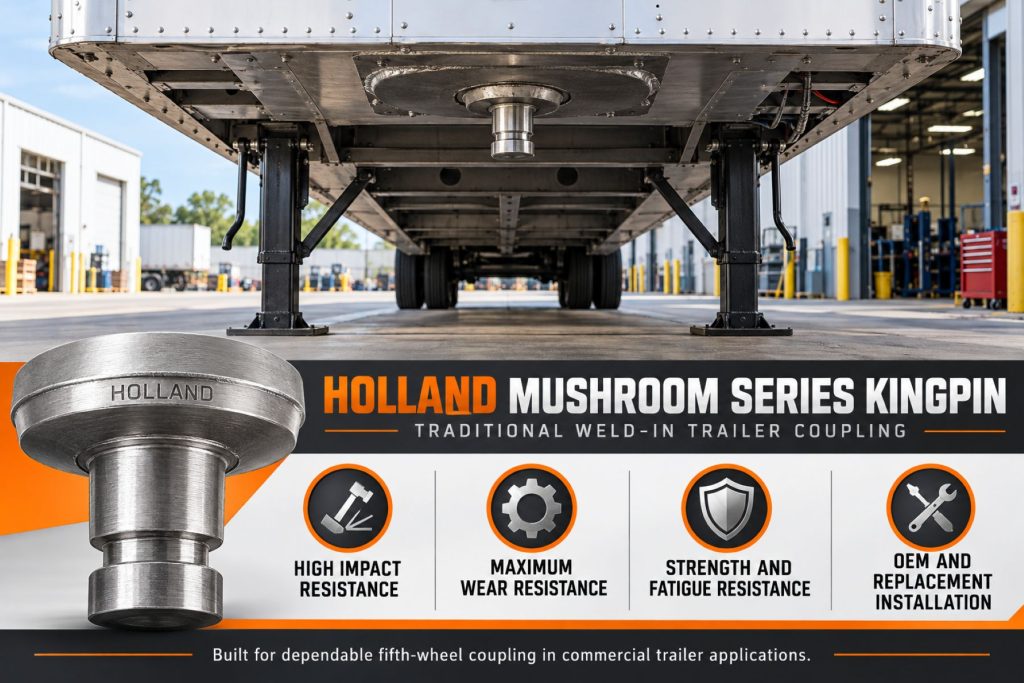
The series is manufactured from heat-treated AISI 8630H alloy steel to provide impact resistance, wear resistance, strength, and fatigue resistance. Proper installation is essential because the welds and surrounding upper-coupler structure become part of the trailer’s primary load path.
Key Characteristics
- Traditional mushroom-style weld-in construction
- Available in 2-inch and 3.5-inch SAE configurations
- Designed for OEM installation and aftermarket replacement
- Manufactured from AISI 8630H alloy steel
- Heat treated to a published hardness of 302–363 BHN
- High impact resistance
- High wear resistance
- Strength and fatigue resistance
- Model-specific upper-coupler thickness compatibility
- Plug-weld and non-plug-weld configurations available on applicable models
- Inspected for internal and external material integrity
- Designed to meet or exceed applicable SAE and TTMA performance requirements when properly installed
Major Components
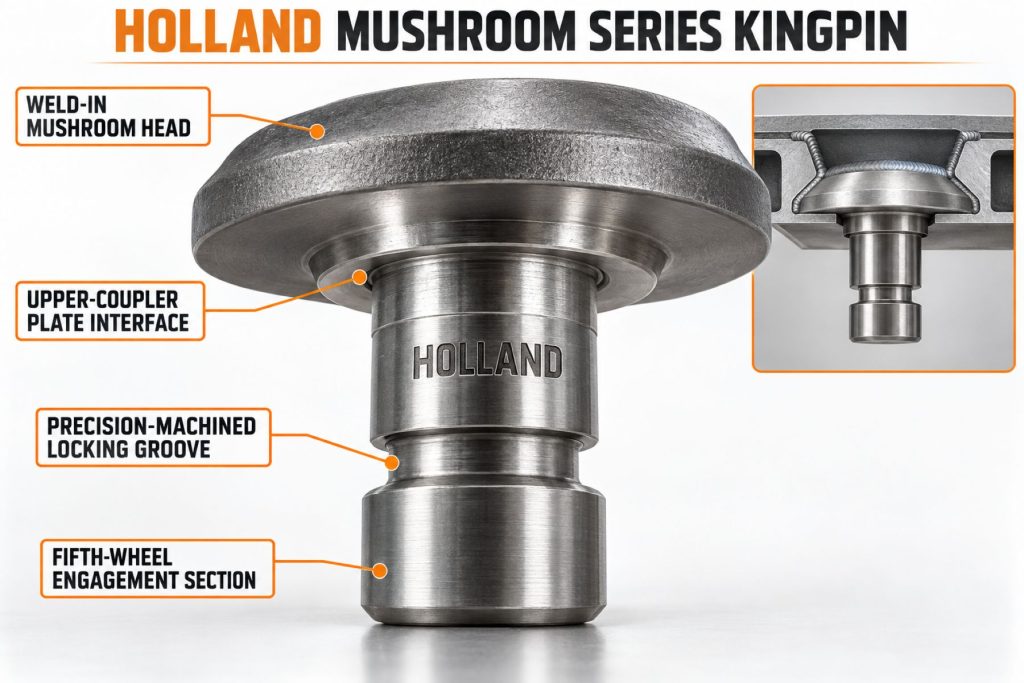
- Kingpin body
- Mushroom-shaped mounting flange
- Upper shank
- Fifth-wheel locking diameter
- Lower guide section
- Kingpin shoulder
- Heat-treated wear surfaces
- Plug-weld holes on applicable models
- Trailer upper-coupler plate
- Upper-coupler reinforcement structure
- Installation welds
- Surrounding trailer bolster structure
Coupling Type and Design
The Mushroom Series uses a one-piece kingpin with a broad upper flange that is welded into the trailer’s upper-coupler structure. The lower portion projects beneath the trailer and provides the precisely formed surfaces required for fifth-wheel guidance and locking.
The standard 2-inch version works with conventional commercial-truck fifth wheels designed for an SAE 2-inch kingpin. The larger 3.5-inch version requires a fifth wheel specifically designed and rated for a 3.5-inch kingpin.
How the Coupling System Works
As the tractor backs beneath the trailer, the trailer upper coupler slides across the fifth-wheel top plate. The fifth-wheel throat guides the kingpin toward the locking mechanism.
When the kingpin reaches the proper position, the fifth-wheel locking jaw closes around its locking diameter. The kingpin then transfers pulling, braking, cornering, and articulation forces between the tractor and trailer while the trailer upper coupler transfers vertical load to the fifth-wheel top plate.
Position and Function Within the Vehicle
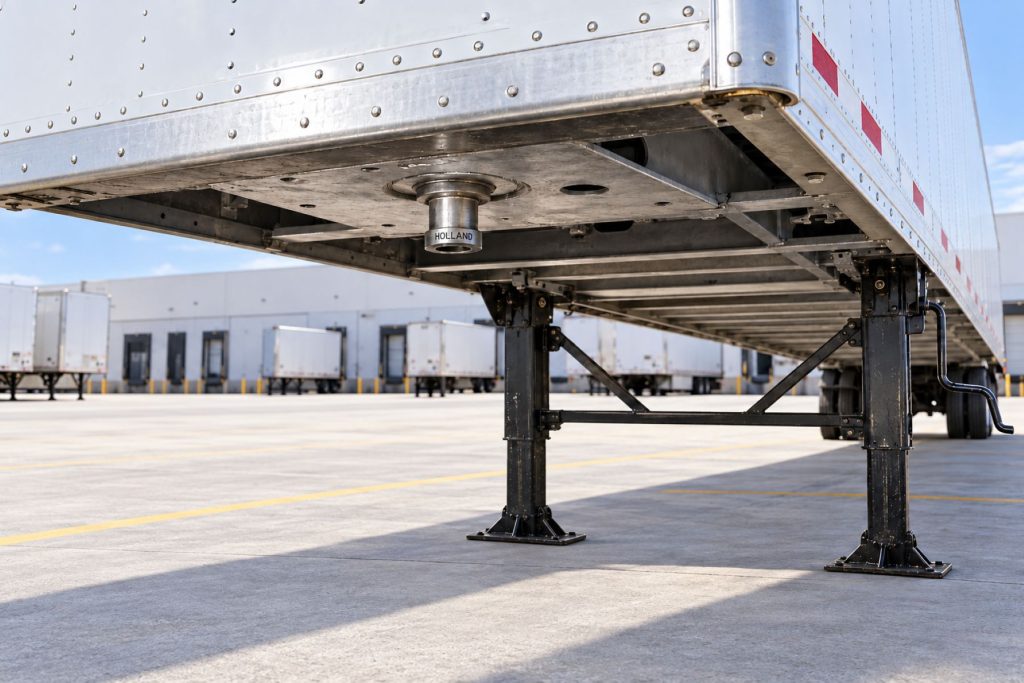
The kingpin is installed at the front underside of the semitrailer within the upper-coupler or bolster structure. Its position establishes the trailer’s coupling point and affects tractor-to-trailer clearance, axle loading, turning geometry, and overall combination length.
The kingpin serves as the central mechanical connection between the semitrailer and fifth wheel. It must remain correctly positioned, structurally secure, dimensionally within limits, and free from cracks or unacceptable wear.
Common Specifications
- Product Type: Mushroom-style weld-in kingpin
- Kingpin Sizes: SAE 2-inch and 3.5-inch
- Material: AISI 8630H alloy steel
- Hardness: 302–363 Brinell hardness
- Installation Method: Welding into the trailer upper-coupler structure
- Upper-Coupler Thicknesses: Model-specific configurations commonly covering approximately 0.25 to 0.75 inch in the 2-inch series
- Plug-Weld Configuration: Available with eight equally spaced plug-weld holes on applicable 2-inch models
- Inspection: Manufacturer inspection for internal and external integrity
- Performance Standards: Designed to meet or exceed applicable SAE and TTMA requirements when properly installed
- Fifth-Wheel Compatibility: Must match the kingpin diameter, coupling geometry, and complete vehicle application
Load Ratings and Operating Capacity
Kingpin capacity depends on the selected 2-inch or 3.5-inch model, its installation, the trailer upper-coupler structure, the fifth wheel, and the complete vehicle application. A kingpin should never be selected by diameter alone.
The trailer remains limited by the lowest-rated component in the coupling system, including the kingpin, upper coupler, reinforcement structure, welds, fifth wheel, mounting system, tractor frame, axles, suspension, tires, wheels, and completed vehicle ratings.
Articulation and Oscillation
The kingpin remains fixed within the trailer while the fifth-wheel top plate pivots around its mounting brackets. This allows normal fore-and-aft articulation between the tractor and trailer as the combination travels over grades, dock approaches, and road transitions.
Side-to-side oscillation depends on the fifth-wheel and mounting design. The Mushroom Series Kingpin does not independently provide oscillation and must not be expected to compensate for an incompatible or improperly mounted fifth wheel.
Sliding and Adjustment System
The Mushroom Series Kingpin is permanently welded into one position and does not include a sliding or adjustment mechanism. Any weight-distribution adjustment is normally performed by repositioning the tractor’s sliding fifth wheel or the trailer’s sliding axle system.
The kingpin position should not be changed without trailer-manufacturer engineering approval because its location affects structural loading, turning clearance, axle weights, and combination geometry.
Release and Locking Mechanism
The kingpin does not contain its own release or locking mechanism. Locking and release are performed by the tractor’s fifth wheel.
The kingpin’s machined locking diameter provides the surface captured by the fifth-wheel jaw. Excessive wear, deformation, incorrect dimensions, or surface damage can prevent secure locking or create excessive movement inside the fifth wheel.
Air and Electronic Controls
Air and electronic controls do not apply directly to the Mushroom Series Kingpin because it is a fixed mechanical component. The mating fifth wheel may use a manual, air-operated, or electronically monitored release system.
Electronic coupling indicators or sensors do not replace a visual inspection of the fifth-wheel lock, kingpin engagement, and full contact between the trailer upper coupler and fifth-wheel top plate.
Mounting and Installation
The correct kingpin model must be selected for the trailer’s upper-coupler thickness, fifth-wheel type, load requirements, and structural design. The trailer should be safely supported and the surrounding upper-coupler material inspected before installation.
Welding must be performed by qualified personnel using approved procedures, filler material, preheating or temperature controls when required, and the specified weld pattern. Incorrect heat input can alter the kingpin’s properties, distort the upper coupler, or create cracks and residual stress.
After installation, the kingpin position, dimensions, weld quality, perpendicularity, and coupling operation should be inspected before the trailer returns to service.
Vehicle Frame and Mounting Compatibility
The Mushroom Series mounts to the trailer rather than the tractor frame. Compatibility therefore depends on the trailer’s upper-coupler plate, bolster assembly, crossmembers, reinforcement structure, kingpin position, and approved welding procedure.
The tractor must use a fifth wheel designed for the installed kingpin diameter. A conventional 2-inch fifth wheel cannot be used with a 3.5-inch kingpin, and a component should never be modified to force compatibility.
Mating Component and Trailer Compatibility
The kingpin must match the fifth-wheel throat, locking jaw, load rating, and intended service. It must also match the trailer upper-coupler thickness and structural design specified for the selected Mushroom Series model.
Compatibility should be confirmed using the complete SAF-HOLLAND part number, dimensional drawing, trailer-manufacturer information, and fifth-wheel specifications. Visual similarity is not sufficient for selecting a replacement kingpin.
Common Applications
- Dry-van trailers
- Refrigerated trailers
- Flatbed trailers
- Tank trailers
- Bulk trailers
- Dump trailers
- Lowboy and heavy-equipment trailers when properly specified
- Container chassis
- Specialized semitrailers
- New OEM trailer production
- Aftermarket upper-coupler repair
- Kingpin replacement during trailer rebuilding
Advantages
- Traditional and widely understood weld-in design
- Available in 2-inch and 3.5-inch configurations
- High impact resistance
- High wear resistance
- Strong resistance to fatigue loading
- AISI 8630H alloy-steel construction
- Controlled heat treatment and hardness
- Multiple models for different upper-coupler thicknesses
- Suitable for OEM and aftermarket installation
- Plug-weld configurations available for applicable installations
- Inspected for internal and external integrity
- Compatible with properly matched commercial fifth wheels
Limitations or Considerations
- Permanent weld-in construction complicates future replacement
- Replacement may require removal and rebuilding of upper-coupler material
- Installation requires qualified welding and structural inspection
- Model must match the upper-coupler thickness
- Kingpin diameter must match the fifth wheel
- Improper heat input can damage the component or surrounding structure
- Incorrect positioning can affect turning clearance and axle loading
- Worn kingpins cannot be restored safely through casual build-up welding
- Trailer corrosion may extend beyond the visible kingpin area
- A higher-capacity kingpin does not increase the trailer’s certified rating
- Replacement should follow manufacturer and engineering procedures
- Part numbers and dimensional drawings must be verified before installation
Driver and Operator Experience
A correctly installed and maintained Mushroom Series Kingpin should provide normal fifth-wheel coupling operation. Drivers usually interact with the kingpin indirectly while positioning the tractor, confirming fifth-wheel engagement, and inspecting the coupling.
Operators should report difficulty coupling, excessive tractor-to-trailer movement, unusual clunking, repeated false coupling, difficult fifth-wheel release, visible kingpin damage, or signs that the upper-coupler plate is distorted.
Coupling and Uncoupling Procedure
Before coupling, the driver should inspect the fifth wheel, kingpin, and trailer upper coupler. The fifth wheel must be open and tilted correctly, and the trailer height should allow the upper coupler to contact the fifth wheel without passing over it.
After coupling, the driver must visually verify that the fifth-wheel jaw is correctly closed around the kingpin, confirm full contact between the upper coupler and fifth wheel, and complete a controlled tug test.
Before uncoupling, the trailer should be positioned on firm ground, its brakes applied, and its landing gear lowered. Pulling pressure should be removed from the locking mechanism before the fifth wheel is released.
Inspection and Wear Points
- Kingpin locking diameter
- Lower guide section
- Kingpin shoulder
- Visible welds
- Plug welds when used
- Upper-coupler plate
- Bolster and reinforcement structure
- Areas surrounding the mounting flange
- Corrosion between structural layers
- Cracks or deformation
- Vertical alignment
- Kingpin position and perpendicularity
- Contact pattern with the fifth-wheel jaws
- Evidence of unauthorized welding or grinding
Lubrication Requirements
The kingpin and fifth-wheel locking mechanism require lubrication according to the fifth-wheel manufacturer’s instructions. Lubricant helps reduce wear and allows the kingpin to enter, rotate within, and release from the locking mechanism correctly.
Low-lube fifth wheels may reduce grease requirements across the upper-coupler contact surface, but the kingpin and locking components may still require specified lubrication. Grease must not conceal cracks, severe wear, or structural damage during inspection.
Maintenance and Ownership Notes
The kingpin should be cleaned and inspected regularly for wear, cracks, deformation, corrosion, and unauthorized repairs. Its critical diameters should be measured using an approved kingpin wear gauge rather than estimated visually.
The surrounding upper-coupler structure is equally important. A kingpin that remains dimensionally acceptable may still be unsafe if its welds, mounting plate, bolster, or reinforcement members are cracked, distorted, or severely corroded.
Common Coupling Problems
- Excessive kingpin wear: Inadequate lubrication, worn fifth-wheel jaws, high mileage, contamination, or misalignment can reduce the locking diameter.
- False coupling: Incorrect trailer height or a damaged kingpin or fifth wheel can prevent the jaw from capturing the kingpin properly.
- Difficult coupling: Fifth-wheel contamination, inadequate lubrication, kingpin damage, incorrect trailer height, or distorted upper-coupler components may be responsible.
- Difficult release: Tractor-to-trailer tension, a worn or deformed kingpin, damaged fifth-wheel components, or insufficient lubrication can bind the lock.
- Excessive coupling movement: A worn kingpin, worn fifth-wheel jaw, incorrect adjustment, or damaged mounting components may create looseness.
- Cracked installation welds: Fatigue, improper welding, corrosion, impact, overloading, or upper-coupler movement may cause cracking.
- Upper-coupler distortion: High coupling, collision damage, structural corrosion, or improper repair may deform the trailer’s coupling plate.
- Kingpin misalignment: Improper installation or structural damage can position the kingpin at an incorrect angle.
Safety and Service Precautions
A worn, cracked, loose, incorrectly installed, or improperly repaired kingpin can allow trailer separation. Any suspected defect should be evaluated before the trailer returns to service.
Do not attempt to restore a worn locking diameter through unapproved weld build-up, grinding, plating, or machining. Heat and material changes can reduce strength and create hidden defects.
Kingpin removal and installation require proper trailer support, fire protection, welding procedures, dimensional inspection, and examination of the complete upper-coupler structure.
Identification Information
Record the following information before ordering or installing a replacement Mushroom Series Kingpin:
- Complete SAF-HOLLAND part number
- Kingpin diameter
- Upper-coupler plate thickness
- Plug-weld or non-plug-weld configuration
- Trailer manufacturer
- Trailer model and model year
- Vehicle identification number
- Trailer type and rated capacity
- Existing kingpin dimensions
- Kingpin position
- Upper-coupler construction
- Fifth-wheel model and rating
- Previous repair information
Buying Considerations
- Determine whether a 2-inch or 3.5-inch kingpin is required
- Measure and verify the upper-coupler thickness
- Confirm the complete existing part number
- Verify the fifth-wheel size and rating
- Determine whether plug-weld holes are required
- Inspect the complete upper-coupler structure
- Confirm trailer load and duty requirements
- Review the manufacturer’s installation procedure
- Determine whether engineering approval is required
- Use qualified welding and inspection personnel
- Compare weld-in replacement with replaceable or removable designs
- Verify genuine replacement-part availability
Variants and Configurations
- 2-inch SAE Mushroom Series kingpins
- 3.5-inch Mushroom Series kingpins
- Models for approximately 0.25-inch upper-coupler plates
- Models for approximately 0.31-inch upper-coupler plates
- Models for approximately 0.38-inch upper-coupler plates
- Models for approximately 0.50-inch upper-coupler plates
- Models for approximately 0.63-inch upper-coupler plates
- Models for approximately 0.75-inch upper-coupler plates
- Models with plug-weld holes
- Models without plug-weld holes
- OEM installation configurations
- Aftermarket replacement configurations
Comparison to Similar Equipment
Compared with the Holland Replaceable Series Kingpin, the Mushroom Series is welded permanently into the trailer structure. The Replaceable Series uses a weld-in housing with a removable kingpin component.
Compared with the Holland Removable Series Kingpin, the Mushroom Series does not provide quick removal or multiple kingpin positions.
Compared with the Holland Cruciform Series Kingpin, the Mushroom Series uses a different mounting-flange design and is intended for traditional weld-in SAE applications.
Compared with a bolt-in kingpin, the Mushroom Series can provide a direct traditional installation but generally requires more extensive structural work when replacement becomes necessary.
Best Fit For
- Trailers designed for a traditional weld-in kingpin
- New OEM trailer production
- Aftermarket replacement using an approved weld-in procedure
- Standard 2-inch commercial fifth-wheel applications
- Approved 3.5-inch heavy-duty coupling applications
- Trailers with a verified upper-coupler thickness
- Repairs performed by qualified trailer and welding specialists
- Fleets seeking an established SAE kingpin design
- Applications requiring high wear and impact resistance
Related Vehicle and Trailer Types
- Dry Van Trailers
- Refrigerated Trailers
- Flatbed Trailers
- Tanker Trailers
- Dump Trailers
- Lowboy Trailers
- Intermodal Container Chassis
- Complete Guide to Semi-Trailer Types
Related Truck and Trailer Models
- Wabash DuraPlate Dry Van Trailer
- Utility 3000D Dry Van Trailer
- Utility 3000R Reefer Trailer
- Great Dane Champion Dry Van Trailer
- Wabash ArcticLite Reefer Trailer
- MAC Aluminum Flatbed
- Fontaine Magnitude RGN
- Timpte Super Hopper
Related Coupling Types
- Trailer Kingpins & Upper Couplers
- Commercial Truck Fifth Wheels
- Fifth Wheel Sliders & Mounting Systems
- Heavy-Haul & Severe-Duty Fifth Wheels
- Terminal Tractor & Yard Coupling Systems
- Pintle Hooks & Drawbar Couplings
Related Coupling Products
- Holland Replaceable Series Kingpin
- Holland FW35 Fifth Wheel
- Holland FW33 Low-Lube Fifth Wheel
- Holland FW70 Heavy-Duty Fifth Wheel
- Holland FW2080 Fully Oscillating Fifth Wheel
Related Equipment Systems
- Fifth Wheels & Coupling Equipment
- Commercial Trailer Systems
- Suspension Systems
- Axles & Differentials
- Brake Systems
- Tires & Wheels
Related Guides
- Fifth Wheel System Explained
- Fixed vs Sliding Fifth Wheels
- How to Couple and Uncouple a Semi-Trailer Safely
- How to Inspect and Maintain a Fifth Wheel and Kingpin
- How to Choose a Commercial Truck Fifth Wheel
- Trailer Kingpins & Upper Couplers
Regulatory and Compliance Notes
SAF-HOLLAND states that properly installed Mushroom Series models meet or exceed applicable performance requirements established by the Society of Automotive Engineers and the Truck and Trailer Manufacturers Association.
Compliance depends on correct model selection, installation, welding, trailer structure, inspection, and maintenance. The complete trailer must also comply with applicable vehicle-safety, weight, dimensional, and operating requirements.
Real World Operating Notes
Kingpin wear should be measured rather than judged only by appearance. A kingpin can look serviceable while its locking diameter has worn beyond the permitted limit.
When excessive play is found, both the kingpin and fifth-wheel lock should be inspected. Replacing only one worn component may not correct the problem if the mating component is also outside its service limit.
Corrosion and cracking can extend into hidden areas above the visible upper-coupler plate. A complete structural inspection is especially important before installing a replacement weld-in kingpin.
Frequently Asked Questions
What is the HOLLAND Mushroom Series Kingpin?
It is a traditional weld-in semitrailer kingpin series used for OEM installations and aftermarket replacement.
What kingpin sizes are available?
SAF-HOLLAND offers Mushroom Series models in 2-inch and 3.5-inch configurations.
What material is used?
The kingpins are manufactured from AISI 8630H alloy steel.
What is the published hardness?
SAF-HOLLAND lists a hardness range of 302–363 BHN.
Can a 3.5-inch kingpin be used with a standard fifth wheel?
No. A 3.5-inch kingpin requires a fifth wheel specifically designed and rated for that kingpin size.
Can a Mushroom Series Kingpin be replaced easily?
Replacement is more involved than with a bolt-in or removable kingpin because the component is welded into the trailer upper-coupler structure.
Can a worn kingpin be repaired by welding it?
Unapproved weld build-up or machining should not be used to restore a worn kingpin. The component should be evaluated and replaced according to approved procedures.
Why does upper-coupler thickness matter?
Mushroom Series models are designed for specific upper-coupler plate thicknesses. Using the wrong model can position the locking surfaces incorrectly or create an unsafe installation.
How is kingpin wear checked?
The critical kingpin diameters should be cleaned and checked with an approved kingpin wear gauge or measurement procedure.
How can the correct replacement model be identified?
Use the complete part number, kingpin diameter, upper-coupler thickness, plug-weld configuration, dimensional drawing, trailer information, and fifth-wheel specifications.
Availability and Where to Find
HOLLAND Mushroom Series Kingpins may be available through SAF-HOLLAND distributors, trailer manufacturers, commercial-trailer dealerships, heavy-duty parts suppliers, upper-coupler repair specialists, and qualified trailer-repair facilities.
Availability depends on the required kingpin diameter, upper-coupler thickness, weld configuration, trailer design, and complete part number. Buyers should obtain the appropriate installation information before ordering or beginning structural work.
Current product information, technical literature, and support resources are available through the SAF-HOLLAND Mushroom Series product page.
Support Trucking Families
Truck Equipment Atlas supports the mission of Grey Cross, a nonprofit dedicated to helping families of truck drivers who lose their lives while on the road. As the site grows, part of its mission is to bring awareness and support to these families.
Podcast or Video Section
Learn More Through Audio and Video
Truck Equipment Atlas will continue expanding with podcast episodes, interviews, and equipment breakdowns to help drivers and fleets better understand trucks and equipment.
Follow the Growth of Truck Equipment Atlas
Truck Equipment Atlas continues to expand with new truck profiles, trailer coverage, diesel engine pages, equipment system resources, manufacturer information, and educational guides.
Visit our Site Updates page to explore recent additions, project milestones, and upcoming resources as we continue building one of the industry’s growing commercial trucking equipment reference libraries.
View the Latest Site Updates: Truck Equipment Atlas Site Updates