
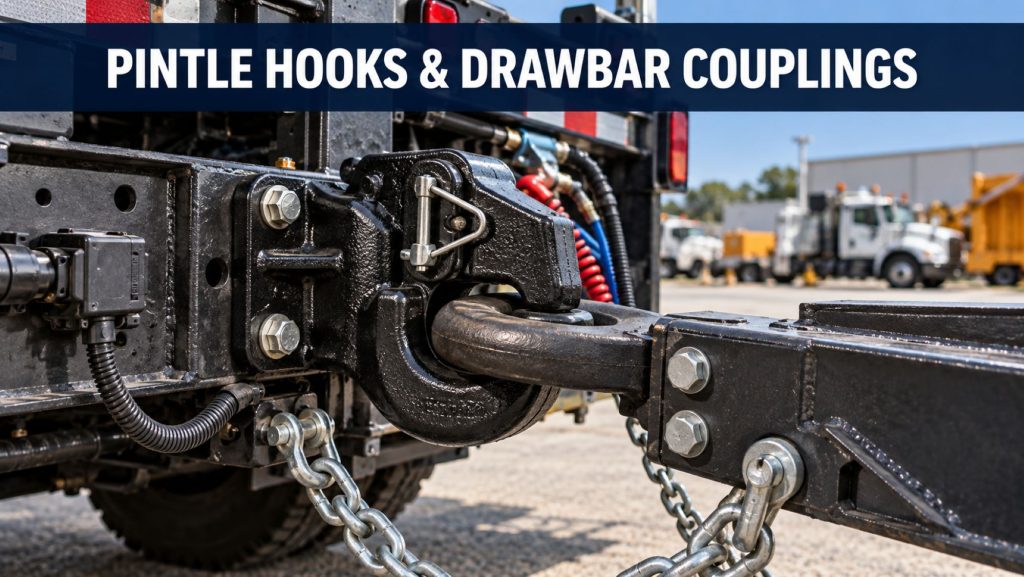
Pintle hooks and drawbar couplings connect trucks, tractors, trailers, converter dollies, and specialized vocational equipment through a hook-and-eye or automatic pin-coupling arrangement.
These systems are commonly used where durability, articulation, frequent coupling, or operation over uneven terrain is more important than the tighter connection generally provided by a conventional fifth wheel or ball hitch.
This section of Truck Equipment Atlas covers rigid and swivel pintle hooks, air-cushioned couplings, slack-reducing systems, drawbar eyes, lunette rings, automatic drawbar couplings, mounting structures, inspection procedures, and related towing equipment.
Pintle-Hook and Drawbar-Coupling Products on Truck Equipment Atlas
Explore the pintle hooks, drawbar eyes, and automatic coupling systems being added to the Truck Equipment Atlas library.
Premier Manufacturing
How Pintle-Hook Coupling Systems Work
A pintle hook mounted on the towing vehicle receives a drawbar eye or lunette ring attached to the trailer or dolly. The eye is lowered over or guided into the hook, and a latch closes above it to prevent separation.
The coupling allows the drawbar eye to rotate horizontally during turns and move vertically as the towing vehicle and trailer cross grades or uneven terrain. Swivel-mount systems may provide additional rotational movement for demanding off-road applications.
The pintle hook, latch, mounting plate, drawbar eye, trailer drawbar, safety equipment, and vehicle frame must be compatible with the intended load and operating environment.
Major Coupling Components
A pintle-hook and drawbar-coupling system may include the following components:
- Pintle-hook body
- Coupling horn or lower hook
- Upper latch
- Secondary locking mechanism
- Lock pin and retaining lanyard
- Drawbar eye or lunette ring
- Trailer drawbar or towbar
- Mounting plate or rear crossmember
- Mounting bolts and reinforcement hardware
- Air chamber on air-cushioned systems
- Slack-reducing plunger or snubber
- Swivel housing and bearings
- Remote-release equipment
- Lock-position sensors
- Safety chains or secondary restraints where required
- Trailer air and electrical connections
Rigid-Mount Pintle Hooks
A rigid-mount pintle hook is bolted directly to a reinforced mounting plate or vehicle crossmember. The hook remains fixed relative to the towing vehicle while the drawbar eye moves within the coupling.
Rigid-mount systems are widely used on straight trucks, dump trucks, utility trucks, military vehicles, converter dollies, and commercial trailers used in doubles and triples combinations.
The mounting structure must be capable of carrying the vertical, pulling, braking, impact, and articulation forces transmitted through the coupling.
Swivel-Mount Pintle Hooks
A swivel-mount pintle hook allows the coupling body to rotate around its longitudinal axis. This movement can reduce twisting forces when the towing vehicle and trailer operate at different roll angles.
Swivel systems may be used for construction, mining, logging, military, agricultural, and severe off-road applications where substantial articulation is required.
The correct combination depends on whether the pintle hook, drawbar eye, or drawbar is designed to provide the required rotation. Two components that both rotate freely may create an unstable or unapproved arrangement.
Air-Cushioned and Slack-Reducing Couplings
Clearance between a pintle hook and drawbar eye is necessary for coupling and articulation, but excessive clearance can create impact loading, noise, and repeated fore-and-aft movement.
Air-cushioned and slack-reducing systems use a plunger, snubber, or similar component to maintain contact with the drawbar eye. This can reduce:
- Coupling shock
- Acceleration and braking impact
- Wear on the hook and drawbar eye
- Noise and vibration
- Driver discomfort
- Stress on mounting structures
The snubber or plunger must be adjusted and maintained according to the manufacturer’s instructions. It does not compensate for components that have worn beyond their allowable limits.
Drawbar Eyes and Lunette Rings
The drawbar eye, sometimes called a lunette ring, is the circular trailer-side component captured by the pintle hook or automatic coupling pin.
Drawbar eyes may be welded, bolted, threaded, or integrated into a complete drawbar assembly. Their inside diameter, cross-sectional diameter, material, mounting design, capacity, and articulation requirements must match the coupling.
A worn drawbar eye can increase coupling slack and impact loading. Both the eye and pintle hook should be measured when excessive movement is discovered.
Fixed, Hinged, and Steering Drawbars
A fixed drawbar is rigidly attached to the trailer or dolly structure. A hinged drawbar can move vertically to simplify coupling and accommodate operating conditions.
Some full trailers and converter dollies use drawbars connected to a steering axle system. As the towing vehicle turns, the drawbar helps steer the trailer’s front axle or dolly wheels.
The drawbar assembly must be inspected as a complete structure, including the eye, tubes or beams, pivots, bushings, steering connections, welds, fasteners, and safety restraints.
Automatic Drawbar Couplings
An automatic drawbar coupling uses a coupling mouth and vertical locking pin to capture the trailer’s drawbar eye. The open coupling guides the eye into position, and the pin drops through the eye when proper alignment is achieved.
Depending on the system, available functions may include:
- Automatic coupling-pin engagement
- Manual or pneumatic release
- Remote cab controls
- Visual lock indicators
- Electronic coupling sensors
- Automatic lubrication
- Integration with vehicle warning systems
Automatic couplings are commonly used with full trailers, center-axle trailers, converter dollies, road-train combinations, and commercial vehicles operating in markets where drawbar systems are widely adopted.
Pintle Hooks on Converter Dollies
Converter dollies allow an additional semitrailer to be connected behind another trailer. The front of the dolly uses a drawbar eye that connects to the lead trailer’s pintle hook, while the dolly’s fifth wheel supports and couples to the following semitrailer.
The pintle hook and drawbar eye must be suitable for the forces created by the following trailer. Dolly brakes, safety equipment, air lines, electrical connections, drawbar structure, fifth wheel, and tires must also be inspected before operation.
Coupling Capacity and Ratings
Pintle hooks and drawbar couplings may have separate ratings for gross trailer weight, vertical load, drawbar pull, D-value, off-road service, or specific vehicle combinations.
The coupling’s published capacity does not independently establish the allowable trailer or combination weight. The complete system remains limited by its lowest-rated component, including:
- Towing vehicle frame
- Rear crossmember and mounting plate
- Pintle hook or automatic coupling
- Drawbar eye
- Trailer drawbar
- Axles and suspension
- Brakes
- Tires and wheels
- Safety restraints
- Certified vehicle ratings
Mounting Height and Drawbar Alignment
The pintle hook and drawbar eye should be positioned at compatible operating heights. Excessive upward or downward drawbar angle can change vertical loading, reduce articulation, interfere with the coupling, and affect trailer stability.
Ride height, vehicle loading, tire size, suspension movement, and terrain can all change the effective coupling angle. Clearance should be checked throughout the expected turning and articulation range.
Rear Crossmembers and Mounting Structures
A pintle hook should be installed only on a mounting structure designed for the coupling and its expected loads. A bumper or thin body panel is not automatically suitable for heavy towing.
Mounting requirements may include:
- Reinforced rear crossmember
- Application-specific mounting plate
- Frame extensions or reinforcements
- Approved fastener pattern
- High-strength mounting bolts
- Clearance for latch operation
- Air-chamber mounting provisions
- Protection for wiring, hoses, and vehicle systems
Common Applications
- Dump trucks and pup trailers
- Utility trucks and equipment trailers
- Construction trucks
- Military vehicles and trailers
- Logging equipment
- Mining and quarry vehicles
- Agricultural trucks and trailers
- Snowplow and municipal vehicles
- Fire and emergency apparatus
- Recovery and towing vehicles
- Converter dollies
- Doubles and triples combinations
- Road-train combinations
- Center-axle and full trailers
Pintle Couplings Compared With Fifth Wheels
A fifth wheel supports part of a semitrailer’s vertical weight directly above the tractor frame. A pintle-hook or drawbar system normally pulls a trailer through a rear-mounted coupling.
Pintle systems generally provide greater clearance and articulation but may create more coupling movement and noise. Fifth wheels provide a broader load-supporting surface and are the standard coupling for most semitrailers.
The correct system depends on the trailer design, required articulation, vertical load, operating terrain, combination configuration, and applicable regulations.
Advantages
- Durable construction for vocational service
- Supports substantial articulation
- Suitable for on-road and off-road applications
- Available in rigid and swivel configurations
- Can be used with converter dollies and full trailers
- Air-cushioned systems can reduce coupling shock
- Automatic couplings can improve operating efficiency
- Available across a wide range of capacities
- Replaceable latches and wear components may extend service life
Limitations and Considerations
- Clearance between the hook and eye can create noise and impact
- Coupling components require regular wear measurement
- Improper drawbar height can affect handling and component loads
- Swivel and rigid components must be correctly matched
- Air-cushioned systems require a dependable air supply
- Mounting structures may require reinforcement
- Off-road service may require reduced capacity ratings
- Unlatched or incorrectly locked couplings can separate
- Safety-chain and brake requirements vary by vehicle and jurisdiction
Driver and Operator Inspection
Before moving the combination, the operator should verify:
- The drawbar eye is fully seated in the coupling
- The latch is completely closed
- The secondary lock or retaining pin is engaged
- The hook and eye are not visibly cracked or excessively worn
- The mounting structure is secure
- Safety chains or secondary restraints are attached where required
- Air and electrical lines are connected and supported
- Trailer brakes and lights operate correctly
- The drawbar has adequate clearance during turns
- No person or equipment is within the vehicle’s path
Maintenance and Inspection
Pintle hooks, automatic couplings, and drawbar eyes should be inspected and serviced according to the manufacturers’ schedules and the severity of the application.
Routine maintenance should include:
- Cleaning the hook, latch, and drawbar eye
- Lubricating specified pivot and contact points
- Measuring hook and drawbar-eye wear with approved gauges
- Inspecting the latch and secondary lock
- Checking air chambers, hoses, plungers, and snubbers
- Inspecting swivel housings and bearings
- Checking mounting bolts and rear crossmembers
- Inspecting the drawbar for cracks, bending, and loose pivots
- Testing remote-release controls and lock sensors
- Inspecting safety chains and attachment points
- Checking trailer air and electrical connections
Common Coupling Problems
Excessive coupling slack: A worn hook, worn drawbar eye, incorrectly adjusted plunger, low air pressure, or damaged snubber can allow excessive movement.
Latch will not close: Misalignment, an incompatible drawbar eye, debris, corrosion, damaged components, or incorrect coupling height may prevent engagement.
Latch will not release: Pressure between the towing vehicle and trailer, damaged release components, corrosion, inadequate lubrication, or a binding drawbar may prevent opening.
Air-cushion system will not operate: Low air pressure, leaking lines, a damaged chamber, a sticking valve, or incorrect adjustment may be responsible.
Rapid hook or eye wear: Excessive slack, misalignment, inadequate lubrication, overloading, incorrect component matching, or severe impact loading can accelerate wear.
Mounting cracks: Overloading, loose fasteners, frame flex, impact loading, corrosion, or an unsuitable mounting structure may cause cracking.
Drawbar instability: Worn pivots, damaged bushings, structural cracks, incorrect loading, or steering-system problems may allow unwanted movement.
Choosing a Pintle Hook or Drawbar Coupling
Coupling selection should begin with the complete towing vehicle, trailer, drawbar, load, and operating environment.
Important selection factors include:
- Maximum gross trailer weight
- Maximum vertical or tongue load
- On-road or off-road operation
- Required horizontal and vertical articulation
- Rigid or swivel mounting
- Standard or slack-reducing operation
- Manual or automatic coupling
- Drawbar-eye dimensions
- Mounting pattern and frame structure
- Air-system availability
- Required safety and locking equipment
- Parts and service availability
Related Fifth-Wheel and Coupling Categories
- Commercial Truck Fifth Wheels
- Fifth Wheel Sliders & Mounting Systems
- Heavy-Haul & Severe-Duty Fifth Wheels
- Terminal Tractor & Yard Coupling Systems
- Trailer Kingpins & Upper Couplers
Related Fifth-Wheel and Coupling Guides
- Fifth-Wheel Systems Explained
- Fixed vs Sliding Fifth Wheels
- How to Couple and Uncouple a Semitrailer
- How to Inspect and Maintain a Commercial Fifth Wheel
- Fifth Wheels & Coupling Equipment
Related Truck and Trailer Resources
- Commercial Trucks
- Commercial Trailers
- Axles & Differentials
- Suspension Systems
- Brake Systems
- Tires & Wheels
- Equipment Systems
Explore the Complete Fifth-Wheel and Coupling Library
Visit the Fifth Wheels & Coupling Equipment hub to explore commercial fifth wheels, slider systems, mounting equipment, heavy-haul couplings, terminal tractor systems, trailer kingpins, upper couplers, pintle hooks, drawbar systems, individual product profiles, and educational guides.